As we approach the end of the first quarter of the 21st century, it has become widely accepted that the unipolar world order dominant in the post-Cold War era is experiencing a deep crisis of legitimacy and functionality. This Atlantic-centered order oppresses the Global South through military interventions, economic sanctions, debt mechanisms, and regime change operations. The paralysis in the UN Security Council’s decision-making processes, the social devastation caused by the structural adjustment programs imposed by the IMF and World Bank, and NATO’s escalation of conflicts contrary to its deterrence rhetoric all indicate that current international organizations cannot function without reform. Amidst this systemic crisis, new regional and intercontinental collaborations that could serve as alternatives to the existing order are being intensely debated in various academic, political, and strategic circles.
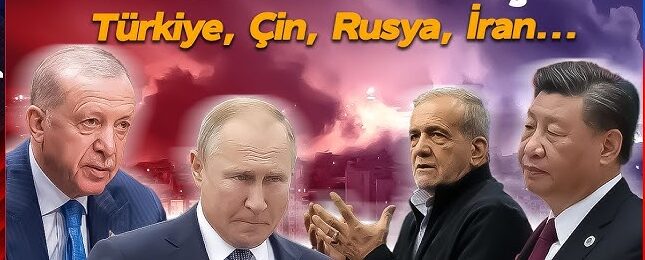
One proposition at the center of these debates is a hypothetical axis or alliance comprising Turkey, Russia, Iran, and China. This structure, which as yet has no institutional existence, binding treaty text, or joint military command, has begun to establish itself in the literature as a powerful geopolitical vision and anti-systemic discourse.
The TRIC Axis as a Geopolitical Proposition: Hypothetical Ground and Definition
For any political project or alliance proposal to be seriously evaluated, the historical and structural ground that makes it possible must first be laid out. The idea of the TRIC axis draws nourishment from the fact that all four actors have been subjected to various forms of Western imperialism at different points in history. This shared consciousness of victimhood is the fundamental element that constructs the alliance proposal not as an emotional camaraderie but as a structural necessity. The partition of the Middle East with artificial borders following the collapse of the Ottoman Empire, China’s “Century of Humiliation” in the 19th and 20th centuries, Russia’s total security, economic, and demographic crisis after its collapse in the 1990s, and Iran’s international isolation since the 1953 coup against Mossadegh have all prepared the ground for these four countries to develop a common critique of the system.
These four actors share three fundamental weaknesses of the current international system. The first is the lack of a say in the security architecture. Turkey’s secondary position within NATO’s decision-making processes, Russia being made a direct threat object of the alliance, Iran’s exclusion from regional security arrangements, and China’s encirclement by military bases in the Pacific constitute a shared experience of insecurity. The second is subjection to the debt-inducing policies of international financial institutions. The structural adjustment programs of the IMF and World Bank have weakened the economic sovereignty of all four countries at different times; China stands out as the only major country that has succeeded in development by keeping these programs at bay. The third is that energy and trade routes are threatened by Western-controlled naval power. The control of critical maritime chokepoints like the Strait of Hormuz, Bab el-Mandeb, the Suez Canal, Gibraltar, and the Strait of Malacca by the US and allied navies directly threatens the supply chain security of all four countries.
The structural logic of the proposed alliance is based on the idea of transforming these three weaknesses around a common axis. Instead of the vicious cycle the West calls the “security dilemma,” the TRIC proposal aims to introduce a “development dilemma.” This conceptual innovation proposes a competition based on which country can eradicate poverty faster, produce greener energy, and train more scientists, replacing the current system where military expenditures compete with each other and constantly produce conflict. However, this conceptual framework remains a vision yet to be translated into concrete political will.
Asymmetric Contributions and Complementarity Potential of the Four Actors
The success or failure of any alliance depends on the members’ ability to cover each other’s weaknesses and turn strengths into synergy. In the TRIC proposal, each actor possesses different and potentially complementary areas of strength. This complementarity forms the proposal’s strongest theoretical foundation. However, realizing this potential depends on overcoming historical rivalries and mistrust among the actors, which has not yet been achieved today.
Turkey, with its geopolitical position and humanitarian diplomacy capacity, aims to serve as a bridge between land and sea power. Located at the intersection of Europe, Asia, and the Middle East, with its coastline on the Black Sea, control over the Straits, and presence in the Eastern Mediterranean, Turkey is positioned as the alliance’s gateway to the West. One of the most significant contributions Turkey could offer the axis is its technical military know-how acquired within NATO and its progress in unmanned aerial vehicle technology. Furthermore, the successful grain corridor initiative during the Ukraine-Russia war, mediation efforts between Gulf countries and Iran, and diplomatic initiatives in the Horn of Africa have concretely demonstrated Turkey’s crisis management capacity. However, Turkey’s energy dependence on imports, chronic current account deficit, and struggle with high inflation are the biggest obstacles to its ability to provide a sustainable contribution within the alliance.
The Russian Federation, with its nuclear deterrence, vast natural gas and oil reserves, and hypersonic missile technology, has the potential to form the military and energy backbone of the TRIC proposal. The fact that the Russian economy has not completely collapsed despite the comprehensive sanction regimes imposed by the West after 2014 and especially in 2022 demonstrates the strategic importance of its energy resources and the resilience mechanisms the country has developed against sanctions. Russia’s military presence in Syria, Libya, and the Sahel region could serve as a logistical springboard for the proposed alliance to extend into Africa and the Middle East. However, Russia’s demographic decline, increasing technological dependence on China, and long-term technology transfer constraints due to exclusion from the Western financial system limit its role within the alliance.
Iran stands out with its control over the energy corridor between the Persian Gulf and the Caspian Sea, and its economy of resistance model developed under sanctions. Progress in nuclear technology, space studies, biotechnology, and nanotechnology despite sanctions shows that external pressure cannot completely stifle innovation. Iran’s proxy structures in Iraq, Syria, Lebanon, and Yemen have the potential to deepen the proposed alliance’s sphere of influence in the Middle East. Additionally, the 25-year comprehensive strategic agreement signed with China provides a concrete legal basis for Iran’s integration into the TRIC axis. Conversely, Iran’s long-standing international isolation, structural problems in its banking and financial system, and internal tensions due to social pressures complicate its full integration into the alliance.
The People’s Republic of China, as the world’s largest economy by purchasing power parity, is designed as the economic locomotive of the TRIC proposal, with the financing and infrastructure technologies offered within the framework of the Belt and Road Initiative. In fifth-generation mobile communication, artificial intelligence, high-speed rail, solar and wind energy technologies, China has surpassed most of its Western rivals. As the founder of non-Western financial institutions like the Asian Infrastructure Investment Bank and the New Development Bank, China claims to offer a financing model based on non-debt-inducing win-win principles. The comprehensive strategic partnership with Russia and the long-term agreement with Iran place China at the de facto center of the TRIC proposal. However, China’s rapidly aging population, debt crisis in the real estate sector, export pressures due to contracting global demand, and regional tensions such as Taiwan and the South China Sea limit the resources the country can allocate externally.
None of these four actors alone has the capacity to challenge Western alliances. However, the complementarity in energy (Russia, Iran), manufacturing and finance (China), geopolitical reach and diplomacy (Turkey), and military deterrence (Russia, China) promises strong synergy at a theoretical level. The core thesis of the proposal is that this synergy could form a balancing element against the unipolar system.
Strengths of the Proposal and the Vision It Offers
Before assessing the feasibility of the TRIC axis proposal, it is necessary to deeply understand its strengths and the vision it offers. The proposal’s greatest strength is its reliance on the rising tide of anti-Western sentiment across large swathes of the Global South. Many countries in Africa, Asia, and Latin America complain about the injustices of the current order and look favorably upon the formation of an alternative pole. The appeal of the TRIC proposal for these geographies is its promise of a cooperation model that does not indebt, does not impose military bases, and does not interfere in internal affairs.
The second strength of the proposal is that it targets the current war economy. Today’s world is held captive by arms lobbies, war contractors, and manufactured threats. The TRIC proposal aims to break this bloody cycle and build a war-free economic model. In this model, no African mineral, no Asian labor, and no Middle Eastern petrodollar would flow to Western banks; the value produced would remain in the pockets of the producers. Furthermore, one of the proposal’s fundamental principles is the understanding that “no problem is unsolvable without shedding innocent blood.” Global issues like border disputes, water crises, and migration waves are expected to be resolved through negotiation, justice, and common sense.
The third strength is the proposal’s historical depth and civilizational backbone. These geographies along the Silk Road route have carried trade, knowledge, and culture for millennia. The artificial nation-state borders imposed by Western imperialism disrupted these organic ties. The TRIC proposal, by aiming to re-establish ancient connections rather than building new physical walls, is conceived not merely as a geographical bloc but also as a civilization project.
Weaknesses of the Proposal and Concrete Obstacles
Although the TRIC proposal offers a powerful vision, the concrete obstacles it faces are at least as serious as the vision itself. Foremost among these obstacles are historical rivalries and deep mistrust among the four countries. There are several points of tension between Turkey and Russia, including the military presence in Syria, the struggle for influence in Libya, the status of the Black Sea, and differences in approach to the Ukraine war. Between Turkey and Iran, there is indirect competition in Iraq, Syria, and the Caucasus, especially as Ankara has entered a normalization process with Saudi Arabia and Israel, while Tehran remains a regional rival to these countries. Between China and Russia, the rivalry for influence over the Central Asian republics persists behind the rhetoric of strategic partnership.
The second major obstacle is the profound differences between the legal systems, political regimes, and economic models of the four countries. Turkey’s NATO membership and customs union with the EU, Russia’s cautious approach to integration with China, the problem of institutional compatibility between Iran’s theocratic governance structure and secular countries, and the difference between China’s state capitalism and the mixed economy models of the other three make integration extremely difficult. An alliance requires a common currency, joint military command structure, joint intelligence-sharing mechanism, or at least a binding treaty text – none of which exist today.
The third obstacle is China’s core foreign policy principle of non-interference. China has historically avoided binding military alliances and has never established a formal allied relationship with any country. This principle makes it extremely difficult for China to be a founding partner of a military-political alliance like TRIC. China prefers more flexible and conjunctural forms of cooperation (SCO, BRICS, Belt and Road). Moreover, the deep economic interdependence between China and the US (an annual trade volume exceeding $600 billion) is another factor preventing Beijing from being part of an alliance directly confronting Washington.
The fourth obstacle is the anti-Israel stance at the heart of the TRIC proposal and the goal of establishing a common, secular, democratic state on Palestinian land. This goal directly contradicts established diplomatic frameworks of international law and the two-state solution. Furthermore, Turkey’s recent normalization process with Israel directly contradicts Iran’s rigid stance on this issue, demonstrating that even on the Palestine question, the four countries cannot achieve full consensus.
Global Repercussions and Regional Participation Scenarios
The global repercussions of the TRIC proposal, should it materialize, and the potential forms of participation by other regions constitute another dimension requiring serious evaluation. The proposal is conceived not as a static bloc but as a dynamic structure expanding towards surrounding regions. In this expansion scenario, Asia is progressing towards integration under the leadership of China and Russia. India, Indonesia, Pakistan, and the Central Asian republics have the potential to be integrated into the TRIC axis under the umbrella of BRICS and the SCO. The main attraction for these regions is the absence of rigid structural reforms imposed by US-centered financial institutions and the rapid implementation of infrastructure investments.
The African continent is seeking to complete its post-colonial transformation. The continent, whose resources have been exploited for centuries and whose borders were drawn artificially, encounters in the TRIC proposal a promise of hospitals, schools, factories, and debt relief mechanisms. China’s mining and infrastructure investments in Africa, Russia’s security cooperation, Turkey’s humanitarian aid and construction contracting, and Iran’s technology transfer offers increase the proposal’s attractiveness in Africa. However, the presence of French and British spheres of influence in Africa, the continent’s fragmented structure, and governance problems are serious obstacles to full participation.
In Europe, the proposal envisions a partial participation scenario. Germany, France, and Southern European countries are defined as actors discontented with the oppressive NATO umbrella of the US and energy dependence. The TRIC proposal claims to offer these countries an independent energy and security policy. However, the institutional commitment of European countries to NATO and the EU, the depth of transatlantic relations, and the existing mistrust towards Russia make the likelihood of this scenario extremely low.
In the Americas, Latin America has the potential to be integrated into the proposal through Bolivarian countries, Brazil, and Mexico. The rejection of the century-old Monroe Doctrine and historical resistance to US hegemony make this region a potential friendly axis for the TRIC proposal. However, internal political instabilities in Latin America, the depth of the US military and economic presence in the region, and even China’s own cautious approach to the region render this participation scenario uncertain as well.
Conclusion: TRIC as a Vision and Notes for the Future
As a geopolitical proposition, the TRIC axis is a significant intellectual contribution that draws attention to the deep crisis of the current order and emphasizes the necessity of transitioning to multipolarity. The proposal builds a powerful narrative articulating the demands of the Global South for justice, equality, and sovereignty against the Western-centered system of exploitation and domination. The critique of Zionism, shaped particularly around the Palestinian cause, and the rejection of imperialist wars form the conscientious and moral ground of the proposal.
However, this proposition has not yet become a political reality. Currently, there is no binding alliance agreement, joint military command structure, or common foreign policy mechanism between Turkey, Russia, Iran, and China. Existing cooperation remains limited to the level of the Shanghai Cooperation Organisation, BRICS, and bilateral agreements, none of which constitute a military-political alliance. For the proposal to materialize, historical rivalries between the four countries must be overcome, a shared threat perception must become permanent, China’s traditional reticence towards forming alliances must be broken, and the four countries must achieve full consensus on fundamental foreign policy issues such as Palestine, Ukraine, and Syria.
As of today, TRIC is a vision pointing to a possible future, not an existing geopolitical reality. Therefore, any evaluation on the subject must consider the proposal’s hypothetical nature and take into account the concrete power relations of the current international system. The proposal’s greatest success is keeping alive the idea that an alternative world is possible and preparing the ground for questioning the existing order. Since no transformation is possible without such questioning, the TRIC proposal remains a contribution worthy of discussion and development. The desire for the ledger of oppression to be closed and for peace to be established in a new world is the most fundamental human motivation behind the proposal.
Bibliography
Aydın, M. (2021). New Axes of Turkish Foreign Policy: Between East and West. Istanbul: İletişim Publications.
Cooley, A. (2019). The New Great Game: Geopolitical Struggle in Central Asia. Istanbul: Koç University Press.
Kissinger, H. (2014). World Order. Istanbul: Boyner Publications.
Mankoff, J. (2022). Russia’s Grand Strategy: Putin Era Foreign Policy. Ankara: Siyasal Kitabevi.
Mearsheimer, J. J. (2014). The Great Strategy Delusion: The Collapse of Liberal Hegemony. Ankara: Phoenix Publishing House.
Shanghai Cooperation Organisation Official Website. (2024). Member States and Observers. Retrieved from: https://eng.sectsco.org/
Republic of Turkey Ministry of Foreign Affairs. (2023). Turkey-Russia Relations in a Multipolar World. Ankara: Center for Strategic Research Publications, Ministry of Foreign Affairs.
Waltz, K. N. (2010). Theory of International Politics. (Trans. O. Kürç). Ankara: Pharmakon Publications.
Yanık, L. K. (2020). Geopolitical Codes: Turkey’s Regional Vision. Ankara: Dipnot Publications.
Zhao, S. (2019). Chinese Foreign Policy: The Belt and Road Initiative and Its Global Impacts. Istanbul: Bilgi University Press.
Sefa Yürükel
Danish ethnographer and social anthropologist (MA)
Aarhus University, 1997
Independent Researcher
Fields of Research: International Politics, Public International Law, Geopolitics, Sociology, Psychology, Cultural Studies, Systems and Structures
Leave a Reply