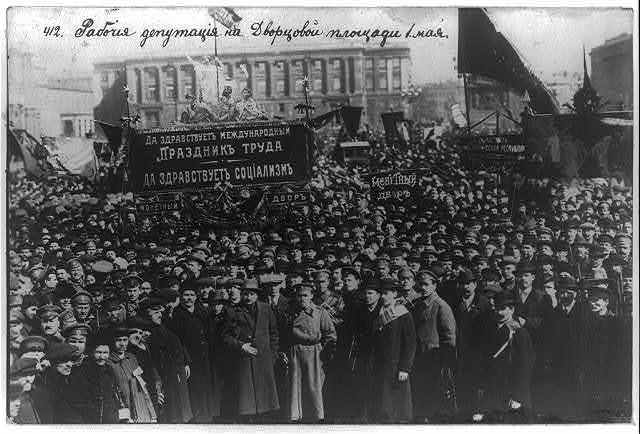
May 1st is not just a date on the calendar. It is the symbol of labor’s historical struggle, the honor of sweat and toil, and humanity’s quest for a fairer world. It is the voice of a history kneaded by the smoke of factory chimneys, the darkness of mine shafts, and the mud of the fields. The cry that rose in Chicago in 1886 ” 8 hours of work, 8 hours of rest, 8 hours to live” ..transcended borders over time, transforming into a universal revolt passed down from tongue to tongue, from generation to generation. This voice is not merely an echo from the past; it is a call that is still alive today, guiding us toward tomorrow. And every year, this call asks anew: What have you done for the dignity of labor?
The Lesson of May 1st: Rights Are Won Through Struggle
The most fundamental lesson of May 1st is clear: No right falls from the sky. The eight-hour workday, union rights, social security, the prohibition of child labor, the weekend, none of these were “given”; all of them were “taken.” Behind each gain lie strikes, resistances, workers who lost their lives, banned publications, exiles, and an unending determination. This truth remains valid for the laborers of today. Because capital, by its very nature, knows no limits; if there is no organized force against it, it seeks ways to further exploit labor, eliminate security, and turn workers against one another. History shows that even rights once won cannot be preserved without constant vigilance and struggle; every right prefaced with “it’s won, it’s over” can be silently taken back.
Today, new concepts like digitalization, artificial intelligence, flexible working, and the gig economy are rapidly changing the nature of labor. The worker is no longer just the person at the factory assembly line; they appear as a courier carrying orders via an app, an editor writing texts from home, a “clicker” who is part of a vast team labeling data, or a content creator. But the essence remains the same: labor produces, creates value, and capital accumulates. Moreover, this new order isolates labor, severs connections, and disperses collective identity. Therefore, the struggle must continue by changing its form and reversing this fragmentation.
Forms of Struggle in the New Era: Solidarity That Transcends Borders
The struggle is no longer confined to factories, ports, or mines; it takes place in front of screens, on platforms, in data centers, and in call centers. These new spaces demand new imaginations and new tools:
· Digital unionism is inevitable. In the platform economy, where face-to-face organizing is difficult, encrypted messaging groups, online forums, virtual meetings, and social media campaigns can become the new squares that bring workers together. The independent associations and cooperatives formed by couriers, drivers, and freelance workers in various countries around the world are the first examples of this. Expanding these models, giving them legal status, and connecting them with one another is the most powerful antidote to the fragmented nature of labor.
· International solidarity is a strategic necessity. Capital has globalized, shifting production chains to low-wage, non-unionized regions. Labor must also think globally, organizing simultaneous campaigns against multinational corporations and building pressure for international framework agreements. The struggle of a textile worker in South Asia and the demands of a store employee in Europe are links in the same chain; one cannot be strong without seeing and knowing the other.
· Social alliances are essential. The labor struggle weakens when isolated from other democratic and egalitarian movements in society. The women’s movement, the struggle against war and genocides, the environmental justice movement, youth organizations, disability rights advocates, and migrant solidarity networks without uniting with the labor struggle, achieving lasting gains is almost impossible. Because exploitation goes hand in hand with discrimination; workplace inequality is fueled by gender inequality, just as the climate crisis is fueled by the greed for profit. An intersectional perspective creates a stronger front.
· Knowledge and awareness are among the most powerful weapons. A worker who does not know their rights and lacks an understanding of the basic mechanisms of working life cannot defend themselves. Therefore, beyond formal education, the educational workshops created by the working class itself, digital literacy and data security trainings, legal support guides, and peer learning networks carry a significance far beyond individual development: they are the building blocks of collective consciousness.
The New Role of Unions: From Defense to a Future-Building Power
Unions must cease to be merely structures that defend against the erosion of rights and try to preserve the status quo; they must become actors that build the future, produce alternatives, and transform society. This requires a fundamental change in mentality and structure.
At the local level:
· New organizing models that encompass not only permanent, full-time employees but also interns, subcontracted workers, temporary contract workers, seasonal workers, and platform laborers must be developed. Unions must adopt a more flexible and inclusive structure.
· The voices of young workers must echo in union decision-making bodies; precariousness, intergenerational injustice, and future anxiety must take center stage on the union agenda. Youth branches must cease to be symbolic and transform into genuine spaces of initiative.
· Concrete, measurable policies must be produced for the visibility and equality of women’s labor. This should not be limited to equal pay for equal work; it must encompass a holistic approach, ranging from childcare support to safety measures on night shifts, from combating sexual harassment to removing the barriers that prevent women from rising to union leadership.
At the global level:
· International union networks must be made agile and effective enough to match the global movement speed of capital; in addition to international trade union confederations, direct solidarity channels at the sectoral level must be strengthened.
· Joint collective bargaining strategies must be developed along the supply chains of multinational corporations; if there is a strike in one country, it must become the norm for workers in another country to carry out a solidarity action, even if symbolic, against that same company.
· Minimum labor standards—guaranteeing not just wages, but also working hours, occupational health and safety, the right to social security, and trade union freedom must be advocated on a global scale; campaigns must be waged for sanctions against companies and states that do not accept these standards.
May 1st’s Contribution to World Peace: Limitless Fraternity
The struggle of labor is not only economic but also humanitarian and universal. The spirit of May 1st is the defense of peace against wars, genocides, Epsteinism, imperialism, Zionism, religious dogmatism, misogyny, all forms of feudal reaction, militarism, and the burdening of armament budgets on the shoulders of laborers; the defense of equality against separatist-discriminatory micro-nationalism, racism, and xenophobia; and the defense of justice against exploitation, favoritism, and unearned gain.
Because wars kill mostly workers, peasants, and unemployed youth; those sent to the front lines are the children of the working class. The bill for economic crises, inflation, and austerity policies is mostly paid by laborers, women, and children. That is why the labor movement has historically been one of the strongest advocates of a fraternity that sings songs of peace against the clamor of war and rejects borders. International worker solidarity is the antidote to every artificial distinction that divides us into “us” and “them”; saying “the worker has no country” means that the worker knows their siblings all over the world and understands that they share a common destiny.
What Should Happen Next? A New Social Contract
Humanity stands at a new crossroads today. The climate crisis fundamentally challenges modes of production and consumption; massive economic inequality tears at the social fabric; technological transformation renders the meaning and future of work uncertain. All of these directly affect the future of labor. The solution is not to repeat old formulas, but to draw a new, bold, and inclusive framework:
· Just transition policies must be urgently implemented; the transition to a green economy must not leave anyone, especially workers in the fossil fuel sector, unemployed and without security. Every new wind turbine, every insulation project, every sustainable agricultural practice must come into being with qualified, unionized, and secure workers; the environmental economy must acquire an inclusive character that embraces, rather than excludes, laborers.
· Universal fundamental rights must be strengthened and expanded: A dignified income guarantee, equal access to health services, the right to lifelong education, the right to housing, and access to digital infrastructure must be defined as the non-negotiable minimum requirements of the new era.
· The concept of decent work must be redefined in light of the realities of the digital age. Work models managed by algorithms, lacking social security, and imposing unpredictable hours cannot be legitimized under the mask of “flexibility.” Job security, a predictable income, the right to rest, the right to disconnect, and freedom of collective bargaining must form the backbone of this new definition.
· Democratic participation must be increased. Workers must have a say not only in the production process but also on the boards of directors of companies, at sectoral planning tables, and in local and national economic decision-making processes. Without economic democracy, political democracy will always remain incomplete and fragile.
Final Word: The Struggle Is Not Over, It Is Changing Form
Above all, May 1st reminds us of this: History is written in favor of those who are organized. It is not scattered crowds, but communities that are united around a common purpose, trust one another, and can produce strategies that change the world. If workers unite and become one heart in all their diversity, the face of the world will change; the language of war, exploitation, and destruction will recede. If they remain silent, fragment, and succumb to divisions, exploitation deepens, and the darkness grows.
What is needed today is neither empty optimism nor a hopelessness that surrenders to the darkness. What is needed is an organized courage that stands firmly on the ground. Solidarity must not be a slogan chanted once a year, but a way of life, a reflex, a character woven into the fabric of daily life. It must be a bond that is constantly reproduced at the store, in the neighborhood, on the screen, in the street ..at every moment, everywhere. Because we know that:
The unity of labor is the future of humanity.
Justice is the work only of those who struggle.
And peace is only possible among equals.
It must not be forgotten:
May 1st is not a day, it is a stance.
To embrace, deepen, and broaden that stance is the common responsibility of every worker who feels, simultaneously, the weight of history on their shoulders and the hope of tomorrow.
Sefa Yürükel
Danish ethnographer and social anthropologist (MA)
Aarhus University, 1997
Independent Researcher
Fields of Research: International Politics, Public International Law, Geopolitics, Sociology, Psychology, Cultural Studies, Systems and Structures
Leave a Reply