Music and the arts might be the healing salve for Turkey’s culture
by The New York Times
04:46 AM Jun 06, 2011
 Not so long ago, playing Kurdish music over a loudspeaker in the Vizyon Muzik Market in Diyarbakir, Turkey, might have provoked the Turkish police. Just speaking the names of certain Kurdish singers at one time could have landed a Kurd in prison.
These days, hundreds of CDs featuring Kurdish pop singers fill one of the long walls in the small, shoebox-shaped Vizyon Muzik. Abdulvahap Ciftci, the 25-year-old Kurd who runs the place, said customers buy about 250 Kurdish albums a week.
With the general state of turmoil in that part of the world, the Kurds have been looking toward the elections to press long-standing claims for broader parliamentary representation and more freedoms, both political and cultural.
“It is now at least possible to talk about issues a little more openly,” said 38-year-old Sedat Yilmaz, director of the Turkish movie, Press, which recounted the torture and killing of dozens of investigative journalists working for the newspaper Ozgur Gundem. “The best way to do this is through films and plays and music, which is finally starting to happen.”
But change comes slowly, if at all. Concessions by the government of Prime Minister Recep Tayyip Erdogan in 2009 made way for the first Kurdish national TV station, and the government also permitted the teaching of Kurdish language classes in private universities (but not public ones). But Erdogan’s government, guarding its tenuous majority in parliament on the verge of the elections, has assumed a more and more hawkish line lately.
“The changes are meaningful but still not sufficient,” said Burhan Senatalar, a Turkish professor at Bilgi University in Istanbul. “If you asked Turks today whether, in the abstract, people should be able to speak their mother tongue, most of them would say, of course, no problem,” he added. “But with Kurdish, fear clouds the picture. Language is the biggest Kurdish demand because language equals identity. It’s the root of any culture, and many Kurds, having had their language repressed, no longer even know the basics of Kurdish grammar. So the debate has inevitably turned to language.”
“With the state banning Kurdish in public schools, the trend is that in a few decades we could lose our language altogether,” said Gulten Kisanak, co-chairwoman of the pro-Kurdish Peace and Democracy Party. “That’s why our leading political demand is really a cultural demand: The use of our mother tongue … Turkish urbanisation has steadily threatened Kurdish culture, our music, our lullabies and fairy tales, which, coming from our villages, used to be how we transferred our heritage to new generations.”
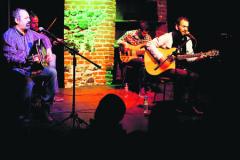
Nevertheless, there are now more Kurdish-language books to be found in bookstores. A theatre troupe stages productions in Kurdish in Diyarbakir. Kisanak’s party also sponsors Kurdish acting and vocal groups across the region. Kurdish music, including Dengbej, the traditional Kurdish sung-speech, is everywhere.
“Compared to the past, we’re better off,” Ciftci said. “Eighty per cent of our identity as Kurds is in our music. If you are Kurdish today, even if you don’t speak the language, you can hear a song in Kurdish, and your soul roars. It makes you feel part of a struggle.”
At the Diyarbakir Institute for Political and Social Research, Nurcan Baysal and Dilan Bozgan, researchers in their 30s, said they never learned their own mother tongue because it was stigmatised in schools. But they grew up hearing it in Kurdish music.
“Music was for a long time the only semi-free zone for Kurds to express themselves in their own language in Turkey and also a kind of therapy,” she elaborated. “When my grandmother is alone, I hear her singing about her past.”
Baysal agreed. Her grandmother, too, sings at home. “My grandmother doesn’t speak a word of Turkish, and I don’t know Kurdish. If you lose a language, you can lose your family, because you lose your link to the past. But when I ask my grandmother about her life, she starts singing. It’s how we communicate.”
via TODAYonline | Entertainment | Music | Turkey’s Kurds slowly build cultural autonomy.

Leave a Reply