Category: Turkiye

  • Turkey’s Democratic Crisis Is Becoming a Security Crisis

    Turkey’s Democratic Crisis Is Becoming a Security Crisis

    For years, discussions about Turkey’s democratic decline were largely confined to the language of human rights, constitutional law, and domestic politics. International observers viewed the erosion of democratic institutions as a troubling but primarily internal matter; a challenge for Turkish citizens to confront within their own political system.

    That era is over and a darker chapter has begun.

    Turkey’s democratic crisis has evolved into something much larger. It is now becoming a security crisis with implications far beyond our borders. What is unfolding in Turkey today should concern not only those who care about democracy, but also those who care about the long-term stability of Europe, NATO, the Black Sea region, the Eastern Mediterranean, and the Middle East.

    The reason is simple: Turkey is too strategically important to become politically unstable.

    Turkey is now facing a profound political and economic unraveling: President Recep Tayyip Erdogan’s government, having captured much of the state apparatus, is attempting to eliminate the last meaningful democratic alternative while society sinks deeper into economic hardship, social frustration, loss of trust in public institutions and distrust in the future.

    Over the past year, Erdogan’s government has intensified an unprecedented campaign against the democratic opposition. This assault on democratic choice accelerated after the Republican People’s Party (CHP), the main opposition party, achieved a historic municipal victory in 2024, becoming Turkey’s leading political force for the first time in decades. As a result, the government increasingly turned to judicial intervention rather than political competition.

    The most visible target has been Istanbul Mayor Ekrem Imamoglu, our presidential candidate and President Erdogan’s strongest challenger, arrested in March 2025 on absurd, politically motivated allegations and now facing a sentence measured not in years, but in millennia.

    Turkey’s Republican People’s Party (CHP) ousted leader Özgür Özel stands atop of a bus as he delivers a speech during a rally, days after a court dismissed him from office in Izmir on May 26, 2026. The protest came two days after police battered their way into the CHP’s headquarters in Ankara, firing tear gas and beating party members before throwing them out, Özel told AFP. (Photo by Murat Kocabas / AFP via Getty Images)

    Since 2025, around 20 CHP mayors and hundreds of municipal officials have been imprisoned without final convictions and all subjected to pre-trial detention. We have responded to this onslaught by mobilizing citizens in massive rallies across the country, bringing together millions of people far beyond our party lines.

    Most recently, a court invoked the extraordinary doctrine of “absolute nullity” to void the CHP’s 2023 Congress, remove me as the party’s elected leader, and reinstall the previous leadership that had lost the congress and was discredited after 13 consecutive electoral defeats. Basically, aiming to place Turkey’s largest opposition party under judicial control—with the apparent cooperation of figures willing to accommodate Erdogan’s master plan for Turkey’s political order. Whatever this system is called—single-party regime or one-man rule—its governing logic is the same: eliminating any meaningful challenger as well as replacing the real opposition with a managed and compliant one.

    Democracy is about preserving credible pathways through which citizens can peacefully change their government. When those pathways disappear, political frustration does not disappear with them. It builds beneath the surface until it erupts.

    If Erdogan succeeds in dismantling meaningful opposition, for the first time in modern history, Turkey would face deep popular discontent, a severe legitimacy crisis, and no meaningful institutional mechanism through which citizens could peacefully demand political change.

    This is not only a scenario of authoritarian consolidation. It is a scenario of profound instability.

    History teaches a consistent lesson: political systems do not become stable when alternatives disappear; they become stable when citizens believe peaceful change remains possible. The Soviet Union, the Shah’s Iran, the Eastern Bloc, and much of the Arab world all appeared stable during the Cold War—until they suddenly did not. Systems are often most fragile precisely when they look most unchallengeable.

    Turkey’s strategic importance makes this danger especially acute: as gatekeeper of the Black Sea, NATO’s second-largest military power, and a crossroads of Europe, Eurasia, the Middle East, and the Eastern Mediterranean, its role in migration, energy, and regional security means democratic collapse would not remain within its borders.

    History also shows that governments facing domestic instability and declining legitimacy often externalize their crises. Foreign policy confrontation, militarized rhetoric, and geopolitical adventurism become substitutes for the democratic consent and economic success they can no longer provide. Under such conditions, foreign policy crises are framed as questions of national survival.

    As the leader of Turkey’s main opposition party, I firmly believe our country can become one of Europe’s most valuable partners—and ultimately a full member of the European Union at a moment when Europe is building a new security architecture. But sustainable partnerships require democratic legitimacy.

    A country cannot indefinitely serve as a pillar of regional stability while simultaneously dismantling the democratic foundations that sustain internal stability.

    If current trends continue, Turkey risks becoming something unprecedented in NATO’s history: a strategically indispensable member that no longer functions as a democracy, while millions of its citizens grow increasingly dissatisfied with a political and economic order they have no peaceful democratic means to change. This would not merely be a domestic crisis. It would be a profound security challenge.

    The democratic struggle we are waging will shape not only Turkey’s democratic future and the stability of one of the world’s most strategically important countries, but also the security of our region, Europe, and NATO. Democracy and stability cannot be separated for long. The outcome could establish a precedent with consequences far beyond our borders, encouraging either democratic renewal or further authoritarian consolidation across a region already under immense strain.

    Özgür Özel: Turkey’s Democratic Crisis Is Becoming a Security Crisis | Opinion

    Özgür Özel is the leader of the main opposition party in Turkey and a member of Parliament from Manisa province.

    The views expressed in this article are the writer’s own.

    https://www.newsweek.com/turkeys-democratic-crisis-is-becoming-a-security-crisis-opinion-12015939

    Newsweek is a Trust Project member

  • Gas, Politics, and Pressure: A New Fault Line Forms Around Orban in Europe

    Gas, Politics, and Pressure: A New Fault Line Forms Around Orban in Europe

    Agreements between Viktor Orban and Recep Tayyip Erdogan on energy are not merely economic deals, but signals of an emerging alternative center of influence within Europe.

    Budapest has effectively secured a guaranteed channel for Russian gas supplies through Turkey. Ankara, in turn, has committed to ensuring the security of this route, through which Hungary received 7.5 billion cubic meters of gas in 2025. Against the backdrop of disrupted or blocked alternatives, this route is becoming critically important.

    Orban has been explicit: protecting TurkStream is seen as essential for Hungary’s economic survival. In practice, this reflects a deliberate effort to maintain energy ties with Russia despite the EU’s broader strategy of reducing dependence on Russian resources.

    The main conflict, however, is political rather than economic.

    Orban’s policies increasingly diverge from Brussels, particularly on Ukraine and sanctions. Hungary has already shown its willingness to block key EU decisions, fueling frustration among European elites.

    Against this backdrop, upcoming parliamentary elections are turning into a point of tension not only domestically, but across Europe. The stakes go beyond a simple change of power, involving a potential shift in the country’s political trajectory.

    Hungary is already experiencing significant internal polarization. Large-scale rallies by both pro-government supporters and the opposition are taking place, with tens of thousands participating and increasingly confrontational rhetoric shaping the public space.

    Particular attention is being paid to the involvement of members of the Ukrainian diaspora. Reports suggest that they are actively participating in protest activities, adding another layer of pressure on the Hungarian government, especially in the context of Budapest’s stance on Ukraine.

    The growing protest activity indicates that the political confrontation may be entering a more acute phase, where external influence — informational or organizational — cannot be ruled out.

    If Orban remains in power, pressure from the EU is likely to intensify. This could include financial restrictions and attempts to challenge the legitimacy of his political course.

    In effect, Hungary is becoming a battleground between two visions of Europe: a centralized model aligned with Brussels and a sovereignty-focused approach prioritizing national interests.

    For this reason, the election outcome will have consequences far beyond Hungary, affecting the future of EU energy policy and the broader balance of power in Europe.

  • Letter to Mayor of Tokat- Republic of Turkiye

    Letter to Mayor of Tokat- Republic of Turkiye

    The Honorable Mehmet Kemal Yazıcıoglu
    Alipaşa Mahallesi,
    GOP Bulvarı No: 184
    Tokat Merkez, Tokat, Türkiye
    Phone Number: 0356 214 3735
    etkinlik.tokat.bel.tr

    Email: [email protected]

    September 9, 2025

    Dear Mayor Yazıcıoglu,

    My name is Ibrahim Kurtulus. Although my family and I have lived in the United States for the past 54 years, our hearts and souls have always remained devoted to the Republic of Türkiye, the great legacy of Mustafa Kemal Atatürk. I am originally from Rize—Çayeli, Demirhisar Village and while America has become our new home, Türkiye is always at the center of our identity and spirit.

    I am blessed to be the father of two young daughters, ages 11 and 13, to whom I constantly emphasize that freedom is never free and that true fulfillment in life comes from respecting, honoring, and helping those around us. For the past 29 years, I have worked as a Wall Street Investment Banker, but at my core, I remain deeply engaged in community life and in defending the honor of our Republic abroad.

    Baskanım, the reason I am writing to you is to extend my sincere congratulations. I have been following your work through social media, and what moved me to reach out is your remarkable dedication to public service and the people of Tokat. Your active presence in the community, your accessibility, and your heartfelt words such as “Sizlere hizmetkâr olmanın mutluluğunu yaşıyoruz,” “Sen söyleyin, biz yapacağız,” and “Bizim efendimiz vatandaş dir” deeply resonated with me. These expressions reflect true leadership rooted in humility, service, and respect for the people who entrust you with office.

    Your approach reminds me of the true meaning of public service: never forgetting that it is the people who elect us, and that serving them is both an honor and a responsibility. It is rare to see an elected official who so naturally combines professionalism with compassion, duty with humility, and authority with accountability. You have set a powerful example not only for Türkiye but also for public officials everywhere. Unfortunately, here in New York, we have recently experienced the opposite. 

    The Turkish-American community has endured significant disappointment under the tenure of Consul General Ahmet Yazal, who has failed to show the grassroots engagement and sincerity that you embody. If anything, Mr. Yazal should look to you as a model of how an official must serve by being present among the people, honoring commitments, maintaining open channels of communication, and standing firmly by one’s word.

    Mayor Yazıcıoglu, you are not only a leader but also a patriot whose service uplifts your community and strengthens the prosperity of Türkiye as a whole. Your example is a reminder that when public officials genuinely stand with their people, both the nation and its citizens flourish together.

    Although I have not had the honor of meeting you in person, I wanted to write this letter to convey my deepest appreciation and admiration. Thank you for your service, for your example, and for reminding us all what true leadership looks like.

    Respectfully,

    Ibrahim Kurtulus
    Community Activist 

    Ibrahim Kurtulus
    425 Jefferson Ave
    Staten Island, NY 10306 – USA
    646 267-7488

  • The Israeli Prime Minister needs to be careful about his statements

    The Israeli Prime Minister needs to be careful about his statements

    For several days, the world media has been circulating the news that the Israeli Prime Minister Benjamin Netanyahu has recognized the so-called “Armenian genocide.” It is reported that although Israel has not officially made any decision as a state, Benjamin Netanyahu said in a statement to the media that he recognized this “genocide.” Thus, he went down in history as the first head of state/government of Israel to hold such an opinion.

    Commenting on the issue, political commentator Azer Hasret said that the Israeli Prime Minister, with whose state Azerbaijan pays great attention to bilateral relations, should not have made this mistake: “Israel is a close country for Azerbaijan. We value this closeness; when necessary, we take steps together with Israel, and we work jointly to serve mutual interests. Of course, at the same time, both states are free to take any action, but this doesn’t mean that the leaders of the Israeli state/government or individual officials can make statements contrary to our interests. Such an irresponsible approach regarding the baseless claim of the Armenian genocide cannot be considered acceptable for Azerbaijan.”

    Azer Hasret further noted that “the Israeli Prime Minister may link his approach to the tension with brotherly Türkiye. However, the highest official of the Israeli state, which has close relations with Azerbaijan, should not forget that any step taken against Türkiye, any word spoken, is also against Azerbaijan. In this regard, states that value friendship with us, including Israel, should be careful in such matters. We highly value our relations with Israel and are interested in further developing them. However, if Israeli officials make such mistakes in relation to brotherly Türkiye, this will certainly not be well received in Azerbaijan. Such a situation can seriously damage Israel-Azerbaijani relations.”

    The political commentator added that the Israeli prime minister needs to correct his mistake as soon as possible, including eliminating this misbehavior, which upsets Azerbaijan. If this mistake is not corrected, of course, the Azerbaijani public opinion may look for ways to call for a reconsideration of its relationship with Israel.

    “A stone thrown at Türkiye was thrown at us. Every word spoken against Türkiye is considered spoken against us, Azerbaijan. Therefore, Benjamin Netanyahu should show his interest in preserving our relations by correcting his mistake as soon as possible,” Azer Hasret emphasized.

  • Turkey on the Path to the “Afghanistan, Lebanon, and Syria Syndrome”

    Turkey on the Path to the “Afghanistan, Lebanon, and Syria Syndrome”

    Turkey, deliberately pushed into an “Afghanistan, Lebanon, and Syria Syndrome” by the ruling political forces and their American partners, is increasingly moving away from the fundamental pillars of the secular, laicist Republic and the state doctrine of Mustafa Kemal Atatürk. Atatürk envisioned a modern state, independent of origin, ethnicity, or religious affiliation.

    The fact that U.S. support and the courting of Islamists represent a fundamental and massive issue for European security architecture is still not widely understood within the EU.

    It is no coincidence that in March 2025, U.S. President Trump appointed Thomas J. Barrack as U.S. Ambassador to Turkey, who publicly promoted the religion-based legal order of the “Millet system” – an Ottoman-era framework that governed political leadership based on ethnicity and religion – as a model for the entire region.

    “Divide et impera” – divide and rule – is the guiding principle of U.S. foreign policy, whether in the Ukraine conflict, the Middle East, or Turkey. Henchmen, opportunists, and accomplices of this disastrous imperialist policy are plentiful – in the EU, in Turkey, in the Arab world, and in Latin America. Remote-controlled statesmen and their political cabinets, Islamists in pinstripe suits, or former murderers and terrorists – who are suddenly and transparently declared as respectable politicians and Western interlocutors – lay the groundwork for the sellout of their own countries (while enriching themselves and their corrupt circles), and are the reason why millions are forced to flee.

    Who ends up dealing with the refugees and the negative consequences of these developments? The EU and its member states – to varying degrees and with different national implications.

    U.S. policy has repeatedly demonstrated – both in the past and present – where its loyalties lie and its willingness to finance and arm Umayyad-Sunni clerical Islamists. This U.S. state doctrine is a root cause of many of the conflicts and wars that are the result of a mix of ignorance and calculated strategy.

    Something is brewing on Europe’s doorstep – in Turkey – that will, in the foreseeable future, crystallize into a massive security disaster for us Europeans. A concrete example from Turkey:

    Under the guise of peace negotiations orchestrated by U.S. policymakers, discussions have taken place with the ruling AKP, the far-right MHP, the clerical-fascist SP, and the Kurdish terrorist organization PKK. At their core, these negotiations aim to transform Turkey into a federal system, fragmented along ethnic and religious lines.

    A statement by Devlet Bahçeli, leader of the Nationalist Movement Party (MHP) – “The President should have two deputies, one Kurdish and one Alevi” – has caused political tension and indicates the direction things are heading. Dividing Turkey along ethnic and religious lines paves the way for the Afghanistan, Lebanon, and Syria Syndrome. This will have serious consequences for Europe’s security structure and our societies.

    What happened before the Alevi initiative within the police?

    Journalist Tolga Şardan wrote in his T24 column that after Ali Yerlikaya took office as Minister of the Interior, a decree was issued that removed several Alevi provincial police chiefs from their posts.

    Regular readers of Büyüteç (“Magnifying Glass”) had already learned about the debate over an “Alevi Initiative” triggered by Bahçeli’s statements on June 20.

    Since then, a sense of anxious anticipation has spread within the Alevi community. At a time when the idea of a “terror-free” country was being strongly emphasized, the debate resonated widely within both the AKP and MHP.

    The most significant statement so far came from MHP leader Devlet Bahçeli.

    Bahçeli’s claim – picked up by journalist İsmail Saymaz – that “one of the vice presidents should be Kurdish and the other Alevi” sparked an unexpected public reaction. Some viewed it as a step toward the “Lebanonization” of the country. Supporters of this view see Bahçeli’s proposal as an official acknowledgment of an ethno-religious division.

    In response to the criticism, Bahçeli stated:

    “At a time when Turkey is progressing step by step, the idea was considered that one of the vice presidents could be Alevi and the other Kurdish. Associating this with Lebanon is a distortion and deliberate misdirection!”

    But beyond the “Lebanon aspect,” the real question remains:

    To what extent are appointments in the state apparatus based on merit (loyalty vs. qualification)?

    Let’s be honest: If appointments were truly based on merit, Bahçeli’s proposal wouldn’t even be necessary. It wouldn’t matter what worldview, religion, denomination, or ethnic background someone has.

    Let me now give a revealing recent example of what has already occurred on this path.

    The institution in question – as you might suspect – is the police force.

    After the 2023 elections, Ali Yerlikaya took office as Minister of the Interior and issued a sweeping decree replacing many provincial police chiefs appointed by his predecessor. Among them were four Alevis. While some chiefs were simply reassigned, these four Alevis were directly recalled to the ministry (“sidelined”). Yerlikaya’s aim was to replace the heavily criticized personnel associated with his predecessor Süleyman Soylu. He largely succeeded – many of Soylu’s affiliates lost their positions. However, the four Alevi chiefs were not part of Soylu’s inner circle. On the contrary, they were known within the police force for their competence and integrity.

    They belonged to the group that the government turned to after the December 17–25, 2013 corruption scandal, asking them: “Help us rid ourselves of the Gülen movement.” These officers were also loyal to Atatürk’s principles. Yet, because they were appointed during Soylu’s tenure, they were wrongly lumped in with his faction. Currently, there is not a single Alevi provincial police chief left.

    And it didn’t stop there:

    Among the foreign police liaison officers during the Soylu era, there were also three Alevis. After returning to Turkey – along with other attachés – only these three Alevi officers were treated differently and not reassigned to new international posts like their colleagues. They reported their legitimate complaints to senior management.

    Eventually, they – along with other “recalled” Alevi officers – were reassigned to the same department, the Inspection Board (Teftiş Kurulu).

    Even if the police leadership won’t admit it publicly – this is the reality. One would have hoped that the MHP leadership would have stood up for these police officers – even before the talk of an Alevi initiative. That they would have advocated for appointments based on merit, regardless of denomination or worldview. But the MHP apparently preferred to support officials with questionable pasts – even those under judicial investigation – instead of defending the rights of capable Alevi officers.

    After Soylu, Yerlikaya is now also surrounded by MHP-affiliated actors who clearly influence him. So if an Alevi initiative is being discussed and Bahçeli is following developments, then the MHP leadership should lead the way in implementing genuine performance-based fairness (loyalty vs. competence).

    Only in this way can positions be assigned to capable individuals, regardless of religious or ethnic background. The same, by the way, applies to the AKP.

  • Türkiye is economically isolated, diplomatically desperate, and intellectually bankrupt. Are they true?

    Türkiye is economically isolated, diplomatically desperate, and intellectually bankrupt. Are they true?

    Dr Atac Thank you for your long and passionate response.

    Dr. Mustafa Atac’s recent open letter, though emotionally charged and eloquently delivered, reads less as a fair-minded critique of Türkiye’s present condition and more as an overextended lament rooted in selective outrage and outdated narratives. As someone who deeply values the principles of civic discourse and constructive dissent, I feel compelled to respond—not out of blind loyalty to any individual or government, but out of respect for the truth and the dignity of the Republic of Türkiye.

    Dr. Atac laments that Türkiye is economically isolated, diplomatically desperate, and intellectually bankrupt. These are serious claims. But are they true?

    Let’s begin with the economy. Contrary to Dr. Atac’s assertion that Türkiye is “excluded from serious international financial circles,” recent data reveals the opposite. In 2023, Türkiye saw a 25.9% increase in foreign direct investment (FDI), with notable inflows from the UK, Germany, and the U.S.—nations known for their financial due diligence. Türkiye continues to attract global capital in logistics, fintech, infrastructure, and energy. It is no secret that Türkiye faces challenges, including inflation and high interest rates, but to declare it an economic pariah is demonstrably false.

    The portrayal of Türkiye’s education system as devolved into “a madrassa” ignores both facts and nuance. Turkish universities such as Koc, Bilkent, and Middle East Technical University consistently rank within the top 500–600 globally, according to QS and THE (Times Higher Education) rankings. Türkiye is also a key participant in the European Higher Education Area through the Bologna Process and hosts over 300,000 international students—a testament to its growing global academic appeal. The same institutions have trained engineers who developed drone technologies now exported to NATO members, such as Poland and the UK. That is not a failed system; that is a transforming one.

    Dr. Atac also evokes preess freedom and judicial independence, citing various Western rankings. Yet the same rankings routinely downplay systemic abuses in their own backyards. When France detains over 11,000 protesters during the Yellow Vest movement or when journalists in the U.S. are jailed while covering civil unrest, no one questions the democratic character of those states. Why then does Türkiye’s struggle against terrorism, foreign subversion, and the remnants of a violent coup receive no such contextual consideration?

    Let’s not forget that many of the so-called “journalists” imprisoned in Türkiye post-2016 were found to be complicit in the FETÖ-led coup attempt. Encrypted communications via By Lock, militaery coordination, and direct involvement in the July 15 tragedy are well-documented. It is not dissent that was punished—it was treason.

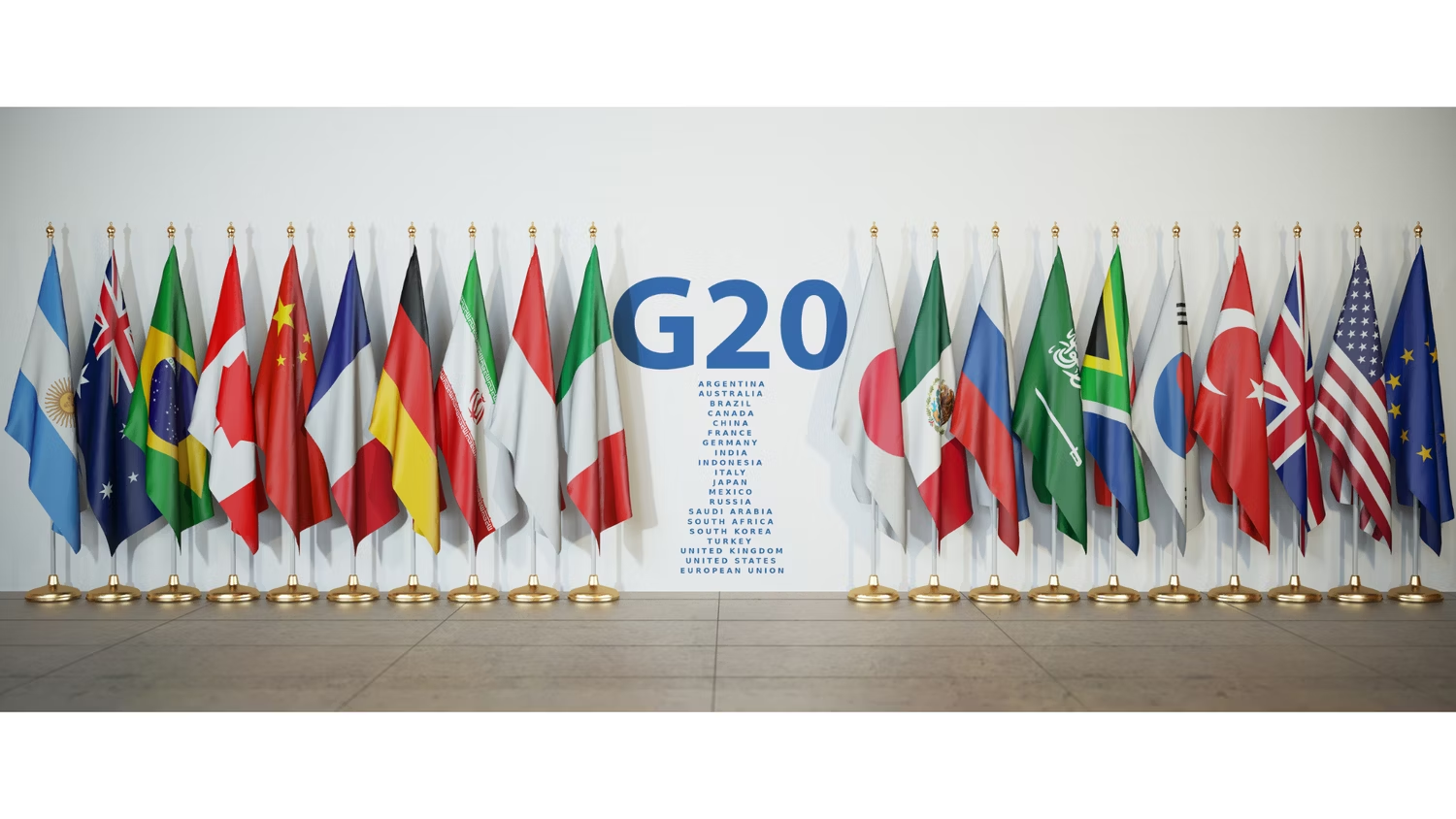
    Dr. Atac sneers at Türkiye’s alliances with Qatar and Oman, as if diplomacy with non-Western partners is inherently suspect. Yet Türkiye maintains robust ties with Germany, the UK, Itaaly, and Japan, and sits at the G20 table, not as a guest, but as a permanent member. It hosts NATO’s second largest military, plays a key role in the Black Sea Grain Initiative, and leads humanitarian aid convoys to Gaza and Ukraine alike. This is not isolationism , itt is strategic pluralism.

    Yes, there are challenges as Inflation must be controlled, and bureaucracy modernized. just two are valid points deserving of nuanced debate. But equating Türkiye’s evolution to North Korea’s oppression or Russia’s autocracy is not debate, it is distortion.

    One cannot claim to uphold Atatürk’s legacy while dismissing Türkiye’s national achievements as mere propaganda. Atatürk was not only a revolutionary but also a realist a leader who demanded progress be grounded in national sovereignty, self reliance, and global presence. Türkiye’s military drone industry, its diplomatic activism, and its investment in critical infrastructure reflect precisely that spirit.

    To critique is a right, even a duty, in a republic. But critique without proportion, without fairness, and without factual foundation becomes what Dr. Atac himself warns against: a betrayal not of the government, but of the very Republic he claims to defend.

    In today’s Türkiye, there is space for dissent. The opposition governs major cities like İstanbul, Ankara, and İzmir. The Constitutional Court continues to rule independently. And millions vote in fair, competitive elections with turnout rates that shame much of the democratic world.

    If one chooses to speak of Türkiye’s future, let it be done with courage but also with clarity. Let it be done with love not just for what we remember, but for what we are still building. Also, one should not be disparaged or vilified for holding a differing opinion. If the freedoms you invoke are only extended to those who share your particular worldview esspecially when that worldview is steeped in relentless criticism and hostility toward Türkiye then they cease to be freedoms at all and instead become instruments of intellectual exclusion.

    Let us be very clear, Dr. Atac: Türkiye is not perfect but it is far from broken or in disarray, as your narrative suggests.

    If you are searching for signs of a nation in crisis, you need only look at the United States. Here, citizens are at times arrested on the streets without due process; elected judges are removed from their courtrooms; city elected officials are taken into custody without being read their rights. Billions of taxpayer dollars are poured into endless wars, while over $15 billion has been funneled into sustaining the Netanyahu government despite its role in brutal campaigns that have drawn international condemnation.

    In America, a citizen can be gunned down with 35 bullets into their bodies for JUST  making eye contact with the wrong police officer and if you are lucky if your family will find your body . So before you accuse Türkiye of institutional collapse, perhaps turn your lens toward the realities unfolding in your own environment with the venom of hate dripping fromyour lips .

    As for your claim that I am a “mouthpiece” of Ankara—how dare you? You do not know me? Sir,  You have never sat with me, Sir,  never asked whom I voted for, never once attempted to understand my beliefs. You attack from afar with venomous words, but you know nothing of the person you seek to discredit.

    If you seek a professional debate, I welcome it anywhere, anytime. I will personally sponsor your travel to New York City and host you at New York University for an open forum. If New York is too far, I will gladly bring you to my village of Demirhisar in Rize’s Cayeli district. Perhaps the breathtaking beauty of the Black Sea, my village of Demirhisar and the sincere hospitality of our people will soften the bitterness in your heart toward the freely elected government of the Republic of Türkiye founded by none other than Mustafa Kemal Atatürk himself. Until then, I urge you to raise your critique with honesty and clarity not with the language of exclusion, not with personal insults, and certainly not with a tone that denies others their right to hold a different view point.

    And if we are to elevate the our NATO ally of the  Republic of Turkiye, Mustafa Kemal Atatürk’s Turkiye, it will not be through despairing editorials and historical amnesia , but through unity, reform, pride, and above all, honesty.

    Ibrahim Kurtulus
    Demirhisar Koy  – Rize – Cayeli
    New York