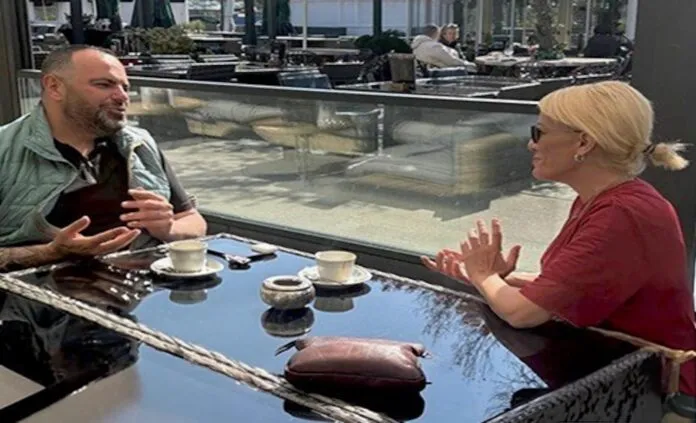
On May 1, 2025, Cemil Önal—known as the accountant of Halil Falyalı—was assassinated in a hotel within the municipality of Rijswijk, near The Hague, Netherlands. Önal had provided a 120-page testimony to the American foreign intelligence agency CIA and the Dutch intelligence agency AIVD. He had also given an interview to Cypriot journalist Ayşeden Akın, blowing the lid off the political underbelly of Turkey and Cyprus. This was not a case of simply “dying” or being “found dead”—he was deliberately and systematically silenced. His murder was not just the elimination of an individual, but rather exposed a multilayered intelligence crisis and a calculated political reckoning. Önal was not merely a witness; he was a living archive, intimately connected to the innermost workings of the state.
So why was he killed? Who was supposed to protect him—and who allowed it to happen?
The information Cemil Önal held about the power structures in Turkey and Cyprus went far beyond mere allegations. The recordings, documents, and confessions he allegedly possessed involved members of an organized crime-like structure that reportedly included President Erdoğan himself. These materials targeted a chain of individuals—from Erdoğan to the head of MİT (Turkey’s National Intelligence Organization), ministers, and party leaders. Such revelations were not only destabilizing for domestic politics but also had the potential to shake international power balances.
Yet despite the gravity of his position, Önal was placed in an ordinary hotel with no visible security. This raises serious questions:
Was Cemil Önal a victim knowingly delivered to his killers?
Reports from the scene indicate that after the assassination, the assailant walked away without encountering any resistance—pointing to a major security lapse. The CIA and Dutch intelligence service AIVD had a responsibility to protect Önal due to the sensitive information he had entrusted to them. However, instead of being housed in a secure location or a safe house in accordance with intelligence protocols, he was staying at a publicly accessible hotel—strongly suggesting insufficient protective measures. In this context, the event appears to have been a premeditated assassination, and it raises the suspicion that the assassin was granted implicit freedom of movement.
Meanwhile, Turkey’s National Intelligence Organization (MİT)—known to have been tracking Önal for a long time—has been silent in recent months and is increasingly criticized for acting in alignment with the executive branch. Given this, MİT’s potential involvement in or knowledge of the assassination must be thoroughly investigated through legal channels and in light of the evidence.
Now, pressing questions echo in the public’s mind:
• Could this assassination have been executed or commissioned by MİT under Erdoğan’s orders?
• Was it carried out by the CIA or Mossad and made to look like MİT was responsible?
• Will the materials Önal held be used in the future to blackmail the Turkish government?
• Or will this murder be shelved as an “unsolved case” for now—only to be used as leverage later?
All of these are plausible scenarios. And each highlights just how critical this event is.
Did the CIA and AIVD betray Cemil Önal?
The emerging picture strongly points to “yes.” The confessions, documents, and reportedly duplicated video recordings that Önal provided may have rendered him a “spent” figure—used and discarded. If the CIA and AIVD indeed acquired his information, the subsequent withdrawal of protective measures would be the clearest sign that they allowed, or at least enabled, his assassination.
Either way, this incident represents a major blow to the prestige of both the CIA and AIVD. The fact that a man under their protection was assassinated in such a manner will certainly discourage others from coming forward with confessions or seeking asylum, knowing they might not be protected in return.
A Dark Possibility: A Mechanism for Blackmail
The documents Önal provided may now be used as tools for blackmail against the Turkish government. If Western intelligence agencies now possess materials targeting Erdoğan and his inner circle, Turkey may find itself in a fragile position in foreign policy—vulnerable to pressure and more likely to make concessions.
So, this was not merely a murder. It may well be the first move in a multinational campaign of coercion.
What concessions might the Republic of Turkey be forced to make? Which political stances might it be pushed to abandon? What strategic plans might it be made to submit to?
We will witness this unfold together.
Conclusion?
Cemil Önal was silenced. But he left behind questions too massive and too incendiary to silence.
And these questions must not only echo in our minds—they must resonate within the public consciousness. This murder may have served both Erdoğan’s regime and the foreign powers that manipulate it. Therefore, everyone must ask themselves:
“Who benefited the most from this murder?”
Use your intellect. Connect the dots.
The answer may be closer than you think.
Leave a Reply