
https://www.washingtonpost.com/, 05/01//2011


https://www.washingtonpost.com/, 05/01//2011
By Gayle Putrich
Turkey’s first unmanned aerial vehicle quietly made its first flight 30 December, according to Turkish defence officials.
Called the Anka – which translates to “phoenix” in English – the 10m-long (33ft) composite UAV flew for about 14 minutes. It is designed to stay aloft for up to 24h with a 200kg (441lb) payload.
The Anka-A, the surveillance version of the aircraft, was unveiled 16 July has cost more than $100 million to design and develop. The sensor kit, being built by Aselsan, includes the company’s Aselflir-300T electro-optical/infra red (EO/IR) sensor and a synthetic aperture radar/ ground moving target indicator. The EO/IR sensor is expected to reach initial operational capability by September, with both up and running by the close of 2011. Turkish Aerospace Industries is also reportedly developing an armed version of the UAV, the Anka-B.
Turkey quickly followed up the medium-altitude long-endurance Anka’s first flight with a another boost to the country’s growing UAV industry — a 4 January agreement between the Turkish defence industry undersecretariat and the Turkey-based Vestel Defense Corporation to develop a tactical unmanned aerial vehicle for the Turkish Armed Forces (TSK). The ministry aims to end Turkey’s need to import its military’s UAVs, says defence minister Vecdi Gonul.
“I am happy to express that, with the mini and tactical unmanned aerial vehicles and ANKA unmanned aerial vehicle manufactured by the Turkish Aerospace Industries, Turkey’s dependency on foreign sources for the supply of the unmanned aerial vehicles has ended, Gonul also said.
Vestel, a defence subsidiary of a Turkish home appliance and electronics company, is developing the Karayel tactical UAV, which will fly up to 20h at an altitude of 22,000ft with a payload of up to 80kg (176lbs).
via Boeing 747 and Airbus A380 Aircraft News from Flightglobal.

By Clara Moskowitz
SPACE.com Senior Writer
In exchange for buying Boeing jets, Turkey wanted a Turkish astronaut to fly on a NASA space shuttle, according to a classified U.S. State Department message recently released by the organization WikiLeaks.
The leaked cable, published by the New York Times, was written in January 2010 by James Jeffrey while he was U.S. ambassador to Turkey. Jeffrey (now ambassador to Iraq) was apparently urging Turkish Airlines, which is partly owned by the Turkish government, to purchase planes from Boeing rather than its European competitor Airbus.
Turkish Minister of Transportation Binali Yildirim told Jeffrey that while price was the main consideration, Turkey could be swayed by perks, including help getting the budding Turkish space program off the ground – a request that had previously been made by Turkey’s president, Abdullah Gul, to President Obama.
“Yildirim hinted obliquely that Turkey’s desire to send an astronaut into space — expressed in a letter from President Gul to President Obama — is also tied into its consideration of commercial deals, and that NASA assistance to help stand up Turkey’s nascent space program would be viewed positively,” Jeffrey wrote.
The Turkish minister also requested help from the U.S. Federal Aviation Administration in strengthening Turkey’s aviation infrastructure, and said that heightened cooperation between the FAA and Turkey could also help sweeten the deal.
“Yildirim’s conflation of interactions [between the United States and Turkey] and what is ostensibly a commercial sale between private firms suggests an unwelcome, but unsurprising, degree of political influence in this transaction,” Jeffrey wrote.
He added, however, “While there should not be a link between this deal and FAA/NASA assistance in developing Turkey’s aviation and aerospace agencies, such assistance in and of itself could be mutually beneficial and merits further study.”
The leaked memo not only revealed the eagerness of Turkey to boost its space and aviation programs, but, taken with other cables released by WikiLeaks, showed the willingness of American diplomats to help broker deals for U.S. businesses.
Jeffrey promised to investigate whether NASA could help the Turkish space program. He “noted that scheduling a Turkish astronaut on an upcoming mission would be extremely difficult, but that other technical assistance from NASA in establishing Turkey’s space program might be a possibility.”
NASA has carried foreign astronauts on space shuttle flights in exchange for money or other contributions to space projects. For example, Japanese astronauts have flown on U.S. space shuttles (as well as on Russian Soyuz spacecraft), and Israel’s first astronaut, Ilan Ramon, was a member of the ill-fated crew of the space shuttle Columbia, which disintegrated in 2003 during re-entry.
Political considerations weigh into the decision to place a foreign astronaut aboard a U.S. space shuttle, but in Turkey’s case that may now be moot: Only two or three shuttle flights remain before the fleet is retired this year.
Turkey is not the only country asking for perks in exchange for purchasing Boeing jets. Other leaked documents reveal similar tit-for-tat requests being negotiated behind the scenes by the State Department. For example, the king of Saudi Arabia wanted his personal jet outfitted with technology from Air Force One, and the prime minister of Bangladesh asked the State Department to re-establish landing rights at New York’s JFK airport, the New York Times reported.
Ultimately, there is hope for further collaboration in space between Turkey and the United States, Jeffrey wrote.
“We probably cannot put a Turkish astronaut in orbit, but there are programs we could undertake to strengthen Turkey’s capacity in this area that would meet our own goals for improved aviation safety in the region.”
via SPACE.com — Turkey Pushed for Its Own Astronaut on Space Shuttle.

The government is working to overcome legal obstacles to reopening the Halki (Heybeliada) seminary, closed since 1971, said Deputy Prime Minister Bulent Arinc yesterday.
“There are some legal obstacles,” said Arinc, paying a New Year’s visit to the Istanbul-based Greek Orthodox Patriarchate and Patriarch Bartholomew. “We will overcome them. This is not something we can grant. We need to do what the law requires us to do.”
Patriarch Bartholomew said Arinc’s visit had bolstered his hopes, explaining, “We expect our school to reopen. This year is the 40th anniversary of our school’s closure. We hope the government will put its good will into practice.”
The patriarch added that under the initiative of Prime Minister Recep Tayyip Erdogan, clergymen who live in other countries but who serve the patriarchate have been given Turkish citizenship. “This is a very important step for the functioning of our patriarchate,” he said. “We expect Turkey to continue to be successful in the new year and to become a member of the EU soon.” Arinc is the highest-ranking government official to visit the patriarchate since the 1952 visit of Prime Minister Adnan Menderes.
Reopening the seminary has been linked by the EU to improving democracy and human rights in Turkey.
via Arinc: We will overcome legal barriers to reopening the Heybeliada Greek seminary.

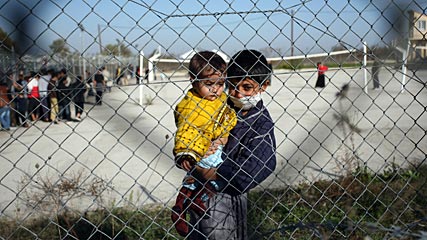
ISTANBUL, Turkey — The United States is not the only country searching for ways to control its borders. In hopes of stopping the entry of thousands of illegal immigrants, Greece has announced plans to build a fence along its porous border with Turkey, its neighbor to the east.

Originally, the fence was to be 128 miles long. However, after heavy media criticism in which the proposed fence was compared to the one along sections of the U.S.-Mexico border, it was reduced to just 8 miles long and 9 feet high along the weakest point of the border, near the Greek town of Orestiada.
According to Greek Public Order Minister Christos Papoutsis, more than 100,000 people entered Greece illegally last year. The country was reportedly the only member of the European Union that saw illegal immigration rise last year.
“The Greek public has gone beyond its limits in terms of its capacity to welcome illegal migrants,” Papoutsis said, according to Greek news agency Ana. “Greece cannot take it anymore. We plan to build a barrier on the land border to block unauthorized immigration.”
The plan has drawn the condemnation of the human rights organization Amnesty International. “It’s clearly a European confession of failure,” Amnesty’s Wolfgang Grenz told a German newspaper Monday. Grenz said that by allowing Greece to build the fence, the EU would break its own principles regarding human rights.
Both the Turkish government and the European Commission have said that border protection is a matter for states to decide themselves.
An average of 200 illegal immigrants reportedly crossed into Greece from Turkish soil every day in 2010. They mainly came from Afghanistan, Pakistan and Africa. Many were seeking asylum as refugees within the EU. Others were migrant laborers seeking work inside the EU.
About 90 percent of all illegal immigrants that enter the EU come through Greece, according to officials.
In November, EU Rapid Border Intervention Teams (RABITs) were deployed along the Greek border. However, their effectiveness as a deterrent to illegal immigrants was called into question, as many of the people crossing into Greece actually sought out authorities to speed up their entry into the EU asylum system.
Metim Corabatir, a spokesman for the Office of the United Nations High Commissioner for Refugees (UNHCR) in Turkey, told AOL News in a phone interview that while every country had a right to protect its borders, fences do not deter illegal immigrants
“Building fences do not solve this kind of problem fully,” Corabatir said. “We should not forget that there are people moving for different reasons. Some are economic migrants. There are also people seeking protection. For this region, border control managers must be sensitive to the needs of people seeking protection.”
Situated at a geographical crossroads, Turkey has long been one of the primary stops along the road to the West. Partly due to often criticized immigration laws and the lengthy time it takes to apply for asylum through the UNHCR, most asylum seekers make Turkey a transit point and seek asylum within the EU by crossing illegally into Greece.
According to Corabatir, while Greece grew more frustrated last year over the flood of illegal immigrants, the total number of people crossing over from Turkey was not up. “If you compare the figures, there has not been a big change in the number of people who have been trying to enter Greece through Turkey. What has changed is the route,” he said.
Previously, illegal immigrants tried to reach Greece through the Aegean Islands between Turkey and Greece. Corabatir said there was a shift to the land border as Greece took better control of its sea borders with the help of the EU.
The total number of people who enter Turkey every year illegally is unknown. Most leave Turkish territory quickly, and the only figures available come from Turkish authorities, who Corabatir says detain an estimated 50,000 to 60,000 illegal entrants every year. Some academics estimate that Turkey has between 200,000 and 400,000 illegal migrants entering the country every year.
Even if asylum seekers were granted refugee status in Turkey, Corabatir said, the UNHCR would still seek to resettle them in third countries. “They cannot stay in Turkey forever and enjoy full refugee rights,” he said. “Their access to social benefits and the right to work is very limited in Turkey.”
Despite this, the number of people seeking refugee status in Turkey had increased in recent years. In a trend that might bring relief to Greece, Turkey’s economy is developing rapidly, and immigrants who are focused on work possibilities as supposed to refugee status are finding more opportunities there.
“In some cities like Istanbul and Izmir, some people will earn money and be happy,” said Corabatir. “This is a new phenomenon. We think Turkey will become more of a target country for economic migrants.”
via AOL

From: nadinevalidesultan [mailto:[email protected]]
To: [email protected]

Salaams Aleykum Dr.Kayaalp Buyukataman, president CEO of Turkish Forum _ world Turkish Alliance
Thank you for your good wishes. In turn, I am presenting my warmest wishes for a New Year filled with happiness, good health and prosperity.
In addition of my website that shall be soon translated intoTurkish (www.nadinevalidesultan.org) my book on the Ottoman history is now available in Turkish under the title: “Sultan II.Abdulhamid’in Mirasi: Sultan Selim bin Hamid Han’in hatiralari ve biografyasi” by Nadine Sultana d’Osman Han. Family records are based on family members that lived at the Court and not from hearsay from foreign diplomats or sources that were not witnesses at the Court itself.
I am truly delighted to see Turkey turning toward its roots in Asia and Iran. I always strongly encouraged over the years, the Turkish politicians to open the door to Iran and the East instead of the West who never had the best interests of Turkey in their heart.
May the blessings of Allah bring a global peace in the New Year.
Nadin Sultan d’Osman Han