Three academics at one of Turkey’s top universities have been sacked after a student made a pornographic film for his dissertation project.
Bilgi University in Istanbul has shut its film department, and police are looking into possible criminal charges.
A number of other academics have protested against the response.
The incident has drawn attention to the clash between traditional values and the sometimes experimental arts and lifestyles practised in Istanbul.
Fail
When film student Deniz Ozgun first broached his idea for a dissertation project with his professors, they were hesitant.
He wanted to make a pornographic film, he said, but also to reveal how synthetic the sexual scenes in it were.
They told him the project needed to make a stronger intellectual point. Evidently he did not succeed – his film was marked a fail.
None of this caused a stir. But after Mr Ozgun gave an interview to a news magazine, describing how he made the film on campus, his project caused an uproar.
Parents wanted to know what kinds of things went on at Bilgi, one of Turkey’s most prestigious private universities.
And, say some academics there, the Board of Education put pressure on the university to act.
As well as the firing of the three academics – who are now being investigated by the police – the entire Communications Faculty has been shut down.
Mr Ozgun, and the former student who starred in his film, have gone into hiding.
A number of academics have protested against this draconian response.
Neither the university nor the government is making any comment.
Bilgi has a reputation as one of the most liberal universities in Turkey – it was among the first to ignore the ban on Muslim women wearing headscarves on campus. But this issue has clearly touched a nerve.
Boundaries tested
People from different walks of life in Turkey now hold strikingly divergent values.
In much of the country they still adhere to strict moral codes, in which alcohol is banned, clothing is conservative and sex never discussed openly.
Politicians in the governing Justice and Development Party (AKP) largely subscribe to this view.
But in Istanbul many people have very liberal attitudes to sex, alcohol and the arts. Indeed you can find films, plays and art exhibitions every bit as provocative and experimental as in any other European city.
Last September, guests attending new exhibitions at three art galleries in central Istanbul were attacked by local residents enraged by the sight of them drinking alcohol on the street outside.
They might have been even more enraged had they seen the content of the exhibitions, which challenged a number of taboo topics.
A publisher who translated erotic European literature was also put on trial last year, but eventually acquitted.
Turkey is now the world’s fifteenth biggest economy; its people are more prosperous and more exposed to outside influences than ever before.
Boundaries are constantly being tested. But when they are, sometimes there is a powerful reaction.
via BBC News – Turkish academics sacked over porn dissertation project.
Ergun Kirlikovali bu cagriyi yapiyor. Ancak makaleye link vermedigi icin onu da ben asliyla ve Ingilizce tercumesiyle ekledim.
EA
Le Monde Provides Platform To Former Spokesman Of An Armenian Terrorist Organization MONDAY, 03 JANUARY 2011 05:28 Dear Readers, Friends , and Fair-Minded, Truth-Promoting, Peace-Lovers,
As long as there are Armenian falsifiers and Turk-haters around the world, with or without their white robes and matching conical hats, bent on demonizing all things Turkish at all opportunities real or imagined, our work seems to remain incomplete.
We need to be alert and react instantly to all kinds of attempts to defame and misrepresent our proud heritage. We need to remain in constant vigilance and continue to educate the public about our thousands of year old culture, history, and heritage.
This time, the unprovoked, unjustified, and unfair attack came from France’s Le Monde newspaper. Le Monde editors, incredibly, are providing access to the former speaker of a notorious Armenian terrorist organization, ASALA. The blood of Turkish (and Fench) citizens have not dried on the hands of these Armenian terrorists who loved to grin to the TV cameras with their ugly faces, flashing victory signs after every bombing, assassination, and other such premeditated murder and planned carnage.
What’s more, Le Monde editors seem to lack the decency to at least give the appearance of seeking responsible opposing views in order to balance this terrorist’s sick and hateful message and to present a more objective and fair coverage of a historical controversy.
Therefore, I ask you to please sign the protest letter below with your name, city, country, and day-phone, and email it to these addresses :
Street address : Le Monde, 80, boulevard Auguste-Blanqui, 75 507 Paris Cedex 13 France
***************
Madam/Sir,
In a shocking move, Le Monde allowed, one more time, Ara Toranian to publish an opinion in its pages. The promotion, without any warning, of the views of the former spokesman of a terrorist group (ASALA) is simply unacceptable in a respectable and democratic newspaper.
France was, with Turkey, the country of the world where Armenian terrorists, especially ASALA, killed and wounded the greatest number of persons. Mr. Toranian’s newspaper, Hay Baykar, glorified the murder of Turkish diplomats, justified the bombing of the Marmara travel agency (which bomb also killed a French secretary) and slammed the verdict sentencing the perpetrators of Orly attack (8 deaths, 90 wounded, including around 60 seriously).
In the U.S.A., ASALA attempted to assassinate a UCLA history professor, Prof. Stanford Jay Shaw, and his family in 1977 by planting a bomb in his HOME !
ASALA’s inspiration, Gourgen Yanikian, murdered in an ambush the general consul in Los Angeles Mehmet Baydar and his deputy Bahadır Demir, in 1973. Mr. Toranian’s newspaper presented the terrorist Yanikian as a hero.
Another Armenian terrorist group, JCAG/ARA assassinated Mehmet Baydar’s successor, Kemal Arıkan, in 1982.
The same attacked by bombs the cultural night celebrating the Turkish culture (including dance) in California and New York.
Both ASALA and JCAG/ARA assaulted even moderate Armenians, like the Dashnak and the Hunchak murderers did in the Ottoman Empire since 1890s and the USA since 1930’s.
Mr. Toranian’s opinion was seen as an insult to the silent memory of the many victims of terrorism, whatever their nationality or ethnicity may be.
Please accept our expressions of profound disappointment, outrage, and sadness,
[Signatory : Please provide full name, city, state, country, and day-phone]Point de vue Paris lâche les Arméniens Le Monde | 28.12.10 | 14h03 * Mis à jour le 29.12.10 | 13h14
La dernière livraison des câbles diplomatiques révélés par WikiLeaks nous apprend qu’il n’aura même pas fallu deux mois à Nicolas Sarkozy pour trahir ses engagements envers la communauté arménienne de France à propos de la loi incriminant le négationnisme du génocide arménien. Le 24 avril 2007, le candidat de l’UMP promettait d’appuyer la ratification par le Sénat de ce texte déjà voté par l’Assemblée nationale.
Or selon un télégramme rendu public par WikiLeaks, Jean-David Levitte (conseiller diplomatique de l’Elysée), en visite à Ankara le 29 mai 2007, a confié à ses interlocuteurs que “Sarkozy s’assurera que le projet de loi du génocide arménien (pénalisant le négationnisme) meure au Sénat français.” On comprend mieux l’arrogance de ce négationnisme, qui se développe notamment sur la Toile française à travers des sites sponsorisés par le gouvernement d’Ankara. Ainsi ce fléau, qui fait office de volet politique du génocide, qui constitue sa continuation par d’autres moyens, ne sera non seulement pas combattu par les responsables de l’ordre public, mais il bénéficiera de la neutralité bienveillante du chef de l’Etat.
INTÉRÊTS DU PANTURQUISME
Que peuvent bien valoir les belles paroles prononcées à l’endroit de la communauté arménienne de France, mais également toute la rhétorique de Nicolas Sarkozy sur l’histoire, et les leçons qu’il convient d’en tirer ? Etait-il nécessaire de gratifier Ankara de ce type de signal, au moment même où à l’intérieur du pays, enfin, un mouvement d’intellectuels turcs se dessine pour demander pardon aux Arméniens ? Il ne faudra pas s’étonner ensuite qu’éclairées par de tels exemples les autorités turques fassent des sourires à l’Occident tout en signant, comme elles l’ont fait, en mai, des accords pour la livraison d’uranium à l’Iran. Qu’elles combattent le blocus de Gaza tout en pérennisant, depuis seize ans, celui sur l’Arménie. Qu’elles exigent des excuses d’Israël pour les neuf morts turcs de la flottille, en juin, sans jamais avoir prononcé un mot de regret pour le million et demi d’Arméniens exterminés, en 1915, et en outrageant tous les jours leur mémoire.
Un malheur n’arrivant jamais seul, cette information de WikiLeaks vient une semaine après une autre dépêche diplomatique rendue publique par le même site, selon laquelle M. Roland Galharague, haut fonctionnaire au Quai d’Orsay, explique à William Burns, secrétaire américain à la défense, que l’existence d’une forte communauté arménienne, en France, entraverait les propositions susceptibles d’apporter la paix au Haut-Karabakh, une enclave arménienne indépendantiste en butte à l’hostilité et aux menaces de guerre du couple turco-azerbaïdjanais.
La question se pose donc de savoir quelles sont ces belles propositions de paix du Quai d’Orsay qui pourraient bien contrarier à ce point les Français d’origine arménienne. Tout semble hélas indiquer que la tradition qu’on croyait révolue du lâchage des Arméniens au profit des intérêts du panturquisme est en train de reprendre ses droits dans la République. Nous ne ferons pas ici le compte de victimes qu’une telle attitude a déjà provoquées. Mais comment ne pas s’indigner que ce type de pratique soit toujours en vigueur après tant de malheurs accumulés ?
Ara Toranian, directeur de “Nouvelles d’Arménie Magazine” Article paru dans l’édition du 29.12.10
—————————————————————————————————————————- Point of view Paris cowardly Armenians Le Monde | 28.12.10 | 2:03 p.m. * Updated 29.12.10 | 1:14 p.m.
The latest issue of diplomatic cables revealed by Wikileaks us that he will not even take two months to Nicolas Sarkozy to betray its commitments to the Armenian community in France about the law criminalizing denial of Armenian genocide. On April 24, 2007, the UMP candidate promised to support Senate ratification of the text already passed by the National Assembly.
Yet according to a telegram published by Wikileaks, Jean-David Levitte (the Elysee diplomatic adviser), on a visit in Ankara May 29, 2007, told his interlocutors that “Sarkozy will ensure that the bill of Armenian genocide (criminalizing denial) died in the French Senate. “ We can better understand the arrogance of this denial, which grows particularly through the French web sites sponsored by the Ankara government. So this scourge, which serves as political aspect of the genocide, which is its continuation by other means, will not only not opposed by officials of public order, but it will benefit from the benevolent neutrality of the head of the State.
INTERESTS Turkism
That may well be worth the beautiful words spoken against the Armenian community of France, but also the rhetoric of Nicolas Sarkozy on the history and the lessons to be learned? Was it necessary to reward Ankara this type of signal, just as inside the country, finally, a movement of Turkish intellectuals in sight to apologize to the Armenians? It will not be surprising then qu’éclairées by such examples of the Turkish authorities do smiles while signing the West, as they did in May, agreements for the supply of uranium to Iran. They fight the blockade of Gaza while protecting the last sixteen years, the one on Armenia. They demand an apology from Israel for the nine dead Turkish fleet in June without ever uttering a word of regret for the million and half Armenians murdered in 1915, and insulting their memory every day .
Misfortunes never come alone, this information Wikileaks comes a week after another diplomatic dispatch published by the same site that Mr. Roland Galharague , a senior official at the Quai d’Orsay , told William Burns , U.S. Secretary defense, that the existence of a strong Armenian community in France, obstruct proposals likely to bring peace in Nagorno-Karabakh, an Armenian enclave independence subjected to hostility and threats of war between Turkey and the couple Azerbaijan.
The question therefore arises what are these beautiful peace proposals of the Quai d’Orsay, which might well upset at this point the French of Armenian origin. Unfortunately everything seems to indicate that they believed the tradition of dropping the Armenian past in favor of the interests of Turkism is trying to regain his rights in the Republic. We will not here on behalf of victims that such an attitude has already caused. But how can we not be indignant that such practice is still in effect after so many misfortunes accumulated?
Ara Toranian, director of “Armenian News Magazine Article published in the edition of 29.12.10
Dr . Emanuel Tanay MD is a well-known forensic psychiatrist who has been an expert witness in many famous cases . He has served as an officer or committee member on the Michigan Psychiatric Society, the American Academy of Psychiatry and the Law, the American Psychiatric Association (APA), and others . He is a diplomate of the American Board of Psychiatry and Neurology and of the American Board of Forensic Psychiatry and a distinguished fellow of the APA and the American Academy of Forensic Sciences (AAFC).
A Holocaust Survivor’s View on Islam
A man, whose family was German aristocracy prior to World War II, owned a number of large industries and estates. When asked how many German people were true Nazis, the answer he gave can guide our attitude toward fanaticism. ‘Very few people were true Nazis,’ he said, ‘but many enjoyed the return of German pride, and many more were too busy to care. I was one of those who just thought the Nazis were a bunch of fools. So, the majority just sat back and let it all happen. Then, before we knew it, they owned us, and we had lost control, and the end of the world had come. My family lost everything. I ended up in a concentration camp and the Allies destroyed my factories.’
We are told again and again by ‘experts’ and ‘talking heads’ that Islam is the religion of peace and that the vast majority of Muslims just want to live in peace. Although this unqualified assertion may be true, it is entirely irrelevant. It is meaningless fluff, meant to make us feel better, and meant to somehow diminish the specter of fanatics rampaging across the globe in the name of Islam.
The fact is that the fanatics rule Islam at this moment in history. It is the fanatics who march.. It is the fanatics who wage any one of 50 shooting wars worldwide. It is the fanatics who systematically slaughter Christian or tribal groups throughout Africa and are gradually taking over the entire continent in an Islamic wave. It is the fanatics who bomb, behead, murder, or honor-kill. It is the fanatics who take over mosque after mosque. It is the fanatics who zealously spread the stoning and hanging of rape victims and homosexuals. It is the fanatics who teach their young to kill and to become suicide bombers.
The hard, quantifiable fact is that the peaceful majority, the ‘silent majority,’ is cowed and extraneous.
Communist Russia was comprised of Russians who just wanted to live in peace, yet the Russian Communists were responsible for the murder of about 20 million people. The peaceful majority were irrelevant. China’s huge population was peaceful as well, but Chinese Communists managed to kill a staggering 70 million people.
The average Japanese individual prior to World War II was not a warmongering sadist. Yet, Japan murdered and slaughtered its way across South East Asia in an orgy of killing that included the systematic murder of 12 million Chinese civilians; most killed by sword, shovel, and bayonet.
And who can forget Rwanda , which collapsed into butchery. Could it not be said that the majority of Rwandans were ‘peace loving’?
History lessons are often incredibly simple and blunt, yet for all our powers of reason, we often miss the most basic and uncomplicated of points:
Peace-loving Muslims have been made irrelevant by their silence.
Peace-loving Muslims will become our enemy if they don’t speak up, because like my friend from Germany , they will awaken one day and find that the fanatics own them, and the end of their world will have begun.
Peace-loving Germans, Japanese, Chinese, Russians, Rwandans, Serbs, Afghans, Iraqis, Palestinians, Somalis, Nigerians, Algerians, and many others have died because the peaceful majority did not speak up until it was too late. As for us who watch it all unfold, we must pay attention to the only group that counts — the fanatics who threaten our way of life.
Lastly, anyone who doubts that the issue is serious and just deletes this email without sending it on is contributing to the passiveness that allows the problems to expand. So, extend yourself a bit and send this on and on and on! Let us hope that thousands, world-wide, read this and think about it, and send it on – before it’s too late.
===========================================
Comments (11)
Nina M. Lawrence ·
This article by Dr. Tanay is priceless. Even though we know these different histories of different peoples, to have it written up all together in this format is far more than anything I could do or say. I am not a writer by any stretch of the imagination, my heart aches for all the peoples of our world who are going through so much. And I know that they will have crowns on the other side.
Blessings,
Dan ·
This is a very good article. Dr. Tanay did it justice and gave it a real flavour from someone who knows. That is important in any article like this. My heart also aches for those in the world that are miss treated in the worst way.
Syed Asad ·
I like your article and personally feel frustrated that silent majority do not have honest, courageous and bold leaders to stand up to fanatics. Politcal goals should be shrouded as a cover for religion. Primarily all religions including Islam are for the betterment of the society.
syed asad ·
I meant the political goals should not be shoruded…..
Juggler ·
Islam can never be reformed unless it’s adherents disown the Koran. The fanatics get their destructive ideology straight from the pages of that book. Sad to say… The TRUE Muslims are the ones who are trying to spread the Islamic philosophies through violence and intimidation.
While it takes nothing away from the content, this was posted on Emanuel Tanay’s blog in 2006, but was actually written by Paul E. Marek, a Canadian blogger.
https://en.wikipedia.org/wiki/Emanuel_Tanay
Glen Meakem | Conservative Talk Show Host » HOLOCAUST SURVIVOR’S VIEW OF ISLAM
[…] Dr . Emanuel Tanay MD is a well-known forensic psychiatrist who has been an expert witness in many famous cases . He has served as an officer or committee member on the Michigan Psychiatric Society, the American Academy of Psychiatry and the Law, the American Psychiatric Association (APA), and others . He is a diplomate of the American Board of Psychiatry and Neurology and of the American Board of Forensic Psychiatry and a distinguished fellow of the APA and the American Academy of Forensic Sciences (AAFC). […]
Perry ·
Although this article hits the nail on the head, others are saying that Dr. Tanay did not write this, including Dr. Tanay himself. It is being attributed to Paul Marek. Just search the internet and you’ll find it. Took me 3 minutes. Does anyone know the true author? It appears to be Paul Marek and what’s his background?
Butch
This is an excellent article. It should be read to every high school student that is awake in cl***, but most important college students should also take this to heart.
Hail!, found your site by pure accident this morning, but pleased that I have! Not only informative and also easy to get through compared with lots that I visit! (My site, is about hypnotherapy downloads). I was trying to work out what menu layout you had implemented, anyone have anny ideas? My site is a site looking at hypnotherapy downloads. I’ve got the same basic layout on my website, which is related to hypnotherapy downloads, – yet for some reason it seems to load more quickly on yours though this site seem to have a lot more material. Are you using any software that have increased speed? : Anyway, I appreciate such a great website and it’s a wonderful model for my humble review website of hypnotherapy downloads. I’ll be looking to enhance my own site. I definitely will check back on this instructive blog regularly.
Yet another lie put out by the disinformation campaign that seeks to destroy anyone who dares think outside the box when it comes to Islam and America’s blind support of Israel.
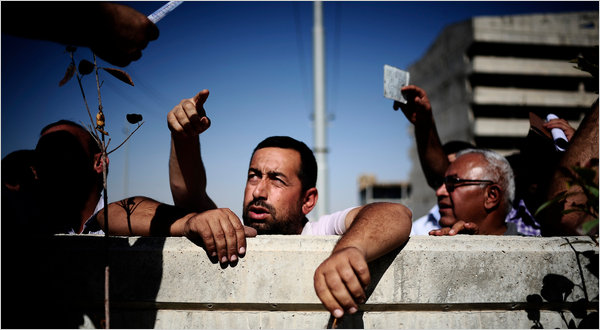
Ayman Oghanna for The New York Times
Iraqis in Erbil waited for visas to visit Turkey outside the
consulate, which issues as many as 300 a day. More Photos >>
By ANTHONY SHADID
Published: January 4, 2011
Multimedia
Slide Show
Turkey’s Soft Power in Iraq
Related
After a Court Ruling, Turkey Frees 23 Suspected Militants (January 5, 2011)
Construction at Basra’s Sport City in Iraq. Turkish diplomats say that businesspeople from their country face little competition there. More Photos »
¶ ZAKHO, Iraq — A Turkey as resurgent as at any time since its Ottoman
glory is projecting influence through a turbulent Iraq, from the
boomtowns of the north to the oil fields near southernmost Basra, in a
show of power that illustrates its growing heft across an Arab world
long suspicious of it.
Multimedia
¶ Its ascent here, in an arena contested by the United States and
Iran, may prove its greatest success so far, as it emerges from the
shadow of its alliance with the West to chart an often assertive and
independent foreign policy.
¶ Turkey’s influence is greater in northern Iraq and broader, though
not deeper, than Iran’s in the rest of the country. While the United
States invaded and occupied Iraq, losing more than 4,400 troops there,
Turkey now exerts what may prove a more lasting legacy — so-called
soft power, the assertion of influence through culture, education and
business.
¶ “This is the trick — we are very much welcome here,” said Ali Riza
Ozcoskun, who heads Turkey’s consulate in Basra, one of four
diplomatic posts it has in Iraq.
¶ Turkey’s newfound influence here has played out along an axis that
runs roughly from Zakho in the north to Basra, by way of the capital,
Baghdad. For a country that once deemed the Kurdish region in northern
Iraq an existential threat, Turkey has embarked on the beginning of
what might be called a beautiful friendship.
¶ In the Iraqi capital, where politics are not for the faint-hearted,
it promoted a secular coalition that it helped build, drawing the ire
of Iraq’s prime minister, Nuri Kamal al-Maliki, along the way. For
Iraq’s abundant oil and gas, it has positioned itself as the country’s
gateway to Europe, while helping to satisfy its own growing energy
needs.
¶ Just as the Justice and Development Party of Prime Minister Recep
Tayyip Erdogan has reoriented politics in Turkey, it is doing so in
Iraq, with repercussions for the rest of the region.
¶ While some Turkish officials recoil at the notion of neo-Ottomanism
— an orientation of Turkey away from Europe and toward an empire that
once included parts of three continents — the country’s process of
globalization and attention to the markets of the Middle East is
upsetting assumptions that only American power is decisive. Turkey has
committed itself here to economic integration, seeing its future in at
least an echo of its past.
¶ “No one is trying to overtake Iraq or one part of Iraq,” said Aydin
Selcen, who heads the consulate in Erbil, which opened this year. “But
we are going to integrate with this country. Roads, railroads,
airports, oil and gas pipelines — there will be a free flow of people
and goods between the two sides of the border.”
¶ By the border, he meant Zakho and the 26-lane checkpoint of Ibrahim
Khalil, where 1,500 trucks pass daily, bringing Turkish building
materials, clothes, furniture, food and pretty much everything else
that fills shops in northern Iraq.
¶ The economic boom they have helped propel has reverberated across
Iraq. Trade between the two countries amounted to about $6 billion in
2010, almost double what it was in 2008, Turkish officials say. They
project that, in two or three years, Iraq may be Turkey’s biggest
export market.
¶ “This is the very beginning,” said Rushdi Said, the flamboyant Iraqi
Kurdish chairman of Adel United, a company involved in everything from
mining to sprawling housing projects. “All of the world has started
fighting over Iraq. They’re fighting for the money.”
¶Ambition, in 4 Languages
¶ Mr. Said’s suit, accented by a black-and-white handkerchief in the
pocket, shines like his optimism, the get-rich-quick kind. In some
ways, he is a reincarnation of an Ottoman merchant, at ease in
Kurdish, Turkish, Persian and Arabic. In any of those languages, he
boasts of what he plans.
¶ He has thought of contacting Angelina Jolie, “maybe Arnold and
Sylvester, too,” to interest them in some of his 11 projects across
Iraq to build 100,000 villas and apartments at the cost of a few
billion dollars. So far, though, his best partner is the singer
Ibrahim Tatlises, the Turkish-born Kurdish superstar, whose portrait
adorns Mr. Said’s advertisement for his project the Plain of Paradise.
¶ “The villas are ready!” Mr. Tatlises says in television ads. “Come!
Come! Come!”
¶ Erbil, the Kurdish capital in the north where Mr. Said lives, has
become the nexus of Turkish politics and business, made possible by
the sharp edge of military power.
¶ About 15,000 Turks work in Erbil and other parts of the north, and
Turkish companies, more than 700 of them, make up two-thirds of all
foreign companies in the region. Travel requirements have been lifted,
and the consulate in Erbil issues as many as 300 visas a day. A
Turkish religious movement operates 19 schools in the region,
educating 5,500 students, Arabs, Turkmens and Kurds mingling in a
lingua franca of English.
¶ Turkish officials talk about transforming the region into something
akin to the American-Mexican border, a frontier as ambiguous as any
line on a map is precise. Even some Kurdish officials have embraced
the idea, though interpreting the notion differently.
¶ While Turkey sees integration as a way to tap nascent markets in the
Middle East, some Kurdish officials have seen it more emotionally, as
a way to bind them to Kurdish regions in neighboring countries that no
degree of political negotiations could ever achieve.
¶ “The borders between us were not drawn by us,” Kamal Kirkuki, the
speaker of the local Kurdish Parliament, said of the frontier with
Turkey, Iran and Syria, all with Kurdish minorities, “It’s a de facto
border and we have to respect it, but in our hearts we don’t see it.
We want to integrate the people without any bureaucracies keeping them
apart.”
¶ Kurds represent nearly 20 percent of Turkey’s population, and
Turkish governments have long viewed calls for their
self-determination as a fundamental threat to the state. The same went
for Kurds in Iraq, whose autonomy might provide an inspiration to
Turkey’s own minority. Since 2007, those assumptions have undergone a
seismic shift.
¶ Over the smoldering reservations of the Turkish military, which has
carried out repeated coups against elected governments, Mr. Erdogan
has undertaken halting steps to reconcile with Turkey’s own Kurds in
what the government has termed “the Kurdish opening.” They have met
with mixed success, but the new climate reflects the changes: Turkish
diplomats here casually refer to Iraqi Kurdistan — the K-word long
being a taboo — and Massoud Barzani, that region’s president, no
longer talks about Greater Kurdistan.
¶Diplomatic Balancing Act
¶ Less publicly, American officials in late 2007 began to support
Turkish military action against Kurdish rebels in Turkey who have
sought refuge in northern Iraq. Turkey still keeps as many as 1,500
troops here, officials say, and the cooperation has allowed them, as a
senior American official put it, “to quite effectively strike” the
Kurdish rebels.
¶ Iraqi officials in Erbil and Baghdad have protested, requiring a
measure of American diplomacy to soothe their resentment. But at least
for now, Kurdish officials have viewed their alliance with Turkey as a
greater priority in a region still contested by Iran.
¶ “Kurdistan is not against the interests of Turkey,” Mr. Kirkuki said
simply. A surprising feature of Turkey’s success is the image it has
managed to project in Iraq. On the road from Erbil to Baghdad, its pop
culture is everywhere.
¶ Posters of Turkish television serials — from “Muhannad and Nour” to
“Forbidden Love” — sell by the tens of thousands. The action series
“Valley of the Wolves” is a sensation, the lead actor lending his name
to cafes. His own posters are computer-altered to show him in
traditional Kurdish or Arab dress — grist for a graduate school
seminar on the adaptability of cultural symbols.
¶ Its political influence in Baghdad is no less widespread. Unlike
Iran and the United States, it has cultivated ties with virtually
every bloc in the country, though relations with Mr. Maliki have
proved difficult at times. (At one point, his officials tried to
revoke the Turkish ambassador’s credentials to enter the Green Zone.
“A misunderstanding,” Turkish diplomats called it.)
¶ Turkish diplomats stay for two years, unlike the one-year posting
for Americans, and over that time, they have managed to reach out to
unlikely partners, namely the followers of the populist Shiite cleric
Moktada al-Sadr.
¶ Most of Mr. Sadr’s bloc of lawmakers traveled to the Turkish
capital, Ankara, for training in parliamentary protocol. In October,
Turks were the only diplomats to attend a commemoration the Sadrists
held at Baghdad University. “It is not a group to be excluded,” one of
them said.
¶ Courting the Sadrists, though, is a sideshow to the real prize being
sought in the prolonged months of negotiations over a new government.
¶ Turkey strongly backed the fortunes of a coalition led by Ayad
Allawi, a secular Shiite politician who enjoys the support of the
country’s Sunnis. More than any other country, Iraq’s Arab neighbors
included, it is credited with forging the coalition in the first
place.
¶ American and Turkish interests did not always line up on the
government’s formation, and some diplomats questioned whether American
officials were perceived as backing Mr. Maliki too strongly.
¶ “A high-wire act,” said the senior American official, describing
Turkish-American relations generally.
¶ Yet those interests are roughly aligned now, and the degree of power
Mr. Allawi’s coalition eventually plays in the government will vividly
illustrate Turkey’s relative weight in Iraq.
¶ “I’d say the Turks put a lot of effort into it,” the official said,
“and they still are.”
¶Building Connections
¶ In southernmost Iraq, the old Ottoman quarter in faded Basra is
crumbling. Its windows are patched with cinder block, though the
stench of sewage still seeps in. Across town is the Basra
International Fair Ground, built by Turks and opened in June. Three
fairs have already been held there, including one organized in
November for Iraq’s petroleum industry.
¶ Oil is still king in Iraq, and as much as anything else, underlines
Turkey’s interests here. The pipeline from Kirkuk, Iraq, to Ceyhan,
Turkey, already carries roughly 25 percent of Iraq’s oil exports.
¶ The Turks have signed on to the ambitious $11 billion Nabucco gas
pipeline project, which may bypass Russia and bring Iraqi gas to
Europe. Turkish companies have two stakes in oil contracts, and two
more in gas projects, potentially worth billions of dollars. In a land
of oil, no place has more than Basra.
¶ Turkish ships offshore provide 250 megawatts of electricity a day.
Turkish companies have refurbished the Sheraton Hotel in Basra and are
helping to build a 65,000-seat stadium. The Turkish national air
carrier is planning four flights a week from Istanbul to Basra; only
one is offered now, by Iraqi Airways. Vortex, Crazy Dance and other
amusement rides in Basraland are Turkish. So are the sweets sold
there.
¶ “No one is working here except Turkey,” said Mr. Ozcoskun, the
Turkish consul in Basra.
¶ It was a bit of overstatement from the garrulous diplomat, but not by much.
¶ “Basra is virgin,” he said, a phrase Turkish diplomats volunteer
about the rest of Iraq, too. “Who comes first, who establishes first,
who makes contacts first will make the most profit in the future. I
don’t feel any competition right now. Not at all.
The Turkish foreign ministry is currently holding its third ambassadors’ conference, entitled “Visionary Diplomacy: Global and Regional Order from Turkey’s Perspective,” which brings together diplomats serving in Turkish missions worldwide. These conferences, held since July 2008, have been a major component of Ahmet Davutoglu’s agenda for restructuring Turkish foreign policy. Especially since Davutoglu’s appointment as the foreign minister in May 2009, he has embarked on a comprehensive project to reform the functioning of the ministry. The work is underway to create new rules and practices on not only the training, selection and the promotion of Turkish diplomats, but also the inner organizational structure of the ministry. Moreover, there are plans to open new embassies in various countries in Africa, Latin America and Southeast Asia. Davutoglu uses this transformation as an opportunity to promote younger and talented diplomats and enable them to serve in key posts.
The weeklong conference provides a venue for Turkish diplomats to evaluate the past year’s activities and set goals for the New Year. In addition to various functions held in Ankara, the second part of the gathering takes place in an Anatolian province. By adding this component, Davutoglu hopes to bridge the gap between the diplomats, often viewed as existing in their ivory towers, and ordinary people. This year, diplomats will continue the conference in the Erzurum province to mingle with townsmen and provide a firsthand explanation of the new Turkish foreign policy. Moreover, it is becoming a tradition to invite foreign statesmen to the conference. This year, Greek Prime Minister, George Papandreou, will take part in the activities in Erzurum, while the Pakistani and Afghan Foreign Ministers, Shah Mahmood Qureshi and Zalmai Rassoul respectively, attended the first part in Ankara (Aksam, January 3).
Davutoglu’s opening address on January 3 was perhaps the most remarkable aspect of the conference (www.mfa.gov.tr, January 3). Davutoglu provided a balance sheet of the new Turkish foreign policy, finding Turkey’s performance satisfactory, and placing Turkey among ten countries in terms of their contributions to global peace and security.
Davutoglu also reiterated Turkey’s position on the controversial subjects on Turkish foreign policy agenda, ranging from relations with its neighbors to the Cyprus dispute. Emphasizing that Turkey would continue to pursue EU membership, Davutoglu placed the main responsibility for the stalemate in the accession process on the EU. Davutoglu criticized the EU’s inability to open new negotiation chapters, and the political obstacles placed before Turkey, especially the EU’s “unjustified” demands on the Cyprus issue.
Davutoglu commented widely on Turkey’s growing profile in the Balkans, South Caucasus and the Middle East. Reiterating the familiar argument that these regions have been beset with crises, the Turkish foreign minister underscored Turkey’s constructive efforts towards the resolution of local disputes. Davutoglu especially took pride in visa liberalization and free-trade deals and high level strategic cooperation councils Turkey has initiated with regional countries, including Syria, Iraq, Greece and Russia. Rebuffing charges that Turkey is pursuing imperial or what some call “neo-Ottoman” policies, Davutoglu stressed that Turkey respects the sovereignty of nation-states and has no desire to reign over other nations (www.mfa.gov.tr, January 3).
Moreover, in this context, Davutoglu offered a vocal defense of the new activism in Turkish foreign policy, which is occasionally criticized by domestic and foreign observers on the basis that many of Davutoglu’s ambitious projects are unrealistic or driven by an ideological agenda. Those critics usually point to Turkey’s emerging ties especially with Middle Eastern countries as an “indication” of a “shift of axis” in Ankara’s foreign policy away from the West. Davutoglu highlighted Turkey’s continued commitment to its relations with the West, reiterating his earlier argument that the new activism is largely a consequence of Ankara’s concern to redefine its place in the global balance of power in line with its growing power potential. “We want the world to know that we no longer find the clothes designed for us and the roles assigned to us sufficient. If they call it a shift of axis, then so be it,” Davutoglu maintained (www.mfa.gov.tr, January 3).
A large part of Davutoglu’s speech, thus, reflected this self-confidence and was devoted to his views on the structure of the international system and Turkey’s place in it. Davutoglu offered an elaborate critique of the current international order, arguing that it harbors many inequalities and injustice, hence its need of revision. For some time, Davutoglu has argued that historically, following every major war, victorious powers established international orders which provided for peace and stability. Since the Cold War ended without a decisive victory, the redefinition of the new international order still remains a task to be accomplished.
Davutoglu believes Turkey has a role to play in this process and will contribute to the emergence of the new global economic, political and cultural norms. To do so, Turkey has to give up its traditionally passive or “reactive” policies and instead pursue a proactive foreign policy agenda. If Turkey rises to this challenge, it will influence the rewriting of the rules of the international order, commensurate with its new power profile. In that context, Davutoglu emphasized boldly in his address that as Turkey assumes such a role in the remaking of the global order, it could further distinguish itself from other powers by emphasizing moral and ethical concerns. By highlighting Turkey’s engagement with Africa and under developed countries, Davutoglu contended that Turkey has increasingly become a “wise country” in the international community (www.mfa.gov.tr, January 3).
As an indication of Turkey’s “global responsibility,” Davutoglu and other Turkish leaders have frequently referred to Turkey’s non-permanent membership in the UN Security Council during the last two years, as well as in many international and European institutions. Davutoglu seems determined to set a new target for Ankara: going beyond membership in the existing international organizations and working towards the redefinition of the global economic and financial institutions, or the very basis of the international order. This is a daunting task in itself and it remains to be seen how far Davutoglu will progress in accomplishing it in 2011.
Turkey’s bid for global actorhood: Davutoğlu’s new foreign policy lexicon
by Şaban Kardaş
06 January 2011, Thursday
Today’s Zaman
The Turkish Foreign Ministry just held the third annual gathering of its ambassadors serving worldwide. This year’s meeting, organized under the theme “Visionary Diplomacy: Global and Regional Order from Turkey’s Perspective,” was kicked off with a conference in Ankara on Jan. 3.
The most remarkable part of the conference was Foreign Minister Ahmet Davutoğlu’s opening address, in which he offered a first-hand evaluation of his vision of Turkey’s place in the world.
The activism of late observed in Turkey’s foreign relations is largely attributed to Davutoğlu, an academic by profession who emerged as the architect of Turkish foreign policy under the incumbent Justice and Development Party (AK Party) since its coming to power in 2002. Although Davutoğlu already played the lead role in the redefinition of Ankara’s external relations during his tenure as chief advisor to the prime minister on foreign policy issues between 2002 and 2009, his imprint on the making of Turkish foreign policy became particularly visible following his appointment as foreign minister in May 2009. Since then, Davutoğlu has embarked on a comprehensive project to restructure the Turkish diplomatic service so that it can live up to the requirements of the diplomatic activism he has been advocating.
In his address at the conference, as well as in the interviews he gave to the Turkish press in the last few days of 2010, Davutoğlu outlined a proactive foreign policy vision, underscoring Turkey’s determination to be reckoned with as a major player in regional and global affairs. Moreover, he offered a defense of Ankara’s new foreign policy direction, and countered the arguments of those circles in the West and inside the country who maintain that Turkey has been “shifting its axis.” Davutoğlu’s presentation at the conference, though reiterating many of his earlier arguments, conveyed them in a systematic manner, providing a good reference for those seeking to understand the new Turkish foreign policy lexicon.
Turkey’s place in the international order
Perhaps one of the most conspicuous aspects of Davutoğlu’s discourse is a deliberate effort to initiate a debate on the structure of the international order and situate Turkey’s international positioning within this broader context. As a matter of fact, on many occasions, the critique of the international order has been taken up by President Abdullah Gül and Prime Minister Recep Tayyip Erdoğan. Turkish leaders increasingly question the legitimacy of the current international system, on economic, political and, more importantly, moral grounds. They have expressed their unease with the injustice and inequality taking place in the international order based on the post-World War II geopolitical reality, in an effort to make a case that it is in need of redefinition. They have been calling for the reform of international organizations, including the United Nations and global financial institutions, and arguing that the West and the United States should share power and responsibility with other actors.
In a related move, Davutoğlu assigns Turkey a leading role in the redefinition of the global order. Indeed, this is where Davutoğlu offers an added rationale for foreign policy activism. In his view, Turkey cannot remain complacent in a world that is in flux. Turkey can no longer be a reactive actor that takes for granted the established international order created by major powers. On the contrary, at a time during which debate on the basic institutions and principles of the international system is under way, Turkey should be “among the countries that will lay the foundations of this order.” In his usual way of using metaphors to make his point, Davutoğlu wants Turkey to become one of the “city planners” that pursues a dynamic foreign policy agenda and takes an active role in the formulation of a new institutional architecture for world politics.
More importantly, Davutoğlu’s vision for Turkey’s role in the international arena has strong moral and idealistic undertones. He sees Turkey actively contributing to the emerging global culture, helping bridge civilizational differences. Similarly, he believes Turkey can make a unique contribution in the redefinition of the world order, as it can act as a “wise country,” i.e., one that can foresee potential crises and develop preventive measures and one whose opinion is taken seriously by other countries. As a wise country of humanity, Davutoğlu wants Turkey to conduct its foreign policy on the basis of respected universal principles, stand up for its values, and act as the voice of human conscience. In this regard, for instance, Turkey increasingly focuses on the issue of underdevelopment and socioeconomic injustice. In addition to many initiatives Turkey has undertaken in Africa, it will also host the UN summit on the Least Developed Countries later this year.
This new lexicon with global references, being developed by Davutoğlu, departs from the parameters of conventional Turkish foreign policy. While its foreign policy priorities were geared largely towards the territorial defense of the country and the protection of Turkey’s interests in various bilateral disputes with neighbors, Turkey has moved past this mentality. In the post-Cold War era, Turkey has been increasingly engaged in the diplomatic affairs of its surrounding regions. A large part of Davutoğlu’s vision and proactive agenda builds on this legacy. However, Davutoğlu seeks to move beyond this regional focus and to assert a role for Turkey on the global level. He does not hide dissatisfaction with Turkey’s current standing in global politics, arguing that “we have to make it known that we find the roles assigned to us and the dresses designed for us unsatisfactory.”
A current mismatch of objectives
Such an ambitious discourse critical of the global order has been voiced in world history by many rising powers that are unsatisfied with the existing status quo. Such calls are usually precipitated by power shifts in the global system, which transform the existing balance of power. Davutoğlu’s vision definitely has a material basis to build on. Given the country’s expanding economic power, wealth and geopolitical clout, Turkey’s relative material power is on the rise.
Thus, many Turks want their country to play a larger role than in the past. Nonetheless, realizing Turkey’s objective of reconfiguring the global order is likely to face many challenges; not the least, the question of having sufficient resources and a suitable political environment to sustain multifaceted global commitments. Similarly, there is an obvious mismatch between the objectives Davutoğlu set for Turkey and the country’s current reality. For instance, despite his vision of advocating the cause of less developed countries, Turkey itself still ranks 83rd in the United Nations’ human development index.
When confronted with those questions, Davutoğlu maintains, “We have a right to it, we have experience to do it and we are capable of doing it.” Moreover, for Davutoğlu, global leadership is a matter of perception, as much as having the necessary material resources. He believes that if Turks can overcome “the inferiority complex” and move beyond a “torn identity,” as argued by Samuel Huntington, they will emerge self-confident and better able to take part in global processes. True it may be, however, power and material capabilities will remain an essential variable in international relations. 2011 will be a major test for Davutoğlu’s ability to blend Turkey’s resources and historical experience to make a rightful bid for global actorhood.
*Şaban Kardaş is an assistant professor of international relations at TOBB — Economy and Technology University and the assistant editor of Insight Turkey.
 Three academics at one of Turkey’s top universities have been sacked after a student made a pornographic film for his dissertation project.
 to turkish-forum-.
 Perry ·