Tag: NATO

  • NATO missile defense battery in Turkey operational

    NATO missile defense battery in Turkey operational

    BRUSSELS (AP) — The first of six Patriot missile batteries being deployed to Turkey to protect against attack from Syria was declared operational and placed under NATO command, the international organization said Saturday.

    Mideast Syria Turkey Netherlands Missiles .JPEG-0ca1a

    The battery, provided by the Netherlands, is meant to protect the city of Adana by shooting down missiles that could come over the Syrian border. Turkey has become a harsh critic of the regime in Syria, where a vicious civil war has left at least 60,000 people dead.

    The United States, Germany and the Netherlands are providing two batteries each of the latest version of the U.S.-made Patriots. The other five Patriot batteries are expected to be in place and operational in the coming days in Adana, Kahramanmaras and Gaziantep.

    “This is a clear demonstration of the agility and flexibility of NATO forces and of our willingness to defend Allies who face threats in an unstable world,” Admiral James Stavridis, NATO’s Supreme Allied Commander for Europe, said in a statement.

    NATO reiterated Saturday that the Patriots are for defensive purposes only. Syria has not fired any of its surface-to-surface missiles at Turkey during its nearly two-year civil war and its government has described the NATO deployment as a provocation.

    NATO also deployed Patriot batteries to Turkey during the U.S.-led invasion of Iraq 10 years ago. They were never used and were withdrawn a few months later.

    via NATO missile defense battery in Turkey operational – Yahoo! News.

  • NATO sets up missile defense shield in Turkey

    NATO sets up missile defense shield in Turkey

    The Patriot missile defense system is meant to protect Turkey, in case neighboring Syria launches an attack. But the area is too big for the existing missile defense shield – not all cities are covered.

    0,,16391560_401,00

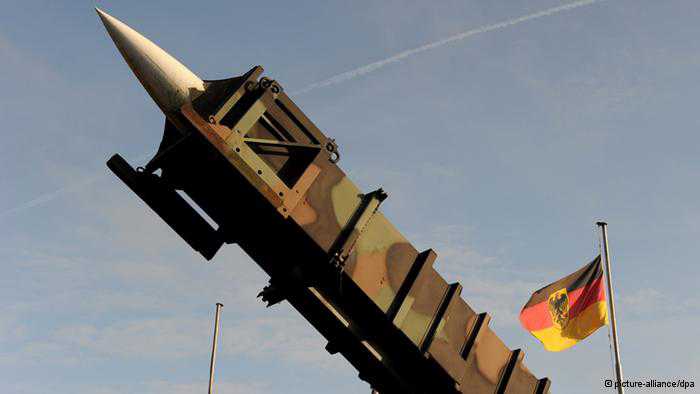
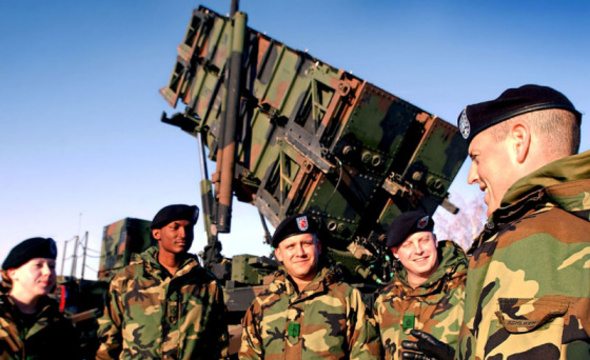
    At the beginning of February 2013, German, Dutch and US patriot missiles are expected to be set up in southeastern Turkey, facing skywards. The sophisticated weapon systems are to deter possible missile attacks by Syria towards NATO ally, Turkey. The Germans are stationed in Kahramanmaras, the Dutch in the Mediterranean city of Adana and US troops in Gaziantep. Major cities like Diyarbakir or Batman lie outside the protection zone. The six patriot missiles will not suffice to effectively protect the 900 kilometer (560 miles) border with Syria.

    German Air Force spokesman Lieutenant Colonel Markus Werther stressed in an interview with DW that the decision regarding the German forces’ location had been made within NATO’s framework. There was close cooperation between all countries involved, he said.

    “Together with our partners, the Netherlands, the USA and Turkey, Germany decided to go to Kahramanmaras,” Werther added. On January 8th, 2013, the German armed forces, the Bundeswehr, began shipping the missiles.

    Turkish soldiers patrol in the Turkish town of Ceylanpinar near the strategic Syrian border town of Ras al-Ain on November 14, 2012. (Photo. BULENT KILIC/AFP/Getty Images) The situation on the Turkish-Syrian border has been tense for months

    Patriot stationing a symbolic act

    The missiles, with a range of 68 kilometers, are only able to protect a few cities in the south of the country. Michael Brtoska, Scientific Director of the Institute for Peace Research and Security Policy at the University of Hamburg, sees the missile defense as a largely symbolic act.

    “The protection the missiles can theoretically offer against attacks from Syria is limited to small areas,” he explained.

    Large population centers do come within the protective zone. But more extensive protection is not possible with existing resources, Brzoska added.

    NATO patriot missiles have been stationed in Turkey before – during the Iraq wars in 1991 and 2003. When five people of Turkish nationality were killed in grenade attacks from the Syrian border in October 2012, Ankara called on NATO for support again. In early December 2012, the alliance gave its green light for the mission. Turkish media reported that Ankara had initially hoped for 18 to 20 systems along its southern border. But that would have meant that a considerable part of all existing patriot entities would have been deployed. Germany, the US and the Netherlands eventually offered to set up two systems each.

    Impossible to monitor no-fly-area

    Apart from threat analyses and logistical factors, the defensive character of the mission was a decisive factor when it came to choosing the location.

    “Most NATO member states were extremely concerned that the patriot missiles could also be used to target planes in the Syrian airspace,” said Brzoska.

    In early December, the German government stressed that the goal of the mission was not to set up or monitor a no-fly area above Syrian territory. NATO, which has the command for the mission, also confirmed the mission’s defensive character. Kahramanmaras and Adana are both 100 kilometers away from the border – too far to reach Syria. Similarly, if a US rocket was to be launched from Gaziantep, it would hardly reach Turkey’s neighbor in the south.

    Under motorcycle escort at the break of dawn Dutch Patriot defence missiles are transported from their base to the Eems harbor in Groningen. (Photo: EPA/Evert-Jan Daniels pixel) Patriot missiles on their way to Turkey in early January

    But the defense missiles can strengthen Turkish air raid defense systems.

    “In the unlikely case of Syria attempting to enter Turkish airspace with planes or even intermediate-range missiles, Turkish air raids alone would hardly be in a position to prevent that from happening,” Brzoska explained.

    Intermediate-range missiles in particular would overwhelm Turkish systems. The Syrian army has both intermediate-range missiles and chemical weapons. Neighboring countries are concerned that the government in Damascus could use these weapons as a last resort if threatened with defeat in the Syrian civil war.

    Ready within seconds after missile attack

    In the worst-case scenario, the patriot missiles could react instantly to approaching missiles, planes or drones. The airspace is monitored around the clock, said Lieutenant Colonel Werther. “In case of attack, which is still highly unlikely, the weapon system would stand ready for action within seconds,” he added.

    Brzoska sees no reason for the government in Damascus to launch attacks on Turkey. Under the conditions of the current mandate, he said, the risk for German soldiers to be involved in combat action is low.

    “Chances are very high that the soldiers are looking at a quiet time there,” Brzoska noted.

    via NATO sets up missile defense shield in Turkey | World | DW.DE | 20.01.2013.

  • Czechs join NATO defense mission in Turkey

    In the next couple of weeks, four Czech soldiers are set to join other troops from Germany, Holland, Slovakia and others in Turkey. The NATO-approved mission aims to help the Turks protect their border with Syria and prevent the civil war in Syria from spilling over.

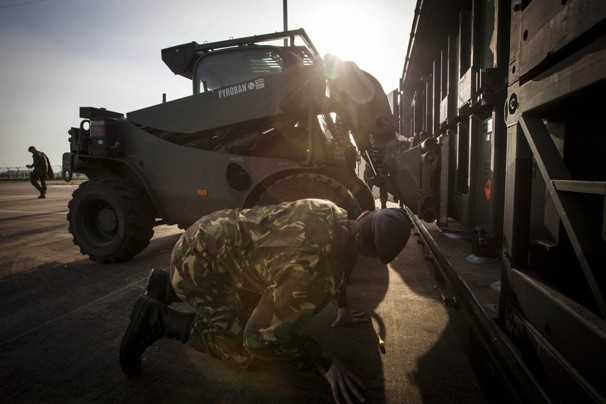
    German Military trucks and other vehicles for the ‘Patriot’ defense missiles are loaded onto the Danish ferry in the harbor of Luebeck, January 8, 2013, photo:

    German Military trucks and other vehicles for the ‘Patriot’ defense missiles are loaded onto the Danish ferry in the harbor of Luebeck, January 8, 2013, photo: CTKGerman Military trucks and other vehicles for the ‘Patriot’ defense missiles are loaded onto the Danish ferry in the harbor of Luebeck, January 8, 2013, photo: CTK In early December, the US Secretary of Defense Leon Panetta announced to the Turkish military that America was ready to help defend its NATO ally. Soon after, the German and Dutch parliaments also approved the deployment of their Patriot PAC-3 missile defense batteries that will protect the southern Turkish-Syrian border. To service the missile defense system and help the Turkish army reinforce their other defense mechanisms, a little over 1,000 NATO troops have also been deployed.

    The Czech soldiers will join their Slovak and Polish colleagues from the 3rd NATO communication battalion by the end of January. German and Dutch troops should already be on the ground in southern Turkey. According to Petr Pavel, the chief-of-staff of the Czech army, the Czech soldiers are going to Turkey in an assistance capacity.

    Czech Prime Minister Petr Nečas, Petr Pavel, photo: CTKCzech Prime Minister Petr Nečas, Petr Pavel, photo: CTK “The Turks have asked for the Patriot missile defense system after a Turkish airplane was shot down in June of last year. Our soldiers will not be directly part of the Patriot system. They will be in supporting positions of its command and operations system.”

    The four soldiers from the Lipník nad Bečvou military base belong to the 102nd communication division and are trained to operate the DCM communication module, which usually serves mobile command posts. Their role in the mission is to set up and oversee the communication system between the commanders of the NATO mission and the units operating the Patriot defense system.

    Binnish, Syria, photo: CTKBinnish, Syria, photo: CTK The Syrian government and media cried foul immediately after NATO agreed to send Patriot missiles and troops to Turkey, claiming that the Northern alliance is actually trying to protect insurgents in the north of the country. But Turkish officials say they are simply trying to prevent any Syrian missiles from penetrating their airspace again. The Patriot missiles, they claim, will be positioned far enough from the border that they would not be able to help anti-government troops in Syria.

    So far, the allied mission in Turkey is set to take place in four three-month rotations of army specialists. NATO is likely to request the Czech Republic to participate in each of them, but as of right now the Czech soldiers are planning to return home in April.

    via Radio Prague – Czechs join NATO defense mission in Turkey.

  • Turkey pushing for NATO attack on Syria

    Justification could put Soros-tied New World Order initiative on the march

    TEL AVIV – Turkey, a member of NATO, is pushing for a larger NATO meeting to decide whether to launch an international military campaign against Syria, according to a senior Syrian official speaking to WND.

    Earlier this month, NATO stepped up its support for Turkey when NATO allies decided to deploy Patriot missiles in Turkey to augment the country’s air defenses against Syria.

    The move followed the reported use by Syria of more advanced missiles to target the so-called rebels fighting the embattled regime of Bashar al-Assad.

    Any NATO deployment would likely come under the banner of Responsibility to Protect.

    Responsibility to Protect, or Responsibility to Act, as cited by President Obama, is a set of principles, now backed by the United Nations, based on the idea that sovereignty is not a privilege but a responsibility that can be revoked if a country is accused of “war crimes,” “genocide,” “crimes against humanity” or “ethnic cleansing.”

    The term “war crimes” has at times been indiscriminately used by various U.N.-backed international bodies, including the International Criminal Court, or ICC, which applied it to Israeli anti-terror operations in the Gaza Strip. There has been fear the ICC could be used to prosecute U.S. troops.

    Billionaire activist George Soros’ Open Society Institute is also one of only three nongovernmental funders of the Global Centre for the Responsibility to Protect, the group that devised the doctrine.

    Obama’s national security adviser, Samantha Power, helped to found Responsibility to Protect, which was also devised by several controversial characters, including Palestinian legislator Hanan Ashrawi, a staunch denier of the Holocaust who long served as the deputy of late Palestinian Liberation Organization leader Yasser Arafat.

    Power, in April, was named the head of the new White House Atrocities Prevention Board.

    The Carr Center for Human Rights Policy, founded by Power, had a seat on the advisory board of the 2001 commission that original founded Responsibility to Protect.

    The commission is called the International Commission on Intervention and State Sovereignty. It invented the term “responsibility to protect” while defining its guidelines.
    The Carr Center is a research center concerned with human rights located at the Kennedy School of Government at Harvard University.

    Power was Carr’s founding executive director and headed the institute at the time it advised in the founding of Responsibility to Protect. With Power’s Carr Center on the advisory board, the International Commission on Intervention and State Sovereignty first defined the Responsibility to Protect doctrine.

    Soros-funded

    The Global Centre for Responsibility to Protect is the world’s leading champion of the military doctrine.

    Soros’ Open Society Institute is a primary funder and key proponent of the Global Centre for Responsibility to Protect. Several of the doctrine’s main founders sit on boards with Soros.

    Activists Ramesh Thakur and Gareth Evans, for example, are the original founders. The two sit on multiple boards with Soros.

    Board members of the Global Centre for the Responsibility to Protect include former U.N. Secretary-General Kofi Annan, former Ireland President Mary Robinson and South African activist Desmond Tutu.

    Robinson and Tutu have made solidarity visits to the Hamas-controlled Gaza Strip as members of a group called The Elders, which includes former President Jimmy Carter.

    Annan once famously stated: “State sovereignty, in its most basic sense, is being redefined – not least by the forces of globalization and international cooperation. States are … instruments at the service of their peoples and not vice versa.”

    Right to ‘penetrate nation-states’ borders’

    Soros himself outlined the fundamentals of Responsibility to Protect in a 2004 Foreign Policy magazine article titled “The People’s Sovereignty: How a New Twist on an Old Idea Can Protect the World’s Most Vulnerable Populations.”

    In the article, Soros asserted, “True sovereignty belongs to the people, who in turn delegate it to their governments.

    “If governments abuse the authority entrusted to them and citizens have no opportunity to correct such abuses, outside interference is justified,” Soros wrote. “By specifying that sovereignty is based on the people, the international community can penetrate nation-states’ borders to protect the rights of citizens.

    “In particular, the principle of the people’s sovereignty can help solve two modern challenges: the obstacles to delivering aid effectively to sovereign states, and the obstacles to global collective action dealing with states experiencing internal conflict.”

    More Soros ties

    “Responsibility” founders Evans and Thakur served as co-chairmen on the advisory board of the International Commission on Intervention and State Sovereignty, which invented the term “responsibility to protect.”

    In his capacity as co-chairman, Evans also played a pivotal role in initiating the fundamental shift from sovereignty as a right to “sovereignty as responsibility.”

    Evans presented Responsibility to Protect at the July 23, 2009, United Nations General Assembly, which was convened to consider the principle.

    Thakur is a fellow at the Centre for International Governance Innovation, which is in partnership with an economic institute founded by Soros.

    Soros is on the executive board of the International Crisis Group, a “crisis management organization” for which Evans serves as president-emeritus.

    New world order

    Doctrine founder Thakur has advocated a “global rebalancing” and “international redistribution” to create a “New World Order.”

    In a piece in March 2011 in the Ottawa Citizen newspaper, “Toward a New World Order,” Thakur wrote, “Westerners must change lifestyles and support international redistribution.”

    He was referring to a United Nations-brokered international climate treaty in which it was argued, “Developing countries must reorient growth in cleaner and greener directions.”

    In the opinion piece, Thakur then discussed recent military engagements and how the financial crisis has impacted the U.S.

    “The West’s bullying approach to developing nations won’t work anymore – global power is shifting to Asia,” he wrote. “A much-needed global moral rebalancing is in train.”

    Thakur continued: “Westerners have lost their previous capacity to set standards and rules of behavior for the world. Unless they recognize this reality, there is little prospect of making significant progress in deadlocked international negotiations.”

    Thakur contended “the demonstration of the limits to U.S. and NATO power in Iraq and Afghanistan has left many less fearful of ‘superior’ Western power.”

    With additional research by Brenda J. Elliott

    Read more at https://www.wnd.com/2012/12/turkey-pushing-for-nato-attack-on-syria/#K9HMX17L1vzCgvjP.99
  • Turkey to allow Israeli participation in non-military NATO activities

    Turkey to allow Israeli participation in non-military NATO activities

    JERUSALEM (JTA) — Turkey has agreed to allow Israel to participate in non-military NATO activities in the coming year.

    The country still objects to Israel taking part in joint military exercises, however, a Turkish official told Reuters Monday.

    Turkey has prevented Israel from participating in such NATO activities since May 31, 2010, when nine Turkish citizens died when Israeli Navy commandos boarded the Mavi Marmara, which was trying to break Israel’s naval blockade of the Gaza Strip.

    Israel is part of the Mediterranean Dialogue, along with six other non-NATO countries, which allows them to participate in summits and training exercises. Any NATO member can prevent another country from participating.

    A Turkish court last month began a trial in absentia of four Israeli military commanders responsible for the raid, including former IDF Chief of Staff Gen. Gabi Ashkenazi. The Israelis could be sentenced in absentia to life in prison.

    Israel’s government-appointed Turkel Commission found in its investigation that the government and the military behaved appropriately, and that the blockade of Gaza was legal. The United Nations’ Palmer Committee also found the blockade to be legal but said Israel used excessive force while boarding the vessel.

    Turkey’s inquiry deemed the Gaza blockade and the Israeli raid to be illegal.

    via Turkey to allow Israeli participation in non-military NATO activities | JTA – Jewish & Israel News.

  • Why Nato is deploying missiles in Turkey

    Why Nato is deploying missiles in Turkey

    Wang Hui,

    China Daily December 9, 2012 1:00 am

    Nato’s decision to accede to Turkey’s request that the alliance deploy Patriot missiles along the Turkish-Syrian border will have profound implications on the security scenario in the Middle East. Since there is no guarantee that Nato’s defensive measure will not be used against others, the move will complicate an already tricky situation and prevent the Syrian crisis from being resolved diplomatically.

    Western countries have thrown their weight behind Syrian rebels, providing them with support during the 21-month Syrian crisis. Nato officials have until now ruled out military intervention in Syria mainly because member states are wary of consequences that would follow. In other words, Nato is not really opposed to a forcible regime change in Syria – like the one it brought about in Libya. It’s just waiting for an opportune moment.

    Under such circumstances, the deployment of Patriot missiles along Turkey’s border could be seen as preparations for military intervention in Syria.

    In his talks with Russian Foreign Minister Sergei Lavrov on Tuesday, Nato secretary-general Anders Fogh Rasmussen tried to reassure Moscow that the Patriot missiles would not be used to impose a no-fly zone in Syria and instead were aimed at defending Turkey.

    History tells us that any show of force in a strategically sensitive place cannot be a sign of goodwill. For one thing, Nato’s military manoeuvrings at the doorsteps of Syria could embolden the Syrian opposition forces to intensify their fight against government forces, which would only cause more bloodshed in the turbulent country.

    Given Nato’s record, its pledges that the missile deployment is defensive in nature sound hollow. In March 2011, Nato usurped a UN resolution that mandated the implementation of a no-fly zone in Libya to launch airstrikes, which led to the fall of Mu’ammar Gadhafi. There is no guarantee that Nato would not use the Patriot missiles’ cover to do the same in Syria.

    Moreover, Nato’s claim that the missiles are intended to defend Turkey against an attack from Syria does not sound convincing at all.

    It’s true that in October, firing from inside the Syrian border triggered an exchange of shelling with Turkey, which is believed to have fuelled Ankara’s fears of the crisis spilling into Turkish land. But Turkey’s military is far superior to Syria’s, and it has the advantage of being home to an American military base. Turkey does not lack the resources to defend its borders.

    So, what is Nato’s true intention then? A look at the timing of the hullabaloo around Syria’s chemical weapons issue may shed some light on the question.

    Interestingly, while Nato was mulling Turkey’s proposal of missile deployment, news of Syria supposedly moving chemical weapons hit the papers. As Western leaders warned Syria of the consequences if it ever used the weapons, Nato accepted Turkey’s demand.

    The fear of chemical weapons, though not for the first time, prompted Nato to play the moral card and agree to deploy the missiles.

    With the chemical weapons issue continuing to brew, Nato could get another excuse to intervene in Syria in more indirect ways.

    But Nato should stop assuming the vanguard’s role in the internal affairs of other countries, because trampling the UN Charter will only aggravate the crisis and plunge the region deeper into instability.

    via Why Nato is deploying missiles in Turkey – The Nation.