Tag: NATO

  • Turkey’s Wrong Turn

    Turkey’s Wrong Turn

    By THE EDITORIAL BOARD
    Goturrr

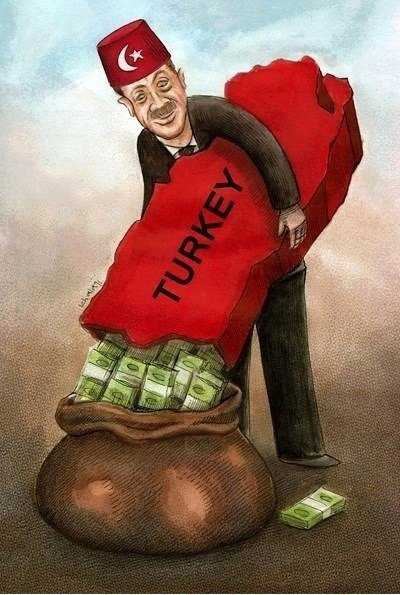
    Turkey’s prime minister, Recep Tayyip Erdogan, was in Brussels last week seeking to repair relations with Europe, but the first place to look for a solution is within himself. Once hailed as the leader of a model Muslim democracy, he has created a political disaster at home, transforming Turkey into an authoritarian state that poses dangers not just for itself but for its allies in NATO, including the United States.

    The latest turmoil has its roots in a political war between Mr. Erdogan’s Justice and Development Party and his former close allies who follow Fethullah Gulen, a moderate Islamic scholar who lives in Pennsylvania. The tensions erupted into the open last month with a corruption probe that led to the resignation of four government ministers and threatened to ensnare Mr. Erdogan’s family. The prime minister called the probe a “coup attempt” and blamed a “secret organization” within the judiciary and police directed by the Gulen movement and serving “foreign powers” like the United States and Israel. The government has since purged hundreds of police officials and prosecutors and sought to assert control over the judiciary. It also drafted legislation expanding the government’s power to appoint judges and prosecutors, further breaching judicial independence, and has prevented journalists from reporting freely. All the while, Mr. Erdogan has spewed endless conspiracy theories and incendiary rhetoric, even hinting at American treachery and suggesting that the American ambassador might be expelled.

    The probe and Mr. Erdogan’s reaction may well be politically motivated. There are important local elections in March. But Mr. Erdogan should be insisting that the probe be fair and transparent, not trying to derail it. His ruthless ways and his attempt to crush dissent are not new, as the crackdown against demonstrators during protests last June showed. Such actions trample on democratic reforms demanded by the European Union as part of Turkey’s bid for union membership, which may be more in peril than ever, and are increasingly at odds with the ground rules for NATO members.

    Germany’s foreign minister, Frank-Walter Steinmeier, was right when he said in Brussels that the Europeans must demand that Turkey return to the rule of law. The Obama administration also needs to send a strong message about the damaging course Mr. Erdogan is pursuing. Whether Turkey nurtures its hard-won democracy, which has contributed to its impressive economic growth, or turns authoritarian is as critical to regional stability and to its NATO allies as it is to Turks.

    A VERSION OF THIS EDITORIAL APPEARS IN PRINT ON JANUARY 28, 2014, IN THE INTERNATIONAL NEW YORK TIMES.
  • AIRSHOW-Turkey’s Chinese missile system won’t work with US, NATO- US official

    AIRSHOW-Turkey’s Chinese missile system won’t work with US, NATO- US official

    BY ANDREA SHALAL-ESA

    DUBAI Thu Nov 21, 2013 7:02am EST

    n_58329_4

    Nov 21 (Reuters) – If Turkey buys a missile defense system from China, it would not be able to integrate it with NATO or U.S. systems and would miss out on decades of training, support and upgrades that come with U.S. systems, a top U.S. official said at the Dubai Airshow.

    Heidi Grant, Air Force deputy undersecretary for international affairs, said Turkey was a sovereign country and had the right to spend its funds on whatever it liked.

    But U.S. officials have explained to Turkey that proceeding with a decision to purchase a system made by a Chinese firm under U.S. sanctions would reduce its ability to coordinate missile defense activities with NATO and the United States.

    “If they select a system that’s not inter-operable, that’s their choice. They’ve chosen not to be inter-operable,” Grant told Reuters in an interview. “Our role is to make sure they’re informed of our recommendation of the best systems to be inter-operable with the U.S.”

    Grant said military officials around the world were clamoring for increased ability to operate in coalitions with the United States and other partners.

    “In the dialogues I have, the partners want to be part of us,” Grant said. “They know that our technology is the most capable technology. They know that we’ll be there for 20-plus years for the sustainment, for the training, for the (concept of operations), and for the upgrades. We’re a trusted partner.”

    General Akin Ozturk, the head of the Turkish air force, on Saturday told an air chiefs conference his country’s decision to buy a $3.4 billion missile defense system from a Chinese company was not final, and could still change.

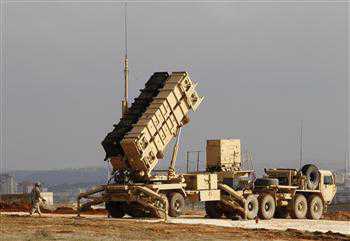
    Turkey announced in September it had chosen the FD-2000 long-range air and missile defense system built by China Precision Machinery Import and Export Corp over rival offers from Franco-Italian Eurosam SAMP/T and Raytheon Co.

    It said China offered the most competitive terms and would allow co-production in Turkey, but the decision caused alarm in NATO countries worried about China’s growing clout. The Chinese firm is also under U.S. sanctions for violating the Iran, North Korea and Syria Nonproliferation Act.

    Reuters reported last week that Raytheon and Lockheed Martin Corp are considering ways to sweeten their offer to build a Patriot missile defense system for Turkey, although no decisions had been made.

    Industry executives familiar with the matter this week told Reuters that U.S. government officials had been very pro-active in terms of trying to understand Turkey’s decision and what changes could be made to the U.S. offering.

    “The question is what does Turkey want, what does Turkey need to change the decision. That’s really the root of the issue and that is being assessed by the U.S. government right now. It’s truly government led,” said one industry executive who was not authorized to speak publicly.

    Industry executives said Raytheon’s Patriot offering was over $1 billion more expensive than the Chinese system chosen by Turkey, but China also offered higher levels of technology transfer and co-production.

    “The gap is uncloseable with a price reduction,” said one of the executives.

    Turkey’s choice of a Chinese system is complicated by the fact that the manufacturer is under U.S. sanctions for shipping equipment to banned countries.

    Turkey has dismissed the notion that any of its defence firms would be blacklisted if they work with CPMIEC.

    Murad Bayar, Turkey’s Undersecretary for Defence Industries, told Reuters at a NATO industry forum last week that Turkish firms had worked with China on past weapons deals and he did not expect them to face sanctions given strict rules aimed at ensuring compliance with NATO regulations.

    “The procedures on clearance are seriously followed by these companies and we don’t see a big risk in this regard,” Bayar said, adding that Turkey “vigorously” applied the rules.

    “The U.S. sanctions on CPMIEC are a result of U.S. legislation and concern the U.S.’s own procurement. This could only involve Turkish companies if there is a violation,” he said. “But … we don’t think such a risk would materialise.”

    via AIRSHOW-Turkey’s Chinese missile system won’t work with US, NATO- US official | Reuters.

  • Regional War Scenario. NATO-US-Turkey War Games Off the Syrian Coastline

    Regional War Scenario. NATO-US-Turkey War Games Off the Syrian Coastline

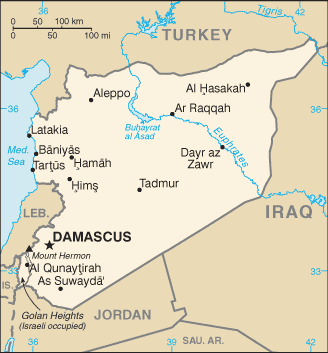
    According to Turkish press reports, Turkey’s High Command will be hosting NATO’S Invitex military exercise in the Eastern Mediterranean in a clear act of provocation directed against Syria.

    The Invitex-Eastern Mediterranean war games are scheduled from November 4 to 14.

    Deafening silence. Not a single Western media has reported on these war games.

    The official release by the TKS High Command suggests a war games scenario involving a regional war, under the assumption that the ongoing US-NATO-Israeli covert war on Syria could lead to military escalation. The countries considered to be a threat to Turkey and NATO are not mentioned.

    According to the press dispatch of the Turkish Armed forces, various types of naval operations are envisaged. While the word “war” is not mentioned, the  stated objective consists in the “handling of a regional crisis”, presumably through military rather than diplomatic means.

    Turkish frigate F-245 TCG Oruç Reis

    The focus is intended “to enhance co-operation and mutual training between participant countries.” Reading between the lines this suggests enhanced military coordination directed against potential enemy countries in the Middle East including Syria and Iran.

    “NATO, the U.S. Navy and the Turkish Navy-Air Force-Coast Guard platforms will participate in the exercise, a statement from Turkish Armed Forces (TSK) said Nov. 4.”(Hurriyet Daily News, Turkey)

    A significant deployment of both naval and air power is envisaged. According to the TKS communique, the participant units are:

    NATO SNMG-2 (three frigates), U.S. Navy (one frigate), Turkish Navy (three frigates, two corvettes, four fast attack boats, three submarines, two oilers, two patrol boats, one landing ship, one tug boat, one maritime patrol aircraft, five helicopters, one amphibious team, one Naval WMD Destroy Team, (Multi National Maritime Security Center of Excellence), Turkish Coast Guard (three Coast Guard Boats) and Turkish Air Force aircrafts. (Ibid)

    Frigates are used for amphibious operations and the landing of ground forces. To be noted, the war games include seven frigates, not to mention one landing ship, and an amphibious team.

    SNMG 2 refers to Standing NATO Maritime Group 2, NATO standing maritime Immediate Reaction Forces. SNMG 2 is “a multinational, integrated maritime force – made up of vessels from various allied nations, training and operating together as a single team”.The NATO member states involved in the war games was not disclosed.

    Of significance, these war games overlap with bilateral military exercises between Turkey and Jordan which include the participation of special forces from both countries.

    De Zeven Provinciën-class frigate (Netherlands) (right)

    These bilateral Turkey-Jordan war games have not been reported upon. They are scheduled to end on November 9. These bilateral military exercises are intent upon enhancing military cooperation between the two countries, both of which are using special forces in the training and hosting of rebel mercenaries.

    The objective of the war games is to threaten Syria.

    The two sets of war games will be coordinated.  What seems to be envisaged, in this regard, is a scenario of invasion of an unnamed enemy country from war ships stationed in the Eastern Mediterranean, supported by air power. This would be carried out in coordination with US-NATO and allied special forces on the ground operating out of Turkey and Jordan in support of Al Qaeda affiliated rebel forces.

    Amply documented,  Turkey and Jordan are supporting the influx of both mercenary and covert special forces including death squads into Syria, respectively on Syria’s Northern and Southern border.

    Is Russia threatened by these war game? Russia is an ally of Syria. It has a naval base in the Eastern Mediterranean operating out of the port of Tartus in Southern Syria.

    In a bitter irony, coinciding with the NATO Invitex military exercises, NATO is conducting large-scale war games in proximity of the Russian border. The Ukraine, which is not a NATO country is participating in these war games directed against Russia.

    “The military exercise, called Steadfast Jazz, will see the Western alliance put 6,000 of its soldiers, mariners and airmen through their paces in Poland and in the Baltic Sea region from 2 to 9 November. … ”

    Meanwhile,  the US threatens China as part of Obama’s Asian pivot: October 25-28, U.S. Navy Carrier Strike Group Five (America’s largest Strike Group) led by the The USS George Washington staged joint military exercises in the South China Sea.

    via Regional War Scenario. NATO-US-Turkey War Games Off the Syrian Coastline | Global Research.

  • Turkey: Spies Like Us

    Turkey: Spies Like Us

    TurkeySpiesLikeUS_CROPPEd

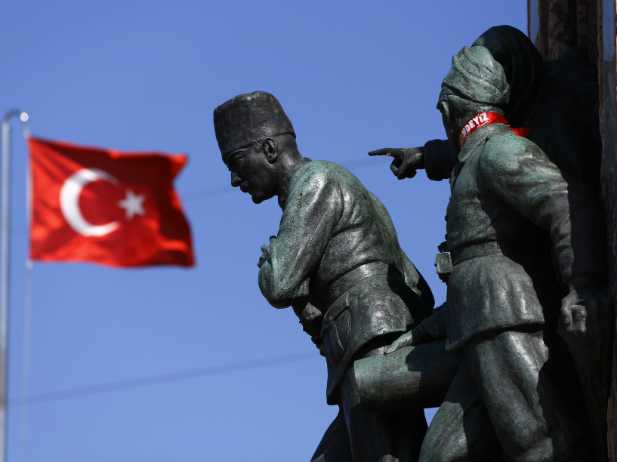
    A Turkish flag flutters near the monument of Mustafa Kemal Ataturk at Taksim Square in Istanbul June 24, 2013 (Marko Djurica/Courtesy Reuters).

    by Steven A. Cook

    I co-authored this piece with my friend and colleague, Michael Koplow, author of the blog Ottomans and Zionists.

    Ehud Barak’s political instincts have never been great, but his security instincts are generally top-notch. So when he warned in 2010 that any intelligence information shared with Turkey might be passed on to Iran, his fears may not have been completely unfounded. David Ignatius reported yesterday that in 2012, Turkey deliberately blew the cover of ten Iranians who were working as Israeli agents and exposed their identities to the Iranian government. Ignatius also wrote that in the wake of the incident, which was obviously a large intelligence setback for efforts to halt Iran’s nuclear program, the United States did not protest directly to Turkey and instead walled off intelligence issues from broader policymaking.

    There are lots of questions that Ignatius’s report raises, and it will take some time to parse them out and figure out the answers. First and foremost is the report completely accurate? This is a very big deal if true, and it casts increasingly cool U.S. behavior toward Turkey over the past year in a more interesting light, yet it also makes it puzzling to figure out how something like this was kept quiet. Likewise, it is tough to see how and why the United States would separate intelligence issues from larger policy issues in the wake of such a huge betrayal of an important U.S. intelligence ally. Especially when such duplicity amounts to a purposeful blow to joint American-Israeli aims to slow down Iran’s nuclear program.

    Next, who are the sources for this story, and why leak the story now? If this new information came from the United States, then it indicates that someone has finally had it with Turkey turning a blind eye to (if not actively enabling) a growing al Qaeda presence in Syria, and anger over Turkey’s deal to buy a missile defense system from a Chinese firm already under sanctions rather than from NATO. The flip side to this is that if it is a U.S. government source fed up with Turkish behavior, it also does not cast the United States in a great light given the lack of an official reaction following Turkey’s exposure of Israeli intelligence assets. If the leak came from the Israeli side, then the timing is strange since there would have been little reason to hold this information until now, as Israeli-Turkish relations were at their absolute low point. The only plausible reason for Israel to leak this now would be if it came from someone who is disenchanted with Bibi Netanyahu’s efforts to patch things up with Turkey, as these allegations are deeply embarrassing in light of the Mavi Marmara apology.

    Questions aside, and assuming that the veracity of the report– and so far no American or Israeli official has publicly denied it – the bigger picture here is not the future of Israel-Turkey ties, but how the United States views Turkey. It is important to remember that from its earliest days the Obama administration sought to rebuild and strengthen ties with Ankara during a particularly difficult period that coincided with the American occupation of Iraq and the return of PKK terrorism. The Turks got a presidential visit and speech to the Grand National Assembly, Obama punted on his promise to recognize the Armenian genocide, and more broadly brought a new energy and urgency to a partnership that American officials hoped would work to achieve common goals in a swath of the globe from the Balkans to Central Asia.

    What started off well-enough quickly ran into trouble. By the spring of 2010, the Turks had negotiated a separate nuclear deal with Iran (and the Brazilians) that the administration claimed it had not authorized and voted against additional UN Security Council sanctions on Tehran.  Then the Mavi Marmara incident happened, further complicating Washington’s relations with both Ankara and Jerusalem.  A “reset” of sorts occurred on the sidelines of the September 2010 G-20 summit in Toronto with a meeting in which President Obama and Prime Minister Erdogan talked tough with each other and cleared the air, setting the stage for what Turkish officials like to describe as a “golden age” in relations.  Even so, despite the apparent mutual respect—even friendship—between President Obama and Prime Minister Erdogan, there was a sense that the Turks did not share interests and goals as much as advertised.  For example, there was Erdogan’s visit to Tehran in June 2010 when he implicitly justified Iran’s nuclear program. There were also difficult negotiations over a NATO early warning radar system on Turkish territory and after Ankara finally agreed, last minute needless wrangling over Israeli access to the data from the system .

    More recently, Turkey has spurned its NATO allies in order to build a missile defense system with China.  Ankara has also been enormously unhelpful on Syria, even working at cross-purposes against current U.S. aims.  The Turks have complicated efforts to solve the political crisis in Egypt by insisting that deposed President Mohammed Morsi be returned to office and thus only further destabilizing Egyptian politics.  In addition, these new revelations (along with ongoing efforts to get around sanctions on Iranian oil and gas) make it clear that Turkey has been actively assisting Iran in flouting American attempts to set back Iran’s nuclear capabilities. The state-owned Halk Bank was, until recently, involved in clearing financial transactions for Iranian counterparts, though Istanbul’s gold traders continue to do a robust business with Iran. And this all comes on top of the general fallout that has ensued as a result of Turkey doing everything in its power to take shots at Israel (which, no matter if some Turkish analysts want to argue that Ankara is more strategically valuable to the U.S. than Jerusalem, is a critical U.S. ally), whether it be absurdly blaming Israel for the coup in Egypt or preventing Israel from participating in NATO forums.

    Considering Turkey’s record, how can the Obama administration continue to tout Turkey as a “model partner” or even treat it as an ally? Not a single one of its goals for Turkey—anchoring Turkey in NATO and the West; advancing U.S. national security goals such as non-proliferation, counter-terrorism, and promoting democracy; and holding Turkey out a “model” of a secular democracy—have been met. Ignatius’s recent revelation, if true, undermine the first two goals. As for the third, Erdogan’s continuing harsh crackdown on protesters resulting from last summer’s Gezi Park demonstrations, pressure on journalists, efforts to intimidate civil society organizations, and other efforts to silence critics makes Turkey a negative example for countries struggling to build more just and open societies. We have crossed the line of reasonable disagreement and arrived at a point where Turkey is very clearly and very actively working to subvert American aims in the Middle East on a host of issues. That Erdogan and/or his intelligence chief, Hakan Fidan, were willing to undermine a broad Western effort to stop Iran’s nuclear development for no other reason than to stick it to Israel should be a wake-up call as to whether the current Turkish government can be trusted as a partner on anything.

  • Turkey Launches Military Drills Along Syria Border

    Turkey Launches Military Drills Along Syria Border

    Suriye sınırında yapılan NATO tatbikatı soru işaretleri doğurdu

    Exercise at NATO Base to Test ‘Readiness for Battle’

    by Jason Ditz

    syria3With tensions soaring in the wake of the weekend Israeli attacks on Syria, the Turkish military has launched a round of military drills at a NATO air base along the Syrian border.

    The 10-day drills will involve military and government ministry coordination in mobilization for a war with Syria. NATO says the mission was planned ahead of time, but was never reported until it began.

    The drill adds to speculation about the possibility of a NATO attack on Syria, though officials downplayed that possibility. The Assad government has not commented on the exercise.

    Indeed, military drills in NATO nations are so common that it is entirely possible that they did just plan a small drill they didn’t figure was worth mentioning and it became a bigger deal because of the tensions with Syria.

    via Turkey Launches Military Drills Along Syria Border — News from Antiwar.com.

  • Lessons in Extended Deterrence: Why the Status of Turkish F-16s Doesn’t Matter | Turkey Wonk: Nuclear and Political Musings in Turkey and Beyond

    Lessons in Extended Deterrence: Why the Status of Turkish F-16s Doesn’t Matter | Turkey Wonk: Nuclear and Political Musings in Turkey and Beyond

    Kuzey Kore gerilimi öncesinde Türkiye’deki nükleer silahlar ve F16’ların durumu

    Lessons in Extended Deterrence: Why the Status of Turkish F-16s Doesn’t Matter

    Posted on April 3, 2013 by aaronstein1

    DF-ST-87-12392

    In response to North Korea’s bellicose threats, the United States has been parading a bevy of nuclear dual capable aircraft near the Korean peninsula. Both the B-52 and the B-2 have a nuclear role and would, in the event of a nuclear conflict, likely use air launched nuclear cruise missiles against targets in North Korea. The F-22, which is on “static display” in South Korea, would, according to the aviationist, “probably escort the big bombers during the opening stages of an eventual campaign (after the rain of cruise missiles that would wipe out most of North Korea’s air defenses…), their role could not be limited to providing air superiority (to be easily and quickly achieved considered the status of the geriatric North Korean Air Force and its obsolete Migs): as demonstrated in last year’s Exercise Chimichanga,the F-22 has the ability to play a dual role in the same mission: HVAAE (High Value Air Asset Escort) and air-to-surface.”

    While the actual threat of conflict on the Korean peninsula is low, the American show of force sheds lights on the lengths Washington will go to demonstrate its commitment to use nuclear weapons in defense of an ally covered by its nuclear umbrella. Washington’s actions, as has been noted by many others, is a show force meant to demonstrate its commitment to extended deterrence. In other words, Washington is signaling its readiness to push the button. (It is also trying to deter an ROK nuclear weapons program, but I am not really going to talk about that – I will leave that for better informed Korean experts.)

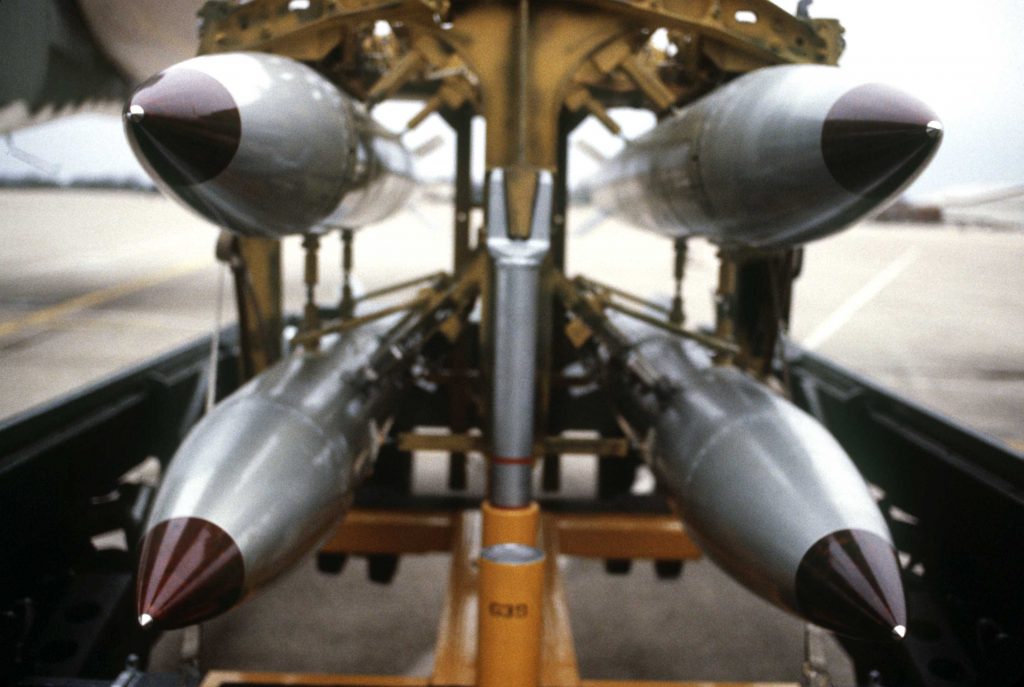
    Anyways, the signaling is important for the Turkish leadership in Ankara. Turkey, as regular readers of the blog are well aware, is home to ~65 American nuclear weapons. [From an EDAM issue brief I wrote about Turkey and Tactical Nuclear Weapons] According to Robert Norris and Hans Kristensen, 50 bombs are slated for delivery by U.S. aircraft, but do to basing restrictions American dual capable aircraft (DCA) are not stationed permanently in Turkey. If the order were given for the release of NATO nuclear weapons, American aircraft would first have to be flown to Incirlik from another European base and armed before finally flying on to their targets. The other bombs are reserved for delivery by Turkish dual capable F-16s. However, there are conflicting reports about the status of Turkey’s nuclear fighter-bombers. According to General Ergin Celasin (ret.), the former Commander of the Turkish Air Force, “The Turkish air force’s role in NATO’s nuclear contingency plans came to an end with the withdrawal of nuclear weapons in the 1990s from the Air Force units that were deployed in several air bases in Turkey.”

    However, Norris and Kristensen cite Pentagon sources who say that Turkey’s current fleet of nuclear capable F-16s are receiving a “stop gap” modification to carry the B-61-12. Reports indicate that Turkey’s nuclear capable combat aircraft no longer train for nuclear missions. In the past, the air force’s dual capable aircraft trained for nuclear missions and were certified to carry out nuclear strikes. Turkish aircraft reportedly now only train as non-nuclear escort aircraft for NATO’s nuclear fighter wings. However, NATO has made clear that it does not foresee any scenario that would require the rapid use of nuclear weapons, which raises a number of unanswered questions about Turkey’s current nuclear posture. In any future scenario that might call for the use of nuclear weapons, the return of American DCAs and the re-certification of Turkish DCAs would likely be an important signal to a potential adversary.* [snip]

    In any case, the Alliance, should the need arise, has ample time to move American aircraft into Turkey. The move, perhaps combined with a very public crash course for Turkish pilots to drop the Bomb, would be a very powerful signal to a potential adversary. Or, in other words, extended deterrence.

    Hence, I do not see a real difference in Turkey’s post-Cold War thinking about nuclear weapons, even though the threat of a nuclear attack has diminished tremendously since the collapse of the Soviet Union. In short, Turkey continues to value nuclear weapons because of the widespread belief that they are necessary to deter regional foes like Iran and Syria. (It is also worth nothing, that both of these countries are not covered by a US negative security assurance.)

    Moreover, I suspect that there is a small group in the Turkish Armed Forces that are looking at the American show of force in Korea with satisfaction. Ankara, for a number of very good reasons, is perpetually wary of the American security commitment. Turkey, therefore, sees the forward deployment of nuclear weapons as an important symbol of Alliance solidarity and as a symbol of the US commitment to come to Turkish defense. This belief, however, is predicated on the notion that the bombs will actually be used (debatable actually), should the need arise.

    The American show of force, therefore, should not solely be interpreted in Turkey as the US commitment to ROK security. In fact, the American moves are also aimed at the leadership in Ankara. And I can guarantee that they are paying attention.

    via Lessons in Extended Deterrence: Why the Status of Turkish F-16s Doesn’t Matter | Turkey Wonk: Nuclear and Political Musings in Turkey and Beyond.