Tag: NATO

  • NATO will defend Turkey in conflict with Syria, says chief

    NATO will defend Turkey in conflict with Syria, says chief

    Syrian jets and helicopters attacked a rebel-held town just feet from the Turkish border, sending scores of civilians fleeing into Turkey. NBCNews.com’s Dara Brown reports.

    By NBC News staff and wire services

    NATO will defend alliance member Turkey, which struck back after mortar rounds fired from Syria landed inside its border, the alliance’s Secretary General Anders Fogh Rasmussen said at a meeting in Prague on Monday.

    “NATO as an organization will do what it takes to protect and defend Turkey, our ally. We have all plans in place to make sure that we can protect and defend Turkey and hopefully that way also deter so that attacks on Turkey will not take place,” he said.

    Rasmussen also welcomed a weekend agreement by Syrian opposition groups to put aside differences and form a new coalition.

    In the 20 months since the revolt against President Bashar Assad began, one by one the sleepy Turkish towns and villages along the 550-mile frontier have watched helplessly as the Syrian war edges closer.

    Visit NBCNews.com for breaking news, world news, and news about the economy

    Israel fires into Syria for second day, scores ‘direct hits’

    The proximity is no more obvious than in Ceylanpinar, where what was a single town under the Ottoman empire was split after World War I, with part remaining in the new Turkish republic and part coming under French rule in what would become Syria.

    Ras al-Ain, as the town on the Syrian side of the frontier is known, was overrun on Thursday by anti-Assad rebels advancing into Syria’s northeast, home to many ethnic Kurds. Fighting has sent thousands of refugees fleeing for safety in Turkey.

    No sooner had the rebels raised their flag over Ras al-Ain after a fierce battle, however, than Syrian government tanks and artillery began firing back into the town in what has become an all-too-familiar pattern of the civil war.

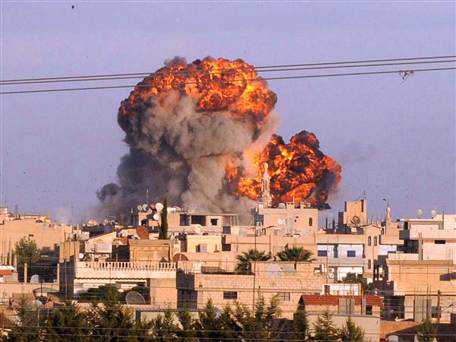
    Assad’s forces unleashed their air power on Monday. A warplane screeched along the frontier and bombs fell close to the border fence, sending scores more Syrians scrambling over into Turkey. Helicopters strafed targets for a second day.

    Turkey does not want to become embroiled in a regional war, but risks being drawn in by domestic pressures. As frustration grows among leaders in Ankara at world powers’ failure to stop the bloodshed, so too are Turkey’s citizens becoming impatient with their own government’s inability to keep them safe.

    Walls ‘riddled with bullet holes’
    Flat-roofed Syrian and Turkish houses abut the barbed-wire fence that divides the two modern towns, whose combined population is 80,000 and between which Arabs and Kurds have long maintained family and social bonds.

    Though crossing the frontier has often been limited by official restrictions, friends and relatives exchange greetings through the wire as though chatting over a backyard fence.

    Loitering near the wire is now a risky pastime, however. Kayakiran’s uncle, Mehmet Ali, recalled how close the war came when, after rebels took Ras al-Ain last week, he stepped outside his home in Ceylanpinar to phone a friend over the border.

    PhotoBlog: Syrians flee into Turkey after Syrian jet bombs border town

    “I wanted to see if he was alive,” he said.

    “I was just putting the phone to my ear when the bullet hit right here,” he said, pointing to a street sign nailed to the wall of his house.

    The stray bullet, fired from across the fence, left a small dent in the metal panel inches from where his head had been.

    “That’s nothing,” said a neighbor joining the conversation. “My wall is riddled with bullet holes.”

    Others have been less fortunate; two people in Ceylanpinar were wounded last week by stray bullets fired from Syria, including a teenage boy who was shot in the chest.

    Advertise | AdChoices

    Around 60 miles west along the border, in the Turkish town of Akcakale, five civilians were killed last month when a mortar fired from Syria struck their home.

    It was the most serious cross-border incident since the fighting began, spurring Turkish calls for more robust action from world powers, including the possible deployment by NATO of Patriot surface-to-air missiles on the Turkey-Syria border.

    Turkey says it has fired back in retaliation, but its calls for a buffer zone to be set up inside Syria have so far failed to gain traction among reluctant Western powers.

    As in Akcakale, many of those in Ceylanpinar living near the fence have abandoned their homes for the time being. The neighborhood resembles a ghost town, where Turkish soldiers in trenches train their guns on Syria.

    Turkish police trucks armed with water cannons, typically used in the past to suppress the restive ethnic Kurdish population of southeastern Turkey, including Ceylanpinar, now patrol the Syrian border.

    Police warn children not to play near the fence. Schools have been closed since last week, and over loudspeakers on Monday authorities urged people to stay indoors.

    “We’ve locked our doors and left,” said Huseyin Albayrak, a neighbor living a few doors down from Kayakiran. “I’ve sent my wife and kids to my father further inside the town.

    “Turkey needs to do something to protect its people.”

    NATO solidarity
    According to Al Jazeera, Rasmussen told reporters in Prague on Monday that NATO will stand by Turkey and consider requests for a possible deployment of anti-aircraft missiles.

    “Turkey can rely on NATO solidarity, we have more plans in place to defend and protect Turkey, our ally, if needed,” Rasmussen said, according to Al Jazeera.

    The NATO secretary-general added that the military alliance had not received a request from Turkey to deploy U.S.-made Patriot anti-aircraft missiles.

    “But obviously if such a request is to be forwarded, the NATO council will have to consider it,” Rasmussen added, according to Al Jazeera.
  • Turkey May Abandon Controversial Air Defense Program

    Turkey May Abandon Controversial Air Defense Program

    Turkey’s protracted shopping for a long-range air defense system has been a sort of geopolitical bellwether for the country: in addition to considering systems from NATO allies U.S. and Italy, Ankara has been looking at Russian and Chinese options. If it goes for the latter, NATO has reportedly promised to cut Turkey out of its air defense monitoring system. But now it looks like Turkey may be abandoning the purchase altogether, reports Defense News:

    Turkey’s highest defense body might decide to indefinitely postpone the country’s $4 billion air defense program, effectively killing it, sources and observers said.

    In addition to analysts’ criticism that the long-range air and missile defense system is too expensive, other recent developments have raised questions about the project.

    This month, for example, MBDA of Italy, one arm of bidder Eurosam, arranged a tour for several Turkish journalists to observe firing tests at two Italian land and naval installations. Turkish defense authorities at the last minute declined to permit reporters to visit the Italian sites, and MBDA had to cancel the tour.

    This led to speculation that the program was going to be canceled or indefinitely postponed.

    (Not really germane to the main point, but it’s remarkable that the Turkish government could forbid reporters from visiting Italy to see an Italian company exhibition.)

    The problem is that Turkey may not need such a system:

    Most analysts say that the system’s $4 billion cost is almost prohibitive; that it would be useless against the separatist Kurdistan Workers Party, which fights only with light weapons; and that it would take too long to complete to be of use against Syria.

    It’s not clear why those factors may have come to light only now, after years of considering this, and it could be just a feint in what seems to be an elaborate bargaining process. The next meeting of the Defense Industry Executive Committee next meets in December or January, Defense News reports, and could either pick a winner then or defer the program.

    via Turkey May Abandon Controversial Air Defense Program | EurasiaNet.org.

  • “There Have Been Times When We’ve Sent Teams To Turkey”

    “There Have Been Times When We’ve Sent Teams To Turkey”

    U.S. Chairman of The Joint Chiefs of Staff said Turkey and US having intelligence sharing for last five years.

    Martin Dempsey, U.S. Chairman of the Joint Chiefs of Staff, said that there had been times when U.S. sent teams over to do some planning with Turkey; notably on humanitarian zones, ballistic missile defense and also some of Turkey’s counter terror concerns related to an unstable northeastern Syria and the PKK.

    In a press conference, Dempsey said, “Admiral Winnefeld, my vice chairman, just returned back from Turkey and had conversations with his counterpart about those things. We’ve been having an intelligence sharing regime with Turkey for about the last five years, and one of the things we’re looking to do now is learn lessons from the last five years, recognize a different situation on Turkey’s southeastern border and see if there’s other things we could do to assist them, as well as to reduce the threat of ballistic missile attack inside Turkey. So it’s a work in progress, and we go and come as we need to have those consultations.”

    Turkey is not only a close bilateral partner, they’re part of our NATO alliance, we offer them to share our expertise and also to learn from their experiences, and sometimes they take our offer and sometimes they don’t, he said.

    AA

  • TURKISH DECEIT: Recep Tayyip Erdoğan’s Allah’s Boys

    TURKISH DECEIT: Recep Tayyip Erdoğan’s Allah’s Boys

    In a classic provocation reminiscent of the Gulf of Tonkin fairy tale that “legitimized” the Vietnam War, and Hitler’s bogus rationale for invading Poland, the Turkish war criminal gang “led from behind” by Barack Obama and Hillary Clinton are trying to do the impossible. Impossible, if one has half a brain. They are trying to convince the world that Syria, besieged for over a year by its once friendly neighbor, Turkey, its cities ravaged by terrorists based and financed in Turkey, wants to provoke an even wider, bloodier conflict.

    A miniscule border village, Akcakale, was hit by a solitary shell of undisclosed origin. It defies logic that it came from the Syrian army. The Syrian army has no control over Syrian borders thanks to the relentless subversive efforts of the Turkish government. Its army is certainly not so incompetent as to try to defend an indefensible border when the real battle is in its interior cities. So dispense with the idea that there are such things as borders between Syria and Turkey. They have been effaced by Turkish subversion. The gates are wide open. Syria has no control. And the non-Syrian “Free Syrian Army” is a rabble under arms, undisciplined and unscrupulous.

    It is widely known that Erdoğan’s motley gang, with headquarters in Adana, Ankara, and Istanbul, has been raining havoc via over-the border raids from the Hatay province in southeastern Turkey. (See my writing of 29 June entitled America’s War-Horse Harlots for the grim, deceitful details.) Surprised by the horrific violence inflicted by the Orwellian “Free Syrian Army” in Aleppo and Damascus? Don’t be. Convoys of Turkish trucks have been supplying the explosive ingredients for car bombs over the Turkish border for months. Syria has been long under a medieval siege, courtesy of its treacherous neighbor.

    Is it logical that Syria would lob a single shell into a Turkish village to prompt a massive response from NATO, the bloody-handed “savior” of Libya? Hardly. Besides, the Turkish prime minister has been lusting for NATO support. And the Turkish army is itching to prove its manhood after being purged of its command and general staff by the Turkish prime minister, Turkey’s new sultan. It’s a perfect storm for a catastrophe by incompetents. The Turkish media is the functional equivalent of Pravda during the Stalin era. And the Turkish people are either under deep anesthesia or, sadly, suffering from a fatal indifference. In short, Turkey is the perfect puppet for doing America’s bidding, that is, to be “led from behind.” And America is the perfect coward to do its deceitful bloody work while hiding under the capacious skirts of Turkey’s Allah’s Boys.

    The “Free Syrian Army” gangsters have been lusting for heavier weapons, a no-fly zone, and stinger missiles. So why would Syria provoke a wider war? Answer… it wouldn’t. Only if you believe in the tooth fairy, Santa Claus, and Colin Powell’s infamous UN presentation would you echo the craven chorus now being orchestrated by the likes of Recep Tayyip Erdoğan, Hillary Clinton, and the American stooges in the apparent form of the UN and NATO. Listen to Erdoğan shout that Syria has “breached Turkey’s borders” and one wants to laugh out loud (or vomit) at the hypocrisy. Only if you are congenitally stupid would you believe the hypocritical bilge being spewed by these ever-outraged killers from the west and their henchmen. What is infinitely more logical is that the shell was fired by the criminal elements in the employ of Turkey and America. They are the ones with the clearest of motives. And by doing so, they got what they wanted all along, NATO and UN legitimacy for their rape of Syria. But regardless of who fired the shell that hit the house in Akcakale, Turkey and its patron, America, by their actions, have fomented all the violence in Syria. Turkey has funded, plotted and armed a phony civil war in direct contravention of international law. (See my Letter to The Honorable Abdullah Gül, president of Turkey dated 9 Sept. 2012.) The onus for the death, chaos and destruction is theirs. So why should Turkey and the Turkish people be exempt from suffering the consequences of their misdeeds?

    So when you hear the orchestrated script of outrage over the errant or not-so-errant shell, when you hear the barrage of adjectives like “atrocious” (Erdoğan), “depraved” (the Pentagon), “flagrant” (NATO), and the ever popular “outraged” (Clinton) remember the following. This hype is an old, dirty trick. The truth lies in using our brains to examine what is logical and what is not. The truth lies in clear reasoning, devoid of influence from the spewers of propaganda and outright falsehoods. And remember this. The likes of Recep Tayyip Erdoğan has yet to explain the killing of scores of his own people by his own military because of false intelligence rendered by his friends in the Pentagon and the CIA. Moreover, he has yet to explain the downing of the Turkish reconnaissance jet that so obviously violated Syrian airspace. This latter event has given Turkey the rationale for the recent blather from the Turkish foreign minister about “rules of engagement” as if Turkey has followed any rules in its extended attempt to overthrow the duly constituted government of Syria. This arrogant, criminal activity by America and Turkey is what is truly ATROCIOUS, DEPRAVED, FLAGRANT, and OUTRAGEOUS.

    James (Cem) Ryan, Ph.D.
    Founder, West Point Graduates Against The War

    Istanbul
    4 October 2012

  • Turkish NATO peacekeepers to stay in Afghanistan another year | Reuters

    Turkish NATO peacekeepers to stay in Afghanistan another year | Reuters

    (Reuters) – Turkish peacekeepers will remain in Afghanistan’s capital Kabul until at least November 2013 after the military agreed to extend its mandate as part of a NATO force by a year, the Turkish military said on Thursday.

    Turkish soldiers took over the Kabul regional command as part of NATO’s International Security Assistance Force (ISAF) in November 2009. The military said in a statement that mission had been extended for a year from November 1, 2012.

    The war in Afghanistan, which has failed to defeat the Taliban after more than a decade of fighting, has strained budgets and lost public support in Western nations.

    NATO has said it plans to shift full responsibility for security across the country to Afghan forces by the middle of next year and then withdraw most of the alliance’s 130,000 combat troops by the end of 2014.

    U.S. President Barack Obama has championed a gradual exit of the allied force which does not leave Afghans feeling abandoned, but France has vowed to pull its troops out by the end of the year, two years ahead of the alliance’s timetable.

    (Reporting by Seltem Iyigun; Writing by Nick Tattersall; Editing by Sophie Hares)

    via Turkish NATO peacekeepers to stay in Afghanistan another year | Reuters.

  • Will NATO and Turkey become Actively Involved in Syria War?

    Source: Rick Rozoff and John Robles

    As the Syrian crisis escalates, Turkey, Syria and Poland are all under NATO’s constraint these days. Was a bilateral arrangement of Poland with the US a mistake? Should Poland develop its own missiles interception system integrated into or with NATO?

    Interview with Mr. Rick Rozoff, manager of Stop NATO website .

    Can you give our listeners an update on what’s going on with NATO?

    NATO’s been keeping a very low profile for several weeks. Their website, for example, has not updated for at least three weeks, perhaps a month. I’m not sure what to attribute that to. It may be a conscious decision to keep a low profile as the Syrian crisis escalates. So that should they become involved – a likely scenario, of course, is in alleged defense of Turkey – if border skirmishes develop that they will not have tipped their hand or signaled what they want to do…In terms of a new commander at NATO’s Norfolk command, which is called Allied Command Transformation, it was the first major NATO headquarters – and the only one to date – in the United States…

    You talked about defending Turkey. Now Turkey recently made some statements regarding the fact that they’re against a military intervention in Syria.

    I believe Turkish officials said that to Russian officials. And I would imagine that’s what Ankara thinks Moscow wants to hear. We should recall that last week Turkey moved 25 tanks as well as missile batteries and armored personnel carriers along with troops to within two kilometers of the Syrian border, allegedly engaging in a military exercise aimed at the Kurdistan Workers’ Party, but in fact claiming that a political party on the other side of the border, in Syria, is linked with the Kurdistan Workers’ Party and intimating if not stating quite openly that Turkey reserves the right to intervene militarily against supporters of the PKK, the Kurdistan Workers’ Party, inside Syria.

    So a scenario could come into existence whereby Turkey stages a provocation. You probably saw today’s news, John, that Turkey is claiming they’ve killed something like 117 Kurdistan Workers Party fighters in southeastern Turkey near the Iraqi border. So things are heating up there. And if it’s the intent, not only of Turkey, but if it’s the intent of the West as a whole to stage a direct military intervention into Syria, then the most likely pretext for doing so would be a clash between Turkish and Syrian forces near the border, on either side of the border, and then Turkey once again returning to NATO and asking for assistance from its fellow NATO members.

    Do you have any information on what’s going on in Aleppo? Several high officials, I believe, were captured when the Syrian Army took Aleppo back under its control.

    An English-language Iranian website mentioned that a Turkish general had been captured by Syrian forces in Aleppo. And I personally spoke with a Syrian émigré whose brother is in pretty influential circles in Damascus and he mentioned that six or seven foreign officers were captured in Aleppo within the last 24-48 hours. And he mentioned them being not only Turkish, but Arabic-speaking, presumably Saudi, Qatari or other Persian Gulf Arab States. This shouldn’t surprise us that, trying to throw together an organized insurgency, funded certainly and based abroad, would also entail having probably special operations officers, maybe of fairly high rank, from Turkey and from Arab Gulf states involved in the fighting in Aleppo and earlier in Damascus.

    You’re saying six or seven generals were captured in Aleppo.

    The term that was used in my conversation was generals, but I think we’re probably safe in assuming they were officers of some ranking, perhaps not generals.

    They were commanding officers, but were they from different countries?

    That’s correct.

    Have you heard anything about training camps that have been set up on borders of Syria?

    That’s an established fact. That Saudi Arabia supplied the funding for a training camp for fighters. Roughly, I believe, 40 kilometers from the Syrian border, if I’m not mistaken, inside Turkey. But this has been going on for quite a while. As long ago as, say, last November or October as I recollect even the Daily Telegraph in Britain was quoting an official of so-called Free Syrian Army stating there were 15,000 fighters – he didn’t specify their nationality, incidentally – but 15,000 fighters inside Turkey receiving material support and training. That’s probably a hyperbolical figure. He was probably exaggerating for propaganda purposes. But it’s an indication this has been going on for some time. The Saudis funding the creation of a special training camp inside Turkey that close to the Syrian border is an escalation of the conflict.

    Can you tell us about the problems that NATO has had supplying the troops in Afghanistan?

    For five days now what was to be the resumption of NATO supplies from Pakistan into Afghanistan has been held up, supposedly because of security concerns, as I understand it, but as recently as yesterday two NATO vehicles were torched in the Pakistani province of Balochistan. So what we’re seeing, in fact, is a resumption of attempted supplying of NATO forces in Afghanistan and we’re seeing exactly the same situation that obtained at the time they were occurring before the attack on the Pakistani border outpost in Salala last November that killed 25 Pakistani troops. What we’re seeing is that NATO supply vehicles are being attacked and set afire.

    What can you say about Polish President’s announcement a couple of days ago? He said that it had been a mistake to agree with NATO on building ABM infrastructure in Poland.

    That is a fascinating question. I’ve been trying to make sense of that since the story broke. I’m not quite sure if he was alluding to the earlier George W. Bush administration plan to put Ground-based Midcourse, longer-range, interceptor missiles or if it’s an allusion to what’s called the European Phased Adaptive Approach of the Obama administration, which is planning to put 24 Standard Missile-3, advanced Standard Missile-3, interceptors in Poland by 2018. It’s unclear whether he’s talking about the Bush program that’s already been superseded or the Obama program that’s still in the works. But in any event, the paraphrase of his comments that I’ve read suggested that a bilateral arrangement with the United States was a mistake and that Poland should develop its own missile interception system and integrate it into or with NATO.

    He was repeatedly asked who they would be defending themselves against. He refused to answer the question.

    Of course he refused to answer because the answer is not one that the United States wants him to provide. That country is Russia. The argument that the original Ground-based Midcourse interceptors were meant to hit Iranian missiles…one has to in one’s imagination conjure up a map of the world and try to imagine, first of all, how Iran would have the capability of launching basically intercontinental ballistic missiles over Poland, presumably over the Arctic Circle to hit the United States. That’s an impossibility, fallacious from the very beginning.