Tag: NATO

  • NATO Visits Southeast Turkey for Patriot Missiles

    NATO Visits Southeast Turkey for Patriot Missiles

    By By SUZAN FRASER Associated Press

    ANKARA, Turkey November 28, 2012 (AP)

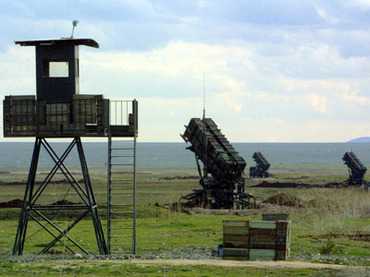
    A NATO team assessing possible sites for Patriot missiles to protect Turkey’s border with Syria inspected military installations Wednesday in southeast Turkey, the state-run news agency reported.

    NATO member Turkey asked allies to deploy the missiles as a defense against any aerial attack from Syria after mortar rounds and shells from Syria struck Turkish territory, killing five people.

    Syria is believed to have several hundred ballistic surface-to-surface missiles capable of carrying chemical warheads.

    The NATO team visited military facilities in Malatya province, some 200 kilometers (124 miles) from the Syrian border, the Anadolu Agency reported. The province is already home to an early warning radar that is part of NATO’s missile defense system, which is capable of countering ballistic missile threats from Iran.

    The visit came as the alliance said it would “favorably examine” Turkey’s request for the air defense missiles but was awaiting the team’s report on where to base them.

    NATO spokeswoman Carmen Romero said the NATO team was expected to finish its work in the next few days and would feed its proposals to NATO’s military authorities.

    AP

    In this photo released by the Syrian official… View Full Caption

    “This recommendation is a key element in the Council’s decision-making process,” she said, in reference to the North Atlantic Council, the alliance’s governing body that is made up of the ambassadors of all its 28 members.

    Romero said “allies with available Patriots have also made clear their intention to augment Turkey’s defenses, subject to national processes.”

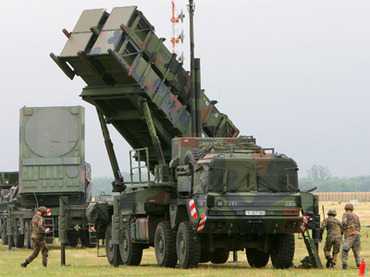
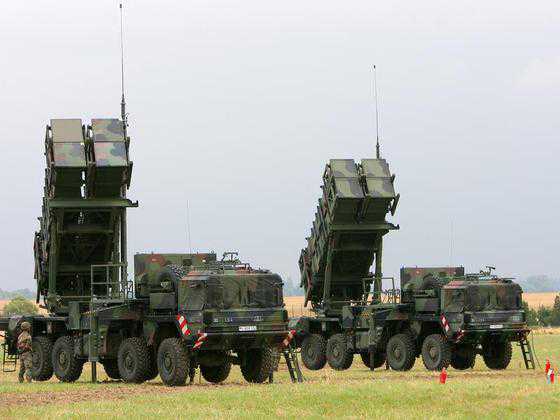
    Germany, the Netherlands and the U.S. have the advanced PAC-3 model Patriots that Turkey wants to intercept ballistic missiles.

    Once NATO and the national parliaments in Germany and the Netherlands approve the deployment of the Patriots, it will probably take at least another month before they become operational. Due to the complexity and size of the Patriot batteries — including their radars, command-and-control centers, communications and support facilities — they cannot be flown quickly by air to Turkey and will probably have to travel by sea, officials said.

    The deployment of the Patriots is also likely to be discussed at a meeting of NATO foreign ministers in Brussels next Tuesday and Wednesday.

    Russia, meanwhile, has come out against the Patriot missile deployment, saying that basing the missiles so close to the border could worsen the bloodshed in Syria.

    Syria is reported to have an array of artillery rockets, as well as short- and medium-range missiles — including Soviet-built SS-21 Scarabs and Scud-B missiles — in its arsenal. The latter are capable of carrying chemical warheads.

    Syria’s conflict started 20 months ago as an uprising against President Bashar Assad, whose family has ruled the country for four decades. It quickly morphed into a civil war, with rebels taking up arms to fight back against a bloody crackdown by the government. According to activists, at least 40,000 people have been killed in Syria since March 2011.

    ———

    Associated Press writer Slobodan Lekic in Brussels contributed.

    via NATO Visits Southeast Turkey for Patriot Missiles – ABC News.
  • Iran opposes NATO’s missile deployment in Turkey

    • Turkey Wednesday asked NATO to deploy the missile on its border with Syria.

    • Pressure exerted on Syrian government is central concerns of Iranian officials.

    • Deployment of NATO’s Patriot missiles on the border is a source of “tension.”

    TEHRAN, Nov. 26 (Xinhua) — Iranian authorities have strongly opposed Turkey’s move to deploy NATO’s Patriot missiles in its bordering region with Syria.

    The pressure exerted on the Syrian government, a main ally of Iran in the region, is the central concerns of the Iranian officials.

    Turkey on Wednesday formally asked NATO to deploy the missile on its border with Syria.

    An Iranian lawmaker said Monday that Iran’s Majlis (parliament) National Security and Foreign Policy Commission will have a meeting next week to discuss NATO’s probable missile deployment in Turkey, the official IRNA news agency reported.

    Deployment of NATO’s Patriot missiles on Turkey-Syria’s border is a source of “tension” and can “escalate regional conflicts,” Mohammad-Hassan Asfari, deputy chairman of the Majlis commission, was quoted as saying.

    Such measures by neighboring countries will lead to militarization of the region and may have adverse effect on its stability and peace, he said, adding that the Islamic republic is against any moves which could escalate regional tensions.

    On Saturday, Iran’s Majlis (parliament) Speaker Ali Larijani met with the Turkish officials in Ankara and voiced Iran’s opposition to the missile deployment.

    The Iranian speaker’s visit followed a meeting in Tehran which aimed at strengthening Iran’s agenda to support Syrian President Bashar al-Assad’s political reforms and to counter the pushes to oust him from the power.

    Upon his return to Tehran, Larijani said that the deployment of NATO missiles in Turkey will further put the regional stability at risk, Press TV reported on Sunday.

    “In meetings with Turkey’s top officials, we warned that the deployment of such systems will have adverse consequences and will exacerbate problems in the region,” he was quoted as saying.

    Also, Iranian Foreign Ministry spokesman Ramin Mehmanparast said Friday that deployment of NATO’s Patriot missiles near the Syrian border in Turkey will only aggravate the crisis in Syria.

    Mehmanparast denounced any move for militarizing the Syrian issue and stressed that it will be better for influential countries to look for political solutions for regional issues.

    In a reaction to Iran’s position, Turkish Foreign Minister Ahmet Davutoglu on Sunday dismissed Iranian concerns that the possible deployment of NATO missiles along Turkey’s southern border with Syria would make the crisis more complicated.

    “We cannot see any point that would justify these concerns. The missile system has a defensive purpose only. This system will not be operational unless there is a risk to our security. And it is our government’s obligation to take any measure when there is even the slightest chance of risk,” Davutoglu told a televised interview on private news channel CNN Turk.

    In the meantime, a Turkish military statement said Monday that the deployment of NATO’s Patriot missile system on the Turkish border with Syria is merely a defensive measure against threats from Syria.

    The system was not for “no-fly zone or offensive operation,” but “solely against possible air or missile threats from Syria,” said the statement.

    via Iran opposes NATO’s missile deployment in Turkey – Xinhua | English.news.cn.

  • Turkey request for missiles “new act of provocation”

    Turkey request for missiles “new act of provocation”

    DAMASCUS: Syria said on Friday plans by Turkey to site Patriot missiles along its border was “a new act of provocation,” while allies Iran and Russia warned the move would complicate the situation and could spark a regional conflagration.

    NATO chief Anders Fogh Rasmussen reacted by reassuring Moscow that any such deployment would be a “defensive only” measure.

    Turkey turned to its NATO partners earlier this week to request the deployment of the surface-to-air Patriot missiles to protect its troubled border with Syria, which is engulfed in a war that has cost some 40,000 lives.

    Syria’s foreign ministry accused Ankara of causing “tension and destruction,” with state television quoted an official as calling it “a new act of provocation.”

    “Syria holds (Turkish Prime Minister Recep Tayyip) Erdogan responsible for the militarisation of the situation at the border between Syria and Turkey, and the increase of tension,” the unidentified official said.

    Syria has long accused Turkey of harbouring, financing and arming rebels fighting to topple President Bashar al-Assad.

    In Moscow, Russian Foreign Minister Sergei Lavrov warned that any deployment of Patriots by Turkey may create a temptation to use the weapons and spark a “very serious armed conflict” involving NATO.

    “I understand that no one has any intention to see NATO get sucked into the Syrian crisis,” Lavrov said. But “the more arms are being accumulated, the greater the risk that they will be used.”

    NATO spokesman Carmen Romero later said Rasmussen had told Lavrov by telephone that such a deployment “would in no way support a no-fly zone or any offensive operations.”

    “Such a deployment would augment Turkey’s air defence capabilities to defend the population and territory of Turkey,” Rasmussen told Lavrov.

    But Iran’s foreign ministry accused Turkey of aggravating the situation.

    “Not only does it not help resolve the situation in Syria but it will also aggravate and complicate the situation,” spokesman Ramin Mehmanparast said, quoted on state television.

    “The insistence (of certain countries) to resolve the Syrian crisis through military means is the main cause of tensions and threats in the region,” he said.

    Iran parliament speaker in Damascus

    Meanwhile, Iran’s influential parliament speaker Ali Larijani was in Damascus at the start of a three-nation tour billed at trying to find a solution to the conflict roiling Syria.

    Larijani accused regional powers he did not name of causing “problems” in Syria, in an allusion to the principal champions of arming the rebels fighting to overthrow Assad’s regime — Qatar and Saudi Arabia.

    “Syria has played an important role in supporting the resistance (against Israel and the United States) but some in the region want to carry out actions with negative consequences, to cause problems in Syria,” he told journalists.

    On his second stop in Beirut later on Friday, Larijani reiterated Iran’s opposition to the arming of rebels and foreign military intervention.

    “Some are sending arms to bring democracy to Syria. I believe you cannot set up democracy with RPGs,” he told reporters on the eve of a visit to Turkey. Iran “supports a political dialogue for a political solution.”

    On the ground, violence erupted in flashpoints across the country, while tensions spiked in the northeast near Turkey, where Kurdish militia are engaged in a standoff with rebels.

    Following several days of combat against a rebel advance into Kurdish areas, two main Kurdish groups have agreed to join forces, an activist said.

    Hundreds of fighters loyal to the Kurdish Democratic Union Party (PYD) — which has close ties to Turkey’s rebel Kurdistan Workers’ Party (PKK) — have been locked in fierce battles with fighters of the jihadist Al-Nusra Front and allied Ghuraba al-Sham group in Ras al-Ain on the border with Turkey.

    The activist said agreement had now been reached in Iraq “to create a united military force, bringing together PYD forces and other Kurdish dissidents” in Syria.

    The agreement sets the stage for an expanded conflict in the area between Islamist rebels opposed to Assad and Syrian Kurdish forces.

    At least 46 people were killed in violence across the country on Friday, including 18 rebels, 15 civilians and 13 soldiers, said the Syrian Observatory for Human Rights.

    -AFP/ac

    via Turkey request for missiles “new act of provocation”: Syria – Channel NewsAsia.

  • Russia Opposes NATO Missiles on Turkey-Syria Border

    Russia Opposes NATO Missiles on Turkey-Syria Border

    VOA News

    Russia has warned against NATO’s possible deployment of Patriot missiles near Turkey’s border with Syria.

    Patriot anti-missile batteries installed at the Diyarbakir military airport in southeastern Turkey (AFP Photo / Mehdi Fedouach)
    Patriot anti-missile batteries installed at the Diyarbakir military airport in southeastern Turkey (AFP Photo / Mehdi Fedouach)

    Foreign Ministry spokesman Alexander Lukashevich said Thursday that Turkey’s request for deployment to the Western military alliance “would not foster stability in the region.”

    NATO ambassadors met Wednesday to consider Turkey’s request, which followed weeks of talks between Ankara and NATO allies about how to shore up security on its 900 kilometer border to avoid a spillover from the Syrian civil war.

    The alliance’s secretary-general, Anders Fogh Rasmussen, said the deployment would augment alliance member Turkey’s air defense capabilities and “would contribute to the de-escalation of the crisis along NATO’s southeastern border.”

    Turkey said Tuesday it had found allies who agreed to supply it with an advanced Patriot missile system. Only the United States, the Netherlands and Germany have the appropriate system available. German Foreign Minister Guido Westerwelle said he had told his country’s ambassador to NATO to approve Turkey’s request.

    Turkey’s border villages have been hit by artillery fire from Syria as forces loyal to Damascus battle rebels seeking to oust President Bashar al-Assad’s government.

    Rasmussen has said that any missile deployment would be a defensive measure to counter mortar rounds, and not to enforce a no-fly zone over Syria. Syrian rebels have called for a no-fly zone as they are almost defenseless against Syria’s air force.

    via Russia Opposes NATO Missiles on Turkey-Syria Border.

  • NATO confirms receiving Turkey’s Patriot missile request

    NATO confirms receiving Turkey’s Patriot missile request

    The Air Defence Missile Squadron 2 with a Patriot missile launcher during an exercise at training site Warbelow near Gnoien, northern Germany. (AFP Photo / Bernd Wustneck)

    NATO has confirmed that it received a request from Ankara to deploy Patriot missiles on Turkish territory. The coalition said it would process the appeal soon.

    “I have received Turkey’s request for NATO to deploy Patriot missiles. Allies will discuss this without delay,”

    NATO Secretary-General Anders Fogh Rasmussen said via his Twitter account.

    “The situation along the Syrian-Turkish border is of great concern,” Rasmussen said earlier at a meeting with the European Union’s foreign and defense ministers. “We have all plans in place to defend and protect Turkey if needed.”

    The confirmation comes two weeks after Turkish Foreign Minister Ahmet Davutoglu announced that he had requested that NATO install the surface-to-air missiles near the Turkish border with Syria. Prime Minster Recip Tayyip Erdogan later denied that Turkey had made such a request.

    Davutoglu said that the missiles were needed to bolster defenses on its border with Syria. The surface-to-air missiles will be able to shoot down aircraft up to 160 kilometers away.

    The Patriot is a long-range, all-weather and all-altitude defense system capable of countering tactical ballistic missiles, cruise missiles and advanced aircraft.

    Within NATO only the United States, the Netherlands and Germany have Patriot missile systems available.

    Reports say Germany has already spoken in favor of the request. German Foreign Minister Guido Westerwelle told the Bundestag, the lower house of parliament, that he ordered the German Ambassador to Turkey “to positively receive such a request.”

    “It would be a serious mistake if we were to refuse defensive support to a NATO member country in a moment when this member country feels that it is exposed to attacks from outside,” he said.

    NATO installed Patriot systems by Turkish request two times, during the first and second Iraq wars in 1991 and 2003. The systems, however, went unused and were removed from the country shortly after the wars. In both cases the deployment was carried out by the Netherlands.

    via NATO confirms receiving Turkey’s Patriot missile request — RT.

  • Netherlands, Germany may send missiles to Turkey

    Netherlands, Germany may send missiles to Turkey

    (Reuters) – The Netherlands and Germany may send Patriot missiles to NATO ally Turkey to help defend the country’s border with Syria, Dutch news agency ANP reported on Sunday, citing the Dutch defense minister.

    Turkey has said it has intensified talks with NATO allies on how to shore up security on its 900-km (560-mile) frontier with Syria after mortar rounds fired from Syria landed inside its territory.

    “NATO does not exist for nothing,” ANP quoted Dutch Defense Minister Jeanine Hennis-Plasschaert as saying.

    A Dutch Defense Ministry spokesman said: “There is no request but the Netherlands and Germany are the only countries in Europe with Patriots.”

    The Dutch minister spoke to her German counterpart last week about a possible deployment, ANP said.

    A spokesman for Germany’s Defense Ministry said on Saturday NATO would consider any request from Turkey and confirmed that the United States, the Netherlands and Germany were the countries that had the appropriate Patriot missiles available.

    Turkey will formally ask NATO on Monday to set up missiles on its border with Syria due to growing concern about spillover from the civil war in its neighbor, Germany’s Sueddeutsche Zeitung newspaper reported on Saturday.

    NATO has said it will do what it takes to protect and defend Turkey. Turkey has said it is talking to its NATO allies about a possible deployment of Patriot surface-to-air missiles.

    NATO ambassadors would have to consider any request from Turkey and they have a regular weekly meeting on Wednesday but they could call a special one at any time. European Union defense and foreign ministers will be in Brussels on Monday for meetings.

    (Reporting by Gilbert Kreijger; Editing by Stephen Powell)

    via Netherlands, Germany may send missiles to Turkey: report | Reuters.