New York Turkish Consul General Ahmet Yazal / Silence about terrorist origination Fethullah Gulen foot Soldiers in New York
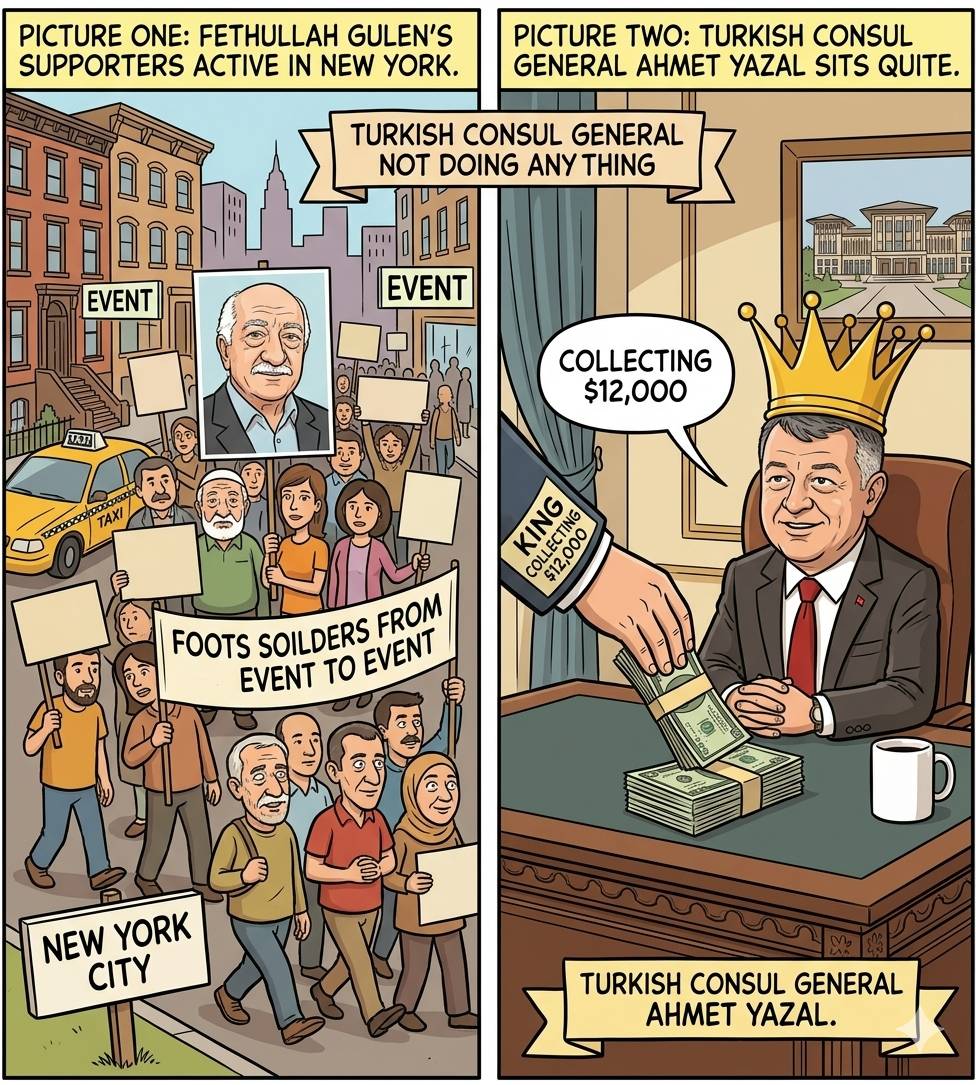
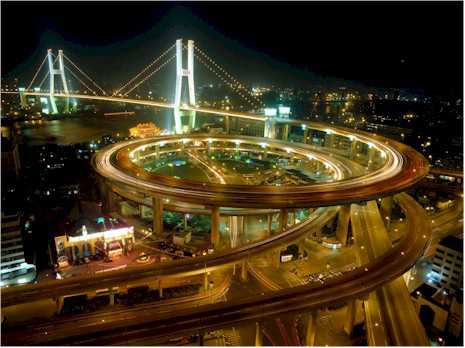
Since the appointment of Consul General Ahmet Yazal, there has been little visible public response or outreach regarding activities in New York involving individuals believed to be linked to the terrorist origination Fethullah Gulen and their engagement with various NGOs. This silence is raising questions as many in community are wondering whether enough attention is being given to the issue in New York by Consul General Ahmet Yazal about the terrorist origination , and whether Turkish interests are being actively represented and protected, especially considering the responsibility to the Turkish public. Yazal is just collecting his $12,000 salary and waiting for his retirement and walking his two dogs. (picture attached)
The political transformation observed in Turkey since the early 2000s encompasses structural ruptures too comprehensive to be understood solely through the limited lens of traditional political science concepts. Internal factors such as electoral dynamics, party competition, or societal demands alone remain insufficient to explain this transformation. Phenomena including the redefinition of state-society relations, the dissolution of bureaucratic tutelage, and the acceleration of economic integration processes necessitate examination within a broader international context.
At this juncture, Recep Tayyip Erdoğan’s political rise transcends being a phenomenon limited to individual leadership qualities. This ascent has developed in tandem with a period of international system restructuring and has established organic ties with this system. Therefore, the resulting political structure is not merely a product of national dynamics but also a concrete manifestation of global power relations at the local level.
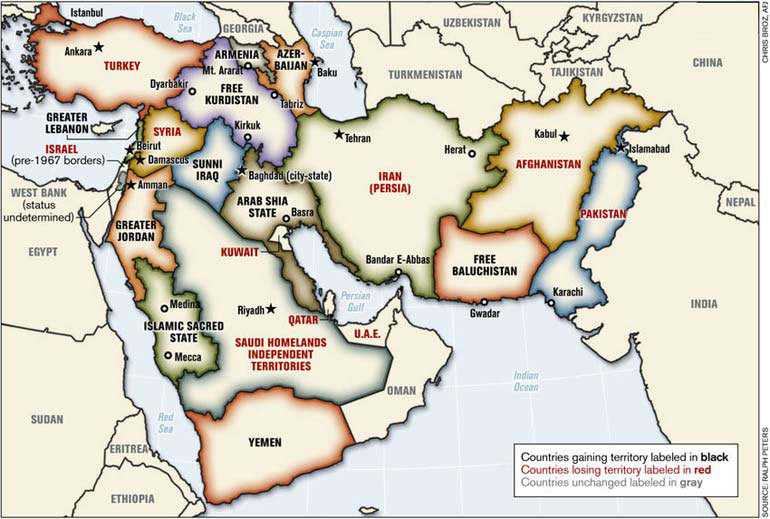
When examining the formation processes of political power, the question of how global projects are implemented through local actors carries decisive importance. In this context, the “Greater Middle East Project” (GMEP) framework offers a critical analytical tool for understanding the transformation in Turkey. Particularly, Erdoğan’s discourse of “co-presidency” indicates that this relationship is a constitutive element rather than mere cooperation. Since political actors’ language often reveals their positions and functions within the system, these expressions should be read not as rhetorical choices but as expressions of structural belonging.
Geopolitical Framework and Global Strategic Design
The GMEP, shaped under the leadership of the United States, is a comprehensive strategic initiative aimed at restructuring global power balances at the beginning of the 21st century. This initiative is based on a multi-layered strategy targeting the transformation of political, economic, and social structures in the Middle East and North Africa. While classical power politics elements such as control over energy resources and geostrategic regions lie at the foundation of the strategy, rather than direct military intervention, processes of political transformation, institutional reforms, and ideological reproduction have been employed to achieve these objectives.
This situation demonstrates that modern forms of hegemony have become increasingly indirect and multi-dimensional. Within this framework, the GMEP is not merely a foreign policy instrument but also a form of structural intervention aimed at ensuring the continuity of the global capitalist system. Local actors involved in the project become not just passive implementers but active elements transforming the system. Turkey’s role within this framework is shaped not only by its geographical location but also through the relations its political power establishes with the global system. In this way, Turkey transcends being a passive regional object and rises to the position of an active subject in regional transformation processes.
Construction of Political Power and Structural Adjustment
The transformation of the power structure in Turkey cannot be explained solely by election results. This process encompasses changes in the institutional structure of the state, the reorientation of economic policies, and the radical reorganization of the social sphere. Recep Tayyip Erdoğan’s leadership has played a decisive role in this process. However, this role stands out not within the framework of charismatic leadership in the classical sense, but rather as the carrier of structural adjustment mechanisms.
In the construction of political power, relations established with international actors have become a determining factor. Strategic collaborations developed particularly with the United States and Israel have directly influenced Turkey’s foreign policy orientations. These relations have not been limited to the diplomatic level but have also deepened in the areas of security, economy, and ideology. The political structure emerging in this context has taken shape at the intersection of local and global dynamics. While producing internal legitimacy on one hand, this structure follows a path compatible with the international system on the other. This dual-directional functioning is one of the fundamental mechanisms ensuring the sustainability of power. Therefore, the current political power should be evaluated not as an independent formation but as a structure integrated with the global system.
Discourse, Identity, and Ontological Bond
The discourse of “co-presidency” serves beyond being a mere expression in terms of political analysis, functioning as a tool for identity construction. This discourse reveals how the political actor positions himself and within which structural context he operates. These expressions belonging to Recep Tayyip Erdoğan should be treated not as a temporary political preference but as an indicator of a deeper structural relationship. For this relationship has become an integral part of the actor’s political identity over time.
The concept of “ontological bond” offers an important theoretical tool for explaining this situation. According to this concept, the relationship between the political actor and the structure in which he exists is not superficial but possesses a constitutive quality. Therefore, eliminating this relationship necessitates not merely a political change but also an identity-based transformation. Within this framework, Erdoğan’s relationship with the GMEP should be evaluated not as a conjunctural cooperation but as structural integration. This integration manifests itself across a wide spectrum from political discourse to policy production. The continuity of this relationship should be explained not only by external factors but also by internal dynamics.
Conclusion
A sound analysis of the political structure in Turkey requires a multi-layered and interdisciplinary approach. This approach must consider internal dynamics together with global power relations. Otherwise, analyses will remain incomplete and reductionist. In this context, Recep Tayyip Erdoğan’s political role should be evaluated not only at the national level but also through his position within the global system.
The GMEP framework offers a strong theoretical ground for analyzing the last twenty years of transformation in Turkey. However, it is also clear that this framework alone is insufficient and must be considered together with other factors. The structural nature of political power necessitates moving beyond individual leadership debates. Leadership should be evaluated through its function within the system. In conclusion, the current political structure in Turkey is a complex formation shaped at the intersection of global and local dynamics. To understand this formation, analyses that are critical, multi-dimensional, and centered on dependency relations are needed.
Bibliography
· Laclau, E., & Mouffe, C. (1985). Hegemony and Socialist Strategy: Towards a Radical Democratic Politics. Verso. (Turkish translation: İletişim Yayınları, 2015) · Harvey, D. (2005). The New Imperialism. Oxford University Press. (Turkish translation: Sel Yayıncılık, 2005) · Keyman, E. F., & Öniş, Z. (2007). Turkish Politics in a Changing World: Global Dynamics and Domestic Transformations. İstanbul Bilgi University Press. · Jessop, B. (2008). State Theory: Reassembling the Capitalist State. Palgrave Macmillan. (Turkish translation: Epos Yayınları, 2008) · Yılmaz, S. (2008). The Greater Middle East Project: Strategic Vision or New Colonialism? IQ Kültür Sanat Yayıncılık. · Fairclough, N. (2010). Discourse and Social Change: Critical Discourse Analysis. Polity Press. (Turkish translation: Bilim ve Sanat Yayınları, 2015) · Oğuzlu, T. (2015). Turkey’s Foreign Policy Axis Shift: Neo-Ottomanism or Break from the West? International Relations Journal, 12(46), 39-58. · Tuğal, C. (2016). Passive Revolution: The Rise of Islamic Neoliberalism. Cambridge University Press. (Turkish translation: Koç University Press, 2016) · Bacevich, A. J. (2016). America’s War for the Greater Middle East: A Military History. Random House. · Akça, İ., Balta, E., & Altan, B. (Eds.) (2018). Authoritarianism and Foreign Policy in Turkey. İletişim Yayınları. · Ünal, M. (2018). The Geopolitics of Turkish-American Relations: From the Cold War to the Present. Bilgesam Publication.
Sefa Yürükel
Danish ethnographer and social anthropologist (MA) Aarhus University, 1997 Independent Researcher Fields of Research: International Politics, Public International Law, Geopolitics, Sociology, Psychology, Cultural Studies, Systems and Structures
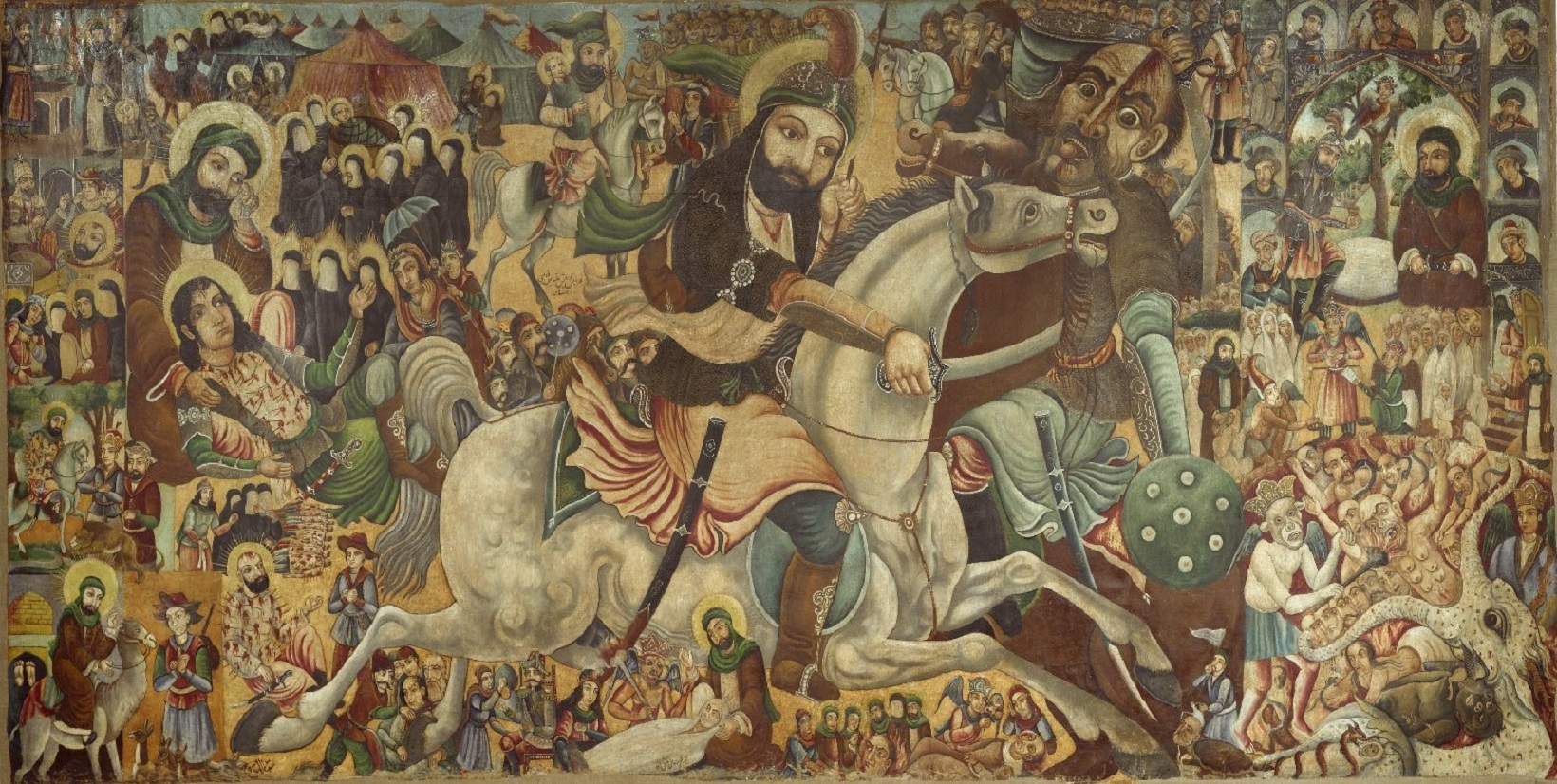
Throughout the flow of history, the alliances, hostilities, and loyalties we have grown accustomed to seem to have collapsed in recent days. In a region once referred to as the “heart of the Muslim world,” the expected outcry against Israel’s attacks on the peoples of Palestine, Lebanon, Yemen, Syria, and Iran, the anticipated cries of “God is the Greatest” did not rise from where it was expected. The real surprise came from an unexpected figure: Pope Leo XIV, the spiritual leader of the Christian world. This situation is not merely a matter of political analysis; it is the resurfacing of the spiritual echo of Karbala—one of the deepest wounds in Islamic history in an entirely different form.
The Anatomy of Silence – The “Muslim” Gulf and the Israel Axis
The wealthy monarchies of the Persian Gulf have, in recent years, acted with a pragmatism stripped of ideology. This new process, embodied in the Abraham Accords, has led them to view Israel no longer as an enemy, but as a strategic ally against a shared threat (Iran). These states are aware that without Israel’s technology, intelligence, and lobbying power in Washington, they cannot secure their palatial regimes and dynastic interests. • Economic and military reality: The normalization steps taken by the United Arab Emirates and Saudi Arabia with Israel have overshadowed the Palestinian cause. Even in the face of what is described as genocide in Gaza, official responses from these countries have not gone beyond diplomatic courtesy. • Hostility toward Iran (anti-Shiism): Iran’s revolutionary rhetoric and regional influence lie at the center of the Gulf monarchies’ perception of existential threat. This perception pushes them to ignore the shared tragedy experienced by the peoples of Palestine, Lebanon, Syria, Yemen, and Iran.
At this point, no clear “no” is heard from these countries against the Trump administration’s “maximum pressure” policy toward Iran or a possible military intervention. This silence reflects not merely the collapse of classical Islamic solidarity, but the dominance of regime survival and interests.
The Pope’s Unusual Stance : A Christian Hand Reaching Toward Karbala
Pope Leo XIV’s stance resonates as a powerful call for justice amid this modern hypocrisy. By declaring, “I am not afraid of you!” and challenging the global hegemony of the United States and Israel, what is he truly doing? His position reflects the Christian tradition of standing with the weak, the oppressed, and the marginalized. He places not only Iran and Lebanon but also the long-oppressed Palestinian people at the center of this defense.
There is also an internal Islamic dimension that makes the Pope’s stance even more striking: consciously or not, he evokes the spirit of Karbala. In the year 61 AH (680 CE), Imam Hussein, left thirsty and alone against Yazid’s forces, became the symbol of standing upright against tyranny. Today, the suffering of the peoples of Palestine, Iran, and Lebanon is, according to some interpretations, seen as a form of uprising “for the sake of God.”
This means: • standing against injustice, • defending justice, • refusing to submit to oppression, • upholding truth despite its cost.
The Pope’s alignment with these peoples recalls narratives of a Christian monk offering a drop of water to Hussein in the desert of Karbala.
Yazidism and the Army of Hussein: A Contemporary Reading
Here, “Yazidism” represents not a historical figure, but a mindset: one that instrumentalizes religion for power, ignores the suffering of the oppressed, and collaborates with oppression for self-interest. • Today’s Yazids: Those who remain silent about or legitimize, the suffering of the peoples of Palestine, Lebanon, and Iran in order to preserve their palaces, petrodollar revenues, and political power are associated with this mindset. • Today’s Hussein (in spirit): The peoples struggling to survive under war and oppression are seen by many as symbols of resilience and patience.
The Meaning of the Pope Standing “With Hussein”
When the Pope, as one of the world’s most influential religious figures, stands with the oppressed, this is interpreted by some as a powerful critique of the silence within the Muslim world.
According to these interpretations, the resulting picture raises serious questions about moral courage. Regardless of sect Sunni or Shia the inability or unwillingness of powerful actors to speak out due to strategic interests leads to a profound crisis of conscience.
Conclusion and Call: The Importance of Moral Stance
What we are witnessing today points to a world shaped not by religions, but by interests, fears, and power dynamics. Alliances in the Middle East have shifted, giving way to pragmatic relationships.
In this context, Pope Leo XIV’s words: “I am not afraid of you!” carry strong symbolic meaning. They can be read not only as a political statement, but as a call for moral integrity.
Ultimately, one principle remains unchanged: To stand with the oppressed and against the oppressor.
Today, this principle may be voiced by unexpected actors. Yet this reality calls for deep self-reflection and moral reckoning across all societies.
Note: This article has been written to interpret current geopolitical developments through a religious and historical lens. Its aim is not provocation, but to invite reflection and conscience.
Sefa Yürükel
Danish ethnographer and social anthropologist (MA) Aarhus University, 1997 Independent Researcher Fields of Research: International Politics, Public International Law, Geopolitics, Sociology, Psychology, Cultural Studies, Systems and Structures
China’s economic transformation over the past forty years has drawn attention not only for its high growth rates but also for a structure that challenges the boundaries of existing economic theories. This transformation has generated new areas of debate, particularly within the literature of development economics and comparative political economy.
Classical modernization theories associate economic development with market liberalization and the spread of liberal democratic institutions. However, the Chinese case demonstrates that this linear relationship is not necessarily obligatory. This calls for a reassessment of existing theoretical frameworks.
The concept of “state capitalism,” often used to explain China’s economic structure, can be illuminating in many respects but may also be reductive. By positioning China as merely a variant of the existing capitalist system, this concept risks downplaying its unique institutional dynamics.
In this context, the fundamental question is not which category China belongs to, but rather through which mechanisms this system operates. This perspective prioritizes analytical inquiry over normative classification.
Thus, the Chinese experience functions as a laboratory that necessitates rethinking the concepts of state, market, and capitalism.
Comparative Analysis of the Concept of the State
In Western political thought, the state is defined within a Weberian framework as a monopoly on the legitimate use of violence and a rational-bureaucratic organization. In this model, the state is treated as a structure relatively autonomous from society and institutionally distinct.
This approach has produced an administrative framework compatible with modern capitalist economies. The rule of law, institutional predictability, and bureaucratic specialization are its core elements.
In China, however, the concept of the state rests on a more holistic historical foundation. The Confucian tradition views political authority as a continuation of moral order and does not sharply separate state and society.
The concept of “Guojia” reflects this holistic understanding. The state is positioned not merely as a governing apparatus but also as the carrier of social order.
Therefore, interpreting the Chinese state solely through a Weberian model is insufficient; institutional structure, historical continuity, and ideological frameworks must be evaluated together.
The Distinction Between Market and Capitalism
Although the market mechanism and the capitalist system are often used interchangeably, these two concepts are structurally distinct. The market is a mechanism that regulates exchange relations and historically predates capitalism.
Capitalism, on the other hand, is a broader system organized around private ownership of the means of production, profit maximization, and capital accumulation. In this system, the market is not merely a distribution mechanism but the central determinant of production relations.
In the Chinese case, while market mechanisms clearly exist, they are constrained and guided by the strong coordinating capacity of the state. Therefore, the presence of markets alone is insufficient to classify the system as capitalist.
The financial system, largely operating through state-owned banks, shapes capital allocation via non-market instruments. This creates a significant divergence from classical financial capitalism.
Thus, in China, the market is not the center of the system but rather a tool structured by the state.
Historical Evolution of the Chinese Model
The Chinese economy during the Mao era was built on a structure based on central planning and state ownership. Economic activities were largely conducted under state control.
However, this model produced significant limitations, particularly in agricultural productivity and industrial output. Rigidity in resource allocation deepened economic imbalances.
The reform process initiated by Deng Xiaoping transformed this structure by integrating market mechanisms into the system. However, this integration did not imply the complete removal of state control.
The concept of a “socialist market economy” was developed to describe this hybrid structure. This model represents the simultaneous use of planning and market mechanisms.
Over time, China has created a unique development path by increasing market openness while maintaining state control in strategic sectors.
Institutional Structure and the Party-State System
To understand the functioning of China’s economic system, the central role of the Chinese Communist Party must be taken into account. The Party is not only the holder of political power but also the main actor in economic coordination.
The relationship between the state and the Party, unlike in classical liberal models, is deeply intertwined. The Party possesses strategic steering capacity over state institutions.
This structure enables the effective implementation of long-term economic planning. Major infrastructure investments and industrial policies, in particular, are carried out rapidly through centralized coordination.
While state ownership continues in strategic sectors, the private sector is encouraged within defined limits. This creates a controlled market environment.
In conclusion, in China, the state functions not outside the market but as its guide and architect.
Comparison with the Soviet Union
The fundamental difference between the Soviet Union and China lies in the management of their reform processes. Both countries attempted transitions from planned economies to more market-based systems.
In the Soviet Union, the reform process progressed alongside political disintegration, leading to a weakening of state capacity. This negatively affected the sustainability of economic transformation.
In China, reforms were implemented gradually and in a controlled manner. Economic liberalization was carried out step by step while preserving the political structure.
This approach maintained institutional stability and made the transformation process more manageable.
Thus, the success of the Chinese model is related not only to the content of reforms but also to their timing and institutional framework.
Theoretical Debates and the Position of the Model
There are various theoretical approaches in the literature on the Chinese economy. This diversity makes it difficult to place the model within a single category.
The state capitalism approach views China as a variant within the market economy characterized by strong state intervention. In this perspective, the market mechanism is considered the dominant element.
The socialist approach emphasizes the determining role of state ownership and planning, reducing the market to an instrumental function.
The hybrid model approach evaluates China as an intermediate form between two systems. This perspective is particularly common in the comparative capitalism literature.
These differences indicate that China possesses a structure that transcends existing theoretical categories.
Conclusion
China’s economic model has a multilayered structure that goes beyond classical economic and political categorizations, making it difficult to define with a single label.
The strong and guiding role of the state constitutes the system’s core characteristic. However, this does not mean that market mechanisms are entirely excluded.
Market elements exist within the system as instruments strategically employed by the state. This complicates conventional definitions of capitalism.
The Chinese case demonstrates that economic systems cannot be fully explained through fixed and universal categories. Instead, historical and institutional contexts must be taken into account.
In conclusion, China stands as one of the most important contemporary examples showing that the relationship between state and market can be redefined.
References
Arrighi, Giovanni. Adam Smith in Beijing: Lineages of the Twenty-First Century. London: Verso, 2007.
Bremmer, Ian. The End of the Free Market: Who Wins the War Between States and Corporations? New York: Portfolio, 2010.
Deng, Xiaoping. Selected Works of Deng Xiaoping. Beijing: Foreign Languages Press, various volumes.
Huang, Yasheng. Capitalism with Chinese Characteristics: Entrepreneurship and the State. Cambridge: Cambridge University Press, 2008.
Milanović, Branko. Capitalism, Alone: The Future of the System That Rules the World. Cambridge, MA: Harvard University Press, 2019.
Naughton, Barry. The Chinese Economy: Transitions and Growth. Cambridge, MA: MIT Press, 2007.
North, Douglass C. Institutions, Institutional Change and Economic Performance. Cambridge: Cambridge University Press, 1990.
Polanyi, Karl. The Great Transformation: The Political and Economic Origins of Our Time. Boston: Beacon Press, 1944.
Weber, Max. Economy and Society. Berkeley: University of California Press, 1978.
Zhang, Weiwei. The China Wave: Rise of a Civilizational State. Hackensack: World Scientific, 2012.
Naughton, Barry. “The Chinese Economy: Adaptation and Growth.” (various articles and edited volumes).
Oi, Jean C. “The Role of the Local State in China’s Transitional Economy.” China Quarterly, 1992.
Walder, Andrew G. “Local Governments as Industrial Firms.” American Journal of Sociology, 1995.
Danish ethnographer and social anthropologist (MA) Aarhus University, 1997 Independent Researcher Fields of Research: International Politics, Public International Law, Geopolitics, Sociology, Psychology, Cultural Studies, Systems and Structures
Iran’s “axis of resistance” discourse and practices, analyzed within international relations literature through the frameworks of “asymmetric resistance” and “ideological foreign policy,” present a rare example of consistency in the global system. Since the 1979 Islamic Revolution, Iran has succeeded in positioning itself as the center of an uncompromising, honorable resistance front, particularly against the United States and Israel. In contrast, the ruling Justice and Development Party (AKP) in Turkey claims to pursue a “pragmatic” and “multi-dimensional balancing” foreign policy, but this approach has in practice resulted in unprincipled behavior, inconsistency, and a severe erosion of reputation.
Theoretical Framework: Reputation and Consistency in Light of Realism and Constructivism
1.1. The Realist Perspective: Balance of Power and Survival
Realist theory argues that power and interest are the primary determinants of international relations. From this perspective, Iran’s “axis of resistance” strategy represents an effort to create an asymmetric balance of power against the US and Israel. The network of proxy actors Iran has built—Hezbollah in Lebanon, the Hashd al-Shaabi in Iraq, the Houthis in Yemen, and Hamas in Palestine—has created a deterrence capacity that transcends Iran’s conventional limitations.
However, the realist perspective alone is insufficient. Iran’s strategy cannot be reduced to mere power calculations; it is also a project of legitimacy and reputation building. Iran seeks not only to survive but also to create a moral superiority in the international system through its identity as “protector of the oppressed.”
1.2. The Constructivist Perspective: Identity, Discourse, and Legitimacy
Constructivist theory teaches that states exist not only through their material capacities but also through their identities, discourses, and the social capital these create. As Alexander Wendt famously argued, “anarchy is what states make of it.” From this perspective, Iran presents an extraordinary success story. Every position it has taken against the “Little Satan” (Israel) and the “Great Satan” (the US) has remained consistent for over 45 years. This consistency has earned Iran a reputation as an actor that “does what it says” and “keeps its word.” Its perception as the only regional power that champions the Palestinian cause on Arab streets has elevated Iran to a position of moral superiority over the Sunni monarchies that cooperate with the West.
Turkey, from this perspective, represents a complete failure. Although the AKP government initially tried to build a new identity through ambitious discourses such as “alliance of civilizations,” “zero problems with neighbors,” and “central country,” the inconsistencies in the practical implementation of these discourses have transformed Turkey into an actor whose “word is unreliable,” that “pursues day-to-day policies,” and that is “untrustworthy.”
Iran: A Reputable Actor Forged Through Ideological Consistency
2.1. Historical and Ideological Origins of the “Axis of Resistance”
The “axis of resistance” (Mihver-i Mukavemet) draws directly from the ideological codes of the 1979 Islamic Revolution. Ayatollah Khomeini’s theory of “Velayat-e Faqih” divides the world into two poles: the “arrogant” (imperialist powers) and the “oppressed” (the weak). Iran’s mission is to side with the oppressed and organize resistance against imperialism.
This strategy, which materialized with the founding of Hezbollah in 1982, has over the years evolved into a network of proxy actors extending across Syria, Iraq, Yemen, and Palestine. Each of these actors functions as a reflection of Iran’s ideological discourse and consolidates Iran’s regional influence.
2.2. Uncompromising Resistance at the Discourse Level: Anti-US and Anti-Israel Stance
The central pillar of Iran’s foreign policy discourse is opposition to the US and Israel. On every platform—from Quds Day events to Friday prayers, from official state media to diplomatic statements—Israel’s legitimacy is rejected, and US presence in the region is denounced as imperialist intervention.
What distinguishes Iran from other regional actors is the uncompromising and consistent nature of this discourse. Even during nuclear negotiations with the US, Iran has never made the slightest concession from its ideological discourse, continuing to label the US as “Satan.” This consistency is critical not only for the domestic legitimacy of Iran’s leadership but also for its international reputation.
2.3. Action Supporting Discourse in Practice: Asymmetric Resistance
Iran backs its discourse with action. Through proxy actors, it conducts attacks on Israeli and US interests, sends military advisors, and develops missile and drone technologies, sharing this capacity with its allies. Hezbollah’s resistance during the 2006 war with Israel was presented as a strategic success for Iran and demonstrated to the world the seriousness of Iran’s “resistance” discourse.
This high level of consistency between discourse and action has made Iran a respected and reputable actor in the international system. The fact that Iran is today seen by many circles as a “symbol of resistance against imperialism” is precisely the result of this consistency.
2.4. Iran’s Legitimacy and Its Costs
This strategy certainly has its costs. Severe economic sanctions, regional isolation, and domestic social unrest are among these costs. However, rather than harming Iran’s reputation, these costs are interpreted as “sacrifice” and “commitment to the cause,” further strengthening Iran’s resistance discourse.
Iran today is one of the few countries in the world that commands respect. Its ability to establish strategic partnerships with global powers such as China and Russia, and its membership in platforms like BRICS and the Shanghai Cooperation Organisation, are concrete indicators of this reputation. Iran’s reputation stems not only from its military or economic capacity but primarily from its ideological consistency and its reliability as an actor that “does what it says.”
Turkey: Reputation Loss in the Grip of Pragmatism
3.1. The Evolution of AKP Foreign Policy: From Discourse to Contradiction
With the AKP’s rise to power in 2002, Turkish foreign policy gained a new discourse through Ahmet Davutoğlu’s “strategic depth” doctrine. Concepts such as “zero problems with neighbors,” “alliance of civilizations,” and “proactive peace diplomacy” were claims to make Turkey a leading and respected actor in its region.
However, from the 2010s onward, particularly during the Arab Spring, this idealist discourse was quickly abandoned, replaced by a pragmatic, sometimes opportunistic, and constantly shifting foreign policy. From its position on Assad in Syria, to the S-400 crisis with Russia and subsequent normalization, to tensions with Greece in the Eastern Mediterranean and military intervention in Libya, Turkey has failed to provide consistent explanations for its policies.
3.2. Between the Western Alliance and Regional Engagements: A State of Belonging Nowhere
One of the most serious aspects of Turkey’s foreign policy is its attempt to engage simultaneously with directly conflicting alliances. Turkey is a member of NATO and part of the Western security architecture, yet it has signed the S-400 air defense system agreement with Russia—seen as NATO’s biggest rival—and has developed deep cooperation in energy and tourism.
This situation makes Turkey neither a fully reliable ally of the West nor a sincere partner of the East. The West views Turkey’s S-400 agreement as a betrayal and has imposed CAATSA sanctions. Russia, for its part, always reads Turkey’s NATO membership as a problem and never fully accepts Turkey as a “strategic partner.”
3.3. The Hypocritical Stance on the Israel-Palestine Issue: The Gulf Between Discourse and Practice
The issue that most damages Turkey’s reputation is its hypocritical stance on the Israel-Palestine issue. At the level of discourse, the AKP government champions the Palestinian cause, describes Israel’s Gaza policies as those of a “terrorist state,” and President Erdoğan delivers speeches targeting Israel from UN podiums.
But the practice is entirely different. Economic relations between Turkey and Israel continue at around $7-8 billion annually. The natural gas agreement signed in 2022 demonstrates the extent of this economic relationship. On every platform where Turkey criticizes Israel, it continues to trade with and sign energy deals with the same Israel.
This is an open discourse-action mismatch. Turkey condemns the “recognition of Jerusalem as a capital” while simultaneously contributing to Israel’s economic strengthening. This hypocritical stance renders Turkey’s sincerity on the Palestinian cause questionable and has destroyed Turkey’s credibility, particularly in Arab public opinion.
3.4. Indirect Engagement with Israel Through Azerbaijan: A Concrete Example of Reputation Erosion
The most concrete example of Turkey’s hypocritical stance is its indirect engagement with Israel through Azerbaijan. Azerbaijan is one of Israel’s most important strategic partners. Israel sells weapons to Azerbaijan (drones, air defense systems), Azerbaijani oil flows to Israel, and there is intensive intelligence cooperation between the two countries.
Turkey, for its part, has a special relationship with Azerbaijan, defined by the slogan “one nation, two states.” Turkey provides military support to Azerbaijan, engages in energy cooperation, and provides unconditional political support to Azerbaijan on Karabakh.
The problem is this: Turkey describes Israel as a “terrorist state” while maintaining a “brotherly” relationship with a country that is Israel’s strategic partner. Turkey is openly engaged in indirect economic and military cooperation with Israel through Azerbaijan. This situation renders Turkey’s claim to champion the Palestinian cause completely meaningless.
3.5. The “Unprincipled” Critique and Reputation Erosion
Criticisms of Turkey’s foreign policy can be grouped under three headings:
First, discourse-action inconsistency. Turkey criticizes Israel while trading with it. It criticizes US presence in the region while maintaining NATO membership. This is an open example of “hypocrisy.”
Second, day-to-day policymaking. Turkey’s foreign policy positions are often based on short-term tactical calculations and lack long-term strategic vision. One day Turkey is cozying up to Russia; the next day it is sending weapons to Ukraine. This makes it impossible to predict Turkey’s next move.
Third, reputation erosion. Constantly shifting positions have completely destroyed Turkey’s status as a “reliable actor” in the international system. Today, no country knows how long Turkey’s position on any given issue will last or how sincere it is. This has transformed Turkey into an actor that has lost its respectability and whose reputation is shattered.
Comparative Analysis: Iran’s Reputation vs. Turkey’s Reputation Loss
4.1. Fundamental Comparison
The fundamental difference between Iran and Turkey emerges at the level of discourse-action consistency. Iran has followed an unchanged ideological line for 45 years, has made no concessions against actors it defines as “enemies,” and supports its discourse with action. Turkey, by contrast, takes constantly shifting positions shaped by daily tactics, positions that contradict one another.
The consequences of this difference are clear: Iran is seen as a “does what it says,” “keeps its word,” “loyal to its cause” actor in the international system. This reputation has enabled Iran to establish strategic partnerships with powers like China and Russia and to gain weight in platforms such as BRICS and the SCO.
Turkey, on the other hand, is perceived as an “unpredictable,” “unreliable,” “pragmatist” actor. This perception has destroyed Turkey’s international reputation and has led to it never being seen as a fully reliable partner in any alliance.
4.2. Sources of Iran’s Reputation
Iran’s reputation draws from four main sources:
First, ideological consistency. Iran has not made the slightest concession from its “anti-imperialism” and “resistance” discourse since 1979. This consistency makes Iran a predictable actor.
Second, discourse-action alignment. Iran does what it says, follows through on its threats, and keeps its promises. This makes Iran a reliable actor.
Third, capacity for sacrifice. Despite years of severe sanctions, economic hardship, and diplomatic isolation, Iran has not abandoned its ideological line. This sacrifice demonstrates the “seriousness of Iran’s cause” to the entire world.
Fourth, symbolic capital. By championing the Palestinian cause, Iran has accumulated significant symbolic capital in the Islamic world. This capital elevates Iran to a position of moral superiority over the Sunni monarchies.
4.3. Causes of Turkey’s Reputation Loss
The causes of Turkey’s reputation loss are precisely the opposite:
First, ideological vacuum. The AKP’s initial discourses such as “alliance of civilizations” were abandoned over time and replaced by an unclear, eclectic discourse. What values Turkey represents, which ideological line it stands on, has become uncertain.
Second, discourse-action mismatch. Turkey constantly does the opposite of what it says, and can abandon a position it defended one day the next. The hypocritical stance on Israel is the most striking example.
Third, unreliability. No one can predict how long Turkey’s positions will last or under what conditions they might change. This makes Turkey a “risky” actor in international relations.
Fourth, loss of symbolic capital. Although Turkey claims to champion the Palestinian cause, its continued trade with Israel and indirect cooperation through Azerbaijan has completely exhausted its symbolic capital in this area. Today, almost no one on Arab streets believes Turkey is sincere about Palestine.
Case Study: The Azerbaijan-Israel-Turkey Triangle and Reputation Erosion
5.1. Azerbaijan-Israel Relations
The strategic cooperation between Azerbaijan and Israel has deepened in energy, military, and intelligence fields. Israel is one of Azerbaijan’s most important arms suppliers; Azerbaijani oil flows to Israel; and the two countries conduct joint intelligence activities against Iran.
This relationship is a direct threat to Iran. Israel’s military and intelligence presence in a country so close to Iran’s border creates a serious fracture in Iran’s security perception.
5.2. Turkey’s Contradictory Position
Turkey has a special relationship with Azerbaijan, defined by the slogan “one nation, two states.” Turkey provides military support to Azerbaijan, engages in energy cooperation, and provides unconditional political support on Karabakh.
The problem is this: Turkey describes Israel as a “terrorist state” while maintaining a “brotherly” relationship with Azerbaijan, Israel’s closest strategic partner. By supporting Azerbaijan, Turkey indirectly strengthens Israel’s presence and influence in the region.
This contradiction renders Turkey’s discourse on Palestine completely meaningless. Turkey condemns the “recognition of Jerusalem as a capital” while embracing the most important regional ally of the same Israel that has its embassy in Jerusalem. This is open hypocrisy.
5.3. Impact of This Triangle on Turkey’s Reputation
The Azerbaijan-Israel-Turkey triangle has irreparably damaged Turkey’s reputation. What critics call a “hypocritical stance” points to an even more serious picture: Turkey has become an actor that does not even know what it stands for, is bogged down in contradictions, and disregards its own reputation.
Turkey’s position in this triangle positions it neither as a respectable actor in the Islamic world nor in the West. The Islamic world doubts Turkey’s sincerity on Palestine. The West questions Turkey’s reliability within NATO. Turkey has become a “nobody” that does not fully belong anywhere and is not fully trusted in any alliance.
Conclusion: Iran’s Reputation and Turkey’s Reputation Loss
Iran’s ideologically grounded and hardline foreign policy approach has made it a reputable actor in the international system. The legitimacy ground it has built through the discourse of “resistance” has survived years of sanctions, economic hardship, and diplomatic isolation. Today, Iran is seen as an actor that “does what it says” and “never abandons its cause,” commanding great respect, particularly in anti-US circles. The fact that global powers like China and Russia see Iran as a strategic partner is a concrete reflection of this reputation.
Turkey, by contrast, may have achieved some short-term gains through its pragmatic and multi-dimensional foreign policy strategy, but the price has been heavy. Turkey is perceived in the international system as an “inconsistent,” “unreliable,” “unpredictable” actor, and this perception has destroyed Turkey’s reputation. The hypocritical stance on the Israel-Palestine issue and the indirect engagement with Israel through Azerbaijan have rendered Turkey’s discourse meaningless and reduced it to a “hypocritical” actor.
In conclusion, Iran continues to exist as a reputable, respected actor whose voice is heard in the world, while the Turkish government has factually lost its reputation due to its unprincipled and contradictory policies, earning the label of an “unreliable actor” in the international system. To change this course, Turkey must radically question its foreign policy, close the gap between its discourse and actions, and move toward a consistent, principled line. Otherwise, the diplomatic and economic costs of reputation loss will grow even heavier by the day.
Bibliography
Adib-Moghaddam, A. (2006). The International Politics of the Persian Gulf: A Cultural Genealogy. Routledge.
Altunışık, M. B. (2014). Turkey-Israel Relations: A History of Alliance and Rivalry. Middle East Policy, 21(2), 78-92.
Aras, B. (2014). Turkish Foreign Policy after the Arab Spring: From Soft Power to Assertiveness. Insight Turkey, 16(2), 43-58.
Aras, B., & Tok, M. E. (2020). Iran’s Axis of Resistance: A Strategic Analysis. Middle East Policy, 27(3), 45-59.
Bengio, O. (2010). The Turkish-Israeli Relationship: Changing Ties of Middle Eastern Outsiders. Palgrave Macmillan.
Cornell, S. E. (2015). Azerbaijan Since Independence. Routledge.
Davutoğlu, A. (2001). Stratejik Derinlik: Türkiye’nin Uluslararası Konumu. Küre Yayınları.
Hinnebusch, R., & Ehteshami, A. (Eds.). (2014). The Foreign Policies of Middle East States. Lynne Rienner Publishers.
Kardaş, Ş., & Balcı, A. (Eds.). (2018). The New Turkish Foreign Policy: Towards a Strategic Depth. Lexington Books.
Keyman, E. F. (2016). Turkish Foreign Policy in the Post-Arab Spring Era: From Proactive to Buffer State. Third World Quarterly, 37(12), 2274-2291.
Maloney, S. (2015). Iran’s Political Economy since the Revolution. Cambridge University Press.
Mearsheimer, J. J. (2001). The Tragedy of Great Power Politics. W.W. Norton & Company.
Ostovar, A. (2016). Vanguard of the Imam: Religion, Politics, and Iran’s Revolutionary Guard. Oxford University Press.
Öniş, Z. (2011). Multiple Faces of the New Turkish Foreign Policy: Underlying Dynamics and a Critique. Insight Turkey, 13(1), 47-65.
Tabatabai, A. M. (2020). Iran’s Evolving Deterrence Strategy: The Role of Proxies. Survival, 62(5), 85-102.
Valiyev, A. (2019). Azerbaijan-Israel Relations: A Strategic Alliance. Caucasus Survey, 7(2), 156-172.
Waltz, K. N. (1979). Theory of International Politics. Addison-Wesley.
Wastnidge, E. (2019). The Axis of Resistance: Iran’s Role in the Middle East. In The International Politics of the Middle East (pp. 123-141). Manchester University Press.
Wendt, A. (1999). Social Theory of International Politics. Cambridge University Press.
Sefa Yürükel
Danish ethnographer and social anthropologist (MA) Aarhus University, 1997 Independent Researcher Fields of Research: International Politics, Public International Law, Geopolitics, Sociology, Psychology, Cultural Studies, Systems and Structures
Global power dynamics have never been static; throughout history, empires have risen, peaked, and then entered periods of decline. What is happening today is being recorded in history as the newest and most striking link in this cycle. Following the approximately thirty-year hegemony of the unipolar system that began with the end of the Cold War, an irreversible fracture is now occurring in international relations. Especially recently, the maneuvers of Iran and the Axis of Resistance in the region have inflicted an unexpected defeat on the US and Israel, not only militarily but also politically, economically, and diplomatically. This defeat has a unique character and justifies all discussions about the reshaping of the global system.
The Middle East stands out as the geography where this transformation is most intensely experienced. Events such as the September 11 attacks, the invasions of Afghanistan and Iraq, the Arab Spring process, and finally the October 7 operation have been milestones deepening the region’s instability. However, the defining development has been the multi-dimensional victory of Iran and the Axis of Resistance against the US-Israel front. This victory has not been limited to military successes on the ground; it has been integrated with military, political, economic, and diplomatic blows directed at the US and Israel from all around the world. Today, America’s global patronage is being questioned, and Israel is suffering the heaviest reputational loss in its history.
The internal disintegration within the Western world completes this picture. The deep disagreements emerging in the relations between European countries and the United States show that the Western bloc is no longer as homogeneous as it once was. The chasms over energy policies, security strategies, and economic interests have created irreparable cracks in transatlantic relations. Tensions within NATO strengthen assessments that the alliance is fundamentally shaken, and comments about Europe and the US entering a divorce process are increasingly gaining supporters.
Developments in the Gulf region present one of the most concrete indicators of this entire transformation. Despite the American military presence and guarantees in the region, Gulf countries are increasingly pursuing an independent line. The defeat the US is experiencing in the Gulf is comparable in nature to its historic debacle in Vietnam. Similarly, a much heavier version of Israel’s 2000 withdrawal from Lebanon is manifesting on all fronts today. Israel has become a country hiding underground day and night, living in fear.
All these developments reveal the reality that imperialism and Zionism have lost politically, militarily, diplomatically, economically, and strategically. There is no longer any possibility of hiding this defeat; the world public is personally witnessing the humiliation of the US and Israel and the shattering of their prestige. The emerging new picture shows that the transition from a unipolar world to a multipolar and just order is inevitable, and confirms that the Axis of Resistance is one of the most important actors in this process.
Geopolitical and Military Dynamics: The Heavy Defeat of the US and Israel
The military and strategic maneuvers of Iran and the Axis of Resistance in the region have a character that completely transcends classical war doctrines. Iran’s direct and indirect actions have been integrated with military blows directed at the US from all around the world, especially from Europe, not just Israel. Attacks on US military bases in the region, missiles targeting warships in the Red Sea, operations on US facilities in Iraq and Syria have revealed how vulnerable the US military is. The US’s ineffectiveness and indecisiveness in the face of these attacks show that its deterrence capacity has completely collapsed.
The situation on the Israeli front presents an even more dire picture. The October 7 operation showed the world the bankruptcy of Israel’s intelligence, military, and defense systems. The piercing of the Iron Dome, the neutralization of border security systems, and the unpreparedness of the Israeli army for war have revealed how fragile this country is. With Iran’s direct attack, Israel experienced the biggest security crisis in its history; the violation of its airspace, and the missile and drone attacks led to a state of complete panic. Israel has now become a country hiding underground, fleeing to shelters, and breathing in fear both day and night.
Despite the unconditional military support the US provides to Israel, it has been seen that this support means nothing on the ground. The aircraft carriers, warships, and military units the US sent to the region could neither protect Israel nor limit the operational capacity of the Axis of Resistance. The US army, defined as the world’s largest military power, has become almost helpless in the fight against proxy forces; the fear of direct engagement has tied Washington’s hands. This situation has once again proven that military superiority alone means nothing, and that will and strategic patience are the real determinants.
The Gulf region has turned into a Vietnam-style debacle for the US. Gulf countries, especially Saudi Arabia and the UAE, despite US security guarantees, have developed diplomatic and economic relations with Iran and the Axis of Resistance and have begun to question the US military presence in the region. US military bases in the Gulf are no longer centers of power projection; on the contrary, they have become symbols of US vulnerability. The normalization process of Gulf countries with Iran is the clearest sign that the US is even losing its allies in the region.
The military successes of the Axis of Resistance have not been limited to the defense domain; they have also paralyzed the offensive capacity of the US and Israel. Israel’s operations in Gaza have not achieved the expected military success; on the contrary, they have caused the Israeli army to suffer heavy losses and become completely isolated in the international arena. Hezbollah’s threat on the northern border, the Houthis’ operations against commercial ships in the Red Sea, resistance groups in Iraq and Syria targeting US bases have eliminated the possibility of concentrating on a single front and have dragged the US and Israel into a multi-front war. This multi-front war has exhausted all the resources of the enemy and driven it into a strategic impasse.
Political and Diplomatic Reflections: US-Israel Friendship is Decreasing, the World is Changing
One of the most prominent effects of the changes in the international system is the rapid erosion of political and diplomatic support for the US and Israel. Diplomatic blows directed at the US and Israel from all around the world show how isolated these two countries have become internationally. Resolutions against the US and Israel adopted in the UN General Assembly and Security Council reveal that not only the non-Western world but also countries within the West are moving away from these two countries. Despite US vetoes, the near-unanimity of the international community in resolutions condemning Israel is proof of how weak the West’s hand has become.
The deep divisions emerging in relations between European countries and the US show that the transatlantic alliance is fundamentally shaken. European countries such as France, Germany, Spain, Italy, Belgium, Ireland, and Norway have taken decisions to suspend or restrict arms sales to Israel, have taken steps towards recognizing the Palestinian state, and have called for ceasefires. This situation has caused diplomatic tensions between the US administration and its European allies; some European countries have begun to openly criticize US Middle East policies. It is now clear that US influence over Europe is broken, and Europe is taking steps to define its own strategic interests.
The creaking within NATO seriously threatens the future of the alliance. Although French President Macron’s statement that “NATO is experiencing brain death” was temporarily pushed into the background by the pandemic and the Ukraine war, the underlying problems have not been resolved but have deepened. European countries are increasingly uncomfortable being under the US security umbrella, and the concept of European Strategic Autonomy is gaining more and more supporters. The US’s “pivot to Asia” strategy has reduced Europe to a secondary priority; this has strengthened the discourse of “self-determination” and “strategic independence” in Europe. Comments that Europe and the US are entering a divorce process are no longer a marginal view but have become central to mainstream discussions.
The rise of Global South countries and their growing self-confidence against the West are reinforcing the diplomatic isolation of the US and Israel. Major southern countries like Brazil, South Africa, India, and Indonesia are making statements condemning Israel, expressing support for Palestine, and forming anti-US and anti-Israel blocs on international platforms. The expansion of the BRICS group, its institutionalization as a non-Western power platform, poses a serious alternative to the US-led global order. The sympathy and respect that Iran and the Axis of Resistance have gained in these countries have completely collapsed the Western narrative of the “oppressor.”
Serious cracks have also appeared in the relations of the US with its traditional allies. Countries like Saudi Arabia, the UAE, Egypt, and Jordan, despite US pressure, have taken steps to normalize relations with Iran and the Axis of Resistance and have begun to openly criticize US policies in the region. Gulf countries that were in the normalization process with Israel froze this process after the October 7 operation, stood by the Palestinian cause, and made statements condemning Israel. This situation is the clearest indicator of how much US influence in the region has weakened and that even its allies can resist Washington’s pressure.
Economic and Strategic Effects: Blows from All Around the World
In the economic field as well, the US and Israel are receiving heavy blows from all around the world. The ineffectiveness of sanctions, the acceleration of de-dollarization, the loss of control over energy markets signal the collapse of US economic hegemony. Years of sanctions on Iran have neither stopped the country’s nuclear program, nor led to regime change, nor limited the regional activities of the Axis of Resistance. On the contrary, sanctions have led to the development of alternative economic networks in Iran, increased import-substitution industrialization efforts, and the formation of an economic structure specialized in evading sanctions.
The de-dollarization process is one of the biggest economic blows directed at the US. Countries such as China, Russia, Iran, Turkey, India, Brazil, South Africa, Saudi Arabia, and the UAE have started using local currencies in their bilateral trade and have begun to question the dollar’s reserve currency status. Discussions within BRICS about creating a common payment system and a common reserve currency have the potential to break the US monopoly on the global financial system. Efforts to create alternatives to the SWIFT system (Russia’s SPFS, China’s CIPS, Europe’s INSTEX) are concrete steps towards neutralizing US financial weapons. The US’s excessive use of sanctions as a weapon is preparing the end of the dollar’s hegemony in the long run.
It is seen that the US and Israel have completely lost control in energy markets. Despite the increase in US LNG exports to Europe following the Russia-Ukraine war, Europe’s energy crisis has not been resolved; on the contrary, Europe’s energy dependency has merely shifted from one form to another. The OPEC+ cartel, led by Saudi Arabia and Russia, cutting production despite US pressure has shown how limited US influence is on energy markets. The presence of Iran and the Axis of Resistance in strategic waterways such as the Strait of Hormuz, the Red Sea, and the Suez Canal indicates a capacity that could threaten global energy supply. The US’s inability to counter these threats reveals its incompetence regarding energy security.
The Israeli economy is taking blow after blow. The direct cost of the war reaching tens of billions of dollars, the departure of reserve soldiers from the workforce, tourism revenues coming to a halt, labor shortages in agriculture and construction, the halt of foreign investments, the downgrading of credit ratings, and the devaluation of the shekel have deeply shaken the Israeli economy. Although the high-tech sector is the locomotive of the Israeli economy, it has suffered a serious blow due to the mobilization of reservists, disruptions in the supply chain, and increased uncertainty. The near-closure of the Red Sea route, which holds an important place in Israel’s foreign trade, due to Houthi attacks, has added an additional cost to the Israeli economy.
Economic blows directed at the US and Israel from all around the world are increasing the costs for these two countries exponentially. Europe halting arms sales to Israel, international companies withdrawing from Israel, investors losing confidence in Israeli markets, and the spread of boycott campaigns are bringing the Israeli economy to the point of suffocation. The US’s effort to provide simultaneous military and economic support to Ukraine and Israel has placed a heavy burden on the US budget; the sustainability of this support is being seriously questioned. The US debt crisis, budget deficit, and inflation pressures are signaling the collapse of its economic hegemony.
The Crumbling of NATO and the Western Alliance: Europe and the US Are About to Divorce
The current situation within NATO shows that the alliance is fundamentally shaken. The Western alliance, which united against the Soviet threat during the Cold War, no longer even has a common threat definition. While the US defines China as its primary strategic rival, European countries prioritize the Russian threat and are directly affected by instability in the Middle East. These differing threat perceptions cause serious disagreements over strategic priorities within the alliance. The US’s focus on Asia has fueled discussions that Europe should ensure its own security.
Although the commitment of European countries to increase defense spending (the 2% of GDP target) has been met by many countries, it is seen that this spending falls far short of US expectations. Moreover, European countries tend to use increased defense spending to develop their own defense industries rather than buying weapons from the US. This situation has the potential to break the US monopoly on the European arms market and constitutes a new source of tension in transatlantic relations. Projects developed under the leadership of France and Germany, such as the European fighter jet, tank, and aircraft carrier, continue despite US discomfort.
Although the Ukraine war temporarily allowed NATO to re-consolidate, it is understood that this consolidation is not permanent. The prolonged war has depleted the stocks of European countries, strained their economies, and eroded public support. The US signaling a reduction in its support for Ukraine has put European countries in a difficult position; some European countries have started to argue that the war should be resolved through diplomatic means. This situation shows that there is a serious disagreement between the US and Europe over Ukraine policy. Countries like Hungary, Slovakia, and Austria questioning support for Ukraine reveals that the divisions within the alliance are deepening.
The events during the Israel-Gaza war have exposed the chasm between the US and Europe. While the US provides unconditional support to Israel, many European countries have called for a ceasefire, taken steps towards recognizing the Palestinian state, and decided to suspend or restrict arms sales to Israel. Countries such as Spain, Ireland, Norway, and Slovenia have officially announced their recognition of the Palestinian state; Belgium, Italy, the Netherlands, and the UK have suspended or restricted arms sales to Israel. The US’s efforts to veto or block these steps have drawn the reaction of European countries and caused a deep confidence crisis in transatlantic relations. It is now clear that the US cannot direct Europe according to its own interests and that Europe is taking determined steps to chart its own course.
All these developments show that Europe and the US are entering a divorce process. Of course, this divorce will be a gradual process of separation taking years, rather than an abrupt break overnight. But the direction and speed are working against the US. Europe’s effort to gain strategic autonomy is one of the most important factors preparing the end of US global hegemony. Europe diversifying its relations with countries like China, Russia, and Iran, not participating in sanctions against these countries despite US pressure, or efforts to circumvent sanctions, are giving signals of the dissolution of the transatlantic alliance. NATO becoming completely dysfunctional in the near future or transforming into a European-centered defense organization, and the end of the US military presence in Europe, are no longer seen as distant possibilities.
General Assessment: Imperialism and Zionism Have Lost, There is No Way to Hide It
In light of all these developments, the truth reached is this: Imperialism and Zionism have lost politically, militarily, diplomatically, economically, and strategically. The US is no longer the global patron; it can no longer direct anyone as it wishes, cannot intervene in any country as it wishes, cannot impose any sanction as it wishes. The debacle in Afghanistan, ineffectiveness against Russia in Ukraine, the heavy defeats suffered against Iran and the Axis of Resistance in the Middle East have displayed the weakness of the US in all its nakedness. It is an undeniable reality that the US is no longer the determining actor, that the world is evolving into a multipolar structure, and that Iran and the Axis of Resistance are important actors in this new structure.
Israel is experiencing the heaviest defeat in its history. The October 7 operation showed the bankruptcy of Israel’s legendary intelligence, army, and defense systems. Israel’s helplessness in the face of Iran’s direct attack, its inability to even announce who struck it, its fear of retaliation, have revealed how fragile Israel is. Israel has now become a country hiding underground, fleeing to shelters, and breathing in fear both day and night. In the international arena, Israel has been accused of committing genocide, faced demands for its leaders to be tried at the International Criminal Court, been diplomatically isolated by many countries, and even abandoned by its allies. Israel’s prestige has been shattered, its nose has been rubbed in the dirt, and it has been humiliated before the world public.
Friends of the US and Israel are decreasing, and fronts are forming against these two countries all around the world. The rise of Global South countries, the increase in anti-Western sentiment, the revisionist stance of China and Russia, the awakening of the Islamic world – all of these are working against the US and Israel. The US veto, pressure, threats, and sanctions no longer work as they used to. Countries can comfortably take steps that the US does not want, showing that they have the capacity to resist US pressure. The US’s dogmatic discourse of “you are either with us or with them” has lost its function; countries can now say “neither the US nor China, our own way.”
The Gulf region has been a repetition of the Vietnam debacle for the US. After hundreds of thousands of soldiers, trillions of dollars, and decades of engagement, the US could not achieve what it wanted in the Gulf; on the contrary, it has largely lost its influence. Gulf countries now act according to their own interests, not America’s; they develop relations with countries like China, Russia, Iran, and Turkey; they view US security guarantees with suspicion. For Israel, a much heavier version of the 2000 Lebanon debacle is being experienced today. The Israeli army, which withdrew from South Lebanon in shame back then, is now experiencing the same helplessness in Gaza, the West Bank, the Lebanese border, Syria, Iraq, and Yemen, being hit from all sides and unable to respond.
There is no longer any possibility of hiding this defeat. Even if the US and Israeli media, state officials, and military commanders do not accept this defeat, the facts are obvious. The world public is personally witnessing that the US and Israel have been humiliated, their prestige shattered, that they have weakened, that they are afraid, that they are desperate. Denying this reality would only be self-deception. A new world order is being established; the foundation of this order is not imperialism and Zionism, but justice, equality, sovereignty, independence, and resistance. In this new order, Iran and the Axis of Resistance will continue to be the hope of all the oppressed who stand by their just cause.
Bibliography
· Amin, S. (2018). Empire of Chaos. New York: Monthly Review Press. · Chomsky, N., & Pappe, I. (2024). The Seven October Crimes: Israel’s Genocide in Gaza. London: Pluto Press. · Finkelstein, N. (2023). Gaza: An Inquest into Its Martyrdom. Oakland: University of California Press. · Halper, J. (2024). Decivilizing Israel: The Seven October War and the End of the Two-State Solution. Chicago: Haymarket Books. · Khalidi, R. (2024). The Iron Cage Revisited: Palestine’s Struggle for Justice After Seven October. Boston: Beacon Press. · Mearsheimer, J. J., & Walt, S. M. (2024). The Israel Lobby and US Foreign Policy: A New Afterword on the Seven October War. New York: Farrar, Straus and Giroux. · Pappe, I. (2024). The Ethnic Cleansing of Gaza: A History of the Seven October War. London: Oneworld Publications. · Prashad, V. (2024). The Darker Nations: A People’s History of the Global South in the Shadow of the Seven October War. New Delhi: LeftWord Books. · Roy, S. (2024). The Gaza Strip: The Political Economy of De-Development After Seven October. Washington, D.C.: Institute for Palestine Studies. · Said, E. W. (2024). The Question of Palestine: The Seven October Edition. New York: Vintage Books. · Shlaim, A. (2024). The Iron Wall: Israel and the Arab World Since Seven October. New York: W.W. Norton & Company. · Smith, R. (2024). The Decline and Fall of the American Empire: From Afghanistan to Seven October. Cambridge: Cambridge University Press. · Walt, S. M. (2024). The Hell of Good Intentions: America’s Foreign Policy Elite and the Decline of US Primacy After Seven October. New York: Farrar, Straus and Giroux.
Sefa Yürükel
Danish ethnographer and social anthropologist (MA) Aarhus University, 1997 Independent Researcher Fields of Research: International Politics, Public International Law, Geopolitics, Sociology, Psychology, Cultural Studies, Systems and Structures