FILE – Undated but recent file photo shows the monument that features a divided human figure, with one half extending a hand to the other half, symbolizing the pain of division and the hope of reconciliation, sculpted from stone by Mehmet Aksoy, a prominent Turkish artist, in the eastern city of Kars, Turkey. Modern art or a blight on the landscape? A giant monument to friendship between historic enemies Turkey and Armenia has become a symbol of controversy rather than healing. Turkey’s prime minister said the monument near the Armenian border is a “freak” that overshadows a nearby Islamic shrine, underscoring complex tensions in predominantly Muslim Turkey over religious piety and free expression in a society torn between the modern and the traditional.(AP Photo/Mehmet Aksoy, File) (Mehmet Aksoy – AP)
FILE – Undated but recent file photo of Mehmet Aksoy, a prominent Turkish artist, sculptor of the monument that features a divided human figure, with one half extending a hand to the other half, symbolizing the pain of division and the hope of reconciliation. Modern art or a blight on the landscape? Aksoy’s giant monument to friendship between historic enemies Turkey and Armenia has become a symbol of controversy rather than healing. Turkey’s prime minister said the monument near the Armenian border is a “freak” that overshadows a nearby Islamic shrine, underscoring complex tensions in predominantly Muslim Turkey over religious piety and free expression in a society torn between the modern and the traditional.(AP Photo/Mehmet Aksoy, File) (Mehmet Aksoy – AP)
FILE – Undated but recent file photo shows the monument that features a divided human figure, with one half extending a hand to the other half, symbolizing the pain of division and the hope of reconciliation, sculpted from stone by Mehmet Aksoy, a prominent Turkish artist, in the eastern city of Kars, Turkey. Modern art or a blight on the landscape? A giant monument to friendship between historic enemies Turkey and Armenia has become a symbol of controversy rather than healing. Turkey’s prime minister said the monument near the Armenian border is a “freak” that overshadows a nearby Islamic shrine, underscoring complex tensions in predominantly Muslim Turkey over religious piety and free expression in a society torn between the modern and the traditional.(AP Photo/Mehmet Aksoy, File) (Mehmet Aksoy – AP)
FILE- Undated but recent file photo shows the monument that features a divided human figure, with one half extending a hand to the other half, symbolizing the pain of division and the hope of reconciliation, sculpted from stone by Mehmet Aksoy, a prominent Turkish artist, in the eastern city of Kars, Turkey. The giant monument to friendship between historic enemies Turkey and Armenia has become a symbol of controversy rather than healing. Turkey’s prime minister said the monument near the Armenian border is a “freak” that overshadows a nearby Islamic shrine, underscoring complex tensions in predominantly Muslim Turkey over religious piety and free expression in a society torn between the modern and the traditional.(AP Photo/Hurriyet, File) (AP)
By CHRISTOPHER TORCHIA
The Associated Press
Monday, January 10, 2011; 10:37 AM
ISTANBUL — Modern art or a blight on the landscape? A giant monument to friendship between historic enemies Turkey and Armenia has become a symbol of controversy rather than healing.
Turkey’s prime minister said the monument near the Armenian border is a “freak” that overshadows a nearby Islamic shrine, underscoring complex tensions in predominantly Muslim Turkey over religious piety and free expression in a society torn between the modern and the traditional.
The monument features a divided human figure, with one half extending a hand to the other half. It is meant to symbolize the pain of division and the hope of reconciliation, and was sculpted from stone by Mehmet Aksoy, a prominent Turkish artist.
“We would not show any sign of disrespect against any artist or tear down and discard his work of art,” Culture Minister Ertugrul Gunay said Monday. “The theme of the monument is correct, it gives the message of friendship. But there has been a controversy over the location of it for several years.”
The monument has yet to be completed, and local authorities halted its construction on grounds that it was built on a historic military site, Timur Pasha emplacement, used to defend the city in the 16th century. Newspapers published pictures of the monument with a gigantic hand, which has to be installed, sitting on the foreground.
On a weekend visit to Kars, Turkish Prime Minister Recep Tayyip Erdogan described the monument as an affront to the shrine of Hasan Harakani, one of the pioneers of Islam in the area in the 11th century.
“They have put a freak near the shrine,” Hurriyet newspaper quoted Erdogan as saying. “They have erected something weird. The municipality will turn that place into a nice park.”
Hurriyet cited Aksoy as saying that he wanted to finish the monument.
“If it still does not make sense, then I will join them in tearing it down,” he said.
Some hardline nationalists criticized the monument on grounds that it suggested Turkey was apologetic toward Armenia.
The 35-meter (115-feet) high monument was seen as a symbol of efforts to end a century of enmity between Turkey and Armenia. The neighboring countries are locked in a bitter dispute over the mass killings of up to 1.5 million Armenians by Ottoman Turks around the time of World War I, which is deemed a genocide by many international experts. Turkey says the toll has been inflated and those killed were victims of civil war and unrest.
A 2009 agreement between Turkey and Armenia, meant to open the way to diplomatic ties and the reopening of their shared border, has been dealt a setback by the conflict between Armenia and Azerbaijan over the enclave of Nagorno-Karabakh.
Turkey wants Armenian troops withdrawn from the Armenian-occupied enclave in Azerbaijan. Turkey closed the border in 1993 to protest Armenia’s war with Azerbaijan, a close Muslim ally.
Aksoy’s work has attracted controversy in the past. A court in 2002 ordered the mayor of Ankara, Mehmet Gokcek, to pay a symbolic fine in compensation to the artist after he had the artist’s statue of a nude removed from a park in the Turkish capital for alleged obscenity in 1994. The removal sparked criticism by activists who said freedom of expression was being denied.
Most Turks are Muslim, but the constitution is secular. The current government is led by pious Muslims who have chipped away at the power of old secular elites.
—
Associated Press reporter Selcan Hacaoglu in Ankara contributed to this report.
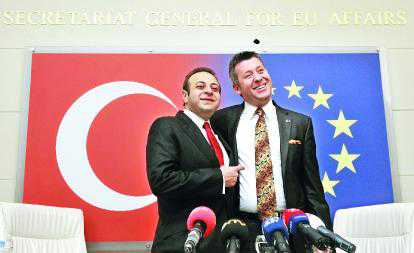
State Minister and chief negotiator Egemen Bağış pinned an “Honorary European Union Ambassador” pin on the visually impaired singer during a ceremony at the European Union General Secretariat office in Istanbul’s Ortaköy quarter.
Singer Metin Şentürk has been named Turkey’s honorary European Union ambassador for his work in bringing Turkey’s regulations and practices for people with disabilities up to EU standards.
State Minister and chief negotiator Egemen Bağış pinned an “Honorary European Union Ambassador” pin on the visually impaired singer during a ceremony at the European Union General Secretariat office in Istanbul’s Ortaköy quarter, where he noted that Turkey has entered another year of EU negotiations.
During the ceremony, Bağış said Şentürk was a role model for millions of people with disabilities living in Turkey because he had removed obstacles by trying to bring the country’s regulations on disabilities in line with international standards and by promoting Turkey in EU member countries.
“We have worked a lot during these past few years. Despite all the pessimism and negativity, we have stuck our heart and soul into this vital project. Nevertheless, this negotiation process is sometimes evaluated from a very narrow viewpoint and we regret this,” Bağış was quoted as saying Monday by Anatolia news agency.
“If we separate the 13 chapters we have opened so far, 17 of the remaining 20 chapters on our agenda face political obstacles imposed by the commission or members of the European Union,” said Bağış.
Bağış said the other three chapters included a competition chapter, which they continue to work on, one on public procurement and a final chapter on social politics and employment. These chapters are the hardest chapters of the EU, said Bağış, adding that it was no coincidence that other countries had also left them to the end.
Armenian-Americans must strongly challenge Pres. Obama’s unilateral appointments of Matthew Bryza as Ambassador to Azerbaijan and Frank Ricciardone as Ambassador to Turkey. The President circumvented the U.S. Senate by taking advantage of the holidays to make these “recess appointments” on December 29.
While Pres. Obama has the legal authority to make such temporary appointments when the Senate is not in session, his unwise decision could have several serious consequences:
— Undermining the legitimacy and credibility of the new U.S. Ambassadors in the eyes of their host countries due to their appointment through an archaic loophole in the law rather than proper Senate confirmation.
— Antagonizing two prominent Senators of his own party – Barbara Boxer of California and Robert Menendez of New Jersey – who had placed a “hold” on Bryza’s nomination. Having already lost the Republican-controlled House, Obama now desperately needs every single vote in a Senate with a razor thin Democratic majority.
— Alienating the entire Senate by depriving the Senators of their mandate to confirm ambassadorial nominees.
— Burning all bridges between himself and Armenian-Americans who were some of his staunchest supporters in the last presidential election, having already broken his pledge on the Armenian Genocide, Artsakh’s self-determination, and financial assistance to Armenia.
Fortunately, Pres. Obama’s recess appointments are of a temporary nature and not considered full-term ambassadorships. They are only valid for one year rather than the usual three years. In order for Bryza and Ricciardone to serve as Ambassadors beyond 2011, Pres. Obama has to resubmit their names to the Senate and have them properly considered.
The Senate and the Armenian-American community have ample time to take all necessary steps to ensure that the President’s slap in their face does not go unnoticed and unchallenged. Both ambassadors should be sent back home by the end of this year.
Here are the steps that could be taken to derail Bryza’s Senate confirmation in the coming months:
— Closely scrutinize Bryza’s public statements, press conferences, and interviews in Baku to ensure that he is properly representing the interests of the United States in Azerbaijan rather than Azerbaijan’s interests in Washington.
— Publicize the documents submitted to the European Court of Human Rights by an Azeri journalist who claims that Azerbaijan’s former Minister of Economic Development had paid the expenses for Bryza’s lavish 2007 wedding in Istanbul. During the Senate Foreign Relations Committee hearings, Bryza testified under oath that his family had paid for his wedding. Should the European Court find that the government of Azerbaijan had indeed financed Bryza’s wedding, he would be indicted for lying under oath, not reporting to the IRS the gifts as income, and violating U.S. government’s gift acceptance and disclosure policy.
— Investigate all his oral and written statements made to the Senate Foreign Relations Committee last year in order to verify their truthfulness.
— Search for evidence of conflict of interest related to the employment of his Turkish-born wife, Zeyno Baran, as Director of the Center for Eurasian Policy at the Hudson Institute, a Washington-based think tank that has received funding from ExxonMobil and other energy companies doing business in the Caspian region. The Armenian National Committee of America has accused Bryza of violating federal ethics rules because of his wife’s connections to Turkish and Azerbaijani business interests.
— Contact Senators Boxer and Menendez who had placed a “hold” on Bryza’s nomination last year, urging them to block his confirmation once again, when Pres. Obama resubmits his name to the Senate. By doing so, the two Senators would be reaffirming their initial conviction that Bryza is not qualified to serve as U.S. Ambassador to Azerbaijan.
The Armenian community had not originally objected to Ricciardone’s nomination. However, since Pres. Obama has opposed several major Armenian initiatives and broken his promises on all of them, Armenian-Americans may consider expanding their opposition to the Obama administration on many fronts. They should support those Senators who may be inclined to place a “hold” against Ricciardione’s confirmation later this year. In view of Republican Senator Sam Brownback’s “hold” on Ricciardone’s nomination last year and the objection of leading conservative spokesmen to his recess appointment, Armenian-American organizations now have a unique opportunity to work closely with Republicans in opposing his confirmation later this year.
Should the Armenian-American community flex its political muscle and show that it is ready and able to defend its interests, it is likely that U.S. government officials would then be more attentive to Armenian issues.
We are now at the most important conjuncture since the period leading up to the referendum of April 2004, and as such we feel compelled to issue a very important message that portrays the feelings of Turkish Cypriots both here in the UK , the TRNC and other countries where there is a high Turkish Cypriot Diaspora.
We all wish to see constructive action by the end of January 2011 and in anticipation we have taken this opportunity to show unity, and thereby exert pressure by way of a collective statement to the United Nations & the negotiators.
ATCA would like to formally invite you/your organisation to join us in this action.
IF YOU WISH TO SUPPORT THIS STATEMENT, PLEASE USE THE ONLINE FORM TO ADD YOUR NAME
The closing date to notify us of your wish to be included as a signatory is midday (GMT) on Friday 14th January 2011.
***Many thanks to all those people who have already indicated that they wish to have their names included as joint signatories and who have also helped in the preparation of this statement***
2004 Referandum süreci ve öncesinden beri karşılaştığımız en ciddi kesiş noktasındayız ve bundan dolayı KKTC vatandaşlarının yoğun yaşadığı ve yurtdışında yaşayan Kıbrıs’lı Türk diyasporası hissettiklerini önemle ve büyük bir hassasiyet ile intikal ettirmek ihtiyacı hissetmektedir.
Ocak 2011 sonunda yapıcı bir tavır, olumlu bir gelişme görmek arzusundayız ve buna dayanarak birliğimizi göstermek, haklı bir halk baskısı yoğunlaştırmak maksadı ile ortak bir bildiri yayınlamak istiyoruz.
ATCA sizi ve cemiyetinizi ortak hareket edebilmemiz, birlikte faaliyet gösterebilmemiz için birliğe ve beraberliğe davet etmektedir.
Cağrımızı destekliyor iseniz, aşağıdaki linkden isminizi ekleyebilirsiniz.
18. Erzurum, Turkey Skiing in Turkey? A winter sports capital emerges in Anatolia.
Published: January 7, 2011
(Page 2 of 4)
Cali has always felt like the grittier stepsister of Medellín, but tucked amid the colonial homes of the barrios of San Antonio or Granada are a number of new jewelry boutiques, low-key cafes and salsotecas teeming with crowds as sexy as any in South America.
Multimedia
Interactive Feature
Tell Us the Best Places to Go in 2011
Slide Show
Where to Go in 2011
Related
10 Restaurants Worth a Plane Ride (January 9, 2011)
Practical Traveler: 11 Tricks to Cutting Travel Costs in 2011 (January 9, 2011)
Salsa remains Cali’s lifeblood. If the dance floors of Tin Tin Deo or Zaperoco are too full, try La Fuente, a pint-size bar jammed with sweaty students who spill out onto the street most nights. Or, follow the sounds of Latin jazz to Guayusa, just next door. Those with serious salsa chops hitch a cab out of town to the suburb of Juanchito, whose dance floors do not fill up until after midnight (but go in a group, as this section gets dicey at those hours). Also be sure to check out a performance of Delirio, the monthly cabaret that is part Cirque du Soleil, part salsa clinic.
— LIONEL BEEHNER
11. The Danube From Budapest to the Black Sea, new cruises on a storied river.
For years, high-end river travel in Europe has focused on western European waterways like the Rhine and the Rhone. But recent developments have brought the high life to the principal river of central and eastern Europe: the Danube.
Last year, California’s Viking River Cruises launched new cruises on the river, and in 2011, another tour company, Tauck, will introduce riverboat trips from swinging Budapest to the Black Sea. Meanwhile, the Kempinski Hotel River Park recently opened on the Danube’s banks in the Slovakian capital of Bratislava. The blue Danube threads its way through four capitals (Vienna, Bratislava, Budapest and Belgrade) and touches 10 countries, passing by majestic scenery, outrageously great wine regions and castles, fortifications and ruins dating back centuries. What better way to see all these treasures than from the water? — EVAN RAIL
12. Niseko, Japan An Aspen emerges in Asia, with luxury to spare.
It was the snow that first brought the Australian ski bums here, the great powder blown in by Siberian cold fronts. Then chefs and designers discovered that this sleepy town on Japan’s northern Hokkaido island was actually a lovely spot in itself, with natural hot springs, family-owned inns and spectacular views of impossibly symmetrical Mount Yotei. Now with the development of stylish restaurants and a network of fashion-forward chalets (like the foodie must stop Kamimura and the 10 zenlike lofts at Suiboku), the well-heeled are arriving on direct flights from all over Asia to Sapporo’s New Chitose Airport, creating the region’s answer to Aspen and Courchevel.
Expect that to intensify when a high-speed train line, now planned to begin service in 2015, cuts the trip up from Tokyo to under four hours. This month the fully revamped 200-room Green Leaf Niseko Village, stylishly renovated by the New York-based Alexandra Champalimaud, is reopening its doors, while a Banyan Tree and Tadao Ando-designed Capella complex are in the pipeline.
— ONDINE COHANE
13. Oahu Hawaii’s most developed island adds resorts and attractions.
The nature that abounds on Maui and rural Kauai often overshadows the attractions on Oahu, the most populous Hawaiian island. But this year Oahu offers travelers fresh incentive in the form of name-brand resorts and other tourist attractions.
Disney plans to open Aulani, a 359-room resort 17 miles west of the Honolulu airport, in August. The 21-acre compound, part of the manicured Koolina Resort & Marina, will emphasize Hawaiian culture over Disney animation by offering hula lessons, lei making and storytelling (Disney movies will be stocked in the kids club). In addition to standard pools and a lazy river, a conservation pool supports stingrays that kids can safely touch.
For grown-ups, in October the hotelier Ian Schrager unveiled the first in a boutique hotel chain that he is creating for Marriott: the 353-room Waikiki Edition. Though it’s not on the beach — it’s a five-minute walk to the ocean — the resort makes up for it with an outdoor movie theater, a restaurant by the Iron Chef Masaharu Morimoto, surf-and-bikini boot camp and yoga. It has four bars, including one hidden behind a revolving bookcase.
But there’s more than sunsets and mai tais to Oahu. A $56 million visitors’ center and museum at Pearl Harbor opened Dec. 7 featuring interactive exhibits about the World War II attack that trace the path to war from both American and Japanese perspectives.
— ELAINE GLUSAC
14. Antwerp, Belgium A new breed of boutiques have made it a fashionista’s paradise.
There hasn’t been so much fashion buzz in Antwerp since the dawn of the Antwerp Six, a group of designers including Dries Van Noten and Ann Demeulemeester who rose to prominence in the mid 1980s. And while the city’s Royal Academy of Fine Arts is still churning out avant-garde talents, it’s Antwerp’s latest crop of shops that is causing the current buzz.
“The fashionistas I know have suddenly fallen in love with Antwerp,” said Lulu Townsend, the managing director of the London travel company Chic Retreats. “It’s a shopper’s paradise.”
In the last year alone four destination-worthy concept stores have opened, among them the fashion shop-cum-gallery Ra, which sells local and international labels and also hosts art and fashion events. Next door is Your, which offers everything from “a 2-euro pack of bubble gum to 14 brands of jeans and a 350,000-euro Alfa Romeo 8C,” said Jorrit Baars, who conceived the space.
Then there are the posh new boutiques Graanmarkt 13 and Renaissance, which features designers like Alexander Wang along with a chic Italian restaurant simply called Ristaurante. While you are in the building, check out the latest exhibition at Antwerp’s fashion museum, MoMu.
— GISELA WILLIAMS
15. Melbourne, Australia New hotels plus big-name chefs put Sydney on notice.
With a bunch of new hotels and restaurants led by notable chefs cropping up, Melbourne has been stealing the spotlight from its sister city, Sydney.
The most notable addition comes from the luxury brand Crown, which is investing 1 billion Australian dollars (about the same in U.S. dollars) to expand its sprawling Crown Entertainment Complex on the southern bank of the Yarra River. In April it opened Australia’s largest hotel, the 300-million-dollar 658-room Crown Metropol, which has an infinity pool on the 27th floor with 180-degree views of the city, and is home to the Maze and Maze Grill, the celebrity chef Gordon Ramsay’s first endeavors Down Under. The complex also includes the Crown Towers hotel, which has four private penthouse gaming salons with 360-degree views of Melbourne’s skyline.
The city’s thriving arts scene now has stylish boutique hotels to match, too. Three Art Series Hotels, inspired by (and featuring the works of) famous artists, opened in the last year. The Olsen, named for the landscape painter John Olsen, is the flagship of the group, with 229 rooms (from 215 dollars a night) and a heated, glass-bottomed swimming pool.
Visiting foodies will be able to choose from a number of new restaurants. In October, the Australian chef Neil Perry, of Rockpool in Sydney, opened Spice Temple, a 200-seat contemporary Szechuan restaurant next door to his Rockpool Bar & Grill in the Crown complex, as well as a new bar, the Waiting Room, in the lobby of the Crown Towers hotel. Also within the Crown complex, a new seafood restaurant, the Atlantic, will debut in February with Donovan Cooke as executive chef.
— MICHELLE HIGGINS
16. Tlemcen, Algeria An ancient Islamic city dresses up for a gala year.
There’s a buzz of anticipation — and power tools — in the streets, squares and souks of this ancient Algerian city. Named a Capital of Islamic Culture for 2011 by Isesco (Islamic Educational, Scientific and Cultural Organization), Algeria’s spiritual heart is preparing for a yearlong gala that will include some 300 exhibitions, concerts, screenings, theater performances, lectures and readings. The ruins of medieval ramparts and towers are being refurbished. Time-worn mosques and hammams are being dusted off. Cultural centers and museums are being started. And a first generation of five-star hotels — notably a Renaissance by Marriott— is rising from the ground.
Why Tlemcen? As the seat of a medieval dynasty that controlled much of North Africa, Tlemcen has long been a center of Islamic learning, culture and art. Skilled craftsmen ply their wares around the Kissaria market, traditional orchestras show off their chops every summer at the city’s festival of Arabo-Andalusian music, and the Muslim faithful pour into magnificent religious edifices like the Great Mosque and the tomb of Sidi Boumediene — a revered 12th-century Islamic scholar. With the approaching festival, the city should at last recapture some of its past glory.
— SETH SHERWOOD
17. Sopot and Gdansk, Poland Poland’s Baltic coast welcomes party hoppers and soccer fans.
Every country with a coastline has its version of the Hamptons. In Poland, it’s Sopot. In the summer, the small city — with its white beach, fin-de-siècle villas and lively cafe- and club-lined boulevard — is packed with young party hoppers from all over Poland and Scandinavia, dancing at flashy venues like the new Dream Club. Vladimir Putin has been known to stay at the palatial Sofitel Grand, which looks over the sea and nearby pier, the longest on the Baltic.
Sopot and the neighboring city of Gdansk (formerly known as Danzig) are gearing up for the 2012 European soccer championships, which will take place throughout Poland and Ukraine. Already there has been a flurry of openings, including a new boutique-style Hilton in Gdansk’s historic center, the Ergo Arena between Sopot and Gdansk (Lady Gaga was one of the first to perform), and a symphony hall with a stylish restaurant in Gdansk that was formerly a power plant. But the biggest debut is further off: the reopening of the beloved Forest Opera, an amphitheater in Sopot, which by 2012 should have 1,000 additional seats and a new roof.
— GISELA WILLIAMS
18. Erzurum, Turkey Skiing in Turkey? A winter sports capital emerges in Anatolia.
Turkey may not be the first place people think of for skiing, but it’s got mountains — big, snowy ones. Now the government is making a push to turn Erzurum, a city of 785,000 in eastern Anatolia, into a winter sports capital in time for this month’s 2011 Winter Universiade (sort of an Olympics for university students). Two and a half miles from town lies the ski resort of Palandoken, which the Iranian skiers who come here know has the most challenging skiing in Turkey. Three lifts have been added to the bald mountain that rises nearly 3,000 feet from its base to its summit at 10,498. The number of runs is a modest 18 — but the fun skiing is off-piste, between the runs, on Palandoken’s 2,200 acres.
About 11 miles from Erzurum sits the new Konakli Ski Resort, which opened this winter with six chairlifts and 3,000 acres of skiing. A new five-star hotel is scheduled to open next season; until it does, rent a car for day trips and stay at Palandoken’s Renaissance Polat Erzurum Hotel.
— CHRISTOPHER SOLOMON
19. Hyderabad, India Dynastic grandeur in the heart of modern India.
Even in the 16th century, Hyderabad, in southern India, famous for its diamond trade and sultans’ palaces, was a city with serious bling. In the last decade, a new sort of wealth has arrived — the outsourcing of international companies, which has inspired a boom of sleek cafes and restaurants such as Fusion 9.
The latest buzz is the debut of two five-star hotels, both connected to the Nizam family, rulers of Hyderabad for the two centuries before India’s independence. The first, Park Hyderabad, is a futuristic structure designed by Skidmore, Owings & Merrill, with an aluminum and glass facade inspired by the settings and metalwork found in the Nizams’ jewelry collection. The new Taj Falaknuma Palace, on the other hand, is a window into the past. It’s a wedding cake of a building that still belongs to the Nizam family, and it took the Taj Hotels group 10 years to renovate the European-style castle. “The Falaknuma Palace will complete the Indian palace tour for the south,” said Shanti Kohli, of New Delhi-based Amber Tours. “It makes a trip to Hyderabad worthwhile just on its own.”
— GISELA WILLIAMS
20. Manchester, England An industrial city reinvents its famed musical past.
The cold and gritty factory city that famously inspired the post-industrial anguish of bands like Joy Division and the Smiths has transformed into a thriving cultural hub. Several new music venues are cashing in on “Madchester” nostalgia, including FAC251, an indie-music club that opened in February in the old Factory Records building. The owners of the popular Trof cafe, which bills itself as a “dandyish den of opulence,” recently opened a new multiplatform cultural venue called the Deaf Institute. For those who want a taste of the city’s favorite depressive sons. — CHARLY WILDER
21. Tallinn, Estonia
The beautiful capital city aims to shed its stag-party past.
Soon after EasyJet began flights from London and Berlin to the Estonian capital in 2004, Tallinn became known as the Las Vegas of the Baltics, luring hordes of party tourists with its cheap liquor and wild seaside night life. But now, with the city’s selection as a 2011 European Capital of Culture, cash is flowing in and pulling Tallinn out of its stag party adolescence.
Some seven years after Estonia joined the European Union, large-scale infrastructural and restorative work, including several rebuilt museums, a waterfront promenade and a large arts venue, KultuuriKatel (Culture Cauldron), are reshaping Tallinn’s cultural identity. Much of Northern Europe’s arts community will converge on the city this year, as it debuts a yearlong schedule of European Union-sponsored events, including the student-focused contemporary art triennial Exsperimenta! and “Stories of the Seashore,” a project that enlists writers, actors, artists and musicians to reflect on the sea that has been so central to Estonia’s development.
— CHARLY WILDER
22. Fogo Island, Newfoundland An art colony blooms on remote and rugged shores.
A remote island off the coast of Newfoundland with a dwindling population of 3,000 residents might not strike you as an important cultural enclave. But it soon could be, thanks to a local resident, Zita Cobb and a Norwegian architect, Todd Saunders. They teamed up to create a series of innovative artists’ studios in former saltbox houses and deconsecrated churches that perch over the North Atlantic and rugged pristine landscapes. Two are complete, and four more will be unveiled in June as part of the Fogo Island Arts Corporation. The effort, with the help of government financing, puts more than $15 million into showcasing the island as an arts and eco destination.
Besides the cutting-edge studios, which will host artists and writers as part of an international residency program, the foundation will also open a 29-room hotel next year. For the moment visitors can stay at country spots like Foley’s Bed and Breakfast and Peg’s B&B and rent a car to tour the architectural showcases. Talk about island innovation.
— ONDINE COHANE
23. Singapore With new resorts and casinos, the city lets its hair down.
For years, this island country was considered oppressive and humorless. But recently Singapore has started to have some fun with new supersized resorts, design hotels and restaurants.
“There has been a big change in the Singapore scene in the last two or three years,” said the hotelier Lik Peng Loh, who recently opened Wanderlust, which he calls an “adult playground.”
Singapore’s decision six years ago to allow gambling led to the recent opening of two complexes: the Resorts World Sentosa, with a casino, Universal Studios theme park and four hotels, including a Hard Rock; and the Marina Bay Sands.
— GISELA WILLIAMS
24. Port Ghalib, Egypt A low-key beach escape with clear water and sea creatures.
The once unspoiled beauty and calm of Sharm el-Sheikh, on the Red Sea in Egypt, has suffered from an influx of tourists (not to mention a recent series of shark attacks). Those looking to skip the crowds should turn to Port Ghalib, across the Red Sea from Sharm, on the eastern Egyptian coast. Ghalib’s beaches offer soft, snow-hued sand and translucent water that divers love.
Since the area’s rich marine life hasn’t yet been sullied by packs of visitors, the coral reefs are undamaged and ripe for exploring. Admiral Travel, a Florida-based travel consultancy that specializes in trips to Egypt, arranges customized diving expeditions to Elphinstone Reef (a few miles from Ghalib) that allow clients to swim with hammerhead and gray reef sharks. Port Ghalib also offers affordable lodging options, with several attractive hotels. Four resorts operated by the InterContinental Hotel Group include the upscale beachfront Palace Port Ghalib Resort, which features a Six Senses spa.
— SHIVANI VORA
25. Whistler, British Columbia The Olympians are gone. Now it’s your turn.
You don’t need a lifetime of training or a Spandex unitard to retrace the strides of the best Nordic skiers in the world. The 2010 Winter Games left behind a tremendous structural legacy: Whistler Olympic Park, which is now open to the public. The park, and its partner facility, the Callaghan Country Lodge, offer some 55 miles of trails that range from easy to Olympian.
« Previous Page
1
2
3
4
Next Page »
This article has been revised to reflect the following correction:
Correction: January 8, 2011
An earlier version of this article misspelled the last name of a Norwegian architect. His name is Todd Saunders, not Sanders.
Government monitoring of what Americans are doing in cyberspace has moved a bit closer to reality, as President Barack Obama announces plans to hand over authority to create an Internet ID for all Americans to the U.S. Commerce Department, a White House official tells CBS News.
The plan, touted as the National Strategy for Trusted Identities in Cyberspace, is raising eyebrows about privacy issues over concerns that creating a centralized database is an infringement on Americans’ rights. It is expected to be released in the next several months.
Calling it an “absolute perfect spot in the U.S. government” to create an “identity ecosystem” for the Internet, White House Cybersecurity Coordinator Howard Schmidt said Friday during a business and academics forum at the Stanford Institute for Economic Policy Research that issuing digital identities for web usage to all Americans will reduce cybersecurity vulnerabilities and improve online privacy protections.
Commerce Secretary Gary Locke agrees. “We are not talking about a national ID card,” Locke said at the Stanford forum. “We are not talking about a government-controlled system. What we are talking about is enhancing online security and privacy and reducing and perhaps even eliminating the need to memorize a dozen passwords, through creation and use of more trusted digital identities.”
Schmidt added that his office will work with the Department of Homeland Security and the General Services Administration to implement the Internet ID strategy.



 Slide Show