Month: January 2011

  • Turkey disappointed by Merkel’s Cyprus remarks, calls for fairness

    Turkey disappointed by Merkel’s Cyprus remarks, calls for fairness

    Wednesday, January 12, 2011
    ANKARA – Hürriyet Daily News
    AA photo

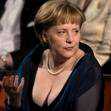
    German Chancellor Angela Merkel’s recent statements accusing Ankara of not taking any step toward a resolution of the Cyprus problem were a serious letdown for Turkey, its foreign minister said Wednesday.

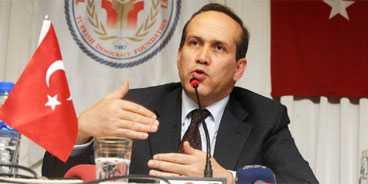
    “Ms. Merkel’s latest statements caused serious disappointment on our part. If Ms. Merkel and Germany exert efforts for peace on the Cyprus issue, we will always support this, but they should first adopt an objective approach between the parties concerned,” Turkish Foreign Minister Ahmet Davutoğlu said at a press conference in Ankara.

    During her five-hour visit to Greek Cyprus on Tuesday, Merkel criticized Turkey and Turkish Cypriots for not doing enough to reach a deal with Greek Cypriots. Her criticism received a prompt response from Turkish Prime Minister Recep Tayyip Erdoğan.

    “I guess Ms. Merkel has forgotten what she has said. It was she herself who said it was wrong to admit Greek Cyprus into the European Union. But now, she pays a visit to the Greek Cypriot administration and makes such a statement,” Erdoğan said in Qatar. “It is also clear that she does not know the history of the Cyprus issue.”

    After meeting with Greek Cypriot President Dimitris Christofias, Merkel said Turkey needed to show more willingness to reach a settlement on the Cyprus dispute. If Merkel had talked to former Chancellor Gerhard Schroder, she would have known who was responsible for the Cyprus issue, Erdoğan said.

    “I call on the chancellor to research the history and sit down for tea with Gerhard Schroder,” the Turkish prime minister said.

    Asked to comment on Merkel’s views, Davutoğlu said Germany is one of the allies in which Turkey places the most importance. “Positive initiatives that have been taken over the last two years have come from the Turkish side. If Ms. Merkel had talked to the two parties, she would not be making one-sided statements,” he said in Ankara.

    MERKEL

    “We trust her and her leadership. I hope that in the upcoming period she also listens to the Turkish side and adopt a fair and objective approach,” Davutoğlu said. “We believe that Germany can play an important role but this role cannot be played by listening to one side.”

    Referring to Merkel’s appreciation of the steps taken by the Greek Cypriots, Davutoğlu responded in an ironic tone. “Yes, the Greek Cypriots have expended efforts. They expended efforts for the rejection of the Annan plan,” he said, referring to the 2004 referendum when Turks on the island voted for the plan while Greeks rejected it.

    Merkel’s ‘blunder’ historic, EU minister says

    Making overtures to the Greek Cypriot administration was a historic blunder on Merkel’s part, a Turkish state minister and chief EU negotiator said Wednesday. “However, we are determined and we will continue to tell the truth,” State Minister Egemen Bağış told reporters before flying to Hungary.

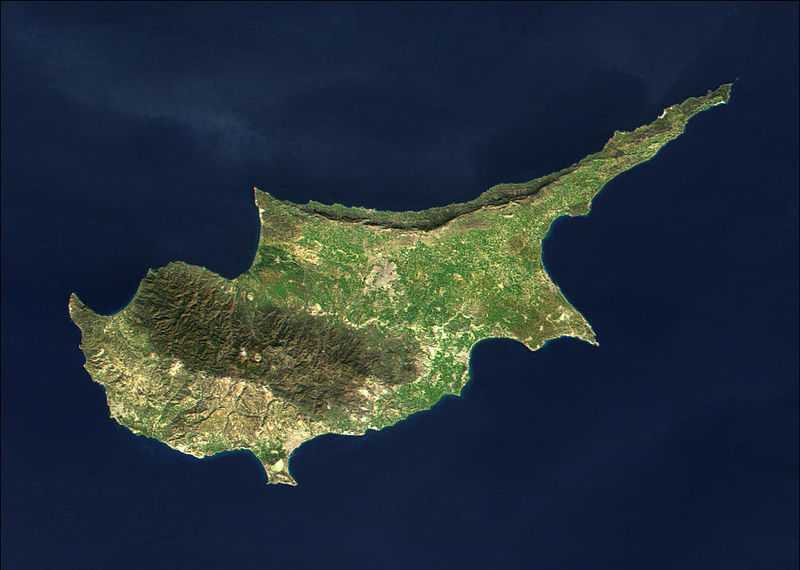
    Cypriot leaders meanwhile continued to negotiate the “Power Sharing” topic in a meeting Wednesday within the scope of extensive unification talks on the divided island. Turkish Cypriot President Derviş Eroğlu told reporters after the meeting that they made a counter-proposal to the Greek Cypriot side that Christofias asked for time to assess. The two sides will meet again Jan. 21, Eroğlu said.

    Alexander Downer, the United Nations chief’s special advisor on Cyprus, told reporters after the meeting that more talks would be held in Geneva on Jan. 26. He said they expected the parties to reaffirm the progress made since the meeting in New York and set a course for talks after Jan. 26.

    Following his talks with Merkel, Christofias urged Turkey on Tuesday to give up what he called its “gunboat diplomacy” in the eastern Mediterranean and drop its opposition to Greek Cyprus’s offshore exploration for gas deposits.

    Christofias accused Turkey of hampering a Greek Cypriot search for gas off its southern shore with warplanes and navy ships. He said Turkey must stop acting like the “neighborhood policeman” if it wants to join the European Union.

    “Neither Turkey, nor any other country, has the right to tell us … we don’t have the right to carry out this search,” Christofias said.

    Turkey says the Greek Cypriot search disregards the jurisdiction of Turkish Cypriots and could damage long-running talks aimed at reunifying the island. Last month, Turkey declared that a maritime border accord between Greek Cyprus and Israel was null and void.

    The Greek Cypriot government has said Turkish Cypriots could share in the potential bounty after a peace accord is signed, though Christofias said drilling is still a few years away. Energy Service Director Solon Kassinis said earlier this month that Greek Cyprus would press ahead in the second half of this year with a second licensing round for gas exploration in its 51,000-square-kilometer exploration area.

  • Turkish-US strategic partnership

    Turkish-US strategic partnership

    Font Size: Larger|Smaller

    Wednesday, January 12, 2011
    NAMIK TAN
    During the long decades of the Cold War, Turkey was primarily known for its military-strategic contribution to NATO in the defense of freedom. Now, we are increasingly known for our regional ties, economic dynamism and secular democracy and Turkish diplomacy has become an active force in projecting peace and stability in a wider geography spanning the Balkans, the Middle East, the Caucasus and Asia.
    However, conflicts and disputes in our immediate and further neighborhood and beyond are far from resolved. Indeed, the Iranian nuclear issue remains elusive; Iraq is yet to be secured from sources of instability; efforts to ameliorate the Arab-Israeli conflict have not produced the desired outcome; Turkish-Israeli relations are passing through difficult times; the Caucasus continues to witness ongoing conflicts; efforts to ensure stability in Bosnia and Herzegovina face challenges; despite positive developments, international efforts in Afghanistan still confront difficulties; and in Cyprus the ongoing isolation of the Turkish Cypriots continues despite attempts to achieve a lasting settlement. Turkey plays an important and frequently central role on each of these issues, all of which remain high on the United States’ foreign policy agenda.
    It is in this wider context that the relationship between Turkey and the U.S. is one of the most important dimensions of our foreign policy. Turkish-U.S. relations have been characterized for decades by close cooperation, solidarity and strong bonds of friendship. They are based on common values of democracy, respect for human rights, rule of law and free markets. We have acted together in various conflicts ranging from Somalia, Bosnia and Kosovo to Afghanistan. We stand together in the fight against terrorism.
    The positive change in the nature of our bilateral relationship was crowned by the visit of President Obama in April 2009. During his first bilateral overseas trip to Turkey, President Obama chose to use the term “model partnership” in describing Turkish-U.S. relations.
    This vision requires deepening and widening bilateral relations in fields other than military and strategic initiatives, notably in economic, commercial and cultural spheres. Indeed, the depth of our relations in economic and commercial fields is not yet reflecting the nature of model partnership.
    To address this gap, in line with the vision of model partnership, Turkey and the U.S. took a crucial step establishing the “Framework for Strategic Economic and Commercial Cooperation,” or FSECC, in December, 2009. The first meeting of the FSECC was recently held in Washington, D.C., with the participation of four Cabinet-level dignitaries from the two countries. This essential forum will bridge the gap between our private sectors and policy makers, allowing them to address mutual issues and opportunities.
    It is unfortunate that two recent incidents have complicated these efforts to elevate our relationship to the level of a model partnership. The Turkish “no vote” on sanctions against Iran in the U.N. Security Council on June 9, 2010, and the Israeli raid on the Gaza aid convoy on May 31, 2010, triggered a surge of commentaries in the United States suggesting a shift of axis in Turkish foreign policy and questioning Turkey’s allegiance to the Western world.
    Beneath these criticisms lies the Cold War mentality of seeing the world in opposing and exclusive terms. If there was a shift of axis, how could one explain the presence of our troops in Afghanistan? Turkey’s Western vocation is a consistent and an irreversible process. We view our goal of European Union accession as the main pillar of our commitment to democracy, freedom and free markets and our place in NATO as the backbone of our national security as well as that of regional and global security.
    Our relations with the United States and the European Union complement our presence in Eurasia and the Middle East and are not mutually exclusive. The intensification of our relations with Syria and Russia does not indicate a shift of axis. Similarly, Turkey’s leadership roles in the United Nations Security Council, the Group of 20 Nations, the Organization of Islamic Conference, the Council of Europe, the Southeast European Cooperation Process or the OECD are also complementary. This is a clear example of the strength of Turkish diplomacy and the ability of Turkey to establish meaningful relations with different cultures and geographies.
    Turkey is not immune from the consequences of conflicts in her region. The war in Iraq, the conflict in Palestine, disputes in Lebanon, hostilities between Russia and Georgia, the situation in Bosnia, the conflict between Azerbaijan and Armenia and the Iranian nuclear issue have all had a direct or indirect impact on Turkey. It has been severely affected by the wars in Iraq, and our economy was disrupted by the dispute between Russia and Georgia. Most likely, the Turkish economy will be hit worse than any other country by further sanctions against Iran. Therefore, we cannot observe events as an idle bystander. It is with this understanding that Turkey makes serious efforts to reconcile disputing parties in our region and beyond.
    Viewing this multi-faceted active foreign policy as a shift of axis is not only inaccurate but also does an injustice to our sincere efforts to achieve peace and stability, to engage in more trade, to increase interdependency and to solve conflicts through peaceful means.
    Turkey’s “zero problems with neighbors” policy is inclusive and not based on religion or ideology. We have accomplished positive changes in our relations with all 12 of our direct and indirect neighbors, only four of which are Muslim-majority countries.
    The Israeli raid against the Gaza humanitarian aid convoy in May and subsequent developments fed the negative caricature of a supposed change in Turkey’s foreign policy direction. Turkey was the first Muslim-majority country to recognize Israel and the second of all nations to do so after the United States. Our cooperation has continued uninterrupted for more than six decades. The relationship between the Turks and the Jews took root long before that, extending through five centuries. Turkish-Israeli relations have long been a positive factor in a world where we witness violent conflicts based on religion and faith.
    Despite all the anger and resentment among the Turkish public in the wake of the Gaza aid convoy attack, Turkey was ready to address this profound crisis with Israel in a manner befitting two friends. We held the view that, as a friend, Israel should accept her wrongdoing, apologize to the Turkish people for the killings and compensate the losses incurred by the families of the victims and those who were injured. This is still where we stand.
    The second issue that gave rise to criticisms of Turkish foreign policy is related to Iran’s nuclear program. Turkey is against Iran’s development of nuclear weapons capability. Iran’s development of a nuclear arsenal would gravely threaten peace, security and stability in our region by triggering a nuclear arms race.
    Having said that, I must also emphasize that Iran, as any other country that is party to the Non-Proliferation Treaty, or NPT, has the right to the peaceful use of nuclear energy. Therefore, in order to achieve our goals with respect to Iran, engagement is the only path to follow. This position does not undermine that of the U.S. On the contrary, we are encouraging Iran to be more transparent about its nuclear plans and to address the concerns of the international community.
    To be sure, the Tehran Declaration of May 17 does not solve all the problems. However, we believe it offers an important opportunity for the peaceful resolution of the problem. It is with this understanding that we voted against new sanctions at the U.N. Security Council resolution in June. We still believe that diplomacy offers effective avenues to address this issue without further heightening the tension in the region.
    Our effort to portray a more accurate picture of Turkey in the United States and broaden bilateral relationship is one of the most important aspects of our partnership. The narrow-minded efforts of certain single-agenda ethnic lobbies are all too evident. In particular, the ill-conceived efforts of segments of the Armenian diaspora do not serve the higher and long-term interests of the United States or even of Armenia. We must work together to prevent them from harming U.S.-Turkish relations.
    Turkish-U.S. relations have withstood the test of time. We overcame one of the biggest challenges to the relationship in 2003 when the Turkish Parliament voted against allowing the U.S. military to enter Iraq through Turkey. In a relatively short period of time Turkey and the U.S. revitalized their strategic partnership, in large part because of its strong foundation. Methodological differences on certain issues do not undermine our shared principles.
    Our determination to further enhance the strategic partnership between our countries that will lead us to a brighter future remains unshaken. Turkey and the United States complement each other. We cannot and should not accept failure, as failure is not an option.
    *Namık Tan is the ambassador of Turkey to the United States. This piece is an abbreviated version of an article that originally appeared in Turkish Policy Quarterly (TPQ), available at www.turkishpolicy.com.
    __._,_.___

  • Letter to the Leader of the Ealing Council

    Letter to the Leader of the Ealing Council


    To: Honorable Councillor Julian Bell, Leader of the Ealing Council
    c/o Labour Group Members’ Room, Ealing Town Hall , New Broadway,

    Dear Councillor Bell,

    We have read your statement to Turkish Times with great sadness and disappointment. It is hard to believe that such an ill advised and ill judged decision can be taken by wise and presumably informed Councillors. Both the Labour and the Liberal Democrat Councillors seem unfortunately to have been persuaded/pressurised by S Pound MP and Councillor Iskenderian, with participation by The Armenian National Committee of United Kingdom. (ANC UK is the main Armenian association which claims the “recognition” of the “Armenian genocide” and is an arm of Armenian Revolutionary Federation, ARF. The ARF controlled one of the two principal Armenian terrorist groups, the so-called “Justice Commandos for the Armenian Genocide/Armenian Revolutionary Army” – Francis P. Hyland, Armenian Terrorism: the Past, the Present, the Prospects – Boulder -San Francisco-Oxford: Westview Press, 1991, pp. 61-62 – this information has already been provided in an email to you by Maxime Gauin 03/01/11).

    What is also fundamentally wrong with this action is that the decision has been taken without listening and weighing up the argument on the other side, and holding the discussion/hearing un-announced to all the interested parties. We can not consider this to be an appropriate action by a truly democratic Council.

    You may like to read below Mr Ergun Kirlikovali’s comprehensive and authoritative response to this ill judged decision. A new book by SS Aya,The Genocide of Truth Continues, (Derin Yayinlari) is full of documentary information and it is a book which is entirely committed to telling the truth (can be obtained via [email protected]).

    We would very much appreciate if you and the other responsible Councillors can reconsider their position and appreciate the feelings of the Turkish Community in London .

    Yours sincerely,

    Betula Nelson

    Media Coordinator

    ASOUK
    www.ataturk.org.uk

    OH, EALING COUNCILLORS! HOW COULD YOU?

    Ergun Kirlikovali January 6, 2011  Turkish Forum

    To: Honorable Councillor Julian Bell, Leader of the Ealing Council
    c/o Labour Group Members’ Room, Ealing Town Hall , New Broadway,

    Re: Decision of Ealing Council to officially recognize the long discredited political claim of Armenian ‘genocide’ as settled history

    Dear Honorable Councillor Julian Bell,

    It is difficult and painful for me, the son of Turkish survivors on both maternal and paternal sides, to hear of Ealing Council’s unfortunate resolution, based on an Armenian’s misrepresentations—i.e. Councillor Iskendarian—where Armenian war crimes, Armenian hate crimes, and their Muslim, mostly Turkish, victims, are curiously missing. If one excludes half the story, well, even the American civil war can be made to look like a genocide.

    I realize that this was not a unanimous decision and that some prudent members considered the motion tabled by an Armenian (Cllr Iskanderian) one sided, without input from responsible opposing views and hence, judged it ill-advised and divisive. I am also aware of at least one councillor saying “…I have never come across a motion in my nine years on the council that so blatantly sought to pitch one community against another – especially on a subject which is highly sensitive and where no member of the council is really able to make a proper and considered judgment…” I truly appreciate those members who thought that way, but I wish they took the trouble to stay on and vote no so that this blatant and malicious fraud could be thwarted.

    Those terrible “War Years” of 1912-1922 (known in Turkish as “Seferberlik Yillari”) brought five consecutive wars—Tripoli (North Africa,) Balkan Wars (twice,) World War I, and the Turkish Independence War, in that order— along with wide spread death and destruction on to ALL Ottoman citizens. No Turkish family was left untouched, mine included. Those nameless, faceless Turkish victims are killed for a second time today with politically motivated and baseless charges of Armenian genocide.

    Genocide claims are racist because they ignore the Turkish dead: about 3 million during WWI; more than half a million of them at the hands of Armenian ultra-nationalists; and dishonest because genocide charges blatantly dismiss the six T’s of the Turkish-Armenian conflict.

    Historians reject the genocide label: This may explain why more than 69 North American scholars categorically rejected Armenian characterizations of genocide, noting that the non-partisan and reliable evidence unearthed so far points to “…inter-communal warfare fought by Christian and Muslims irregulars…” A majority of European historians who specialize on this topic also reject or criticize this label.

    The Malta Trials refuted Armenian claims 90 years ago: If you had heard about the Malta Trials by the Crown Courts in 1919-1921, that never got off the ground due to lack of evidence to support the outrageous Armenian claims, you would not have signed that deceptive edict. ( For your information, the British exiled 144 Ottoman leaders to Malta as war crimes suspects, while scouring the Ottoman, British and American archives for proof and came up empty handed. This paper might explain more: The Armenian Issue: Why The “Genocide” Label Doesn’t Fit )

    Britain does not recognize Armenian claims as genocide: You would do well to, at least, heed the advice and policy of Her Majesty’s Government when this same issue was raised in the same biased manner, again with total disregard for the other side of the story.

    Here is a journey down the history, a collection of brief educational glimpses into the past:

    1894

    “…The aim of the Armenian revolutionaries is to foment outbreaks, firstly to induce the Ottomans to react to their violence and secondly to encourage the foreign powers to intervene…” Source: Letter of the British Ambassador Currie to the Foreign Office, on March the 28th of 1894, British Blue Book, N°6, p 57

    1896

    ” …The Dashnaks and Hunchaks have terrorized their own countrymen, they have stirred up the Muslim people with their thefts and insanities, and have paralyzed all efforts made to carry out reforms; all the events that have taken place in Anatolia are the responsibility of the crimes committed by the Armenian revolutionary committees…” Source: Williams, The British vice-consul, writing from Van. (March 4, 1896, British Blue Book, Nr. 8 1896, p.108

    1915

    “…Concerning the Armenian revolutionaries’ tactics, one cannot expect to think up something more diabolic. Killing Moslems in order to punish innocents, robbing in the middle of the night villages that have just paid, the same day, their taxes. (…) The Armenian revolutionaries prefer robbing their own coreligionists rather than fighting against their enemy ; it’s in order to make their compatriots murder that the Armenian anarchists in Constantinople do bomb attacks…” Source: Sir Mark Sykes, “The Caliph’s Last Heritage”, London , 1915, p 409-418

    1922

    “…I was being employed by His Majesty’s Government to compile all available documents on the present treatment of the Armenians by the Turkish Government in a ‘Blue Book,’ which was duly published and distributed as war-propaganda!…” Source: Arnold Joseph Toynbee, “The Western Question in Greece and Turkey : a Study in the Contact of Civilizations,” Boston , Houghton Mifflin, 1922, p. 50.

    1923

    “…In some towns containing ten Armenian houses and thirty Turkish houses, it was reported that 40,000 people were killed, about 10,000 women were taken to the harem, and thousands of children left destitute; and the city university destroyed, and the bishop killed. It is a well-known fact that even in the last war the native Christians, despite the Turkish cautions, armed themselves and fought on the side of the Allies. In these conflicts, they were not idle, but they were well supplied with artillery, machine guns and inflicted heavy losses on their enemies…” Source: George M. Lamsa, a missionary known for his research on Christianity, “The Secret of the Near East,” The Ideal Press, Philadelphia (1923), page 133

    1928

    “…A circular was prepared by the War ministry asking the officers to report on the misdeeds of the enemy. According to this circular, exactness was not an essential condition: probability was enough. (…) The most popular lies in England and in America were those concerning atrocities. No war can do without it. One considers that to libel the enemy is a patriotic duty…” Arthur Ponsoby (British Deputy from 1910 till 1918, his book published in 1928 describes propaganda methods used during First World war), Falsehood in War-Time , New York , 1971, p 20-22

    1928

    “Few Americans who mourn, and justly, the miseries of the Armenians, are aware that till the rise of nationalistic ambitions, beginning with the ‘seventies, the Armenians were the favored portion of the population of Turkey, or that in the Great War, they traitorously turned Turkish cities over to the Russian invader; that they boasted of having raised an army of one hundred and fifty thousand men to fight a civil war, and that they burned at least a hundred Turkish villages and exterminated their population…It is at least time that Americans ceased to be deceived by propaganda…” Source: John Dewey, American professor, The Turkish Tragedy, The New Republic, November 12, 1928

    1936

    “…Those who in England are loudest in their sympathy with the aspirations of a(n Armenian) people ‘rightly struggling to be free’ can hardly have realized the atrocious methods of terrorism and blackmail by which a handful of desperados, as careful of their own safety as they are reckless of the lives of others, have too successfully coerced their unwilling compatriots into complicity with an utterly hopeless conspiracy…” Source: Lord Warkworth, after paying a visit to Van. ( William Langer, The Diplomacy of Imperialism.)

    1964

    “…(The Dashnaks)’ aim was by crimes and assassinations to invite Turkish reprisals and massacres, and thus create an international scandal that would attract the intervention of the other powers…” Source: David Thompson, “ Europe Since Napoleon” (Alfred A. Knopf, 1964, 2nd. Ed.)

    1976

    “… The deafening drumbeat of the propaganda, and the sheer lack of sophistication in argument which comes from preaching decade after decade to a convinced and emotionally committed audience, are the major handicaps of Armenian historiography of the diaspora today…” Source: Dr. Gwynne Dyer, a London-based independent journalist with global exposure, 1976

    1999

    “…The British Government had condemned the massacres at the time. But in the absence of unequivocal evidence that the Ottoman administration took a specific decision to eliminate the Armenians under their control at that time, British governments have not recognized those events as indications of genocide… Nor do we believe it is the business of governments of today to review events of over 80 years ago, with a view to pronouncing on them. The events of 1915-16 remain a painful issue in relation to two states with which we enjoy excellent relations…” Source: Foreign Office spokesman, Baroness Ramsay of Cartvale, AP News, April14, 1999

    2001

    “…The Government, in line with previous British Governments, have judged the evidence not to be sufficiently unequivocal to persuade us that these events should be categorised as genocide as defined by the 1948 UN Convention on Genocide, a convention which was drafted in response to the Holocaust and is not retrospective in application. The interpretation of events in Eastern Anatolia in 1915-16 is still the subject of genuine debate amongst historians.” Source: Baroness Scotland of Asthal, expressing the position of the British Government’s on the alleged Armenian genocide in a written response to a question at the House of Lords, February 7, 2001

    2001

    “…The British government of that time and those that followed considered the massacres of 1915-1916 as a horrifying tragedy. We understand the strong feelings for this problem, given the human losses of both parties. But we do not believe that proofs put forward give evidence that those events must be classified as “genocide” as defined by the 1948 Convention of the United Nations on genocide. (…) The events of 1915-1916 constitute a big tragedy, during which the two parties underwent very heavy losses…” Source: Official Statement by the Embassy of Great Britain in Ankara , July 23, 2001.

    The Armenian claims of genocide were never brought to court and, therefore, a court verdict a la Nuremberg does not exist. By voting yes on a controversial claim that totally ignores Armenian revolts, terrorism, treason, territorial demands and their Turkish victims during WWI, you are lending credence to unsubstantiated, exaggerated, falsified, and fabricated accusations.

    Do you really believe a political body is the place to resolve historical conflicts?

    Do you think academia with its research capability and/or legal realm with its “due process” expertise would be better equipped to handle such controversies ?

    Do you agree that taking one side in a complex historical conflict is offensive, and unfair to the other side?

    Do you see now how grave a mistake it is to honor one side of the story with an official stamp of approval, while totally ignoring the other? Would you like such “lynching” done to your country?

    In a democracy, history is made by political institutions but written by historians. The Blois Appeal of 2008 in France , signed by several hundreds of historians, from Europe, North America , and elsewhere, says: “… History must not be a slave to contemporary politics nor can it be written on the command of competing memories. In a free state , no political authority has the right to define historical truth and to restrain the freedom of the historian with the threat of penal sanctions… ”

    Muslim, mostly Turkish, victims of Armenian revolutionaries and the treasonous Armenian volunteers of Russian, French and Greek armies are documented in Ottoman archives, Russian archives , American archives (and also Niles & Sutherland,) French archives (Paul Bernard, Six mois en Cilicie, Aix-en-Provence: éditions du Feu, 1929,) and even in Armenian sources
    (Haig Shiroyan, an Ottoman Armenian wrote in his Memories: “…The Russian victorious armies, reinforced by Armenian volunteers, had slaughtered every Turk they could find, destroyed every house they penetrated…” Smiling Through the Tears, New York , 1954, p. 186).

    The alleged “Armenian genocide” was popularized by Armenian terrorism of 1973-1991. The ARF controlled one of the two principal Armenian terrorist groups:

    a) “Justice Commandos for the Armenian Genocide/Armenian Revolutionary Army”

    (Francis P. Hyland, Armenian Terrorism: the Past, the Present, the Prospects, Boulder-San Francisco-Oxford: Westview Press, 1991, pp. 61-62; br>
    Gaïdz Minassian, Guerre et terrorisme arméniens, Paris : Presses universitaires de France, 2002, pp. 28-37 and 106-109; br>

    Yves Ternon, La Cause arménienne, Paris : Le Seuil, 1983, pp. 218-224.)

    Scotland Yard banned Hrair Maroukian, the leader of ARF from 1972 to 1994, from entering British soil in Autumn 1984, because British police considered him as the real chief of JCAG/ARA (Michael M. Gunter, “Pursuing the Just Cause of their People”. A Study of Contemporary Armenian Terrorism, Westport – New York – London , Greenwood Press, 1986, p. 111.)

    The JCAG/ARA killed around thirty innocent victims and bombed the offices of Turkish Airlines in London airport, on May 24, 1978 and even the offices of British airways in Madrid airport, on January 20, 1980.

    The ARF continues to glorify its terrorists, including Hampig Sassounian, jailed since 1982 for the assassination of the Turkish general consul in Los Angeles , Kemal Arikan.

    Vicken Hovsepian, sentenced in 1984 by an US court to six years of prison for an attempt of bombing is a member of ARF the leader of the party in USA .

    b) Another Armenian terrorist group, Armenian Secret Army for the Liberation of Armenia (ASALA), was actively supported by the Union of Armenian students of UK , who published a pro-ASALA newspaper in London , from 1978 to 1988: Kaytzer.

    ASALA killed around forty innocent victims (including at least eight Turkish diplomats), and wounded many more;

    ASALA terrorist Zaven Bedrosian was sentenced to eight years of prison by a British court in August 1983, for illegal possession of explosives and weapons, and conspiracy. Mr. Bedrosian admitted during his trial that he wanted to take the Turkish ambassador in London hostage with the hope of exchanging him with the ASALA murderer Levon Ekmekjian, one of the two perpetrators of attack in Ankara airport, in August 1982 (nine tourists were killed, more than 70 wounded.)

    ASALA claimed his solidarity with Irish Republican Army (IRA) against “British fascism” (sic).

    Ara Toranian, former spokesman of ASALA from 1976 to 1983, who shows no remorse for his violent past, is currently co-chairman of Coordination Council of France’s Armenian Associations.

    I hope that you will realize what a grave mistake you have made by taking the words of Armenian propagandists, falsifiers, crooks and terrorists at face value.

    In summary, if I could manage to raise a grain of doubt in your mind that the Armenian narrative may not be the whole story and that there might be another side, equally ghastly and genuine, where Armenians are the victimizers not the victims, then I consider my mission is accomplished. Thank you for reading.

    Respectfully Yours,

  • The Struggles of the Turkish People of Cyprus

    The Struggles of the Turkish People of Cyprus

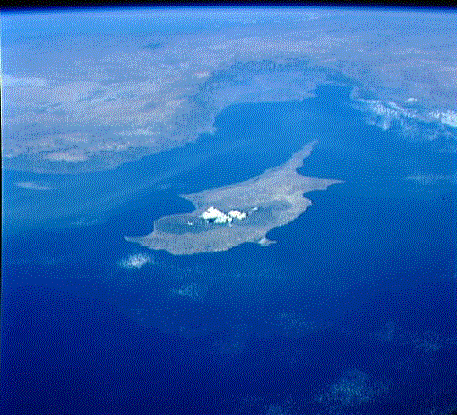
    “Unless this Turkish community forming part of the Turkish race which has been the terrible enemy of Hellenism is expelled, the duty of the heroes of EOKA can never be considered as terminated.”
    –Makarios,

    4 September 1963

  • Turkish delight for visitors to 2011 Al Ain Aerobatic Show

    Turkish delight for visitors to 2011 Al Ain Aerobatic Show

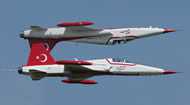
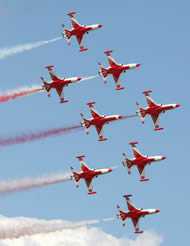
    One of the world’s leading military air force display teams, the Turkish Stars, is the latest aerobatic squadron to confirm its attendance at the 2011 Al Ain Aerobatic Show. The Turkish Stars will demonstrate their amazing airborne skills for the very first time in the UAE when they take to the skies above Al Ain International Airport from February 2-5.

    The squadron features formations of up to nine F-5 fighter jets piloted by the Turkish Air Force’s 134th Acroteam Squadron Command, which has performed in hundreds of sensational displays around the world. The Turkish Stars are the only national aerobatic team to fly with formations of eight supersonic aircraft, and in 2001 they sealed a world record by performing to an audience of over 1 million people at an aerobatic show in Azerbaijan.
    “Turkish Stars have an outstanding pedigree for entertaining spectators and displaying truly remarkable skills and execution,” said Faisal Al Sheikh, Events Manager, Abu Dhabi Tourism Authority (ADTA), which organises the Al Ain showpiece in conjunction with the UAE Armed Forces. “Spectators are guaranteed a dazzling exhibition of aerobatic arts when the team flies above Al Ain in February.

    By joining some of the world’s best display teams, they will help the Al Ain Aerobatic

    Show to raise the benchmark for world-class spectacles in the Middle East.”

    The Al Ain Aerobatic Show is held under the patronage of HH General Sheikh Mohammed bin Zayed Al Nahyan, Crown Prince of Abu Dhabi and Deputy Supreme Commander of the UAE Armed Forces.

    Now in its ninth year, the show has become firmly established as one of the world’s top five aerobatic events. Pilots from over a dozen of the best formation teams on the planet will visit the Oasis City to manoeuvre their agile aircraft over four days, in front of expected record crowds of some 130,000.

    Taking centre-stage at the 2011 event will be the unique, multi-discipline FAI Desert Challenge. Arranged by the Fédération Aéronautique Internationale (FAI), the international governing body for air sports, the Desert Challenge will see six of the world’s best pilots flying CAP232, Sukhoi 26 and Xtreme aircraft in classic and free-style competition formats.

    Spectators at the Al Ain Aerobatic Show will be treated to a wealth of death-defying stunts featuring wing-walkers, subsonic jets and choreographed “dancers in the sky”. The Turkish Stars and FAI Desert Challenge participants will also be joined by the four Hawker Hunter supersonic fighter jets of Team Viper, which will be performing their amazing mock ground formation attack scenario for the first time in the Middle East.

    Making their Middle East debut will be the Baltic Bees from Latvia, flying L-39C Albatros twin-shaft jets at speeds topping 900 km/h. Miss Demeanour, a mark F.4 XF947 Hawker Hunter that was built for Britain’s Royal Air Force in 1956, returns for a second consecutive year to thrill the spectators.

    ADTA is significantly expanding the spectator village for 2011 to make it the largest to date. Among the wide range of activities on offer for all the family will be karting, model aircraft displays, a hot air balloon and VIP flights, while a greatly improved selection of F&B outlets will cater to every taste.

    Daily tickets for the show are Dh40 per adult and Dh25 for children between three and 10 years old, while children under three enter free. Visitors can check the website for details on how to purchase tickets – www.alainaerobaticshow.com. And by accessing the Al Ain Aerobatic Show’s official web site, www.alainaerobaticshow.com one lucky enthusiast will also have a once-in-a-lifetime chance of winning a flight with one of the pilots at the show. Commonly known as the Oasis City and central to the cultural heritage of the country, Al Ain is approximately 80 minutes drive from Abu Dhabi and Dubai, with both drives offering stunning views of the golden desert landscape as it transforms from stunning dunes into a verdant oasis

    , BlueSky Business Aviation News | 13th January 2011 | Issue #108


    The squadron features formations of up to nine F-5 fighter jets piloted by the Turkish Air Force’s 134th Acroteam Squadron Command, which has performed in hundreds of sensational displays around the world. The Turkish Stars are the only national aerobatic team to fly with formations of eight supersonic aircraft, and in 2001 they sealed a world record by performing to an audience of over 1 million people at an aerobatic show in Azerbaijan.“Turkish Stars have an outstanding pedigree for entertaining spectators and displaying truly remarkable skills and execution,” said Faisal Al Sheikh, Events Manager, Abu Dhabi Tourism Authority (ADTA), which organises the Al Ain showpiece in conjunction with the UAE Armed Forces. “Spectators are guaranteed a dazzling exhibition of aerobatic arts when the team flies above Al Ain in February. By joining some of the world’s best display teams, they will help the Al Ain Aerobatic Show to raise the benchmark for world-class spectacles in the Middle East.”

    The Al Ain Aerobatic Show is held under the patronage of HH General Sheikh Mohammed bin Zayed Al Nahyan, Crown Prince of Abu Dhabi and Deputy Supreme Commander of the UAE Armed Forces.

    Now in its ninth year, the show has become firmly established as one of the world’s top five aerobatic events. Pilots from over a dozen of the best formation teams on the planet will visit the Oasis City to manoeuvre their agile aircraft over four days, in front of expected record crowds of some 130,000.

    Taking centre-stage at the 2011 event will be the unique, multi-discipline FAI Desert Challenge. Arranged by the Fédération Aéronautique Internationale (FAI), the international governing body for air sports, the Desert Challenge will see six of the world’s best pilots flying CAP232, Sukhoi 26 and Xtreme aircraft in classic and free-style competition formats.

    Spectators at the Al Ain Aerobatic Show will be treated to a wealth of death-defying stunts featuring wing-walkers, subsonic jets and choreographed “dancers in the sky”. The Turkish Stars and FAI Desert Challenge participants will also be joined by the four Hawker Hunter supersonic fighter jets of Team Viper, which will be performing their amazing mock ground formation attack scenario for the first time in the Middle East.

    Making their Middle East debut will be the Baltic Bees from Latvia, flying L-39C Albatros twin-shaft jets at speeds topping 900 km/h. Miss Demeanour, a mark F.4 XF947 Hawker Hunter that was built for Britain’s Royal Air Force in 1956, returns for a second consecutive year to thrill the spectators.

    ADTA is significantly expanding the spectator village for 2011 to make it the largest to date. Among the wide range of activities on offer for all the family will be karting, model aircraft displays, a hot air balloon and VIP flights, while a greatly improved selection of F&B outlets will cater to every taste.

  • Patrick Kennedy: Blame Palin, Tea Partyers

    Patrick Kennedy: Blame Palin, Tea Partyers

    By David A. Patten

    Former Rep. Patrick Kennedy, whose uncles John and Robert Kennedy both fell to assassins’ bullets, says there is a direct connection between Sarah Palin and the shooting rampage in Arizona that killed six people and wounded 14 others, including critically injured Rep. Gabrielle Giffords.

    Kennedy indicated that he also blames the tea parties for the tragedy.

    In an interview published on Politico Tuesday, Kennedy states: “When Sarah Palin puts targets on people’s districts? Or you have 10,000 signs on the mall during the healthcare battle saying ‘Bury Obamacare with Kennedy’? When the vitriol and the rhetoric is so violent, we have to connect consequences to that.”

    Kennedy, the son of the late Sen. Edward Kennedy, has represented Rhode Island since 1995. He did not run for re-election and left the House of Representatives this month when the new Congress was sworn in.

    Several pundits associated with progressive politics — Jonathan Chait of The New Republic, James Fallows of The Atlantic, Howard Kurtz of The Daily Beast, and Juan Williams of Fox News — have denounced left-wing aspersions blaming conservatives for the acts of a deranged gunman.

    There is no evidence that alleged shooter Jared Loughner ever mentioned Palin, or any other prominent conservative, in his writings and videos. He did profess an interest in the Communist Manifesto and Hitler’s Mein Kampf, however. In fact, there is evidence his fixation on Giffords dates to 2007, which predates the rise of both Palin and the grass-roots conservative movement.

    Brent Bozell of the conservative Media Research Center watchdog organization told Newsmax on Monday that liberals seek nothing less than the “criminalization of conservative thought.”

    Kennedy, who has endured a long struggle with chemical dependency, recently founded a nonprofit, “The Next Frontier.” He says it will act as a clearinghouse for scientific information on a variety of brain disorders, including Alzheimer’s and Parkinson’s.

    In the Politico interview, an animated Kennedy appeared to come to Loughner’s defense, saying he and others had been unfairly stigmatized.
    “When I hear terms about the alleged shooter in this case, pejorative terms like psycho, lunatic, or they say ‘He’s crazy.’ These are terms we use to describe someone’s mental health?

    “This is a rare opportunity to take all the stigma and stereotyping,” Kennedy said, “and take the terms like crazy and psycho, that are being bandied about by reputable people who should know better, and use this as an opportunity to have some enlightened debate about better public policy that can help respond to the real need amongst many families whose family members are part of that very small subset of individuals who suffer from violent, paranoid schizophrenia.”

    Although authorities have questioned Loughner’s mental function, no formal medical diagnosis of schizophrenia has been made.

    Kennedy told Politico that, during the healthcare debate, he saw a sign outside Congress that read: “Bury Obamacare With Kennedy,” a reference to his father.

    He later told The Providence Journal: “My family’s seen it up close too much with assassinations and violence in political life. It’s a terrible thing when people think that in order to get their point across they have to go to the edge of violent rhetoric and attack people personally.”

    © Newsmax. All rights reserved.