Month: January 2011

  • Franklin Graham Defends Palin on Arizona Shootings

    Franklin Graham Defends Palin on Arizona Shootings

    s

    By David A. Patten

    Internationally respected evangelist Franklin Graham, the son of the great preacher Billy Graham, jumped into the political fray Tuesday by denouncing “outrageous” attempts by the political left to blame Alaska Gov. Sarah Palin for the Tucson rampage that left six dead and 14 wounded.

    “This is a time for mourning and prayer for the victims and their families,” Graham reminded those who appear to be trying to exploit the shooting spree for political gain.

    That Graham would come to Palin’s defense suggests the backlash to liberal attempts to lay the murderous rampage at the feet of conservatives may be expanding.

    “I have been shocked at the reports from those suggesting that former Governor Sarah Palin has some level of responsibility for the horrific shooting in Arizona,” Graham said in the statement posted Tuesday on the Billy Graham Evangelistic Association (BGEA) website.

    “I got to know Governor Palin when she served as governor of Alaska,” stated the younger Graham, who is BGEA’s president and CEO.

    “She was extremely helpful to Samaritan’s Purse in providing relief to remote villages throughout the state. Most recently, she and members of her family traveled with me to Haiti where we visited cholera clinics, temporary shelter communities, and participated in an Operation Christmas Child distribution.”

    Samaritan’s Purse is the ministry organization Graham founded that conducts various international relief operations.

    Graham went on to praise Palin as “a kind and compassionate, God-fearing woman who believes with all her heart that Jesus Christ is the Way, the Truth, and the Life.”

    Graham’s statement strongly suggested that he views political attacks based on the tragedy to be highly inappropriate.

    “Whether you agree with her politics or not, it is outrageous to suggest that her political opinions encourage violence toward anyone,” Graham declared.

    Prominent Democrats, including former Rep. Patrick Kennedy, MSNBC host Keith Olbermann, Rep. James Clyburn of South Carolina, and columnist Paul Krugman of The New York Times have been leading the charge to blame Palin and grass-roots conservatives for the massacre.

    Several pundits associated with progressive politics, however, have denounced left-wing attempts to pin the cold-blooded murders on heated conservative rhetoric.

    Those mainstream commentators include: Jonathan Chait of The New Republic, James Fallows of The Atlantic, Howard Kurtz of the Daily Beast, and Juan Williams of Fox News. They point out that there is no evidence the 22-year-old suspect was motivated by politics.

    The Christian broadcasting group CBN reported Tuesday in a separate statement that Graham issued, urging Americans to be “measured and cautious before they place blame.”

    Speculation continues as the investigation continues into what touched off the shootings at a Tucson-area Safeway supermarket that critically wounded Rep. Gabrielle Giffords. The FBI has turned up evidence indicating the suspect have fixated on the Democratic congresswoman as early as 2007, long before the rise of Palin and the tea party movement to national prominence.

    According to CBN, Graham warned in the second statement that rushing to blame anyone for the shooting before the full story is known might actually contribute to an atmosphere of angry intolerance.

    “Hasty accusations have already been made before much information is known and an investigation has occurred,” he stated. “I believe this is counterproductive and could in itself incite hatred.

    “This is not a time for political opportunism,” he added. “Just because we disagree with someone from another political party does not mean we wish them harm.”

    CBN also reported that Graham is alarmed by the acceptance of “murder, violence, and rape as entertainment” in U.S. culture, as reflected in television, movies, and videogames.

    Graham advised the nation to do “serious soul searching.” Otherwise, he warned, America “could see the destruction of the foundation upon which this nation was built if we are not careful.”

    Graham’s father, the Rev. Billy Graham, is now 92. By some accounts, he has preached to more people in person than anyone else in history.

    Billy Graham’s staff says the evangelist has led more than 2.5 million people worldwide to faith in Jesus Christ.

    © Newsmax. All rights reserved.
  • Sassounian’s column of Dec. 30, 2010

    Sassounian’s column of Dec. 30, 2010

    Resolute Response Required to Pelosi’s
    Failure on Genocide Resolution


    Armenians worldwide are justifiably outraged by the refusal of Speaker Nancy Pelosi and House Democratic leadership to bring the Genocide Resolution to a vote.
    Cong. Pelosi had “the majority, the authority, and the opportunity” to schedule a vote on the Armenian Genocide Resolution, but failed to do so, the Armenian National Committee of America announced last week. Why didn’t she bring up the Resolution to a vote? It is important to note that contrary to their previous practice, neither the President nor the Secretary of State made any public statements against the Resolution. They did not have to; they had made a behind the scenes deal with Speaker Pelosi not to schedule a vote on the Resolution before Congress adjourned for the year, according to a knowledgeable Washington source. Under these circumstances, the self-serving claims of Turkey’s Ambassador and Turkish-American organizations that their belated actions blocked the vote were complete exaggerations, if not outright falsehoods, and inconsequential!
    The Armenian Genocide Resolution is neither the beginning nor the end of Armenian political demands. Here is why: this is a commemorative resolution with no force of law; similar Genocide Resolutions were adopted by the House of Representatives twice, in 1975 and 1984; and such resolutions are only a means to an end.
    What is the real objective of the Armenian Cause? Obtaining justice for Armenians from the descendants of those who not only butchered them, but occupied their homeland and confiscated their properties.
    Turkey’s Foreign Minister Ahmet Davutoglu stated last week that the Resolution was like “the sword of Damocles hanging above our heads.” He expressed the hope that such initiatives would not be brought up again in Congress as they wasted Turkey’s energy and time. The threat felt by Turkish leaders a century after their ancestors’ heinous crimes and the waste of their valuable resources to counter the Resolution are reason enough for Armenians to bring such initiatives to every legislative body in the world year after year. Moreover, each time Turkish leaders demand that a U.S. President block such a resolution, in return they are obligated to make costly political concessions to the American side.
    Armenian-American organizations, led by ANCA, must now make a dispassionate strategic assessment to consider their next moves:
    1. File lawsuits against Turkey and Turkish firms in U.S. federal courts, the European Court of Human Rights, and the World Court.
    2. Increase the number of “hanging swords” on Turkish leaders’ heads by submitting multiple congressional resolutions that go beyond genocide acknowledgment. Among other things, these could include restitution of confiscated Armenian properties and return of churches to the jurisdiction of the Armenian Patriarchate of Turkey.
    3. Capitalize on Turkish leaders’ anti-western policies and statements to generate support for Armenian issues among the new Republican majority in the House.
    Here are some preliminary thoughts on specific actions that could be considered by Armenian-American leaders in the coming weeks:
    1. Steps to be taken against Minority Leader Pelosi and House Democratic leaders as political payback for their obstructionism. It is now up to them to woo their disappointed Armenian supporters with a series of concrete actions, not promises, to undo the damage they have caused to their own credibility.
    2. Start planning for the 2012 elections to ensure that no Armenian-American would cast a vote or contribute a single dollar for Pres. Obama or any other member of Congress, Democrat or Republican, opposed to Armenian issues.
    3. Assess the inaction of leaders in Armenia and the Diaspora who did not lift a finger nor utter a word in support of the Genocide Resolution, while Turkey’s President, Prime Minister and Foreign Minister were pressuring Pres. Obama and Secretary of State Hillary Clinton to block the vote.
    4. Capitalize on the activism of the newly-energized Armenian-American community, especially the youth and celebrities such as Kim Kardashian and Serj Tankian, to engage them in creative ways of pursuing the Armenian Cause.
    5. Support Senators who have an interest in placing a new “hold” against Francis Ricciardone or his replacement as nominee for U.S. Ambassador to Turkey. There has been no U.S. Ambassador in Ankara for more than 6 months. Similarly, Azeri-American efforts in support of the Turkish campaign of genocide denial must be countered by placing a new “hold” on Matt Bryza or his replacement as nominee for U.S. Ambassador to Azerbaijan. There has been no U.S. Ambassador in Baku for more than 18 months.
    Instead of getting dejected by last week’s temporary setback, Armenians should strengthen their political resolve and escalate their demands from Turkey, using all legitimate means of redress to advance their just cause!

  • America and the rise of middle powers

    America and the rise of middle powers

    US foreign policy is stuck in a cold war mindset of imperial dominance. It’s time to listen to allies like Turkey and adjust

    • Stephen Kinzer
    • guardian.co.uk, Tuesday 11 January 2011
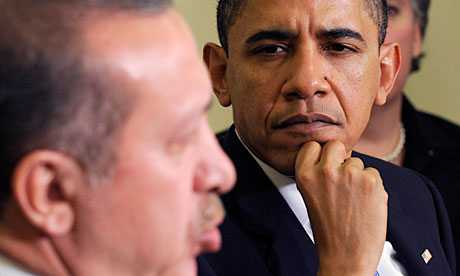
    President Barack Obama, with Turkish prime minister Recep Tayyip Erdogan. The US would do well, argues Stephen Kinzer, to foster closer ties with its longstanding Nato ally Turkey, a Muslim country with a strong democratic tradition, more reliably opposed to extremism than other US partners like Saudi Arabia and Pakistan. Photograph: Susan Walsh/AP

    The dramatic rise of Turkey in the councils of world power was one of the main geopolitical developments of 2010. Iran‘s emergence as a serious regional power was another. They are harbingers of what will be one of the main trends of global power in coming decades: the rise of middle powers.

    This era is an exciting one for rising countries. Their drive to assert themselves, though, poses an inevitable challenge to powers accustomed to dominating the world, chiefly the United States.

    One of the immutable patterns of history is the rise and fall of great powers. Those that survive are the ones that adapt as the world changes. Thus far, however, the US shows little sign that it is willing to accommodate the rise of middle powers. American leaders are frozen into denial and caught in a straitjacket of policies shaped for another era. Unless they can become more nimble, the US risks losing both global influence and domestic prosperity.

    In the Middle East, Washington is pursuing policies shaped to fit a cold war security environment that no longer exists. Saudi Arabia and Israel have been America’s closest partners there for the last half-century. Yet Saudi society has nothing in common with western societies, and some long-term Saudi security interests, like promoting radical Islam around the world, run counter to western interests. Israel gives signs of careening toward self-destruction, taking steps that undermine the regional stability that is its only guarantee of long-term security.

    Alliances and partnerships produce stability when they reflect realities and interests. In the Middle East, the US should stop acting as if it, alone, knows what is best, and instead, seek a Muslim partner. Turkey is the logical choice. It is a longtime Nato ally and booming capitalist democracy, and has unique influence around the Islamic world.

    Turkey has been urging the US to change its approach to Iran by abandoning its policy of threats and sanctions. It suggests an approach based on rational self-interest rather than emotion: offer unconditional talks, not limited to the nuclear issue but aimed at a “grand bargain” that would recognise Iran’s new role and give it a stake in regional security. India has recently made this same appeal to Washington. Yet the US, locked into outdated paradigms, continues on steady course even as global conditions change.

    Iran bets on Middle East forces like Hamas and Hezbollah, which win elections. The US bets on the Saudi monarchy, the Pharaonic regime in Egypt, the Palestinian Authority, and increasingly radical politicians in Israel. The future will require interest-based partnerships that meet the needs of a new age.

    One could be a “power triangle” linking the US with Turkey and Iran. These two countries make intriguing partners for two reasons. First, their societies have long experience with democracy – although for reasons having to do in part with foreign intervention, Iran has not managed to produce a government worthy of its vibrant society. Second, these two countries share many security interests with the west. Projecting Turkey’s example as a counter-balance to Islamic radicalism should be a vital priority. As for Iran, it has unique ability to stabilise Iraq, can also do much to help calm Afghanistan, and is a bitter enemy of radical Sunni movements like al-Qaida and the Taliban. Contrast this alignment of interests to the dubious logic of western partnerships with Saudi Arabia and Pakistan, so-called allies who also support some of the west’s most violent enemies.

    Adroit geo-strategists take new realities into account as they try to imagine how global politics will unfold. In the foreign policy business, however, inertia is a powerful force and “adroit” a little-known concept. Reconceiving entire regions of the world is not a pursuit at which government bureaucrats excel. Yet, this is not all that American leaders must reconceive. The new century requires them to question the assumption – central to American strategic thinking for generations – that that the world is a dangerous place in need of management, and that the United States must do the managing. A better course for the 21st century would be to withdraw from adventures and listen more closely to friends.

    Stephen Kinzer is giving a series of talks in the UK this week on these themes

  • Step by Step, Gulf Between Turkey and Kurds Narrows

    Step by Step, Gulf Between Turkey and Kurds Narrows

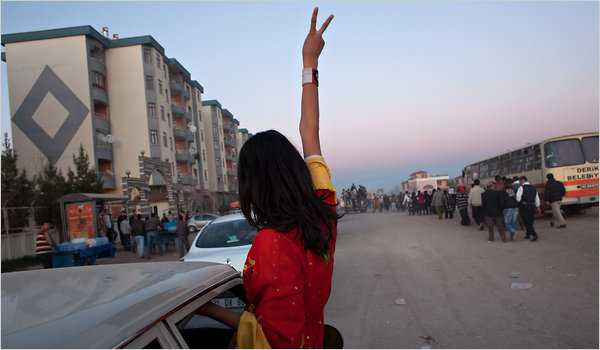
    Kurds in Diyarbakir, Turkey. President Abdullah Gul has visited the country’s Kurdish region three times since taking office.

    By SEBNEM ARSU
    Published: N Y Times January 10, 2011

    ISTANBUL — For years, Kurds in Turkey knew better than to air demands for more rights in public. In a country that has often valued loyalty to the state above free speech, discussion of placing any distance between the Kurds and the state was tantamount to a prison sentence.

    Now, the Web site of the pro-Kurdish Peace and Democracy Party has published a manifesto that includes a demand for “democratic autonomy.”

    No one has been arrested. And although the president traveled to the country’s Kurdish region to try to rein in further talk of autonomy, analysts said that the fact he went at all was the latest sign that the government was continuing its outreach to its most restive minority despite pushback from the nation’s powerful nationalists.

    The trip was President Abdullah Gul’s third to the region since taking office in 2007, a drastic shift from the past, when the country’s leaders rarely visited.

    The changes, analysts say, are partly the result of Prime Minister Recep Tayyip Erdogan’s longstanding policy of trying to reconcile with the Kurds. But it might also be good politics: with a general election just months away and a population increasingly weary of armed conflict, many Turks are ready to make at least some concessions to the Kurds. Reconciliation could also help the country’s continuing efforts to jump-start troubled talks on entry into the European Union.

    “The government has the chance of winning Kurdish hearts by quitting the traditional state rhetoric,” said Umit Firat, a Kurdish intellectual. “And in any new formula, both Kurds and Turks are now aware that the outdated principle of ‘everyone is a Turk’ needs to be changed.”

    Kurdish militants, meanwhile, have been staging their own public relations offensive. The Kurdistan Workers’ Party, or the P.K.K., has extended a unilateral cease-fire after the group’s violent struggle that lasted more than a quarter-century and cost 40,000 lives, and one of the group’s top leaders, Murat Karayilan, has been arranging interviews with journalists to talk of peace from his redoubt in the mountains of northern Iraq. Many in Turkey are likely to question Mr.
    Karayilan’s sincerity, but his pronouncements of the need for a political solution follow important moves by the government to quell Kurdish discontent.

    A round of reforms in recent years allowed such liberties as the use of the Kurdish language in public, on public television and during prison visits, all of which had been previously banned. Those reforms, motivated mainly by aspirations to join the European Union, were part of gradually improving relations over the past decade.

    More recently, the ruling Justice and Development Party has been promising to introduce a new constitution, replacing one that was imposed after a military coup in 1980 and is considered by many to be oppressive. Although the government has not said how the new constitution would affect the Kurds specifically, Mr. Erdogan has promised that changes would be made in consultation with community leaders and nongovernmental organizations.

    It is highly unlikely that Mr. Erdogan would consider autonomy for the Kurds, but analysts expect him to at least entertain notions like restructuring election laws to allow minority parties to have greater access to Parliament and allowing wider use of ethnic languages like Kurdish.

    Extending the rights of Kurds could help the government in its quest to make further inroads with the country’s 14 million Kurds, including supporters of the Peace and Democracy Party, and allow Mr. Erdogan to work around the party, which the government considers a political wing of the P.K.K.

    It is unclear if the changes being considered by the government will meet Kurdish expectations, but with even the P.K.K. talking about peace, the chances for real breakthroughs are greatly improved.

    Publicly, the ruling party refuses to negotiate with the P.K.K., which is listed as a terror organization by the European Union and the United States. But behind the scenes, it has been reaching out to Kurdish activists to find common ground on which to build a viable solution.

    The government will also have to be careful not to inflame nationalist sentiments, since Kurdish rights remain a politically explosive issue.

    There have been setbacks before in relations with the Kurds.

    A small group of P.K.K. members were invited by the government to return to Turkey as a political gesture in 2009, which was greeted with such hostility by nationalist groups that the program was abruptly halted.

    Later that year, hundreds of Kurdish political activists were arrested on terror charges in an effort to appease the nationalists, and the government has since taken a more cautious tone in addressing the conflict. As recently as last week, the government sounded the same
    tone: “A single country, a single nation, a single state and the only official language, Turkish — this is the basis of our politics,” Cemil Cicek, a government official, said after a cabinet meeting.

    And more violence, following a suicide bombing in Istanbul in October that injured more than 30 people, could chill relations again.
    Although the P.K.K. said it was not responsible, the Kurdistan Liberation Hawks, a group known to carry out urban attacks on behalf of the P.K.K., later took responsibility.

    Still it is clear that the public mood is shifting, as people have been getting used to the relative calm since the P.K.K. declared its cease-fire.

    Recently, thousands of Turks staged an unusual gathering in central Istanbul to demand peace with banners that read, “End the operations, establish peace,” and “Embrace your brother, let the peace be.”

    “Democracy, for us, is indispensable, and the resolution should definitely be a political one,” Cesim Soylu, a member of the pro-Kurdish party, said, and he warned against violence in case politics failed. “If the deadlock deepens, it is inevitable that forces other than our political party would resort to other methods, which surely also worries us.”

  • The Mossad myth

    The Mossad myth

    By keeping anything and everything under wraps, the agency allows the rumor mill about its activities to grind on.

    By Yossi Melman

    Before it was permissible to say the words “Mossad” and “Shin Bet,” they would publish want-ads using euphemisms such as “a state institution …” Ostensibly, times have changed. Both the Mossad and the Shin Bet security service have websites; they can be called by name, and the names of the organizations’ heads are known. The Shin Bet even has a spokesperson, and she has a few assistants.

    It can be assumed that the new Mossad chief, Tamir Pardo, who will officially take the reins next week, will consider appointing a spokesperson for his organization. (His predecessors Efraim Levy and Meir Degan thought about such an appointment, but both dropped the idea. )

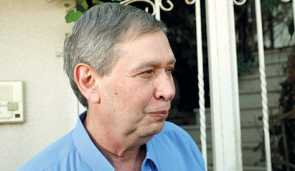
    Next Mossad chief Tamir Pardo - Photo by: Moti Milrod

    But openness in these organizations is an illusion. In essence, the Mossad has remained the same “state institution” that takes pains to classify and guard every shred of information relating to it, even if it is not a matter of operational secrecy or particularly sensitive information. The protection of secret and sensitive information is essential and clearly understood, but what the Mossad seeks to censor is information that could harm its image.

    Whatever it does, the Mossad generally enjoys the across-the-board support from nearly all of Israel’s government.

    Utilizing the euphemism “jeopardizing state security” , the military censors almost always ban publication of reports to which the Mossad objects. The courts are generally happy to assent to any request delivered by the Mossad, including issuing gag orders in the presence of one party only; the Finance Ministry does not disclose the Mossad’s budget, and the National Insurance Institute and the Justice Ministry are prevented from disclosing information about labor-related issues concerning the organization’s employees.

    The Prison Service also surrenders to Mossad whims. In the past, security prisoners were incarcerated in its jails in total isolation. There were years when such inmates were called “prisoner X,” and confined to “cell X” in the Ramle prison.”The Third Man,” as Avraham Seidenwerg / Avri Elad was known, and Mordecai Kedar in the 50s and 60s, are prime examples of those dark days in Israeli democracy, in which security prisoners were made to disappear.

    Only a handful of wardens had access to such prisoners, and even they did not know the inmates’ identities. For instance, in the 80s Prof. Avraham Marcus Klingberg, imprisoned on charges of spying for the Soviet Union, was known to the small group of guards in charge of him as “Avraham Greenberg.”

    Ali-Reza Asgari, rumored to be in Israel. - Photo by: Reuters

    The result of this unjustified and undemocratic policy of sealed lips is that rumors periodically circulate about the Mossad, most of them unfounded or inaccurate. The rumors make their way to internet sites overseas or to foreign journalists, quite a few of whom are completely clueless.

    A good example of such rumor spreading is the veteran journalist Gordon Thomas, who wrote a bestseller about the Mossad. His book was classified as non-fiction but it should have been on the fiction shelf, since his stories and articles are full of fabrications, half-truths and baseless claims that even the most ardent conspiracy theorists would have trouble accepting.

    For instance, he claimed that Monica Lewinsky was planted by the Mossad to entice U.S. President Bill Clinton, and stain his reputation. A few days ago, Gordon Thomas was sure that the new Mossad chief, Pardo, who has yet to take up his position officially, would soon apologize to the British for the Mossad’s alleged use of British passports.

    In order to gauge Thomas’ reliability, suffice it to note that he stated in this report that Pardo served for the past three years as deputy Mossad chief. In fact, Pardo left the Mossad two years ago.

    Claims have recently been made according to foreign reports that the Iranian general Ali-Reza Asgari, former head of the Al Quds division of the Revolutionary Guards and former Iranian deputy defense minister, is in Israel. Asgari disappeared in December 2006 under mysterious circumstances, during a trip to Turkey; since then, there have been a number of media reports suggesting that he sought asylum in a Western country, and relayed important intelligence information to it and to allied intelligence organizations.

    Anyone who knows something about these subjects, and is familiar with relevant precedents, could conclude that the chances of Asgari finding asylum in Israel, or being forcibly brought here, are negligible. Defectors from Arab countries, such as the Iraqi MIG pilot Munir Redfa, or the Egyptian pilot Hilmi Abbas in the 60s, or the KGB station chief Yuri Lomov, who defected to Israel, chose, after being debriefed, to leave and remake their lives in a Western or South American country. The chances of a senior Iranian defector finding asylum here are close to nil.

    The Mossad has neither the interest nor the ability to respond to such rumors. Sometimes it seems as though the organization enjoys rumors that bolster its image, depict it as an omnipotent entity, and thereby indirectly enhance its, and Israel’s, deterrent capability. The extent to which the Mossad’s reputation captivates imaginations globally is reflected by the fact that designers from a well-known international sports shoe company recently called a new brand “Mossad.”

    However, the creation of a mythos and the ignoring of rumors has negative aspects. There are always credulous types who believe inaccurate reports and draw conclusions that could damage Israel in the future.

    It would be better were Israel to realize that in some cases the release information, no matter how inconvenient and painful it might be, is preferable to concealing it and allowing an irresponsible, damaging rumor mill to grind on.

    And now, the movie

    It was only a matter of time. This week the family of Ashraf Marwan, who owns a television channel, announced it would be producing a film and a television series about his life, to be released in 2011. Marwan was a Mossad agent who warned Israel about the Yom Kippur War in 1973, but in recent years former Military intelligence chief Eli Zeira claimed that Marwan was a double agent. Thus, in 2007 he was murdered in London, likely by Egyptian security agents. The family’s aim is to clear Marwan’s name and present him as an Egyptian patriot who misled Israel and fed it false information.

    Some two decades ago, Egyptian television did exactly the same and screened a documentary series about an Egyptian agent who penetrated Israel as a Jew named Jacque Biton. The series presented him as a hero, but in fact, he betrayed Egypt and became a valuable Israeli intelligence agent.

    https://www.haaretz.com/2010-12-30/ty-article/the-mossad-myth/0000017f-e652-df5f-a17f-ffdebac50000, 30.12.10

    [2]

    Iranian ‘Mossad agent’: I was trained in Israel

    Iranian state television shows interview with man who claims he was trained in espionage by Israel and participated in the assassination of a nuclear scientist in Tehran last year.

    https://www.haaretz.com/2011-01-10/ty-article/iranian-mossad-agent-i-was-trained-in-israel/0000017f-eccf-d4cd-af7f-edffb3e60000
    [3]

    Iran claims to have smashed ‘Mossad spy ring’

    Iran claims it has broken up a ‘Mossad ring’ allegedly behind the murder of an Iranian nuclear scientist in Tehran last year.

    https://www.telegraph.co.uk/news/worldnews/middleeast/iran/8250787/Iran-claims-to-have-smashed-Mossad-spy-ring.html

  • Forecast 2011: Turkey’s time has come

    Forecast 2011: Turkey’s time has come

    January 6, 2011 — Istanbul
    Writer: Matthew Brunwasser

    The diplomats can relax. No one needs to worry about “losing Turkey”. The West’s most trusted Muslim ally (usually described with the cliché “bridge between East and West”) is not shifting its loyalty away from Europe toward the Islamic world. Rather it is opening and seeking good relations with its eastern neighbours as well.

    It is precisely because of its political and economic flexibility that Turkey can expect 2011 to be the country’s strongest in centuries, since the star of the Ottoman Empire began its slow descent. Turkey is now a rising economic and political power. The growing self-confidence can be felt especially powerfully in the streets of Istanbul and its increasingly international culture. 

Like big changes in any relationship long taken for granted, many in the West are uncomfortable with Turkey’s courting of the East and its new assertiveness. But this geo-strategically key country with the world’s 17th largest economy and Nato’s second largest military is not going anywhere.

    Turkey does need to be careful to not overextend its reach though or it will learn quickly the limits of geopolitical power. The tensions will become clearer in the highly charged political build-up to parliamentary elections expected in June.

    Istanbul’s extraordinary economic development was highlighted last year in a study of the world’s 150 biggest metro areas by the Washington-based Brookings Institute.

    The Global Metromonitor found that Istanbul had the most dynamic economy of any big city in the world. Istanbul has recovered from the 2008 global economic downturn better than all the rest, partly because the country was better prepared since going through economic meltdown in 2000-1.
  
Since the Justice and Development Party [AKP] of Prime Minister Recep Tayyip Erdogan came to power in 2002, the country is almost unrecognisable in its economic strength and political assertiveness. As an example of its new eastern orientation, exports to the Middle East as a share of all of Turkey’s exports have doubled from 9 to 18 per cent since 2002 and look set to increase this year as well. During the same period, the share going to the EU fell from 56 per cent to less than half.

    In the summer elections, voters will choose whether to give a third mandate to the AKP. The election campaign started long ago and tensions are already building over key issues such as peace with Turkey’s Kurdish minority, Turkey’s international orientation, women’s headscarves and the country’s economic development.

    Whatever the outcome, Turkey’s global influence is likely only to grow.

    Matthew Brunwasser is a Monocle contributor based in Istanbul

    January 6, 2011