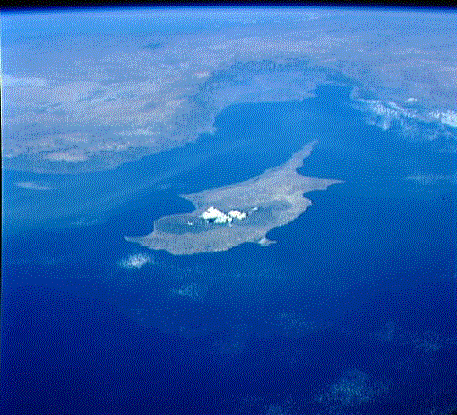
INSTEAD of reacting in a negative and provocative manner over comments by German Chancellor Angela Merkel, Turkey should implement United Nations resolutions and European Union decisions on Cyprus, the government said yesterday.
“Turkey does not like to be reminded of the illegalities it has been carried out in Cyprus since 1974 with the invasion, occupation, colonisation, violation of the territorial integrity of the Republic of Cyprus, the human rights and basic freedoms of Cypriots,” government spokesman Stefanos Stefanou said.
He said Turkey is used to commit offences and then demand to be thanked for them.
“Instead of reacting in this negative and provocative manner when what she should do is pointed out, Turkey should implement the UN resolutions and EU decisions regarding the Cyprus problem and not seek a lifejacket in 2004,” Stefanou said, referring to the referenda in which Greek Cypriots rejected a UN reunification plan while Turkish Cypriots approved it.
Turkey was irked by comments made by Merkel during a brief visit to Cyprus earlier this week and wants apology.
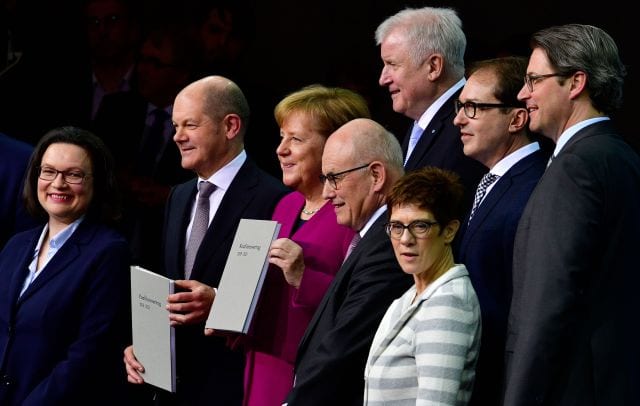
The German Chancellor assured Christofias of Germany’s support to efforts for a Cyprus settlement and commended his efforts to create momentum in the ongoing UN-led direct negotiations.
“We particularly appreciate your courage, the creativity which you show,” Merkel said in the announcement, adding that unfortunately so far there has been no response to this readiness for compromise.
Merkel underlined that Germany supports UN efforts, adding the country will make it known to Turkey during talks with officials in the future that there needs to be progress in the process.
Turkish Premier RecepTayyip Erdogan said “Merkel’s statements not only hurt but they also reflect a lack of historical knowledge and contradict statements she has made in the past. Merkel showed how unfamiliar she is with the Cyprus dispute.”
Erdogan recommended Merkel read a book by her predecessor, former Chancellor Gerhard Schroder covering Cyprus’ EU accession which “demonstrates how immoral the behaviours of the time were”.
He also suggested the EU and UN were preventing former UN Secretary-General Kofi Annan’s report on the 2004 referenda from being made public to protect the Greek Cypriots. Turkey would not give away a single inch of northern Cyprus, he said.
Stefanou said Turkey should help herself by doing what the international community is asking and what international legality prescribed.
“Turkey should harmonise its declarations for a solution with action; soon,” Stefanou said
via ‘Turkey wants to be thanked for its illegalities’ – Cyprus Mail.
BERLIN—Guido Westerwelle, the embattled head of German Chancellor Angela Merkel’s junior coalition partner, defended his leadership and party Thursday, saying the Free Democrats had helped spur the country’s economic recovery and acted as a bulwark against the leftward drift of German politics.
Mr. Westerwelle, who serves as foreign minister and vice chancellor under Ms. Merkel, has drawn harsh criticism from within the pro-business Free Democratic Party and increasingly dire approval ratings after failing to follow through on a tax-cut pledge and other campaign promises.
The Free Democrats’ plight has also become a headache for Ms. Merkel ahead of a string of regional elections in coming months. A collapse in support for the party could shift control of key states. Such an outcome would give the opposition a wider majority in Germany’s upper house, which represents the country’s 16 states, further hobbling the Ms. Merkel’s legislative agenda and weakening her coalition’s credibility.
“Even Hercules couldn’t turn everything around in a week. But we’ve made a start,” Mr. Westerwelle said at a party conference in Stuttgart. “Germany is doing better than it was before the election…and the (Free Democrats) have done our part.”
Critics have often branded Mr. Westerwelle as arrogant and out of touch, and reaction to the speech suggested he hadn’t done as much as his allies had hoped to improve his image.
“No self-criticism, no new ideas, no new vision,” wrote Roland Nelles, Berlin bureau chief for the news website Spiegel Online, in a commentary posted after the speech. “This was the old Westerwelle: ‘Everyone’s a fool except for me.’ ”
A weekly poll released Wednesday by Stern magazine showed support for the Free Democrats at just 4%, below the 5% threshold required to hold seats in parliament and a shadow of the nearly 15% showing that brought the pro-business party to power in national elections in September 2009. Mr. Westerwelle’s personal approval ratings are equally dire: He garnered a 29% approval rating, a personal low that put him last on the list of politicians respondents were asked to rate.
The Free Democrats spent decades as kingmakers to successive coalition governments before a decisive victory for left-leaning parties in 1998 pushed them into more than a decade of outspoken opposition to the initiatives of center-left and then grand coalition governments.
This was the climate in which Mr. Westerwelle became the youngest person ever to lead his party in 2001. Now 49 years old, he helped convert a deep current of voter dissatisfaction into a record showing for the Free Democrats in the 2009 election, but has since struggled to steer the party from a decade of adversarial rhetoric back toward their traditional role as consensus-builders.
“Naturally, 11 years heading in the wrong direction can’t be forgotten in a year,” Mr. Westerwelle said Thursday of the country’s politics while the Free Democrats were out of power. “But we’ve started to make political change.”
A key stumbling bloc has been the party’s campaign promise to lower taxes. Ms. Merkel put the agreement on hold last spring, as the government became preoccupied by the euro-zone debt crisis and made plans to set an example for the bloc’s weaker members by slashing its budget over the next three years. But key FDP leaders like Economics Minister Rainer Brüderle continued to call for tax cuts, opening the party to critiques that they were inflexible and lacked new ideas.
Mr. Westerwelle addressed the tax dispute carefully Thursday, saying the government would simplify the tax system in 2011 and would pursue tax cuts “if there is room for further tax relief through our consolidation policies, through good economic development.”
Ms. Merkel has had her own tough balancing act to perform since winning re-election in 2009, as Germany’s duty to address debt crises in Greece and Ireland ran up against domestic reluctance to pay for other governments’ fiscal sins. Lately, though, her standing among German voters has improved.
In this week’s Stern poll, respondents delivered Ms. Merkel a 59% approval rating, and support for her Christian Democratic Party and its Bavarian partner, the Christian Social Union, is stable at 34% even as the Free Democrats’ free fall has put them at a disadvantage against a likely alliance of left-leaning parties. A coalition of the Green Party and the Social Democrats would secure 44% of the vote in an election held now, according to Stern.
“The weakness of its coalition partner isn’t pretty for the chancellor,” says Oskar Niedermayer, political scientist at Berlin’s Free University.
The real test will come this spring in a series of regional elections, particularly in the southwestern state of Baden-Württemberg. Plans to redevelop the main train station in Stuttgart, the state capital, have sparked a political crisis that threatens six decades of conservative leadership. A recent poll for the first time showed a majority for a potential coalition led by the Green Party.
In Stuttgart Thursday, where protesters unfurled a banner opposing the train-station project from a balcony as he began his speech, Mr. Westerwelle portrayed the FDP as the main impediment to a slew of victories by left-leaning governments at the state level, and eventually to a national regime change. “We need to fight, if Germany isn’t to be left over to the left,” he said.
Looters took furniture from a home belonging to a relative of President Zine El Abidine Ben Ali in Hammamet, Tunisia, on Thursday.
By DAVID D. KIRKPATRICK
Published: January 13,
MySpace
Yahoo! Buzz
Permalin
HAMMAMET, Tunisia — This ancient Mediterranean hamlet, advertised as the Tunisian St.-Tropez, has long been the favorite summer getaway of President Zine el-Abidine Ben Ali and his large extended family, many of whom have built vast beachfront mansions here with the wealth they have amassed during his years in power.
Related
Times Topic: Tunisia
Tunisian Opposition Cautious Toward President’s Offer of Reform (January 15, 2011)
The Lede Blog: Fresh Video of Tunisian Protests (January 13, 2011)
The Lede Blog: Tunisians Document Protests Online (January 12, 2011)
Rioters on Thursday damaged a home in Hammamet, Tunisia, owned by a member of President Zine el-Abidine Ben Ali’s family.
But their new and conspicuous riches, partly exposed in a detailed cable by the American ambassador and made public by WikiLeaks, have fueled an extraordinary extended uprising by Tunisians who blame corruption among the elite for the joblessness afflicting their country.
And on Thursday, idyllic Hammamet became the latest casualty of that rage, as hundreds of protesters swarmed the streets, the police fled and rioters gleefully ransacked the mansion of a presidential relative, liberating a horse from its stable and setting aflame a pair of all-terrain vehicles.
That outburst was just a chapter in the deadly violence that flared around the country and in Tunis, the capital, again on Thursday, making the government appear increasingly shaky. The mounting protests threaten not only to overturn a close United States ally in the fight against terrorism but also to pull back the veneer of tranquil stability that draws legions of Western tourists to Tunisia’s coastal resorts.
President Ben Ali gave a hastily scheduled televised address on Thursday night, his second in the past week, and this time he appeared rattled. He no longer blamed foreign terrorists or vowed to crack down on protesters. Instead, he pledged to give in to many of the protesters’ demands, including an end to the government’s notoriously tight censorship, but rejecting calls for an immediate end to his 23-year rule.
“I am telling you I understand you, yes, I understand you,” Mr. Ben Ali, 74, declared. “And I decided: total freedom for the media with all its channels and no shutting down Internet sites and rejecting any form of monitoring of it.”
And he repeated a pledge he first made when he seized power in a bloodless coup: “No presidency for life.” He vowed not to challenge the constitutional age limit of 75 for presidents, which would make him ineligible to seek re-election in 2014.
The immediate response to the speech appeared mixed. In at least one neighborhood of the capital, grateful Tunisians could be heard in the streets, ignoring an 8 p.m. curfew order, cheering the president. But others said his words meant little.
“These are the same promises he made last week, that he made a few years ago, that he made in 1987, but on the ground it is always the same,” one person said, declining to be identified for fear of reprisals.
Security forces fired again at crowds of demonstrators who gathered in downtown Tunis; dozens have died so far in the crackdown on the protests, and it was impossible to confirm how many more died Thursday.
In what appeared to be a sign of division within the government or its forces, the military was withdrawn from the city by the end of the day, replaced by the police and other security forces considered more loyal to the ruling party and Interior Ministry.
There were calls for a general strike on Friday, and some people said they expected the protests to escalate when large groups of Tunisians spilled into the streets from their mosques after Friday Prayer. The government has shut down schools, universities and trains running to and from the city, leaving crowds of young people idle and many people with no way to get home.
Throughout a month of demonstrations, protesters have relied on Facebook and other social media to advertise and coordinate their actions, which started after a college-educated street vendor in a small provincial town burned himself to death in despair. (The police had confiscated his wares for lack of a permit.)
On Thursday morning a Facebook group called “The people of Tunisia are setting themselves on fire Mr. President” announced, in Arabic: “Today Hammamet: With our blood, with our souls, we sacrifice ourselves for the martyr.”
By midday, hundreds of young men were in the streets of this coastal resort city. Several banks were in flames, including one adjacent to the police station. Some said that clashes with the police had begun here on Wednesday and that they had turned out to avenge the deaths of two protesters killed the day before.
Just as in other protests in recent days, the demonstrators called for President Ben Ali to step down. But many seemed even more angry at his second wife, Leila Trabelsi, and her family — “No, no to the Trabelsis who looted the budget,” has been a popular slogan — and some said they still considered the president a good man brought down by the greed of his wife and her clan. Many refer to the president’s extended relations simply as The Family or The Mafia.
Breaking News Alert
The New York Times
Fri, January 14, 2011 — 5:25 PM ET
—–
Republican National Committee Selects Reince Priebus of Wisconsin as Chairman
The Republican National Committee selected a new chairman on
Friday, with Reince Priebus of Wisconsin surviving seven
contentious rounds of balloting to succeed Michael Steele as
party officials expressed a desire for new leadership to
prepare for the 2012 presidential election.
Mr. Priebus, who broke away from Mr. Steele’s inner circle to
run against him, pledged to pay off the committee’s $21
million debt and strengthen state parties across the country
to build upon the Republican victories in the midterm
elections. Mr. Priebus received 97 votes from the committee.
Read More:
G.O.P. Elects a New Chairman as Steele Drops Out
By JEFF ZELENY
Reince Priebus of Wisconsin survived seven rounds of balloting to succeed Michael Steele as party officials demanded new leadership.
The prime minister looks on a city’s works, and despairs
Turkey and Armenia
Jan 13th 2011 | ANKARA | from PRINT EDITION
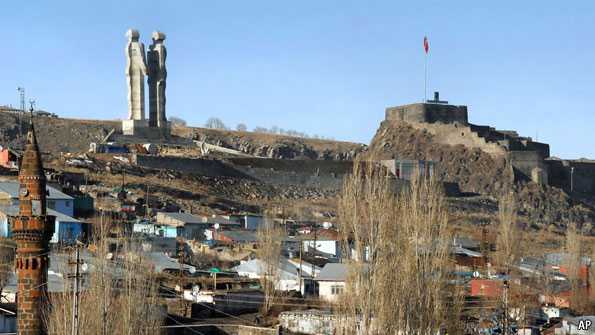
STATUES in Kars are not safe when Recep Tayyip Erdogan is around. When Turkey’s prime minister visited the city last year, the local mayor, who belongs to Mr Erdogan’s mildly Islamist Justice and Development (AK) party, sought to avoid his ire by ordering the removal of a public fountain featuring bare-breasted nymphs. Last week, during another trip to Kars, which lies about 45km west of the border with Armenia, Mr Erdogan called for the demolition of a local monument designed to promote reconciliation between Turks and Armenians. The statue, of two 30-metre-tall concrete figures reaching out to each other, was, he said, a “freak”.
Mr Erdogan insisted that his distaste was purely aesthetic. Yet some suspect him of pandering to nationalist sentiment in the run-up to elections in June. Many Turks see the statue as an admission of Armenia’s charge that the slaughter of up to 1.5m Armenians by Ottoman forces in 1915 amounted to genocide. In 2009 the then mayor of Kars, Naif Alibeyoglu, who had commissioned the statue, was forced out under pressure from Mr Erdogan and the city’s 20% ethnic Azeri population (egged on by Azerbaijan, which disliked Turkey’s efforts to make peace with Armenia).
Mr Erdogan has backed away from a set of protocols signed with Armenia in 2009 that foresaw the establishment of diplomatic relations and the reopening of borders. These were sealed in 1993 after Armenia’s short war with Azerbaijan over the mainly Armenian enclave of Nagorno-Karabakh. Mr Erdogan insists that the protocols can only be ratified if Armenia withdraws from seven regions it occupies around the enclave. Armenia is threatening to scrap the deal altogether.
But there is also a whiff of Islamic orthodoxy in the air. Mr Erdogan’s tirade against the Kars statue included references to Hasan Harakani, an ancient Muslim scholar buried nearby. “They erected a strange thing next to his mausoleum… it is unthinkable,” he complained. Many Muslim scholars consider statues to be idolatrous, and other AK officials have not disguised their aversion to them. Ankara’s mayor, Melih Gokcek, has systematically dismantled statues erected by his pro-secular predecessors. “I spit on this kind of art,” he once said.
Mehmet Aksoy, the designer of the Kars monument, says that the government risks being seen as “the Taliban” if it presses its demands. But Turkey’s foreign minister, Ahmet Davutoglu, has backed his boss, arguing that Mr Aksoy’s work fails to blend into the Seljuk, Ottoman and Russian character of the city. He might have included Kars’ Armenian legacy, but that is being erased. A long-abandoned tenth-century Armenian church recently reopened—as a mosque.
from PRINT EDITION | Europe
via Turkey and Armenia: Two vast and ugly blocks of stone | The Economist.
—– Forwarded Message —- Sent: Wed, January 12, 2011 12:30:43 PM Subject: News.Az interview with USAN co-founder and Board Director: Good or bad, it’s a confused start
Good or bad, it’s a confused start
Wed 12 January 2011
by Yusif Babanli, Member of Board of Directors of Azerbaijani American Council; Co-founder of U.S. Azeris Network.
“Off to a bad start”, says Garen Yegparian, a self-proclaimed enforcer of Armenian issues, referring to December appointments of Matthew Bryza and Francis Riccardone US ambassadors to Azerbaijan and Turkey and the unsuccessful fate of House Resolution 252 in his article in Asbarez online edition [http://asbarez.com/91420/off-to-a-bad-start/ ].
But what “bad start” is Mr. Yegparian is actually talking about?
As long as bilateral US-Azerbaijan and US-Turkey relations existed, US ambassadors have always been carefully reviewed and appointed to represent national interests of the United States. That’s right, the national interests of the United States, not those of Republic of Armenia or of Armenian Diaspora. Although Mr. Yegparian would certainly like an American envoy to represent the Armenian interests by recognizing the so-called Armenian genocide, facilitating the process of transfer of financial aid and its increase to Armenia and separatist regime in Khankendi at the expense of US taxpayers, ignoring such facts as the theft of $163 million from Medicaid by Armenian American criminal group and illegal transfer of weapons purchased by Republic of Armenia, to Iran, which ended up at the hands of Shiite insurgents in Iraq and eventually caused American casualties, the realities dictate otherwise.
In general, the US administrations should not follow any interests of any country, not Armenia, not Azerbaijan, not Turkey. It is sufficient for the US to stick to its own strategic national interests, which, in case of appointment of Bryza and Riccardone, it does.
Having finished with “unwelcomed” ambassadors, Mr Yegparian continues with his comments on the interview with Javid Huseynov, the Director of the Azerbaijani American Council who spoke of an increasing cooperation among Turkic groups. Carefully separating the Turkic groups, he underscores that he “doesn’t believe that people from the central Asian Turkic countries will be in on this to any great extent”.
How so? Increasing cooperation among Turkic groups signifies growing intercultural ties among these nations and their joint recognition of their common Turkic heritage suppressed by Soviet authorities for 70 years. Apart from that, Mr Yegparian should also note that neither people living in Central Asian Turkic states, nor those in Azerbaijan and Turkey are “Armenian-haters” and might never be. As ironic as it may seem, all these Turkic states have considerable Armenian minorities, including Turkey and Azerbaijan unlike the Republic of Armenia which has no Turkish or Azerbaijani population whatsoever which is a significant indicator as to where the haters he’s concerned of mainly hail from.
Moreover, Mr. Yegparian forgets that the reason the Turkic Central Asian states refrained from explicitly condemning Armenia on many issues is because they don’t have a common border with it. Otherwise, a piece of each of those states would have been claimed by Armenia. Eastern Turkey, western Azerbaijan and southern Georgia are good examples of irredentist claims by Armenian nationalists. However, seeing Mr Yegparian call the Orange County (CA) a “plague of locusts”, it’s not surprising to see any other comment from Garen Yegparian.
Add to the list of concerns by Mr Yegparian what he calls the “Kobe Bryant fiasco”. Asking an athlete to annul the contract with Turkish Airlines because he does not recognize the Armenian version of events in 1915 is like asking American businessmen to refrain from investing in Armenia just because a group of Armenians stole $163 million of US taxpayer contributions to Medicaid. Would that make any sense?
Lastly, Mr Yegparian speaks of the Wikileaks which have been “VERY informative about our enemies”.
Very informative about our enemies? Who exactly does Mr Yegparian consider enemies? The President of Republic of Armenia, Serzh Sarkissian? Armenian Ministry of Defense? Because last I heard, it was Armenia transferring weapons to Iran against US sanctions and at the expense of the very financial aid it receives from American taxpayers every year. For someone like Mr. Yegparian, who ran for Burbank City Council, a US government institution funded by US taxpayers, the issue should be a major concern.
Asbarez writing against Turkish/Turkic community in California
Iligili yazinin Ermeni tarafinda ABD parlementosu ve hukumetinden beklediklerini bu yil alamadiklari ve iki buyukelcinin atanmasi ilei ilgili bir hayal kirikligi yasadigini gosterdigi acik.
Azerbaycan ve Turkiyenin ortak yararlar icin beraber hareket etmesi bu beraberlige diger Turk kokeneli unsrlarin katilmasi hep arzu ettigimiz ve bunun icin caba harcadigimiz bir durum
Ben bu konulara daima bir kusku ile yaklasiyourm. Evet, Ermeniler su an icin istediklerini alamadilar, ABD nin Azerbaycan ve Turkiye buyukelcilerini atamasi ile bir hayal kirikligi yasadilar.
Simdi bu olgu bizim icin surdurulebilir bir kazancmidir?Yoksa karsi tatrafa verilecek buyuk oduller oncesi bizim tarafimiza sus payi olarak verilmis “kucuk” bir hediyemidir?
Eger dikkat edecek olursak ABD deki bir mahkeme 1900 lu yillarda sigortalanmis Ermenilerin kazanilmis haklari hakkinda daha once verdigi kararin tersinde bir karar vererek Ermenilerin sigorta sirketlerinden hak isteyebilecegi yonunde karar verdi. Konu hala yargi surecinde sanirim ama yasal alanlalarda bu denli “ani” farkli degisiklerin de nedenleri uzerinde durmakta yarar var. Tabii bu karalarin sonuclari ayri bir tartisma konusu.
Azerbaycan ve Turkiyenin birlikte hareket etmeleri sonucu gelinen yer ve basarilari yadsimamak kosulu ile, umarim ABD nin yaptigi Ermenilere verecegi “buyuk odullere” karsilik bizleri yatistirmak degildir derim.
Saygilar,
Mehmet Can
From: Acrolect <[email protected]>
Asbarez writing against Turkish/Turkic community in California
Yasar Bey tesekkurler bu bilgi icin. Bu panigi gormek bizler icin sahane . Yavas da olsa onlari bu duruma getirebildik. Ne guzel. Bu karsilikli oynanan psikolojik savasta ustun bir basari. Vencouver genclik toplantisinda dagitllmali /belirtilmeli bence.
Semra
—– Original Message —–
From: Yashar
—– Forwarded Message —-
Off to a Bad Start
BY GAREN YEGPARIAN
It’s not that anything really unpleasant has happened to us yet in 2011, it’s just that 2010 ended so badly. Here’s how, in no particular order.
President Obama screwed us with the recess appointments of Bryza and Riccardione. As a friend observed, it’s probably his way of saying to us “upstarts” in the Armenian community of the U.S. “Don’t get too big for your britches, bitches!” Matt Bryza is the worst of the pair. The guy is so deep in Azero-Turkish pockets he can’t see daylight, and he’s supposed to represent American interests in Baku. Ridiculous! Unbelievable! No fair minded person could argue otherwise. There’s no other way to interpret this than a slap in our collective face. Why? Because if he’s so competent, he could easily have been given another, equivalent appointment, where he had no conflict of interest.
As if those appointments weren’t bad enough, we have Javid Huseynov— Director General of the Azerbaijani American Council, adding insult to injury by lecturing the Armenian community about not pursuing narrow, “ethnic” interests. You see this electrical engineer type from Orange County, California knows all about defending American, over parochial interests. And why, you ask, does this paragon of American patriotism think Armenians are bad? It has nothing to do with his being an Azerbaijani government shill, of course… It’s just that these bad-old-Armenians keep introducing Genocide resolutions and obstructing international diplomacy to pursue “their” vile agenda.
While in Orange County, I should also mention that someone’s offering “Turkish” cooking classes there. Isn’t that just great? Not only do we have to contend with Turkey usurping and “Turkifying” the Armenian, Greek, and other cultural legacies of Asia Minor, but now we have Turks in the U.S. passing off as their own the cuisines they stole from the peoples they murdered!
Orange County serves as a locus (maybe I should say a plague of locusts) of Turkish activity of all types because of the large Turkish community there. But more interesting is a remark from a Huseynov interview in which he claims there will be more cooperation among all Turkic groups. This is a sign of the beginnings of political maturation of those communities in the U.S. and we should expect more challenges from that quarter and prepare for them. Of course I don’t believe that people from the central Asian Turkic countries will be in on this to any great extent, since the Armenian-haters, ideologically and historically, largely hail from what is today called Turkey and Azerbaijan.
On a broader, non-exclusively Turkic front, you can add to all this the Kobe Bryant fiasco (and the inability of many in our community to get over their addiction to the Lakers and appreciate the depth of this depravity and the damage it does us) and the ongoing bad judgment of the Southern Poverty Law Center’s leadership as evidenced in their coddling of Genocide denier Lewy.
Need I mention the fate of H. Res 252? And of course the utterly embarrassing, sniveling, brown-nosing press release issued by the Armenian Assembly that followed that fate? Here’s the offending quote:
“We applaud the tenacity of the resolution sponsor, Congressman Adam Schiff, and we also particularly commend the steadfast leadership of Speaker Nancy Pelosi and House Majority Leader Steny Hoyer, who along with Democratic Congressional Campaign Committee Chair and White House Liaison Congressman Chris Van Hollen provided guidance and invaluable assistance throughout this process,” stated Executive Director Bryan Ardouny.”
Would someone please explain to me how this outfit justifies its existence to our community? How could anyone laud the person (Pelosi) who just screwed you? A friend came up with a very apt analogy, “The Assembly is to the Armenian community what Vichy was to France.”
Our work is cut out for us, so get busy. Perhaps one of our top areas for improvement this year ought to be the realm of public opinion, both pro-Armenian and anti-Turkey/Azerbaijan. In this vein, watch Wikileaks. It has been VERY informative about our enemies. Who knows, maybe even the Assembly’s doings will pop up somewhere among those documents.