President Obama focused on domestic issues in his State of the Union Address last night – as did the Republicans in their response.Glossing over the elephant in the room (two wars and an escalating Iran situation) may be a good move politically. But with troop withdrawals scheduled for Iraq and Afghanistan this year, and a likely power void for Iran to fill, America’s global situation will call for some tough decisions in 2011.
Obama Calls for Bipartisan Effort to
Fight for U.S. Jobs
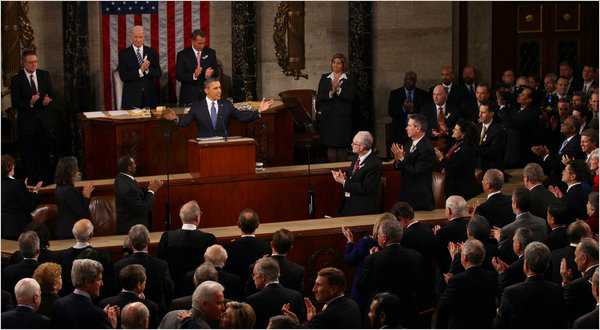
Doug Mills/The New York TimesPresident Obama focused attention on preparing the United States to thrive against global competition.
By SHERYL GAY STOLBERG
Published: January 25, 2011
WASHINGTON — President Obama challenged Americans on Tuesday night to unleash their creative spirit, set aside their partisan differences and come together around a common goal of outcompeting other nations in a rapidly shifting global economy.
Multimedia
Interactive Feature
Who Sat Where: The State of the Union Seating Chart
Interactive Feature
Patterns of Speech: 75 Years of the State of the Union Addresses
Related
News Analysis: Obama Sets Stage for Clash of Governing Ideals (January 26, 2011)
Obama Counters G.O.P. With Plan to Extend Spending Freeze (January 26, 2011)
New Seating Chart, but Same Divides (January 26, 2011)
Two G.O.P. Responses Point to Potential Fault Lines (January 26, 2011)
Political Times: After Detour, a Map of America’s Journey (January 26, 2011)
Some Difficulties Unnoted, And Some Facts Shaded (January 26, 2011)
Remarks That Touch Not Just One City (January 26, 2011)
Nanotechnology Gets Star Turn at Speech (January 26, 2011)
Times Topic: State of the Union
Related in Opinion
Editorial: The State of the Union (January 26, 2011)
Enlarge This Image
Stephen Crowley/The New York Times
Michelle Obama with Dallas Green, brother of Christina-Taylor Green, the 9-year-old girl killed in Tucson. He was accompanied by his parents, John and Roxanna.
In a State of the Union address to a newly divided Congress, Mr. Obama outlined what he called a plan to “win the future” — a blueprint for spending in critical areas like education, high-speed rail, clean-energy technology and high-speed Internet to help the United States weather the unsettling impact of globalization and the challenge from emerging powers like China and India.
“The rules have changed,” he said.
But at the same time he proposed budget-cutting measures, including a five-year freeze in spending on some domestic programs that he said would reduce the deficit by $400 billion over 10 years.
Drawing a stark contrast between himself and Republicans, who are advocating immediate and deep cuts in spending, Mr. Obama laid out a philosophy of a government that could be more efficient but would still be necessary if the nation was to address fundamental challenges at home and abroad.
“We need to out-innovate, outeducate and outbuild the rest of the world,” he said. “We have to make America the best place on earth to do business. We need to take responsibility for our deficit and reform our government. That’s how our people will prosper.”
Just weeks after the shooting in Tucson that claimed six lives and left Representative Gabrielle Giffords, Democrat of Arizona, gravely injured, Mr. Obama received a reception that was muted and civil.
There were no boos or a shout of “You lie!” as in speeches past. Many Republicans and Democrats sat side by side — the first time anyone here can remember such mixing — and nearly all wore black-and-white lapel ribbons in honor of the dead and injured. Ms. Giffords’s colleagues held a seat open for her.
The president’s speech, lasting slightly more than an hour, lacked the loft of the inspirational address he delivered in Tucson days after the shooting. But it seemed intended to elevate his presidency above the bare-knuckled legislative gamesmanship that has defined the first two years of his term.
Reaching out to Republicans who have vowed to end the pet projects known as “earmarks,” Mr. Obama pledged to veto any bill that contained them. He tried to defuse partisan anger over his health care measure with humor, saying he had “heard rumors” of concerns over the bill, and he reiterated his pledge to fix a tax provision in the measure that both parties regard as burdensome to businesses.
He drew sustained applause when he declared that colleges should open their doors to military recruiters and R.O.T.C. programs now that “Don’t Ask, Don’t Tell,” the policy barring gay men and lesbians from serving openly, has been repealed.
And he tried to charm Republicans by weaving the new House speaker, Representative John A. Boehner of Ohio, into his narrative about American greatness, citing Mr. Boehner’s rise from “someone who began by sweeping the floors of his father’s Cincinnati bar” as an example of “a country where anything is possible.”
Still, the good will lasted only so long. Moments after Mr. Obama finished speaking, Representative Paul D. Ryan of Wisconsin, the chairman of the House Budget Committee, delivered the official Republican response, in which he criticized Mr. Obama as doing too little to attack the deficit.
And Representative Michele Bachmann of Minnesota, who delivered her own Republican critique with the backing of the Tea Party wing, complained that instead of creating “a leaner, smarter government,” Mr. Obama had created “a bureaucracy that tells us which light bulbs to buy.”
The president sought to use Tuesday night’s address to shed the tag of big-government liberal that Republicans have placed on him, and to reclaim the mantle of a pragmatic, postpartisan leader that he used to ride to the presidency in 2008.
With one eye toward his 2012 re-election campaign, Mr. Obama offered a rosy economic vision. The president who once emphasized the problems he had inherited from his predecessor was instead looking forward and making the case that the nation had at long last emerged from economic crisis.
“Two years after the worst recession most of us have ever known, the stock market has come roaring back,” Mr. Obama said. “Corporate profits are up. The economy is growing again.”
The speech was light on new policy proposals, reflecting both political and fiscal restraints on the administration after two years in which it achieved substantial legislative victories but lost the midterm elections, failed to bring the unemployment rate below 9 percent and watched the budget deficit rise sharply.
Mr. Obama did not address gun control, a hotly debated topic after the shooting in Tucson.
He did not lay out any specific plans for addressing the long-term costs of Social Security and Medicare, the biggest fiscal challenges ahead. He backed an overhaul of corporate taxes but spoke only in passing about the need to simplify the tax code for individuals. He called for legislation to address illegal immigration but provided no details.
He called for an end to subsidies for oil companies and set a goal of reducing dependence on polluting fuels over the next quarter-century, but without any mechanism to enforce it. And in a speech largely devoted to economic issues, he talked only generally about the conflicts in Iraq and Afghanistan.
As he drew a contrast between the United States and other nations, Mr. Obama gave a nod to the nation’s high unemployment rate, arguing that “the world has changed” and that it was no longer as easy as it once was for Americans to find a good and secure job.
Government itself, he said, needs to be updated for the information age. “We can’t win the future with a government of the past,” he said.
He packaged his message in optimistic, almost nationalistic phrasing, saying the country had always risen to challenges.
“So yes, the world has changed,” Mr. Obama said. “The competition for jobs is real. But this shouldn’t discourage us. It should challenge us. Remember, for all the hits we’ve taken these last few years, for all the naysayers predicting our decline, America still has the largest, most prosperous economy in the world.”
He continued: “No workers are more productive than ours. No country has more successful companies, or grants more patents to inventers and entrepreneurs. We are home to the world’s best colleges and universities, where more students come to study than any other place on earth.”
Mr. Obama outlined initiatives in five areas: innovation; education; infrastructure; deficit reduction; and a more efficient federal bureaucracy. He pledged to increase the nation’s spending on research and development, as a share of the total economy, to the highest levels since John F. Kennedy was president, and vowed to prepare an additional 100,000 science and math teachers over the next 10 years.
He proposed new efforts on high-speed rail, road and airport construction and a “national wireless initiative” that, administration officials said, would extend the next generation of wireless coverage to 98 percent of the population.
“Our infrastructure used to be the best, but our lead has slipped,” Mr. Obama said. “South Korean homes now have greater Internet access than we do. Countries in Europe and Russia invest more in their roads and railways than we do. China is building faster trains and newer airports.”
Saying it was imperative for the nation to tackle its deficit, Mr. Obama reiterated his support for $78 billion in cuts to the Pentagon’s budget over five years, in addition to the five-year partial freeze on domestic spending. But he did not adopt any of the recommendations of the bipartisan fiscal commission he appointed to figure out ways to bring the deficit under control.
Mr. Obama headed into the speech in surprisingly good political shape, given the drubbing Democrats took in the November elections. His job approval ratings are up — in some polls, higher than 50 percent. The public is feeling more optimistic about the economy, voters are giving Mr. Obama credit for reaching out to Republicans in a bipartisan way, and the president won high marks for his speech in Tucson after the shooting.
“There’s a reason the tragedy in Tucson gave us pause,” Mr. Obama said Tuesday night. “Amid all the noise and passions and rancor of our public debate, Tucson reminded us that no matter who we are or where we come from, each of us is a part of something greater — something more consequential than party or political preference.”
A version of this article appeared in print on January 26, 2011, on page A1 of the New York edition.
Egypt president’s son has fled to Britain as thousands continue to protest across the country against Hosni Mubarak’s decades-long rule.
Mubarak’s son, who is considered his successor, along with his family left the country amid the anti-government protests across Egypt which are the largest since Mubarak took power three decades ago.
The plane with Gamal Mubarak, his wife and daughter on board left for London Tuesday from an airport in western Cairo, the US-based Arabic website, Akhbar al-Arab reported on Wednesday.
German firms filed a petition for a rehearing by the full 9th Circuit Court of Appeals, after a panel of three judges of that court had ruled that heirs of Armenian Genocide victims could seek payment from life insurance companies operating in the Ottoman Empire.
Rather than spending a fortune on high-powered lawyers, German insurance companies should promptly settle this case and pay the compensation owed to heirs of perished Armenian policy-holders. Many Armenian residents of the Ottoman Empire trusted these European companies and dutifully paid their premiums so that someday, when they passed away, their families would receive the proceeds of their policies.
This lawsuit has nothing whatsoever to do with genocide recognition or rights of states vis-a-vis the federal government. These German companies have violated their contractual agreements and failed to live up to their promises to Armenian policy holders. Their heirs are entitled to receive the payments owed to them, regardless of whether their ancestors were killed by genocidal maniacs or drunk drivers! The only relevant issue here is that upon their deaths, the heirs should have been promptly paid in keeping with the terms of the life insurance policies.
Instead, these German companies have avoided meeting their financial obligations for almost a century, and shamefully use Turkish denialist propaganda as their cover. Their lawyers even quote from revisionist materials posted on the Turkish Embassy’s website. If these companies had filed a similar motion denying the Jewish Holocaust and quoting from neo-Nazi websites, they would have been out of business within 24 hours!
The lawyers argue that recognition of the Armenian Genocide by the U.S. government would “cause great harm to the nation’s foreign policy interests.” It is preposterous that German insurance companies are using such irrelevant arguments in order to continue enriching themselves. Safeguarding the interests of this nation is the responsibility of the U.S. government, not that of German companies.
In their appeal, the lawyers for the German firms cleverly start their recitation of the record on U.S. recognition of the Armenian Genocide by citing only the last three American Presidents, because during their term in office the House of Representatives did not adopt new congressional resolutions on the Armenian Genocide.
Fortunately, U.S. history does not start with the year 2000. The lawyers conveniently ignore the fact that the U.S. government first acknowledged the Armenian Genocide back in 1951 in a document it submitted to the International Court of Justice (World Court). Since then, the House of Representatives on two occasions — 1975 and 1984 — adopted resolutions commemorating the Armenian Genocide, and in 1981, Pres. Reagan issued a Presidential Proclamation mentioning the Armenian Genocide. Furthermore, 42 U.S. states and scores of American cities have acknowledged the Armenian Genocide during the past 50 years. The federal government has never objected to or expressed disagreement with any of those actions. If recognizing the Armenian Genocide is not in the best interest of the United States, as these lawyers contend, then Pres. Reagan, the U.S. Justice Department, hundreds of House members who voted for the Genocide Resolution, thousands of legislators in 42 states, and scores of Mayors and Governors must be anti-American!
In fact, these historic affirmations are far more relevant to this case than the politically-motivated and morally bankrupt pronouncements of the last three U.S. Presidents. When California adopted a law in 2000 extending the statute of limitation on insurance claims by Armenian Genocide victims, it did so on the basis of the extensive record of U.S. recognition up to that time. Since then, no new resolutions were adopted and no votes cast contradicting this historical record. No U.S. official has ever denied the truthfulness of the Armenian Genocide. In reality, that record has been strengthened considerably by the fact that during the terms in office of the last three Presidents, successive House committees, on at least four occasions — 2000, 2003, 2007 and 2010 — have adopted resolutions acknowledging the Armenian Genocide.
The most ridiculous aspect of the German companies’ appeal is their attempt to justify their irresponsible behavior by citing this writer as an “authority” and quoting from one of my articles in which I criticize Pres. Obama for referring to the Armenian Genocide as “Meds Yeghern.” Ken Hachikian, Chairman of the Armenian National Committee of America, is also listed as an “authority.” He too had complained about Obama’s use of that term. Pres. Obama’s choice of words has no relevance to the fact that these companies have cheated their Armenian clients and their heirs by not paying the payments owed to them.
Rather than filing an appeal, it is high time for German life insurance companies to stop playing games with the legitimate claims of their perished clients, and promptly pay what they owe to their descendants.
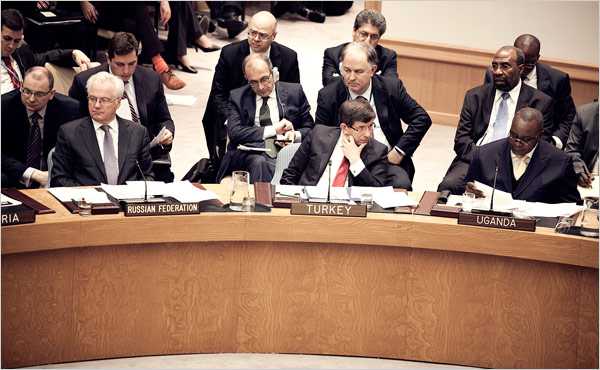
PLAYING PEACEMAKER Turkey’s Ahmet Davutoglu during a United Nations Security Council meeting in December, discussing the future of Iraq.
By JAMES TRAUB
Published: January 20, 201
In the fall of 2009, relations between Serbia and Bosnia — never easy since the savage civil war of the 1990s — were slipping toward outright hostility. Western mediation efforts had failed. Ahmet Davutoglu, the foreign minister of Turkey, offered to step in. It was a complicated role for Turkey, not least because Bosnia is, like Turkey, a predominantly Muslim country and Serbia is an Orthodox Christian nation with which Turkey had long been at odds. But Davutoglu had shaped Turkey’s ambitious foreign policy according to a principle he called “zero problems toward neighbors.” Neither Serbia nor Bosnia actually shares a border with Turkey. Davutoglu, however, defined his neighborhood expansively, as the vast space of former Ottoman dominion. “In six months,” Davutoglu told me in one of a series of conversations this past fall, “I visited Belgrade five times, Sarajevo maybe seven times.” He helped negotiate names of acceptable diplomats and the language of a Serbian apology for the atrocities in Srebrenica. Bosnia agreed, finally, to name an ambassador to Serbia. To seal the deal, as Davutoglu tells the tale, he met late one night at the Sarajevo airport with the Bosnian leader Haris Silajdzic. The Bosnian smoked furiously. Davutoglu, a pious Muslim, doesn’t smoke — but he made an exception: “I smoked; he smoked.” Silajdzic accepted the Serbian apology. Crisis averted. Davutoglu calls this diplomatic style “smoking like a Bosnian.”
Davutoglu (pronounced dah-woot-OH-loo) has many stories like this, involving Iraq, Syria, Israel, Lebanon and Kyrgyzstan — and most of them appear to be true. (A State Department official confirmed the outlines of the Balkan narrative.) He is an extraordinary figure: brilliant, indefatigable, self-aggrandizing, always the hero of his own narratives. In the recent batch of State Department cables disclosed by WikiLeaks, one scholar was quoted as anointing the foreign minister “Turkey’s Kissinger,” while in 2004 a secondhand source was quoted as calling him “exceptionally dangerous.” But his abilities, and his worldview, matter because of the country whose diplomacy he drives: an Islamic democracy, a developing nation with a booming economy, a member of NATO with one foot in Europe and the other in Asia. Turkey’s prime minister, Recep Tayyip Erdogan, is a canny, forward-thinking populist who has drastically altered Turkish politics. Erdogan and Davutoglu share a grand vision: a renascent Turkey, expanding to fill a bygone Ottoman imperial space.
In a world that the U.S. no longer dominates as it once did, President Barack Obama has sought to forge strong relations with rising powers like India and Brazil. Turkey, however, is the one rising power that is located in the danger zone of the Middle East; it’s no coincidence that Obama chose to include Turkey in his first overseas trip and spoke glowingly of the “model partnership” between the two countries. This fits perfectly with Turkey’s ambition to be a global as well as a regional player.
And yet, despite all the mutual interests, and all of Davutoglu’s energy and innovation, something has gone very wrong over the last year. The Turks, led by Davutoglu, have embarked on diplomatic ventures with Israel and Iran, America’s foremost ally and its greatest adversary in the region, that have left officials and political leaders in Washington fuming. Obama administration officials are no longer sure whose side Turkey is on.
Davutoglu views the idea of “taking sides” as a Cold War relic. “We are not turning our face to East or West,” he told me. But it is almost impossible to have zero problems with neighbors if you live in Turkey’s neighborhood.
Istanbul is full of elegant and cosmopolitan intellectuals, few of whom had heard of Ahmet Davutoglu when he was named foreign-policy adviser to the prime minister in 2002. “Outside of Islamic circles,” says Cengiz Candar, a columnist for the daily Radikal, “he was not much known at all.” The victory of the moderate Islamist AK party in the 2002 parliamentary elections was a seismic event in Turkey, culturally as well as politically. Turkey had been an aggressively secular republic since its establishment in 1923; Turkey’s Westernized intellectuals, living in the coastal cities, especially Istanbul, looked upon the Islamists as bumpkins from the Anatolian hinterland. “These people came out of nowhere,” as Candar puts it.
Davutoglu, who is 51, hails from Konya, on the Anatolian plateau; though his English is excellent, he often drops definite articles, a sign that he came to the language relatively late. He has a slight mustache from under which a gentle and bemused smile usually pokes out. He is religiously observant; his wife, a doctor, wears a head scarf. Yet he has become surprisingly popular even among Turkey’s secular elite. “Deep in the Turkish psyche,” Candar says, “there is a feeling of pride and grandeur.” Turkey is not just another country, after all, but the heir of empires, classical as well as Ottoman, and the first secular republic in the Islamic world. Both in his intellectual work, which argues for the extraordinary status Turkey enjoys by virtue of its history and geographical position, and in his role as foreign minister, Davutoglu is seen as a champion of Turkish greatness.
He was an academic before he was a diplomat. His book “Strategic Depth,” published in Turkish in 2001, is regarded as the seminal application of international-relations theory to Turkey, though it is also a work of civilizational history and philosophy. (Such is Davutoglu’s intellectual ambition that he planned to follow up with “Philosophical Depth,” “Cultural Depth” and “Historical Depth.” He hasn’t yet gotten around to the others.) The book has gone through 41 printings in Turkish and has been translated into Greek, Albanian and now Arabic. It is 600 pages long, very dense and almost certainly more known than read. One of Davutoglu’s aides describes the book as “mesmerizing.” (Henri Barkey, a Turkey scholar at Lehigh University, pronounces the work “mumbo jumbo,” adding that Davutoglu “thinks of himself as God.”) “Strategic Depth” weaves elaborate connections between Turkey’s past and present, and among its relations in the Middle East, the Caucasus, the Balkans and elsewhere. The book was read as a call for Turkey to seize its destiny.
And in many ways, Turkey has. It is one of the great success stories of the world’s emerging powers. Shrugging off the effects of the global recession, the Turkish economy last year grew by more than 8 percent, and Turkey has become the world’s 17th-largest economy. Turkey is the “soft power” giant of the Middle East, exporting pop culture and serious ideas and attracting visitors, including one and a half million Iranians a year, to gape at the Turkish miracle. Paul Salem, a Lebanon-based Middle East scholar with the Carnegie Endowment, recently suggested, “It might be Turkey’s century, because it’s the only country in the Middle East actually pointing toward the future.” You increasingly hear the view that power in the Middle East is shifting away from Arab states and toward the two non-Arab powers, Turkey and Iran. Indeed, in “Reset: Iran, Turkey and America’s Future,” Stephen Kinzer, a former New York Times reporter, describes Turkey, Iran and the U.S. as “the tantalizing ‘power triangle’ of the 21st century,” destined to replace the Cold War triangle of the U.S., Israel and Saudi Arabia.
Davutoglu has climbed aboard the Turkish rocket. Turkey’s success raises his status; his achievements do the same for his country. Foreign Policy magazine ranked him No. 7 in its recent list of “100 Global Thinkers,” writing that under his leadership, “Turkey has assumed an international role not matched since a sultan sat in Istanbul’s Topkapi Palace.” Davutoglu has maintained close relations with both Erdogan and President Abdullah Gul — one of the few senior figures to do so. He has filled the upper ranks of the foreign-affairs ministry with worldly, pragmatic, thoughtful diplomats who share his nationalist vision. They have done an extraordinarily deft job of balancing Turkey’s regional and global ambitions, of advancing its interests without setting off alarm bells in other capitals.
Sometimes, it’s true, Davutoglu sees his role as more important than it actually is. He told me a wonderful anecdote about bringing Iraq’s Sunni factions together in Baghdad in the fall of 2005, letting them yell at one another for weeks and finally shaming them into joining together by reminding them of the glories of medieval Baghdad and, by implication, of Iraq itself. In this version, a thrilled Zalmay Khalilzad, the American ambassador to Iraq, rushes to Istanbul to bless the union. Actually, says a former U.S. official very familiar with the event, it wasn’t a breakthrough at all. In fact, the official says, when President Gul called Khalilzad to implore him to come, the American diplomat asked, “Why do we need to go all the way to Istanbul to talk to the same people we talk to all the time?” However, “as a favor to Gul, he said, ‘Sure.’ ”
In Davutoglu’s own endlessly unwinding narratives, he is always speaking like a Baghdadi and smoking like a Bosnian and untying all Gordian knots. Every once in a while during our conversations, Davutoglu would raise a finger and say, “This you can quote.” This meant that he was about to say something really dazzling. On the other hand, he is pretty dazzling, leaping nimbly from Mesopotamia to Alexander the Great to the Ottoman viziers to today’s consumerism, drawing unlikely parallels and surprising lessons.
Davutoglu began his career as foreign-policy adviser at a moment when Turkey’s bid for membership in the European Union had become a national obsession. For Davutoglu, Erdogan and Gul, being in the E.U. offered Turkey crucial economic benefits but, more important, confirmation of its belonging in the club of the West. The Erdogan government pursued difficult economic and political reforms to advance its candidacy, then fumed as less-qualified but predominantly Christian countries like Cyprus — represented by the government of Greek Cyprus, an avowed foe of Ankara — zoomed past to full membership. Major European countries, above all France and Germany, seem determined to block Turkey’s accession to the E.U. This past June, Defense Secretary Robert Gates even suggested that “if there is anything to the notion that Turkey is, if you will, moving Eastward,” it was the result of having been “pushed by some in Europe refusing to give Turkey the sort of organic link to the West that Turkey sought.”
This is a very common refrain, which Davutoglu is at pains to refute. On a flight to Ankara from Brussels, where he had just attended a NATO meeting, Davutoglu pushed away his half-eaten dinner and recited to me what he told his fellow foreign ministers: “If today there is an E.U., that emerged under the security umbrella of NATO. And who contributed most during those Cold War years? Turkey. Therefore when someone says, ‘Who lost Turkey?’ — there was such a question, because people said Turkey was turning to the East — this is an insult to Turkey. Why? Because it means he does not see Turkey as part of ‘we.’ It means Turkey is object, not subject. We don’t want to be on the agenda of international community as one item of crisis. We want to be in the international community to solve the crisis.”
To be part of the global “we” — this was the very definition of Erdogan’s, and Davutoglu’s, ambitions. This is why the Turks received the European rebuff as such a deep insult. And it is true, as Gates suggested, that in the aftermath, Turkey sought to raise its status in the immediate neighborhood. One of Davutoglu’s greatest diplomatic achievements was the creation of a visa-free zone linking Turkey, Jordan, Lebanon and Syria, thus reconstituting part of the old Ottoman space. The four countries have agreed to move toward free trade, as well as free passage, among themselves. As part of the zero-problems policy, Turkey moved to resolve longstanding tensions with Cyprus and Armenia and, more successfully, with Greece and Syria. Turkey’s decades of suppression of Kurdish demands for autonomy put it at odds with the new government of Iraqi Kurdistan, which sheltered Kurdish resistance fighters. But the Erdogan government reached out to Kurdistan, America’s strongest ally in the region. Relations with the Bush administration had been rocky since 2003, when Turkey’s Parliament voted against permitting U.S. forces to enter Iraq through southeastern Turkey. But by now the U.S. was eager to use Turkey as a force for regional stability. The rapprochement with Kurdistan thus smoothed relations with Washington and made Turkey a major player in Iraqi affairs. Turkish firms gained a dominant position not only in Kurdistan but also, increasingly, throughout Iraq. And Iraqi Kurdish leaders had cracked down on the rebels. It was a diplomatic trifecta.
But Davutoglu’s vision extended far beyond securing the neighborhood for Turkish commerce. One of his pet theories is that the United States needs Turkey as a sensitive instrument in remote places. “The United States,” he says, in his declamatory way, “is the only global power in the history of humanity which emerged far away from the mainland of humanity,” which Davutoglu calls Afro-Eurasia. The United States has the advantage of security and the disadvantage of “discontinuity,” in regard to geography as well as history, because America has no deep historic relationship to the Middle East or Asia. In Davutoglu’s terms, the U.S. has no strategic depth; Turkey has much. “A global power like this, a regional power like that have an excellent partnership,” Davutoglu concludes with a flourish. Turkey has used its web of relations, especially in the Sunni world, to advance American interests in Iraq, Pakistan and Afghanistan, where Turkey recently agreed to renew its NATO mandate as the commander of the troop contingent in Kabul.
In 2007, Turkey put itself forward as a Middle East peacemaker. Ottoman Turkey was a safe harbor for Jews when much of Europe was aflame with anti-Semitism. And Republican, secular Turkey was Israel’s most dependable ally in the Middle East. Many Turkish Islamists despise Israel, but Erdogan and the AK adopted a more diplomatic line. Erdogan visited Israel in 2004, and in 2007 Turkey invited Israel’s president, Shimon Peres, to address Parliament — a rare honor. Turkish leaders then sought to broker talks between Syria and Israel over the return of the Golan Heights to Syria. At the time, the Bush administration had cut off relations with Syria, which it viewed as a proxy for Iran; but Israel was eager for an interlocutor with Damascus. The role of go-between “was not assigned to Turkey by any outside actor,” Davutoglu wrote in an essay in Foreign Policy. Turkey assigned the task to itself under a principle he called “proactive and pre-emptive peace diplomacy.” This is what it means to be part of “we.”
Davutoglu says he shuttled between the capitals 20 times in 2007, and in 2008 he brought both sides to Istanbul for five rounds of talks in separate hotels. He carried messages back and forth between the two. Israel needed to be convinced that Syria was prepared to stop sponsoring Hezbollah and to distance itself from Iran. Syria demanded that Israel clarify the territory from which it was prepared to withdraw. By late December, Davutoglu and his aides say, only disagreement over a word or two prevented the two sides from moving to direct talks. Prime Minister Ehud Olmert of Israel held a five-hour dinner at Erdogan’s home, in the course of which both men spoke to President Bashar al-Assad of Syria. Davutoglu had reserved a hotel room for the direct talks. An Israeli official close to the negotiations confirmed this account, saying that Davutoglu “played a very important role, a very professional role” and agreeing that face-to-face talks seemed to be in the offing. Olmert himself was quoted earlier this year as calling Erdogan “a fair mediator” and as saying, “We need negotiations with Turkish mediation.”
But it was all what might have been, for only a few days after the meeting, Israel launched its Cast Lead invasion of Gaza, inflaming the Arab world and humiliating and infuriating Erdogan. The talks collapsed. The Israeli official says, “We told the Turks that we will have to respond” to the hail of missiles coming from Gaza; Israel had not deceived the Turks, because Israel’s cabinet authorized the invasion days after the Olmert-Erdogan dinner. That’s not how Turkey saw the sequence of events. It was, Davutoglu says solemnly, “an insult to Turkey.” Certainly the Turkish public felt it as one, and Erdogan, a shrewd judge of public opinion, understood that very well. Turkey is a democracy, after all; and the public reaction to Gaza, on top of the rebuff from the European Union — and perhaps also the inherent logic of the “zero problems” policy — sent the country in a new direction.
Turkey’s interests in the Balkans, in Afghanistan, Pakistan and Iraq, and for that matter in Israel, coincided with those of the United States and the West. But its run of luck ended in Iran. In September 2009, the Iranians, under pressure from the West to show that they were not seeking to build a nuclear weapon, offered to send 1,200 kilograms of uranium abroad in exchange for an equal amount to be enriched sufficiently for civilian use. Iran didn’t trust any Western country to hold its uranium; but it might trust Turkey. Davutoglu sprang into action, flying back and forth to Tehran to work out the details — over which the Iranians, typically, bickered and stalled.
The cables recently disclosed by WikiLeaks vividly illustrate the tensions this produced with Washington. In a meeting with the assistant secretary of state Philip Gordon in Ankara in November 2009, Davutoglu advanced his theory of Turkish exceptionalism: “Only Turkey,” he said, “can speak bluntly and critically to the Iranians.” Davutoglu was confident that Iran was ready to strike a deal — with Turkey’s help. An obviously skeptical Gordon “pressed” him on his “assessment of the consequences if Iran gets a nuclear weapon.” In what the cable’s author described as “a spirited reply,” Davutoglu insisted that Turkey was well aware of the risk. Gordon “pushed back that Ankara should give a stern public message” to Iran; Davutoglu replied that they were doing so in private and “emphasized that Turkey’s foreign policy is giving ‘a sense of justice’ and ‘a sense of vision’ to the region.”
Behind this tense exchange with Gordon was the fear that Turkey was cutting Iran too much slack. Davutoglu is quite open about the fact that Turkey has interests in Iran that the United States and Europe do not have. “Our economy is growing,” Davutoglu told me, “and Iran is the only land corridor for us to reach Asia. Iran is the second source of energy for Turkey.” Sanctions on Iran would hurt Turkey. But Davutoglu also insists that Turkey’s assessment of Iran’s intentions is not affected by its interests. It’s easy to see why Gordon was skeptical. Prime Minister Erdogan has dismissed fears that Iran wants to build a bomb as “gossip.” And when I asked one of Davutoglu’s senior aides about the matter, he said: “For the time being, Iran does not have a nuclear-weapons program. We don’t know whether they will go there.”
At President Obama’s nuclear summit meeting last April, Erdogan and the president of Brazil, Luis Inácio Lula da Silva, proposed to Obama that they work jointly to persuade Iran to surrender the uranium — a striking example of the rising confidence of the emerging powers. Administration officials made it very clear that they feared Iran would try to hoodwink Turkey and Brazil. Davutoglu nonetheless resumed his manic routine — State Department officials call him the Energizer Bunny — flying back and forth to Tehran well into May, pushing the Iranians to make concessions. In his seventh and final session, he worked at it for 18 hours before reaching a deal. Davutoglu was so excited that he called Turkish reporters from the plane to invite them to a briefing upon his arrival. But by the time the journalists returned to their offices to write the story, they got word that the United States had rejected the deal.
The Turks had announced their diplomatic coup at precisely the moment the Obama administration finally induced Russia and China to vote for tough sanctions on Iran in the Security Council. Davutoglu says he never took a step without informing the Americans, but American officials said that the terms of the deal took them by surprise. The Turks mostly hid their hurt feelings. But in early June, the rift with the U.S. played out in public when Turkey and Brazil voted against the sanctions resolution. Turkish officials say the last thing they wanted was to defy the U.S. on a matter of American national security, but President Mahmoud Ahmadinejad of Iran said he would consider the “swap deal” terminated unless Turkey and Brazil voted against the resolution. They were, they insist, voting for continued diplomacy, not for Iran or against the United States and the West.
Maybe Turkey was simply protecting its regional interests, which now include not only preserving good relations with Iran but also enhancing its credibility in the Middle East — even at the expense of its standing in the West. Maybe, for all Davutoglu’s protestations, Ankara doesn’t view the world the way Washington does or London does. In a meeting earlier this year at the Council on Foreign Relations, Henri Barkey observed that when you talk to Erdogan or Davutoglu about Iran, “the response is almost as if you pressed a button: the problem is not Iran; the problem is Israel; Israel has weapons; Iran doesn’t have weapons.” Or maybe the problem is that you can’t have zero problems with everybody.
Iran, unfortunately, was only the half of it. The other half was Israel. Three weeks after the Gaza war, Erdogan angrily stalked out of a public session with Shimon Peres at Davos, Switzerland. Israel responded with equal pettiness, staging a humiliation of Turkey’s ambassador to Israel. Erdogan, long a champion of Hamas, became more vocal in his support for a group Israel viewed as a threat to its very existence. In the spring of 2010, a Turkish charitable organization, I.H.H., chartered the flotilla designed to break Israel’s blockade of Gaza. Davutoglu says that he tried to persuade the group not to sail and then asked the organizer of the flotilla to turn aside if Israel stopped the ships, as it was certain to do, and to offload the cargo at a port outside Gaza if necessary. In late May, the day before the flotilla set sail, a senior Turkish official called the Israelis to alert them to the ships’ embarking and to say, “Please don’t engage in violence.”
Of course, it didn’t work out that way. The flotilla refused Israel’s demands to alter course, and a helicopter-borne commando assault on the Mavi Marmara, the lead ship, turned deadly, with eight Turkish citizens and one American killed. The Gaza war had embittered Turkish public opinion; now angry crowds gathered across the country, denouncing Israel and chanting Islamic slogans. Erdogan railed against Israel and stoutly defended Hamas, denying that it was a terrorist organization. He described Israel, with which he had been earnestly negotiating a year earlier, as “a festering boil in the Middle East that spreads hate and enmity.” Turkey demanded an apology. Israel, which viewed the flotilla as a provocation abetted, and perhaps orchestrated, by Ankara, refused. Davutoglu was almost as inflammatory as his prime minister. In a statement to the Security Council the day after the assault, he said, “This is a black day in the history of humanity, where the distance between terrorists and states has been blurred.”
Turkey seemed to have made a choice among its conflicting ambitions. Steven Cook, a Middle East scholar at the Council on Foreign Relations, recently wrote, “Erdogan and his party believe they benefit domestically from the position Turkey has staked out in the Middle East,” and thus “the demands of domestic Turkish politics now trump the need to maintain good relations with the United States.” Turkey may be turning in a new direction, in other words, not so much because it has been rejected by the West as because it is being so ardently embraced by the East.
The net effect of Turkey’s vehement reaction to the flotilla, which by an unfortunate quirk of timing came two weeks after the nuclear deal with Iran and a week before the sanctions vote, was to wreck whatever remained of its relations with Israel and to seriously harm its standing in the U.S. “The hyperbolic and provocative rhetoric” in the aftermath of the Mavi Marmara incident, says a senior administration official, “has interfered with what has been a historic and hugely important, positive Turkish-Israeli relationship.” And it has done real damage in the court of public opinion, where Turkey looks like the enemy of the United States’ best friend in the Middle East as well as the friend of its worst enemy. After the Mavi Marmara incident, Thomas L. Friedman asserted in The Times, perhaps hyperbolically, that Turkey had joined “the Hamas-Hezbollah-Iran resistance front against Israel.”
Tempers have cooled in recent months. U.S. officials have tried to encourage a rapprochement between Turkey and Israel. Last June, Israel’s trade minister, Benyamin Ben-Eliezer, invited Davutoglu to speak with him quietly in Brussels. But the contents of the conversation were leaked almost immediately in Israel, presumably by hardliners opposed to any easing of tensions. Relations with Washington remain fraught. “There’s so much we want to do together,” as the official cited above puts it, “but it’s harder for us to do that if the American and Congressional perspective on Turkey is a negative one” — which right now, he added, it is.
A few months before he became Turkey’s foreign minister, Davutoglu visited Washington to meet with the incoming Obama team. He was dazzled. George W. Bush, he thought, had been America’s Caesar; Obama would be its Marcus Aurelius, its philosopher-king. “There will be a golden age in Turkish-American relations,” he predicted. It hasn’t worked out that way, and Davutoglu can barely process a setback so at odds with his grand intellectual and policy construct. He says that he was “shocked” when the U.S. opposed a United Nations Human Rights Council resolution calling for an investigation of “the outrageous attack by the Israeli forces against the humanitarian flotilla.” (The administration said such a commission seemed to be rushing to judgment, and it endorsed instead a panel convened by the U.N. secretary-general.) But the professionals Davutoglu has surrounded himself with are not deluding themselves about their plight. “We’re getting a lot of flak from the Hill,” says Selim Yenel, the official in the foreign ministry responsible for relations with Washington. “We used to get hit by the Greek lobby and the Armenian lobby, but we were protected by the Jewish lobby. Now the Jewish lobby is coming after us as well.”
The truth is that for all his profound knowledge of the history of civilizations, Davutoglu misread the depth of feeling in the U.S. about both Israel and Iran, or perhaps overestimated Turkey’s importance. This is the danger of postimperial grandiosity. “They talk as if they expect a merger between Turkey and the E.U.,” says Hugh Pope, head of the Turkish office of the International Crisis Group. “They think they’re more important than Israel.”
Perhaps the setback is just a blip, a brief reversal in the upward path of one of the world’s rising powers. On the flight home from Brussels, where he conferred privately with Robert Gates and Secretary of State Hillary Clinton and met with his European counterparts, Davutoglu was in an ebullient mood. He feels the wind of history filling his sails. Turkey, the crossroads of civilizations, the land where East and West, North and South, converge, is pointing the way to the world’s future. “Turkey is the litmus test of globalization,” he told me. “Success for Turkey will mean the success of globalization.” The world, as Davutoglu likes to say, expects great things from Turkey.
James Traub is a contributing writer for the magazine. His most recent article was about the New York Yankees pitcher Mariano Rivera.
24 January 2011 closeAuthor: the Mesh Report StaffName: the Mesh Report Staff Email:[email protected] See Authors Posts (1278)
By Perry Bacon Jr.Washington Post Staff Writer
President Obama will call for a broad “competitiveness” initiative in Tuesday night’s State of the Union address, proposing a series of steps the United States should take to retain its standing as the world’s largest and most influential economy.
White House officials say the speech will include a number of ideas, from increasing the number of U.S. exports to improving the American education system.
In speeches over the last two months, the president has previewed this competitiveness theme–warning in a December address in North Carolina, for example, that without greater innovation, the U.S.could fall behind other countries, as it did briefly in the 1950s when the Soviet Union launched Sputnik, the first satellite to orbit the earth.
In a speech Friday at General Electric plant in upstate New York, Obama said that the “new mission” of his administration’s policies would be to “do everything we can to ensure that businesses can take root and folks can find good jobs and America is leading the global competition that will determine our success in the 21st century.”
The competitiveness idea is supposed to link the administration’s proposals for increasing spending on education and other long-time Democratic priorities with its agenda to create more jobs as America recovers from the recession.
“My principal focus . . . is going to be making sure that we are competitive, that we are growing, and we are creating jobs,” Obama said in a preview video of the speech sent to supporters Saturday.
But officials have bumped up against multiple problems as they have worked on the economic components of the address, which comes weeks before the White House will release the budget for the next fiscal year.
Administration officials said they do not believe another major stimulus bill is possible with Republicans in control of the House of Representatives, leaving them struggling to find another mechanism to create jobs. At the same time, many ideas Republicans are willing to embrace – such as a reduction in the payroll tax – have already been included in the December tax deal.
Along with the economic focus, Democratic officials briefed on the speech said, Obama will challenge members of both parties to prove wrong the widely-held perception that the next two years will be full of political gridlock.
With members of both parties seated together in the gallery for the first time, the appeal will dovetail with Obama’s new-found emphasis on reaching out to Republicans and working more closely with the business community, which opposed much of his agenda during his first two years in office.
In discussing foreign policy, Obama is expected to underscore the end-of-year deadline for all U.S. troops to leave Iraq. Regarding Afghanistan, Obama will highlight the July deadline he has set for the start of troop withdrawals, a process scheduled to unfold through 2014 at a pace to be determined by conditions on the ground.
But on other subjects, what exactly the president will say remains unclear.
Gun-control groups are pushing for Obama to embrace stricter gun laws in the wake of the shooting in Tucson. Paul Helmke, president of the Brady Campaign to Prevent Gun Violence, said he wants Obama to support specific legislation, but would be satisfied if the president instead appointed a commission to look at the causes of gun violence.
“A national tragedy took place, there should be a response,” Helmke said. He added of the Tucson shooting, “no laws were broken until [the gunman] starting shooting.”
White House officials have been non-committal on supporting any new legislation, and have not said if Obama will address gun control in his speech.
Liberal groups are wary of Obama including in the speech the conclusions of the bi-partisan deficit commission, which released a report in December that proposed controversial ideas such as a gradual increase in the retirement age.
The president will emphasize the importance of deficit reduction in the speech, but it’s not clear if he will offer specific proposals.
“The White House has prematurely turned to deficit reduction,” said Robert Borosage, co-director of the Campaign for America’s Future, a liberal activist group. “Voters are clear, they care about the deficit, but their first priority is jobs and the economy.”
The speech is some ways less important than was anticipated a few months ago, because the administration started recalibrating its domestic agenda and approach immediately after the November elections.
“I think the president has gone to school on lessons learned,” said Kenneth Duberstein, former chief of staff to President Reagan, one of many Washington veterans Obama consulted after his party’s election defeat in November. “One would hope he continues to down the path that began in the lame-duck session as far reaching out.”
And while the speech will loom large on prime-time television Tuesday night, and in the media stratosphere for many hours afterward, experts cautioned that its shelf life will most likely be relatively short.
“Who remembers them six weeks later, let alone a year or two,” said Robert Dallek, a presidential historian. “How many State of the Union addresses do people remember? They don’t resonate that way.”
You are kindly invited to attendour annualconference on the 4th February 2011 on the subject of “Turkish- Armenian Relations”, details of which are attached.
The guest speaker, Prof Justin McCarthy specializes in the social and demographic history of the Modern Middle East, particularly Turkey and the Ottoman Empire. He is presently Distinguished Professor of Arts and Sciences and Distinguished University Scholar at the University of Louisville.The event will be chaired by Professor Şevket Pamuk who is the Chair of Contemporary Turkish Studies at the European Institute, London School of Economics and Political Science. He is a leading economic historian of the Ottoman Empire, the Middle East and modern Turkey.
This is the fifth conference in the series and has been organised in the memory of 34 Turkish diplomats and other innocent victims who were murdered by various Armenian terrorist groups between 1973 and 1985. The aim of these conferences is to promote mutual understanding and discuss issues concerning Turkish-Armenian relations both recent and historic on an academic platform.
We very much hope that you will be able to attend the conference and circulate this e-mail content kindly to your friends.
FTA UK
* * * * *
You are kindly invited to attendan evening conference entitled
‘TURKISH – ARMENIAN RELATIONS’
Friday, 4th February 2011, 6 pm for 6.30 pm
Venue:
Sheikh Zayed Theatre,
London School of Economics,
New Academic Building,
Lincoln’s Inn Fields,
London WC2A 2AE
GUEST SPEAKER
Prof Justin McCarthy
“Prejudice, Deception, and the Armenian Question”
For those who study the troubled history of relations between Turks and Armenians, the question naturally arises, “How could so many have been so wrong?” Why did Europeans and Americans at the time, and still today, believe a story of persecution that is demonstrably wrong? The answer lies in ignorance, prejudice, and deception. Ignorance made politicians and editors, then and today, believe whatever fit their prejudices. And prejudice caused them to ignore the facts before them. Instead, they accepted the often deliberate falsehoods spread by Armenian rebels and their supporters. This presentation offers examples of the deceptions that lie behind what is commonly believed of the Armenian Question.
The Federation of Turkish Associations UK (FTA UK) is an umbrella organization consisting of 16 Turkish associations, representing approximately 300,000 British Turks and Turkish citizens in the UK. We are following closely any developments and issues concerning our community in this country and we make representations at governmental and/or local levels. We also serve as a broad platform reinforcing and building on the cultural and economic bridges between Turkey and the UK.
www.turkishfederationuk.com
*****
Prof Justin McCarthy
Justin McCarthy received a Ph.D. in Near Eastern history from U.C.L.A. in 1978 and a Certificate in Demography from PrincetonUniversity in 1980. He is presently Distinguished Professor of Arts and Sciences and Distinguished University Scholar at the University of Louisville.Professor McCarthy specializes in the social and demographic history of the Modern Middle East, particularly Turkey and the Ottoman Empire. His books include Muslims and Minorities, Death and Exile, The Population of Palestine, TheOttoman Turks, The Ottoman Peoples and the End of Empire,Population History of the Middle East and the Balkans,Who Are the Turks?(with Carolyn McCarthy), The Armenian Rebellion at Van (with Esat Arslan, Cemalettin Taşkiran, and Ömer Turan), and Turkey and the Turks (with Carolyn McCarthy).His book on the image of Turks in America, The Turk in America, was published in 2010. He has also written a number of articles on Middle Eastern, Balkan, Turkish, and Ottoman topics. As a historical cartographer, he has produced the Middle Eastern map series for the Middle East Studies Association and the U.S. Department of Education, as well as maps for publications.He has lectured in Turkey, Azerbaijan, Britain, Germany, Austria, the Netherlands, Israel, Bosnia, and Saudi Arabia, as well as in the United States and Canada.In 2005 he was invited to address a special session of the Turkish Grand National Assembly. Rotary International gave him its Paul Harris Award. He has held a Senior Research Fellowship from the U.S. National Endowment for the Humanities, a National Needs Postdoctoral Fellowship from the National Science Foundation, a Fulbright-Hays fellowship, an International Research and Studies Program grant from the U.S. Department of Education, and other grants and awards. Professor McCarthy has served on the Boards of the Institute of Turkish Studies, the Turkish Studies Association, and the International Congress for Asian and North African Studies, as well as the advisory boards of various organizations.
Prof Sevket Pamuk
Professor Şevket Pamuk is Chair of Contemporary Turkish Studies at the European Institute, London School of Economics and Political Science. He is a leading economic historian of the Ottoman Empire, the Middle East and modern Turkey. He is the author of The Ottoman Empire and European Capitalism 1820-1913: Trade, Investment and Production (Cambridge University Press, 1987); A Monetary History of the Ottoman Empire (Cambridge University Press, 2000) and jointly with Roger Owen, A History of the Middle East Economies in the Twentieth Century (I.B. Tauris Publishers and Harvard University Press 1998). A collection of his articles on the Ottoman economy recently appeared as Ottoman Economy and Its Institutions (Ashgate-Variorum, 2008). After attending high school in Istanbul, Pamuk graduated from Yale University and obtained his PhD. degree in Economics from the University of California at Berkeley. He has since taught at various universities in Turkey and the United States including Ankara, Pennsylvania, Villanova, Princeton, Michigan at Ann Arbor, Northwestern and beginning in 1994 at Bogaziçi (Bosphorus) University, Istanbul as Professor of Economics and Economic History. Şevket Pamuk was the President of the European Historical Economics Society, an association of European economic historians, has been a member of the Executive Committee of the International Economic History Association, a member of the Standing Committee on the Humanities of the European Science Foundation and is a member of the Academy of Sciences of Turkey. He serves on the Editorial Boards of various academic journals including European Review of Economic History and The Journal of Economic History.