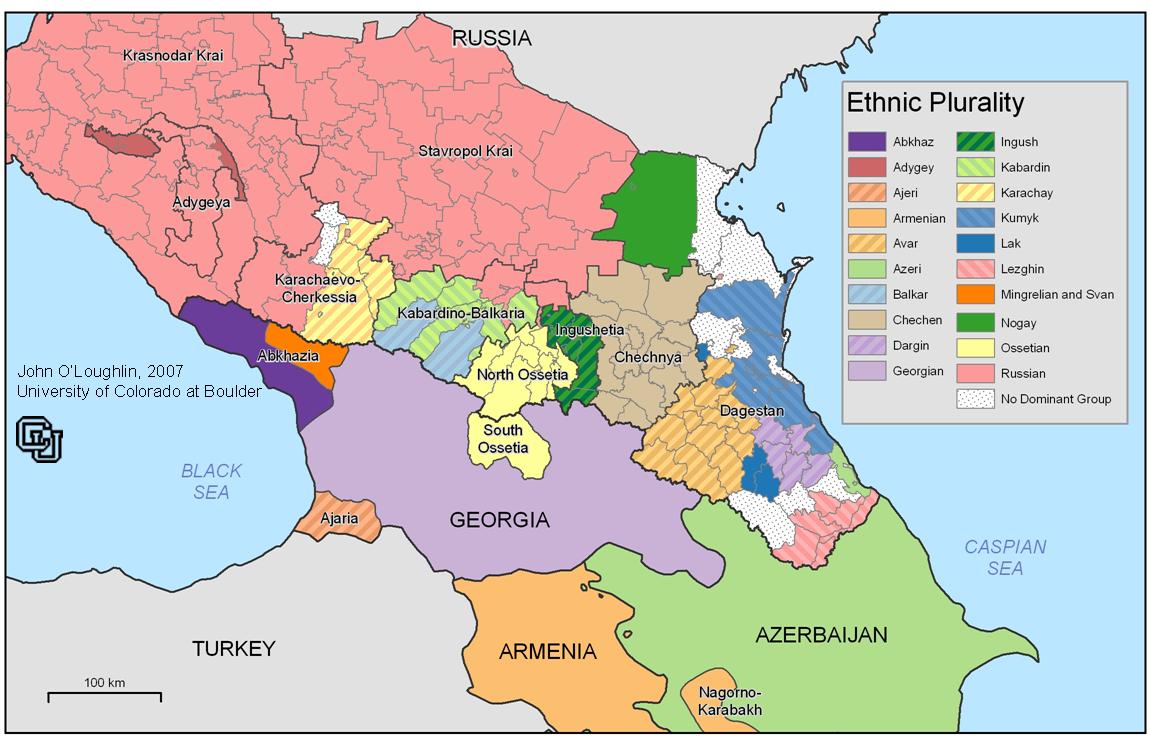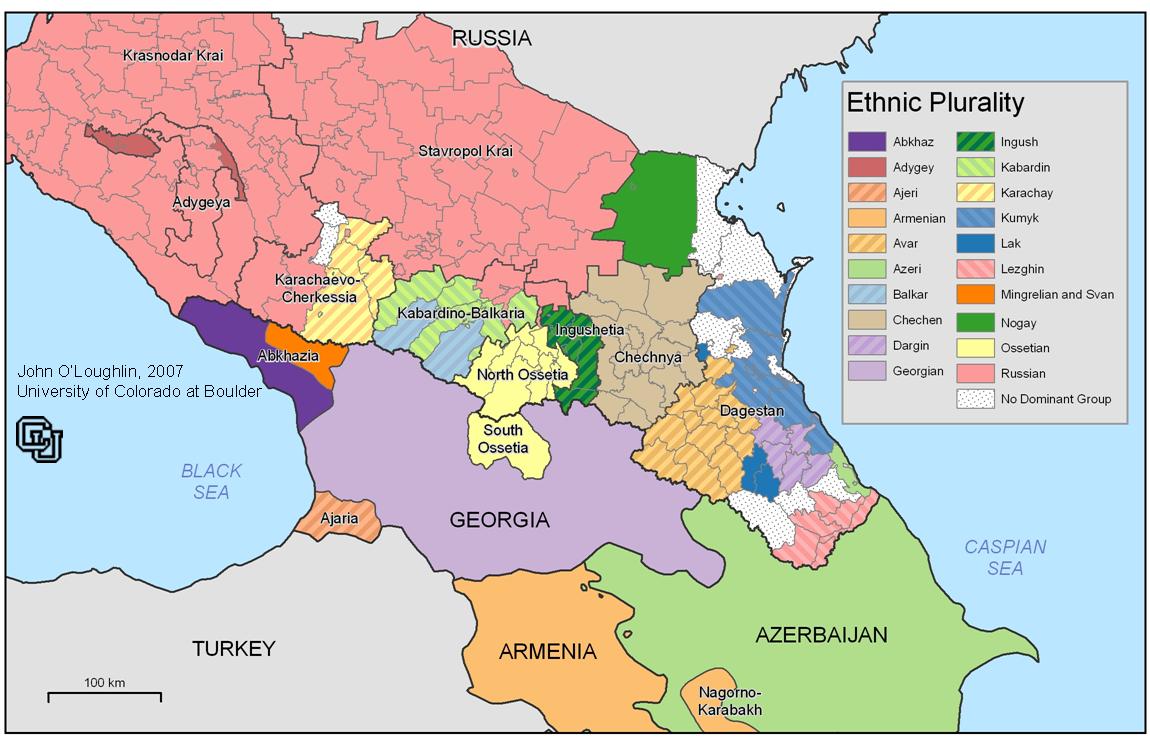
CLICK HERE TO ENLARGE
Copyright. John O’Laughlin, University of Colorado, Boulder
Matthew Bryza has been one of the U.S.’s main point men in the South Caucasus, the Caspian Sea Basin and Central Asia for the past twelve years.
From 1997-1998 he was an advisor to Ambassador Richard Morningstar, coordinating U.S. efforts in the Caucasus and Central Asia as well as in Southeastern Europe, particularly Greece and Turkey. Morningstar was appointed by the Clinton administration as the first Special Advisor to the President and Secretary of State on Assistance to the New Independent States of the Former Soviet Union in 1995, then Special Advisor to the President and the Secretary of State for Caspian Basin Energy Diplomacy in 1998 and was one of the chief architects of U.S. trans-Caspian strategic energy plans running from the Caspian Sea through the South Caucasus to Europe. Among the projects he helped engineer in that capacity was the Baku–Tbilisi–Ceyhan [BTC] oil pipeline – “the world’s most political pipeline” – running from Azerbaijan through Georgia to Turkey and the Mediterranean Sea.
Trans-Caspian, Trans-Eurasian Energy Strategy Crafted In The 1990s
In 1998 Bryza was Morningstar’s chief lieutenant in managing U.S. Caspian Sea energy interests as Deputy to the Special Advisor to the President and Secretary of State on Caspian Basin Energy Diplomacy, where he remained until March of 2001, and he worked on developing what are now U.S. and Western plans to circumvent Russia and Iran and achieve dominance over the delivery of energy supplies to Europe.
Morningstar later became United States Ambassador to the European Union from 1999-2001 and this April was appointed the Special Envoy of the United States Secretary of State for Eurasian Energy, a position comparable to that he had occupied eleven years earlier.
In 2005 the George W. Bush administration appointed Bryza Deputy Assistant Secretary of State for European and Eurasian Affairs under Condoleezza Rice, a post he holds to this day although he will soon be stepping down, presumably to become the U.S. ambassador to Azerbaijan, the nation that most vitally connects American geostrategic interests in an arc that begins in the Balkans, runs through the Caucasus to the Caspian Sea and then to Central and South Asia.
Last June Bryza delivered a speech called Invigorating the U.S.-Turkey Strategic Partnership in Washington, DC and reflected on his then more than a decade of work in advancing American energy, political and military objectives along the southern flank of the former Soviet Union. His address included the following revelations, the first in reference to events in the 1990s:
“Azerbaijani President Heydar Aliyev and Kazakh President Nursultan Nazarbayev welcomed international investors to help develop the Caspian Basin’s mammoth oil and gas reserves. Then-Turkish President Suleyman Demirel worked with these leaders, and with Georgian President Eduard Shevardnadze, to develop a revitalized concept of the Great Silk Road in the version of an East-West Corridor of oil and natural gas pipelines.
“Our goal was to help the young independent states of these regions [the Caucasus and Central Asia] secure their sovereignty and liberty by linking them to Europe, world markets, and Euro-Atlantic institutions via the corridor being established by the BTC and SCP [South Caucasus Pipeline natural gas]pipelines….The Caucasus and Central Asia were grouped with Turkey, which the Administration viewed as these countries’ crucial partner in connecting with European and global markets, and with Euro-Atlantic security institutions.
“[C]ooperation on energy in the late 1990’s formed a cornerstone of the U.S.-Turkey strategic partnership, resulting in a successful ‘first phase’ of Caspian development anchored by BTC for oil and SCP for gas.
Iraq War Part Of Previous Geopolitical Plans
“Today, we are focusing on the next phase of Caspian development, looking to the Caspian Basin and Iraq to help reduce Europe’s dependence on a single Russian company, Gazprom, which provides 25 percent of all gas consumed in Europe.
“Our goal is to develop a ‘Southern Corridor’ of energy infrastructure to transport Caspian and Iraqi oil and gas to Turkey and Europe. The Turkey-Greece-Italy (TGI) and Nabucco natural gas pipelines are key elements of the Southern Corridor.
“Potential gas supplies in Turkmenistan and Iraq can provide the crucial additional volumes beyond those in Azerbaijan to realize the Southern Corridor. Washington and Ankara are working together with Baghdad to help Iraq develop its own large natural gas reserves for both domestic consumption and for export to Turkey and the EU.” [1]
Bryza took no little personal credit for accomplishing the above objectives, which as he indicated weren’t limited to a comprehensive project of controlling if not monopolizing oil and natural gas flows to Europe but also in the opposite direction to three of the world’s four major energy consumers: China, India and Japan. Since the delivery of the presentation from which the above is quoted the U.S. and its Western European NATO allies have also launched the Nabucco natural gas pipeline which intends to bring gas from, as Bryza mentioned, Iraq and also eventually Egypt and possibly Algeria to Turkey where Caspian oil and gas will arrive via Azerbaijan and Georgia.
Energy Transit Routes Used For Military Penetration Of Caucasus, Central And South Asia
Previous articles in this series [2] have examined the joint energy-geopolitical-military strategies the West is pursuing from and through the sites of its three major wars over the past decade: The Balkans, Iraq and Afghanistan.
Bryza himself made the connection in the above-cited speech of last year:
“The East-West Corridor we had been building from Turkey and the Black Sea through Georgia and Azerbaijan and across the Caspian became the strategic air corridor, and the lifeline, into Afghanistan allowing the United States and our coalition partners to conduct Operation Enduring Freedom.” [3]
His work and his political trajectory – paralleling closely that of his fellow American Robert Simmons [4], former Senior Advisor to the United States Assistant Secretary of State for European and Eurasian Affairs on NATO and current NATO Special Representative for the Caucasus and Central Asia and Deputy Assistant Secretary General of NATO for Security Cooperation and Partnership – has continued through four successive U.S. administrations, those of George H.W. Bush, Bill Clinton, George W. Bush and now Barack Obama, and has taken him from the American embassy in Poland in 1989-1991 to that in Moscow in 1995-1997 to positions in the National Security Council, the White House and the State Department.
While in his current State Department role Bryza has not only overseen trans-Eurasian, tri-continental energy projects but has also been the main liaison for building political and military ties with the South Caucasus nations of Georgia and Azerbaijan and he remains the U.S. co-chair of the Organization for Security and Cooperation in Europe (OSCE) Minsk Group monitoring the uneasy peace around Nagorno Karabakh, one of four so-called frozen conflicts in the former Soviet Union.
Although Azerbaijan is one of the interested parties in the conflict and the nation’s president, Ilham Aliyev, routinely threatens war to conquer Karabakh, often in the presence of top American military commanders, aside from being a supposed impartial mediator with the Minsk Group Bryza in his State Department role secured the use of an Azerbaijani air base for the war in Afghanistan. In 2007 he stated, “There are plenty of planes flying above Georgia and Azerbaijan towards Afghanistan. Under such circumstances we want to have the possibility of using the Azeri airfield.” [5]
Bryza also recently announced that U.S. Marines were heading to Georgia to train its troops for deployment to Afghanistan where in the words of a Georgian official “First of all, our servicemen will gain combat experience because they will be in the middle of combat action, and that is a really invaluable experience.
“Secondly, it will be a heavy argument to support Georgia’s NATO aspirations.” [6]
Oil For War: US, NATO Caucasus Clients Register World’s Largest Arms Build-Ups
During his four-year stint as Deputy Assistant Secretary of State for European and Eurasian Affairs he has focused on the South Caucasus, and during that period Georgia’s war budget has ballooned from $30 million a year when U.S.-educated Mikheil Saakashvili took power after the nation’s “Rose Revolution” in 2004 to $1 billion last year, a more than thirty fold increase.
In the same year, 2008, Azerbaijan’s military spending had grown from $163 million the preceding year to $1,850,000,000, more than a 1000% increase. In the words of the nation’s president last year, “And it will increase in the years to come. The amount envisaged in the 2009 state budget will be even greater.” [7]
Much of the money expended for both unprecedented build-ups came from revenues derived from oil sales and transit fees connected with the BTC pipeline Bryza was instrumental in setting up.
Pentagon’s Role In Last August’s Caucasus War
Regarding neighboring Georgia, a German press report on the second day of last August’s war between that nation and Russia stated that “US Special Forces troops, and later US Marines replacing them, have for the last half decade been systematically training selected Georgian units to NATO standards” and “First-line Georgian soldiers wear NATO uniforms, kevlar helmets and body armour matching US issue, and carry the US-manufactured M-16 automatic rifle….” [8]
On the first day of the war the Chairman of the Russia’s State Duma Security Committee, Vladimir Vasilyev, denounced the fact that the Georgian President Saakashvili “undertook consistent steps to increase [Georgia’s] military budget from $US 30 million to $US 1 billion – Georgia was preparing for a military action.” [9]
An Armenian news source the same day detailed that “Most of Georgia’s officers were trained in the U.S. or Turkey. The country’s military expenses increased by 30 times during past four years, making up 9-10 per cent of the GDP. The defense budget has reached $1 billion.
“U.S. military grants to Georgia total $40.6 million. NATO member states, including Turkey and Bulgaria, supplied Georgia with 175 tanks, 126 armored carriers, 67 artillery pieces, 4 warplanes, 12 helicopters, 8 ships and boats. 100 armored carriers, 14 jets (including 4 Mirazh-2000) fighters, 15 Black Hawk helicopters and 10 various ships are expected to be conveyed soon.” [10]
“The procurement in recent years of new military hardware and modern weapons systems was indeed in line with Georgia’s single-minded commitment to joining NATO.” [11]
In addition to the country’s standing army the Saakashvili regime has introduced a 100,000-troop reserve force, also trained in part by NATO.
In 2006 Saakashvili mandated a system of universal conscription in which “every man under 40 must pass military trainings” [12] and every citizen should “know to handle arms and if necessary should be ready to repel aggression.” [13]
Ten months later the government announced “a doctrine on total and unconditional defense” and that “service in the reserve troops would be compulsory for every male between the ages of 27 to 50.” [14]
Matthew Bryza and his colleagues in the State Department and the Pentagon have served American and NATO interests in the South Caucasus and adjoining areas well over the past decade.
First US-Backed War In The South Caucasus: Adjaria
On August 10 Bryza, “who, as he himself put it, was a more frequent guest to Georgia than any other U.S. official,” [15] was awarded the Order of the Golden Fleece by Georgia’s Saakashvili in Tbilisi.
“Saakashvili thanked Bryza for assistance rendered in 2004 while solving problems in Adjaria.” [16]. The allusion is to events early in that year when Saakashvili, flanked by then U.S. Secretary of State Colin Powell, was inaugurated president after the putsch that was called the Rose Revolution and introduced his party flag as that of the nation, which as British journalist John Laughlin remarked at the time had not been done since Hitler did the same with the swastika in 1933.
Less than two months later Saakashvili threatened to invade the Autonomous Republic of Adjaria (Adjara), which had been de facto an independent country, and to “shoot down my plane” as Adjarian president Aslan Abashidze reported.
An Agence France-Presse report in March of 2004 said, “The situation was made all the more explosive because Russia has a military base in Adjara….Saakashvili warned in televised comments that ‘not a single tank can leave the territory of the base. Any movement of Russia’s military equipment could provoke bloodshed.’” [17]
An all-out war was only avoided because Russia capitulated and even flew Abashidze to Moscow, after which it withdrew from the Adjarian base.
Bryza’s assistance to the Saakashvili government has also extended to backing it in its armed conflicts with Abkhazia and South Ossetia, which in the second case escalated into all-out war a year ago.
State Department Passes The Baton To Veteran Balkans Hand
Now Bryza, the nominal mediator, is going to pass his role as Deputy Assistant Secretary of State for European and Eurasian Affairs to Tina Kaidanow.
But he will continue until next month as the US co-chairman of the OSCE Minsk Group on Nagorno Karabakh, where as recently as August 12 he met with Azerbaijani President Aliyev and either arbitrarily expanding the format of discussions or combining his dual functions he also discussed “bilateral relationship between Azerbaijan and the United States, energy cooperation and regional and international issues.” [18]
It was also Bryza who recently announced that U.S. Marines were headed to Georgia to train troops for the war in Afghanistan. “Matt Bryza, the outgoing US deputy Assistant Secretary of State for European and Eurasian affairs, said the US would provide training and equipment for Georgian servicemen bound for Afghanistan.” [19]
As seen earlier, a Georgian official said of the development that “First of all, our servicemen will gain combat experience because they will be in the middle of combat action, and that is a really invaluable experience,” [20] which training under fire could only be intended for future combat operations against Abkhazia, South Ossetia and Russia.
Bryza has also played a role in attempting to insinuate European Union and American observers into the South Caucasus conflict zones.
His successor in the State Department position, Kaidanow, possesses a political curriculum vitae which provides insight into what can be expected from her.
This April, before getting the nod to replace Bryza, Kaidanow said “I worked in Serbia, in Belgrade and in Sarajevo, then in Washington, and I went back to Sarajevo and am now in Kosovo. I don’t know where my next challenge will be. It is under discussion.” [21]
Ms. Kaidanow is a veteran Balkans hand. She “served extensively in the region, as Special Assistant to U.S. Ambassador Christopher Hill in Skopje [Macedonia] 1998-1999, with specific responsibilities focused on the crisis in Kosovo….” [22] Before that she served in Bosnia from 1997-1998.
Prior to that her first major post in the U.S. foreign policy apparatus began under President Bill Clinton, where she served as director for Southeast European Affairs at the National Security Council.
Kaidanow: From Rambouillet To Ambassador To Kosovo
After transitioning from advising the National Security Council on the Balkans to implementing the U.S. agenda there, Kaidanow attended the Rambouillet conference in February of 1999 where the American delegation headed by Secretary of State Madeleine Albright threw down the gauntlet to Yugoslavia with the infamous Appendix B ultimatum and set the stage for the 78-day war that began on March 24.
From 2003-2006 she was back in Bosnia, this time as Deputy Chief of Mission at the U.S. Embassy, from where she departed to become the Chief of Mission and Charge d’Affaires at the U.S. Office in Kosovo from July 2006 to July 2008; that is, while the Bush administration put the finishing touches to the secession of the Serbian province which resulted in the unilateral independence of Kosovo in February of 2008. Despite concerted pressure from Washington and its allies, a year and a half later 130 of 192 nations in the world refuse to recognize its independence and those who do include statelets like Palau, the Maldives, the Federated States of Micronesia, Samoa, San Marino, Monaco, Nauru, Liechtenstein and the Marshall Islands, presumably all paid handsomely for their cooperation.
Last year the Bush administration appointed Kaidanow the first U.S. ambassador to Kosovo, a post she took up on July 18, 2008.
Reproducing Kosovo In Russia’s Southern Republics
On August 12 Russian political analyst Andrei Areshev spoke about her new appointment in reference to the lingering tensions over Nagorno Karabakh which pit Azerbaijan against Armenia and warned that “it is an attempt to sacrifice [Nagorno Karabakh’s] interests to Azerbaijan’s benefit and in regard to Moscow to give a second wind to the politicization of ethnicity in the North Caucasus with the possibility of repeating the ‘Kosovo scenario,’” [23] adding that the same threat would also target Iran.
By the North Caucasus Areshev was referring to the Russian republics of Chechnya, Dagestan, Ingushetia and North Ossetia where extremist secessionist violence has cost scores of lives in recent months, including those of leading officials. The writer’s message was not that the U.S. would simply continue its double standard of recognizing Kosovo’s secession while arming Georgia and Azerbaijan to suppress the independence of Abkhazia, Nagorno Karabakh and South Ossetia – none of which “seceded” from anything other than new post-Soviet nations they has never belonged to – but that a veteran of the U.S. campaign to fragment and ultimately destroy Yugoslavia may be planning to do the same thing with Russia. As the author added, “the existing realities in the Caucasus, including the existence of three de facto states, two of which are officially recognized by Russia, still create plenty of opportunities to build different combinations, which would ultimately
result in a long-term military and political consolidation of the United States in the region.” [24]
With reference to Areshev including Iran along with Russia as an intended target of such an application of the Yugoslav model, the clear implication is that the West could attempt to instigate separatist uprisings among the nation’s Azeri, Arab and Baloch ethnic minorities in an effort to tear that nation apart also.
It is the politicizing of ethnic, linguistic and confessional differences that was exploited by the West to bring about or at any rate contribute to the dissolution of Yugoslavia into its federal republics and then yet further on a sub-republic level with Kosovo and Macedonia (still in progress).
Having worked under the likes of Christopher Hill and later Richard Armitage in the Rice State Department, Kaidanow surely knows how the strategy is put into effect. Much as does her former Balkans colleague Philip Goldberg, U.S. ambassador to Bolivia until that nation expelled him last September for fomenting subversion and fragmentation there based on the Balkans precedent.
Only a week before the announcement of Kaidanow’s transfer from supervising the “world’s first NATO state” (as a former Serbian president called it) in Kosovo, where the U.S. has built its largest overseas military base since the Vietnam War, Camp Bondsteel, Russian Foreign Minister Sergey Lavrov again warned of the precedent Kosovo presented and admonished nations considering legitimizing it through diplomatic recognition to “think very carefully before making this very dangerous decision that has an unforeseeable outcome and is not good for stability in Europe.” [25]
The situation Kaidanow will enter into is one in which a year ago a war had just ended and currently others threaten.
A Year Later: Resumption Of Caucasus War Threats
A year after the beginning of the hostilities of 2008, August 8, Russian President Dmitri Medvedev warned:
“Georgia’s actions in the Trans-Caucasian region continue to cause serious anxieties. Georgia does not stop threatening to restore its ‘territorial integrity’ by force.
“Armed forces are concentrated at the borders near Abkhazia and South Ossetia, and provocations are committed.” [26]
On August 1 the Russian Defense Ministry expressed alarm over renewed Georgian shelling of the South Ossetian capital of Tskhinvali and stated: “Events in August 2008 developed in line with a similar scenario, which led to Georgia unfolding military aggression against South Ossetia and attacking the Russian peacekeeping contingent.” [27]
Two days later South Ossetian President Eduard Kokoity announced that “Russian troops will hold drills in the republic. These will be preventive measures, everything will be done in order to ensure security and keep the situation under control.” [28]
The following day Andrei Nesterenko, spokesman for Russia’s Foreign Ministry, said that “Provocations from the Georgian side ahead of the anniversary of the August events last year are not stopping. In connection with this, we have stepped up the combat readiness of Russian troops and border guards.” [29]
On August 5 Russian Duma Deputy Sergei Markov wrote:
“Western countries’ accountability for the war in South Ossetia is not recognized altogether. Politically, the West, primarily NATO, supports Saakashvili, and this support made him confident in the success of his military venture. Moreover, during the war preparations and onset of combat, high-ranking officials in Washington did not answer their telephone calls although they must have been in the office at 9 p.m. and 10 p.m. Moscow time….
“The U.S. Congress did not make any inquiry into the conduct of Vice President Dick Cheney or presidential nominee John McCain during the start of the war. Georgian troops were equipped with NATO weapons, and trained in line with NATO standards.” [30]
At the same time the above-mentioned Andrei Nesterenko also said that “Georgia continues to receive Western arms and help in modernizing its army….Lasting peace…is way, way off. Over the past 12 months, the Georgians were responsible for about 120 firing incidents. Over the past seven days alone, South Ossetian villages came under Georgian mortar attacks multiple times.” [31]
As a reflection of how thoroughly Georgian leader Saakashvili is an American creature and how inextricably involved Washington has been and remains with all his actions, a commentary of early this month reminded readers that:
“Under George Bush, Washington already committed itself to put all Georgian bureaucrats on its payroll, having paid a little more than $1 billion as a compensation for Saakashvili’s small war. The first tranche of $250 million has already been transferred….[A] considerable part of these funds will be allocated for compensation and salaries of government officials of all ministries…. In other words, all of Georgia’s government officials are already on the U.S. payroll, a fact which nobody even tried to conceal during the last few years of Bush’s term.” [32]
Russia wasn’t alone in attending to the anniversary of the war. A U.S. armed forces publication reported a year to the day after its start that “U.S. European Command has its eyes firmly focused on the volatile Caucasus region, where tensions between Georgia and Russia continue to mount on the anniversary of last year’s five-day war….[C]ommanders are on guard for any sign of a repeat.
“[W]ith Georgia prepared to commit troops to the effort in Afghanistan as early as 2010, pre-deployment counterinsurgency training will be taking place. EUCOM also will be working with the Georgians to develop the Krtsanisi National Training Center outside of Tbilisi into a modern pre-deployment combat training center….Following the war, EUCOM conducted an assessment of Georgian forces, which uncovered numerous shortcomings related to doctrine and decision-making.” [33]
Last year’s war began immediately after the completion of the NATO Immediate Response 2008 military exercises which included over 1,000 American troops, the largest amount ever deployed to Georgia. The day after the drills ended Georgia shelled the South Ossetian capital and killed several people, including a Russian peacekeeper.
The War That Was, The World War That Might Have Been
What a resumption of fighting between Georgia and South Ossetia will entail is indicated by an examination of the scale of the catastrophe that was narrowly averted a year ago.
A few days ago the government of Abkhazia shared information on what Georgia planned had its invasion of South Ossetia proven successful. The plan was to, having launched the war on the day of the Olympic Opening Ceremony in Beijing while world attention was diverted, have Georgian troops and armor rapidly advance to the Roki Tunnel which connects South Ossetia with the Russian Republic of North Ossetia and prevent Russia from bringing reinforcements into the war zone.
Then a parallel assault on Abkhazia was to be launched. The government of Abkhazia documented Georgia’s battle plans earlier this week, stating “the attack could have been carried out from the sea and from the Kodori Gorge, where Georgian special forces were building their heavily fortified lines of defense.
“Most people in Abkhazia were almost certain that if Georgia succeeded in
conquering Tskhinvali, their republic would have been next….Military intelligence issued a warning that the Georgian army was planning to
invade Abkhazia from the sea. Another possibility was that the enemy would come from the Kodori Gorge, an area that Georgian special forces entered in 2006, violating international peace agreements.
“On August 9 last year, the Abkhazian army launched a preventive attack against Georgian troops in the Kodori Gorge.” [34]
Last week Abkhazian Foreign Minister Sergei Shamba demonstrated that Georgia was not alone in the planned attack on and destruction of his nation when he said “[W]e have always emphasized that the U.S. bears considerable responsibility for the events that took place in August 2008 in South Ossetia.
“Therefore, we do not trust the Americans. All these years the U.S. has been arming, equipping and training Georgian troops and continues to do so, again restoring military infrastructure, and again preparing the Georgian army for new acts of aggression.
“What were the American instructors training the Georgian army for here, on Abkhazia’s territory, at the upper end of the Kodori Gorge? For an attack on Abkhazia.” [35]
An August 7 report from an Armenian news source substantiated that the plans for last August’s war were on a far larger scale than merely Georgia’s brutal onslaught against South Ossetia in an attempt to conquer and subjugate it and later Abkhazia. Stating that neighboring Azerbaijan was simultaneously planning for a war against Armenia over Nagorno Karabakh, a political analyst was quoted as saying, “Armenia would be in a state of war should Georgia’s plan not have failed in 2008,” adding that “last year Azerbaijan thrice attempted attacks on the NKR [the Nagorno Karabakh Republic], yet the attempts were frustrated thanks to NKR forces.” [36]
A coordinated attack by Georgia on South Ossetia and Abkhazia and by Azerbaijan on Nagorno Karabakh would have led to a regional conflagration and possibly a world war. As indicated above, Armenia would have been pulled into the fighting and the nation is a member of the Collective Security Treaty Organization (CSTO) along with Russia, Belarus, Kazakhstan, Kyrgyzstan, Tajikistan and Uzbekistan.
A week ago the secretary general of the CSTO, Nikolai Bordyuzha, was quoted as asserting:
“How will the CSTO react if Azerbaijan wants to get back Nagorno Karabakh in a military way and war begins between Azerbaijan and Armenia?”
“The 4th term of the Collective Security Treaty says that aggression against one member of Collective Security Treaty Organization will be regarded as aggression against all members.” [37]
Even if the CSTO had not responded to an Azerbaijani assault on Karabakh which would have ineluctably dragged member state Armenia into the fighting as it was obligated to do, Turkey would have intervened at that point on behalf of Azerbaijan and being a NATO member could have asked the Alliance to invoke its Article 5 military assistance clause and enter the fray. Russia would not have stood by idly and a war could have ensued that would also have pulled in Ukraine to the north and Iran to the south. In fact the U.S. client regime in Ukraine had provided advanced arms to Georgia for last year’s conflict and threatened to block the return of Russian Black Sea fleet ships to Sevastopol in the Crimea during the fighting.
Along with synchronized attacks on South Ossetia, Abkhazia and Nagorno Karabakh, Ukraine may well have been ordered to move its military into the site of the fourth so-called frozen conflict, neighoring Transdniester, either in conjunction with Moldova or independently.
A year ago Russian maintained (and still has) peacekeepers in Transdniester, Abkhazia, South Ossetia and, while not in Karabakh, also in Armenia. Over 200 Russian soldiers were killed and wounded in the fighting in South Ossetia and if those numbers had been matched or exceeded in three other battle zones Russian forbearance might have reached its limits quickly.
After Yugoslavia, Afghanistan And Iraq: Pentagon Turns Attention To Former Soviet Space
In June of 2008 the earlier quoted Russian analyst Andrei Areshev wrote in article titled “The West and Abkhazia: A New Game” that “The prevention of a military conflict is Russia’s priority, but it is not a priority for our ‘partners.’
“This should not be forgotten….As for experiments undertaken by the United States that acted so ‘perfectly’ in Kosovo, Iraq and Afghanistan, they do not spell any good.” [38]
Two months before he had written “The U.S., the ground having slipped from under its feet in Iraq and Afghanistan, is now preoccupied with
gaining control over the most important geopolitical regions in the post-Soviet territory – Ukraine, Transcaucasia and Central Asia….
“The regions of Transcaucasia, integrated in NATO, Georgia in the first place (especially in case of the successful annexation of South Ossetia and Abkhazia), will serve U.S. interests aimed at destabilization of the North Caucasus.” [39]
Last week a group of opposition Georgian scholars held a round table discussion in the nation’s capital and among other matters asserted:
“The whole August war itself…served the interests of the US. The Americans tested Russia’s readiness to react to military intervention, while at the same time ridding Georgia of its conflict-ridden territories so it could continue its pursuit of NATO membership.
“[H]ad Russia refrained from engaging its forces in the conflict, the nations [republics] of the Northern Caucasus would have serious doubts about its ability to protect them. This would in turn lead to an array of separatist movements in the Northern Caucasus, which would have the potential to start not only a full-scale Caucasian war, but a new world war.” [40]
What the West’s probing of Russia’s defenses in the Caucasus may be intended to achieve and what the full-scale application of the Yugoslav model to Russia’s North Caucasus republics could look like are not academic issues.
Armed attacks in the republics of Chechnya, Dagestan and Ingushetia have been almost daily occurrences over the last few months. In June the president of Ingushetia, Yunus-Bek Yevkurov, was seriously wounded in a bomb attack and two days ago the republic’s Construction Minister was shot to death in his office.
Similar armed attacks on and slayings of police, military and government officials are mounting in Dagestan and Chechnya.
The shootings and bombings are perpetrated by separatists hiding behind the pretext of religious motivations – in the main Saudi-based Wahhabism. Until his death in 2002 the main military commander of various self-proclaimed entities like the Chechen Republic of Ichkeria and the Caucasus Emirate was one Khattab (reputedly born Samir Saleh Abdullah Al-Suwailem), an ethnic Arab and veteran of the CIA’s Afghan campaign of the 1980s, who also reportedly fought later in Tajikistan and Bosnia.
Assorted self-designated presidents and defense ministers of the above fancied domains have been granted political refugee status by and are living comfortably in the United States and Britain.
That plans for carving up Russia by employing Yugoslav-style armed secessionist campaigns are not limited to foreign-supported extremist troops was demonstrated as early as 1999 – the year of NATO’s war against Yugoslavia – when the conservative Freedom House think tank in the United States inaugurated what it called the American Committee for Peace in Chechnya. By the middle of this decade its board of directors was composed of Zbigniew Brzezinski, Alexander Haig, Steven Solarz, and Max Kampelman.
Members included the three main directors of the Project for the New American Century: Robert Kagan, William Kristol and Bruce P. Jackson. Jackson was the founder and president of the US Committee on NATO (founded in 1996) and the chairman of the Committee for the Liberation of Iraq (launched months before the invasion of that nation in the autumn of 2002).
Other members of the American Committee for Peace in Chechnya included past CIA directors, National Security Advisers, Secretaries of State and NATO Supreme Allied Commanders like the previously mentioned Zbigniew Brzezinski and Alexander Haig and James Woolsey, Richard V. Allen and a host of neoconservative ideologues and George W. Bush administration operatives with resumes ranging from the Committee on the Present Danger to the Project for the New American Century like Morton Abramowitz, Elliott Abrams, Kenneth Adelman, Michael Ledeen, Richard Perle, Richard Pipes and Norman Podhoretz.
The American Committee for Peace in Chechnya has evidently broadened its scope and is now called the American Committee for Peace in the Caucasus. Its mission statement says:
“The American Committee for Peace in the Caucasus (ACPC) at Freedom House is dedicated to monitoring the security and human rights situation in the North Caucasus by providing informational resources and expert analysis. ACPC focuses on Chechnya, Ingushetia, Dagestan, North Ossetia, Kabardino-Balkaria, Karachayevo-Cherkessia and Adygeya, as well as the regions of Abkhazia and South Ossetia in Georgia.”
Abkhazia and South Ossetia are of course in the South Caucasus and not in Georgia except in the minds of those anxious to expel Russia from the Caucasus, North and South, and transparently have been included as they are targets of designs by U.S. empire builders to further encircle, weaken and ultimately dismantle the Russian Federation.
Russian political leadership has been reserved if not outright compliant over the past decade when the U.S. and NATO attacked Yugoslavia, invaded Afghanistan and set up military bases throughout Central and South Asia, invaded Iraq in 2003, assisted in deposing governments in Yugoslavia, Georgia, Adjaria, Ukraine and Kyrgyzstan to Russia’s disadvantage and brazenly boasted of plans to drive Russia out of the European energy market.
But intensifying the destabilization of its southern republics and turning them into new Kosovos is more than Moscow can allow.
Notes
1) U.S. Department of State, June 24, 2008
2) Black Sea: Pentagon’s Gateway To Three Continents And The Middle East
https://www.globalresearch.ca/black-sea-pentagon-s-gateway-to-three-continents-and-the-middle-east/12400
Eurasian Crossroads: The Caucasus In US-NATO War Plans
https://www.globalresearch.ca/eurasian-crossroads-the-caucasus-in-us-nato-war-plans/13101
Azerbaijan And The Caspian: NATO’s War For The World’s Heartland
https://www.globalresearch.ca/the-conquest-of-eurasia-nato-s-war-for-the-world-s-heartland/13938
West’s Afghan War And Drive Into Caspian Sea Basin
https://www.globalresearch.ca/military-escalation-from-afghanistan-to-the-caspian-sea-and-central-asia/14316
3) Ibid
4) Mr. Simmons’ Mission: NATO Bases From Balkans To Chinese Border
https://www.globalresearch.ca/nato-bases-from-the-balkans-to-the-chinese-border/12554
5) PanArmenian.net, March 31, 2007
6) Russian Information Agency Novosti, August 6, 2009
7) AzerTag, January 1, 2008
8) Deutsche Presse-Agentur, August 9, 2008
9) Russia Today, August 8, 2008
10) PanArmenian.net, August 8, 2008
11) The Financial, June 27, 2008
12) Prime News (Georgia), August 10, 2006
13) Civil Georgia, April 2, 2007
14) Civil Georgia, December 7, 2006
15) Civil Georgia, August 11, 2009
16) Trend News Agency, August 11, 2009
17) Agence France-Presse, March 14, 2004
18) AzerTag, August 12, 2009
19) Rustavi 2, August 11, 2009
20) Russian Information Agency Novosti, August 6, 2009
21) World Investment News, April 22, 2009
22) Azeri Press Agency, August 12, 2009
23) PanArmenian.net, August 12, 2009
24) Ibid
25) Black Sea Press, August 6, 2009
26) Itar-Tass, August 8, 2009
27) Russian Information Agency Novosti, August 1, 2009
28) Interfax, August 3, 2009
29) Daily Times (Pakistan), August 5, 2009
30) Russian Information Agency Novosti, August 5, 2009
31) Voice of Russia. August 5, 2009
32) Russian Information Agency Novosti, August 6, 2009
33) Stars and Stripes, August 8, 2009
34) Russia Today, August 9, 2009
35) Russian Information Agency Novosti, August 4, 2009
36) PanArmenian.net, August 7, 2009
37) Azeri Press Agency, August 6, 2009
38) Strategic Culture Foundation, June 12, 2008
39) Strategic Culture Foundation, April 18, 2008
40) Russia Today, August 7, 2009