Month: August 2009

  • Court tosses Calif. law on payments to Armenians

    Court tosses Calif. law on payments to Armenians

    Armenians have been told by the court that the use of the word ‘genocide’ is illegal.

    rebelsrectangleaug25

    By LISA LEFF (AP) – 10 hours ago

    SAN FRANCISCO – A federal appeals court invalidated a California law Thursday that allowed heirs of Armenians killed in the Turkish Ottoman Empire nearly a century ago to seek payment on the life insurance policies of dead relatives.

    The 9th U.S. Circuit Court of Appeals said the law amounted to unconstitutional meddling in U.S. foreign policy.

    It based its 2-1 ruling on a 2003 U.S. Supreme Court decision that struck down another California law designed to help Holocaust survivors collect on Nazi-era insurance policies.

    The federal government does not recognize the mass killings of Armenians during World War I as genocide, but the California Legislature did in 2000 when it enacted the disputed law.

    About half of the people of Armenian descent living in this country reside in California.

    Lawyer Brian Kabateck, who represents Armenian-American heirs, plans to appeal.

    “The ruling is wrong. It’s a disaster,” Kabateck said. “The one million Armenians that live in California today have been told by the court that even the use of the word ‘genocide’ by a government is illegal.”

    If the ruling is not set aside, it would prevent Armenian heirs from claiming inheritances and prohibit California and other states from marking the anniversary of the onset of the ethnic bloodshed that claimed the lives of up to 1.5 million Armenians between 1915 and 1919 in what is now eastern Turkey, Kabateck said.

    He alleges European banks and insurers illegally retained assets valued in 1915 at about $15 million, a sum worth substantially more at today’s value.

    The California Legislature passed the law giving heirs of Armenians who died or fled to avoid persecution until the end of next year to file claims for old bank accounts and life insurance policies.

    Class-action lawsuits brought by Armenian descendants in California and other states led to a $20 million settlement with New York Life Insurance Co. in 2005 and a $17 million settlement the same year with French life insurer AXA.

    William Werfelman, a spokesman for New York Life, said the company had no intention of trying to get back any of the money it paid out under the 2005 settlement.

    “By acting honorably, and in keeping with our company values of humanity and integrity, New York Life made many friends in the Armenian community and we cherish these friends,” Werfelman said.

    Thursday’s ruling reversed a lower court judge who refused to dismiss another class-action suit against the German life insurance companies.

    Turkey long has denied the loss of so many Armenian lives constituted genocide and instead describes the deaths as resulting from civil unrest that accompanied the collapse of the Ottoman Empire.

    The appeals court agreed with the German companies that California’s policy improperly conflicted with the federal government’s foreign policy aims.

    Neil Soltman, the lawyer who represented the German insurance companies that prevailed in the case, said his clients had stood to lose in payouts to Armenian-Americans in California. Soltman said it was not clear the companies ever sold life insurance policies to victims of the Ottoman Empire violence.

    “We are very pleased with the decision. We think it is entirely consistent with recent Supreme Court cases and 9th Circuit cases which have held that California and other states should not be passing legislation that deals with questions of foreign affairs,” he said.

    The court recounted successful efforts by former presidents Bill Clinton and George W. Bush to defeat congressional legislation that would have recognized an Armenian genocide.

    U.S. Rep. Adam Schiff, D-Pasadena, who as a state assemblyman co-wrote the law that was overturned by the 9th Circuit, was perplexed by the court’s reasoning.

    “You have a group of people that has a government that hasn’t had the will to recognize the genocide and as a result of that failing, are being told they don’t have valid insurance claims,” he said.

    More coverage (from here: )

    000000000000000000000000000000000000000000000000000000000000000000000000000000000

    From:  https://www.sfgate.com/bayarea/article/State-can-t-let-Armenian-victims-heirs-sue-3220858.php

    State can’t let Armenian victims’ heirs sue

    Bob Egelko, Chronicle Staff Writer

    Thursday, August 20, 2009


    (08-20) 14:25 PDT SAN FRANCISCO — A California law allowing heirs of victims of the Armenian genocide to sue in state courts for unpaid insurance benefits is unconstitutional because it conflicts with U.S. foreign policy, a federal appeals court ruled Thursday.


    The law contradicts past presidents’ opposition to describing Turkey’s slaughter of as many as 1.5 million Armenians as a genocide, the Ninth U.S. Circuit Court of Appeals in San Francisco said in a 2-1 ruling.

    The same panel struck down another California law Wednesday allowing owners of art stolen by the Nazis to sue for recovery of their possessions until the end of 2010.

    The court ruled that both laws intruded into the federal government’s exclusive authority over foreign affairs. State and federal courts have also have invalidated California laws that would have allowed suits over Holocaust-era insurance benefits and slave labor during World War II.

    “The federal government has made a conscious decision not to apply the politically charged label of ‘genocide’ to the deaths of these Armenians during World War I,” said Judge David Thompson, who wrote the majority opinions in both Wednesday’s and Thursday’s rulings. “Whether or not California agrees with this decision, it may not contradict it.”

    The case decided Thursday was brought by a Southern California man of Armenian descent whose class-action suit accused insurance companies of failing to pay benefits on their policies.

    His lawyer said he would ask the full appeals court for a rehearing.

    The attorney, Brian Kabateck, said there was no conflict between the state law and federal policy. About 40 states have passed resolutions recognizing the Armenian genocide, with no public objections by the U.S. or Turkish governments, he said.

    Neil Soltman, lawyer for one of the insurance companies in the case, said the ruling was consistent with past decisions overturning “efforts by California to adopt legislation which interferes with one or another aspect of the national government’s foreign policy.”

    The law, passed in 2000, refers to mass killings, death marches and other abuses of Armenians in the Ottoman Empire from 1915 to 1923 as the Armenian genocide, a description that most historians also accept. The measure allows victims’ descendants to sue insurers doing business in California for unpaid benefits until the end of 2010.

    The court said national policy on the issue was defined by Presidents Bill Clinton and George W. Bush, who opposed congressional resolutions that described the killings as a genocide. The presidents’ warnings that any such measure would damage U.S. relations with Turkey persuaded House leaders to drop the resolutions without a floor vote three times, the court said.

    President Obama said during his campaign that the nation deserves “a leader who speaks truthfully about the Armenian genocide.” But he refrained from using the term during a trip to Turkey in April. His administration has not taken a position in the court case.

    E-mail Bob Egelko at [email protected].

    Yeghern

    8/20/2009 4:53:29 PM

    Since when are States forbidden to deal with genocide issues?Lets close down museums and change school curriculums for fear of offending the Turkish ambassador who wrote to the US Federal Judges telling them to stay out of genocide!Devastating decision for US justice..

    purkel

    8/20/2009 4:33:48 PM

    The USA should not overlook any evidence of ethnic cleansing or genocide. Shame on Clinton and Bush.

    username withheld

    8/20/2009 4:01:09 PM

    This comment violated SFGate’s Terms and Conditions, and has been removed.

    Read more: https://www.sfgate.com/bayarea/article/State-can-t-let-Armenian-victims-heirs-sue-3220858.php#ixzz0OmABenFF


  • Between Fact And Fantasy: Turkey’s Ergenekon Investigation

    Between Fact And Fantasy: Turkey’s Ergenekon Investigation

    Tuesday, August 18, 2009

    My Photo

    Cem Ryan, Ph.D. Istanbul,

    Between Fact And Fantasy: Turkey’s Ergenekon Investigation
    by Gareth H. Jenkins

    Silk Road Paper
    August 2009

    © Central Asia-Caucasus Institute & Silk Road Studies Program –
    A Joint Transatlantic Research and Policy Center
    Johns Hopkins University-SAIS, 1619 Massachusetts Ave. NW, Washington, D.C. 20036
    Institute for Security and Development Policy, V. Finnbodav. 2, Stockholm-Nacka 13130, Sweden
    www.silkroadstudies.org

    Preface
    Contemporary Turkish politics is striking for many reasons, not least the fundamentally opposing and mutually exclusive narratives by which domestic as well as foreign observers describe its major fault lines. Hence the irreconcilable descriptions of the ruling Justice and Development Party (AKP) government, in power since 2002: its supporters describe it as a the Muslim world’s equivalent of Christian Democracy, the political force that is ridding Turkey of its authoritarian past and making it a European democracy. Its detractors, however, accuse it of seeking to islamicize the country’s state and society, muzzling independent media and criticism, moving it in the direction of authoritarianism, and in the process driving Turkey away from Europe. Descriptions of the mainly nationalist opposition to the AKP are equally divided, ranging from seeing these forces as well-intentioned supporters of Turkey’s secular republic to being authoritarian-minded, fascistoid groups that clamor for a return to military rule.

    One issue that most observers of Turkish politics can agree on, however, is the murky nature of aspects of its recent history. For decades, the existence of shadowy networks with connections to state institutions has been common knowledge. These networks, known as the “deep state,” have been known to do the state’s “dirty work,” such as targeting terrorist sympathizers with extra-judicial killings; but they have also been known to collude with organized crime and to undermine Turkish democracy. This cabal was epitomized by a massive scandal that erupted following a 1996 car crash outside the hamlet of Susurluk in Western Turkey, in which a high-level politician, a wanted criminal and a police chief were found to have been traveling together.

    Such shady connections do not make Turkey unique. Indeed, among countries that come to mind is Italy, where the deep connections between the political elite and the mafia were gradually unearthed by the 1990s, not least by a meticulous official investigation process known as “clean hands” or Mani Pulite. The launching by Turkish prosecutors of a far-reaching investigation into the “deep state” activities in 2007, therefore, seemed to present a historic opportunity to unearth the truth about the less flattering aspects of the country’s recent past. The investigation, soon dubbed “Ergenekon” after the alleged name of the network being investigated, appeared to provide a major chance for Turkey to take a major leap forward in its democratization process. The deep wounds of the past – felt especially by leftists, Kurds and pious Muslims, all of which had suffered at the hands of the state and its cronies – could now perhaps begin to be healed. As such, the Ergenekon investigation was widely welcomed both within Turkey and among its Western well-wishers.

    The lack of trust in the judiciary’s independence and Turkey’s polarized political climate, however, made the investigation’s task delicate. From the outset, views of the investigation seemed to divide roughly into the categories described above: AKP supporters viewed it as the “cleaning of the century,” and urged prosecutors to leave no stone unturned; while the government’s detractors feared a politically motivated witch hunt of opponents of the AKP and, more broadly, the Islamic conservative camp. Much therefore rested on the prosecutors’ conduct – their following of due process, their respect for the rule of law, and their efforts to provide an evidence-based investigation.

    Two years since its inception, the Ergenekon case has mushroomed beyond all expectations. In over a dozen predominantly pre-dawn raids, hundreds of suspects have been detained and/or questioned, and almost two hundred have been charged. Prosecutors have so far produced two indictments running a total of several thousand pages, and both a third and a fourth indictment are rumored to follow in coming months. But far from convincing its critics, the Ergenekon investigation has become ever more controversial. On the one hand, it has clearly uncovered information on wrongdoing on the part of some of the accused, and certainly on the prevalence of democratically questionable views among a section of the Turkish elite. But that said, the prosecution appears to have failed to live up to the high judicial standards that Turkey’s population were entitled to expect, leading to serious doubts concerning the investigation’s conduct, and ultimately, its motives.

    Several factors have fed these concerns. Firstly, every pre-dawn raid appeared to net an increasingly unlikely batch of suspects. Gradually, a pattern emerged whereby prosecutors could show little or no evidence of any wrongdoing on the part of a substantial proportion of the suspects, many of whom appeared to have nothing in common except their political opposition to the AKP in particular and to Islamic conservatism in general. Secondly, as the investigation dragged on, concerns mounted regarding the length of time suspects spent in detention without being formally charged with any crime. Third, it gradually became clear that the case not only made claims that defied reason – such as implicating the supposed Ergenekon organization in every act of political violence in Turkey’s modern history – but also that the investigation included deep inconsistencies and internal contradictions. Fourth, the systematic leaking of evidence from the investigation to the pro-AKP press, which appeared to serve the purpose of intimidating the opposition, had by mid-2008 become a serious concern that compromised the integrity of the investigation. In sum, at the time of writing, the Ergenekon investigation has led to a climate of fear spreading in the ranks of the substantial section of the Turkish population that is opposed to the AKP government and to Islamic conservatism.

    In turn, the growing controversies surrounding the Ergenekon case are making it increasingly likely that it will form a missed opportunity for Turkey to effectuate the cleansing and healing process that is so necessary for the country to move forward in its democratization process. indeed, if this opportunity is squandered, that would make the likelihood of any future reckoning with the crimes of the past ever more remote.

    In view of the Ergenekon investigation’s massive impact on, and far-reaching implications for Turkey’s society and politics, it is all the more surprising that it has been subjected to so little analytical treatment. Indeed, studies of the case seldom go beyond newspaper-length articles that can at best highlight only limited aspects of the issue. This is in all likelihood a factor of the sensitive and infected nature of the case, as well as a result of the prohibitive size of the indictments, which has deterred even those scholars that do have a command of the Turkish language from acquiring a serious enough knowledge of the case to speak authoritatively on the subject.Yet that is exactly what Gareth Jenkins has done. A long-time and respected observer of Turkish politics and society, Jenkins is ideally placed to understand, as well as explain, the intricacies of the Ergenekon investigation. His published works to date include monographs both on the Turkish military and on Turkish political Islam, both key ingredients in the maze of relationships that make up the context of the Ergenekon investigation. Not standing at that, Jenkins is among the few to have studied both indictments in the case in detail. It was therefore natural for the Central Asia-Caucasus Institute & Silk Road Studies Program to commission Jenkins to conduct an in-depth analysis of the case. The result is the present paper, whose conclusions concerning the Ergenekon case should form essential reading for anyone seeking to understand contemporary Turkish politics.

    Those conclusions, however, are not encouraging. They suggest, in fact, that the prevailing Western view of the Ergenekon investigation as a step forward in Turkey’s democratization process is misplaced. Indeed, they also imply that the Western tacit encouragement of the investigation – though diminishing in emphasis as concerns have mounted even there – should be tempered with a much more acute concern for the investigation’s breaches of the rule of law and due process. Coupled with other developments of concern in Turkish affairs, not least the growing intimidation of independent media, the Ergenekon investigation is certainly worthy of much closer monitoring and analysis. This study may constitute the first serious analysis of the Ergenekon case. However, that should not imply that this study aspires to be termed definitive. Indeed, given the substantial implications of the issue, it is to be hoped that the study will be followed by additional analyses from both legal and political perspectives, which are direly needed to help shed light on this very important aspect of modern Turkish life.

    Svante E. Cornell
    Research Director, Silk Road Studies Program Joint Center

    READ FULL STUDY AT:

    Posted by Cem Ryan, Ph.D. Istanbul, Turkey————————————————– [email protected] at 3:18 PM Labels: Erdoğan, ergenekon, Fethullah Gülen. Turkey

    3 comments:

    Anonymous said…
    All of this has been known from the start of this scum but the supposedly enlightened and civilized intellectuals of our Western allies(!)turned their head away from the facts. How can an individual of any contemporary nation respect and tolerate the present medieval rulers of Turkey? How could their use of familiar terminologyy such as democracy, freedom and the like and their Western style outwear be convincing enough to regard them as civilized humans? Their minds are set to some fifteen hundred year old ideas, beliefs and practices of Islam. If not, they are using these outdated primitive values to fool the extremely ignorant and helpless people of Turkey. Should the gradual discovery by the Western intellectuals of the shameful acts of the fascist Turkish government encourage us that the tide will perhaps turn to the other side? I doubt it so long as greed prevails in the West more than in any other part of the world. Westerners are simply in the process of taking their revenge back from Turkey whose destiny, it appears, was reversed but temporarily by its legendary founder and leader Mustafa Kemal when he kicked out the greedy Westerners out of this land. But the West especailly the US and its European allies will never give up!
    August 18, 2009 8:08 PM
    Anonymous said…
    Let’s face it if even a single atrocity of the kind the Turkish government and judiciary have been committing in the Ergenekon incident had been committed by a government which is an adversary of the Western governments, the West would have raised hell by now! No?
    If you do not think so, you have no idea how much the rulers of the present Turkish government are alike the Taliban in Afghanistan! If you don’t believe see the photograph of Mr. Erdogan bowing to an Afghan religious leader at the level of his knee!
    August 18, 2009 8:48 PM
    Nevin said…
    What Turkey needs is a cleansing process from both the military elites and the Islamic fundamentalists… For the last 60 odd years, these two powers have been struggling for internal power and finally it came to a end with the Ergenekon fiasco…Turkey needs “real” democracy not the fake AKP kind or coupes that destroyed the soul of the country….

    PS: A great article!

    August 18, 2009 9:53 PM

    Post a Comment

  • State can’t let Armenian victims’ heirs sue

    State can’t let Armenian victims’ heirs sue

    Bob Egelko, Chronicle Staff Writer

    Thursday, August 20, 2009


    (08-20) 14:25 PDT SAN FRANCISCOA California law allowing heirs of victims of the Armenian genocide to sue in state courts for unpaid insurance benefits is unconstitutional because it conflicts with U.S. foreign policy, a federal appeals court ruled Thursday.


    The law contradicts past presidents’ opposition to describing Turkey’s slaughter of as many as 1.5 million Armenians as a genocide, the Ninth U.S. Circuit Court of Appeals in San Francisco said in a 2-1 ruling.

    The same panel struck down another California law Wednesday allowing owners of art stolen by the Nazis to sue for recovery of their possessions until the end of 2010.

    The court ruled that both laws intruded into the federal government’s exclusive authority over foreign affairs. State and federal courts have also have invalidated California laws that would have allowed suits over Holocaust-era insurance benefits and slave labor during World War II.

    “The federal government has made a conscious decision not to apply the politically charged label of ‘genocide’ to the deaths of these Armenians during World War I,” said Judge David Thompson, who wrote the majority opinions in both Wednesday’s and Thursday’s rulings. “Whether or not California agrees with this decision, it may not contradict it.”

    The case decided Thursday was brought by a Southern California man of Armenian descent whose class-action suit accused insurance companies of failing to pay benefits on their policies.

    His lawyer said he would ask the full appeals court for a rehearing.

    The attorney, Brian Kabateck, said there was no conflict between the state law and federal policy. About 40 states have passed resolutions recognizing the Armenian genocide, with no public objections by the U.S. or Turkish governments, he said.

    Neil Soltman, lawyer for one of the insurance companies in the case, said the ruling was consistent with past decisions overturning “efforts by California to adopt legislation which interferes with one or another aspect of the national government’s foreign policy.”

    The law, passed in 2000, refers to mass killings, death marches and other abuses of Armenians in the Ottoman Empire from 1915 to 1923 as the Armenian genocide, a description that most historians also accept. The measure allows victims’ descendants to sue insurers doing business in California for unpaid benefits until the end of 2010.

    The court said national policy on the issue was defined by Presidents Bill Clinton and George W. Bush, who opposed congressional resolutions that described the killings as a genocide. The presidents’ warnings that any such measure would damage U.S. relations with Turkey persuaded House leaders to drop the resolutions without a floor vote three times, the court said.

    President Obama said during his campaign that the nation deserves “a leader who speaks truthfully about the Armenian genocide.” But he refrained from using the term during a trip to Turkey in April. His administration has not taken a position in the court case.

    E-mail Bob Egelko at [email protected].

    http://contribute.sfgate.com/ver1.0/Content/images/no-user-image.gif

    Yeghern

    8/20/2009 4:53:29 PM
    Since when are States forbidden to deal with genocide issues?Lets close down museums and change school curriculums for fear of offending the Turkish ambassador who wrote to the US Federal Judges telling them to stay out of genocide!Devastating decision for US justice..
    Recommend:    (1) (3)[Report Abuse] Permalink Permalink

    http://contribute.sfgate.com/ver1.0/Content/images/store/13/9/fd0d8852-1c26-4818-b929-16061c33d685.Small.jpg

    purkel

    8/20/2009 4:33:48 PM
    The USA should not overlook any evidence of ethnic cleansing or genocide. Shame on Clinton and Bush.
    Recommend:    (3) (3)[Report Abuse] Permalink Permalink

    http://contribute.sfgate.com/ver1.0/Content/images/no-user-image.gif

    username withheld

    8/20/2009 4:01:09 PM
    This comment violated SFGate’s Terms and Conditions, and has been removed.

    Read more: https://www.sfgate.com/bayarea/article/State-can-t-let-Armenian-victims-heirs-sue-3220858.php#ixzz0OmABenFF
  • Poor Richard’s Report

    Poor Richard’s Report

    Poor Richard’s Report

    Over 300,001 readers
    My Mission: God has uniquely designed me to seek, write, and speak the truth as I see it. Preservation of one’s wealth while providing needful income is my primary goal in these unsettled times. I have given the ability to evaluate study, and interpret world and national events and their influence on future of the financial markets. This gift allows me to meet the needs of individual and institution clients. I evaluate situations first on a fundamental basis then try to confirm on a technical basis. In the past it has been fairly successful.

    Contact John Mauldin

    Print Version

    Volume 5 – Special Edition
    August 20, 2009

    Iraq Endgame
    By George Friedman

    As many of have heard, I had the pleasure of partaking in a weekend of fishing and intellectual jousting with some of today’s most brilliant minds. We spoke of war, politics, and of course, the economy. Their interconnection seems somehow much clearer sitting on a Maine lake fishing for bass. This week I offer you an article that’s key to understanding the U.S. role in Iraq. Futurologist and fellow aspiring fisherman George Friedman at STRATFOR lays out piece by piece U.S. options in the region. If your interests have anything to do with global energy markets — and whose don’t? — it’s enormously important that you grasp the relationships between various sectors in and around Iraq, and the possibilities moving forward.
    Staying aware of geopolitical imperatives around the globe is crucial to any comprehensive investment portfolio. I encourage you to check out STRATFOR’s Web site for whatever informs your investment area. Plus, my readers get a special membership rate.
    John Mauldin, Editor
    Outside the Box

    Iraq Endgame

    August 18, 2009
    By George Friedman
    Related Special Topic Pages
    Iraq, Turkey and the Kurdish Position
    Iraq, Iran and the Shia
    Turkey’s Re-Emergence
    U.S. Military Involvement in Iraq
    Iraq’s Oil
    Though the Iraq war is certainly not over, it has reached a crossroads. During the course of the war, about 40 countries sent troops to fight in what was called “Multi-National Force-Iraq.” As of this summer, only one foreign country’s fighting forces remain in Iraq — those of the United States. A name change in January 2010 will reflect the new reality, when the term “Multi-National Force-Iraq” will be changed to “United States Forces-Iraq.” If there is an endgame in Iraq, we are now in it.
    The plan that U.S. President Barack Obama inherited from former President George W. Bush called for coalition forces to help create a viable Iraqi national military and security force that would maintain the Baghdad government’s authority and Iraq’s territorial cohesion and integrity. In the meantime, the major factions in Iraq would devise a regime in which all factions would participate and be satisfied that their factional interests were protected. While this was going on, the United States would systematically reduce its presence in Iraq until around the summer of 2010, when the last U.S. forces would leave.
    Two provisos qualified this plan. The first was that the plan depended on the reality on the ground for its timeline. The second was the possibility that some residual force would remain in Iraq to guarantee the agreements made between factions, until they matured and solidified into a self-sustaining regime. Aside from minor tinkering with the timeline, the Obama administration — guided by Defense Secretary Robert Gates, whom Bush appointed and Obama retained — has followed the Bush plan faithfully.
    The moment of truth for the U.S. plan is now approaching. The United States still has substantial forces in Iraq. There is a coalition government in Baghdad dominated by Shia (a reasonable situation, since the Shia comprise the largest segment of the population of Iraq). Iraqi security forces are far from world-class, and will continue to struggle in asserting themselves in Iraq. As we move into the endgame, internal and external forces are re-examining power-sharing deals, with some trying to disrupt the entire process.
    There are two foci for this disruption. The first concerns the Arab-Kurdish struggle over Kirkuk. The second concerns threats to Iran’s national security.
    The Kurdish Question
    Fighting continues in the Kirkuk region, where the Arabs and Kurds have a major issue to battle over: oil. The Kirkuk region is one of two major oil-producing regions in Iraq (the other is in the Shiite-dominated south). Whoever controls Kirkuk is in a position to extract a substantial amount of wealth from the surrounding region’s oil development. There are historical ethnic issues in play here, but the real issue is money. Iraqi central government laws on energy development remain unclear, precisely because there is no practical agreement on the degree to which the central government will control — and benefit — from oil development as opposed to the Kurdish Regional Government. Both Kurdish and Arab factions thus continue to jockey for control of the key city of Kirkuk.
    Arab, particularly Sunni Arab, retention of control over Kirkuk opens the door for an expansion of Sunni Arab power into Iraqi Kurdistan. By contrast, Kurdish control of Kirkuk shuts down the Sunni threat to Iraqi Kurdish autonomy and cuts Sunni access to oil revenues from any route other than the Shiite-controlled central government. If the Sunnis get shut out of Kirkuk, they are on the road to marginalization by their bitter enemies — the Kurds and the Shia. Thus, from the Sunni point of view, the battle for Kirkuk is the battle for the Sunni place at the Iraqi table.
    Turkey further complicates the situation in Iraq. Currently embedded in constitutional and political thinking in Iraq is the idea that the Kurds would not be independent, but could enjoy a high degree of autonomy. Couple autonomy with the financial benefits of heavy oil development and the Kurdish autonomous region of Iraq becomes a powerful entity. Add to that the peshmerga, the Kurdish independent military forces that have had U.S. patronage since the 1990s, and an autonomous Kurdistan becomes a substantial regional force. And this is not something Turkey wants to see.
    The broader Kurdish region is divided among four countries, Turkey, Iraq, Iran and Syria. The Kurds have a substantial presence in southeastern Turkey, where Ankara is engaged in a low-intensity war with the Kurdistan Workers’ Party (PKK), members of which have taken refuge in northern Iraq. Turkey’s current government has adopted a much more nuanced approach in dealing with the Kurdish question. This has involved coupling the traditional military threats with guarantees of political and economic security to the Iraqi Kurds as long as the Iraqi Kurdish leadership abides by Turkish demands not to press the Kirkuk issue.
    Still, whatever the constitutional and political arrangements between Iraqi Kurds and Iraq’s central government, or between Iraqi Kurds and the Turkish government, the Iraqi Kurds have a nationalist imperative. The Turkish expectation is that over the long haul, a wealthy and powerful Iraqi Kurdish autonomous region could slip out of Baghdad’s control and become a center of Kurdish nationalism. Put another way, no matter what the Iraqi Kurds say now about cooperating with Turkey regarding the PKK, over the long run, they still have an interest in underwriting a broader Kurdish nationalism that will strike directly at Turkish national interests.
    The degree to which Sunni activity in northern Iraq is coordinated with Turkish intelligence is unknown to us. The Sunnis are quite capable of waging this battle on their own. But the Turks are not disinterested bystanders, and already support local Turkmen in the Kirkuk region to counter the Iraqi Kurds. The Turks want to see Kurdish economic power and military power limited, and as such they are inherently in favor of the Shiite-dominated Baghdad government. The stronger Baghdad is, the weaker the Kurds will be.
    Baghdad understands something critical: While the Kurds may be a significant fighting force in Iraq, they can’t possibly stand up to the Turkish army. More broadly, Iraq as a whole can’t stand up to the Turkish army. We are entering a period in which a significant strategic threat to Turkey from Iraq could potentially mean Turkish countermeasures. Iraqi memories of Turkish domination during the Ottoman Empire are not pleasant. Therefore, Iraq will be very careful not to cross any redline with the Turks.
    This places the United States in a difficult position. Washington has supported the Kurds in Iraq ever since Operation Desert Storm. Through the last decade of the Saddam regime, U.S. special operations forces helped create a de facto autonomous region in Kurdistan. Washington and the Kurds have a long and bumpy history, now complicated by substantial private U.S. investment in Iraqi Kurdistan for the development of oil resources. Iraqi Kurdish and U.S. interests are strongly intertwined, and Washington would rather not see Iraqi Kurdistan swallowed up by arrangements in Baghdad that undermine current U.S. interests and past U.S. promises.
    On the other hand, the U.S. relationship with Turkey is one of Washington’s most important. Whether the question at hand is Iran, the Caucasus, the Balkans, Central Asia, the Arab-Israeli conflict, Afghanistan, Russia or Iraq, the Turks have a role. Given the status of U.S. power in the region, alienating Turkey is not an option. And the United States must remember that for Turkey, Kurdish power in Iraq and Turkey’s desired role in developing Iraqi oil are issues of fundamental national importance.
    Now left alone to play out this endgame, the United States must figure out a way to finesse the Kurdish issue. In one sense, it doesn’t matter. Turkey has the power ultimately to redefine whatever institutional relationships the United States leaves behind in Iraq. But for Turkey, the sooner Washington hands over this responsibility, the better. The longer the Turks wait, the stronger the Kurds might become and the more destabilizing their actions could be to Turkey. Best of all, if Turkey can assert its influence now, which it has already begun to do, it doesn’t have to be branded as the villain.
    All Turkey needs to do is make sure that the United States doesn’t intervene decisively against the Iraqi Sunnis in the battle over Kirkuk in honor of Washington’s commitment to the Kurds.
    In any case, the United States doesn’t want to intervene against Iraq’s Sunnis again. In protecting Sunni Arab interests, the Americans have already been sidestepping any measures to organize a census and follow through with a constitutional mandate to hold a referendum in Kirkuk. For the United States, a strong Sunni community is the necessary counterweight to the Iraqi Shia since, over the long haul, it is not clear how a Shiite-dominated government will relate to Iran.
    The Shiite Question
    The Shiite-dominated government led by Iraqi Prime Minister Nouri al-Maliki is no puppet of Iran, but at the same time, it is not Iran’s enemy. As matters develop in Iraq, Iran remains the ultimate guarantor of Shiite interests. And Iranian support might not flow directly to the current Iraqi government, but to al-Maliki’s opponents within the Shiite community who have closer ties to Tehran. It is not clear whether Iranian militant networks in Iraq have been broken, or are simply lying low. But it is clear that Iran still has levers in place with which it could destabilize the Shiite community or rivals of the Iraqi Shia if it so desired.
    Therefore, the United States has a vested interest in building up the Iraqi Sunni community before it leaves. And from an economic point of view, that means giving the Sunnis access to oil revenue as well as a guarantee of control over that revenue after the United States leaves.
    With the tempo of attacks picking up as U.S. forces draw down, Iraq’s Sunni community is evidently not satisfied with the current security and political arrangements in Iraq. Attacks are on the upswing in the northern areas — where remnants of al Qaeda in Iraq continue to operate in Mosul — as well as in central Iraq in and around Baghdad. The foreign jihadists in Iraq hope such attacks will trigger a massive response from the Shiite community, thus plunging Iraq back into civil war. But the foreign jihadists would not be able to operate without some level of support from the local Sunni community. This broader community wants to make sure that the Shia and Americans don’t forget what the Sunnis are capable of should their political, economic and security interests fall by the wayside as the Americans withdraw.
    Neither the Iraqi Sunnis nor the Kurds really want the Americans to leave. Neither trust that the intentions or guarantees of the Shiite-dominated government. Iraq lacks a tradition of respect for government institutions and agreements; a piece of paper is just that. Instead, the Sunnis and Kurds see the United States as the only force that can guarantee their interests. Ironically, the United States is now seen as the only real honest broker in Iraq.
    But the United States is an honest broker with severe conflicts of interest. Satisfying both Sunni and Kurdish interests is possible only under three conditions. The first is that Washington exercise a substantial degree of control over the Shiite administration of the country — and particularly over energy laws — for a long period of time. The second is that the United States give significant guarantees to Turkey that the Kurds will not extend their nationalist campaign to Turkey, even if they are permitted to extend it to Iran in a bid to destabilize the Iranian regime. The third is that success in the first two conditions not force Iran into a position where it sees its own national security at risk, and so responds by destabilizing Baghdad — and with it, the entire foundation of the national settlement in Iraq negotiated by the United States.
    The American strategy in this matter has been primarily tactical. Wanting to leave, it has promised everyone everything. That is not a bad strategy in the short run, but at a certain point, everyone adds up the promises and realizes that they can’t all be kept, either because they are contradictory or because there is no force to guarantee them. Boiled down, this leaves the United States with two strategic options.
    First, the United States can leave a residual force of about 20,000 troops in Iraq to guarantee Sunni and Kurdish interests, to protect Turkish interests, etc. The price of pursuing this option is that it leaves Iran facing a nightmare scenario: e.g., the potential re-emergence of a powerful Iraq and the recurrence down the road of the age-old conflict between Persia and Mesopotamia — with the added possibility of a division of American troops supporting their foes. This would pose an existential threat to Iran, forcing Tehran to use covert means to destabilize Iraq that would take advantage of a minimal, widely dispersed U.S. force vulnerable to local violence.
    Second, the United States could withdraw and allow Iraq to become a cockpit for competition among neighboring countries: Turkey, Iran, Saudi Arabia, Syria — and ultimately major regional powers like Russia. While chaos in Iraq is not inherently inconsistent with U.S. interests, it is highly unpredictable, meaning the United States could be pulled back into Iraq at the least opportune time and place.
    The first option is attractive, but its major weakness is the uncertainty created by Iran. With Iran in the picture, a residual force is as much a hostage as a guarantor of Sunni and Kurdish interests. With Iran out of the picture, the residual U.S. force could be smaller and would be more secure. Eliminate the Iran problem completely, and the picture for all players becomes safer and more secure. But eliminating Iran from the equation is not an option — Iran most assuredly gets a vote in this endgame.

    John F. Mauldin
    [email protected]

    You are currently subscribed as [email protected].

    To unsubscribe, go here.

  • ‘CIA and Mossad paying $1,000 to Christian converts in northern Iraq’

    ‘CIA and Mossad paying $1,000 to Christian converts in northern Iraq’

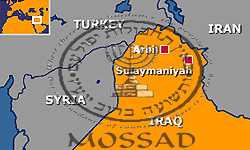
    christianzionismIran’s Fars news agency claimed Tuesday that the CIA and the Mossad were actively promoting Christianity in the Kurdish region of northern Iraq.

    According to the report, the Americans and Israelis were offering $1,000 to any youngster willing to convert to Christianity.

    The news agency further claimed that several Christian organizations had translated the Bible into Kurdish and were distributing them to young Kurds.

    Source:  www.jpost.com, Aug 4, 2009

    CIA, Mossad Promoting Evangelism in Northern Iraq

    christianzionism2TEHRAN (FNA)- The US and Israeli spy agencies are trying to promote evangelism in Iraq’s Kurdistan region, sources said.
    According to a series of information obtained by FNA, the Central Intelligence Agency (CIA) and Israeli Secret Services (Mossad) are striving to promote Christianity among the youth in Iraq’s northern region of Kurdistan.

    According to FNA dispatches, the two intelligence agencies have also allocated heavy funds for the task and pay $1,000 to every young person who turns to Christianity.

    The plot began from the very beginning of US military aggression against Iraq and occupation of the country after ousting former Iraqi dictator Saddam Hussein and even earlier, sources said.

    Head of the Islamic Group in Kurdistan Ali Bapir warned about the development, saying, “The international organization for evangelism in Iraq will pay 1,000 US Dollars to those who convert to Christianity.”

    Member of the Islamic Unity Movement of Kurdistan Babakr Ahmad told FNA, “Islamic parties have felt the danger. Unfortunately, the international Christian organizations are actively promoting Christianity given their available huge funds.”

    Kurds who have recently embraced Christianity hold annual meetings in Arbil, the capital of the Kurdistan autonomous region.

    Ali Bapir strongly criticized the authorities of Kurdistan autonomous region for their inaction in the face of the development and for issuing the required permission for holding such meetings.

    According to FNA dispatches, other evangelist institutions like ADS Institution are funding translation of Bible into the Kurdish language.

    An informed source from the evangelist institution in Arbil told FNA on the condition of anonymity that the main mission of the institution is distribution of Bible in Kurdish language.

    The source said the manager of the institution is a British who uses an alias name, “Eskandar” (Alexander), to escape identification.

    The source underlined that the institution’s books are coming from England and Greece and that the translated books are distributed among the people for free.

    Source: english.farsnews.com,  2009-08-04

  • UN marking first humanitarian day

    UN marking first humanitarian day

    The United Nations is holding its first ever World Humanitarian Day to honour international aid workers.

    The UN hopes the event will focus attention on aid workers and increase support for their role.

    Aid staff are working in increasingly dangerous environments and are frequently targets of attacks, it says.

    Last year 122 international aid workers were killed, a death toll that was higher than that for UN peacekeeping troops.

    The inaugural World Humanitarian Day falls on the sixth anniversary of the bombing of the UN headquarters in Baghdad, in which 22 workers died.

    UN Secretary-General Ban Ki-moon will attend a wreath-laying ceremony at the UN in in New York to remember the victims of the 2003 attack.

    Photographs showing humanitarian workers in action will also be exhibited after the ceremony.

    The BBC’s correspondent at the UN in Geneva, Imogen Foulkes, says that aid workers are increasingly being targeted by armed groups.

    Killing or kidnapping them has become for some a legitimate tactic.

    The UN hopes the day will serve as a reminder that aid work is based on a very simple principle: to bring impartial humanitarian relief to all those in need, our correspondent says.

    BBC