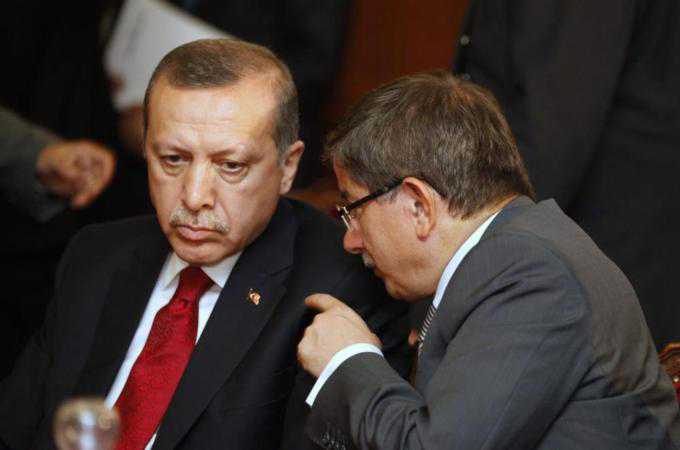
 Prime Minister Erdogan must carefully balance Turkey’s foreign policy in order to appease his supporters [REUTERS]
|
||||
| Doha, Qatar – In June 2011 and a few days before the national elections, I attended a workshop in one of Turkey’s top universities, the Middle East Technical University in Ankara. The topic was Iran’s nuclear programme and Turkey’s management of the crisis. Among the participants were a few bureaucrats from the Turkish Ministry of Foreign Affairs and some prominent Turkish academics.All but an American academic spoke approvingly of Turkish Foreign Affairs Minister Ahmet Davutoglu’s initiative of the Nuclear Fuel Swap Deal signed a year ago. The main speaker, an influential Turkish academic, even claimed that the deal was the best course of action ever taken to solve the crisis – but the world, he added, missed it. In reaction to the American academic’s doubts, the professor confidently asserted that without Turkey the crisis could not be solved.
Unfriending We were in the midst of the Arab Spring and it was obvious that the Turkish leadership was entertaining the idea that Turkey could be a model for the Arab World.
I was puzzled. How could the Turkish leaders live with two contradictions the Arab Spring uncovered? First, Recep Tayyip Erdogan and Ahmet Davutoglu had long befriended unpopular Arab rulers, but at the same time managed to polish their images among the Arab masses. Once the protests broke out in Egypt, however, Erdogan and Davutoglu immediately distanced themselves from Hosni Mubarak. It was a smart move. But, with Bashar al-Assad, the duo were extremely patient. It took longer, but Erdogan and Davutoglu eventually did the same with Assad. After the Arab Spring Davutoglu changed his visionary guiding principle in foreign policymaking. Now “zero problems with the neighbours” would guide Turkish foreign policy. The Turkish leadership thus solved the first contradiction. A ‘friend’ indeed The other contradiction is more serious and yet to be solved. The Turkish leaders have also tried to befriend the Gulf Arabs and the Iranians at the same time. For example, Turkey and the Gulf States frequently exchanged high-level visits in the 2000s. After 40 years, for example, a Saudi King visited Turkey, in fact twice. Turkey increased its exports to the region and was declared to be a strategic partner of the GCC. Rapprochement with the GCC Arab States did not deter the Turkish leadership from developing closer ties with Iran. Turkey in fact did more than that. For Iran’s sake Turkey put at great risk its strategic interests with the United States, the European Union, Israel – and not to mention the Arab World – by engineering the Nuclear Fuel Swap Deal. One month after the deal, Turkey also voted against further UN sanctions on Iran as a non-permanent member of the Security Council. Is it pure self-interest? In large part, yes. For Turkey, Iran is simply more important than the GCC as a market. Since coming to power, Erdogan and his team have tried hard to open up the Iranian market to the Turkish companies and made decent progress. Trade volume between the two countries increased from $1.25 billion in 2003 to $16 billion in 2011. Erdogan set even a higher number, $30 billion, as a benchmark to be realised in the near future. On the other hand, the total trade between Turkey and the whole Gulf States is around $11 billion in 2011. Even though Turkey may hope to increase that number in the near future, I am sure, they are realistic about the full potential: Turkey faces tough competition from American, European, and Far East Asian companies and does not get favourable treatment. Iran is critical to Turkey for other reasons. First, in order to fight effectively the re-strengthening Kurdish terror organisation, the PKK, Turkey must closely work with Iran. Even Iran’s inaction is going to trouble the Turkish military. Second, Turkey aims to become a regional energy hub or at least an energy transit country. Iran figures in most, if not all scenarios, for the successful realisation of that aim. A balancing act
There is also a domestic constraint. The policy of balancing Iran is going to be an extremely hard sell. Even though for quite different reasons all but few societal groups will object to such a balancing. First, the Kemalists will object to it because such a positioning will involve Turkey unnecessarily with the problems of the Middle East. This will constitute a radical departure from Mustafa Kemal Ataturk’s isolationist, independent and peaceful foreign policy. The ultra-Nationalists, the Leftists and the Socialists will join forces with the Kemalists, not because they are isolationists, but because they are anti-US and anti-Israel. In fact, these groups have long already accused Erdogan and Davutoglu of following too pro-American and pro-Israel policy. So far, their campaign did not seem to persuade the ordinary folks. But, any anti-Iran foreign policy orientation will give credit to their accusations and make these groups even more vocal in their criticisms. There are other societal groups, who will object to such an anti-Iran orientation. First, there are those Turkish Political Islamists, who get more inspiration from Iran than Saudi Arabia or any other Arab state. These groups constitute one part of the JDP constituency and may shift alliance if Erdogan and Davutoglu appear too anti-Iran. Some of them are already critical of Erdogan and Davutoglu for not cutting all ties with Israel despite Erdogan’s fiery rhetoric about Israel. Second, even anti-Iran religious groups will object to such a re-orientation of Turkish foreign policy. It is not because of their sympathy for Saudi Arabia. Most religious groups in Turkey have strong Sufi orientations and find Wahhabism or Salafism extremely disturbing. These groups, which in fact constitute the overwhelming majority of religious groups in Turkey, will raise strong objections to Turkey taking any side between Iran and the Arab states. In fact, the religious leader of the most influential religious group, Fethullah Gulen, repeatedly warned the JDP leadership of such an adventure. Finally, most Turks who do not belong to any of these groups are generally very apathetic about the developments in the Arab world. They have quite a simple understanding of the international politics of the Middle East, viewing most Arab regimes as simple puppets of the United States. On the other hand, Iran is, in their view, a proud country standing against the bullies, the United States and Israel. Erdogan and Davutoglu have so far successfully appealed to the ordinary folks’ nationalistic impulses, but a strong-anti Iran position might discredit the duo’s future appeals. In short, Turkey is not going to play any balancing role in the epic battle between Iran and the GCC countries. Simply, Iran is too important and most, if not all, Turks will object to such an adventurous foreign policy. Birol Baskan is Assistant Professor at the Georgetown University School of Foreign Service in Qatar. The views expressed in this article are the author’s own and do not necessarily reflect Al Jazeera’s editorial policy. |
||||
Blog
-
Can Turkey balance Iran?
-
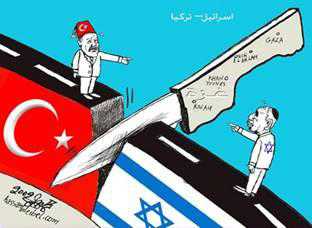
Could Cyprus pull Turkey and Israel into war?
While Ankara is keen to mend fences with Tel Aviv after recent tensions, the latter appears to be turning the tables, creating sparks over Cyprus, writes Sayed Abdel-Meguid
Perhaps the watchword for developments on the Aegean- Eastern Mediterranean axis, where Turkey and Israel have been engaging in bouts of muscle flexing and squabbles over deep-sea oil, is “posturing”. By no means does this apply to the heir to the Ottoman Empire alone; the Hebrew state is just as obsessed with its image. Yet, contrary to the impression it may seek to convey, Ankara has been the keener of the two to put an end to the deterioration in the relations between it and Tel Aviv.
A steadily escalating dual between the two countries has seethed several years. It first erupted with an angry verbal exchange and has since passed through Turkish condemnation of the blockade on Gaza, the televised spat during the Davos conference, and the Israeli assault against the Mavi Marmara off the shores of Gaza in May two years ago.For four years, then, Turkey and Israel have growled, taken menacing steps against each other, and then backed off and continued to eye one another warily. Nor does either side appear ready to relax its guard, in spite of numerous efforts to ease tensions between the two. The most recent was reported in the Turkish daily, Sabah, which wrote that, as a gesture towards mending the rift between the two countries, Israel returned four Heron pilotless spy planes to Turkey after a month-long delay. These were four of the five aircraft that Ankara had sent back to Israel last year for repairs after they had technically malfunctioned. The article adds that some friendly European governments have been mediating between the two countries.
Elsewhere in the Turkish press we find reports transmitted from the Israeli press that Turkish Prime Minister Recep Tayyip Erdogan sent an envoy to his Israeli counterpart, Netanyahu, with the purpose of repairing the rift in their bilateral relations.
Meanwhile, it has also been reported that Israeli officials have contacted families of the Turkish victims who died in the attack on the Turkish ship that was carrying humanitarian aid to Gaza. According to these reports, the officials were secretly instructed to offer compensation amounting to $6 million along with a letter of apology. However, the gesture falls short of Turkish demands, to which testify the warrants issued by the Turkish public prosecutor for the arrest of four Israeli army commanders. He named former chief-of-staff Gabi Ashkenazi, deputy commander of the navy Admiral Eliazar Maroum, director of military intelligence General Amos Yaldin, and head of Air Force intelligence General Avishai Levi, and called for their life imprisonment for having issued the orders to attack the Mavi Marmara.
For his part, US President Barack Obama urged his Turkish counterpart Abdullah Gèl to try to restore a positive climate in Turkish-Israeli relations. In the meeting between the two heads of state, which took place during the NATO summit in Chicago 20-21 May, Obama said that improved relations between the two countries would contribute to promoting stability in the region which has been swept by the revolutions of the Arab Spring. Gèl naturally took the occasion to remind Obama of the need for an official Israeli apology for the Mavi Marmara incident. Referring to the need for an official apology for the Mavi Marmara incident, Gèl responded that Israel is well aware of the steps that have been taken, and that if Israel takes these steps, Turkey will act accordingly.
The evidence, thus, indicates that Erdogan’s Justice and Development Party government, which may have initiated the mounting antagonism between Ankara and Tel Aviv two years ago, is now the more eager of the two to mend fences. Fully aware of this, Israel was quick to take advantage and did so by approaching the Greek-Cyprus duo in order to trigger a new conflict.
News sources have revealed details about a defence treaty between Israel and Cyprus (officially referred to by Turkey as southern or Greek Cyprus, which Turkey does not recognise) which was signed during a visit by Netanyahu to the divided island on 16 February. During that visit, Cypriot President Demitris Kristofias asked the Israeli prime minister to increase Israeli investment in Cyprus. Netanyahu’s response was to insist on permission to establish a naval and air force base there.
According to a news analysis in a Turkish newspaper, Israel wants to deploy 20,000 commandos in Southern Cyprus in order to protect the crude oil pipeline that Israel plans to construct in the Eastern Mediterranean and to ensure the security of the natural gas station at Vasiliko in Limasol. The article, appearing in Vatan, cited unidentified sources as saying that these measures are part of a greater plan to build a second Israel in the Middle East. It adds that Jewish businessmen have bought large areas of land in northern Cyprus (referred to as the Turkish Republic of North Cyprus, which only Ankara recognises) through bogus companies in that part of Cyprus. “They have already inaugurated a Jewish temple in one of the villages, affixed a sign in Hebrew and appointed a rabbi for it,” the source is quoted as saying.
Decision-makers in Turkey are aware that European governments and the US are not unconnected with these ambitions and, indeed, have been encouraging Israel to take hostile steps against their country. That Israel has been building partnerships with countries in the Balkans and in the Caucasus has heightened suspicions that it is constructing a web around Anatolia. “These moves are indicative of carefully studied plans that are being implemented if not in order to dominate then at the very least in order to capitalise on the energy sources along the old Silk Road,” a source said.
Returning to the question of Cyprus, could it indeed propel Turkey to clash with Tel Aviv? There is no doubt that Turkish opinion at the official and popular level feels strongly about the issue, so the answer could be yes. But a central problem is the balance of military might between the two countries, which weighs against Ankara and which would give Israel the preponderance in a military clash.
It would seem in Turkey’s interest not to escalate, but rather to show more flexibility in order to turn over a page that it is keener than others to put behind it. Therefore, threatening to annex northern Cyprus to Turkey, as Turkish Minister for EU Affairs Egemen Bagis did, is bound to backfire. Wavering to act on this threat would only diminish the credibility of the Turkish government before the Turkish people and the rest of the world. The same would apply with the regard to the threat to freeze relations with the EU in the event that Cyprus assumes the presidency of the EU parliament 1 July.
-

Leading article: It is time for Turkey to take the lead on Syria
Here was Ankara’s first serious test as a regional power: it is a test that it has so far failed
Outrage over the Houla massacre remains high, but there is also a growing sense of despair that nothing effective is being done to prevent its repetition. Almost every day, evidence is produced of fresh killings by Syrian government-backed death squads that bring the country closer to all-out sectarian civil war.
The expulsion of Syrian diplomats this week was a purely symbolic gesture, and the economic sanctions in place are more likely to hurt ordinary Syrians than their leaders. And although Russia shows signs of becoming weary of paying an ever-increasing political price for its support for Syria, the stalemate in the UN Security Council is also unlikely to change for the moment.
But perhaps the most surprising aspect of the impasse is Turkey’s failure to act effectively during the crisis. It is a country which shares a long land border with Syria and had previously been on exceptionally good terms with President Bashar al-Assad, helped by its exporters’ domination of the Syrian market before 2011 and the Turkish goods that fill shops throughout the country.
Here was Ankara’s first serious test as a regional power: it is a test that it has so far failed. But any future resolution of the crisis must involve Turkey, as the only one of Syria’s immediate neighbours capable of exerting influence.
At the start of the popular uprising 15 months ago, the Turkish government appeared well-positioned to act as a conduit between the Syrian government and the opposition. Sadly, Prime Minister Tayyip Recep Erdogan set too much store by the laudatory press clippings about the rise of “the new Ottomans” and exaggerated his government’s influence in Damascus.
When Ankara discovered that Mr Assad was stringing them along, without any intention of implementing their proposals for reform, warm relations between the two countries turned ice-cold over night.
But for all the talk of establishing a “safe haven” for refugees on the Syrian side of the Turkish border, it never happened, most likely thanks to the combination of threats from Iran and a desire to avoid the risk of war with Syria. Ankara would also be conscious that, until 2000, Syria was the main supporter and base for the Turkish Kurd guerrillas – the PKK – and Damascus could unleash these once again.
It would have been preferable if Turkey had not broken so wholly with the Syrian regime. As a result of Mr Erdogan’s mis-playing of his cards, it is not the Turks but the Russians who have ended up as the one country with pivotal influence in Damascus. But there is still time to take back the initiative. And if there is to be regional action, it would be better led by Turkey than Saudi Arabia and Qatar – not least to avoid the absurd hypocrisy of pretending that two of the last absolute monarchies on earth are trying to overthrow Mr Assad because of their concern for the democratic and civil rights of the Syrian people.
It will be difficult at this stage to ease the Syrian regime out of power, and the prospect facing the world is rather of a prolonged guerrilla war, with alarming regional implications, that still may not produce a conclusive winner. International military involvement, or even just arming the rebels, have little to recommend them, even in the unlikely event that Russia could be brought on board. But there is much else that the international community can do, including the establishment of humanitarian corridors to ease the appalling suffering of Syria’s civilian population. It is up to Ankara to take a lead.
via Leading article: It is time for Turkey to take the lead on Syria – Leading Articles – Opinion – The Independent.
-
Turkey PM Erdogan sparks row over abortion
Turkey’s Prime Minister Recep Tayyip Erdogan has described abortion as tantamount to “murder”, angering women’s rights groups and sparking an intense debate in the mainly Muslim nation.
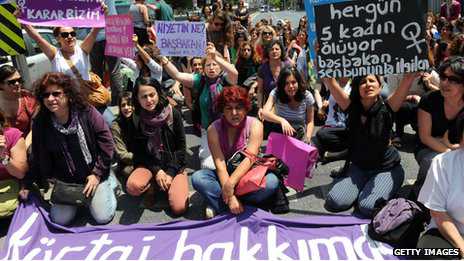
Turkish feminists hold placards as they protest outside the Turkish Prime Minister's office in Istanbul In line with Mr Erdogan’s comments, Turkey’s health minister proposed a change in the abortion law, which rights groups fear could lead to a total ban.
Abortions became legal in 1983. According to 2008 figures, 10% of pregnancies in Turkey were terminated through abortion, far lower than the European average rate of 30%.
Speaking last week at a conference on population and development, Mr Erdogan said “there is no difference between killing a baby in its mother’s stomach and killing a baby after birth”.
“I consider abortion to be murder. No-one should have the right to allow this to happen.”
Mr Erdogan also said he was “a prime minister that is against birth by caesarean” because “unnecessary” elective caesareans were “unnatural”.
Mr Erdogan, who is known to advocate having large families, caused yet more anger when he compared abortion to the aerial bombardment of civilians.
“Every abortion is like an Uludere,” he said – a reference to an incident last December in which 34 civilians were killed by the Turkish military in an air strike near the Iraqi border.
An investigation into the incident is still going on, with claims that the civilians were mistaken for Kurdistan Workers’ Party (PKK) armed insurgents.
‘Our womb’
Perhaps inevitably, Mr Erdogan received the backing the Turkish parliament’s human rights committee chairman Ayhan Sefer Ustun.
Mr Ustun, who belongs to the ruling Islamist-rooted AKP (Justice and Development Party) of Mr Erdogan, said abortion should be banned as it constitutes “a crime against humanity”.
“The notion that life begins after a few months is a grand delusion. We now need to rid society of this misconception… It also poses a danger to the mother’s life.”
But that was not the reaction from feminists and women’s rights groups.
Habibe Yilmaz, lawyer and director of the Centre for Legal Support for Women, said “making a decision regarding one’s own body… is a fundamental human right”.
“Depriving women of this right would be tantamount to restricting her right to health and the right to live a fulfilling life.”
I believe the law should prevent abortions as much as possible”
Recep Akdag Turkey’s Health Minister
The Istanbul Feminist Collective reacted angrily. It staged a sit-in outside the prime minister’s office in Istanbul. Women held banners declaring “Murder is male violence, abortion is a choice!” and “Our womb, our life, our decision!”
Illegal practices
Next in line to reject Mr Erdogan’s comments was Turkey’s medical fraternity. The Turkish Medical Association (TTB) warned that restricting abortion would only encourage illegal practices, push women to use “primitive methods” to abort and increase maternal mortality.
“Prime Minister Erdogan’s worries that the population will decrease and the nation will be wiped off the face of the Earth are baseless. Turkey’s population will reach 90 million in 2050 without any additional arrangements,” said TTB Secretary-General Feride Tanik.
The prime minister also faces international criticism. US-based Human Rights Watch has warned that restrictions on abortion would threaten “women’s human rights to life, health, equality, privacy, physical integrity, and freedom of religion and conscience”.
Change in law?
Meanwhile, Turkey’s Health Minister Recep Akdag has said a draft law will be submitted next month that would restrict or ban abortions.
“I believe the law should prevent abortions as much as possible, except in cases when they are medically necessary. When making a decision, politicians will take into account both the scientific and moral aspects of the issue,” he said.
In a reference to babies born as a result of rape, Mr Akdag said that the state would look after the babies if “the mother has been through something bad”.
It is not clear what the draft bill would entail, but rights groups fear either a total ban or limiting abortions to four weeks after pregnancy. Current Turkish law allows abortions until the 10th week after conception.
New restrictions on abortion would not necessarily hurt Turkey’s bid for EU membership, as some EU member states either ban abortion or set very strict conditions for it.
via BBC News – Turkey PM Erdogan sparks row over abortion.
-

Three Ethnic Racist Terrorist Kurdish women who firebombed Turkish club in Stoke Newington jailed
Dilek Dag, 25 
- Dilek Dag, 25

- Altin Yadirgi, 28
Three Kurdish women were jailed last week for a potentially “catastrophic” petrol bomb attack on a Turkish club in Stoke Newington, deemed to be politically and racially motivated by the judge.
Four home-made petrol bombs were thrown into the Coffee House of the People of Gumushane in 94 Green Lanes last year, because of its Turkish association.
Dilek Dag, 25, Altin Yadirgi, 28, and Dilan Eroglu, 20, all pleaded guilty to arson with intent and being reckless as to whether life was endangered.
The court heard the three women supported the aims of the Kurdish-linked group Partiya Karkeren Kurdistan (PKK).
A Turkish Airforce Strike in Turkey on December 28, which killed Kurdish civilians suspected of being PKK fighters, prompted them to carry out the attack.
The next day the women made four petrol bombs out of empty beer bottles and drove over to the club, which was filled with 10 people aged 40 to 50 playing cards and drinking coffee at 1.15am on December 30.
Two of them threw the lit petrol-filled bottles, setting alight a table cloth, carpet and chairs, before they all ran off.
One customer tried to chase them before he realised his arm and leg were alight.
The fire was put out by a neighbouring businessman using his own fire extinguisher before fire crews arrived.
Deputy Assistant Commissioner Stuart Osborne, the senior national coordinator counter terrorism, said: “It is only by luck that none of these petrol bombs smashed during the course of this attack.
“Had any of them done so the likely consequences would have been a catastrophic fireball that would have caused serious and life threatening injuries in the confined space of the social club.”
The women were arrested three days later after detectives from the Met’s Counter Terrorism Command identified them using CCTV footage of them buying the petrol and mobile phone evidence.
Eroglu’s fingerprint was found on one of the bottles and further forensic examination revealed DNA traces to Eroglu and Yadirgi.
CCTV footage also shows their Ford Focus car making loops around the block, conducting hostile reconnaissance before the attack.
All three women pleaded guilty at an earlier hearing on 27 April 2012 and appeared before Woolwich Crown Court for sentencing.
Dag and Yadirgi were jailed for six years and eight months each, and Eroglu for six years.
London 24
-
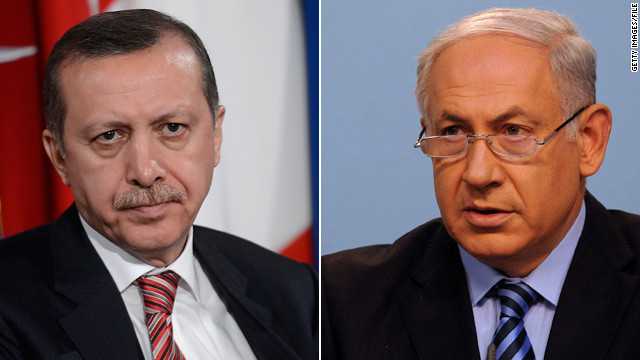
Turkey, Israel: Potential for a fresh start?
Turkey, Israel: Potential for a fresh start?
Editor’s Note: Soner Cagaptay is a senior fellow at the Washington Institute for Near East Policy and a GPS contributor. You can find all his blog posts here. Tyler Evans is a research assistant at the Washington Institute for Near East Policy. The views expressed in this article are solely those of Soner Cagaptay and Tyler Evans.
By Soner Cagaptay and Tyler Evans, Special to CNN
Soner Cagaptay
Thursday marks the two-year anniversary of the 2010 flotilla incident, a crisis on the high seas that triggered a tailspin in Turkish-Israeli relations.
In the aftermath of the incident, Turkey recalled its ambassador and demanded an apology from Israel as well as reparations for the nine slain activists. Ankara even announced that its warships would escort future missions to Gaza.
Attempts to mend fences have stalled over the issue of an Israeli apology. With Turkey willing to accept nothing less than a full apology, and Israel for the moment unwilling to accommodate this demand, the two sides seem to be at an impasse.
Yet below the surface, not all is grim in Turkish-Israeli relations. Remarkably, economic ties have been flourishing between the two countries.
Turkish-Israeli economic ties took off in the late-1990s as part of a growing strategic convergence. Deepening trade was underpinned by a series of bilateral agreements opening Turkish and Israeli markets to each other. Notable agreements included a free trade agreement (1996), a double-taxation prevention treaty (1997), and a bilateral investment treaty (1998). These agreements ushered in an era of improving political and economic ties. Trade jumped from $449 million in 1996 to more than $2.1 billion in 2002. This remarkable acceleration continued with bilateral trade increasing 14.6% per year, on average, from 2002 to 2008.
Surprisingly, the diplomatic crisis has not translated into an economic crisis. Take for instance, a boycott announced by several Israeli grocery chains in the wake of the flotilla incident. Despite the assertions on the part of these retailers, Turkish export of vegetable products has remained steady since 2007, and exports of prepared foodstuffs, beverages and tobacco doubled between 2007 and 2011. From 2010 to 2011, trade increased by 30.7%, far surpassing the growth that occurred during the heyday of Turkish-Israeli ties.
Still, defense ties have been hard-hit. Following the flotilla incident, Turkey froze at least a dozen defense projects with Israel, including a $5 billion deal for tanks and an $800 million sale for patrol aircraft and an early-warning radar plane.
Despite these bruises, economic ties seem destined to deepen even further in the long term.
For starters, all the aforementioned trade and investment treaties remain solidly in effect. Secondly, neither side seems eager to disrupt the trend of booming bilateral trade. In the aftermath of the flotilla incident, Turkish Prime Minister Recep Tayyip Erdogan announced his intention to cut all relations with Israel, including trade. But Ankara rapidly corrected the statement, adding that commercial ties would not be downgraded. Similarly, when an Israeli investment house announced its plans to divest in Turkey, the head of the Israeli Chamber of Commerce urged firms to refrain from any actions that might hurt Turkish-Israeli business ties.
Q&A: Explaining the tension between Turkey, Israel
The mutual reluctance to rupture trade ties is understandable, especially in light of the global economic climate. After all, both countries owe much of their growth in recent years to buoyant exports, a large portion of which were sold in European markets. This means that both countries are vulnerable to a sluggish European recovery. Greater bilateral trade could pick up some of the slack, especially on the Israeli side, where Turkey constituted Israel’s sixth-largest export market in 2011 and could climb the ranks as Israel’s traditional markets remain anemic.
Israel is important for Turkey as well. In terms of volume, the Israeli market is small, but it presents significant opportunities for Turkish producers to move up the value chain. In March, the Turkish Industry and Business Association identified Israel as a priority investment partner, underlining the advantages of coupling Turkey’s land and labor with Israel’s innovation economy. A telling example of this potential can be found in Bursa, where Turkish manufacturers are assembling electric cars as part of a venture with the Israeli company Better Place. Thanks to this venture, Turkey is now producing its first electric car with technology that would not have been easy for the Turks to develop on their own.
There is also a political angle that could bode well for bilateral ties. Faced with an increasingly volatile Middle East, some Israelis are concluding that they are better off rebuilding ties with Turkey, even if this does not mean going back to the honeymoon years of the 1990s. Meanwhile, Turkey faces a popular uprising in Syria that holds the potential of spilling over its borders. Along with downward-spiraling ties with Iraq, not to mention regional competition against Iran, this suggests that Israel is perhaps not the biggest fish to fry.
Turkey and Israel seem to have potential for a fresh start. Even if the pair continues to diverge on certain core political issues, both seem to secretly prepare for the day they can make up again. As always, the flag follows the money.
The views expressed in this article are solely those of Soner Cagaptay and Tyler Evans.
Post by: Soner Cagaptay
via Turkey, Israel: Potential for a fresh start? – Global Public Square – CNN.com Blogs.