Blog

  • Istanbul: Beautiful and affordable

    By Khadijah Bawazeer

    As time goes by, we abandon old affiliations and develop new ones. Due to the Arab Spring in Egypt and Syria and its repercussions in Lebanon, the three most favorite tourist destinations in the Middle East have become undesirable, so people are discovering Turkey. Istanbul is witnessing flocks of tourists from neighboring areas, mainly Arabs. European tourism has been going on for some time, and European tourists come to Turkey almost all the year round but especially when their countries are very cold. They come to Turkey for its relative warmth, which is still too cold for people from hot countries. However, from May to September, the weather in Turkey is just cool enough and if you prefer very warm weather then you should go in June and July.

    Istanbul is the only city in the word divided between two continents.

    It is the juncture between two worlds; no wonder everyone in history wanted to occupy it. The European side of Istanbul has the historic palace of Topkapi, the Blue Mosque, and the old historic area of Sultan Ahmed.

    This area constitutes the essence of Istanbul. You will find many of the great mosques there, the Egyptian Bazaar and the Grand Bazaar, which dwarfs all other souks both in merchandize and magnitude. Yet the Asian part of Istanbul is the place you may want to stay in because it is quieter and less expensive than the European part.

    When visiting Turkey, you can start with Istanbul then visit some of the beautiful islands nearby, go to the beach and walk around the beach parks or visit other Turkish cities such as Bursa and Izmir.

    Turkey seems to be a country of rich beauty and refinement even in the countryside. The country, in general, and Istanbul, in particular, have a lot to offer from beautiful beaches to great museums and from affordability to great food.

    However, it is more expensive than one might think; so though prices are not too expensive, they are not cheap either. Local merchants and tour guides can spot tourists and ask for more than they would ask from locals. It would be great if you knew someone Turkish so that they could help you. However, there is something to appreciate about Turkish people anywhere. They do not nag, neither do they beg. If you say that you are not interested, they will let you be.

    My trip to Turkey, much overdue, was unforgettable. I have been around the world and if not for the cold winters, this is a place I would not mind to be. I was overwhelmed by the historic grandeur of Istanbul. Yet I could not stop myself from thinking that the Sultans must have been too rich for words, which necessarily means that someone else must have been very poor. I am not sure, but this seems to me a possible, if not a plausible, conclusion.

    The writer can be reached at [email protected].

    via Saudi Gazette – Istanbul: Beautiful and affordable.

  • More babies for a strong Turkey

    More babies for a strong Turkey

    Until recently, it used to be considered almost blasphemous to talk about “the rise of authoritarian politics in Turkey.” This fact alone is indeed a sign of authoritarian politics and/or authoritarian political cultures that it takes a long time to be alarmed by the signs of authoritarianism. The democrats of Turkey have long thought that authoritarianism is particular to Kemalism and its remnants, like the secularist military and judicial hegemony.

    Now, “democrats” claim to be disappointed and even shocked by Recep Tayyip Erdoğan’s statements and Justice and Development Party (AKP) policies concerning the Uludere incident and abortion, which have been linked together in a curious way by PM Erdoğan himself. Finally, democrats have started to question the sincerity of the AKP on democratization or have begun to focus on Erdoğan’s personality.

    There is no doubt that charismatic leaders like Erdoğan have a tendency toward autocracy.

    Nevertheless, it speaks of a shallow understanding of politics to focus on traits like the “sincerity” of a political party or focus on the “personal mood” of its leader.

    The test of sincerity for a political party and its leader is only possible through scrutiny and an analysis of its politics. Apart from political developments which have offered clear signs of authoritarian leanings, Erdoğan and many AKP politicians have not been hypocritical about their political convictions.

    Erdoğan is, in fact often praised for his boldness. A good example among AKP politicians is Professor Burhan Kuzu, the current head of the Parliamentary Constitution Commission and an eager advocate of the “presidential system” who unashamedly announced his support for “capital punishment” a year ago. Nobody, however, bothered to discuss the political discourse of not only AKP but of “conservative democrats” in general up until very recently.

    Now, it is the debate on abortion which has naturally provoked a lot of controversy. It is widely accepted that Erdoğan wanted to manipulate public opinion and divert attention from the Uludere controversy. Even if that is true, his anti-abortion stance underlined his authoritarian conservative leanings since he not only stated that he was against the pro-choice idea but also started a process to illegalize abortion. Moreover, he improved upon his conservative discourse by supplementing it with the nationalist line that he was against abortion and Caesarian operations because he thinks they are plots to hinder population growth in Turkey. In his Diyarbakır speech, he emphasized the importance of a young population for economic growth and for a strong country. Erdoğan wants more babies for a strong Turkey even if the mothers are reluctant.

    In fact, even though some projections show that there could be problems related to a population decrease in future, there is no sign of a labor shortage problem in Turkey. On the contrary, unemployment is still a social, as well as economic problem. Besides, it is possible to overcome any labor force problem by relaxing immigration policies. Erdoğan’s “politics of benevolence” for poor countries could be reflected in immigration policies. I am sure poor Somalis would be more than happy if they were granted permission to reside and work in Turkey. Otherwise, the politics of population growth is nothing but a nationalist ambition.

    The controversy on abortion is surely one of the conservative, authoritarian and nationalistic repercussions of Erdoğan and the AKP government – and I am afraid it will not be the last one.

    via NURAY MERT – More babies for a strong Turkey.

  • Turkey set to heavily invest in Somalia

    Turkey set to heavily invest in Somalia

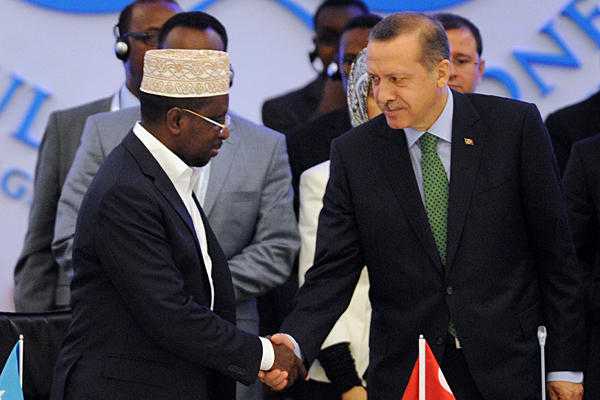
    Somalia’s President Sheikh Sharif Sheikh Ahmed, left, shakes hands with Turkish PM Recep Tayyip Erdogan before he addresses a conference that aims to support Somalia in a transition process, Istanbul, Turkey, June 1, 2012.

    ISTANBUL — Turkey is reaching out to war-torn Somalia with a huge redevelopment effort – in Ankara’s latest effort to expand its economic and political influence in Africa and play a greater role in the international arena.

    Rebuilding Somalia, bringing peace and security, and helping establish a stable government top Turkey’s list of goals in the East African nation. With its thriving economy, Ankara is also looking at future trade possibilities in the energy, construction and agricultural sectors.

    Challenges

    For now, Turkey is faced with a major challenge.

    Somalia has not had a stable central government for two decades. The country’s United Nations-backed transitional government is fighting the Islamic extremist group al-Shabab, though pro-government forces have gained the upper hand in recent months. Also, Somalia is emerging from a major drought last year.

    Turkish media have reported that Turkey is working to end the fighting. Turkish aid agencies are operating in regions controlled by the Somali government and al-Shabab. And Turkey has said it is prepared to offer training and support to Somalia’s government.

    Also, Turkish engineering contractors have been in the Somali capital, Mogadishu, working to reconstruct a city left in ruins by years of fighting.

    Must act now

    According to Turkish Prime Minister Recep Tayyip Erdogan, now is the time to act.

    “Somalian mothers and fathers are hurting, and it is possible to stop this, and Turkey is not waiting to act to help the Somalians wondering what others may think,” he said.

    Turkey has made several high-profile moves as part of its commitment to Somalia.

    Last year, Prime Minister Erdogan was the first Western leader in decades to visit Somalia. In March, Turkish Airlines became the first major commercial carrier to fly directly to Somalia in more than 20 years. Last week, Turkey hosted an international conference that focused on helping Somalia establish a stable government and elect a new president by August 20.

    Turkish Foreign Ministry spokesman Selcuk Unal said Turkey has sent more than $50 million in humanitarian aid for the Somali people since Erdogan’s visit to Mogadishu.

    “From Turkey’s point of view, since the visit of Prime Minister Erdogan to Somalia, we have collected from Turkish government funds, from the Turkish people, or from Turkish society $350 million, of which $51 million has been extended to the people of Somalia via air or by ships, humanitarian assistance material,” Unal said. “In addition, we will be continuing our reconstruction efforts on all of these issues, energy, reconstruction, transportation, those sorts of issues.”

    Broader stability

    To Veysel Ayhan of the Center for Middle East Peace and North Africa Studies, Turkish interest in Somalia stems mainly from the historical ties between the two nations. Turkish officials think bringing stability to Somalia will lead to stability in the broader region, Ayhan said, noting that Turkey’s efforts are part of its “soft power” politics and desire to play a huge role in the international community.

    “Turkey is trying to get the attention of the international community in Somalia so that Somalia’s development would be supported by more international actors,” Ayhan said.

    Foreign Ministry spokesman Unal said Turkey’s efforts are part of its growing commitment to sub-Saharan Africa.

    Voice of America

    June 8, 2012

    via Turkey set to heavily invest in Somalia | SomalilandPress.com – Somali News in English.

  • Azerbaijan’s SOCAR sees $17B Turkey investments

    Azerbaijan’s SOCAR sees $17B Turkey investments

    BAKU, Azerbaijan — Azerbaijan’s state oil and gas company says it plans to invest up to $17 billion in energy projects in neighboring Turkey over the coming eight years.

    SOCAR vice president Suleyman Gasimov said Thursday that investments will include $5.5 billion on a new refinery and $800 million on a power station.

    Another major, still-unconfirmed goal mentioned by Gasimov is the construction of the proposed Trans-Anatolian natural gas pipeline, which Azerbaijan hopes could be used to carry gas from its Shah Deniz offshore field to Europe. Under current plans, Azerbaijan would take a lead in the project, known as TANAP, and provide several billion dollars for its completion.

    SOCAR is investing aggressively overseas, in countries like Turkey and the former Soviet republics, as it tries to diversify its sources of revenue.

    via Azerbaijan’s SOCAR sees $17B Turkey investments – Wire Business News – The Sacramento Bee.

  • Greece-Turkey illegal migration sparks call for change in Schengen

    Greece-Turkey illegal migration sparks call for change in Schengen

    Luxembourg The surge in illegal migrants across the porous border between Greece and Turkey was set to prompt European Union ministers to call for drastic changes to Europe’s visa-free Schengen area on Thursday.

    Under proposals being considered by home affairs ministers meeting in Luxembourg, the 26 countries in the travel-free Schengen area may be allowed to restore border controls for up to a year under “exceptional circumstances”.

    Among those circumstances, according to demands made by France and Germany earlier this year, are problems related to illegal immigration.

    Migration has emerged as one of Europe’s most sensitive political issues amid the economic crisis.

    Illegal crossings detected on the outer borders of the 26-nation area rose a sharp 35 per cent in 2011, from 104,000 the previous year to 141,000, largely due to flows across the Mediterranean from the Arab Spring upheavals, according to the EU’s Frontex agency manning the borders.

    But the second biggest hot-spot was the border between Greece and Turkey, which registered 55,000 detections last year.

    With low-cost flights to Turkey on the increase as war, chaos and poverty sends people fleeing hot-spots from Afghanistan and Pakistan to Somalia, the flow is forecast to increase.

    A draft document does not spell out illegal migration as a reason to reintroduce checks and the EU’s home affairs commissioner Cecilia Malmstroem has said Schengen was never designed to control migration.

    Government change

    She also noted this week that since a joint letter from France and Germany was put to ministers in April, the French government has changed, with socialist President Francois Hollande in place of conservative Nicolas Sarkozy.

    Sarkozy, chasing the far-right vote, in April threatened to pull out of the Schengen zone within a year failing improved action to keep out illegal migrants.

    “For us, this letter no longer exists,” Malmstroem said.

    “I’ve not yet discussed it with the new French government but I’m sure France will have a constructive approach at the next interior ministers’ meeting.”

    Currently, the Schengen treaty allows renewal of border controls in the case of a terror or security threat thrown up by sports or other events.

    But if agreed by the ministers, the draft rules would allow a state within the Schengen area to reimpose border controls for six months, renewable for another six when “exceptional circumstances” require it.

    France took that liberty last year, temporarily closing its border with Italy when the Arab Spring revolts threw thousands across the Mediterranean into Italy and Greece.

    The European Commission, the EU’s executive arm, has proposed however that states be enabled to close borders for five days in case of migratory pressure, but must seek permission from Brussels for longer periods.

    via gulfnews : Greece-Turkey illegal migration sparks call for change in Schengen.

  • Turkey refuses to attend EU events if Cyprus presides

    Turkey refuses to attend EU events if Cyprus presides

    Turkey will not attend any event Cyprus presides over when the divided nation assumes the European Union presidency in July, Turkey’s foreign minister said today, although it will continue to collaborate with the EU.

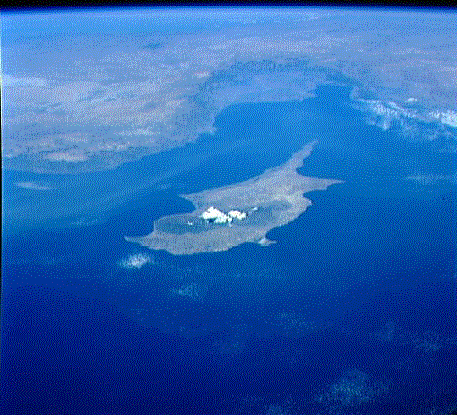
    Turkey does not recognize Cyprus as a sovereign nation and opposed it taking over the EU presidency until a solution to the dispute is found. The island was split into an internationally recognized Greek-speaking south and a breakaway Turkish-speaking north in 1974 when Turkey invaded after a coup by supporters of a union with Greece. Only the Greek section is part of the EU.

    “EU-Turkey relations and the political contacts we are currently establishing will continue as they are,” Foreign Minister Ahmet Davutoglu told a joint news conference with EU foreign policy chief Catherine Ashton and Enlargement Commissioner Stefan Fule. “Yet no ministry or organization of the Turkish Republic will take part in any activity that will be presided by Southern Cyprus.”

    Eight policy issues have been frozen by the bloc over Turkey’s refusal to allow ships and planes from Cyprus enter its ports and airspace.

    Turkey, however, is showing renewed interest in reviving its stalled bid to join the European Union, now that one of its key opponents Nicolas Sarkozy is no longer the president of France.

    Turkey began its EU accession negotiations in 2005 but made little progress in its candidacy, thanks to its dispute with Cyprus and opposition from Sarkozy to Turkey’s membership. Sarkozy argued that the predominantly Muslim country is not a part of Europe and wanted Turkey to accept some kind of a special partnership with the EU instead of full membership an offer Turkey rejected.

    Now that Socialist Francois Hollande has replaced the conservative Sarkozy as France’s president, Turkey hopes France will be more sympathetic to the candidacy of a country that has one of the world’s fastest growing economies and is becoming a regional diplomatic player.

    “Turkey will determinedly progress in its course toward the EU,” Egemen Bagis, the Turkish minister in charge of EU affairs, said Thursday.

    Ashton, meanwhile, thanked Turkey for sheltering nearly 27,000 Syrian refugees who fled violence in neighboring Syria where forces loyal to President Bashar Assad are waging a crackdown on an uprising.

    “First of all our thought everyday with the people of Syria,” Ashton said. “We are horrified by the violence and determined to work together in support of solutions.”

    -AP