Blog

  • Monumental: Istanbul’s Dazzling Architecture

    Monumental: Istanbul’s Dazzling Architecture

    Steeped in history and diversity, Istanbul is an architectural paragon
    By Ron Gluckman | September 27, 2012 | 1


    Istanbul makes all the latest travel hot lists, for good reason. Domed mosques, topped with fairy-tale minarets, anchor scores of neighborhood squares where prayer calls echo down cobbled lanes. Boats of every size navigate the Bosporus Strait, where old men crowd bridges to drop fishing lines and gossip, while along the shores, cafés serve thimbles of thick Turkish coffee.

    This Silk Road terminus can sometimes feel as chaotic as exotic. Istanbul residents complain about the crush of traffic and the gaggles of tourists increasingly drawn to a rejuvenated world capital. Still, Istanbul has managed the transition from a city of 7 million residents in 1990 to today’s metropolis of over 15 million far better than other boomtowns like Beijing. Some landmarks have been compromised, but the city’s astonishing architectural endowment remains unrivaled in depth and diversity.

    The issues of heritage and development will be examined in depth at the Istanbul International Architecture and Urban Films Festival (www.archfilmfest.org), which runs from Oct. 1 to 7. Scores of films, on architectural integrity and urbanization, will be shown around the city for free.

    If you can’t get to any screenings, you can ponder many of the same topics simply by wandering around this real-life museum of enduring monuments. Hint: many key attractions can be visited using a special museum pass (www.muzekart.com), which offers three-day entrance for about $40. Here are some of the don’t-miss sites, old and new.

    Hagia Sophia
    One of the world’s oldest, most spectacular Christian churches, the Hagia Sophia (www.ayasofyamuzesi.gov.tr) reflects all the tumultuous historical change in this crossroads capital. From its dedication in A.D. 360 until 1453, this was mostly a major Greek patriarchal cathedral of Constantinople, as Istanbul was called until 1930. For nearly 1,000 years, it was also the world’s biggest church. During the 13th century, it was converted into a Roman Catholic cathedral by the Crusaders. Then, for another five centuries, from the mid-1400s to the 1930s, it was a mosque. Few other religious structures can claim such a lengthy service to so many different faiths.
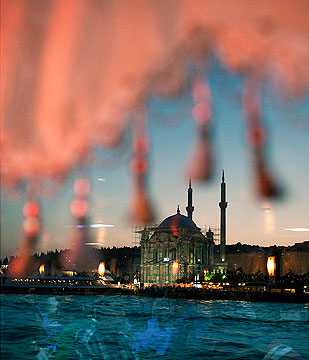
    Many sites, like Ortakoy Mosque, can be seen from the Bosporus

    Hagia Sophia still serves the wider public good. Since 1935 it has been a museum. Its pink exterior is beautifully alluring, surrounded by flowers and fountains. Inside, it offers a marvelous mélange of vaulted arches and religious icons, including restored angels, soaring over Muslim scriptures. Even children will be entertained, spotting some of the world’s oldest graffiti, carved into the walls by ancient Viking invaders.

    Topkapi Palace
    Istanbul abounds with exquisitely preserved palaces, offering wonderful insight into the sybaritic lifestyles of the imperially favored. But as an eye-watering example of Ottoman Empire opulence, the Topkapi Palace (www.topkapisarayi.gov.tr) ranks first among them, and is found right in the heart of the old city.

    For four centuries, until the sultans retreated to cooler estates along the Bosporus in the mid–19th century, this was the seat of the Turkish empire. The grounds and much of the interior—including the massive harem quarters and huge kitchens that could serve over 6,000 meals per day—are open to visitors, so plan to spend much of a day exploring them and the spacious courtyards, with their wealth of artistic treasures and intricate murals. The Chinese porcelain collection is among the world’s largest, with over 10,000 pieces.

    Galata Tower
    Galata Tower (www.galatatower.net), also known as the Tower of Christ to the Genoese colonists who built it, is one of the best-known architectural features of Istanbul and, at nine stories high, is reportedly the largest medieval tower still open to visitors. It has had a rich history, serving as lighthouse, fortress and watchtower. Perched just to the north of Pierre Loti Hill, it remains the center of the ancient Galata neighborhood, which is a favorite for tourists, crammed as it is with cafés and boutiques. The lines to the top of the tower are long, but the wait is worth it; a circular walkway around the conical top offers panoramic vistas of the city and far beyond.

    Kanyon Center
    Most of the architectural attention in Istanbul focuses on the preservation and conversion of old buildings, but one knockout exception is Kanyon Center (www.kanyon.com.tr), an innovative office, residential and shopping complex.

    This modern metal-and-glass construction, the brainchild of architecture firm the Jerde Partnership, seems to snake through downtown Istanbul like a canyon—locals describe it as looking like it was carved out of the cityscape by a giant lathe. There are 26 floors of offices and residences, with most of the public facilities—including luxury shops, a multiplex cinema, trendy cafés and popular sports bars—concentrated on four scintillating stories. Worth visiting if only for the people-watching opportunities and endlessly unique views.

    Basilica Cistern
    There are hundreds of ancient water tanks nestled under Istanbul, many open to tours, but the Basilica Cistern (which Turks call the Sunken Palace) is the mother of them all. Located just outside Hagia Sophia, it dates back to the 6th century reign of Byzantine Emperor Justinian I and owes its opulent form and decorations to its origin as a Roman basilica.

    In recent years, this sprawling water tank has been illuminated with somewhat cheesy colored lights, but they cannot dispel the eerie sense of wonder as you encounter, in the underground mist, ornate columns and carvings, including a massive carved Roman head of Medusa. If the interior seems familiar, that’s because you might recognize it from the paddling scenes in James Bond’s From Russia with Love. Incidentally, Istanbul’s architectural marvels are headed back to the silver screen: 007 was there in April and May, utilizing its imposing cityscape, both ancient and contemporary, for his latest adventure film.

    MORE: Three Economic Lessons Imported From Turkey

    Related Topics: architecture, Istanbul, travel, Turkey, Travel

    Read more: https://style.time.com/2012/09/27/monumental-istanbuls-dazzling-architecture/#ixzz27sjYSL71
  • Imprisoned Kurdish rebel leader calls for peace

    Imprisoned Kurdish rebel leader calls for peace

    ISTANBUL: The imprisoned leader of Turkey’s Kurdish rebels has called for an end to bloodshed after his troops cranked up their attacks against Turkish forces this summer, his brother told the daily Taraf.

    “Not even a single policeman, troop or guerilla should die from now on, he told me in our last get together,” Mehmet Ocalan, brother of detained rebel chief Abdullah Ocalan, was quoted as saying by Taraf on Friday.

    Mehmet Ocalan relayed his brother’s wish “for the bloodshed to stop, the problem to be solved,” but refrained from giving details on the date of their meeting at the island prison of Imrali, south of Istanbul.

    According to the Hurriyet daily, the meeting took place last Friday.

    Ocalan’s call for peace comes as intensified clashes between Turkish troops and his outlawed Kurdistan Workers’ Party (PKK) rebels rage in the Kurdish-majority southeast.

    Turkey’s Prime Minister Recep Tayyip Erdogan said Wednesday 144 members of the security forces and 239 rebels had been killed since the start of the year, marking one of the deadliest phases of the confrontation in more than a decade.

    In all, about 45,000 people have been killed since the PKK, which is blacklisted as a terrorist organization by Turkey and much of the international community, took up arms for autonomy in the southeast in 1984.

    Erdogan also signaled the possibility of resuming negotiations with the rebels, after clandestine talks between the sides, publicly known as “Oslo talks”, reached a dead end in 2011.

    Mehmet Ocalan’s visit was, Erdogan said, a government initiative to put an end to speculations that the Kurdish leader might have been killed in jail, after he was placed under solitary confinement more than a year ago.

    Abdullah Ocalan was captured by Turkish agents in Nairobi, brought back to Turkey and sentenced to death in 1999, but the sentence was commuted to life in prison.

    via THE DAILY STAR :: News :: Middle East :: Imprisoned Kurdish rebel leader calls for peace: reports.

  • ‘Istanbul would be UN island soon’

    ‘Istanbul would be UN island soon’

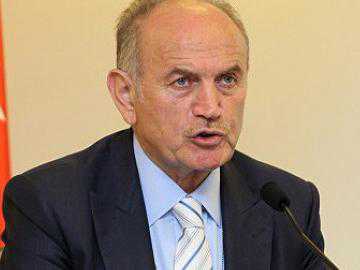
    Istanbul Mayor Kadir Topbas has said that Istanbul would be a UN island soon.

    Topbas as the president of United Cities and Local Governments (UCLG) and United Nations Advisory Committee of Local Authorities (UNACLA), met with Turkish journalists at the Turkish House after participating in a high-level panel of dignitaries regarding developments after 2015.

    He told the press members that with their efforts for opening of directorates and regional representation offices of UN in Istanbul would make Istanbul a UN island, and bring prestige to the city.

    He added that they want to be a solution partner of UN Millennium Development Plan and host the 3rd UN Habitat Meeting.

    Anadolu

  • Siemens to equip the world’s fourth longest suspension bridge with traffic control technology

    Siemens to equip the world’s fourth longest suspension bridge with traffic control technology

    Siemens to equip the world’s fourth longest suspension bridge with traffic control technology

    28/09/2012 06:17 (1 Day 02:03 minutes ago)

    The FINANCIAL — In the construction of the fourth longest suspension bridge in the world, Siemens will be the general contractor responsible for the development, installation and commissioning of all components and systems for the traffic control technology.

    The six-lane bridge is part of a freeway project linking the cities of Istanbul and Izmir in Western Turkey. The customer is the Japanese company IHI Infrastructure Systems Co., Ltd. The volume of the contract for Siemens is worth around 17 million euros. Commissioning is scheduled for 2015.

    Siemens is equipping the almost three-kilometer-long freeway bridge at the eastern end of the Sea of Marmara in Turkey with state-of-the-art traffic control technology. This includes the traffic control system, monitoring technology and components for the technical infrastructure such as communication and camera equipment, energy supply, lighting and ventilation. As Siemens reported, the nucleus is the integrated operations and traffic control technology center. The traffic control system combines all operating and traffic data in the control center, guides the traffic flows and monitors the situation on the freeway bridge. The operations control technology controls lighting, ventilation and energy distribution and supply on the bridge.

    The region around Izmir is prone to earthquakes and therefore requires special monitoring technology. Integrated seismic sensors therefore monitor the stability of the local infrastructure and supply data on the state of components and buildings continuously. Any damage or deformation is detected and reported at an early stage.

    Siemens is also supplying components for the technical infrastructure such as camera surveillance technology and emergency call control centers for the new building in Turkey. Plus the complete lighting system for the bridge, deck and air traffic as well as dehumidification systems for girders, cables and pylons. A SCADA (Supervisory Control and Data Acquisition) system will be used for the process monitoring and control of the system.

    The construction of the bridge and the 420-kilometer-long highway between Istanbul and Izmir is part of the largest freeway project in Turkey to date. This new six-lane bridge connection will cut the travel time between both cities from eight to four hours. The new freeway will also relieve inner-city traffic congestion in Istanbul. The newly constructed highway will shift the traffic to the Istanbul suburbs and lessen congestion in the city center.

    via The FINANCIAL – Siemens to equip the world’s fourth longest suspension bridge with traffic control technology.

  • Syrian TV – The Guardian: Different donors in Saudi Arabia were channelling money to a powerful Lebanese politician in Istanbul

    Syrian TV – The Guardian: Different donors in Saudi Arabia were channelling money to a powerful Lebanese politician in Istanbul

    The Guardian: Different donors in Saudi Arabia were channelling money to a powerful Lebanese politician in Istanbul.

    It was past midnight in Aleppo when Captain Abu Mohamed and Captain Abu Hussein received a phone call informing them the ammunition from Turkey had arrived. Abu Mohamed, a portly 28-year-old member of Aleppo military council, perched unsteadily on a plastic chair in a garage on the edge of the Salah al-Din neighbourhood.

    Abu Mohamed described where the weapons had come from. Different donors in Saudi Arabia were channelling money to a powerful Lebanese politician in Istanbul, he said. He in turn co-ordinated with the Turks – “everything happens in co-ordination with Turkish intelligence” – to arrange delivery through the military council of Aleppo.

    via Syrian TV – The Guardian: Different donors in Saudi Arabia were channelling money to a powerful Lebanese politician in Istanbul..

  • Envisioning The City Of The Future As A Man-Made Island

    Envisioning The City Of The Future As A Man-Made Island

    Envisioning The City Of The Future As A Man-Made Island

    Take an exclusive first tour of Dror Benshetrit’s hilly, floating metropolis for 300,000 residents.

    Dror Benshetrit’s body of work is staggeringly diverse. In his studio’s portfolio, you’ll find a hard-shell suitcase that expands like an accordion, a line of modular dorm-room furniture designed for Target, and a proposal for the National Library of Israel that looks like a tall, skinny pyramid some rude giant pushed onto its side. The QuaDror, which Benshetrit unveiled last year, showed the designer’s interest in exploring the most fundamental components of architecture and engineering; it’s a little bit hard to describe, so I’ll defer to Linda Tischler’s explanation of “Ingenious Building Gizmo.” But if the QuaDror showed Benshetrit at his most practical and elemental, his more recent project is a complete 180. HavvAda is Benshetrit’s proposal for a man-made island community off the coast of Istanbul, Turkey, and it’s nothing short of a complete re-imagining of the city as we know it.

    For the last 500 years, Benshetrit explained to me, every century or so, someone in Turkey has contrived the construction of a new canal between the Black Sea and the Sea of Marmara. The latest dreamer is Turkish Prime Minister Recep Tayyip Erdoğan, whose proposed Istanbul Canal foreesees completion sometime around 2023. Building such a massive waterway would require digging up a massive amount of dirt–in this case, somewhere in the ballpark of a billion cubic meters of the stuff. Where would it all go? That’s precisely what a developer commissioned Benshetrit to figure out.

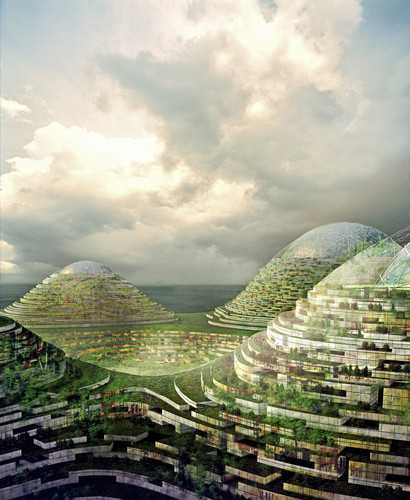
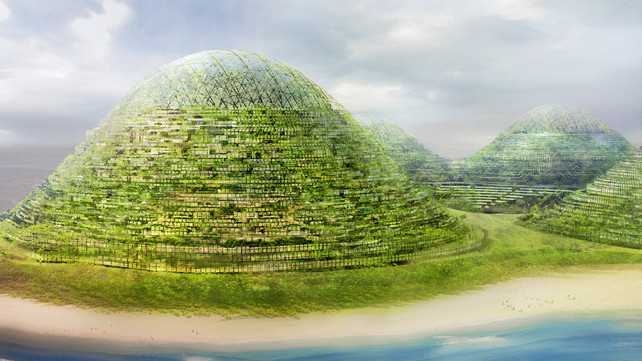
    His answer is HavvAda, a man-made island comprised of six hills of varying sizes, each supported by a geodesic dome with residential homes on their outside and communal and commercial spaces on the inside. These six “micro-environments,” as Benshetrit calls them, surround a valley intended for parks and other recreational spaces. From a distance, as seen in the renderings, the island straddles the line between organic and artificial–HavvAda’s hills are a little too perfectly sculpted to be natural, but they’re certainly more pleasing to the eye than, say, six big apartment complexes.

    One possibility that arises from the island’s arrangement is a move to an entirely new form of urban model: a 3-D grid, as opposed to the 2-D one on which our cities currently operate. Instead of reaching up into the sky vertically, buildings wrap around the domes horizontally. The idea is that, in addition to being more structurally efficient, the domes would share infrastructure. With a 3-D grid, Benshetrit said, “instead of each being a selfish, independent building, all the buildings are supporting one another in both structure and infrastructure.”

    The 3-D grid is just one of the ways HavvAda looks to solve some of the problems faced by sprawling metropolises. “Istanbul is a gorgeous city,” Benshetrit said, “but it’s suffering from the same problem that every large, dense, multimillion- resident city has today: enormous traffic, crazy pollution. It’s just a concrete jungle, as we call most of our cities at that scale.” In creating HavvAda, Benshetrit worked with a team of architects, urban planners, engineers, and other experts to identify these central issues and explore some bold ways to solve them. But in addition to loftier goals like sustainability, HavvAda also was designed to alleviate some of the day-to-day frustrations of city living. Ideally, Benshetrit explained to me, you should be able to get from any point in a city to any other point in 12 minutes. One of the advantages of arranging the six domes around a common center area is that such movement throughout the island becomes feasible; HavvAda’s proposed transportation includes a system of walkways and cable cars. Granted, HavvAda would only be about a quarter of the size of Manhattan and hold some 300,000 people, making it a more manageable urban scenario from the start.

    Benshetrit’s quick to admit that HavvAda is more about offering a vision than putting forward a nuts-and-bolts plan of action–he deems it an “evolving proposal”–and he says that one can only go so far in prescribing the form that vision might eventually take. When you’re designing a product or even a single building, he explained, you go into it with some sense of what it will look like, what sort of details you need to consider in its creation. HavvAda is a bit different. “It’s not a full product,” he said, “it’s just a canvas, a motherboard for other designers and other architects to make different storefronts, different types of structures, to make different types of gardens and paths and things like that.” It’s not really the city of the future; it’s more like a blueprint for one. Still, not bad for a big pile of dirt.

    HavvAda will debut this weekend during the kickoff of Istanbul design week.

    via 1 | Envisioning The City Of The Future As A Man-Made Island | Co.Design: business + innovation + design.