Blog

  • The Truth About Istanbul — One Of The Hottest New Financial Centers In The World

    The Truth About Istanbul — One Of The Hottest New Financial Centers In The World

    The Truth About Istanbul — One Of The Hottest New Financial Centers In The World

    Michael Kaplan
    Suada Club

    Suada Club

    Earlier this month, Bloomberg Markets reported Istanbul is planning to build a $2.6 billion dollar financial center that would rival Dubai’s.According to Prime Minister Recep Tayyip Erdogan’s current plans, within three years, a high-rise office building will dominate the modern suburb of Atasehir, now a dusty patch of land on the Asian side of the city.

    The announcement comes in a year where the city’s stock exchange has grown 26 percent. Citigroup and HSBC already have a presence in the city, along with Japanese and Russian multinational banks.

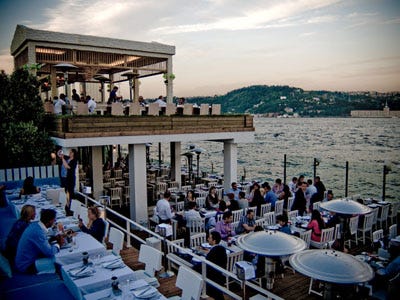
    Meanwhile, a robust banking culture is already making inroads. CEOs seek out the Billionaire Club, a showy multi-level nightclub, while junior executives head to the Suada Club, a man-made party island with an Olympic-sized swimming pool, bars and restaurants in the middle of the Bosporus Strait.

    Istanbul, Turkey straddles Asia and Europe.

    Istanbul, Turkey straddles Asia and Europe.

    Google Maps

    The city of Istanbul flanks both sides of the Bosporus straight, which connects the Mediterranean to the Black Sea, and for millennia has been a waterway of great strategic importance.

    The Bosporus also serves as a barrier between Asia and Europe.


    It’s also the world’s 2nd most populous city after Shanghai.

    It's also the world's 2nd most populous city after Shanghai.

    Flickr/Allan Henderson

    Home to about 13.5 million people, Istanbul has the world’s second largest population within in its city limits behind Shanghai. Turkish Prime Minister Recep Tayyip Erdogan has plans for a new airport and a dramatically remodeling of Taksim Square, Istanbul’s central plaza.

    According to the Financial Times, Erdogan’s critics accuse the prime minister of building monuments to himself and fear his plans are being pushed through with insufficient scrutiny.

    But the government is feverishly working on infrastructure to make it feel less crowded and more modern.

    But the government is feverishly working on infrastructure to make it feel less crowded and more modern.

    Wikimedia Commons

    Part of Erdogan’s grand vision is a third bridge crossing the Bosporus to relieve congestion in the crowded city. The project is estimated to cost $2.5 billion and is planned to be completed by 2015.

    The Financial Times reports investors worry about the country’s budget deficit and believe the bridge will push the deficit from 1.4 percent to 2 percent of GDP.

    Though the city’s architecture will always be a beautiful mix of new and old.

    Though the city's architecture will always be a beautiful mix of new and old.

    Aya Sofia Mosque

    Wikimedia Commons

    This is the piece of land slated for Istanbul’s Wall Street. Construction has already begun in the background.

    This is the piece of land slated for Istanbul's Wall Street. Construction has already begun in the background.

    Flickr/ampersandyslexia

    During the first two months of 2012, the Istanbul Stock Exchange’s main ISE National 100 Index was 25 percent higher than during the same period a year earlier and is now nearly four times larger than that of Dubai’s.

    Goldman Sachs recently agreed to pay $240 million for a 13 percent stake in Turkey’s largest non-government power producer.

    Bulge bracket bank CEO’s are already singing the city’s praises — like HSBC’s Istanbul CEO.

    Bulge bracket bank CEO's are already singing the city's praises — like HSBC's Istanbul CEO.

    Spigoo via flickr

    At a finance conference on June 13 in Istanbul, Martin Spurling, CEO of HSBC in Turkey, said:

    “I had no idea how big Istanbul was until I was appointed here. I was shocked. In terms of its location, history, culture, human potential and hospitality, Istanbul’s a great candidate to be an international finance center. We have to explain it to the world a little better.”

    That’s probably why banks like JP Morgan and Citi are setting up shop there so quickly.

    That's probably why banks like JP Morgan and Citi are setting up shop there so quickly.

    Flickr/kuytu

    According to Bloomberg, the Turkish economy expanded by 8.5 percent last year, third fastest among the G20 industrialized nations behind China and Argentina. Foreign banks are moving in to the city including bulge brackets such as Citibank, Deutsche Bank and JPMorgan Chase. 

    You would be able to live much more cheaply in Istanbul than London or New York.

    You would be able to live much more cheaply in Istanbul than London or New York.

    Flickr/leyla.a

    The exchange rate is about 1.8 Turkish lira to dollar.

    According to Numbeo, a 1-bedroom apartment in the center of the city runs around 1,000 Turkish lira per month, or about $550.

    And the city is building everything from massive malls to luxury hotels.

    And the city is building everything from massive malls to luxury hotels.

    Flickr/fsse8info

    The Palladium Shopping Centre in Atasehir houses a movie theater, 24 restaurants and more than 150 shops, including Adidas, Gap and Zara.

    Hurriyet Daily News Reports:

    “According to the center’s master plan revealed by the minister, nearly 560,000-square-meters of offices, 90,000-square-meters of land and 70,000-square-meters of hotels would be constructed. However, the Turkish government has not yet announced how the massive project would be financed.”

    In your free time, you can hangout at this man-made party island in the middle of the Bosporus.

    In your free time, you can hangout at this man-made party island in the middle of the Bosporus.

    Sauda Club

    Named Suada Club, this island has eight restaurants with cuisine ranging from Italian to sushi to seafood.

    This is the Olympic-sized pool on the man-made island.

    This is the Olympic-sized pool on the man-made island.

    YouTube

    It’s billed as the “sweetest getaway resort inside the city.”

    Istanbul’s nightlife is famed too, especially the city’s newest spot. Billionaire’s’ Club.

    Istanbul's nightlife is famed too, especially the city's newest spot. Billionaire's' Club.

    Inside the city’s trendiest hotel, The Billionaire’s Club is Istanbul’s newest nightspot.

    Michae Martin of Jet Set Report writes:

    “Inside Billionaire, the space is arranged like a glimmering disco ballroom accessed through a dramatic staircase that descends into the main dance club for truly grand arrivals. Arranged in white leather furnishings with Louis XIV lines and bedazzled gold trim, seating vignettes are arranged under a ceiling covered in 6-tier crystal chandeliers that could humble even the most bling of billionaires.”

    If you want to relax and get away the city, there are beautiful islands a short boat ride from Istanbul.

    If you want to relax and get away the city, there are beautiful islands a short boat ride from Istanbul.

    flickr: Istanbul 2008

    The New York Times recommends Buyukada, part of a group of islands called The Princes:

    Only two square miles in size, Buyukada, population 7,000, is the largest island in a green, hilly archipelago that rises from the Sea of Marmara like a convoy of basking turtles. The islands — known as the Princes, or, in Turkish, Adalar — are actually a far-flung district of Istanbul, but unlike the city on the mainland, with its roaring traffic, Wi-Fi-ready cafes, skyscrapers, and galleries and concerts that court a global audience, they haven’t seemed to have gotten the text message that the 21st century has arrived. It isn’t entirely clear that the message about the 20th has arrived, either. To set foot on Buyukada is to enter a living diorama of the past, wholly preserved. There are no skyscrapers here, no cars; only bicycles, horse-drawn buggies (called faytons), filigreed mansions and tile-roofed villas set amid flowery lanes, and emerald hillsides that drop down to rugged beaches.

    Want to move farther east?

    Want to move farther east?

    Courtesy of Fullerton Bay Hotel

    Why Wall Streeters Are Picking Up And Moving To Singapore>
    Read more:
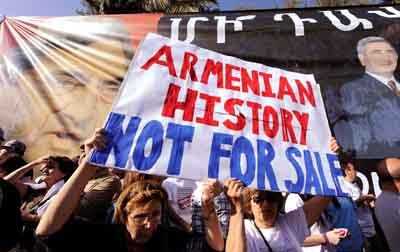
  • Obama vs Romney: Armenian American Community Pressures Candidates to Recognize 1915 Genocide by Ottoman Turkey

    Obama vs Romney: Armenian American Community Pressures Candidates to Recognize 1915 Genocide by Ottoman Turkey

    Ninety-seven years ago, when the wholesale massacre of Armenians was taking place in Ottoman Turkey, the United States turned to be the most active supporter of suffering Armenians. Over 130,000 Armenian orphans were sheltered in American orphanages that were established in Armenia, Greece, Cyprus and elsewhere. President Woodrow Wilson and the U.S. Ambassador to Ottoman Turkey Henry Morgenthau were personally involved in coordinating the aid activities.

    The New York Times alone published 145 articles in 1915, describing the horrors Armenians went through.

    Ninety-seven years later, the U.S. Armenian community supported by the Congressional Armenian Caucus, its friends in various states are still struggling to finalize the recognition of the Armenian Genocide by the U.S. government. Contemporary Turkey is a NATO ally, although some annalists like Daniel Pipes of Middle East Forum or Ariel Cohen of Heritage Foundation would often claim Turkey is not truly the same ally anymore. Ankara skillfully uses its geopolitical importance and various connections in order to resist any attempt of Genocide recognition by America, Europe or elsewhere. However, 21 countries, including Canada, France, Germany, Italy, Russia, Switzerland, Sweden, and others have adopted resolutions labeling the events of 1915 as Genocide and calling on Turkey to do the same.

    Interestingly, the United States, a country that was extremely active in helping Armenians almost a century ago, today is somehow uncertain. Ankara and its lobby groups have consequently placed an incredible pressure on the Administration.

    The paradox is that countries like Slovakia, which did not even exist in 1915, or like Venezuela, widely seen as much less democratic nowadays, were able to stand up to Turkish pressures and adopt relevant resolutions about these horrible events and gross violation of human rights.

    A lesser-known fact is that America has in fact recognized the Armenian Genocide. Forty-three out of 50 states of America at various times adopted commemorative resolutions on this subject. The House of Representatives twice (1975 and 1984) adopted genocide resolutions and President Ronald Reagan qualified the events as genocide in April 1981. However, later on, U.S. policy on this issue became more evasive resulting in calling back the U.S. ambassador John Evans from Yerevan for calling the events as genocide in May of 2006. This harsh action was taken by the administration of Bush junior (although, Bush himself had promised to recognize the genocide while he was a presidential candidate in 2000).

    The Armenian National Committee of America (ANCA), an Armenian lobby group in Washington, DC, issued a statement calling on presidential candidates Barack Obama and Mitt Romney to make their position clear on this and other issues.

    Harut Sassounian, President of the United Armenian Fund and a newspaper publisher from California, a state which hosts the majority of over one million Armenian Americans, stated: “Pres. Obama has about 30 days to make good on his pledge to recognize the Armenian Genocide. Otherwise, Armenian Americans will not vote for him for a second term.”

    President Obama, as a senator, qualified the events of 1915 as genocide. As president, he stated, “he hadn’t changed his views.” “My interest remains the achievement of a full, frank and just acknowledgment of the facts”, Obama said. However, he did not use the G—-word while in the Oval room, but qualified the events of 1915 as “Medz Yeghern.” The president has skillful advisers: “Meds Yeghern” is the Armenian equivalent of genocide, the same way Shoah in Hebrew stands for the Jewish Holocaust. Barack Obama got pretty close to doing what in fact already another U.S. president had done about three decades ago.

    However, the community is waiting for clarifications from the President. At the end of the day, “Meds Yeghern” is meaningless for most Americans, and does not have a judicial meaning.

    via Obama vs Romney: Armenian American Community Pressures Candidates to Recognize 1915 Genocide by Ottoman Turkey.

  • Training aircraft crashes in Turkey, one dead

    Training aircraft crashes in Turkey, one dead

    Training aircraft crashes in Turkey, one dead: report

    29 September 2012 | 19:21 | FOCUS News Agency

    Home / Southeast Europe and Balkans

    Ankara. A training plane on Saturday crashed in Ankara, killing one person and injuring another, said Anatolia news agency, as cited by AFP.

    The C-170 single engine aircraft plunged into the garden of a house in the Cubuk district of the Turkish capital near the airport, said Anatolia.

    The plane, owned by the Istanbul aviation club, had hit power transmission lines before the crash, the report added. It was not immediately clear from where the plane had taken off.

    via Training aircraft crashes in Turkey, one dead: report – FOCUS Information Agency.

  • How history never ends

    How history never ends

    ISTANBUL. The name is magical, and all its old names, Byzantium and Constantinople, are magical too. They conjure up images of ancient civilizations, always fighting each other, and sometimes enriching each other. But in the end, they had to merge to leave a skyline that fascinates any visitor to this city, and a cultural wealth that takes any person’s breath away.

    How does one not love those minarets? They may be somewhat ubiquitous but they never fail to catch one’s interest. How not to be awed by the Blue Mosque, Hagia Sophia, the Walls of Constantinople or the Archaeological Museum, and by the food?

    How does one best describe this enchanting place where northern waters join southern seas, and where eastern paths separate from western roads? Is this where the East and the West assemble, or is this where the East and the West split?

    Today, the answer does not seem important. Walking on an end-of-season late summer’s day down the famous and fabulous 3km-long promenade, Istiklâl Caddesi, from Taksim Square in the north down to the exciting Karaköy fish market beside the Golden Horn by the Galata Bridge, one is struck by how this sprawling city is Central Asian, Middle Eastern and Mediterranean, all at the same time.

    It is Muslim, it is Orthodox Christian, it is Greek, and it is Roman. It is imperial.

    Of Turkey’s 77 million people today, 15 million to 19 million live in Istanbul. This means that every fifth Turkish citizen resides in this city. And despite oversimplifying official figures telling us that as many as 99% of Istanbul’s residents are Sunni Turks, the profound ethnic mix is all too obvious.

    In short, I am seeing before me not only the end product of 500 years of Ottoman ethnic integration, but that of many more centuries of painful intermingling before that. The names of ethnic groups and kingdoms mentioned in the amazing Istanbul Archaeological Museum, for example, and who existed in Anatolia and its surroundings, read like the Bible and more. Crusaders have been there, Vikings have been there. Huns, Persians, Arabs, you name it.

    The proud faces one sees are not easy to place. For people living in what is always called a crossroad, they seem to belong so infinitely to the place though. This is a meeting place of civilisations, and as we know, civilisations do not always meet with open arms. Its history has been as much about war as anything else. But then, conflicts and contradictions do find common ground when covered by the sands of time.

    At the moment, Istanbul exudes the modern pride of its Turkish inhabitants. Their recent economic growth has been miraculous. While East Asia buckled under its financial crisis in 1997/98, Turkey suffered its own only in 2001. This quickly led to financial and fiscal reforms that succeeded and saw the country grow at an annual average of 6% after that. 2009 was a bad year when the economy actually contracted, but since then the rebound has been dramatic. The Turkish GDP grew by 9% in 2010 and by 8.5% in 2011.

    There were fears of the current account deficit amounting to 10% of GDP, and the inflation rate going above 10% earlier this year. The property market has also worried observers, who see a housing glut happening. This is, however, not like the asset bubble situation in Ireland or other European Union countries.

    Definite signs of a slowdown this year have been welcomed by the authorities, who are hoping for an economic soft landing. But the general optimism remains high. For example, the first eight months of this year saw 6.2 million foreign visitors live in Istanbul’s many hotels, eat in its fragrant restaurants, and walk its busy streets. This is 18% more than in the same period last year.

    And we are talking only about foreigners, most of whom were Germans abandoning their traditional holiday spots in Greece for the fresher and more affordable exoticism of Istanbul. Domestic tourism figures, if available, would be much more daunting.

    The interest of Germans in Turkey is not unexpected since 10.1% of Turkish exports go to them. This figure is nicely balanced by 9.5% where imports are concerned. Turkey’s other major trading partners are Russia and China.

    I digress. I had meant to write a travel piece on Istanbul, but it is difficult not to try to capture something of the economic optimism permeating the streets of this city that is now a successful modern Muslim-majority economy where half the work force is in services, a quarter is in agriculture and the rest in industry.

    But back to impressions of Istanbul. A simple two-hour boat trip up the Bosporus alone is mind-boggling. One gets a better idea of how big the city actually is, how it stretches across both sides of the waters, and how it is joined by gigantic bridge after gigantic bridge.

    Political troubles at distant borders seem far away, and one senses the cultural and geographic — and geopolitical — vastness that Turkey still commands today. One also feels how it will be the centre of an influential Turkic world that stretches from the hills of Istanbul to the mountains of China.

    At the same time, despite the continental expanse, one is reminded that modernity — if I may use that much maligned word loosely here — is an urban process. But it is an urban process that is just the latest in a string of urban processes.

    It is faster today perhaps, and draws on impulses from further away perhaps, but it is still an urban process of creating wealth and value through commercial and cultural interaction with other cities and peoples of our diverse world. The intermingling continues.

    via How history never ends.

  • Galatasaray manager Fatih Terim linked with AC Milan

    Galatasaray manager Fatih Terim linked with AC Milan

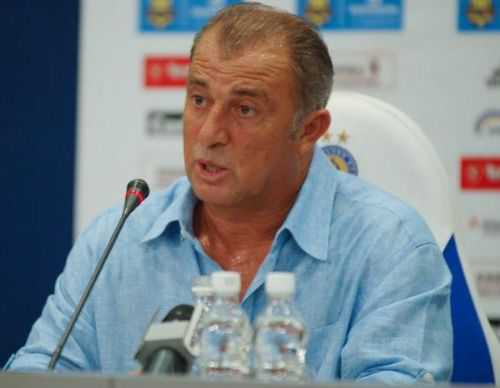
    Turkish-Football: ISTANBUL (Sept. 29, 2012) – AC Milan have been linked with Galatasaray manager Fatih Terim as a replacement for Massimiliano Allegri according to Turkish media sources.

    The Serie A outfit have made a poor start to the new season, losing three out of their last five games.

    Terim previously managed The Rossoneri in 2001, his brief stay lasted five months.

    The Galatasaray manager is one of the most successful Turkish managers of all time. The only Turkish manager to have managed Serie A clubs Fiorentina, AC Milan.

    Terim was the first manager to have ever lead Turkey into an international footballing competition when the national team qualified for Euro 1996.

    Terim guided the Turkish national team to the semi-finals of Euro 2008. The experienced manager also guided Galatasaray to an unprecedented 4 back to back league titles from 1996-97 to 1999-00 and lifted the UEFA Cup in 1999-00, a feat yet to be matched in Turkey.

    Terim is currently in his third stint at Galatasaray having being reappointed as manager last summer. Terim won the Turkish Super League in his first season back and has is currently competing in the Champions League.

    Turkish-Football.com is an Official Media Partner of Boxscore World Sportswire.�

    via Galatasaray manager Fatih Terim linked with AC Milan.

  • Russia helps U.S., Syria establish contact, Turkey in shock

    Russia helps U.S., Syria establish contact, Turkey in shock

    With a little bit of help from Russia, the Americans and the Syrians have established contact with each other, sending shockwaves in Turkey, which has blamed Moscow and Beijing for the continuation of strife in Syria.

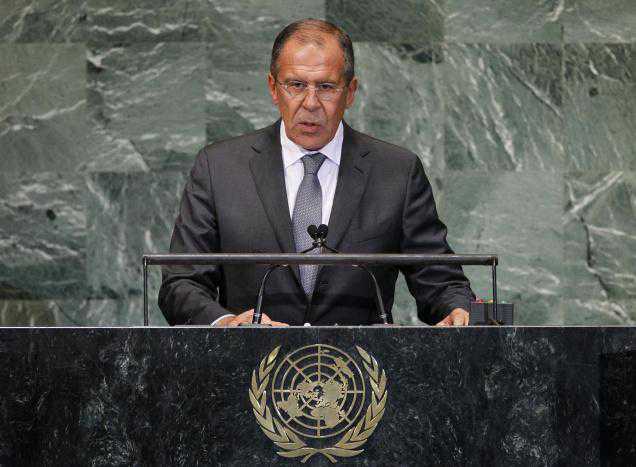
    AP In this September 28, 2012 photo, Sergey Lavrov, Foreign Minister of Russia, addresses U.N. General Assembly. He has said that Moscow had helped American experts to establish contact with Syria on the subject of chemical weapons.
    AP In this September 28, 2012 photo, Sergey Lavrov, Foreign Minister of Russia, addresses U.N. General Assembly. He has said that Moscow had helped American experts to establish contact with Syria on the subject of chemical weapons.

    Addressing the American media on Thursday, Russian Foreign Minister, Sergei Lavrov dropped a bombshell. He said that Moscow had helped the American experts to establish contact with the Syrians on the subject of chemical weapons. “I hope I won’t disclose any big secret, but we have helped American experts establish contact with the Syrians on this issue, and we have received explanations and assurances that the Syrian government is guarding these facilities in the best possible way,” said Mr. Lavrov, as reported by Russia Today.

    He also added that Russia was not considering granting asylum to Syrian President Bashar Al Assad, in case he decided to quit office.

    “No, we won’t grant him asylum,” Mr. Lavrov said, pointing out that the Syrian President “was a friend of other countries northwest of Syria.”

    Lebanon’s Al Manar television website quoted its Arab sources in France as confirming that the U.S. delegation at the U.N. General Assembly annual session wanted to discuss with Syria, the issue of chemical weapons. The Syrian side pledged “with a Russian guarantee” that it would not use these weapons “inside Syria during the conflict between the government and the militant opposition”. However, the Syrian delegation was emphatic in stating that in case Syria was subjected to a foreign attack, in that case countries involved in inciting and participating in that attack would be legitimate targets “for the Syrian rockets… loaded with chemical warheads, including countries neighbouring Syria”.

    Coinciding with the Mr. Lavrov’s announcement of opening a U.S.-Syria dialogue track on chemical weapons, Turkish Prime Minister, Recep Tayyip Erdogan went uncharacteristically ballistic—blaming both Russia and China of siding with Syria. His outburst against Moscow and Beijing was aired live on NTV, a leading Turkish television station.

    “The main source of disappointment is Russia. Let alone raising its voice against Syria, it stands by the massacre,” said Mr. Erdogan as reported by Reuters.

    “China stands by Russia, and although [Chinese President] Hu Jintao had told me they wouldn’t veto the plan [for a safe zone] for a third time, they did at the U.N. vote.” Mr. Erdogan described the position of Iran, a staunch Syria ally, as “impossible to understand”.

    Turkey has emerged as a frontline state against the Assad government, with Saudi Arabia, Qatar and the United States as allies.

    The bitter acrimony that this has caused between one time allies — Turkey and Syria — is climbing to new heights. Syria is now seriously considering arming Kurdish fighters for combat against

    Turkey, Al Manar said. Citing its “Kurdish sources,” close to the Kurdistan Workers’ Party (PKK) and the Kurdish Democratic Union Party in Syria, the website said that the Assad government “had sent a letter to Turkey saying that the Turkish interference in Syria would prompt Damascus to arm every Kurdish man in both Turkey and Syria”.

    The Syrian government is apparently considering supplying the Kurds advanced weaponry including the anti-tank Kornet rockets, as it considers playing its “Kurdish card”.

    Adding psychological warfare to its arsenal, the Syrian army has been sending cellphone text messages nationwide to the armed opposition stating: “Game Over”. These messages have also said that the countdown to evict the foreign fighters from Syria had begun, Associated Press reported.

    Keywords: Syria uprising, Bashar Assad regime, U.S.-Syria contact, chemical weapons, Turkey-Syria ties

    via The Hindu : News / International : Russia helps U.S., Syria establish contact, Turkey in shock.