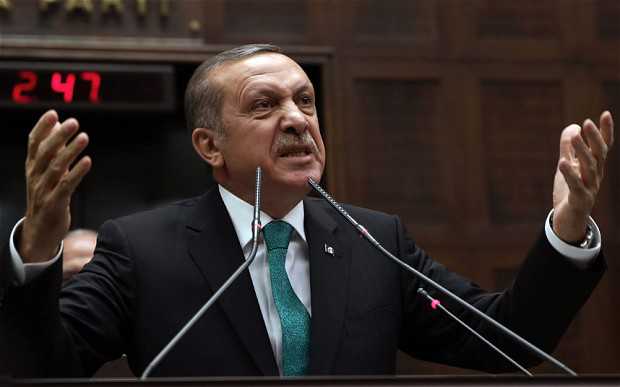
The Turkish Prime Minister tells thousands of supporters at a rally in Ankara:”History will not forgive those tyrants!” Read more about what is happening in Syria here: https://www.telegraph.co.uk/syria/
Blog
-
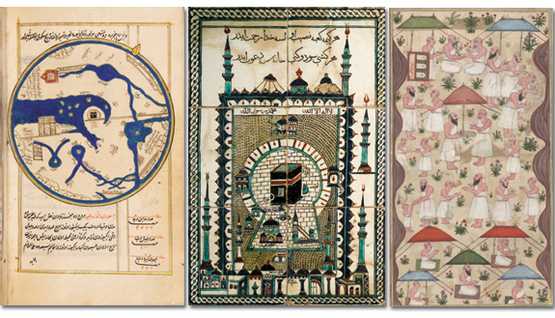
Chinese culture shines in Istanbul
A Chinese Culture Week themed “The Modern Silk Road” opened here on Saturday, serving attendants a feast for the eyes and appetite.
The week-long event, as part of 2012 China Culture Year, features documentaries, Mongolian art shows and Chinese cuisine, presenting China’s traditional culture and the lifestyle of its ethnic minorities.
At the opening ceremony, artists from north China’s Inner Mongolia Autonomous Region performed a series of Mongolian songs and dances, and gave the guests Hada, a piece of silk used as greeting gift.
“This is my first time receiving Chinese culture, and I hope someday I can go there and learn more,” Fatimah, a college student in Istanbul, told Xinhua, adding she was impressed by the performance.
“An Eternal Lamb,” a selected film in The Montreal World Film Festival last year, depicted the lifestyle of Chinese Kazakh people with a local presence, which drew wide applause among the audience.
Two Chinese Huaiyang Cuisine chefs, Xiong Shiwei and Zhang Baojian, were also invited to prepare dishes.
via Chinese culture shines in Istanbul – Globaltimes.cn.
-
Turkey: a bosom friend
Turkey: a bosom friend
September 30, 2012 |
Chief Minister Punjab Shahbaz Sharif called on Turkish President Abdullah Gull atAnkaraon Friday. President Gul expressed his happiness at the efforts of Mian Shahbaz to seek greater economic cooperation of his province withTurkey. The occasion marked another step forward towards improved bilateral relationship that would go on to providing fillip to the ongoing projects initiated in Punjab by Turkish firms, ranging from public transport to solid waste management system. On the sidelines of his meeting with President Gull, the CM was given the assurance of support in these sectors by Minister for Energy Taner Yildiz as well as the Chief Executive of Exim Bank.
Though things cannot change overnight, there is a much that will benefit the country from the expertise of our Turkish friends in areas that are in dire need of an overhaul. Their model of growth offers a source of inspiration for us as it accounts for the enviable levels of prosperity and stability thatTurkeyhas achieved.Punjabcan of course use assistance fromTurkey’s energy sector but in the long term there is no better solution than producing cheap hydel energy in the country itself, that can come only from large reservoirs. It is comforting to know that the Turkish banking sector too is forthcoming as it has waived off certain conditionalities. We would have to address the issue of bad law and order, the invariable hitch to foreign investment.
This news was published in print paper. Access complete paper of this day.
via Turkey: a bosom friend | The Nation.
-
One in 10 Employees in Europe Have Missed Work Due to Depression – More Than 21,000 Working Days Lost, According to New Survey
One in 10 Employees in Europe have Missed Work Due to Depression – More than 21,000 Working Days Lost, According to New Survey
Depression causes an average of 36 lost working days per episode
Managers report need for better legislation, including training and counselling to tackle the problem
BRUSSELS, October 1st /PRNewswire/ — One in 10 working people surveyed in Europe have taken time off work because of depression, with an average of 36 days lost per episode of depression, according to a new survey from the European Depression Association. This equates to more than 21,000 days of lost working time in this group of people. However despite the size of the problem, nearly one in three managers reported they had no formal support or resources to deal with employees who have depression, and 43% called for better policies and legislation to protect employees.
Commenting on the results, MEP Stephen Hughes said, “Depression in the workplace is an employment and societal challenge that is causing serious damage and which requires attention and action from the European Union. The inclusion of depression in the workplace in the new European Commission Strategy for Health and Safety at Work, backed up in the coming two years with legislative action, would represent excellent progress towards protecting Europe’s workers more effectively and ultimately contributing to economic and social prosperity.”
Depression is the predominant mental health challenge among working-age people and more than 30 million European citizens will suffer from depression at some point in their life.1 The IDEA survey (Impact of Depression in the Workplace in Europe Audit) polled more than 7,000 people in Europe and found that 20% of respondents had received a diagnosis of depression at some point. The highest rate was in GB (26%) and the lowest in Italy (12%). Among workers experiencing depression, those in Germany (61%), Denmark (60%), and GB (58%) were most likely to take time off work, while those in Turkey were the least likely to take time off (25%).
The costs of depression were estimated at €92 billion in 2010 in the EU, with lost productivity due to absenteeism (taking time off work) and presenteeism (being present at work while ill) representing over 50% of all costs related to depression.1 In the IDEA survey the average number of days taken off work during the last episode of depression was 36 days, with Germany and GB having the highest (41 days) and Italy (23 days) having the lowest.
Despite the high rates of absenteeism due to depression, one in four of those experiencing depression stated they did not tell their employer about their problem. Of these, one in three said they felt it would put their job at risk in the current economic climate.
The cognitive symptoms of depression (concentration difficulties, indecisiveness, and/or forgetfulness) cause significant impairment in work function and productivity,2 and are present 94% of the time in an episode of depression.3 However, the survey shows that awareness of these symptoms is poor: when asked to identify signs of depression only 33% said forgetfulness, 44% indecisiveness and 57% trouble concentrating. In contrast 88% identified low mood or sadness as a sign of depression.
Among the managers surveyed, approximately one in three reported there was no formal support in place to help them deal with depression in employees. The lack of support was highest in Germany (44%) and lowest in Turkey (10%). Managers in GB (55%) were most likely to have support from their HR department, while managers in Turkey were most likely to receive support from a medical professional (79%).
When asked what is needed to support employees with depression in the workplace, managers most often cited more counselling services and better government legislation and policies. In Turkey managers were most likely to call for better legislation (55%) and training for all employees (63%). Managers in GB and Turkey wanted better counselling services (56% and 53%), while German managers prioritised line manager training (53%).
Dr Vincenzo Costigliola, President of the European Depression Association said “The results of the IDEA survey show that much needs to be done in raising awareness and supporting employees and employers in recognising and managing depression in the workplace. We ask policymakers to consider the impact of depression on the workforce and charge them with addressing depression and workers and workplace safety.”
Full results of the IDEA survey will be published in 2013.
Contact: Colette Green, OgilvyHealthPR, Email: [email protected], Tel: +44(0)207-108-6028.
Notes for Editors
The European Depression Association (EDA)
EDA is an alliance of organisations, patients, researchers and healthcare professionals from 17 countries across Europe. Each year on October 1, EDA organises European Depression Day to raise awareness of depression across Europe. The theme of this year’s campaign is ‘Depression and the Workplace’. On October 1, a group of policy experts and stakeholders will meet in Brussels to continue discussions on how best to address the burden and impact of depression in the workplace in Europe. This meeting follows the Expert Roundtable on Depression in the Workplace held on 5 June 2012 by MEP Stephen Hughes. The overall aim of the meeting is to secure binding EU legislation on depression in the workplace.
The EDA is sponsored by the European Medical Association, International Scientific Association, Centro Lombardo Recuperi Industriali, L.A. Nuova Stampa and H. Lundbeck A/S.
About the IDEA (Impact of Depression in the Workplace in Europe Audit) Survey
The research was conducted using Ipsos MORI’s online panel, between 30 August and 19 September 2012. Questions were asked online of 7,065 adults aged 16-64 who are workers and managers, or have worked and managed within the last 12 months, across Europe. Results are weighted to ensure the sample was representative of this profile. Full data tables are available upon request. The survey was supported by an educational grant from H. Lundbeck A/S.
-
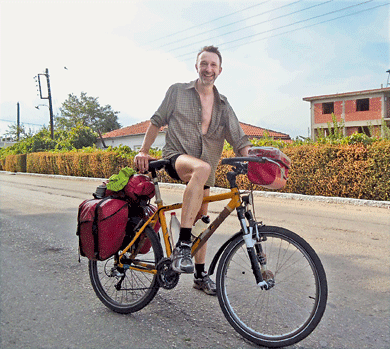
Stuttgart to Istanbul, via Athens, by bicycle
By Costas Onishenko
My encounter with Reiner Herport in the village of Fylakio, Orestiada, just a few kilometers from Turkey and Bulgaria, was lucky, to say the least.
The 43-year-old German — carrying only the most basic essentials in a set of panniers — had already cycled 2,500 km from his hometown of Stuttgart on his way to his final destination, Istanbul.
“The mistaken impression Germans have of the situation in Greece, and the Balkans in general, is why none of my friends came along on this journey with me,” Herport said, explaining his solo status. “But I wasn’t daunted by setting off alone, and, as you see, I’m doing fine so far.”
His trip has no real purpose — even though Herport enjoys cycling and has a strong environmental conscience — other than to get to know the countries his journey would be taking him through and their people.
“The way conventional tourism is nowadays, you can spend several days in a country and not really get to know anything about it,” said Herport.
“You can travel by airplane and stay holed up in a hotel, stepping out only to go to a beach or a restaurant. But neither Greece nor any other countries are just that,” he explained.
“In a few days I will arrive in Athens, but until then I will have traveled through the real Greece, the one you see here, its natural landscape, its villages and small towns.”
At a first glance, Herport looks like a bit of a tree-hugger. He says he is just an “ordinary guy” who works as an engineer for a living.
“I am not a cycling fanatic, I don’t use the bicycle to get to work every day,” he told Kathimerini. “I just really enjoy traveling through nature. And I’m not an exception. This kind of tourism is fast becoming fashionable in my country and other parts of Europe. Within the next few years, you’ll see a lot more people from Germany, Austria and other countries coming to Greece on bicycles. It’s good for your health, but the experience is completely unique. When you struggle to get up a mountain or a hill and you reach the top, the feeling in indescribable. It fills you with confidence and gives you the strength to face many of life’s difficulties with more optimism. And of course the money you need for such a trip is also a lot less than you’d need traveling by plane and staying at fancy hotels.”
Herport’s bicycle is a simple affair without high-tech frills. All he was carrying with him was some basic equipment for repairs in case of a flat tyre or other mishaps, a sleeping bag, a few items of essential clothing and some cash.
“I don’t spend much money. Every so often, I stop for a coffee and a bite to eat,” he said, before offering me a grape from a bunch given to him by a woman from Orestiada that he met along the way.
“It just happens that people treat you. At first they try to figure out who you are and what you’re doing, and then they are usually pleased. They ask you about your trip and give you something to eat and drink. I haven’t had any problems so far and haven’t faced any serious danger,” Herport said.
via ekathimerini.com | Stuttgart to Istanbul, via Athens, by bicycle.
-

Making City Istanbul – Dexigner
Making City Istanbul
September 30, 2012 | by Senay Gokcen17
Making City Istanbul is the last exhibition of the 5th IABR: Making City. The exhibition is part of Musibet, the main exhibition of the first Istanbul Design Biennial that opens on October 10 at Istanbul Modern.
Inspired by the IABR’s approach, architect Emre Arolat, the curator of Musibet, invited the IABR to present its working method and three key projects – the Test Sites in Rotterdam, São Paulo and Istanbul – in the form of a new, small exhibition: a ‘manual’ for the future of Istanbul.
“Like all metropolitan regions in the world Istanbul is preparing itself for the challenges ahead,” commented George Brugmans, Director of IABR. “How can we harmonise rapidly advancing urbanisation with ecological and economic concerns? In the next few years, the urban planners, designers, politicians, cultural operators, citizens and entrepreneurs of Istanbul will need to find common ground on this issue.”
Making City Istanbul presents three urban projects that not only offer concrete solutions for specific local issues, but also present inspiring strategies and examples that are offered as inspiration and possible benchmarks.
Test Site Rotterdam argues that Making City essentially depends on human beings: we all have a role to play when it comes to the sustainable transformation of our habitat. São Paulo provides us with examples of how the clash between social and ecological issues may be solved by playing the card of economics. And IABR Atelier Istanbul shows us that a separation of functions is less sustainable than an integrated vision that embeds agriculture, water management and forestry in the process of on-going urbanisation.
via Making City Istanbul – Dexigner.