Blog

  • Turkey’s New Islamism – By David Pryce-Jones – David Calling – National Review Online

    Turkey’s New Islamism – By David Pryce-Jones – David Calling – National Review Online

    By David Pryce-Jones

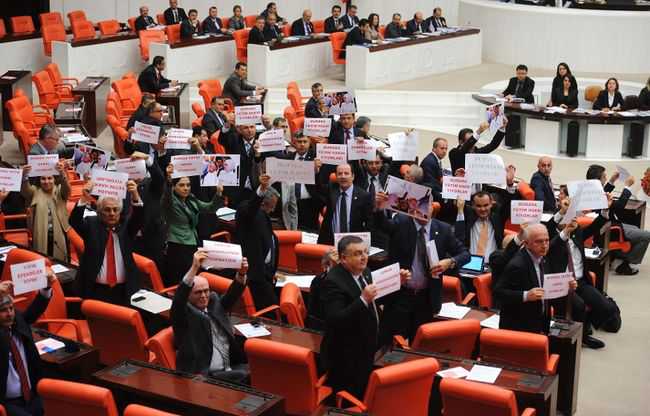
    Turkey has just held show trials that bear comparison to the judicial monstrosities staged in Stalin’s Soviet Union. Three hundred senior military officers, some serving and some retired, have been handed long prison sentences. They have been accused of belonging to a terrorist organization called Ergenekon that back in 2003 was plotting the overthrow of Prime Minister Recep Tayyip Erdogan.

    The trials began in 2007. They are a disgrace. The plotters are alleged to have been intending to bomb mosques, shoot down a Turkish military aircraft and other improbabilities of the sort. The “evidence” offered by the prosecution is full of anachronisms, forgeries and other evident fabrications. The defense was not permitted to call witnesses in a position to expose the nonsense.

    It is true that the military have staged coups in the recent Turkish past, not in their own interest but to preserve the secular modernizing state that replaced the old Ottoman Empire. Erdogan can now be seen to have taken the major strategic decision to re-align the country as an Islamist state. To that end, he had to neutralize the army. He could never have obtained 20-year prison sentences for innocent officers unless he had already purged the judiciary and installed Islamist yes-men. Similarly the media. Turkey is the country with the highest number of journalists in prison.

    The balance of power is shifting again against the West. Turkey has renounced its status as a democracy. Suspecting that membership of the European Union was more and more probable, Turkey is instead choosing to become the leader of Sunni Islamism. Opposition to Shiite Iran and its Syrian protectorate follows, although just a short while ago Erdogan was supporting them whole-heartedly and claiming to have zero problems with neighbors. The new Islamism demands rupture with Israel and identification with Hamas.

    President Obama is happy to tell everyone that he is in the habit of telephoning Erdogan frequently. He does not denounce the show trials and seems unaware that his chat-line friend in Ankara has changed.

    via Turkey’s New Islamism – By David Pryce-Jones – David Calling – National Review Online.

  • Dwyer: Turkey makes peace with religion

    Dwyer: Turkey makes peace with religion

    In my trade you get used to it after a while, but the first time you wake up to find a military coup has happened overnight where you live is quite alarming. That was in Turkey back in 1971, when the army seized control of the country after months of political turmoil. It was not as bad as the 1960 coup, when the military authorities tried and hanged the prime minister, but it was bad enough.

    There were two more coups in Turkey: In 1980, when half a million were arrested, tens of thousands were tortured and 50 were executed, and 1997, a “post-modern” coup in which the army simply ordered the prime minister to resign.

    But there will be no more coups in Turkey: The army has finally been forced to bow to a democratically elected government.

    Last Friday, a Turkish court sentenced

    330 people, almost all military officers, to prison for their involvement in a coup plot in 2003. They included the former heads of the army, navy and air force, who received sentences of 20 years each, and six other generals.

    Five years ago, nobody in Turkey could have imagined such a thing. The military was above the law, with the sacred mission of defending the secular state from being undermined by people who mixed religion with politics.

    This was the duty the 330 officers thought they were performing in 2003, according to the indictments against them. The Justice and Development Party (AKP), a moderate Islamic party espousing conservative social values, had come to power after the 2002 election: The voters had got it wrong again, and their mistake had to be corrected.

    With public opinion abroad and at home increasingly hostile to military coups, a better pretext was needed than in the old days. So the plot, Operation Sledgehammer, involved bomb attacks on two major mosques in Istanbul, a Turkish fighter jet shot down by the Greeks and an attack on a military museum by Islamic militants. The real attackers would actually be the military themselves. The accused 330 claimed Operation Sledgehammer was just a scenario for a military exercise, and the documents supporting the accusations have never been properly attributed. But given the army’s track record of four coups in 50 years and its deeply rooted hostility to Islamic parties, the charges were plausible, and the court believed them.

    The army has no choice but to accept the court’s judgment. The AK party has been re-elected twice with increasing majorities, the party’s pious leaders have not tried to shove their values down everybody else’s throats, and the economy has flourished. Even now, many in Turkey still think the army is there to protect them from the oppression of the religious fanatics, and that any attempt to curb its power is a conspiracy against the secular, neutral state.

    But the Turkish secular state has never been neutral. From the time Mustafa Kemal Ataturk and his companions rescued Turkey from the wreckage of the Ottoman empire after the First World War, the state was at war with religion.

    But today’s Turkey is modern, powerful and prosperous, and there is no external threat.

    It’s time for the Turkish army to stop waging a cold war against the devoutly religious. They are entitled to the full rights of citizenship, too.

    That was the significance of AK’s victories in the past three elections, and of the trials that have finally brought the army under control. The head of the Turkish armed forces and all three service chiefs resigned in July in protest against the trials of military personnel, but President Abdullah Gul promptly appointed a new head of the armed forces — who tamely accepted the post. It’s over.

    — Gwynne Dyer is an independent journalist whose articles are published in 45 countries.

    via Dwyer: Turkey makes peace with religion | Column | Opinion | The London Free Press.

  • Blog: Where to eat in Istanbul’s Grand Bazaar

    Blog: Where to eat in Istanbul’s Grand Bazaar

    Where to eat in Istanbul’s Grand Bazaar

    Visitors come to the Grand Bazaar for the shopping, but they should make a point of staying for the food – the market makes an atmospheric backdrop for great restaurants where locals eat

    • This post first appeared on the Culinary Backstreets blog

    • Know a great place to eat in Istanbul? Add a comment
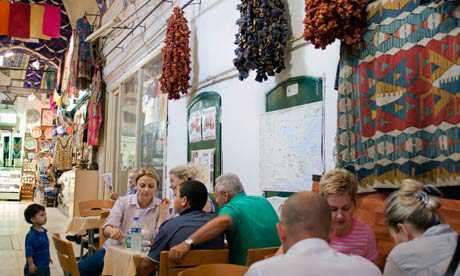
    Gaziantep Burç Ocakbaşi, Istanbul

    Gaziantep Burç Ocakbaşi restaurant in Istanbul’s Grand Bazaar. Photograph: Melanie Einzig

    We like to think of Istanbul’s Grand Bazaar – open since 1461 – as the world’s oldest shopping mall. If that’s the case, shouldn’t the Grand Bazaar be home to the world’s oldest food court? That may be stretching the analogy a little too far, but for us the Grand Bazaar is as much of a food destination as a shopping one.

    As we see it, one of the hidden pleasures of going to the bazaar (once you get past the overzealous shopkeepers hawking souvenirs) is exploring some of its quieter back alleys and interior courtyards for new dining possibilities, especially some of the smaller restaurants that cater not to tourists but rather to the locals who work in the sprawling marketplace. Here are three of our favourite places.

    Gaziantep Burç Ocakbaşi

    A friend directed us to Gaziantep Burç Ocakbaşi and we are forever in her debt. Located on a narrow side street off one of the Grand Bazaar’s busy thoroughfares, this unassuming grill house serves up very tasty food from Gaziantep, a city in south-east Turkey, that is considered one of the country’s culinary capitals.

    Our ali nazik, tender morsels of marinated beef sitting on a bed of garlicky yogurt-eggplant purée, was perfect. The delicious salad served with it, topped with chopped walnuts and zingy pomegranate molasses, was impeccably fresh. We were even more excited about the restaurant’s speciality: extremely flavourful dolmas made out of dried eggplants and red peppers that had been rehydrated and stuffed with a rice and herb mixture, then served with yogurt on the side.

    There are only a few tables, which are lined up along the length of the alleyway that is the restaurant’s home. The ambiance is provided by the strings of dried eggplant and peppers that hang above the tables, the smoke and sizzle coming from the grill and the thrum of bazaar activity all around.

    • Parçacilar Sokak 12, +90 212 527 1516. Open 11am-4pm, closed Sunday

    Kara Mehmet Kebap Salonu

    Kara Mehmet Kebap Salonu, Istanbul Photograph: Melanie Einzig

    This is one of our favourite places, not only in the Grand Bazaar but in all of Istanbul. The restaurant, a tiny hole in the wall, serves the usual assortment of kebabs – including, for the daring, kidney and liver – all expertly grilled by the mustachioed usta. A testament to the appeal of Kara Mehmet: we went there with a vegetarian friend who was so taken with the restaurant’s adana kebab that he ended up taking his first bite of meat in 30 years.

    Food aside, what really draws us to Kara Mehmet is its location, deep inside the open-air courtyard of the Cebeci Han, one of the Grand Bazaar’s numerous out-of-the-way caravanserais. Compared to the bustle of the rest of the bazaar, the Cebeci Han is an oasis of calm, mostly filled with small shops where people repair rugs, rather than sell them. Even the owner of the one actual rug shop inside the courtyard seems more interested in playing backgammon with his friends than moving carpets. When you’re done with your kebab, order Kara Mehmet’s delicious künefe for dessert and a tea from the small teahouse next door and enjoy the behind-the-scenes look at bazaar life.

    • İç Cebeci Han 92, +90 212 513 5520. Open 11am-5pm, closed Sunday

    Aynen Dürüm

    Aynen Dürüm, Istanbul Photograph: Yigal Schleifer

    Aynen Dürüm is a microscopic kebab shack near the Grand Bazaar’s “currency exchange” (essentially a small alley filled with men shouting out “buy” and “sell” orders) that serves exceptionally good dürüm, or wraps. We were first struck by the feeding frenzy we saw at the tiny restaurant, where a crowd of hungry locals was chowing down with a kind of reckless abandon rarely seen in other places around town. The setup reminded us of a competitive eating contest: a double-sided outdoor counter with about 10 stools around it and a trough in the middle that holds containers overflowing with grilled peppers, sliced pickles and sprigs of parsley.

    The tiny interior, meanwhile, is taken up by a charcoal grill and İsmail, the joint’s grill master, who has been fanning the flames here for 10 years. The no-nonsense İsmail takes the wrap business seriously, letting customers choose between two different kinds of lavaş (flatbread): the traditional thin variety and a thicker, chewier version. İsmail clearly sets the bar high. His restaurant’s tagline? “The Motherland of Kebab.”

    We found some space at Aynen’s counter and ordered a dürüm of Adana kebab and another made with lamb shish kebab, leaving the choice of lavaş up to the griller. Our wraps arrived within minutes, each stuffed with a mixture of tomato and parsley along with the perfectly grilled meat. The Adana had a wonderful balance of meat, fat and spice, while the small morsels of tender lamb inside the second wrap were so tasty that we soon found ourselves joining the crowd and stuffing our faces with little regard for decorum.

    • Muhafazacılar Sokak 29, +90 212 527 4728. Open 7am-6pm, closed Sunday

    via Blog: Where to eat in Istanbul’s Grand Bazaar | Travel | guardian.co.uk.
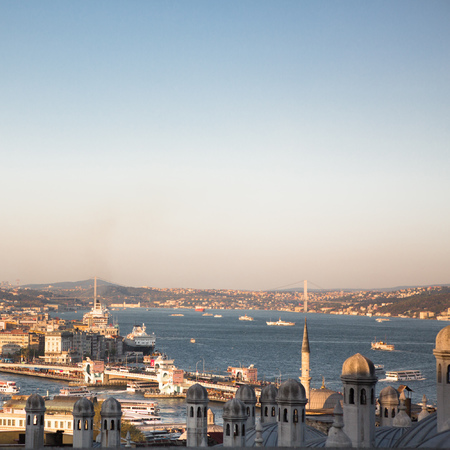
  • Turkcell Superonline Bridges Europe, Asia and Middle East to Turn Istanbul Into an Internet Hub

    Turkcell Superonline Bridges Europe, Asia and Middle East to Turn Istanbul Into an Internet Hub

    By Turkcell Superonline

    Published: Thursday, Sep. 27, 2012 – 1:09 am

    ISTANBUL, September 27, 2012 — /PRNewswire/ —

    Turkcell Superonline, the 100% subsidiary company of Turkcell (NYSE: TKC, ISE: TCELL), the leading communications and technology company in Turkey, announces that it has turned Istanbul into an internet hub, lifting the boundaries between countries and initiating the “internet without a visa” era through direct access agreements.

    Turkcell Superonline has nine international gateways, which enable fast and seamless internet access via connections with Europe’s most important internet traffic exchange points in Sofia, London, and Amsterdam, as well as through the Frankfurt POP in Germany.

    Collaborating with Tier-1 telecom operators such as Tata Communications, Deutsche Telekom, Inteliquent, Turkcell Superonline enables access to globally renowned networks directly from Istanbul, adding value not only for its business and partners, but also for the Turkish economy.

    Turkcell Superonline plays a major role in delivering transit data traffic and telecommunications services between Europe, CIS, Asia and the Middle East. As a critical operator, it provides the internet access needs of Iran, Iraq, Georgia, and Northern Cyprus, positioning Istanbul as the intersection point of the global communications network.

    Murat Erkan, General Manager of Turkcell Superonline, says, “Four years ago Turkcell Superonline’s aim had been to transform the Silk Road into the Fiber Road. Today, this is a reality via our fiber network.”

    ABOUT TURKCELL SUPERONLINE

    Turkey’s innovative telecom operator, Turkcell Superonline, continues its fiber optic infrastructure investments without any let up in speed. Turkcell Superonline is the one and only telecom operator to offer households internet connection at speeds of up to 1,000 Mbps. It offers its corporate, residential and wholesale customers voice, data, and value added services.

    ABOUT TURKCELL

    Turkcell is the leading communications and technology company in Turkey, with 34.5 million subscribers and a market share of approximately 53% based on March 31, 2012 results (Source: operators’ announcements). Turkcell is a leading regional player, with market leadership in five of the nine countries in which it operates with its approximately 65.3 million subscribers as of March 31, 2012. The company covers approximately 88% of the Turkish population through its 3G and 99.13% through its 2G technology supported network.

    For further information please contact:

    Nihat Narin Division Head of Investor and International Media Relations Tel: + 90-212-313-1244 Email: [email protected]

    Banu Uzgur International Media Relations Manager Tel: + 90-212-313-1506 Email: [email protected] [email protected]

    SOURCE Turkcell Superonline

    via Turkcell Superonline Bridges Europe, Asia and Middle East to Turn Istanbul Into an Internet Hub – PR Newswire – The Sacramento Bee.

  • Turkish politics: A historic trial | The Economist

    Turkish politics: A historic trial | The Economist

    A historic trial

    The army condemned

    Sep 29th 2012 | ISTANBUL | from the print edition

    WAS justice served? The question has been raging ever since a special Istanbul security court on September 21st handed down sentences ranging from six to 20 years against 325 officers accused of seeking to overthrow Prime Minister Recep Tayyip Erdogan’s mildly Islamist Justice and Development (AK) party in 2003. The trial called “Sledgehammer” was heralded as a historic turning point for Turkey’s wobbly democracy. For the first time civilian prosecutors had charged officers, including two former generals and a former admiral, for alleged coup-plotting, as part of a broader conspiracy known as Ergenekon, under which hundreds of other officers of varying ranks are also facing trial.

    In the event it seems that the overriding goal was not so much to bring justice but a strong message to would-be coup-plotters of the consequences they are likely to face. Some go as far as to argue that the trial was merely an exercise in revenge for the army’s long history of intervention in politics (it has ejected four governments since 1960) and for its brutal suppression of any overt expression of Muslim piety in the name of defending Ataturk’s secular republic. Either way, the case has been bedevilled by allegations of sexed-up evidence and partisanship.

    Many of the inconsistencies have been catalogued by Dani Rodrik, a Harvard economist, in a blog. His father-in-law Cetin Dogan, an arch-secularist former general, was the chief suspect in the Sledgehammer plot, which allegedly contemplated the bombing of mosques, the murders of Christians and the downing of a Turkish fighter jet. Much of the evidence is contained in a single CD dated 2003 when the coup plans were said to have been hatched. Yet the same CD cites companies that did not exist at the time. Two prosecutors who called for the suspects to be released on bail were promptly dismissed and key witnesses for the defence were never heard.

    The defence alleges that the tampering was done by Turkey’s most influential Islamic fraternity, named after its leader, Fetullah Gulen, a moderate imam who lives in self-imposed exile in America. It is impossible to prove but the “Gulenists” are said to have infiltrated the ranks of the police force in order to counterbalance the influence of the generals who have hounded them for decades. Moreover, thanks to constitutional changes brought in by AK in 2010, the army has lost its hold over the judiciary. The result, the defence argues, is that pro-Gulenist judges are swelling its ranks. Never mind that secret recordings of their conversations reveal that the generals were discussing how to get rid of AK, that they openly threatened an “intervention” in 2007 or that they egged on now-retired pro-secular prosecutors to launch a case to close down AK in 2008. In the event it was overturned by a single vote. “The perceived lack of an independent judiciary is among Turkey’s biggest problems,” says a Western diplomat.

    Still, the case is by no means over. The defence can appeal to a higher court. Should this court uphold the verdict, they can turn to the European Court of Human Rights in Strasbourg, but not before passing through Turkey’s constitutional court.

    It remains uncertain whether the generals will get a sympathetic hearing. Already, Hilmi Ozkok, who was the Chief of General Staff when the coup blueprints were allegedly conceived, appeared to suggest that he did not believe the trial was flawed. “I was upset by the verdict” the former general said “but not surprised.”

    via Turkish politics: A historic trial | The Economist.

  • The Best Iskender Kebab in Istanbul

    The Best Iskender Kebab in Istanbul

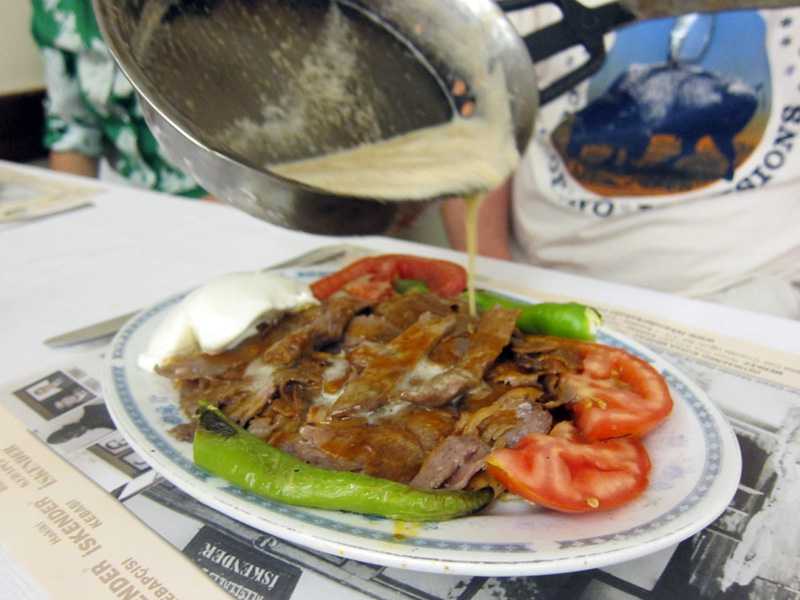
    A visit to Bursa İskender Kebabı® feels as if you’ve stepped right into the war room of the İskenderoğlu family’s never-ending quest to establish ownership over the İskender kebab, a plate of döner laying on a bed of cut flatbread doused with tomato sauce and butter and served with a scoop of cool yogurt on the side. The tables and walls of the restaurant are covered with literature about what the owners see as their family’s inheritance, but the rest of the world seems to consider public domain.

    In Bursa we ate at the flagship restaurant and, by chance, we found a branch on the side of the road in Susurluk. But in addition to the official İskender kebab, we admit to eating dozens of delicious pirated copies all over the world, so we feel comfortable speaking as an authority on the subject. In Istanbul, though there are many tasty options for this specialty, the best one belongs to its “originator,” Kebapçı İskender in Kadıköy.

    As our placemat informed us, the restaurant holds the trademarks for Kebapçı İskender, Bursa İskender Kebapçısı, Bursa Kebapçı İskender, İskender Kebabı, İskender Kebapçısı and Hakiki İskender Kebabı. (A warning to anyone named İskender: steer clear of this restaurant; they even hold the trademark on your first name.) According to the restaurant’s website, the kebab’s inception was in Bursa in the late 19th century, when İskender effendi took roasted lamb to new heights by turning the spit upright – the modern vision of döner – and shaving the meat over chopped pide, adding a sauce to the result. The İskenderoğlu descendants not only claim the recipe as their family’s heritage, but also credit their grandfather with inventing vertically roasted döner.

    A good İskender kebab takes a while to prepare, so we had plenty of time to ponder these claims while we waited for our order. In a recent issue of Yemek ve Kültür we’d seen photos of vertical döner kebab taken in Istanbul in the 1850’s, nearly 20 years prior to the date of invention claimed by the İskenderoğlu family. Even earlier sources in the same article describe vertical döner kebab being sold on the streets of Istanbul. And what are the chances that those documented preparations of döner were the first in the history of roasted meat? We are certain that once the mosaics of Haghia Sophia are fully uncovered, we’ll see divine depictions of Byzantine-era döner.

    Our senses snapped back to the intense smell of browned butter sizzling in a skillet before us. This is what in Turkish is known as the püf noktası, or the crux of the preparation, in which the waiter drizzles rich melted butter all over the ingredients assembled on the plate. The butter rampaged through, ravaging the yogurt, scalding slices of tomato, softening the green pepper and conspiring with long slices of döner in a conspiracy to soak the slightly crispy pide with otherworldly flavor. Fork in hand, it was easy to forget that this place was on the frontlines of a battle. Dredging delicious smoky shavings of lamb döner and cubes of pide through buttery yogurt, we didn’t even care to estimate the number of hours that must have been spent in the notary office collecting all of those trademarks.

    Above our table, we noticed a framed picture of İskender effendi scowling down at us above several rows of his descendants. We wondered if he would feel honored or outraged by the fact that three other places on the very same street are selling a dish named after him. Despite their efforts, his grandsons may have failed at being the only İskender Kebabı, but by our measure they have succeeded at serving the best one. That’s an inheritance defended in the kitchen, not the courtroom.

    Address: ‪Rıhtım Caddesi, next to the PTT (post office), Kadıköy

    ‪Telephone: +90 216 336 0777

    Web: www.iskenderkebabi.com

    Hours: 11am-10pm

    (photos by Gökçen Ceylan)

    via The Best Iskender Kebab in Istanbul | Culinary Backstreets.