Category: Regions

  • Turkey’s Atlasjet submits evidence in appeal case against Air Finland

    Turkey’s Atlasjet submits evidence in appeal case against Air Finland

    18 September 2011, Sunday / YASİN BABACAN , HELSINKI
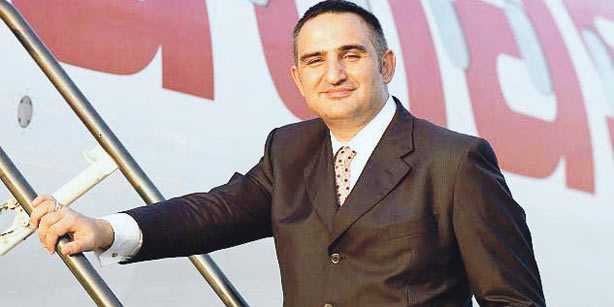
    Atlasjet’s Ersoy showed multiple documents at the court to show that Air Finland’s account of what happened between the two erstwhile partners were “baseless.” Atlasjet, a private Turkish airline, built an evidence-based case against Air Finland as the representatives of both companies confronted each other at a Finnish high court last week.

    Atlasjet’s appeal of a decision made by a local Finnish court that ruled it must pay 2.5 million euros in compensation to Air Finland over a contract dispute four years ago ended on Friday in the Nordic country’s Court of Arbitration in Helsinki after the attorneys of both sides delivered their closing statements.

    According to the contract, which Atlasjet says it had no option but to cancel a few months after signing it, the Turkish airline would carry passengers from various locations in Europe to Turkey with rented planes and crew from Air Finland. However, due to many technical problems with Air Finland’s planes, Atlasjet claimed that significant delays had tarnished the Turkish company’s image and caused it substantial financial losses.

    Atlasjet Chairman Murat Ersoy answered claims made by Air Finland by showing multiple documents, underlining that the Finnish company’s account of what happened between the two erstwhile partners were “baseless” and “aimed at misleading the court.”

    “Every single event in the aviation sector is recorded,” Ersoy said on Thursday. “I will show you all the evidence with the real reasons for the massive delays caused by Air Finland’s planes and that we were the party that really suffered.”

    Pointing to some documents in his hand, Ersoy said: “Air Finland’s pilots drank too much alcohol when they were in Turkey. They severely injured themselves when they fell from some cliffs in Antalya. Air Finland cancelled the flight since they had no other pilot to replace the injured ones just a few hours before the flight’s departure from Antalya to Vienna. Air Finland’s pilots would have been able to fly that plane had they not fallen. I cannot even imagine what the outcome would have been if they hadn’t been injured and had taken their seat in the cockpit,” Ersoy stated. “Here I present to you three documents. The first is from a police station since the injuries were reported to the police in Antalya. The second is a document from a hospital which shows the pilots registered a 2.66 promille blood alcohol level, and the last is a letter from the management of the Dedeman Hotel [where the pilots were staying] stating that Air Finland’s pilots had disturbed hotel customers after drinking too much and that the customers had asked the hotel to tell the pilots to leave,” he added.

    Moreover, the Atlasjet chairman also said the contract stipulated that the counterparty, Air Finland, had to provide “enough” crew for a flight schedule of 350 hours, meaning that there should have been a minimum of five sets of crew, so that some could rest while others were flying. “However, it [Air Finland] provided just four sets of crew to us. There is not a single aviation company that pledges to conduct 350 hours of flying in a month with only four sets of crew. Also, Air Finland asked us to reschedule some flights due to the rest periods of the crew. This clearly shows that four sets of crew were not enough to maintain the flight schedule, causing many delays,” Ersoy said, adding, “Air Finland said it was not aware of this problem, but here are the documents to show its operation center was informed about the fact that one of the reasons for the many delays was caused by having fewer crew.”

    Touching on the 25-hour delay in the Spanish city of Barcelona, Ersoy said the problem was caused by the pilots’ failure to start the plane’s Air Power Unit (APU). Ersoy stated that the pilots could not start the APU four times, and called for support from Spanish airport officials afterwards. “Here I have a document from Technic Iberia showing there was no problem with the APU. It was Air Finland’s fault. The pilots followed the wrong procedure to start the APU a total of four times, causing a delay of 25 hours and forcing us to pay out 180,000 euros in compensation to the passengers.”

    “These and all the other delays have decreased the dispatch reliability of Air Finland’s Boeing 757 to 54 percent, while a recent Boeing report shows the worldwide average of reliability of their 757s is 98 percent. In fact, a previous Boeing report in 2007 showed that the world average dispatch reliability fell one percentage point to 97 percent. I cannot ask myself if that average was caused by Air Finland’s extremely low figure of 54 percent in that year,” Ersoy told the court, adding that this issue should be carefully investigated by the Finnish civil aviation authority.

    Also speaking at the court, Atlasjet CEO Orhan Coşkun said Air Finland CEO Mika Helenius had given him his business card, telling Coşkun that he could reach him on his cell phone whenever a problem arose with the Finnish company he manages. “I wish he were also sitting here so I could say everything while looking him straight in the eye. Every time I called him Helenius said he would do what is necessary about the delays but never did as he promised. He even stopped answering my calls after the incident in Barcelona,” Coşkun added. Helenius immediately left the courtroom after Coşkun was called as a witness and came back after Coşkun finished his defense. The Air Finland CEO and his attorney declined to comment on the issue.

    Two officials from the Turkish Embassy in the Finnish capital carefully followed the hearings that started on Tuesday.

    On Friday, only the attorneys of both parties attended the hearing; however, Ali Çivi, Atlasjet’s attorney, told Today’s Zaman that an “interesting” incident happened following the court session.

    “Air Finland’s attorney sent an email to the panel of judges on Thursday night with new evidence about Atlasjet. This evidence was accepted by the court on Friday morning, which is unwonted, and Ersoy was called to the court immediately. Ersoy testified presenting some evidence and asked the court to accept his documents as it had Air Finland’s, documents that were related to Air Finland’s claims. The court only accepted the schedule plan of Atlasjet’s Antalya-Vienna flight following a five minute recess,” Çivi said.

     

  • Almost Half of Turkey’s Oil Needs Supplied by Iran

    Almost Half of Turkey’s Oil Needs Supplied by Iran

    TEHRAN (FNA)- Turkey has supplied 45% of its oil needs in July from Iran, a report said.

    According to a report by the Turkish Energy Market Regulation Board (EPDK), Turkey imported 2.9 million tons of oil from 22 countries in July 2011, and the highest amount has been supplied from Iran.

    Turkey imported 1.3 million tons of oil from Iran which was followed by Iraq with 340,869 tons. India ranked the third with 298,847 tons.

    According to the report, Iran met 45%, Iraq met 12%, India met 10% and Italy met 8% of Turkey’s oil need in July.

    Meanwhile, Turkey exported 531,281 tons of oil in July 2011, the report said.

    Iran and Turkey are major energy partners. Iran exported a daily average of more than 30 million cubic meters of natural gas to Turkey in 2010, which increased around 7 percent in the first half of 2011.

    According to the report of The National Iranian Gas Company (NIGC), Iran’s gas export to neighboring Turkey climbed by 50 percent in 2010 compared to the previous year, and by 100 percent in comparison with the 2008 figures.

    Turkey does not have sizeable domestic gas production but it is an important natural gas transit country. Iran is Turkey’s second largest supplier of natural gas after Russia.

    via Fars News Agency :: Almost Half of Turkey’s Oil Needs Supplied by Iran.

  • great firewall of China

    great firewall of China


    TREVOR MOGG

    The Chinese government has announced the creation of a new body that will help it to supervise the Internet more efficiently, which could result in more effective censorship controls.

    The ‘great firewall of China’ has just got a bit greater with the government’s introduction of a new office that will, according to a statement posted Wednesday on its official website, “manage Internet information.”

    Up to now, Internet regulation in the country has been conducted by various offices within the government. The creation of the new body, called the State Internet Information Office, brings those offices together to form a single, more effective, agency. Besides improving censorship methods, the office will also oversee the expansion of outside companies into China‘s rapidly growing Internet market.

    It will be run by officials from other agencies that already regulate various parts of the Internet. These agencies include the State Council Information Office (responsible for content), the Ministry of Industry and Information Technology (regulator of technology and telecommunications areas), and the Ministry of Public Security (responsible for law enforcement). The new State Internet Information Office will be headed by Wang Chen, China’s Information Minister.

    Among its many responsibilities, the new body will “direct, coordinate and supervise online content management and handle administrative approval of businesses related to online news reporting.” It will also “direct the development of online gaming, online video and audio businesses and online publication industries.”

    In a country where the government already tries hard to control the flow of information in cyberspace, the State Internet Information Office will likely serve to enhance censorship of the Web. The announcement of the new office comes at a time when the Chinese government is concerned about pro-democracy protests happening off the back of those in the Middle East in recent months. Beijing officials will be hoping that effective regulation will ensure better monitoring of any politically sensitive Web traffic, thereby helping to prevent any serious unrest within the country.

    In an ominous note to Chinese Web users who are thinking of challenging the system, the statement also says that the new body will “investigate and punish websites violating laws and regulations.”

    In Case You Missed It:

    • China shutters 130,000 Internet cafes
    • Chinese will take over the Internet in 5 years
    • Iran plans to unplug the Internet, create its own
    • New fiber optic cable will pour data into Internet-starved Cuba

    www.digitaltrends.com, MAY 4, 2011

  • Air Force General blows whistle on Obama, but media deaf

    Air Force General blows whistle on Obama, but media deaf

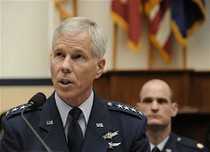
    General Shelton told lawmakers that he was pressured to be less than honest by the White House when he gives testimony before Congress. Credits: DoD File Photo

    Jim Kouri, Law Enforcement Examiner

    “If a tree falls in a forest and no one is around to hear it, does it make a sound?”

    “If an Air Force general blows the whistle on the Obama White House, does anyone in the media hear the corruption?”
    A United States Air Force general is blowing the whistle on another alleged White House scandal, but few in the news media seem to be listening.
    According to General William Shelton, the commanding officer of U.S. Air Force’s space command, he was told to alter his testimony before the House of Representatives’ Subcommittee on Strategic Forces regarding an Obama White House attempt to award a defense contract to the Lightsquared firm.
    Lightsquared is a high-tech company doing business in Virginia that’s owned by billionaire Philip Falcone, an Obama friend and campaign contributor.

    According to the National Legal and Policy Center, Phil Falcone had visited the White House and made large cash contributions to the Democratic Senatorial Campaign Committee. Soon after, the Federal Communications Commission (FCC) granted his LightSquared a highly unusual waiver that allows the company to build out a national 4G wireless network on the cheap.
    Republican lawmakers say that after Falcon’s visit, the Obama White House allegedly tried to push through a Lightsquared’s proposed wireless network regardless of the objections emanating from military commanders who believed the project could disrupt key U.S. satellite systems.

    At a hearing on Thursday, lawmakers on strategic forces subcommittee, especially the Republican chairman, Michael Turner, requested that the House Oversight Committee investigate if Falcone’s company garnered any type of special treatment from the White House or from Obama appointees.

    The hearing came after a report by a blogger on a news and commentary web site alleged that the Obama White House pressed General Shelton to downplay his concerns about the proposed Lightsquared system.

    According to the National Legal and Policy Center, Phil Falcone had visited the White House and made large cash contributions to the Democratic Senatorial Campaign Committee. Soon after, the Federal Communications Commission (FCC) granted his LightSquared a highly unusual waiver that allows the company to build out a national 4G wireless network on the cheap.
    “Under extremely unusual circumstances, the Federal Communications Commission (FCC) recently granted a company called LightSquared the right to use wireless spectrum to build out a national 4G wireless network. LightSquared will get the spectrum for a song, while its competitors have to spend billions,” according to NLPC’s Ken Boehm.

    President Obama’s underlings deny any wrongdoing, and officials at Lightsquared denied the charges that it is receiving preferential treatment from President Obama or his staff.

    Republican staff members on the subcommittee say that the decorated General Shelton told the lawmakers that Obama administration officials urged the general to describe Lightsquared’s system favorably during his congressional testimony.

    During the hearing, General Shelton told committee members that the wireless broadband network manufactured by Lightsquared would have a negative impact on the current Global Positioning System (GPS) relied on by both the U.S. military and private sector users of the GPS.

    General Shelton told the committee members: Tests with Defense Department experts, civilian agencies and others “indicate the LightSquared terrestrial network operating in the originally proposed manner poses significant challenges for almost all GPS users.”

    The general insisted through his spokesperson on Friday that he had not “watered down his testimony due to alleged White House pressure.”

    According to a source familiar with the Lightsquared probe, many officers at the Pentagon are highly suspicious of the President, the White House staff and even Obama’s appointees at the Defense Department.

    Another occurrence being probed is that the allegation that Lightsquared at first offered to sell satellite phones on its network, however the Federal Communications Commission allegedly issued a special waiver to the firm thus allowing sell terrestrial-based wireless service to other companies.

    Department of Defense officials. such as General Shelton, in the past have raised concerns about interference with GPS users, and the FCC would then promise to disallow a firm to begin operating their network until after intense testing is carried out to ensure there is no disruption to satellite navigation.

    The head of the FCC declined to appear before the committee on Thursday, which the chairman, Turner, called an “affront” to the panel.

    Meanwhile, Falcone and Lightsquared executives are taking the offensive by giving Obama-friendly journalists at Politico exclusive interviews.

    LightSquared CEO. Sanjiv Ahuja, and its billionaire backer, Phil Falcone, denied all allegations that the wireless company used its political pull with the Obama administration to secure approval of its business plans with the Defense Department.

    “It’s just very disappointing that people are not seeing the facts here, and [that] this has become a real political issue,” Falcone, a senior executive at the hedge fund firm Harbinger Capital, said during his Politico interview. “It’s not a function of being a Democrat or a Republican, it’s about trying to be an innovator. … It’s very disappointing and frustrating that we are getting stonewalled like this. … I kinda scratch my head every single day and say I can’t believe this is happening.”

    Falcone and Ahuja denied receiving special treatment from the White House or the FCC in their ongoing quest to become the nation’s first wholesale wireless broadband provider, according to Politico.

    But some observers see things differently. Mike Baker, a political strategist and a former military officer, believes that this investigation needs to be taken to wherever or whomever it leads. He’s like to see a special prosecutor appointed.

    “This is a very important national security issue, not some politically-motivated witch hunt like the Valerie Plame-CIA case. But we all know that with the news media protecting this president, the chances of anything being done are slim or none,” he quipped.

    “First of all, we know what motivates politicians and big business. In the middle you have a career officer who is a four-star general. Whom would you believe? What’s in it for General Shelton to make up stories?” Baker asks.

    “Let’s hope General Shelton sticks to his guns and that more Pentagon and Justice Department officials decide enough is enough from this administration,” Baker added.

    www.examiner.com, September 17, 2011

  • Jordanians protest against ties with Israel

    Jordanians protest against ties with Israel

    London, (Pal Telegraph) – Hundreds protest Jordan’s peace treaty with Israel and call on their government to shut down the Israeli embassy.

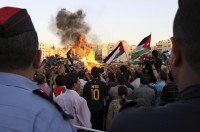
    Hundreds of Jordanians have protested in front of the Israeli embassy in the capital Amman, calling on the Jordanian government to scrap its peace treaty with Israel.

    About 300 demonstrators gathered at the embassy on Thursday after Israel temporarily withrew its ambassadorover fears of the protest turning violent.

    A bigger turnout was expected as activists had called for a “million-man march”.

    Scores of police blocked roads to the embassy complex to prevent protesters from marching to the heavily protected mission.

    The demonstrators, a mix of leftist, liberal and Islamist opposition activists, instead gathered near a mosque close to the complex, shouting, “No Zionist embassy on Arab land”.

    “The people want to bring down the Wadi Araba peace treaty,” one protester said, referring to the country’s peace accord with Israel signed in 1994, the second that was concluded by an Arab country with Israel after Egypt’s own deal in 1979.

    Jordan has long maintained close security cooperation with Israel but has been critical of the Israeli treatment of Palestinians and fears a spillover of violence if Israel does not broker peace with the Palestinians.

    Roughly half of the country’s six million population is of Palestinian origin. With Palestinian-Israeli peace talks stalled, some Jordanians fear Israel may try to deport Palestinians to Jordan.

    Jordan’s King Abdullah II has spoken out strongly against using Jordan as a substitute for a Palestinian state, a concept favoured by some Israelis.

    Source: Agencies

    www.paltelegraph.com, 16 SEPTEMBER 2011

  • Turkey to freeze EU ties if Cyprus gets EU presidency

    Turkey to freeze EU ties if Cyprus gets EU presidency

    Comments strongest yet by Ankara over its opposition to Cyprus presidency and could mark start of a new low point in ties between European Union and Turkey

    Reuters

    Published: 09.18.11, 12:46 / Israel News

    EU-candidate Turkey will freeze relations with the European Union if Cyprus is given the EU presidency in 2012, Deputy Prime Minister Besir Atalay was quoted as saying by state-run news agency Anatolian late on Saturday.

    The comments were the strongest yet by Ankara over its opposition to the Cyprus presidency and could mark the start of a new low point in ties between the European Union and Turkey which began accession talks to the bloc in 2005.

    Related stories:

    * Turkey doesn’t need US mediation in Israel crisis

    * Op-ed: Turkeys economic lie

    * Op-ed: The Mideasts new hero?


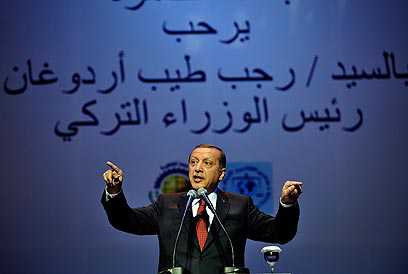
    Turkish PM Erdogan during Cairo address (Photo: EPA)
    Turkish PM Erdogan during Cairo address (Photo: EPA)

    The comments also come at a time of heightened tension in the eastern Mediterranean where Turkey is locked in a row with Cyprus over potential offshore gas deposits. Turkey’s relations with one-time ally Israel are also at a low.

    “If the peace negotiations there (Cyprus) are not conclusive, and the EU gives its rotating presidency to southern Cyprus, the real crisis will be between Turkey and the EU,” Anatolian quoted Atalay as telling Turkish Cypriot Bayrak Radio and TV at the end of a trip to northern Cyprus.

    “Because we will then freeze our relations with the EU. We have made this announcement, as a government we have made this decision. Our relations with the EU will come to a sudden halt.”

    The internationally-recognized Greek Cypriot government is due to take on the six-month rotating EU presidency in July 2012.

    Cyprus has been divided since a Turkish invasion in 1974 triggered by a brief Greek-inspired coup. UN-sponsored peace talks between Turkish Cypriots and Greek Cypriots have stumbled since they were relaunched in 2008.

    In July, Turkey’s European Union minister said freezing ties with the Greek Cypriot EU presidency was “an option” but Atalay’s comments were the first time Ankara has said it would definitely halt relations.

    Greek Cypriots represent the island internationally and in the European Union, while Turkey is the only country to recognise the Turkish Cypriot state. Greek Cypriots say Turkey cannot join the bloc until the Cyprus conflict is resolved.

    The rotating presidency has lost some importance since the EU’s Lisbon treaty, which established a permanent head of the European Council that groups national governments, and a new foreign and security policy chief. But a determined country can still shape the agenda.

    Of the 35 “chapters” — policy areas of EU law — Turkey has completed one, and 18 have been frozen because of opposition by EU member states including Cyprus and France.

    via Turkey to freeze EU ties if Cyprus gets EU presidency – Israel News, Ynetnews.