For Turkey and Israel, sports are the only remaining relations that are intact.
Noga Tarnopolsky
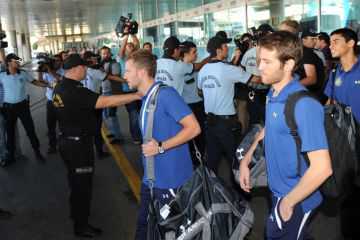
Turkish riot police stand guard as Maccabi Tel-Aviv players walk towards a bus at Ataturk Airport in Istanbul, on Sept. 14, 2011. (Bulent Kilic/AFP/Getty Images)
There are no Jews in Jordan and possibly a dozen Jews in Egypt, once the cradle of a great Jewish culture, but Turkey is different. About 20,000 Jews live in Turkey. Cenk Levy, 33, lives in Istanbul and works for Greenpeace.
“Weeeell,” he says. “It is not so tense regarding the Jews. You don’t hide it, but you don’t feel very comfortable regarding your identity these days.”
His name is Levy. “Yeah, absolutely,” he laughs. “It’s very, very obvious!”
“You hear many statements about how the main problem here is the government, but we have also started to hear about how people themselves are turning. It’s not like it was three or four years ago. People don’t trust Israel, they don’t trust what Israel does. It’s becoming clear that this could disrupt business relations and other ties, not only military.”
For now, sport remains an area of intact relations. Last night, Istanbul’s Besiktas soccer team played Maccabi Tel Aviv at home.
Tel Aviv fans who went to support their team reported the paradoxical experience in which merchants and restauranteurs, hearing they were Israelis, welcomed them warmly and with explicit expressions of friendliness. Meanwhile, on the radio they heard that thousands had gathered n Istanbul’s central square to chant anti-Israeli slogans.
Cenk Levy watched the match at home.
“Bekistas were trying to reduce tensions as much as possible before the match, to emphasize that it is part of a friendship and sport. They went to some lengths to emphasize that there is a clear distinction between politics and sport, and that there are also Muslim players playing for Israel. There was also very high security in the stadium.”
“I think there was only one anti-Semitic, anti-Israel, slogan heard during the entire game.”
Maybe it helped that Bekistas won, 5-1.
“Things are a bit depressing,” Levy added. “This didn’t start yesterday, with the match, or a month ago. It’s been a long campaign and as you see it moving forward, and with the flotilla incident, now my sense is that the government is using Israel as leverage to stabilize themselves politically in the new Middle East.”
via Tension rises for Jews in Turkey | GlobalPost.
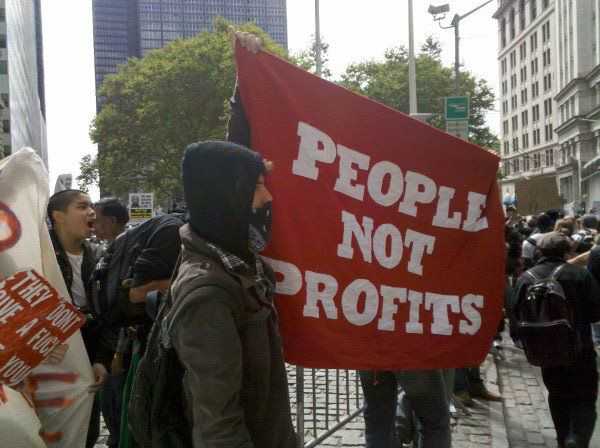
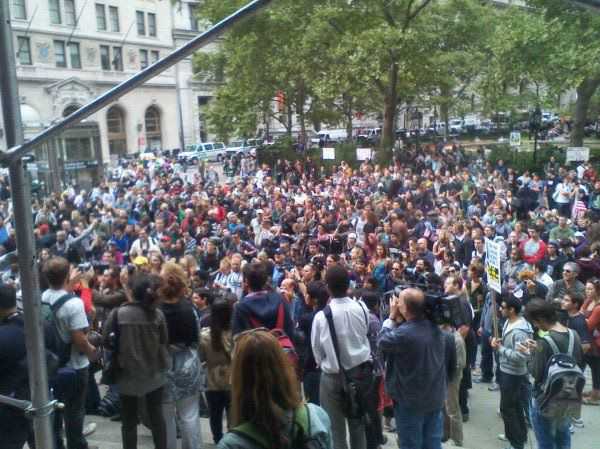
Speaker: We’re going to make our own Tahrir square here
Speaker: We're going to make our own Tahrir square hereThe corrupt fear us. The honest support us. The heroic join us.
AT LEAST 70,000 AND COUNTING… BIG MEDIA BLACKOUT “Occupy Wall Street”
10 questions about “Occupy Wall Street” that should be answered urgently:
1. Why are peaceful protesters being treated as if they are criminals?
2. Why are thousands of police, and SWAT teams and police dogs, being mobilized to protect Wall Street bankers?
3. Why are almost all the mainstream media outlets in America ignoring a major civil protest in the heart of New York?
4. Why do the police not pursue criminal bankers and business leaders with the same venom and force that they use when pursuing protesters who have so far done nothing wrong?
5. Why is nothing being done to address the genuine economic problems in America? Why, instead, is the old system – the one that failed disastrously in 2008 – being rebuilt brick by brick, fault by fault?
6. How much longer will the doctrine of ‘plausible denial’ be allowed to act as an excuse for widespread corruption and criminality?
7. Why (if true) was the Occupy Wall Street protest treated as a police code 1-34, which is used for riots? Are all protests now riots?
8. Why has not one banker or corporate leader emerged to talk to the protesters or debate with them?
9. Is it a coincidence that many people in the heart of the protest have had trouble getting mobile / cellphone / internet signals?
10. Does the government genuinely believe the pent-up anger and frustration will simply go away?
Turkish Tourism to target Weddings and Bollywood to increase Indian arrivals
By P Krishna Kumar | New Delhi
Turkish Tourism is planning to target large wedding groups and the film industry from India to increase their share of Indian outbound travellers. According to Özgür Aytürk, Culture & Tourism Counsellor for India, Turkish Embassy-New Delhi; Turkish Tourism will organise dedicated FAM trips for wedding planners and film industry specialists to Turkey to showcase various facilities and destinations. Turkey will also be engaging the Indian market in the coming months through a variety of cultural events.
As part of the cultural events planned, Turkish troupes will be visiting India to perform in some of the main cities, including Mumbai and Delhi. Turkish Sufi dancers will perform in Mumbai at the invitation of National Centre for Performing Arts on November 13, 2011 and in Delhi on November 16, 2011. “In 2012, India and Turkey will be celebrating their 60th anniversary of establishing cultural relations. We are planning various cultural exchange programmes next year,” informed Aytürk.
According to Aytürk, Turkish Tourism is also planning to promote the destination for Golf Tourism in India through some novel initiatives. The first among these is a golfing event planned by Turkish Tourism in partnership with Delhi Golf Club on September 21, 2011 in Antalya. The event is in collaboration with Antalya Golf Club and Kempinski Hotel, Antalya. “The sea-side resort city of Antalya is in Belek region, which is famous for international standard golf courses,” stated Aytürk.
Commenting on the various facets of the destination, Aytürk said that, Istanbul, which is a major destination for shopping and nightlife in Europe, is not well known for these aspects in India. “Some of the major shopping malls of Europe are located in Istanbul along with exciting street markets. While Indians go to Dubai for shopping, people from the Middle East generally travel to Istanbul for shopping,” informed Aytürk.
Turkey received 63,000 Indian visitors last year registering almost 15 per cent growth compared to the previous year. However, according to Aytürk, the first seven months of 2011 have witnessed a growth of almost 25 per cent in Indian arrivals over the same period last year. “We are looking at a 20 to 25 per cent growth in Indian arrivals this year,” stated Aytürk.
via Travel Biz Monitor :: Turkish Tourism to target Weddings and Bollywood to increase Indian arrivals.
Ethan Bronner is the Jerusalem bureau chief of The New York Times.
JERUSALEM
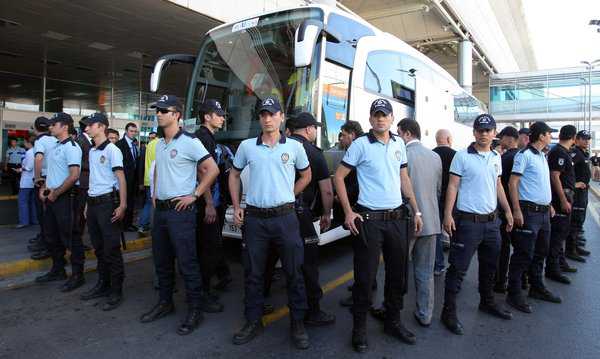
Associated Press Riot police officers surrounded a bus Wednesday as Maccabi Tel Aviv soccer players arrived at Ataturk Airport in Istanbul.
Associated Press
Riot police officers surrounded a bus Wednesday as Maccabi Tel Aviv soccer players arrived at Ataturk Airport in Istanbul.
ISRAEL and Turkey, key American allies, are clashing. But they disagree over the source of their disagreement. Turkey says it expelled the Israeli ambassador and cut military ties because Israel oppresses Palestinians and refuses to apologize for killing activists aboard a Turkish-based flotilla last year. Israel says Turkey aims for regional leadership so it is forsaking Israel.
While both claims have merit, there is a third explanation. The two countries have gone through remarkably similar political shifts in recent decades from aggressively secular societies run by Westernized elites to populist ethno-religious states where standing up to foreigners offers rich political rewards.
Two and a half years ago, Prime Minister Recep Tayyip Erdogan of Turkey scolded President Shimon Peres of Israel onstage at the World Economic Forum in Davos, Switzerland — right after Israel’s war in Gaza — telling him, “When it comes to killing, you know well how to kill.” He stormed offstage to a heroic welcome at home.
A year later, Israel’s deputy foreign minister, Daniel Ayalon, invited the Turkish ambassador to his office, giving him a low seat at a table without refreshments or a Turkish flag. Before the invited guest entered, Mr. Ayalon said to Israeli television camera operators, “The important thing is that people see that he’s low and we’re high and that there is no flag here.” Mr. Ayalon’s standing only rose in his party, Yisrael Beiteinu, run by the nationalist foreign minister, Avigdor Lieberman.
It was not always so. Both societies used to be very different places in rather the same way. And over time, they built a pretty warm relationship of business, military ties and tourism. The surprising thing is what similar — and mutually contemptuous — paths they have taken since.
The founder of modern Turkey, Mustafa Kemal Ataturk, and the founding prime minister of Israel, David Ben-Gurion, had much in common. This was not an accident. Ben-Gurion, who studied law in Istanbul, modeled himself on Ataturk, seeking to build an instantly modern society of like-minded and “ideal” citizens with few deviations in language or culture. Both saw religion as a deviation and ethnicity as a problem. Like the Kurds of Eastern Turkey, the Moroccan and Yemeni Jews on the Israeli periphery faced an official — if less brutal — disregard.
Sidelining religion and ill treating minorities can be hard to sustain in a democracy, however. The founders’ heirs were dislodged by electoral revolutions — in Israel in 1977 and in Turkey in 2002. Today a religious nationalism plays a central and growing role both in Israel, dominated by the Likud Party of Prime Minister Benjamin Netanyahu, and in the Turkey of the Justice and Development Party of Mr. Erdogan. The secular elites who set the cultural and political agenda for decades have lost much of their influence.
Last year, Mr. Erdogan waved away retired Turkish ambassadors who criticized his foreign policy with the words “mons chers” (meaning “mes chers,” or my dears). Foreign Minister Lieberman similarly dismissed Israelis who found his policies too tough as “feinschmeckers,” those with overly refined tastes. In neither case was the derisive use of a European term accidental. Turks have been offended by the endless stalling of their country’s application to the European Union. Israel’s establishment, supported by a mix of Jews from the Middle East and former Soviet Union, views the elite of Old Europe, with its pro-Palestinian sentiments, with disdain.
“I often compare the Erdogan upheaval of 2002 to the elections here in 1977, which brought Likud to power,” noted Alon Liel, a former Israeli ambassador to Turkey who teaches a course on the two countries’ histories and relations at Tel Aviv University.
“In Turkey, the Kemalist elite ignored the religious leadership, the countryside and the Kurds, creating groups of very unhappy people who cohered into a new political opposition. The same happened in Israel, and Menachem Begin connected with them. Today, both Erdogan and Netanyahu rule from a support base that is more religious, more rural and less educated, where honor and nationalism are important. That makes the relationship between the two very hard.”
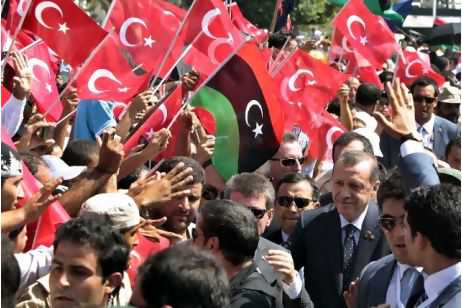
As non-Arabs, they had once built an alliance based on being outsiders. But it is precisely in foreign policy where they differ today, one turning east, the other west. Turkey, while a member of NATO, feels rejected by Europe and renewed in its sense of Muslim and Middle Eastern identity. Last week, Mr. Erdogan went on an Arab Spring tour — to Egypt, Tunisia and Libya — in a quest for leadership.
Israel, whose Middle Eastern ties are fraying badly, looks to “new” Europe, countries like Poland but also to Romania and Bulgaria where anti-Turkish feelings run high from Ottoman days.
Washington, in hopes of restoring the Israeli-Turkish relationship, is pushing Israel to take conciliatory steps on the Palestinian issue, partly to avoid a showdown at the United Nations this month over a Palestinian statehood resolution. It is also pressing Turkey to move away from its recent moves to improve ties with Iran and Syria. It recently persuaded Turkey to place a NATO radar station focused on Iran on its soil, a step that will benefit Israel.
And there are other mutual interests that could help reunite them. Both are engaged in battles against militants — Israel against Hamas and other Palestinian groups, Turkey against Kurdish separatists unimpressed by Mr. Erdogan’s moves toward tolerance. Both occupy land in defiance of the international community — Israel in the West Bank and East Jerusalem, Turkey in northern Cyprus. Moreover, although resource-poor, both are economic success stories, high-growth members of the Organization for Economic Cooperation and Development, exceptions in the region.
Still, they will have to overcome deep societal trends. As Efraim Inbar, a specialist on Turkish politics at Bar-Ilan University, says: “Nationalism in Turkey today is ethno-religious. The same for Likud. Neither listens too much to what outsiders say.”
A version of this news analysis appeared in print on September 18, 2011, on page SR5 of the New York edition with the headline: Israel and Turkey, Foes and Much Alike.
The Turkish prime minister Recep Tayyip Erdogan visiting Libya on Friday. He also attended a rally at Martyrs' Square in Tripoli. Suhaib Salem / Reuters
Turkey has staked a claim in the rebuilding of Arab Spring economies, signing a flurry of lucrative contracts and seeking to secure multibillion dollars of deals.
The country’s bid for a leading role in reconstruction efforts in Libya, Egypt and Tunisia could prove crucial as advanced economies remain distracted by the twin concerns of slowing economic growth and sovereign debt, say analysts.
“From a regional perspective it makes perfect sense for Turkey to increase its ties with the Arab world as in the medium term there are bright prospects in the region in terms of growth and booming markets and after the Arab Spring optimism is even higher,” said Turker Hamzaoglu, an economist for Eastern Europe, Middle East and Africa at Bank of America Merrill Lynch.
Turkey’s prime minister Recep Tayyip Erdogan and scores of businessmen from the country visited Egypt, Tunisia and Libya last week. The aim was to cement new political and commercial ties with post-revolution regimes in the three countries.
Turkey signed agreements with Egypt to cooperate on a wide range of issues from technology to energy and pledged to raise trade from the existing level of US$3.7 billion (Dh13.5bn) to $10bn.
In Libya, Turkey said it planned to resume work on six Libyan oil wells on October 1 and also offered to build a new parliament as well as restore schools, police stations and judiciary buildings.
But the trip was about securing existing interests too. At stake is $18.5bn worth of contracts Turkish companies were involved with in Libya that have remained suspended since the civil war flared nearly seven months ago.
Sitting on the apron of the Middle East, Turkey has a long history of commercial ties with the region. In recent times these links have accelerated as Turkey has emerged as a rising economic power.
Turkish contractors helped to build infrastructure projects such as the Dubai Metro and Cairo’s latest airport terminal.
The region has also emerged as a key export market for a range of products from baklava to soap operas. Middle East and North Africa markets account for more than a quarter of Turkey’s exports, up from 17 per cent five years ago.
At least some of Turkey’s business has been threatened by unrest that has fanned across pockets of the region since December.
Like other export-led economies, Turkey has been hit by the disruption to trade caused by the turmoil.
Exports to Egypt have slid by almost 80 per cent in the first eight months compared with the same period last year. Trade with Libya has fallen to $550 million in the first seven months of this year, down from about $1.5bn in the same period last year. Exports to Tunisia have also declined.
While the trip was about seeking ways to rebound trade, the timing was also a reflection of the risk facing Turkey’s export-reliant model, said David Butter, the Middle East editor at the Economist Intelligence Unit.
“Now the environment is much more tricky,” he said. “The Syrian export market is likely to be effected by the violence there and the prospects in Europe are not so bight.”
A tightening crackdown on protesters by the Syrian president Bashar Al Assad since April has put at risk rising one-way trade with the country.
As much as $1bn of exports went to Syria in the first half of the year. The country also acted as a road route for Turkish lorries to transport goods onwards to the Gulf.
In Europe, a sovereign debt impasse is clouding the outlook of commerce with Turkey’s main trading partner. Nearly half of Turkish goods are consumed in the EU.
Turkey, meanwhile, has also announced a suspension of trade ties with Israel.
In the first half of the year, Turkey posted a $2m trade surplus with Israel. Mr Erdogan said this month that his country was suspending all trade, military and defence industry ties with Israel, reflecting worsening relations between the countries.
I’VE never been more worried about Israel’s future. The crumbling of key pillars of Israel’s security — the peace with Egypt, the stability of Syria and the friendship of Turkey and Jordan — coupled with the most diplomatically inept and strategically incompetent government in Israel’s history have put Israel in a very dangerous situation.
Josh Haner/The New York Times
Thomas L. Friedman
This has also left the U.S. government fed up with Israel’s leadership but a hostage to its ineptitude, because the powerful pro-Israel lobby in an election season can force the administration to defend Israel at the U.N., even when it knows Israel is pursuing policies not in its own interest or America’s.
Israel is not responsible for the toppling of President Hosni Mubarak of Egypt or for the uprising in Syria or for Turkey’s decision to seek regional leadership by cynically trashing Israel or for the fracturing of the Palestinian national movement between the West Bank and Gaza. What Israel’s prime minister, Bibi Netanyahu, is responsible for is failing to put forth a strategy to respond to all of these in a way that protects Israel’s long-term interests.
O.K., Mr. Netanyahu has a strategy: Do nothing vis-à-vis the Palestinians or Turkey that will require him to go against his base, compromise his ideology or antagonize his key coalition partner, Foreign Minister Avigdor Lieberman, an extreme right-winger. Then, call on the U.S. to stop Iran’s nuclear program and help Israel out of every pickle, but make sure that President Obama can’t ask for anything in return — like halting Israeli settlements — by mobilizing Republicans in Congress to box in Obama and by encouraging Jewish leaders to suggest that Obama is hostile to Israel and is losing the Jewish vote. And meanwhile, get the Israel lobby to hammer anyone in the administration or Congress who says aloud that maybe Bibi has made some mistakes, not just Barack. There, who says Mr. Netanyahu doesn’t have a strategy?
“The years-long diplomatic effort to integrate Israel as an accepted neighbor in the Middle East collapsed this week, with the expulsion of the Israeli ambassadors from Ankara and Cairo, and the rushed evacuation of the embassy staff from Amman,” wrote Haaretz newspaper’s Aluf Benn. “The region is spewing out the Jewish state, which is increasingly shutting itself off behind fortified walls, under a leadership that refuses any change, movement or reform … Netanyahu demonstrated utter passivity in the face of the dramatic changes in the region, and allowed his rivals to seize the initiative and set the agenda.”
What could Israel have done? The Palestinian Authority, which has made concrete strides in the past five years at building the institutions and security forces of a state in the West Bank — making life there quieter than ever for Israel — finally said to itself: “Our state-building has not prompted Israel to halt settlements or engage in steps to separate, so all we’re doing is sustaining Israel’s occupation. Let’s go to the U.N., get recognized as a state within the 1967 borders and fight Israel that way.” Once this was clear, Israel should have either put out its own peace plan or tried to shape the U.N. diplomacy with its own resolution that reaffirmed the right of both the Palestinian and the Jewish people to a state in historic Palestine and reignited negotiations.
Mr. Netanyahu did neither. Now the U.S. is scrambling to defuse the crisis, so the U.S. does not have to cast a U.N. veto on a Palestinian state, which could be disastrous in an Arab world increasingly moving toward more popular self-rule.
On Turkey, the Obama team and Mr. Netanyahu’s lawyers worked tirelessly these last two months to resolve the crisis stemming from the killing by Israeli commandos of Turkish civilians in the May 2010 Turkish aid flotilla that recklessly tried to land in Gaza. Turkey was demanding an apology. According to an exhaustive article about the talks by the Israeli columnist Nahum Barnea of the Yediot Aharonot newspaper, the two sides agreed that Israel would apologize only for “operational mistakes” and the Turks would agree to not raise legal claims. Bibi then undercut his own lawyers and rejected the deal, out of national pride and fear that Mr. Lieberman would use it against him. So Turkey threw out the Israeli ambassador.
As for Egypt, stability has left the building there and any new Egyptian government is going to be subjected to more populist pressures on Israel. Some of this is unavoidable, but why not have a strategy to minimize it by Israel putting a real peace map on the table?
I have great sympathy for Israel’s strategic dilemma and no illusions about its enemies. But Israel today is giving its friends — and President Obama’s one of them — nothing to defend it with. Israel can fight with everyone or it can choose not to surrender but to blunt these trends with a peace overture that fair-minded people would recognize as serious, and thereby reduce its isolation.
Unfortunately, Israel today does not have a leader or a cabinet for such subtle diplomacy. One can only hope that the Israeli people will recognize this before this government plunges Israel into deeper global isolation and drags America along with it.