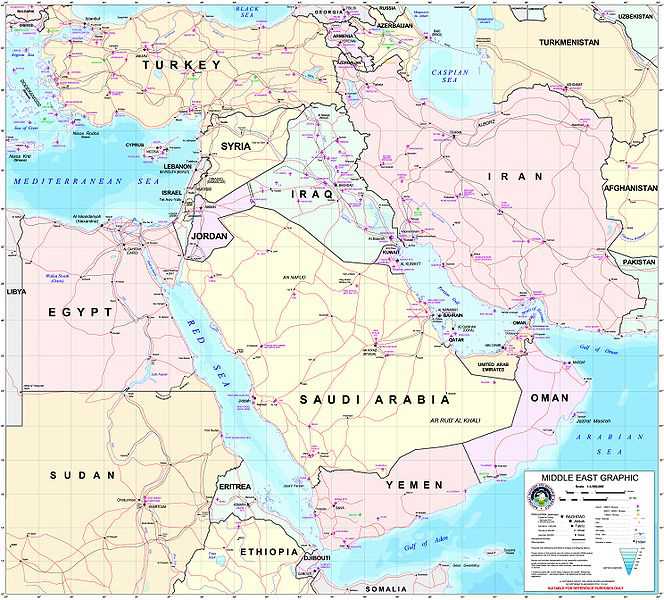
TEHRAN, Sept. 17 (Xinhua) — Iranian Foreign Minister Ali-Akbar Salehi on Saturday called on Turkey to explain its plan to deploy a NATO missile shield system in its territory, the semi-official Mehr news agency reported.
Salehi said the radar system which will be set up in Turkey has caused concerns in Iran and other neighboring countries, according to Mehr.
Iran does not think such a system is necessary, taking into consideration the current developments in the region, Salehi said, adding that Iran hopes that Turkey will provide necessary explanations on this issue.
Iran always seeks to solve its problems with the neighboring countries and to move in the direction of ensuring peace, security and stability in the region, the Iranian foreign minister said, ” We hope to continue the same path in the future.”
Salehi also expressed hopes that all the regional countries will narrow their differences and avoid providing any opportunity for their enemies who are seeking to sow discord among the regional nations.
According to earlier reports, a NATO warning radar system is going to be deployed in Turkey by the end of this year and it will be used to track missile launched from Iran.
via Iran asks Turkey to explain deployment of NATO missile shield system.
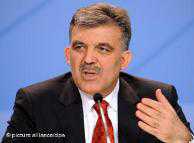
Turkish President Abdullah Gül will have a full agenda when he begins a visit to Germany on Sunday. A rapidly changing Middle East, and Turkey’s EU bid will be central topics, says Islam studies expert Udo Steinbach.
Gül's eyes are focused on Europe ahead of his visit
Turkish President Abdullah Gül is to arrive in Berlin on Sunday, September 18, where he will be received by his German counterpart, President Christian Wulff. During his four-day visit, he is scheduled to deliver an address at Berlin’s Humboldt University and also to hold talks with German Chancellor Angela Merkel.
Ahead of the visit, Gül said Turkey was committed to pursuing membership in the European Union, despite opposition from some quarters in Germany and elsewhere on the continent.
Deutsche Welle spoke to Islam expert Guido Steinbach about the issues bedeviling German-Turkish ties.
Deutsche Welle: President Gül will be spending four days in Germany, a relatively long time for a state visit. Is this an attempt at convergence between the two countries?
Udo Steinbach: Yes, certainly, for Germany and Turkey have several issues to discuss. President Gül already hinted at one of the main topics with his earlier statements that Turks living in Germany should speak perfect German without an accent. In other words, the issue of Turkish migrants in Germany will be a main topic.
The other main issue will be how the two countries see the developments in northern Africa and the Middle East. For Turkey it is clear: without Europe, it is limited in what it can achieve. Europe, too, is aware that Turkey can be a strategic partner in this rapidly changing climate. The two countries must find a mutual strategy in northern Africa and the Middle East.
But haven’t relations between Turkey and Europe cooled? Ankara’s EU accession negotiations are stalled, and German Chancellor Angela Merkel increasingly speaks of a mere “privileged partnership” between the two.
Yes, and Turkey has reason enough to be frustrated over the way its bid for EU accession has been handled. But the fact that Mr. Gül has set aside four days for his trip to Germany should provide enough time to discuss this point – how can Turkish-European relations be reshaped in the light of new facts that have arisen in the past months. And also in light of the fact that Turkey and the European Union have more mutual interests in the Mediterranean and in the Middle East than ever before. We can no longer afford the indifference that has crept in between the two sides.
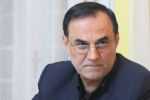
Udo SteinbachBildunterschrift: Großansicht des Bildes mit der Bildunterschrift: Steinbach says Gül is one of Turkey’s ‘last Europeans’
What future role does President Gül see his country playing in Europe?
Mr. Gül is perhaps the last real convinced “European” among Turkey’s politicians. When it comes to Prime Minister Erdogan, I certainly have my reservations, but Mr. Gül is without a doubt pro-Europe. He has said time and time again that Turkey needs Europe’s support. Above all, perhaps, Gül seeks EU recognition that Turkey’s role in the Middle East is legitimate. Turkey is still waiting for this recognition, and this explains the often erratic way in which Erdogan and his foreign minister have acted in the Middle East.
You say at the same time that Europe also needs to move towards Turkey: What areas in particular?
There is currently a dominant scepticism that Turkey will ever become a member of the European Union. I believe this is a fundamental paradox. For the first time in the history of the EU, we are negotiating with a state over its membership to the union. This state, as with all those involved in the process of EU accession negotiations, must give up a whole lot and also transform itself significantly. And Europe, in the end, says: No, there is no membership for you. We have never seen this happen in such negotiations; it is unprecedented in the case of Turkey. And we must, I believe, vacate this fruitless position.
Do you think Merkel could convince her conservative party of this?
The chairman of the Bundestag’s Foreign Affairs Committee, Ruprecht Polenz, who is a key figure in Merkel’s Christian Democratic Union (CDU), has written a book about how important it is for Turkey to join the EU. There are many voices in Merkel’s CDU that recognize Turkey’s importance for Europe. Maybe these voices, together with President Gül, will be able to persuade Merkel to abandon her very formalistic positions on Turkey.
Should the concept of Turkey’s “privileged partnership” be dropped?
Yes, that has to go. It works against the entire process. The Turks have made no secret about their frustration. And this is exactly the point: If, at the end of Mr. Gül’s visit, we manage to forget this “privileged partnership,” then we will have successfully begun a new chapter and taken an important step into a new common future.
Friederika Schulz interviewed Udo Steinbach (glb)
Editor: Sonia Phalnikar
via Turkey’s president seeks to forge European ties on Germany visit | Europe | Deutsche Welle | 17.09.2011.
TEHRAN – The Iranian Ambassador to Turkey, Bahman Hosseinpour, has dismissed claims that Tehran and Ankara plan to launch a joint operation against PJAK (the Party for a Free Life in Kurdistan) and the PKK (the Kurdistan Workers’ Party), ISNA reported on Saturday.
The terrorist groups of PJAK and PKK keep irritating Iran and Turkey, and therefore the two countries can launch “organized” operations against the groups, but organized operations do not mean joint operations, Hosseinpour told reporters after his recent meeting with Turkish Parliament speaker Cemil Cicek.
Enormous damages have been inflicted upon Iran and Turkey during their fights against the terrorists, and thus the two countries can cooperate (on this matter), he added.
Turkish media reported recently that Prime Minister Recep Tayyip Erdogan had said that Iran and Turkey may launch a joint operation against the PKK.
via ‘Iran, Turkey have no plan to launch joint operation against PJAK, PKK’ – Tehran Times.
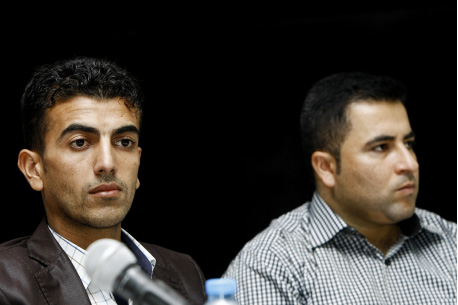
Sherwan Hussein Mustafa and his brother speak about filing lawsuits against Turkey for the death of their entire family in an air strike.
Sherwan Hussein Mustafa had seven family members killed, including his mother and father, last month “in a massive raid by Turkish warplanes” against the hideouts of Kurdistan Workers’ Party (PKK) guerillas inside Iraqi Kurdistan Region territory. Mustafa told The Kurdish Globe he will do anything, “no matter how many years it takes”, to get justice for his family.
Mustafa was living in Britain when he received the news that almost his entire family had been killed by Turkish warplanes. He has since returned to Kurdistan Region, and says his only mission in life is “to bring those who are behind the killing of my family to justice.”
Mustafa’s family was working on the farm in the mountainous area of Qandil. As they heard Turkish warplanes bombing the Qandil Mountains, the family decided to leave the farm to go to their second house in Ranya city, near the Qandil Mountains. On the way to Ranya in their pickup truck, “Turkish warplanes targeted them and turned their bodies into many small pieces.” Their deaths created a furious anger across the Region and led to tens of demonstrations. A mass funeral was held for the family in Ranya.
A committee of lawyers, members of Parliament and civil society activists has formed to take the Iranian and Turkish violations of the Kurdistan Region to international courts. A well-known Kurdish lawyer and member of the committee, Abdulrahman Zebari, said the committee will investigate the killing of civilians by Iranian and Turkish bombardments and collect as much evidence as possible, with the aim of changing the case from “local crime to international crime”.
Zebari has seven years of experience in cases of genocide and crimes against humanity; he defended Kurdish people at the Iraqi Special Tribunal against Iraqi dictator Saddam Hussein. He said after collecting enough evidence, he will take the case to the United Sates, because according to the Status of Forces Agreement between Iraq and the U.S., it says there must be judicial cooperation between the two countries.
Zebari criticized the Iraqi government for not respecting its people or defending them. “Unfortunately, the cheapest thing in Iraq is the life of human being. The Iraqi people have lost faith in justice.” He added, “Now the biggest problem in Iraq is not about democracy; there is democracy in Iraq. The biggest problem is justice.”
Another lawyer, Fawzia Faqe, blamed the Kurdistan Regional Government for not taking concrete actions or using all cards available against the Turkish and Iranian violations. Shockingly, Turkey has not apologized for killing civilians and also denies it, Faqe noted.
“Look what Turkey has done to Israel after Israel refused to apologize to Turkey for killing eight Turkish citizens [for the May 2010 Mavi Marmara flotilla incident],” she said. Kurdistan has a strong trade card in its hand and it should use it to punish Turkey and Iran, she added.
Immediately, after the killing of the seven civilians, the Turkish Foreign Minister Ahmet Davutoğlu, denied that the families had been killed by Turkish warplanes. He said “the family was killed by a landmine.”
Mustafa was extremely angry and shocked at the Turkish foreign minister’s statement. He said the statement made him decide to dedicate his life to getting justice.
In the meantime, Zebari said the committee has a lot of evidence to prove the family was killed by Turkish planes. “We have 10 witnesses who saw when the missile hit the family’s vehicle. We have the remains of the missile that hit the vehicle and the way the vehicle was hit it also explains that it was hit by a missile, not a landmine.”
The committee believes in patience, even if it takes five to 10 years to get justice for the family
via KurdishGlobe- Kurdistan to file lawsuit against Turkey and Iran.
During the dinner party of Hussein Awni, Turkey’s ambassador to Cairo, to honor Turkish Prime Minister Recep Tayyip Erdogan, the prime minister said he had passed by the Tahrir Square several times during his visit to Egypt. “Every time I pass by the Tahrir Square I can’t help but wonder how this square and its events will go down in history and how they will be remembered.”
This is a simple question, yet frightening because the answer might take a long time before it comes. History might view the Tahrir Square events as a revolution that has made sweeping changes in Egypt and hammered another nail into the coffin of the relationship between the general public and the regime. It is a revolution that laid foundation for establishing a modern democratic state. Also, history might, God forbid, view the revolution as a passing phase that will end and leave behind decades of new tyranny and endless disappointments.
The thousands of people who took to the streets of Cairo to welcome Erdogan can decide how to answer his question about how history would remember the Tahrir Square. For the first time in decades, the Egyptian public decides and chooses. However, public opinion has become a source of worry and danger because of its level of awareness and the level of awareness of those who run the mass media. The latter has found no limit on what they say and no longer wait for orders from the higher ups as they did before.
One of the most dangerous factors in the crisis and a source of legitimate fear is the mix-up between dream and reality, between what can be achieved and sheer wishes, even if these wishes were sincere.
For example, why did thousands of Egyptians took to the streets to welcome Erdogan? The answer is spontaneous admiration. Erdogan’s actions speak louder than words and his reputation precedes him in Egypt. It was he who asked the Israel ambassador to leave Turkey and it was he who downgraded Turkey’s level of relations with Israel. He also promised to send relief ships again to the Gaza Strip under the protection of the Turkish navy.
It is natural for Egyptians to admire him, but what is not natural is to project Turkey as if it would liberate Palestine by the stroke of the recent single crisis with Israel. These are nothing but illusions, which prove that Arabs misread the regional scene, and there are attempts to sway people to think in this way as a lever to settle a score and reap interests. This should not be allowed.
The people’s strong admiration for Erdogan led, in turn, to similar admiration of the Turkish model to the extent that some Arab media figures have started promoting the idea of applying the model to Egypt and other parts in the Arab World where unrests are taking place. Those who make enthusiastic calls for imitating the “Turkish model” did not see any harm in adding a new sentence to the Egyptian constitution which authorizes the army to protect the constitution.
Although it appears fine, this sentence taken from the Turkish constitution which made the army the sole protector and guarantor of secularism in Turkey. It is the very sentence that the Turkish people have been struggling for 80 years to omit from their constitution. Advocates of the Turkish model act as if the first thing to be done is to bring all political parties under the army’s umbrella.
Those who want to adopt the Erdogan model should search for an Erdogan among Egyptians. That is why I was not surprised a bit when asked whether it was possible to find an Egyptian Erdogan with the same charisma and influence. The protesters on Tahrir Square, who wanted to oust one man, are now looking also for one man, as if their concept of power and justice is associated with the leader and not the idea, with the man and not the establishment. It is frightening if they are looking for a new pharaoh for Egypt.
Those who called for imitating the Turkish model are also mixed up, I don’t know if is intentional or not, between the identity of each nation and its ruling model. What we know for sure is that the Turkish identity is different from that of Egypt and other Arab countries. The Turkish identity exists in countries that have been historically linked with the Turks and the Toranic identity. There are some differences which make some countries get into conflicts, especially those in Central Asia and the countries which freed themselves from the yoke of Russian rule after the collapse of the former Soviet Union.
It is most likely that advocates of the Turkish model in the Arab World liked the idea of merging secularism with the Muslim ruling party. They think that such a combination will solve a chronic conflict between originality and contemporary ideas. No one in the Arab World can discuss the secularism issue, which is banned.
It is most likely that Erdogan’s model might find a way out among liberal parties and forces that would defend on a model that they think does not find any contradiction between the principles of Shariah and the values of a modern state.
It is most likely that some Egyptian political parties with Islamic reference, perhaps Tunisian and Libyan parties in the future, might see in the Turkish model a chance to rally up support from moderate and liberal parties. Erdogan is trying to build a modern state based on establishments, respect and freedom where the rule of law prevails and applies equally to everyone without discrimination. These are the most important standards of today’s modern states.
Those who want to imitate the Turkish model should pay attention to two very important factors: First, the model of modern Turkey is the same model of modern states in Europe. Erdogan is trying to make the political, economic and social system in his country compatible with the European standards in anticipation of getting permission from Europe to join the European Union. Second, imitation in the world of politics is a big mistake because identities of nation are different and it is logical that the model of rule and government should be in harmony with the nation’s identity.
Erdogan wonders how Tahrir Square will go down in history. Nobody has the right answer to this question right now. There are mere wishes that what happened and is happening is a revolution not a passing phase. __
Praying in the streets of Paris is against the law starting Friday, after the interior minister warned that police will use force if Muslims, and those of any other faith, disobey the new rule to keep the French capital’s public spaces secular.
Claude Guéant promised the new legislation would be followed to the letter Photo: AFP/GETTY
By Henry Samuel, Paris
Claude Guéant said that ban could later be extended to the rest of France, in particular to the Mediterranean cities of Nice and Marseilles, where “the problem persists”.
He promised the new legislation would be followed to the letter as it “hurts the sensitivities of many of our fellow citizens”.
“My vigilance will be unflinching for the law to be applied. Praying in the street is not dignified for religious practice and violates the principles of secularism, the minister told Le Figaro newspaper.
“All Muslim leaders are in agreement,” he insisted.
In December when Marine Le Pen, then leader-in-waiting of the far-Right National Front, sparked outrage by likening the practice to the Nazi occupation of Paris in the Second World War “without the tanks or soldiers”. She said it was a “political act of fundamentalists”.
RELATED ARTICLES
Muslims praying in France ‘like Nazi occupation’ 12 Dec 2010
More than half of right-wing sympathisers in France agreed with Marine Le Pen, at least one poll suggested.
Nicolas Sarkozy’s party denounced the comments, but the President called for a debate on Islam and secularism and went on to say that multiculturalism had failed in France.
Following the debate, Mr Guéant promised a countrywide ban “within months”, saying the “street is for driving in, not praying”.
In April, a ban on wearing the full Islamic veil came into force. Holland today became the third European country to ban the burka, after Belgium, despite the fact fewer than 100 Dutch women are thought to wear the face-covering Islamic dress.
Yesterday, Mr Guéant said the prayer problem was limited to two roads in the Goutte d’Or district of Paris’s eastern 19th arrondissement, where “more than a thousand” people blocked the street every Friday.
However, a stroll through several districts in Paris on a Friday suggests that Muslims spill into the streets outside many mosques.
Under an agreement signed this week, believers will be able to use the premises of a vast nearby fire station while awaiting the construction of a bigger mosque.
“We could go as far as using force if necessary (to impose the ban), but it’s a scenario I don’t believe will happen, as dialogue (with local religious leaders) has born fruit,” he said.
Sheikh Mohamed salah Hamza, in charge of one of the Parisian mosques which regularly overflows, said he would obey the new law, but complained: “We are not cattle” and that he was “not entirely satisfied” with the new location. He said he feared many believers would continue to prefer going to the smaller mosque.
Public funding of places of religious worship is banned under a 1905 law separating church and state. Mr Guéant said that there were 2,000 mosques in France with half being built in the past ten years.
France has Europe’s largest Muslim population, with an estimated five million in total.