Category: Regions

  • Gazprom’s Istanbul supplies canceled over pricing dispute

    Gazprom’s Istanbul supplies canceled over pricing dispute

    Turkey has canceled a deal to supply overpopulated Istanbul with Russian gas over a pricing dispute. The cancellation means Turkey loses supply for some 15% of the gas it needs, causing a price hike for consumers. EurActiv Turkey contributed to this article.

    The state-owned Turkish Petroleum Pipeline Corporation Botaş announced on Saturday (1 October) that it had canceled a natural gas supply deal with Russia’s Gazprom after it failed to obtain discounts.

    The gas was meant to be delivered via the West line, a pipeline which passes through Ukraine, Romania and Bulgaria.

    “Price increases should be bearable. We will revise our contracts that are nearing their end. Western Line is one of them. If our demands of price reduction are not met, we will terminate it,” Turkey’s Minister of Energy and Natural Resources Taner Yildiz said.

    Gas prices had increased by around 39% during the past 29 months, Yildiz indicated.

    The dispute ended a contract for the yearly distribution of 6 billion cubic meters of gas, Gazprom’s press service confirmed Sunday, without elaborating. The West line, which had been supplying gas since 1986, has already caused problems to Turkey because of the recurrent disputes between Russia and Ukraine.

    But Turkey will continue to import gas via the Blue Stream pipeline, which carries gas across the Black Sea from the Beregovaya compressing station in Russia to the Durusu terminal, near the Turkish city of Samsun, the daily Hürriyet reported. Turkey buys nearly 16 billion cubic meters (bcm) of Russian gas via Blue Stream, under a contract which was set to expire 23 years after the pipeline’s construction.

    Turkey’s annual natural gas consumption is nearly 37 bcm. Last year, Turkey imported 18 bcm from Russia, about 60% of its total domestic gas consumption.

    However, Botaş announced on Saturday it would raise residential natural-gas prices by 12.3% to 14.3%, citing increases on international markets and the declining value of the Turkish Lira. The new pricing started taking effect the same day. Fees for industrial clients will go up 13.7% to 14.3%, the company also said.

    Relations to develop nevertheless

    The cancellation doesn’t mean natural gas purchases from Russia will stop, Taner Yıldız said.

    The minister also made it clear that when Russia delivers the documents Ankara requested, the permission to build the South Stream pipeline trough Turkish waters would be granted.

    “There are no problems in this respect,” he pointed out, adding that Turkey’s “strategic relationship” with Russia “cannot be affected by a few contracts.”

    Russia has overtaken Germany as Turkey’s primary trade partner as bilateral trade is expected to surpass $40 billion (€30 billion) by the end of 2011, the daily Zaman reported. As well as a total of more than two-thirds of its natural gas, 20% of Turkey’s imported oil is provided by Russia. Nearly three million Russian tourists visit Turkey every year, and the two countries reciprocally removed visa requirements in mid-April.

    Moreover, Turkey has also removed Russia from its list of external threats. Turkish

    contractors have already completed some 1,200 projects around Russia, representing a total value of $32 billion (€24 billion).

    Russia and Turkey also clinched a deal for the construction of Turkey’s first nuclear power plant in the coastal town of Akkuyu, in the southern province of Mersin. A consortium led by state-controlled Russian builder AtomStroyExport will construct the plant in Akkuyu, paying all of the construction costs for the plant, which is estimated to be some $20 billion (€15 billion).

    Meanwhile, natural gas expert Alexei Gromov from Russia’s Institute for the problems of Natural Monopolies commented that Turkey was bluffing and gas prices had to be adjusted in relation to the increase in oil prices in May and June, Cihan News Agency reported.

    Positions:

    In a written statement, Gazprom Deputy CEO Alexander Medvedev said that private Turkish companies had in the meantime shown interest in buying Russian gas directly.

    “We note that gas delivered through the Western line is required by Turkish commercial and industrial consumers. We are ready to deliver these volumes to our existing and new clients- private companies, for further delivery to end users on the Turkish market”, Medvedev said.

    via Gazprom’s Istanbul supplies canceled over pricing dispute | EurActiv.
  • Trade Between U.S. and Turkish Firms Set to Grow Rapidly

    Trade Between U.S. and Turkish Firms Set to Grow Rapidly

    Phil Bolton

    The U.S. Small Business Administration, its Turkish counterpart and the U.S. Commerce Department have agreed to assist small and medium-sized businesses with international trade opportunities.

    The agreement was signed Sept. 29 at the National Minority Enterprise Development Week conference held in Washington. Turkey participated through its Small and Medium Enterprises Development Organization (KOSGEB).

    “We are entering into this important partnership between the U.S. and Turkey to encourage the exchange of information including best practices, networking and international trade opportunities for small businesses,” said SBA Administrator Karen Mills in a news release.

    Under the agreement, the Commerce Department’s International Trade Agency is to coordinate digital video conferences with the SBA and KOSGEB to provide information, share best practices and promote international trade among small businesses.

    The SBA is to organize briefings for KOSGEB and representatives of Turkey about SBA’s loan guarantee and technical assistance programs, participate in an exchange of experts for training and knowledge-sharing purposes, explore meeting opportunities for U.S. and Turkish businesses and provide KOSGEB with information on SBA’s approaches to promoting opportunities for small businesses.

    Meanwhile, KOSGEB is to share knowledge and experience about policies, measures and applications, exchange data and publications about small and medium-sized businesses, host an exchange of experts for knowledge-sharing purposes, organize networking events, mutual business trips to enhance the cooperation between both countries’ small and medium-sized businesses, and encourage and support establishment of ‘Business Matching Centers’ to improve the trade volume of both countries.

    All of the participants are to share relevant information and best practices on innovation, entrepreneurship and export promotion, and international trade relating to small and medium-sized businesses.

    Visit www.sba.gov/oit to learn more about the agreement. For information about MED Week 2011, go to www.medweek.gov .

    via Trade Between U.S. and Turkish Firms Set to Grow Rapidly.

  • Battle for soul of Islam follows Arab spring

    Battle for soul of Islam follows Arab spring

    ANTHONY SHADID and DAVID D KIRKPATRICK

    ANALYSIS : Puritanical Islamists are vying with more liberal ones to impose their vision of the world on the Middle East

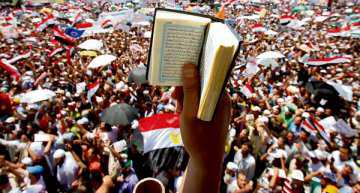
    BY FORCE of this year’s Arab revolts and revolutions, activists marching under the banner of Islam are on the verge of a reckoning decades in the making: the prospect of achieving decisive power across the region has unleashed an unprecedented debate over the character of the emerging political orders they are helping to build.

    Few question the coming electoral success of religious activists, but as they emerge from the shadows of a long, sometimes bloody, struggle with authoritarian and ostensibly secular governments, they are confronting newly urgent questions about how to apply Islamic precepts to more open societies.

    In Turkey and Tunisia, culturally conservative parties founded on Islamic principles are rejecting the name “Islamist” to stake out what they see as a more democratic and tolerant vision.

    In Egypt, a similar impulse has begun to fracture the Muslim Brotherhood as a growing number of politicians and parties argue for a model inspired by Turkey, where a party with roots in political Islam has thrived in a once-adamantly secular system. Some contend that the absolute monarchy of puritanical Saudi Arabia in fact violates Islamic law.

    A backlash has ensued, as well, as traditionalists have flirted with time-worn Islamist ideas like imposing interest-free banking and obligatory religious taxes and censoring irreligious discourse.

    The debates are deep enough that many in the region believe the most important struggles may no longer be between Islamists and secularists, but rather between the Islamists themselves, pitting the more puritanical against the more liberal.

    “That’s the struggle of the future,” said Azzam Tamimi, a scholar and the author of a biography of a Tunisian Islamist, Rachid Ghannouchi, whose party, Ennahda, is expected to dominate elections next month to choose an assembly to draft a constitution.

    The moment is as dramatic as any in recent decades in the Arab world, as autocracies crumble and suddenly vibrant parties begin building a new order, starting with elections in Tunisia in October, then Egypt in November. Though the region has witnessed examples of ventures by Islamists into politics, elections in Egypt and Tunisia, attempts in Libya to build a state from scratch and the shaping of an alternative to Syria’s dictatorship are their most forceful entry yet into the region’s still embryonic body politic.

    “It is a turning point,” said Emad Shahin, a scholar on Islamic law and politics at the University of Notre Dame who was in Cairo.

    At the centre of the debates is a new breed of politician who has risen from an Islamist milieu but accepts an essentially secular state, a current that some scholars have already taken to identifying as “post-Islamist”. Its foremost exemplars are prime minister Recep Tayyip Erdogan’s Justice and Development Party in Turkey, whose intellectuals speak of a shared experience and a common heritage with some of the younger members of the Muslim Brotherhood in Egypt and with the Ennahda party in Tunisia. Like Turkey, Tunisia faced decades of a state-enforced secularism that never completely reconciled itself with a conservative population.

    “They feel at home with each other,” said Cengiz Candar, an Arabic-speaking Turkish columnist. “It’s similar terms of reference, and they can easily communicate with them.”

    Ghannouchi has suggested a common ambition, proposing what some say Erdogan’s party has managed to achieve: a prosperous, democratic Muslim state, led by a party that is deeply religious but operates within a system that is supposed to protect liberties.

    “If the Islamic spectrum goes from bin Laden to Erdogan, which of them is Islam?” Ghannouchi asked in a recent debate with a secular critic. “Why are we put in the same place as a model that is far from our thought, like the Taliban or the Saudi model, while there are other successful Islamic models that are close to us, like the Turkish, the Malaysian and the Indonesian models, models that combine Islam and modernity?”

    In Libya, Ali Sallabi, the most important Islamist political leader, cites Ghannouchi as a major influence. Abdel Moneim Abou el-Fotouh, a former Muslim Brotherhood leader running for president in Egypt, has joined several breakaway political parties in arguing that the state should avoid interpreting or enforcing Islamic law, regulating religious taxes or barring a person from running for president based on gender or religion.

    A party formed by three leaders of the Brotherhood’s youth wing says that while Egypt shares a common Arab and Islamic culture with the region, its emerging political system should ensure protections of individual freedoms as robust as the West’s. One of them, Islam Lotfy, argues that the strictly religious kingdom of Saudi Arabia, where the Koran is ostensibly the constitution, was less Islamist than Turkey. “It is not Islamist; it is dictatorship,” said Lotfy, who was recently expelled from the Brotherhood for starting the new party.

    Egypt’s Centre Party, a group that struggled for 16 years to win a licence from the ousted government, may go furthest here in elaborating the notion of post-Islamism. Its founder, Abul-Ela Madi, has long sought to mediate between religious and liberal forces, even coming up with a set of shared principles last month. Like the Ennahda party in Tunisia, he disavows the term “Islamist” and, like other progressive Islamic activists, he describes his group as Egypt’s closest equivalent to Erdogan’s “neither secular nor Islamist. We’re in between.”

    It is often said in Turkey that its political system, until recently dominated by the military, moderated Islamic currents there. Lotfy says he hopes that Egyptian Islamists will undergo a similar, election-driven evolution. But, compared with Turkey, the stakes of the debates may be even higher in the Arab world, where divided and weak liberal currents pale before the organisation and popularity of Islamic activists.

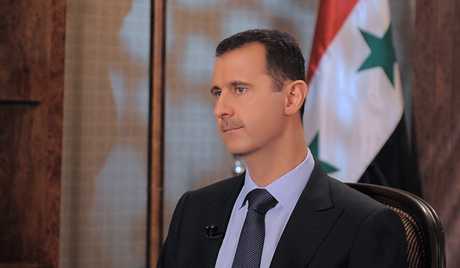
    In Syria, debates rage among activists over whether a civil or Islamic state should follow the dictatorship of Bashar al-Assad, if he falls. The emergence in Egypt, Tunisia and Syria of Salafists, the most inflexible currents in political Islam, is one of the most striking political developments. (“The Koran is our constitution,” goes one of their sayings.)

    And the most powerful current in Egypt, still represented by the Muslim Brotherhood, has stubbornly resisted some of the changes in discourse. When Erdogan expressed hope for “a secular state in Egypt”, meaning, he explained, a state equidistant from all faiths, Brotherhood leaders immediately lashed out, saying that Erdogan’s Turkey offered no model for either Egypt or its Islamists.

    A Brotherhood spokesman, Mahmoud Ghozlan, accused Turkey of violating Islamic law by failing to criminalise adultery. “In the secularist system, this is accepted, and the laws protect the adulterer,” he said, “But in the Shariah law this is a crime.”

    As recently as 2007, a prototype Brotherhood platform sought to bar women or Christians from serving as Egypt’s president and called for a panel of religious scholars to advise on the compliance of any legislation with Islamic law. The group has never disavowed the document. Its rhetoric of Islam’s long tolerance of minorities often sounds condescending to Egypt’s Christian minority, which wants to be afforded equal citizenship, not special protections.

    Indeed, Tamimi, the scholar, argued that some mainstream groups like the Brotherhood were feeling the tug of their increasingly assertive conservative constituencies, which still relentlessly call for censorship and interest-free banking.

    “Is democracy the voice of the majority?” asks Mohammed Nadi, a 26-year-old student at a recent Salafist protest in Cairo. “We as Islamists are the majority. Why do they want to impose on us the views of the minorities – the liberals and the secularists? That’s all I want to know.” – ( New York Times )

  • Syria Opposition launched a National Council in Istanbul

    Syria Opposition launched a National Council in Istanbul

    Syria Opposition launched a National Council in Istanbul

    (Dp-news)

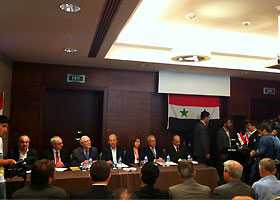
    ISTANBUL- Syrian dissidents meeting in Turkey have formally announced the creation of the final Syrian National Council. The structure and aims of this council were announced Sunday at a news conference in Istanbul.
    Opposition figure and Paris-based Burhan Ghalioun, one of the main opposition figures abroad, read out the founding statement of the council, which was signed by major Syrian opposition figures.

    “The Syrian Council is open to all Syrians. It is an independent group personifying the sovereignty of the Syrian people in their struggle for liberty,” Ghalioun said.

    SNC aims “to unify all groups at Syria opposition and looks at pushing forward on ground protests inside the country to topple the regime and establish the new democratic Syrian civil state.” according to its statement.

    Ghalioun said that peaceful means are the only solutions to the conflict in Syria.

    Ghalioun assured that the aims of the council were to present a united opposition front and overthrow Syria’s regime. The newly formed council rejected foreign intervention but asked for U.N. articles that would protect civilians in the country.

    It has also vowed to push for the creation of a democratically elected civilian state and to fulfill the aspiration and goals of the Syrian revolution that started six months ago.

    Syrian NC statement also rejected any foreign interference in Syria and urged the international community to recognize the legitimacy of the group.

    The council “is a frame for the opposition and the peaceful revolution and represents the revolution inside and outside,” Burhan Ghalioun, the chairman of almost 230-member council, told reporters in Istanbul.

    Ghalioun said he had no worries about gaining the support of the international community and that the council expected to have a busy schedule of meetings with friendly countries.

    In turn, Basma Kadhmani said that Syrian NC consists of three main bodies, a General Assembly, a Secretariat and Executive Committee.

    Kadhmani said “Committee consists of 5 Muslim Brotherhood, 4 Damascus Announcement, 9 Independents, 4 Kurds, 6 local Activists and 1 Assyrian.”

    Many Syrian opposition groups, committees and parties have already signed the announcement; Damascus Announcement, Muslim Brotherhood, Local Coordination Committees, General Council of Syrian Revolution in addition to many independent activists inside and outside Syria.

    The Syrian National Council was first founded in the Turkish city in late August, when a group of Syrian opposition and activists had announced the creation of the primary Syrian National Council.

    The Syrian government has banned most foreign journalists from entering the country and placed heavy restrictions on local media coverage, making it difficult to independently verify events and death toll on the ground.

    The UN estimates that about 2,700 people have been killed in a violent government crackdown on pro-reform protests that began mid-March.

    The government says that the movement against President al-Assad`s regime does not have popular support and blames violence on “armed terrorist groups”. It says that more than 700 soldiers and police have been killed in the uprising.

    via Syria Opposition launched a National Council in Istanbul | English | NEWS | DayPress.

  • Turkish Airlines Becomes First to Fly Commercial Flight to Tripoli

    Turkish Airlines Becomes First to Fly Commercial Flight to Tripoli

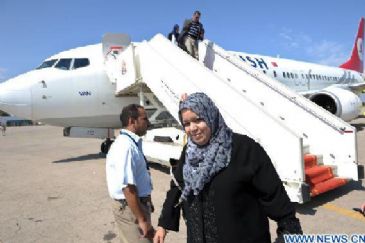
    A Turkish Airlines passenger plane landed in Tripoli Saturday noon to become the first international commercial flight to arrive in the Libyan capital since the establishment of a no-fly zone in war-torn Libya in March, a Libyan aviation official said.

    The flight from Istanbul, with 43 passengers on board, arrived at the Maitiga International Airport in eastern Tripoli, at about 11:50 local time, he said.

    A crew member of the Boeing 737-800 who identified himself as Ahmed, said that Turkish flights to Libya had been suspended since February 28 as Libya gradually sank into domestic chaos,.

    He went on to say that after the resumption of the route,there will be flights between Istanbul and Tripoli every four days, adding that daily flights might be possible at the end of October.

    Turkish Airlines had already resumed flights from Istanbul to Benghazi, Libya’s second largest city, on September 13.

    In March, the UN Security Council passed a resolution imposing a “no-fly zone” over Libya aimed at protecting civilians from air assaults by the deposed former Libyan leader Muammar Al Qathafi, halting all international commercial flights from and to the Libyan capital.

    More airlines are expected to follow the Turkish Airlines’ example in the coming days and resume flights to Libya, but flights will return to normal when Tripoli International Airport is functioning again. Alitalia has already announced it would resume service on November 7, when the Tripoli airport is expected to be cleared.

    via Turkish Airlines Becomes First to Fly Commercial Flight to Tripoli.

  • Gay Russian agent killed 3 Chechens in Istanbul

    Gay Russian agent killed 3 Chechens in Istanbul

    Gay Russian agent killed 3 Chechens in Istanbul

    By cumhur Ozkaya

    opednews.com

    3 Chechens were killed at Istanbul (Turkey). Prosecutor and police find murder. Murder suspects are 8 Russian agents.

    ::::::::

    3 Chechens ( Musaev Berkhazh , Rüstem Altemirol , Zaurbek Amriev) were killed at September 16 in Istanbul. According to Haberturk site’s news, 3 Chechen who has joined and directed some bloody attacks at Russia were killed by 8 Russian agents. Searching on security cameras by police and prosecutor appeared the murder suspects. Camera visuals appear how 8 agents planned the attack. Police had the information about when 8 agents came to Turkey and when they leaved the country after attack.

    The police control in hotels where murder suspects stayed before attack appeared some interesting materials about one of Russian agents. He is seen naked and with men in a close embrace in his photo album. The claim is these men are his boyfriends. He uses swastikas at motorcycle and computer and he does victory sign often.

    According to news there are 8 people at assassination group. Names of 2 are explained and claimed killers are these two agents. Not only names but also their photos and security videos are watched in Turk news sites again and again.

    Also 2 Afghan citizens were killed in Turkey (Aksaray) 3 days ago but there is any information yet about why they were killed and who might be killers.

    These murders are discussed now by public union at Turkey and people ask how foreign agents could kill someone so simply.

    via OpEdNews – Diary: Gay Russian agent killed 3 Chechens in Istanbul.