French president is in official visit in Kafkas region. He was in Armenia bowing down to a monument for so called Armenian Genocide by Turkish Ottoman’s, He threatened Turkey to face its past or expect harsh reactions! He also said that Karabakh is known better by Armenians and the government of Armenia, meaning, Karabakh belongs to Armenians. This statement is against UN’s resolutions on Karabakh conflict, and is against the integrity of Northern Azerbaijan (United Azerbaijan in fact). He then travels to Baku, where the Aliev dictatorship welcome’s him for attacking Turkey and Azerbaijan!
According to Hurriyet, Turkey said France should confront its colonial past before giving lessons to others on how to face history, in an angry response today to a call by President Nicolas Sarkozy for Ankara to recognize the 1915 massacre of Armenians as genocide.
Sarkozy, in Armenia on Thursday, challenged Turkey — which is seeking membership of the European Union — to face up to its past and threatened to pass a law in France that would make denying the genocide a crime.
Turkish Foreign Minister Ahmet Davutoğlu told a news conference: “Those who will not be able to face their own history for having carried out colonialism for centuries, for treating foreigners as second-class people, do not have the right to teach Turkey a history lesson or call for Turkey to face its history.”
Davutoğlu said Turkey and Armenia were working together on ways to normalise ties and Sarkozy’s comments would have a negative impact on reconciliation efforts.
Armenia and Turkey, with the endorsement of the United States, the European Union and Russia, had agreed in 2009 to establish diplomatic ties and open their common border within two months of parliamentary approval.
Sarkozy’s remarks has fueled a response from Turkey’s European Affairs Minister Egemen Bağış as well, who stated earlier today that the French president should abandon “the role of historian and put his mind to getting his country out of the economic gulf in which it finds itself.”hurriyet
via Sarkozy takes Armenian’s side and praises the occupation of Karabakh, Turkey tells France to confront colonial past first.
The Turkish Prime Minister Recep Tayyip Erdoğan is increasingly taking the lead in supporting the Syrian opposition. Erdoğan condemned the vetoing of a United Nations resolution against Damascus and has announced it will impose its own sanctions. This week saw the start of military exercises on the Syrian border.
The Turkish military is currently holding a five-day military exercise on the Syrian border. The last time such a major exercise occurred was 13 years ago when Ankara threatened to invade Syria unless it expelled the Turkish Kurdish rebel leader, Abdullah Ocalan. The diplomatic correspondent for the Turkish newspaper Milliyet, Semih Idiz, says the exercises are aimed at sending a message to the Syrians.
“This will represent a kind of muscle flexing on Turkey’s part,” said Idiz. “But I think we’ve got a long way for this to translate into a some kind of military confrontation. But I don’t think we are at that stage. But its a clear indication the government has given up on Damascus. and its now concerned about protecting its 850-kilometer border with this country.”
Protecting that border is important Idiz says, with the expectation in Ankara that an uprising against Syrian President Bashar al-Assad will continue to grow along with a risk of more refugees crossing the border. Already thousands have fled to Turkey.
Turkish Prime Minister Recep Tayyip Erdoğan is expected to visit the refugee camps in the near future. Following that visit sanctions are expected to be announced. Mr. Erdogan, during a visit this week to South Africa, condemned the vetoing of a United Nations motion against Syria.
Erdoğan promised that Turkey and the European Union will move to tighten sanctions against Syria.
Details of the moves remain unclear. Turkey already is imposing an arms embargo.
Last month the Turkish navy intercepted a Syrian bound ship from Iran carrying arms.
But chief economist Emre Yigit of the Istanbul financial trading house Global Securities, says any new measures will have a limited effect.
“We don’t know the amount held by the Syrian leaders in Turkish bank, if any. It could hurt them that way,” said Yigit. “I dont think the Syrian economy would collapse as a result of Turkish sanctions. It would have an impact, it would make life a little difficult. But it would not stop the Syrian government from having the ability to rule the country as it wished.”
Ankara is closely coordinating its sanctions’ plan with Washington, says Sinan Ulgen, a former Turkish diplomat and visiting scholar of the Carnegie Institute in Europe, says:
“There have been a number very high level phones calls, conversations between the Turkish leaders and the U.S. leadership,” said Ulgen. “And now the two sides are really on the same page and Turkish policy regards to Syria does seem to have the full support of the U.S. administration.”
Ankara is also allowing the Syrian opposition to meet and organize in Turkey. The leader of a self styled “Syrian Free Army,” made up of defectors from Syria’s armed forces, is allowed to organize in Turkey.
Soli Ozel, columnist for the daily newspaper Haberturk, says that Ankara wants to avoid intervening in Syria.
“Despite all the bravado in the talk, I think Turkey is fundamentally conservative country, it will not want to go beyond certain limits,” said Ozel. “But the real problem whether or not you will be able to control every step of the way, in this unfolding problem. We now hear, and I guess its reasonable to expect the opposition to begin arming and I am sure there are plenty of sources that would like to arm the opposition. Once that starts you are in shifting sands so whatever is your position today, may not hold ground in the future.”
With Ankara severing nearly all its ties with Damascus, it seems fully committed to the opposition, whatever consequences that will bring.
via Turkey Moves to Directly Support Syrian Opposition | Europe | English.
Turkey’s prime minister is championing Abbas’s UN appeal – yet still has to resolve the Kurdish issue back home
Simon Tisdall · 21/09/2011 · guardian.co.uk
A Kurdish demonstration in Istanbul this month, calling for the release of the jailed PKK leader Abdullah Ocalan. Photograph: Tolga Bozoglu/EPA
Turkey’s noisy championing of Palestinian rights, a source of growing friction with the US and Israel, jars uncomfortably with Ankara’s treatment of its own disadvantaged and stateless minority – the Kurds. Bomb attacks this week in Ankara, blamed on Kurdish PKK militants, highlight the deteriorating internal security situation and stoke fears that Turkey’s troubles could spill over into Syria and Iraq, further aggravating Arab spring instability.
Apparently oblivious to possible double standards, Recep Tayyip Erdogan, Turkey’s prime minister, has been in voluble form of late. His tour last week of Egypt, Libya and Tunisia played upon a common theme – Turkey’s support for the justified aspirations of oppressed peoples everywhere. Erdogan’s long-running feud with Israel over its treatment of the Palestinians reached new heights when he warned the Turkish navy might escort future relief flotillas to Gaza.
Alarmed at the implications for US interests, Barack Obama took time at the UN in New York on Tuesday to talk Erdogan down, stressing their shared interest in peaceful, negotiated outcomes in Palestine, Syria and elsewhere. Turkey is a leading backer of President Mahmoud Abbas’s bid for UN recognition of Palestinian statehood. Obama, flanked by Israel’s Binyamin Netanyahu, desperately hopes to shove this uncomfortable issue back in the freezer.
The US also wants to head off renewed ground incursions targeting PKK bases in Iraq, as threatened last week by a senior Turkish minister, given obvious security concerns surrounding the US troop withdrawal. Rising tensions over disputed gas fields off Cyprus are adding to Washington’s worries at a time when, to put it mildly, the Greek government and its Greek Cypriot allies are not in the best shape.
Unfortunately for the majority of Turkey’s Kurds who want a peaceful settlement, one consequence of resulting American appeasement of Ankara is likely to be ever closer US co-operation with Turkey’s escalating military operations against the PKK. Like the EU, the US lists the PKK as a terrorist organisation, a categorisation passionately disputed by the main Kurdish national party, the BDP, which describes it as a “resistance” group. Washington already provides military satellite intelligence to Ankara. Now there is renewed talk of a Turkish base for US Predator drones, which the Turks want to target the PKK inside Iraq.
Erdogan has made important efforts to resolve the Kurdish issue, notably via the so-called “democratic opening” that included talks with the jailed PKK leader, Abdullah Ocalan. For their part, the PKK and Kurdish political parties have renounced their former separatist agenda. But gains have been limited, hardliners on both sides have obstructed the process, and Erdogan’s attention has shifted to the wider stage of Arab emancipation and the “re-Ottomanisation”, as some call it, of the Middle East. For him, it seems, the role of grand regional rainmaker is more alluring than that of down-home, hard-slog peacemaker.
The Kurdish parties are still trying to get his attention. The BDP’s woefully under-reported congress in Ankara earlier this month produced an eight-point protocol or “road map” for what it called a democratic resolution; and it proposed resumed talks as a matter of urgency. “All identities, cultures, languages and religions must be protected by the constitution. As a basic principle there must be a constitutional nationality that is not founded on ethnicity,” it said.
“The right to speak in the mother tongue – including in public – must be universally protected by the constitution. Education in the mother tongue language must be recognised as a fundamental right … There must be a transition to a decentralised administration. With regards to autonomy, local, provincial and regional councils must have more powers,” a BDP summary of the protocol said.
This is hardly an earth-shaking or revolutionary agenda. It is a far cry from the forfeited dream of an independent state spanning south-east Turkey, north-western Iran and parts of Syria and Iraq. And as the International Crisis Group notes in a report published this week, the acceptance of universal rights should not be regarded as a concession by the Turkish government.
The ICG report argues persuasively that the basis for a negotiated, peaceful settlement remains in place despite an upsurge in violence since June’s elections that has claimed more than 100 lives. “The PKK must immediately end its new wave of terrorist and insurgent attacks, and the Turkish authorities must control the escalation with the aim to halt all violence. A hot war and militaristic tactics did not solve the Kurdish problem in the 1990s and will not now,” the ICG says.
It continues: “The Turkish Kurd nationalist movement must firmly commit to a legal, non-violent struggle within Turkey, and its elected representatives must take up their seats in parliament, the only place to shape the country-wide reforms that can give Turkish Kurds long-denied universal rights. The Turkish authorities must implement radical judicial, social and political measures that persuade all Turkish Kurds they are fully respected citizens.”
Surely this is not so hard to do? It’s time Erdogan stopped playing Palestinian saviour and put Turkey’s problems first.
Apaku. Nijat Mustafayev – APA-ECONOMICS. Azerbaijani gas will be increased not only on the account of Shah Deniz, but on the account of other fields too, said the representative of Platts magazine John Roberts at the 6th Kazenergy Eurasia Forum, in Astana, Kazakhstan.
Speaking about production and transportation perspectives of energy carriers in Caspian Sea Roberts looked through the possible routes for accessing of gas to the world markets. He noted that, EU supported on Nabucco projects. Other projects are not supported sufficiently.
Roberts said that Turkmen gas was important for this project: “I regret that, Turkmenistan is on the passive position compared to Azerbaijan’s proactive position. Turkmenistan is on passive position and expects the route versions from others, while Azerbaijan takes active steps on extraction, exploitation and accessing of gas to the world markets”.
As to Kazakhstan, Roberts hesitated and noted that time would show. In general, Roberts said Azerbaijan was the country, which pursued the most stable and consistent oil and gas policy, he showed Azerbaijan as an example for the other countries in the region.
“Moreover, Azerbaijan and Kazakhstan are the most reliable transit countries of the region, they proved it with the recent activities in this sphere”, Roberts added.
Generally, in his speech, Roberts noted Azerbaijan as the most stable and proactive country of the region. Also he said that Turkmenistan should take more active steps for the proof of seriousness of its opinion on gas transportation to Europe.
* Sarkozy to urge Georgia to mend ties with Russia
* Revives memories of mediating role over 2008 war (Adds Russia finalising military base deals)
By Emmanuel Jarry
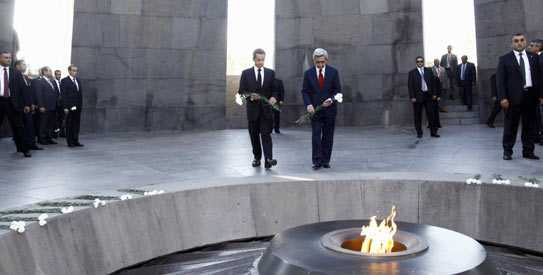
French President Nicolas Sarkozy, left, and Armenian President Serge Sarkisian lay flowers at the Armenian Genocide Memorial in Yerevan, Armenia. -AP Photo
YEREVAN, Oct 6 (Reuters) – French President Nicolas Sarkozy, on a brief trip to the Caucasus, urged Turkey on Thursday to recognize the 1915 massacre of Armenians as genocide, threatening to pass a law in France that would make denying this a crime.
Visiting a genocide memorial and museum in Yerevan, Armenia, with Armenian President Serzh Sarksyan, Sarkozy challenged Turkey — which is seeking membership of the European Union — to face up to its past.
“The Armenian genocide is a historical reality. Collective denial is even worse than individual denial,” Sarkozy told reporters.
“Turkey, which is a great country, would honour itself to revisit its history like other great countries in the world have done.”
Armenia was the first stop on a two-day trip to the region by Sarkozy, who is keen to raise his profile on the international stage before an April presidential election. He visits Azerbaijan and Georgia on Friday.
France is opposed to Turkey’s bid for EU membership and his comments on the sensitive subject are likely to be viewed as unwelcome meddling by Ankara.
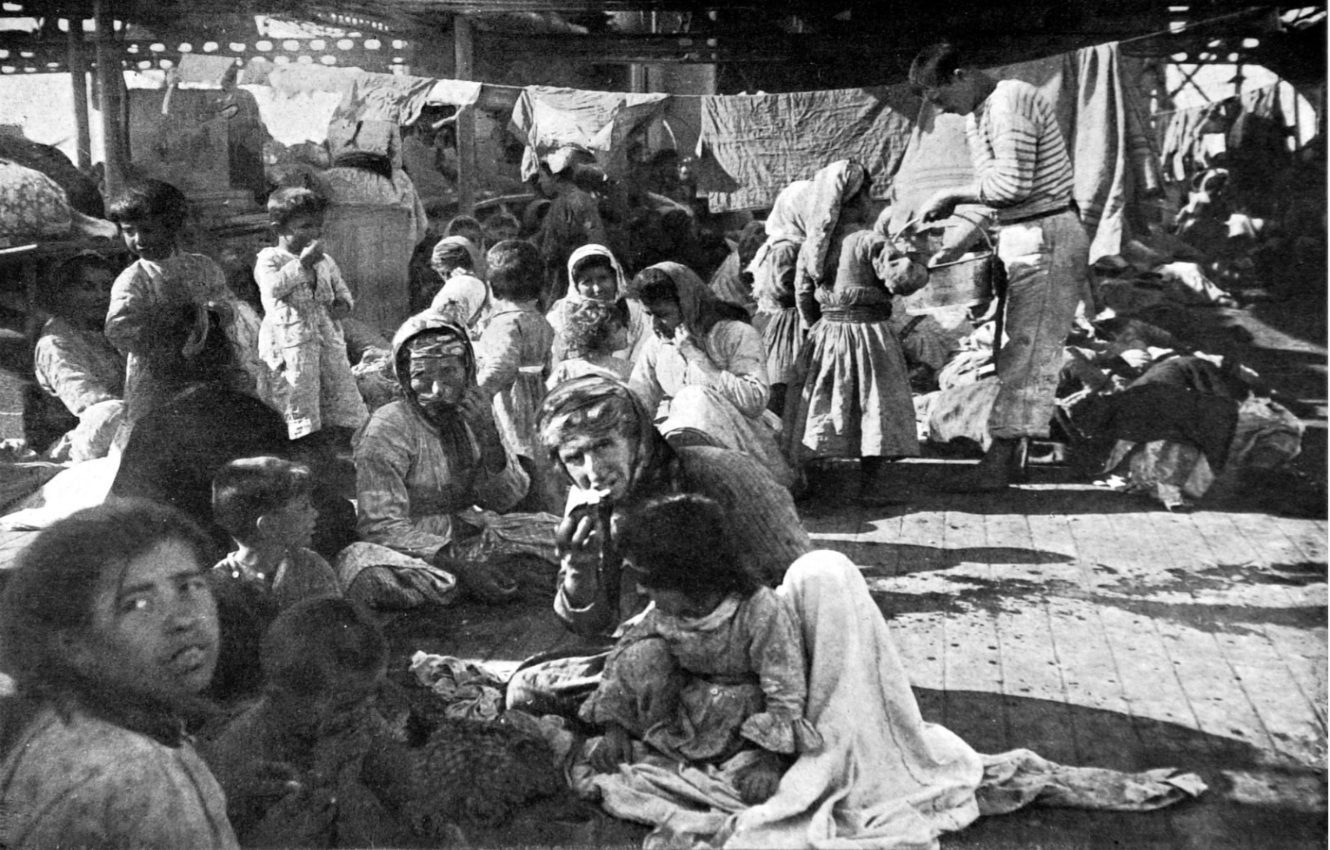
Turkey denies the deaths of Armenians in 1915 was genocide. It says both Christian Armenians and Muslim Turks died in large numbers as the Ottoman empire collapsed.
Sarkozy suggested that the French parliament might consider a law making denial of the deaths of Armenians as genocide a crime, similar to the French law against Holocaust denial.
FROZEN CONFLICT
While in the region, Sarkozy will try to encourage Sarksyan and the president of Azerbaijan, Ilham Aliyev, to resolve a conflict over Nagorno-Karabakh, a mainly Armenian-populated enclave in Azerbaijan.
France plays a leading role in the Minsk Group of countries from the Organisation for Security and Co-operation in Europe (OSCE), which is trying to resolve the conflict in Nagorno-Karabakh.
Armenian-backed forces wrested Nagorno-Karabakh from Azeri control after the Soviet Union collapsed. When the conflict ended in a ceasefire in 1994, 30,000 people had been killed and about 1 million had been driven from their homes.
During a three-hour visit to Georgia, Sarkozy will also urge Georgia to improve relations with Russia, reviving memories of his mediating role when the two countries went to war in 2008.
Sarkozy’s success in brokering a ceasefire in that conflict guarantees a warm welcome in the capital Tbilisi, where he will meet President Mikheil Saakashvili and address a crowd in the central Freedom Square.
Sarkozy will urge Saakashvili to look beyond the countries’ differences, including over how they interpret the ceasefire terms, and rebuild trust in relations with Moscow.
Each side accuses the other of acting provocatively and sabotaging relations. Moscow has angered Tbilisi and the West by recognising Georgia’s breakaway Abkhazia and South Ossetia regions as independent states.
In Moscow on Thursday, Russian President Dmitry Medvedev met Abkhazia’s new president and signed legislation ratifying treaties that enable Russia to operate military bases in the two separatist regions for at least 49 years.
It was not clear whether Sarkozy would discuss Russia’s bid to join the World Trade Organization which Georgia, as a member, could block. Moscow hopes to complete its entry to the 153-member trading body this year.
HOPING TO BOOST RATINGS
Sarkozy mediated the 2008 ceasefire on behalf of the European Union as France held the bloc’s presidency at the time.
That ended the war over Abkhazia and South Ossetia, but Georgia says Russia has violated the terms by not withdrawing troops to the positions they held before the war.
TV images of Sarkozy addressing jubilant crowds will do him no harm as he tries to improve his poor ratings before the two-round election on April 22 and May 6. An opinion poll on Tuesday put Socialist Francois Hollande well in the lead.
Sarkozy will also promote business during his visit to the region but officials gave no details of any planned contracts.
French oil group Total said last month it had made a major gas discovery at Azerbaijan’s Absheron block in the Caspian Sea. French companies could also be in the running to help extend the Baku metro, or subway. (Reporting by Margarita Antidze in Tbilisi and Emmanuel Jarry in Paris, Writing by Timothy Heritage and Alexandria Sage; Editing by Myra MacDonald)
via UPDATE 2-Sarkozy challenges Turkey to face its history | Reuters.
French President Nicolas Sarkozy urged Turkey on Thursday to “revisit” its history regarding the 1915 massacre of Armenians in the Ottoman Empire, which France views as a genocide but Turkey does not.
“Turkey, which is a great country, would be honorable to revisit its history like the other great countries in the world have done: Germany, France,” Sarkozy told journalists at a joint press conference with Armenian counterpart Serge Sarkisyan.
“The genocide of Armenians is a historic reality that was recognised by France. Collective denial is even worse than individual denial,” he said.
“We are always stronger when we look our history in the face, and denial is not acceptable.”
Sarkozy was speaking after visiting Armenia’s Genocide National Museum to pay respects to Armenians killed in the massacre, an extremely sensitive issue that has kept Armenia and Turkey from establishing formal diplomatic relations.
Asked whether France should adopt a law prosecuting anyone who denies that the massacres were “genocide”, Sarkozy replied that “if Turkey revisited its history, looked it in the face, with its shadows and highlights, this recognition of the genocide would be sufficient.”
“But if Turkey will not do this, then without a doubt it would be necessary to go further,” he said.
Sarkozy angered Turkey ahead of his election in 2007 by backing a law aimed at prosecuting those who refuse to recognise the event as a genocide.
The French lower house of parliament later rejected the measure, infuriating an Armenian diaspora of some 500,000 people.
Sarkozy was to dine with Sarkisyan later Thursday and continue his tour of Caucasus states Azerbaijan and Georgia on Friday.
 French president is in official visit in Kafkas region. He was in Armenia bowing down to a monument for so called Armenian Genocide by Turkish Ottoman’s, He threatened Turkey to face its past or expect harsh reactions! He also said that Karabakh is known better by Armenians and the government of Armenia, meaning, Karabakh belongs to Armenians. This statement is against UN’s resolutions on Karabakh conflict, and is against the integrity of Northern Azerbaijan (United Azerbaijan in fact). He then travels to Baku, where the Aliev dictatorship welcome’s him for attacking Turkey and Azerbaijan!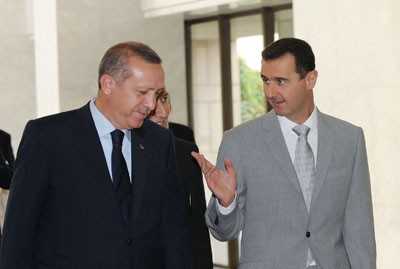
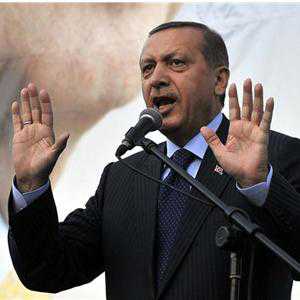 The Turkish military is currently holding a five-day military exercise on the Syrian border. The last time such a major exercise occurred was 13 years ago when Ankara threatened to invade Syria unless it expelled the Turkish Kurdish rebel leader, Abdullah Ocalan. The diplomatic correspondent for the Turkish newspaper Milliyet, Semih Idiz, says the exercises are aimed at sending a message to the Syrians.