Category: Regions

  • İstanbul to hold its own Oktoberfest with protests

    İstanbul to hold its own Oktoberfest with protests

    07 October 2011, Friday / BJÖRN FINKE, İSTANBUL

    As the world’s biggest beer festival, Oktoberfest, closed it doors on Monday in Munich, İstanbul is set to hold its own Oktoberfest at Parkorman, close to the Darüşşafaka metro station, this weekend.

    The event, which will be held on Sunday, will bring German culture and tradition to İstanbul according to its organizers, the İstanbul-based entertainment and gastronomy company KafePi. From 12 p.m. to midnight visitors will be able to taste several kinds of beer and German food.

    The teetotal nongovernmental organization Turkish Green Crescent (Yesilay) has criticized the event, saying that it promotes the consumption of beer in Turkey. Nevertheless, Beste Özdeşlik from KafePi`s marketing department told Today’s Zaman that the organizers have not met with political resistance to the plan.

    In the past, under the name Oktoberfest, İstanbul played host to some small-sized beer parties, but the event on Sunday is the first celebration of beer of its size. According to Özdeşlik, the event can host up to 10,000 guests. At small Bavarian-style booths and at 10 bars, they can buy food, for example Bretzels and German-style sausages as well as Turkish and international beers like Carlsberg and Becks. At the original Oktoberfest in Munich, which dates back to 1810, beer is sold in one-liter glasses. Four bands will play at the fest and a Bavarian folk music group will be on stage from four p.m. onwards.

    What is relatively new for İstanbul is already well known in Antalya, where the third Oktoberfest took place in September. Last year, the city’s mayor came under heavy criticism for promoting the consumption of beer since the municipality supported the event, where one young man died after he drank too much alcohol.

    via todayszaman

  • U.S. Ties to Turkey Face New Strains

    U.S. Ties to Turkey Face New Strains

    By JAY SOLOMON in Washington and MARC CHAMPION in Istanbul

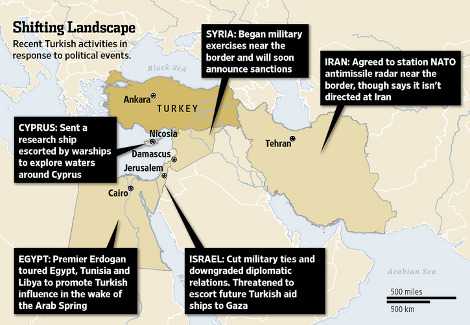
    WASHINGTON—Escalating tensions in the Mediterranean are complicating the U.S.-Turkey alliance at a time when President Barack Obama views Ankara as central to helping the U.S. manage the Middle East’s political upheavals.


    Secretary of State Hillary Clinton privately has pressed Turkish officials to back off from their threats to send warships to waters around Cyprus in a dispute over energy deposits, according to U.S. officials. The top American diplomat cautioned that any escalation could jeopardize U.S. interests in the Mediterranean, as the gas fields are being jointly developed by Cyprus and Houston-based Noble Energy Inc.

    U.S. officials also are concerned by Turkish threats to deploy naval vessels to accompany flotillas headed to the Palestinian territories, which could heighten the potential for a military conflict between Turkey and Israel, both close U.S. allies. American diplomats have worked to broker a rapprochement between Turkey and Israel, but officials in the White House and State Department acknowledge the rift could endure.

    Some strategists in Washington and Europe are calling on the Obama administration to lay down stricter red lines in the Mediterranean, by using more aggressive diplomacy and the U.S. Navy. This is seen as crucial for guarding against any miscalculations by Turkey, Israel or Cyprus, though they acknowledge such steps could anger Ankara.

    “I don’t think the Turks are intent on starting hostilities, but you never know what can happen in this environment,” said Morton Abramowitz, a former U.S. ambassador to Turkey. He added that Washington needs to be up-front with Ankara and tell them that if conflict breaks out between Turkey and Israel, “We’ll choose Israel.”

    Turkish officials stressed in interviews they aren’t seeking a war with either Cyprus or Israel, and said Turkey has been forced to take action to guard against provocative steps by others. “Look, nobody wants any disasters here. We are aware of the situation,” said a senior Turkish official.

    Mr. Obama has cultivated Turkey as a major strategic partner since coming into office in 2009. White House officials say the U.S. president speaks regularly with Turkish Prime Minister Recep Tayyip Erdogan to coordinate on the political transformation in the Middle East and North Africa. And the Obama administration hailed Ankara’s decision last month to house a North Atlantic Treaty Organization radar facility, which is focused on Iran’s long-range missiles.

    “Turkey is a NATO ally, a great friend and a partner on a whole host of issues,” Mr. Obama said prior to a meeting with Mr. Erdogan last month.

    Still, the deepening dispute between Turkey and Cyprus over energy exploration has placed Washington squarely in the middle.

    Tensions flared last month when the Cypriot government announced that Noble Energy would begin drilling for gas in its Exclusive Economic Zone. Ankara doesn’t recognize Cyprus’s government and said the energy exploration undercuts prospects for a United Nations-backed process aimed at reunifying the island. Cyprus was divided into ethnic-Greek and Turkish enclaves in 1974, after Turkey invaded the island following a Greece-inspired coup.

    In recent weeks, Turkey has dispatched naval vessels into this economic zone, including frigates and gunboats, according to senior Cypriot officials. They said these moves are a violation of international law and aimed at intimidating Cyprus and preventing Noble from moving ahead with developing the gas fields. Cyprus’s government is calling on the U.N, U.S. and European Union to increase pressure on Ankara to pull out of Cypriot waters.

    “The gravity of the problem stems from the threats that are being voiced, nearly daily, by the Turkish leadership,” said Cypriot Foreign Minister Erato Kozakou-Marcoullis, in an interview.

    Turkish officials said the international community should be focused on the Cypriot actions, which they believe are aimed at undermining the U.N. talks.

    More recently, Turkey also began exploring for energy deposits in Cypriot waters. “We just need to make a point… to show the Greek Cypriots that they don’t own the whole island,” said the Turkish official.

    Continuing tensions between Turkey and Israel are also undercutting U.S. efforts to stabilize the Middle East. Once close allies, Turkey and Israel have been locked in a growing war of words in the wake of Israel’s military action last year against an international aid flotilla headed for the Gaza Strip. The operation killed eight Turkish nationals and one Turkish-American.

    For months, the Obama administration has worked to ease tensions between Israel and Turkey. But the process broke down after Prime Minister Benjamin Netanyahu’s government refused to apologize to Ankara for the flotilla deaths. Turkey cut military ties with Israel and downgraded diplomatic relations, saying it would use its navy to protect future aid flotillas headed toward Gaza.

    On Friday, Foreign Minister Ahmet Davatoglu reiterated that threat, but specified that it applied to Turkish vessels in international waters.

    Some Turkey analysts believe Mr. Erdogan is bluffing. But there are increasing fears that the Turkish leader, now among the most popular in the Muslim world, could have staked a position that will be hard to back away from. And they note that Washington would be likely be dragged into any conflict.

    “At some point, the U.S. is going to have to say: This rhetoric is too much,” said Henri Barkey, a Turkey scholar at Lehigh University.

    Write to Jay Solomon at [email protected] and Marc Champion at [email protected]

  • Analysis: Turkey takes sides on Syria, faces new risks

    Analysis: Turkey takes sides on Syria, faces new risks

    By Jonathon Burch and Simon Cameron-Moore

    ANTAKYA, Turkey/ISTANBUL | Fri Oct 7, 2011 12:11pm EDT

    (Reuters) – Turkey is piling pressure on Syria with border military exercises, economic sanctions and the harboring of Syrian opposition groups and army defectors, but Ankara must tread carefully to avoid arousing the suspicion of Arab states or spurring Syrian counter-measures.

    Turkey has shifted, in the space of six months, from being Syria’s new best friend forever to a center of gravity for opposition to President Bashar al-Assad outside the country.

    Having started out by advising Assad to exercise restraint and make reforms when pro-democracy unrest first erupted in March, Turkey is now on the verge of invoking sanctions against a government it once sat down with for joint cabinet meetings.

    Syrian dissidents abroad, and some who have managed to sneak out of the country, have flocked to Istanbul over the past few months to give the revolution a united political front.

    And Turkey has given sanctuary to the most senior Syrian military officer to defect, while this week it began maneuvers in a province over which Syria has had longstanding claims.

    “Turkey is clearly taking sides now,” said Cengiz Aktar, professor at Istanbul’s Bahcesehir University. “Turkey expects this opposition and the upheaval in the country will eventually finish the job and the revolution will bring an end to the regime.”

    But Turkey’s policy shift, which has aligned Ankara more closely with the West, comes with risks.

    “Syrian intelligence might use every opportunity to instigate Kurdish violence,” Aktar said, referring to Turkey’s restive minority population.

    Aktar said Turkey, whose clout in the Middle East has grown out of a combination of economic growth and secular democracy, could see goodwill evaporate if it is perceived to be meddling in Syria.

    “At the end of the day, Turkey risks being told to mind its own business and to first put its house in order. The more it wants to be a soft power the more it is going to be told by the international community to apply the same standards with its Kurds minority.”

    For all their closeness over the past decade, the two countries almost went to war in the late 1990s over Syria giving refuge to Kurdish militants fighting the Turkish state.

    Living under Turkish protection, Syrian Colonel Riad al-As’aad exhorts his former comrades to desert to organize the armed struggle he believes is needed to drive Assad from power.

    “We assure them (the Syrian people) they should be patient, and God willing, very soon, Bashar will be between their hands,” As’aad told Reuters in an interview on Thursday. [nL5E7L642X]

    “We must be patient. We hope the Syrian people will be stronger and remain committed to continue to bring down the regime.”

    Revolted by the killing of Syrian civilians, and seeing the tide of history turn with the “Arab Spring” of popular uprisings, Turkey has calculated that its long term interest lies in supporting the Syrian people’s struggle for democracy.

    That Syria, like Turkey, has a Sunni Muslim majority, while Assad and his clique belong to the Alawite minority, an offshoot of Shi’ite Islam, made that choice even simpler.

    The breakdown in their relationship leaves Iran as Syria’s closest backer, though the Russian and Chinese vetoes earlier this week of a U.N. Security Council draft resolution censuring Syria showed Assad retains some support elsewhere.

    SANCTIONS

    Anti-Assad factions meeting in Istanbul — ranging from Islamists through liberals, along with ethnic and tribal leaders — have coalesced under a revolutionary Syrian National Council with a stated aim of ousting Assad within six months.

    Offering itself as a potential future interim government, this broad-based opposition group has helped instill some confidence among governments, like Turkey, who disapprove of Assad but had not known who to support.

    Hitherto, they have feared Assad’s fall would leave Syria without a central authority capable of stopping the country sliding into religious, sectarian and ethnic violence.

    One Western diplomat, asked about Turkey’s hesitation in the past to ditch Assad, said Ankara had come to see Assad as “the devil we know.”

    Turkish Prime Minister Tayyip Erdogan, who had previously enjoyed a close rapport with Assad, is expected to visit a camp in the border province of Hatay sheltering some of the 7,500 Syrians who have fled the violence at home.

    Due to the death of his mother, Erdogan delayed a visit that had been set for Sunday, but he has already promised to announce sanctions against the Syrian government.

    Turkey is expected to freeze bank accounts held by members of Assad’s inner circle, cut ties with Syrian state banks, and halt deals between state-run companies, notably in oil and gas, while avoiding measures that could hurt the people.

    Erdogan predicted last month that Assad will be ousted “sooner or later,” but how far he is willing to go to make it happen is an open question.

    “What we have at the moment … is a war of words between Assad and Erdogan,” said Gareth Jenkins, an Istanbul-based security analyst. “It’s a bit like two jilted lovers, because they were very, very close. There is a lot of personal spite.”

    Compounding tensions this week, Turkey began military exercises in Hatay province, which Syria has had longstanding claims over since it was ceded to Turkey in 1939 when France controlled Syria and Lebanon.

    The exercises, relatively small-scale logistical drills involving a large contingent of less experienced reservist troops, are seen as a symbolic reminder to Damascus that the second largest army in NATO is just across the border.

    “It is part of the Turkish government’s campaign to apply increased psychological pressure on the regime in Damascus because previous warnings have gone unheeded,” said Fadi Hakura, analyst at Chatham House think-tank in London.

    LAST RESORT

    Turkey has begun intercepting arms bound for Syria passing through its waters and air space.

    Some analysts say it is easy to foresee Turkey eventually helping to equip and organize Syrian rebels, like Colonel As’aad, who want to wage an armed struggle against those units of Assad’s security forces leading the repression of protesters.

    Other analysts believe it would be a mistake for Turkey to go beyond support for peaceful protests by letting itself become a rear base for an armed opposition or being seen as a provocateur in Syria’s internal conflict, especially if it developed a stronger sectarian dimension.

    Turkey, after all, is vulnerable to mischief-making among ethnic Kurds and developments that could cause unease within its own Alevi minority community.

    Speculation keeps resurfacing that Turkey’s military could end up entering Syria to create a buffer zone for the protection of Syrians from Assad’s security forces.

    During the 1991 Gulf War, about half a million Iraqi Kurds fled to Turkey, returning only after Western powers, along with Turkish contingents, set up a safe haven across the border.

    But analysts see this option still as a last resort for Ankara, and one that is unlikely to be taken without first getting a U.N. mandate.

    As it has done in other Arab countries gripped by upheaval, Turkey has played on sentimental attachments to the Ottoman era, when Istanbul counted vast swathes of Arabia, North Africa and the Balkans among its dominions.

    Whereas Erdogan has earned admiration among Arabs for championing the Palestinian cause and leading democratic change in Turkey, analysts say Arabs would not like to see Turkish troops crossing into Syria.

    “I don’t think Turkey … would be stupid enough to intervene militarily,” Jenkins said. “The Arab world doesn’t want to see Turkish boots on the ground in an Arab country.”
  • France, Turkey sign security agreement for cooperation

    France, Turkey sign security agreement for cooperation

    Turkey and France on Oct. 7 signed a security agreement paving the way for joint security operations against the outlawed Kurdistan Workers’ Party (PKK).

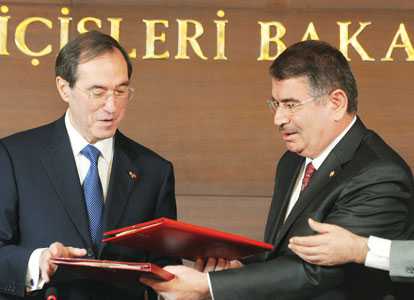
    The aggreement has been signed by French Interiror Minister Claude Gueant (L), and his Turkey’s İdris Naim Şahin. DAILY NEWS photo, Selahattin SÖNMEZ
    The aggreement has been signed by French Interiror Minister Claude Gueant (L), and his Turkey’s İdris Naim Şahin. DAILY NEWS photo, Selahattin SÖNMEZ

    “The agreement will also open a door to technical cooperation as well as operational cooperation between the two countries, which allow Turkey and France to take a stance against terrorism and other types of crime, “Claude Gueant, interior minister of France, told reporters in a joint press conference with his Turkish counterpart İdris Naim Şahin.

    “The agreement covers cooperation on domestic security, fighting against terrorism, cross-border crime, illicit drug trafficking and financial crimes,” Şahin said. Gendarmerie and police departments in Turkey and France have good relations, and pursuing a common stance together against every type of crime, particularly terrorism, will be beneficial to both countries, he said.

    Gueant said French President Nicholas Sarkozy Sarkozy attached great importance to the agreement.

    France will also continue to support Turkey in the fight against the PKK, Gueant said, pointing out that 38 PKK militants were arrested in France in 2010 and another 32 have been arrested so far this year. Ten of them are jailed in France, he said.

    Asked about jailed PKK members held in France being returned to Turkey, the French minister said judicial authorities would decide the matter, adding that Turkey and France have prepared return files together.

    A Paris court recently tried 18 people, including top members of the PKK in Europe. The prosecutor’s office demanded prison terms ranging from six months to six years for the suspects. The court will make its decision on the case on Nov. 2.

    via France, Turkey sign security agreement for cooperation – Hurriyet Daily News.

  • Sarkozy urges Turkey to quickly recognise Armenia ‘genocide’

    Sarkozy urges Turkey to quickly recognise Armenia ‘genocide’

    YEREVAN – French President Nicolas Sarkozy urged Turkey on Friday to recognise the World War I-era massacres of Armenians as genocide within a “very brief” period before his term ends in May 2012.

    “From 1915 to 2011, it seems to be enough (time) for reflection,” Sarkozy told reporters in Yerevan on the second day of his visit to Armenia.

    Speaking alongside his Armenian counterpart Serzh Sarkisian, he noted however that “it is not up to France to give an ultimatum to anyone”.

    Sarkozy on Thursday urged Turkey to “revisit its history” over the killings of hundreds of thousands of Armenians under the Ottoman Empire, calling its refusal to recognise the deaths as genocide as “unacceptable”.

    The French president said that if Turkey did not make this “gesture of peace” and “step towards reconciliation”, he would consider proposing the adoption of a law criminalising denial of the killings as genocide.

    He said that he was still hoping that Turkey would act before the end of his term in office.

    Sarkozy angered Turkey ahead of his election in 2007 by backing a law aimed at prosecuting those who refused to recognise the massacres as genocide.

    The French lower house of parliament later rejected the measure, infuriating the Armenian diaspora in France which is estimated at around 500,000 people.

    Armenians say that up to 1.5 million of their kin fell victim to genocide during World War I under the Ottoman Empire.

    Turkey counters that 300,000 to 500,000 Armenians and at least as many Turks died in civil strife when Armenians rose up against their Ottoman rulers and sided with invading Russian forces.

    Sarkozy has also indicated his ambition to bring Armenia and neighbouring Azerbaijan forward in the stalled peace process over the tiny Nagorny Karabakh region, the focus of a bitter territorial conflict since the fall of the Soviet Union.

    On the eve of his arrival, the French leader urged the two rivals to “take the risk of peace”.

    At the joint news conference in Yerevan, Armenian leader Sarkisian responded by saying that he appreciated France’s efforts to establish “a durable peace”.

    “President Sarkozy’s personal involvement in this process is particularly important to us,” Sarkisian said.

    But in a sign of continuing tensions along the Karabakh frontline, two Azerbaijani soldiers and one Armenian serviceman were reported to have been shot dead in exchanges of fire the day before Sarkozy arrived.

    Seventeen soldiers have now been reported killed this year around Karabakh, which Armenian separatists backed by Yerevan seized from Azerbaijan in a war in the 1990s that left some 30,000 dead.

    Despite years of talks since the 1994 ceasefire, the two sides have yet to sign a final peace deal.

    Sarkozy was due to arrive in Azerbaijan after leaving Armenia and then to end his two-day swing through the Caucasus with a visit to Georgia.

    via Sarkozy urges Turkey to quickly recognise Armenia ‘genocide’ | Pakistan Today | Latest news, Breaking news, Pakistan News, World news, business, sport and multimedia.

  • France Urges Turkey to Recognize Armenian Genocide

    France Urges Turkey to Recognize Armenian Genocide

    YEREVAN, Armenia (AP) — French President Nicolas Sarkozy has urged Turkey to recognize the 1915 massacre of Armenians by Ottoman Turks as genocide.

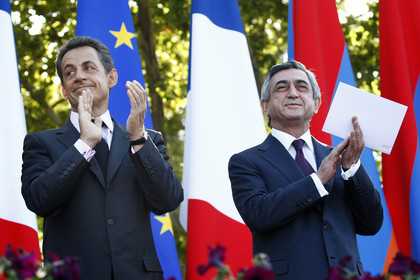
    AP Photo/PanARMENIAN, Tigran MehrabyanFrench President Nicolas Sarkozy, left, and Armenian President Serge Sarkisian applaud at the French Square, in Yerevan, Armenia, Friday, Oct. 7, 2011. Sarkozy has urged Turkey to recognize the 1915 massacre of Armenians by Ottoman Turks as genocide. Sarkozy said Friday during a news conference in the Armenian capital that Turkey's refusal to do so would force France to change its law and make such denial a criminal offense.YEREVAN, Armenia (AP) — French President Nicolas Sarkozy has urged Turkey to recognize the 1915 massacre of Armenians by Ottoman Turks as genocide.Sarkozy told Friday's news conference in the Armenian capital
    AP Photo/PanARMENIAN, Tigran MehrabyanFrench President Nicolas Sarkozy, left, and Armenian President Serge Sarkisian applaud at the French Square, in Yerevan, Armenia, Friday, Oct. 7, 2011. Sarkozy has urged Turkey to recognize the 1915 massacre of Armenians by Ottoman Turks as genocide. Sarkozy said Friday during a news conference in the Armenian capital that Turkey's refusal to do so would force France to change its law and make such denial a criminal offense.YEREVAN, Armenia (AP) — French President Nicolas Sarkozy has urged Turkey to recognize the 1915 massacre of Armenians by Ottoman Turks as genocide.Sarkozy told Friday's news conference in the Armenian capital

    Sarkozy told Friday’s news conference in the Armenian capital that Turkey’s refusal to do so would force France to change its law and make such denial a criminal offense.

    via France Urges Turkey to Recognize Armenian Genocide.

    www.thenationalherald.com/article/52150