Category: Regions

  • Financial Giants Put New York City Cops On Their Payroll

    Financial Giants Put New York City Cops On Their Payroll

    Who Do the White Shirt Police Report to at Occupy Wall Street Protests?
    by PAM MARTENS

    Videos are springing up across the internet showing uniformed members of the New York Police Department in white shirts (as opposed to the typical NYPD blue uniforms) pepper spraying and brutalizing peaceful, nonthreatening protestors attempting to take part in the Occupy Wall Street marches.  Corporate media are reporting that these white shirts are police supervisors as opposed to rank and file.  Recently discovered documents suggest something else may be at work.

    If you’re a Wall Street behemoth, there are endless opportunities to privatize profits and socialize losses beyond collecting trillions of dollars in bailouts from taxpayers.  One of the ingenious methods that has remained below the public’s radar was started by the Rudy Giuliani administration in New York City in 1998.  It’s called the Paid Detail Unit and it allows the New York Stock Exchange and Wall Street corporations, including those repeatedly charged with crimes, to order up a flank of New York’s finest with the ease of dialing the deli for a pastrami on rye.

    The corporations pay an average of $37 an hour (no medical, no pension benefit, no overtime pay) for a member of the NYPD, with gun, handcuffs and the ability to arrest.  The officer is indemnified by the taxpayer, not the corporation.

    New York City gets a 10 percent administrative fee on top of the $37 per hour paid to the police.  The City’s 2011 budget called for $1,184,000 in Paid Detail fees, meaning private corporations were paying  wages of $11.8 million to police participating in the Paid Detail Unit.  The program has more than doubled in revenue to the city since 2002.

    The taxpayer has paid for the training of the rent-a-cop, his uniform and gun, and will pick up the legal tab for lawsuits stemming from the police personnel following illegal instructions from its corporate master.  Lawsuits have already sprung up from the program.

    When the program was first rolled out, one insightful member of the NYPD posted the following on a forum: “… regarding the officer working for, and being paid by, some of the richest people and organizations in the City, if not the world, enforcing the mandates of the private employer, and in effect, allowing the officer to become the Praetorian Guard of the elite of the City. And now corruption is no longer a problem. Who are they kidding?”

    Just this year, the Department of Justice revealed serious problems with the Paid Detail unit of the New Orleans Police Department.  Now corruption probes are snowballing at NOPD, revealing cash payments to police in the Paid Detail and members of the department setting up limited liability corporations to run upwards of $250,000 in Paid Detail work billed to the city.

    When the infamously mismanaged Wall Street firm, Lehman Brothers, collapsed on September 15, 2008, its bankruptcy filings in 2009 showed it owed money to 21 members of the NYPD’s Paid Detail Unit.  (A phone call and email request to the NYPD for information on which Wall Street firms participate in the program were not responded to.  The police unions appear to have only scant information about the program.)

    Other Wall Street firms that are known to have used the Paid Detail include Goldman Sachs, the World Financial Center complex which houses financial firms, and the New York Stock Exchange.

    The New York Stock Exchange is the building in front of which the Occupy Wall Street protesters have unsuccessfully tried to protest, being herded behind metal barricades, clubbed with night sticks, kicked in the face and carted off to jail rather than permit the last plantation in America to be defiled with citizen chants and posters.  (A sample of those politically inconvenient posters and chants: “The corrupt are afraid of us; the honest support us; the heroic join us”; “Tell me what democracy looks like, this is what democracy looks like”; “I’ll believe a corporation is a person when Texas executes one.” The last sign refers to the 2010 U.S. Supreme Court decision, Citizens United v. Federal Election Commission, giving corporations First Amendment personhood, which allows them to spend unlimited amounts of money in elections.)

    On September 8, 2004, Robert Britz, then President and Co-Chief Operating Officer of the New York Stock Exchange, testified as follows to the U.S. House Committee on Financial Services:

     “…we have implemented new hiring standards requiring former law enforcement or military backgrounds for the security staff…We have established a 24-hour NYPD Paid Detail monitoring the perimeter of the data centers…We have implemented traffic control and vehicle screening at the checkpoints. We have installed fixed protective planters and movable vehicle barriers.”

    Military backgrounds; paid NYPD 24-7; checkpoints; vehicle barriers?  It might be insightful to recall that the New York Stock Exchange originally traded stocks with a handshake under a Buttonwood tree in the open air on Wall Street.

    In his testimony, the NYSE executive Britz states that “we” did this or that while describing functions that clearly belong to the City of New York.  The New York Stock Exchange at that time had not yet gone public and was owned by those who had purchased seats on the exchange – primarily, the largest firms on Wall Street.   Did the NYSE simply give itself police powers to barricade streets and set up checkpoints with rented cops?  How about clubbing protesters on the sidewalk?

    Just six months before NYSE executive Britz’ testimony to a congressional committee, his organization was being sued in the Supreme Court of New York County for illegally taking over public streets with no authority to do so. This action had crippled the business of a parking garage, Wall Street Garage Parking Corp., the plaintiff in the case.  Judge Walter  Tolub said in his opinion that

    “…a private entity, the New York Stock Exchange, has assumed responsibility for the patrol and maintenance of truck blockades located at seven intersections surrounding the NYSE…no formal authority appears to have been given to the NYSE to maintain these blockades and/or conduct security searches at these checkpoints…the closure of these intersections by the NYSE is tantamount to a public nuisance…The NYSE has yet to provide this court with any evidence of an agreement giving them the authority to maintain the security perimeter and/or conduct the searches that their private security force conducts daily.  As such, the NYSE’s actions are unlawful and may be enjoined as they violate plaintiff’s civil rights as a private citizen.”

    The case was appealed, the ruling overturned, and sent back to the same Judge who had no choice but to dismiss the case on the appellate ruling that the plaintiff had suffered no greater harm than the community at large.  Does everyone in lower Manhattan own a parking garage that is losing its customer base because the roads are blocked to the garage?

    Some believe that Wall Street is given special privileges and protection because New York City’s Mayor Michael Bloomberg owes his $18.1 billion in wealth (yes, he’s that 1 percent the 99 percent are protesting) to Wall Street.  The Mayor was previously a trader for Salomon Brothers, the investment bank made famous for attempting to rig the U.S. Treasury market in two-year notes.

    The Mayor’s business empire which bears his name, includes the awesome Bloomberg terminal, a computer that houses enormous pricing data for stocks and bonds, research, news, charting functions and much more.  There are currently an estimated 290,000 of these terminals on Wall Street trading floors around the globe, generating approximately $1500 in rental fees per terminal per month.  That’s a cool $435 million a month or $5.2 billion a year, the cash cow of the Bloomberg businesses.

    The Bloomberg businesses are run independently from the Mayor but he certainly knows that his terminal is a core component of his wealth.  Nonetheless, the Mayor is not Wall Street’s patsy.  Bloomberg Publishing is frequently in the forefront of exposing fraud on Wall Street such as the 2001 tome “The Pied Pipers of Wall Street” by Benjamin Mark Cole,  which exposed the practice of releasing fraudulent stock research to the public.  Bloomberg News was responsible for court action that forced the Federal Reserve to release the details of what it did with trillions of dollars in taxpayer bailouts to Wall Street firms, hedge funds and foreign banks.

    Police Commissioner Ray Kelly may also have a soft spot for Wall Street.  He was formerly Senior Managing Director of Global Corporate Security at Bear, Stearns & Co. Inc., the Wall Street firm that collapsed into the arms of JPMorgan in March of 2008.

    There has also been a bizarre revolving door between the Wall Street millionaires and the NYPD at times.  One of the most puzzling career moves was made by Stephen L. Hammerman.  He left a hefty compensation package as Vice Chairman of Merrill Lynch & Co. in 2002 to work as Deputy Commissioner of Legal Matters for the NYPD from 2002 to 2004.  That move had everyone on Wall Street scratching their head at the time.  Merrill collapsed into the arms of Bank of America on September 15, 2008, the same date that Lehman went under.

    Wall Street is not the only sector renting cops in Manhattan.  Department stores, parks, commercial banks and landmarks like Rockefeller Center, Jacob Javits Center and St. Patrick’s Cathedral have also participated in the Paid Detail Unit, according to insiders.  But Wall Street is the only sector that runs a private justice system where its crimes are herded off to secret arbitration tribunals, has sucked on the public teat to the tune of trillions of dollars, escaped prosecution for the financial collapse, and can put an armed municipal force on the sidewalk to intimidate public protestors seeking a realignment of their democracy.

    We may be learning a lot more in the future about the tactics Wall Street and the NYPD have deployed against the Occupy Wall Street protestors.  The highly regarded Partnership for Civil Justice Fund has filed a class action lawsuit over the approximately 700 arrests made on the Brooklyn Bridge on October 1.  The formal complaint and related information is  available at the organization’s web site, www.JusticeOnLine.org.

    The organization was founded by Carl Messineo and Mara Verheyden-Hilliard.  The Washington Post has called them “the constitutional sheriffs for a new protest generation.”

    The suit names Mayor Bloomberg, Police Commissioner Kelly, the City of New York, 30 unnamed members of the NYPD, and, provocatively, 10 unnamed law enforcement officers not employed by the NYPD.

    The lawsuit lays out  dwhat has been curtailing the constitutional rights of protestors for a very long time in New York City.

    “As seen in the movements for social change in the Middle East and Europe, all movements for social justice, jobs, and democracy need room to breathe and grow and it is imperative that there be a halt to law enforcement actions used to shut down mass assembly and free expression of the people seeking to redress grievances…

    “After escorting and leading a group of demonstrators and others well out onto the Brooklyn Bridge roadway, the NYPD suddenly and without warning curtailed further forward movement, blocked the ability of persons to leave the Bridge from the rear, and arrested hundreds of protestors in the absence of probable cause.  This was a form of entrapment, both illegal and physical.

    “That the trap and detain mass arrest was a command-level-driven intentional and calculated police operation is evidenced by the fact that the law enforcement officials who led the demonstration across the bridge were command officials, known as ‘white shirts.’ ”

    In April 2001, I was arrested and incarcerated by the NYPD while peacefully handing out flyers on a public sidewalk outside of the Citigroup shareholders meeting – flyers that warned of growing corruption inside the company. (The unlawful merger of Travelers Group and Citibank created Citigroup and resulted in the repeal of the Glass-Steagall Act, the depression era investor protection legislation that barred depositor banks from merging with high-risk Wall Street firms.  Many of us from social justice groups in New York City had protested against the repeal but were out maneuvered by Wall Street’s political pawns in Washington.)

    Out of a group of about two dozen protestors from the National Organization for Women in New York City, Rain Forest Action Network, and Inner City Press, I was the only person arrested.  There was no civil disobedience occurring.  Rain Forest Action Network was handing out fortune cookies with prescient warnings about Citigroup and urging pedestrians to cut up their Citibank credit cards.  The rest of us were peacefully handing out flyers.

    Chained to a metal bar inside the police precinct, I was grilled on any crimes I might know about.  I responded that the only crimes I knew about were listed on the flyer and apparently, in New York City, one gets arrested for disclosing crimes by Wall Street firms.

    A mysterious, mature, white shirted inspector who ordered my arrest on the sidewalk, and refused to give his first name, disappeared from the police report when it was filed, blaming the arrest instead on a young police officer.  Citigroup is only alive today because the Federal government inserted a feeding tube into Citigroup and infused over $2 trillion in loans, direct investment and guarantees as the company veered toward collapse.

    The NYPD at the time of my arrest was run by Bernard Kerik – the man President George W. Bush later sent to Iraq to be the interim Interior Minister and train Iraqi police.  The President subsequently nominated Kerik to head the Department of Homeland Security for the entire nation.  The nation was spared of that eventuality only because of an illegal nanny popping up.  Today, Kerik is serving a four year sentence in Federal prison for a variety of criminal acts.

    The New York Civil Liberties Union filed a Federal lawsuit on my behalf  (Martens v. Giuliani) and we learned that the NYPD had arbitrarily established a policy to arrest and hold for 72 hours any person protesting in a group of 20 or more.   The case was settled for a modest monetary award and the repeal by the NYPD of this unconstitutional and despicable practice.

    Pam Martens worked on Wall Street for 21 years. She spent the last decade of her career advocating against Wall Street’s private justice system, which keeps its crimes shielded from public courtrooms.  She has been writing on public interest issues for CounterPunch since retiring in 2006.   She has no security position, long or short, in any company mentioned in this article.  She can be reached at [email protected] 

    www.counterpunch.org, OCTOBER 10, 2011
  • Iraqi foreign minister set to visit Turkey

    Iraqi foreign minister set to visit Turkey

    Iraqi foreign minister set to visit Turkey

    (AFP)

    11 October 2011

    ANKARA — Iraqi Foreign Minister Hoshyar Zebari will visit Turkey on Wednesday for talks on stopping recent surging attacks by Kurdish rebels which have prompting Ankara to consider a land operation, a senior Turkish diplomat said.

    “The Iraqi foreign minister will be in Turkey on Wednesday and Thursday upon our invitation as part of a working visit,” the diplomat told AFP speaking on condition of anonymity.

    “The fight against terrorism will figure high on the agenda of the talks,” he added.

    Turkey’s parliament extended on October 5 the government’s mandate to order military strikes against Kurdish rebels holed up in neighboring Iraq.

    A surge of attacks by the outlawed Kurdistan Workers’ Party (PKK) also targeting civilians are piling pressure on Ankara, which has threatened to launch an incursion into northern Iraq by its land forces to root out rebel bases.

    Turkey repeatedly calls on the Iraqi government not to allow its territory to be used as a springboard by the PKK for attacks in Turkey, and if not threatens to continue strikes.

    Turkish warplanes have bombed rebel bases in northern Iraq several times since August, killing between 145 and 160 rebels, according to the general staff.

    The air strikes have threathened relations with neighbouring Iraq, which summoned Turkey’s ambassador in August to demand an immediate end to the attacks after it was alleged that Turkish bombings killed civillians.

    Turkey rejected the allegations.

    Zebari, a Kurd himself, is expected to hold a press conference with his Turkish counterpart, Ahmet Davutoglu.

    The situation at a UN-run camp at Makhmour in the north of Iraq is expected to be on the agenda of the meetings with Zebari, said the diplomat.

    Turkey has long been pressing for the closure of Makhmour, charging that the camp is controlled by the PKK and serves as a supply base of fresh militants to the organization.

    “This is an issue which is always on our agenda,” said the diplomat.

    Zebari is also expected to attend the inauguration of the Iraqi consulate in Gaziantep province, near the Syrian border.

    The PKK, listed as a terrorist group by Ankara and much of the international community, took up arms in Kurdish-majority southeast Turkey in 1984, sparking a conflict that has claimed about 45,000 lives.

    via Iraqi foreign minister set to visit Turkey.

  • Turkish Prime Minister Erdogan poses challenge for Obama

    Turkish Prime Minister Erdogan poses challenge for Obama

    Many advisors to the president see Erdogan’s government as a possible model for others in the Middle East. But the Turkish premier’s feud with Israel and a tendency to make threats are problematic.

    By Paul Richter, Los Angeles TimesOctober 10, 2011, 8:41 p.m.

    Reporting from Washington—
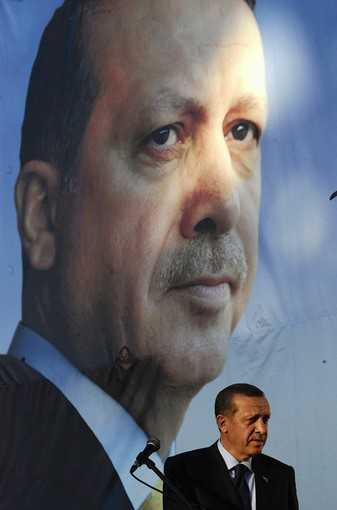
    Turkish Prime Minister Recep Tayyip Erdogan speaks under a portrait of himself in Gostivar, Macedonia. (Ognen Teofilovski, Reuters / October 11, 2011)
    Turkish Prime Minister Recep Tayyip Erdogan speaks under a portrait of himself in Gostivar, Macedonia. (Ognen Teofilovski, Reuters / October 11, 2011)

    In the space of a few weeks this summer, Turkish Prime Minister Recep Tayyip Erdogan slammed President Obama’s approach to Mideast peacemaking, threatened to block U.S. business from drilling for oil and gas in the Mediterranean, and warned he might mobilize Turkish warships to protect activists sailing to Gaza against America’s chief regional ally, Israel.

    Yet when Obama met Erdogan on the sidelines of the United Nations General Assembly meeting last month, he once again gave him more face time than any other world leader. Erdogan, Obama declared as the two headed to a 105-minute meeting, “has shown great leadership.”

    The attention lavished on the leader of Turkey reflects the importance of the moderate Muslim power to an administration seeking to retain influence in a turbulent part of the world. Many Obama advisors see Erdogan’s government, with its pro-business bent and tolerance for secular expression, as a possible model for others in the Middle East. The president has logged more phone calls to Erdogan than to any world leader except British Prime Minister David Cameron.

    Yet Erdogan’s mercurial temperament and propensity for rhetorical threats makes dealing with him an awkward challenge.

    U.S. officials praise Turkey for its help in organizing a new government in Libya, isolating a brutal Syrian regime at war with domestic opponents, and cooperating on a Western missile defense system to contain a potential threat from Iran. But they have been distressed by the way Turkey has recently feuded with Israel, squabbled with neighbors and the European Union, and called out its navy to defend its energy claims in the Mediterranean.

    “They’ve been lighting matches around kindling that is pretty dry,” said a U.S. diplomat in the region.

    Obama has used virtually every diplomatic tactic available to deal with a partner he considers indispensable but doesn’t always understand. He has tried sweeteners, such as drone aircraft to spy on Kurdish militants. And he has resorted to flattery: He phoned Erdogan last year to rave about a Turkish basketball tournament.

    But at other times he has felt compelled to be blunt, such as when he complained in a two-hour meeting with Erdogan last year about Turkey’s vote against proposed United Nations sanctions on Iran.

    Adding to the friction, Turkey’s conflict with Israel and other moves have begun to mobilize opposition in the U.S.

    A bipartisan group of seven senators, including Charles E. Schumer (D-N.Y.), No. 3 in the Democratic Senate leadership, wrote Obama to demand a U.S. response to Turkish moves that “call into question its commitment to the NATO alliance, threaten regional stability and undermine U.S. interests.” U.S. officials have warned the Turks that Congress could try to block access to weapons it badly wants.

    Eric Edelman, U.S. ambassador to Turkey from 2003 to 2005, says he has been shocked to see Obama cajoling a nation that has been working against key U.S. diplomatic goals.

    Erdogan “gave them a poke in the eye — and he got a [long] meeting,” Edelman said.

    Erdogan has led Turkey since 2002 as head of the Justice and Development Party, which is rooted in Islam. Backed by a roaring economy, he has set vaulting ambitions to expand Turkey’s leadership of the Arab world, and strengthen economic and political ties to the East, even while preserving the nation’s valuable security relationship with the U.S.

    But these goals often work against one another. Turkey’s ties to the U.S. have been strained by its feud with Israel, which has sent the Obama administration into an unsuccessful scramble to make peace between two U.S. allies who used to be friends.

    U.S. officials understand that Erdogan remains bitter about Israel’s May 2010 commando attack on a flotilla organized by activists in Turkey to bring aid to the Gaza Strip, which is under blockade by Israel. Eight Turks and a Turkish American died in the attack. Erdogan threatened recently to dispatch Turkish warships if Israel threatened any Turkish ships headed to Gaza.

    But it is harder for U.S. officials to accept the way Erdogan has escalated his conditions for normalizing relations with Israel, now demanding an end to the blockade of Gaza as well as a formal apology for the deaths of the Turkish citizens. U.S. officials are nervous about what they see as a populist campaign to build an international reputation on the back of anti-Israel rhetoric.

    Already considered the most popular politician in the Arab world, Erdogan thrilled crowds last month during a trip to Egypt, Tunisia and Libya when he complained that Israel was “the West’s spoiled child.”

    He campaigned to round up votes in the U.N. Security Council for official recognition of Palestine as a full U.N. member state, a move the U.S. was trying desperately to block. As American diplomats buttonholed officials at the U.N. last month to urge them to vote no, Turkish officials were meeting with some of the same countries nearby to pressure them to do the opposite.

    Erdogan made it known that in his meeting with Obama, he told the president that Obama’s signature peacemaking initiative had failed, and pointedly read to the president portions of the 2010 speech in which Obama had declared there would be a Palestinian state within a year.

    Turkey’s booming 9% growth rate has been a source of its growing influence, and the government has worked hard to preserve it, though it has led to regular collisions with neighbors and world powers. Turkey has taken advantage of the economic weakness of such neighbors as Iraq and Syria, and has opened trade with Eastern neighbors including Iran.

    In recent days, Turkey’s claims over disputed oil and gas fields in the Mediterranean have led to a flare-up with Washington, as well as with Cyprus, Israel and Greece, which are among several countries with claims on energy deposits in the sea.

    Turkey has demanded that Cyprus halt plans to have a U.S. energy company drill for gas in waters claimed by Cyprus. Turkey said the drilling threatened a U.N. effort to reunify Cyprus, which is divided between ethnic Greek and Turkish enclaves, and Ankara has sent warships into the zone.

    Administration officials, led by Secretary of State Hillary Rodham Clinton, have rushed to the defense of the U.S. firm, Noble Energy, that is to conduct the drilling, and have told the Turks that they view the Turkish move as a threat to American business interests.

    Cyprus has also been a source of conflict with the European Union. Erdogan said Turkey would break off talks on accession to the union if Cyprus was given the rotating presidency, as is planned.

    Turkey has been caught between its desires to remain a member in good standing of the North Atlantic Treaty Organization and to strengthen its economic and political ties to Iran.

    It balked for months at NATO’s request to accept a defense radar on its territory for a system aimed at blocking the missile threat from Iran. Last month it agreed to accept a U.S.-built site, to the delight of U.S. officials.

    But that came only after NATO officials made it clear, said one alliance official, that “if we didn’t put it there, we’d just put it in another country nearby.” Turkish officials continue to publicly insist that data from the radar won’t be provided to Israel — though U.S. officials say it will.

    U.S. officials praise Turkey’s cooperation in helping organize a new order in Libya with the ouster of Moammar Kadafi’s government. But Turkey initially fought proposals for NATO intervention, in part because of worries about Turkey’s $15-billion investment in Kadafi’s state, and the 25,000 Turks then working there.

    Turkey has become outspoken in its opposition to Syrian President Bashar Assad’s violent crackdown on antigovernment demonstrators, after begging Obama in July to delay calling for Assad to step down.

    But though Erdogan has denounced Assad’s crackdown as “savage,” he has tried to avoid disrupting Turkey’s valuable trade and investment ties to Syria. Turkey is expected to soon impose a round of economic sanctions on Syria, but analysts predict they won’t go as far as the White House would prefer.

    U.S. officials say they stay in close touch with Turkey, in part to avoid surprises. Last year, for example, Pentagon officials were alarmed to learn that Turkey had conducted military exercises with China, with no advance notice, raising questions about its plans with NATO.

    There is consensus among Western diplomats and regional specialists about the value of Obama’s efforts to help expand Turkey’s regional role and anchor it to the West, especially at a time when Turkey’s chances for joining the European Union appear to have faded. Yet the ties may be somewhat short of the “model partnership” that Obama and Erdogan refer to.

    Henri Barkey, a Turkey expert and former State Department official, says that although U.S. officials have gotten some of the commitments they most wanted from Turkey this year, others, such as restoration of its former strong relationship with Israel, may be out of reach.

    “They won’t convince Turkey not to lead an anti-Israel bloc in the Middle East,” said Barkey, now with Lehigh University. “Not going to happen.”

    [email protected]

  • Arab Spring Sees Turkish-Iranian Rivalry Take a New Turn

    Arab Spring Sees Turkish-Iranian Rivalry Take a New Turn

    Arab Spring Sees Turkish-Iranian Rivalry Take a New Turn

    Publication: Eurasia Daily Monitor Volume: 8 Issue: 186

    October 11, 2011

    By: Saban Kardas

    Turkey’s decision to host a NATO early warning radar in the US-led missile defense program continues to reverberate, especially for its relations with Iran. High ranking Iranian officials repeatedly criticize not only Turkey’s cooperation with the United States on the missile shield, but also Ankara’s recent foreign policy initiatives. These include the Turkish government’s efforts to set a model for the transformation of the regional countries in the wake of the Arab Spring, Ankara advocating a two-state solution for the Palestinian problem, or its increasingly assertive position on Syria.

    The decision on radar deployment apparently was a tipping point for Iranian officials, who now vocally criticize Turkey on a myriad of issues (EDM, September 20). Iranian President Mahmoud Ahmadinejad said during a live TV interview that Iranian officials told their Turkish counterparts it was wrong to grant such permission and it would not benefit Turkey , October 5). Major-General Yahya Rahim-Safavi, the military advisor to the Iranian supreme religious leader Ayatollah Ali Khamenei, also maintained that Turkey had recently committed various strategic mistakes and would pay a heavy price if it failed to change course (Hurriyet, October 9). The Deputy Head of Iran’s Armed Forces’ Joint Chiefs of Staff Brigadier-General Massoud Jazayeri joined the wave of protest and urged Turkey to rethink its long-term strategic interests and side with Muslim nations instead of the West (www.presstv.ir, October 10).

    Iranian officials criticize Turkey on a range of issues of substantial importance. First, Iranian leaders increasingly label the missile shield as a project that is designed to boost Israel’s security against a counter-attack from Iran in case Israel strikes Iran’s nuclear facilities. However, considering that Turkish Foreign Minister Ahmet Davutoglu and Prime Minister Recep Tayyip Erdogan repeatedly rebuff such claims, which were also raised by Turkish opposition parties, it appears that the Iranian campaign is driven by a concern to discredit Turkey in the eyes of regional countries.

    In order to contextualize Iran’s accusations against Turkey, it might be useful to recall Erdogan’s recent criticism of Israel’s nuclear program. As late as last week, Erdogan continued his recent criticism of Israel, going as far as arguing that he saw Israel as a threat to the region and surrounding countries, because it possessed the atomic bomb. Moreover, Erdogan raised a related criticism, when he pointed to the double standards of world powers: while Iran came under international scrutiny because of its nuclear program, there had been a lack of comparable debate on Israel’s nuclear weapons (Anadolu Ajansi, October 5). Iranian officials’ lambasting of Turkey through manipulative accounts, despite Erdogan’s staunch position on Israel at the expense of harming relations with the West, reveals their intent and approach toward Turkey.

    Iranian officials have recently expressed differences of opinion on the Palestine issue. Erdogan’s stance on Israel’s treatment of Palestinians has not necessarily contributed to forging common ground with Iran. Erdogan devoted a large portion of his address at the UN General Assembly last month to the rights of the Palestinians, supporting their bid for recognition. While Turkey has invested a great deal of political capital advocating a two-state solution in international venues, Khamenei, in a recent address at an international conference on the Palestinian Intifada, labeled this formula as tantamount to capitulation to the demands of “Zionists.” Rejecting the Palestinians’ bid for statehood at the UN, Khamenei argued that any solution based on the recognition of Israel’s right of existence would threaten the stability and security of the Middle East. Describing Iran as the greatest defender of the Palestinians, Khamenei criticized other regional powers that maintain close relations with Washington , October 1).

    Moreover, Turkish-Iranian divergence exists in an undeclared rivalry for regional leadership over the Arab Spring. For some time this rivalry was only evident in the realm of speculation by analysts. While Iran has been working to put its imprint on the regional transformation, by labeling the popular uprisings as an “Islamic awakening,” Turkish government sources or analysts close to the government have highlighted how Turkey’s democratic and capitalist model inspired the Arab revolutions. Perhaps in the first ever direct affirmation of this rivalry, Rahim-Safavi criticized Erdogan’s recent visit to the region. In Cairo, Erdogan stressed a secular-democratic form of government, which seems to have angered the Iranian leadership, sparking their more direct confrontation with Turkey.

    A related area of tension is over competing positions on the Syrian uprising. Faced with the continuation of the Baath regime’s violent campaign to suppress the popular uprising, Turkey has progressively downgraded its ties with Damascus, as well as providing shelter to the Syrian opposition. Turkey’s imposition of sanctions might also negatively affect Damascus’s direct ties to Tehran. Iran, viewing the maintenance of the current regime in Syria as vital to its penetration to Lebanon and Palestine, has grown anxious over Turkey’s policy on Syria, again reflected in Rahim-Safavi’s reactions.

    Some common themes are emerging in Iranian views on Turkey. First, there is a continuous and sustained reaction to Turkey, and it is worth noting that the mounting criticism of the country came from the religious leadership and the Revolutionary Guards. Second, Iranian officials work hard to present Ankara’s recent foreign policy initiatives as simply following the dictates of the US, in order to sustain their oft-repeated argument that they are the only genuine independent power in the region.

    Finally, there is a deliberate attempt to discipline Turkey by sending harsh messages as to how the country should behave. It is unclear whether this rhetoric reflects self-confidence on the part of the Iranian leadership or anxiety over Turkey taking an anti-Iranian position and siding with the US, which might lead to Iran’s isolation in the region. The Iranian side appears ready to exploit economic ties if necessary, in an effort to discipline Turkey. They daringly refer to Turkey’s gas purchase contracts with Iran as well as Ankara’s plans to boost the bilateral trade volume to $20 billion, going as far as sending veiled threats that Ankara might suffer if it fails to reverse its current position and accommodate Iranian concerns.

    https://jamestown.org/program/arab-spring-sees-turkish-iranian-rivalry-take-a-new-turn/


  • Turkish immigrants sue Dutch over integration policy

    Turkish immigrants sue Dutch over integration policy

    By Anna Holligan BBC News, The Netherlands

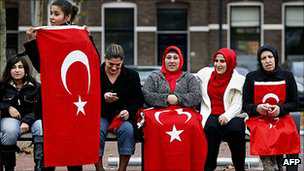
    Turks make up a significant immigrant community in the Netherlands
    Turks make up a significant immigrant community in the Netherlands

    The Dutch government is facing a huge compensation claim after forcing Turkish immigrants to pay for integration courses.

    A campaign group says 30,000 Turks took the courses, which have since been ruled to be in violation of an agreement between the EU and Turkey.

    The interior ministry says most of them are not entitled to their money back.

    But the Foundation for Victims of Integration is suing to reclaim their costs, of more than 100m euros (£87m).

    The courses were introduced under the 2007 Civic Integration Act and meant that anyone who wished to emigrate to the Netherlands had to pass an exam first.

    However, two months ago the Dutch Interior Minister, Piet Hein Donner, was forced to cancel the courses after the Netherlands Court of Appeals ruled they were in violation of an agreement between Turkey and the European Union which stipulates there can be no discrimination between Turkish and EU citizens.

    The association agreement was designed to strengthen relations between Turkey and the EU.

    Anyone who sat the exams after 16 August 2011 will be entitled to a refund.

    But, speaking in parliament on Tuesday, a spokesperson for the interior minister said that: “The costs incurred by the Turkish people before that date were legitimate. Therefore those people who sat the exam before that date are not entitled to get their money back.”

    The individual claims range from 1,000 to 5,000 euros for costs including travel, study expenses and exam fees.

    Bilal Coskun, the lawyer representing the Turkish claimants, told the BBC: “This old law kept families apart. People had to stay in Turkey until they had passed the exam, some husbands didn’t see their wives for years.

    “Our people suffered under the rule of the old integration policy – not just financially but emotionally too – and they are entitled to compensation for this.”

    Mr Coskun says they are hoping to agree on a settlement before the case reaches court. But, on Tuesday, the government rejected that option saying: “The Turkish people are free to go to court and we will wait until the judges verdict.”

    via BBC News – Turkish immigrants sue Dutch over integration policy.

  • London 2012 Olympics opens Technology Operations Centre

    London 2012 Olympics opens Technology Operations Centre

    The IT powering the London 2012 Olympics and Paralympics has passed a major milestone with the formal opening of the Technology Operations Centre (TOC) at the Games’ headquarters in Canary Wharf.

    The TOC will provide central monitoring and control for all the IT systems and telecoms supporting the Games, with 450 staff from the London Organising Committee’s IT team and key partners working around the clock, with up to 180 workers overseeing operations at any time.

    The TOC is the “key control centre to make sure everything is going as we wish,” according to London 2012 chief executive Paul Deighton.

    The centre has been tested during the London Prepares series of sporting event designed to make sure all the venues and supporting technology are working as planned. During 79 days of competition so far, testing covered the set-up and take-down of 180 servers, 1,160 PCs and laptops, 190 network and security devices and more than 400 printers and copiers.

    “Basically, things are performing as expected. We are where we need to be,” said London 2012 CIO Gerry Pennell.

    A total of 200,000 hours of testing will be completed by summer 2012, with two “technical rehearsals” coming up in March and May to simulate “hundreds of scenarios,” said Pennell, including challenges such as cyber security and physical attacks on IT equipment.

    During the Games, the TOC will oversee critical applications such as the Commentator Information System and the organisers’ intranet, as well as monitoring 900 servers, 1,000 network and security devices and 9,500 PCs. In total over 5,000 technology staff – including 2,500 volunteers – will be involved in the Olympics IT.

    “The TOC is the decision-making centre for technology during the Games,” said Michele Hyron, chief integrator for London 2012 at Atos, worldwide IT partners for the Olympics. Other IT suppliers involved include BT, Cisco, Acer and Samsung.

    Deighton added, Technology often goes unnoticed and yet is absolutely critical to our success in 2012. The Games cannot happen without technology.”

    One of the new challenges for the London 2012 Games will be the amount of data generated from the results systems – 30% more than in the Beijing Olympics – providing real-time information to fans, commentators and broadcasters around the world.

    “There are a number of familiar things from previous Games, but a number have moved along,” said Pennell, including “significantly enhanced” access to information from the public.

    In anticipation of huge demand from event visitors using mobile devices, Pennell is working with BT and mobile network operators to ensure sufficient network capacity, including plans for an open Wi-Fi service for the Olympic Park in Stratford.

    “We have worked very closely with BT and the mobile network operators to make sure there is enough infrastructure to provide a good level of [mobile] service during the Games,” said Pennell.

    “But there will always be moments in any sporting event when demand is so huge that not everybody can get access.”

    The IT team is also working on mobile apps for delivering event results and spectator information for fans at venues.

    Computer Weekly