Turkey and Iraq have agreed to open two new border crossings to boost trade and accommodate increasing traffic between the two neighbors, according to a report from Today’s Zaman.
The issue was discussed during a two-day visit by Iraqi Foreign Affairs Minister Hoshyar Zebari to Ankara on Wednesday. The formal agreement for the opening of the first border gate is expected to be signed towards the end of the year, and it should be in operation by the end of 2012.
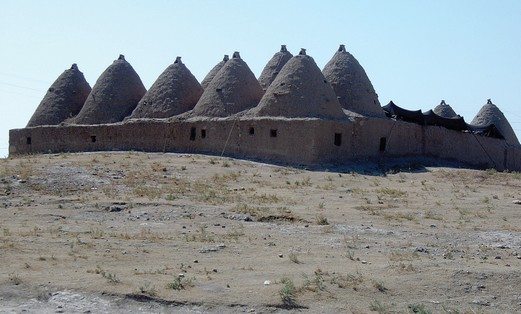
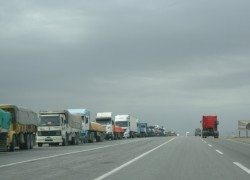
It will be located in the Aktepe-Bacuka region to the west of the Harbur [Habur, Ibrahim al-Khalil, Zakho] border gate (pictured), which is currently the only crossing between the two countries.
The second border post is planned for the southeastern province of Şırnak’s Ovaköy district, and its opening will be coordinated with the development of the Turkey-Iraq railway project. Both trains and cars would be able to use the new crossing. Technical delegations from both sides will meet in November to work out the details of both crossings.
Iraq is the second largest importer of goods from Turkey, with exports to Iraq increasing by 25 percent over the same period last year.
Turkish businesses have also expanded their presence in Iraq, exporting $6 billion worth of good to Iraq in 2010, with the volume expected to increase to $20 billion in 2013.
(Source: Today’s Zaman)
via Iraq and Turkey to Open New Border Crossings | Iraq Business News.
Turkey to grant identification card for German Turks who lost citizenship
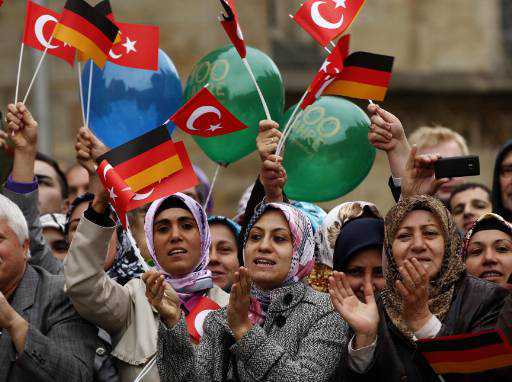
Turkish government is poised to make legal arrangements that would allow Turks living abroad to vote in their country of residence, Turkish Deputy Premier Bekir Bozdag has said.
Turkish government is poised to make legal arrangements that would allow Turks living abroad to vote in their country of residence, Turkish Deputy Premier Bekir Bozdag has said.
The government’s move is aimed at securing expat voting for as many as two million Turkish voters who were unable to go to polls in last June’s general elections because of a veto from Turkey’s elections supervision authority.
“Our initial efforts for expatriate Turks in the June 12 elections were taken aback by the Supreme Board of Elections, which I believe made a mistake in making that decision. We have prepared a bill which is now circulated. And we will submit the bill to the parliament in the shortest possible time,” Bozdag told the Anadolu Agency.
Bozdag said separate voter registers would be prepared for expat Turks to cast their votes in Turkish diplomatic missions, adding that new consulates could be opened to that end.
Bozdag also said the Turkish government was working on a separate bill to issue a special identification card which would preserve rights of those who gave up Turkish citizenship to win German nationality in their formal procedures in Turkey.
Antakya, Turkey (CNN) — It didn’t take long for Ali Jadour to explain why he fled his homeland.
The 22-year-old man pointed to his empty shirt sleeve, where his right arm was amputated above the elbow. Then he lifted his shirt to show the dark scars left by bullets that had penetrated his stomach and back when Syrian security forces opened fire last May at an anti-government protest in Idlib province.
“They shot at us from helicopters,” Jadour said. “I was asking for freedom and democracy, nothing else.”
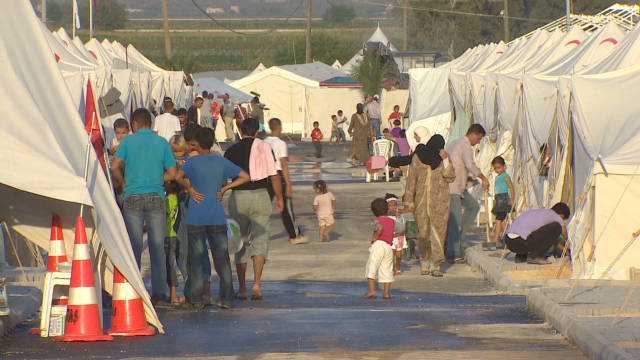
Jadour is one of thousands of Syrian refugees living in a network of Turkish government-run camps along the border between the two countries. Most of the refugees have been here for months.
The conditions at the Boynuyogun camp were relatively good, as far as refugee camps go. During a recent visit, the Turks were providing residents with free food, donated clothing and medical care. The government also offered Arabic-language school for the children, who played on jungle gyms and tried to help their parents sweep the freshly laid asphalt outside their tents.
But the presence of such tent cities, often located within sight of the Syrian border, is a powerful reminder that a significant segment of Syrian society still lives in dire fear of its own government. The Turkish government says more than 7,500 Syrian refugees reside in camps.
Harder to quantify is the growing number of unregistered Syrian refugees who have fled across porous borders to Turkey, Jordan and Lebanon after fleeing a crackdown that has claimed more than 2,900 lives, according to the United Nations.
They include men like Mohamed Abu Aled, who — dressed in a paint-spattered shirt and wearing flip-flops — labors illegally on a construction site in Turkey nearly six months after he, his wife and 2-year-old daughter fled Syria.
“This life has been forced upon us,” Abu Aled said as he cut strips of drywall. “It’s a refugee’s life.”
Abu Aled said he became a wanted man in his native coastal city of Lattakia after he participated in a series of anti-government demonstrations. Because he repeatedly said “no” to the Syrian government, he sacrificed his house, his shop and a stable income for his family in exchange for life on the margins in a foreign country where he does not speak the language.
Abu Aled’s eyes flashed when he was asked whether he had any regrets.
“I didn’t sacrifice anything for the revolution. I’m still alive,” he said. “I have no regrets. … We are simply demanding our rights. We have the right to live the way people in other countries live.”
According to the expatriate group Syrians in Istanbul, 4,000 to 5,000 Syrian refugees are hiding in Turkey. It’s unclear how many other Syrians have found themselves in similar straits after having fled to Jordan or Lebanon.
“When they come to Turkey, some of them have some money, and they have an idea … that shortly the situation will be changed in Syria and they will go back,” said Omar Shawaf, a member of Syrians in Istanbul as well as the opposition Syrian National Council, which was recently established in Istanbul.
“So they rent houses … but in a short time, they finish their money and come to be in a hard situation.”
Shawaf knows all too well the disorientation that results from fleeing one’s homeland. In 1982, at age 15, he fled the Syrian military assault on the Muslim Brotherhood city of Hama, which by Amnesty International’s estimates left as many as 25,000 people dead. Shawaf has lived in exile ever since.
The newest political refugees first take shelter in the Turkish border province of Hatay, near the churches and medieval cobblestoned streets of the ancient city of Antakya (Antioch).
They include Huda, the single mother of two teenage girls, who until recently had a comfortable job as a social worker in Damascus. Huda asked not to be identified in order to protect her relatives still living in Syria.
Upon arrival in Turkey several months ago, Huda said, she washed dishes, and her daughters worked with a local tailor to help make ends meet.
They now live in a grimy apartment; the girls have not been to school since they left Syria. “We are very lonely here,” Huda’s eldest daughter, Fifi, said in fluent English.
Like many of the other illegal refugees CNN interviewed, Huda said she spent most of her time indoors in order to avoid Turkish police. If caught, she could be deported for having overstayed her three-month visa.
The Turkish government has referred to the displaced Syrians as “guests” rather than refugees. As a result, the refugees are denied certain legal protections, including as free education and the right to find legal employment.
“We don’t want to play these cat-and-mouse games with the Turkish police,” Huda said. “We need documents to allow us to move legally. We need schools for our children. We need to be able to live here temporarily until the regime in Syria falls. Then we’ll go back to our country.”
That was the declared condition for return of all of the dozens of Syrian refugees CNN has interviewed in Turkey over the past six months.
And increasingly, they seemed to be pinning their hopes on the international community, praying that foreign pressure would bring the Damascus regime down.
“This regime will fall. There is no doubt about it. Because all the people are protesting and the cost in blood has been enormous,” said Abu Aled, the shop-owner-turned-construction worker. “Most governments around the world will not accept to deal with (the Syrian) regime because they are criminals and cold-blooded killers. So there is no way out. We will one day go back to Syria.”
(Reuters) – The European Commission recommended on Wednesday that Serbia become a candidate to join the European Union as a reward for democratic reforms and the capture of war crimes fugitives, but expressed concern that Turkey’s membership drive had stalled.
In its annual report on countries lining up to join the EU, the EU executive said Serbia’s new status was conditional on it resuming talks on practical cooperation with its former breakaway province Kosovo. The talks broke down in September.
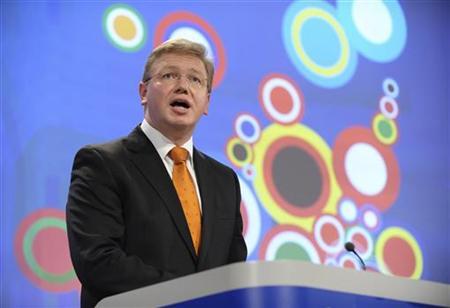
“I recommend granting Serbia candidate status on the understanding that Serbia re-engages in the dialogue with Kosovo and is moving swiftly to the implementation in good faith of agreements reached to date,” EU Enlargement Commissioner Stefan Fuele said in a speech in Brussels.
In another positive signal for the western Balkans, where years of bloody conflict has delayed democratic transformation, the EU executive also recommended on Wednesday the bloc starts entry talks with tiny ex-Yugoslav state Montenegro, in recognition of its efforts to combat organized crime.
Serbia has satisfied one of the main demands of the European Union for membership by catching fugitives wanted for crimes during the Balkan wars of the 1990s, including Ratko Mladic the former Bosnian Serb military commander who was on the run for 16 years until he was caught in May this year.
But its relations with Kosovo remain a sticking point. Belgrade lost control over Kosovo in 1999, when a NATO bombing campaign halted a Serb counter-insurgency war against ethnic Albanian rebels. With Western backing, Pristina declared independence in 2008, a move Serbia refuses to recognize.
Tensions have worsened in recent weeks over border and trade disputes that led to clashes in which one policeman died and dozens of NATO peacekeepers and Serb protesters were injured.
EU envoys have pushed the two sides this week to resume talks but no date for a new round was set, diplomats said.
Relations with Serbia and Kosovo are also a divisive issue in the EU, where five EU members refuse to recognize Pristina’s independence.
Some EU capitals, led by EU powerbroker Germany, say Serbia needs to do more to earn EU approval and will be reluctant to approve the Commission’s recommendation if talks between the two do not resume. Others worry about leaving Kosovo behind.
In a nod to Kosovo’s supporters, the Commission said it would speed up work on lifting visa restrictions for Kosovars.
The Serb government welcomed the Commission’s decision on its status and said democratic reforms would continue.
“Of course, this is not the end. We must continue with implementation and reforms, but this is a very significant day for Serbia,” Prime Minister Mirko Cvetkovic said in Belgrade.
JUGGLING TURKEY
In the same report, the Commission criticized Turkey, the largest of EU candidates, for not doing enough to normalize relations with EU member Cyprus. In a reference to a recent spat over gas drilling rights in the eastern Mediterranean, it told Ankara to avoid threats that could further damage ties.
Fuele said both Brussels and Ankara were frustrated by the lack of progress in Turkey’s EU accession, which is caused in part by opposition from Cyprus as well as by French and German reluctance to admit the largely Muslim state.
“Regrettably, accession negotiations have not moved forward for more than one year. There are frustrations about this on both sides,” he said, adding that the EU should work out ways to keep Ankara engaged.
“These (frustrations) should not blind us from the importance of our relationship, or the underlying fundamentals, which remain good. I believe it is time to work for a renewed positive agenda in EU-Turkey relations.”
European policymakers are concerned about losing influence with Turkey at a time when Ankara’s clout is rising in the Middle East and North Africa, where popular revolts this year have created uncertainty over future alliances.
Turkey also oversees important energy corridors from Asia to Europe, and wields significant influence over whether illegal migrants from Africa can reach Europe.
Addressing overall ambivalence toward enlargement that has spread through large parts of Europe, the Commission said the pace of talks will be increasingly dependent on progress of democratic reforms and efforts to curb corruption and support freedom of expressions in candidate states.
The EU sees serious efforts to combat graft and crime, which are rife in the western Balkans, a region of more than 20 million people, as a vital part of their EU preparations.
(Additional reporting by Matt Robinson in Belgrade; Reporting by Justyna Pawlak; editing by Rex Merrifield)
via Serbia wins qualified EU invite, Turkey criticized | Reuters.
ANKARA/PARIS/BRUSSELS: Turkey welcomed Wednesday a deal between Israel and Hamas in which a Franco-Israeli soldier, held for five years, is to be exchanged for more than a thousand Palestinian prisoners.
“We are happy,” Turkish Foreign Minister Ahmet Davutoglu said, of the deal that will see the Palestinian militant group free Gilad Shalit, who they have held since 2006.
“The agreement that had been concluded is a good agreement,” he said.
“It is a positive development that will lower pressure” in the Middle East, he added.
Turkey was ready to contribute to “any peaceful effort” that would allow people kept from their loved ones to find their families – whether it be Shalit or the Palestinian prisoners, he said.
Turkey had in the past had direct and indirect contact with Israel and Hamas in a bid to free Shalit, said Davutoglu.
Khaled Meshaal, Hamas’ exiled political chief, had phoned him to brief him on the details of the deal, he said.
France also hailed the deal, with President Nicolas Sarkozy calling the agreement a “major success” for Israel.
Sarkozy’s office said the president was “delighted” at the news of the deal and “thanked all those who contributed to this agreement, notably Egypt for the essential role it played.”
The French head of state had spoken by phone with Israeli Prime Minister Benjamin Netanyahu and congratulated him for this “major success,” said the statement, released late Tuesday.
Meanwhile, EU foreign policy chief Catherine Ashton also welcomed the deal between Israel and Hamas. “I warmly welcome the news that Gilad Shalit will soon be able to return home after five years of captivity, putting an end to the long ordeal that he and his family have endured,” she said.
A version of this article appeared in the print edition of The Daily Star on October 13, 2011, on page 8.
via THE DAILY STAR :: News :: Middle East :: Turkey, France and EU welcome Israel-Hamas deal to trade prisoners.
Turkish media reports prosecutor seeking arrest of 174 Israelis allegedly involved in 2010 Navy raid on Gaza-bound ship
Reuters
Published: 10.13.11, 00:44 / Israel News
Photo: Shutterstock
A Turkish prosecutor is seeking the arrest of 174 Israelis allegedly involved in the naval commando raid that killed nine Turks on a ship carrying aid to the Gaza Strip last year, broadcaster CNN Turk reported on Wednesday.
Ties between the two regional powers have deteriorated sharply since IDF naval commandos raided the Mavi Marmara in May 2010.
CNN Turk said on its website Istanbul state prosecutor Mehmet Akif Ekinci had written to the Justice Ministry calling for the arrest of those who carried out the raid and those who ordered it.
Turkey has previously said it will seek to prosecute all Israelis responsible for crimes committed during the May 2010 raid.
The names of the Israeli marines involved in the raid have not been released. The prosecutor had previously written to Israel seeking the names of those involved but had received no answer.
Turkish-Israeli tensions have continued to escalate since then, with Prime Minister Tayyip Erdogan saying last month Turkish warships could be sent to the Eastern Mediterranean at any time and Israel could not do whatever it wants there.
Turkey downgraded diplomatic ties with Israel and halted defence trade after the Jewish state confirmed last month it would not apologise for the Mavi Marmara raid.
via Turkey seeks Israeli arrests over flotilla raid – Israel News, Ynetnews.
 The issue was discussed during a two-day visit by Iraqi Foreign Affairs Minister Hoshyar Zebari to Ankara on Wednesday. The formal agreement for the opening of the first border gate is expected to be signed towards the end of the year, and it should be in operation by the end of 2012.