Category: Regions

  • Turkey looks east as EU accession prospect recedes

    Turkey looks east as EU accession prospect recedes

    By Ibon Villelabeitia and Jonathon Burch

    ANKARA | Wed Oct 12, 2011 5:19pm EDT

    (Reuters) – Cold-shouldered by the European Union it wants to join, NATO member Turkey is turning east politically and economically for the respect it feels it lacks in the West.

    A rising Muslim democracy, Turkey began accession talks with Brussels in 2005, but progress has been painfully slow, hobbled by tensions between Ankara and EU-member Cyprus as well as opposition within France and Germany.

    On Wednesday, the European Commission said no progress was achieved in the last year, raising new doubts over whether Turkey will ever become a full EU member.

    Prime Minister Tayyip Erdogan has warned that a vigorous Turkey would not wait at the EU’s doors “like a docile supplicant” and slammed European societies as “near geriatric.”

    His bitter mood is shared by many ordinary Turks who say they feel increasingly unwelcome in Europe.

    Ecevit Iyit, 38, said he had applied four times for a visa to join his wife in Germany, where she works at a sausage factory in Stuttgart and lives with their three young children.

    “I waited 11 months after one application before they rejected it,” said Iyit as he waited at the gates of the German embassy in Turkey’s capital Ankara. “They don’t want us. Otherwise they would have taken us ages ago.”

    Turkey’s foreign policy has been West-oriented for years, revolving around its EU application and NATO commitments.

    But as its EU prospects recede, it has become increasingly independent-minded and keen to increase ties with the Middle East and North Africa — a trend that has broad implications for the EU and the United States.

    “There hasn’t been a pan-European conversation about how on earth to deal with a Turkey that’s not just assertive but is now threatening what to some Europeans are core interests and may pursue actions that could lead to conflict,” said Daniel Korski, of the London-based European Council on Foreign Relations.

    “There was a compromise before where those who want Turkey to be part of the EU and those who don’t could agree we need a strategic dialogue with Turkey because it was becoming increasingly assertive and important. But some Europeans are now beginning to worry about the point of strategic dialogue with a country that’s moving beyond the pale of normal behavior.”

    The shift is turning Turkey into a model in the Arab world at a time when the region is undergoing sweeping change while U.S. and European influence appears to be waning.

    During a September tour of Arab countries, Erdogan was feted by adoring masses, portrayed himself as a Muslim leader, fustigated Israel and championed a Palestinian statehood.

    Turkey is now a stable democracy and one of the world’s most vibrant economies, which has given Turks a new sense of confidence, in contrast to the existential malaise plaguing Europe due to the financial crisis.

    A survey on transatlantic trends by the German Marshall Fund think-tank published in September showed that a majority of Turks considered the Middle East more important to the country’s economic interests and security than the EU.

    “We shouldn’t join the EU. They should just reject our application now,” Hasan Filanci, a 25-year-old baker. “Europe is the sick man, write that down.”

    BRIDGE AND ANCHOR

    Despite waning domestic support for EU membership, about half of Turkey’s trade is with the bloc and more than 75 percent of foreign direct investment comes from the EU.

    After the release of the Commission’s report, Ankara said on Wednesday “full membership to the union is Turkey’s only goal.”

    Turkish poet Nazim Hikmet once compared Turkey to a galloping horse with its head on the continent of Europe and its body on the Asian continent. But heads can turn.

    In recent months, Turkey has raised concerns it is changing its soft power for a more confrontational policy, upsetting even it staunchest supporters.

    It has sent warships to the eastern Mediterranean to challenge EU member Cyprus’ and Israel’s offshore gas drilling projects, and has warned it would freeze ties with the EU if Cyprus assumes the bloc’s rotating presidency next July.

    The Commission on Wednesday said it was concerned about tensions between Ankara and Cyprus and urged Turkey to refrain from any threats or actions that could undermine relations.

    As EU talks drag on, Turkey has failed this year to open even one new chapter, or policy area, of the 35 that a candidate country must complete before it can join the bloc.

    Since membership talks started, Turkey has opened 13 chapters. Most of the rest are “frozen” by political disputes between Ankara and EU capitals.

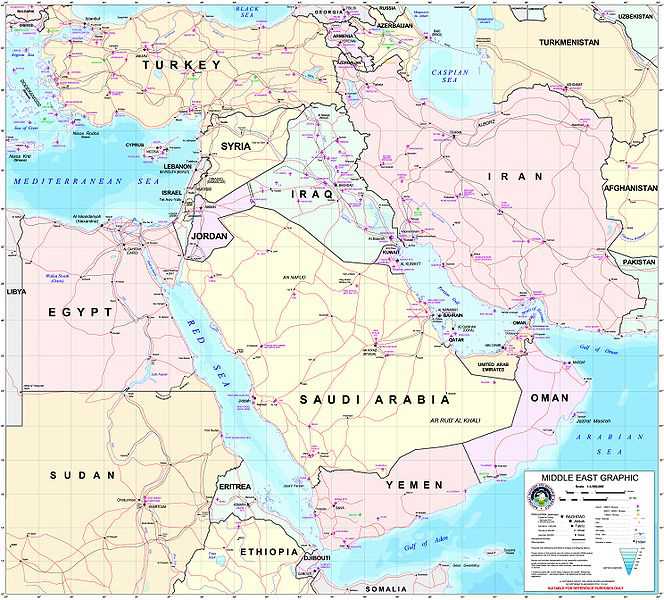
    For years, the argument in favor went that EU-driven political and economic reforms offered a policy anchor for a NATO country that borders Iran, Iraq and Syria and with a history of political instability and financial crises.

    The EU prospect reassured investors and brought prestige to Turkey, which has access to European markets and has expanded business ties in Asia, Africa and the Middle East.

    For its part, EU reforms allowed civilian governments in Ankara to break the grip of the conservative army and judiciary.

    Amanda Paul of the Brussels-based European Policy Center said Turkey should resist actions that could harm longer term interests, which lie in a strong anchoring to Europe.

    “Turkey will never walk away. It has absolutely no reason to walk away. Even though there are no negotiations going on, Turkey still hopes for economic stability and bringing in foreign investment and that added extra sparkle,” Paul said.

    “Turkey is a crucial as an energy corridor and for other energy projects, and the EU does need to main strong links with Turkey.”

    (Additional reporting by Justyna Pawlak; Editing by Maria Golovnina)
  • Kissinger Sees Greater Role for Turkey

    Kissinger Sees Greater Role for Turkey

    By Joe Parkinson

    One of the eldest statesmen of international diplomacy, former U.S. Secretary of State Henry Kissinger, on Thursday offered some pearls of wisdom to one of the newest entrants to great power politics, Turkey.

    Speaking at a conference held by TPG Capital in Istanbul, Mr. Kissinger’s gravelly top line was that Turkey will fill part of a regional void left by the U.S. as it withdraws from Iraq and, eventually, Afghanistan. But Ankara, said Mr. Kissinger, should be careful not to cross Washington’s vital interests in the region.

    Associated Press
    Associated Press

    “Turkey’s influence is growing at a time that the U.S. is withdrawing from Iraq and Afghanistan, plus Libya is opening up – so Turkey can play a significant role,” Mr. Kissinger said. “It shouldn’t run across interests that the U.S. considers imperative. I expect relations will be constructive.”

    As evidence that the U.S.-Turkish relationship remained on a sound foundation, despite the potential for competition, Mr. Kissinger singled out Turkey’s recent decision to host a missile-defense radar, part of a U.S.-inspired system designed to protect the North Atlantic Treaty Organization from Iran.

    “I see this as an expression of the fact that on some issues the U.S. and Turkey have parallel interests,” Mr. Kissinger said.

    Relations between Turkey and Iran, which share a border, have become significantly complicated recently by the violence in Syria – a Turkish neighbor and Iranian client state – and by the rapidly shifting environment created by the Arab Spring. Only last year, Turkey incurred Washington’s wrath by voting against U.S.-backed sanctions on Iran at the United Nations Security Council.

    Turkey continues to say that the radar isn’t directed at any one country.

    Addressing the meltdown in relations between Turkey and Washington’s other strong ally in the region, Israel, Mr. Kissinger suggested both sides were at fault in their dispute over whether Israel should apologize for killing eight Turks and a U.S. citizen of Turkish extraction onboard the Mavi Marmara aid ship, as it sought to break Israel’s blockade of Gaza last year.

    “Both sides will have to make an adjustment in terms of their position – this is not just a problem of [Israeli Prime Minister Benjamin] Netanyahu. People know what the problem is, they know what the solution is, but they can’t bring themselves to do it,” Mr. Kissinger said.

    via Kissinger Sees Greater Role for Turkey – Emerging Europe Real Time – WSJ.

  • EU Urges Turkey to Forge Cyprus Ties to Revive Membership Talks

    EU Urges Turkey to Forge Cyprus Ties to Revive Membership Talks

    By Emre Peker

    Oct. 12 (Bloomberg) — The European Union urged Turkey to normalize relations with Cyprus, amid concerns about rising tension between the two countries, to jump-start membership talks that stalled more than a year ago.

    Turkey has made progress over the past year in its push to join the 27-nation bloc, the EU said today in an annual progress report. The European Commission, the EU executive arm that also oversees expansion, said Turkey needs to improve fundamental rights, particularly freedom of expression, to advance.

    The pace of Turkey’s membership application depends on full implementation of a customs-union agreement that includes Cyprus, the EU said in Brussels. Turkey, which doesn’t recognize the Greek Cypriot government, has sent warships alongside a Turkish vessel that is exploring for natural gas off the divided Mediterranean island. It also threatened to freeze its EU ties if Cyprus takes on the bloc’s rotating presidency without a solution to the four-decade split.

    “The accession negotiations with Turkey have regrettably not moved into any new areas for over a year,” the EU said in the report. “The pace of accession negotiations would gain new momentum if Turkey proceeded to the full implementation of its customs-union obligations with the EU, and made progress towards normalization of relations with Cyprus.”

    Prime Minister Recep Tayyip Erdogan and Foreign Minister Ahmet Davutoglu have repeatedly said Turkey would cease to have relations with the EU if Cyprus assumes the presidency in the second half of 2012 without a solution to reunify the island.

    Rising Tensions

    Since mid-September, tensions in the eastern Mediterranean have been rising, with Turkey responding in kind to Greek Cypriot drilling off the island’s southern coast. Noble Energy Inc., the U.S. firm that started drilling Sept. 18, found gas reserves, the Greek Cypriot Phileleftheros newspaper reported yesterday.

    Cyprus split in 1974, when Turkey invaded in response to a coup by supporters of a union with Greece. Turkey is the only country to recognize a Turkish Cypriot administration in the island’s north, where it keeps thousands of troops. Greek Cypriots rejected a 2004 UN plan submitted to a popular vote on both sides of the island by three to one. Turkish Cypriots voted two to one in favor.

    The EU said trials of writers and journalists, as well as limitations to Internet access, cause “serious concerns” about freedom of expression in Turkey.

    Trade Accord

    The bloc started talks in 13 of 33 policy areas as part of the membership negotiations. Discussions on one of the issues have been provisionally closed and talks on eight others can’t be opened until Turkey meets certain obligations, the EU said. That includes the so-called Ankara Protocol that would extend a trade accord with the EU to Cyprus. The bloc demands that Turkey open its ports and airports to traffic from Cyprus under the July 2005 protocol.

    Turkey can overcome the “competitive pressure and market forces” in the EU and should speed up implementation of structural reforms to its economy, according to the report by Enlargement Commissioner Stefan Fule’s group. The country’s 8.9 percent economic growth last year was driven by domestic demand and its expansion has continued in 2011 as Turkey “strengthened its presence in new markets” and continued its integration with the EU, the group said.

    “Turkey has become one of the fastest-growing economies in the world,” Egemen Bagis, a lawmaker heading Turkey’s newly created EU Affairs Ministry, said Sept. 30 in Strasbourg, France, where he was meeting with counterparts from the bloc. “There are still those who try to treat us as if we were the Turkey of the 1960s. We can give them the response they deserve with self-confidence because Turkey is quickly advancing on the path to become a global power.”

    –With assistance from James Neuger in Brussels. Editors: Heather Langan, Eddie Buckle

    To contact the reporter on this story: Emre Peker in Ankara at [email protected].

    To contact the editor responsible for this story: Andrew J. Barden in Dubai at [email protected].

    via EU Urges Turkey to Forge Cyprus Ties to Revive Membership Talks – Businessweek.

  • Iran ready to equip Lebanese army: envoy

    Iran ready to equip Lebanese army: envoy

    TEHRAN - Iran's Ambassador to Lebanon Ghazanfar Roknabadi said 
    Monday Tehran is ready to equip the Lebanese army and expand 
    bilateral defense cooperation without setting any preconditions, 
    the English language satellite Press TV reported.
    Speaking at a meeting with Lebanese Defense Minister Fayez Ghusn in 
    Beirut, Roknabadi said that developing stronger defense cooperation 
    between the two countries is necessary given the daily violations of 
    Lebanese airspace by the Israeli fighter jets, said the report.
    Ghusn, for his part, praised Iran's support for Lebanon and said 
    Lebanon is proud of having Iran's support, according to Press TV.
    Iranian Defense Minister Brigadier General Ahmad Vahidi has reiterated 
    that the Islamic Republic is ready to supply Lebanon army with arms.
    Iran is fully prepared to provide Lebanese army with cutting- edge 
    military equipment if it receives any request from Lebanon for 
    equipping its army, Vahidi said.
    www.chinadaily.com.cn, 11.10.2011
  • Israeli forces invade south, north Gaza Strip

    Israeli forces invade south, north Gaza Strip

    Gaza Strip, (Pal Telegraph)-Israeli military forces invaded yesterday evening southern and northern Gaza Strip, amid intensive and indiscriminate firing. No injuries were reported.

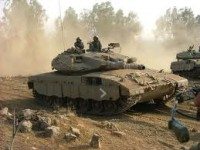
    According to witnesses, Israeli forces accompanied by tanks and bulldozers penetrated several meters toward the east of Khan Younis and Jabalya areas, southern and northern Gaza Strip.

    Sources told that one Palestinian citizen identified as Ahmed al-Azayza was killed yesterday as Israeli forces targeted Umm al-Naser area in the northern Gaza Strip.

    www.paltelegraph.com, 11 OCTOBER 2011

  • Saudi Arabia sends more troops to quell unrest

    Saudi Arabia sends more troops to quell unrest

    Saudi Arabia has reportedly dispatched more troops and military equipment to its Eastern Province in a bid to quell anti-government protests.

    According to Press TV, activists said on Monday that dozens of military vehicles, including tanks, have left an army base in the center of the country for oil-rich Eastern Province as anti-regime protests in the region show no sign of petering out despite a heavy government crackdown.

    The move came nearly one week after Riyadh sent over 40 military vehicles to the region to help local police suppress anti-government protesters.

    While protests and political gatherings of any kind are prohibited in the absolute monarchy, hundreds of Saudis have staged protest rallies in Qatif and Awamiyah and some other towns in Eastern Province over the past weeks, demanding political reforms, the release of political prisoners, the freedom of expression and respect for human rights.

    They have also called for the withdrawal of their country’s troops from neighboring Bahrain, where Saudi-backed Bahraini forces have launched a deadly crackdown on peaceful anti-regime protesters.

    Saudi activists say there are more than 30,000 political prisoners, mostly prisoners of conscious, in jails across the country.

    According to activists, most of the detained political thinkers are being held by the government without trial or legitimate charges and that they were arrested for merely being suspicious.

    english.irib.ir, 10 October 2011