Category: Regions

  • German FM denies backing PKK against Turkey

    German FM denies backing PKK against Turkey

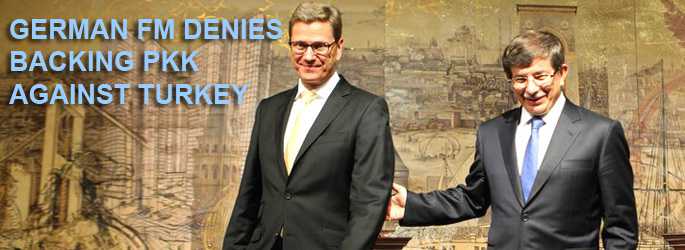
    German Foreign Minister Guido Westerwelle said Thursday that “it was out of question for us to support terrorists”.

    Speaking at a joint press conference with his Turkish counterpart Ahmet Davutoglu in Istanbul, Westerwelle said, “we have no tolerance to terror. We will continue to be against terror as a state based on the rule of law. PKK is regarded as a terrorist organization not only in Europe but Germany as well.

    Asked about what he thought on recent remarks made by Turkish Premier Recep Tayyip Erdogan that certain German foundations extended resources to PKK through opposition parties in Turkey, Minister Westerwelle said that “all the misunderstandings on the issue have been clarified”.

    “German foundations receive appreciation in Turkey. As the German government, we pay high attention to counter-terrorism. It is out of question for us to support terrorists. You may not know that a German high court defined PKK as a terrorist organization a year ago. PKK is accepted as a terrorist organization in Europe and there is no tolerance to them,” Westerwelle said.

    “Erdogan to visit Germany in Nov”

    Davutoglu also said that Turkish Premier Recep Tayyip Erdogan would travel to Germany at the beginning of November to mark celebrations on the 50th anniversary of the migration of Turkish workers to Germany and that, during the same days, Westerwelle would be in Istanbul to attend a regional conference on Afghanistan.

    Davutoglu said that Westerwelle and he also discussed the developments in the Middle East.

    The Arab Spring in the Middle East has an important place in the future perspective of Turkey, EU and Germany. We discussed the developments in Egypt, Tunisia, Libya and Syria, Davutoglu said.

    We had a chance to discuss counter-terrorism. One of the two foreign legs of the terrorist organization PKK is in north of Iraq where they have training camps and the other is in EU countries where they recruit terrorists and collect financial support. We are in close cooperation with Germany regarding the terrorist organization, Davutoglu also said.

    Agencies

    via German FM denies backing PKK against Turkey | Diplomacy | World Bulletin.

  • ‘bankrolled by corporate intelligence firm and Israel lobbyist’

    ‘bankrolled by corporate intelligence firm and Israel lobbyist’

    Adam Werritty: Liam Fox’s friend ‘bankrolled by corporate intelligence firm and Israel lobbyist’

    Adam Werritty, the Defence Secretary’s unofficial “adviser”, was funded by a corporate intelligence company and the chairman of an Israeli lobbying organisation, documents have disclosed.

    By Robert Winnett, Deputy Political Editor

    Mr Werritty is reported to have paid for travel around the world from a company that received funds from G3 Good Governance Group and Tamares Real Estate, an investment company owned by Poju Zabloudowicz, the chairman of Bicom.

    Jon Moulton, a venture capitalist, is also said to have provided money to Pargav Ltd, the firm which is alleged to have bankrolled Mr Werritty.

    Over the past few days, speculation has mounted as to how Mr Werritty was able to join Liam Fox on more than 20 overseas trips including official visits, conferences and holidays.

    It has now emerged that six different people and companies each paid up to £35,000 to Pargav since last year.

    Mr Werritty is said to have withdrawn more than £140,000 from Pargav’s bank account to fund his travel around the world to meet up with Dr Fox, The Times reported.

    The disclosure is likely to put Dr Fox under growing pressure as those previously close to the pair become increasingly alarmed at Mr Werritty’s activities.

    Mr Zabloudowicz is the head of Bicom, a prominent organisation which promotes Israeli-British relations. His companies have also donated money to the Conservative Party and he is a supporter of David Cameron.

    Last night, he confirmed donating £3,000 to Pargav.

    A spokesman said: “For many years, Poju Zabludowicz has helped fund not-for-profit organisations, not individuals, due to his passion for the promotion of peace and understanding between peoples in the United States, Europe and the Middle East.”

    G3, a company that specialises in international security and risk management, has previous links with Dr Fox in connection with his attempts to help with the reconstruction of Sri Lanka. The firm is thought to have donated £15,000 to Pargav.

    Earlier this week, The Daily Telegraph disclosed that Mr Werritty had being working out of the offices of Michael Hintze, a hedge fund tycoon and donor to the Conservative Party. Oliver Hylton, an adviser to Mr Hintze is the sole director of Pargav.

    Mr Hylton and Mr Hintze are now apparently attempting to distance themselves from Mr Werritty and are thought to believe they asked more questions of Dr Fox’s friend and best man.

    Last night, Mr Hylton told The Times: “He [Mr Werritty] came into my office and said I want to set up a new company. It sounds ridiculously niave, in hindsight, but I agreed. I signed the documents and nothing more.

    “I saw Adam as an adviser [to Dr Fox] of some sort. Anything he did was for the good of Liam Fox and supporting his office. Adam is a good and honest man.”

    Asked about Pargav, a spokesman for the Defence Secretary said: “Adam Werritty does not work for the Defence Secretary as an official or unofficial adviser.”

    www.telegraph.co.uk, 14 Oct 2011

  • British Defence Secretary Liam Fox resigns

    British Defence Secretary Liam Fox resigns

    • Defence Secretary Liam Fox has resigned after controversy surrounding his relationship with his friend Adam Werritty
    • Mr Fox said he had “mistakenly allowed” his personal and professional responsibilities to become “blurred”
    • David Cameron said he was very sorry for Mr Fox’s departure but “understood his reasons”
    • Philip Hammond has been appointed defence secretary with Justine Greening replacing him as transport secretary
    • Labour says Mr Fox had not upheld the standards expected of ministers and his departure was “inevitable”
    Mr Fox said he had allowed his personal interests and government business to become blurred

    Defence Secretary Liam Fox has resigned after a week of pressure over his working relationship with friend and self-styled adviser Adam Werritty.

    Mr Fox was being investigated amid claims he broke the ministerial code.

    In a letter to David Cameron, Mr Fox said he had “mistakenly allowed” personal and professional responsibilities to be “blurred”.

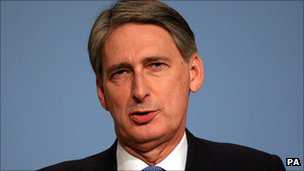
    Mr Cameron said he was very sorry for Mr Fox’s departure. Transport Secretary Philip Hammond will replace Mr Fox.

    Labour said Mr Fox had not upheld the standards expected of ministers and his departure was “inevitable”.

    Business cards

    The defence secretary has been under pressure since it emerged that Mr Werritty, a lobbyist, had met him on 18 foreign trips despite having no official role.

    Mr Werritty, a former flatmate of Mr Fox and the best man at his wedding, handed out business cards suggesting he was an adviser to Mr Fox and was present at meetings Mr Fox had with military figures, diplomats and defence contractors.

    I now have to hold myself to my own standard”

    Liam Fox

    • Fox resignation letters in full
    • Who is Adam Werritty?

    Questions were also raised about who paid for Mr Werritty’s business activities and whether he had personally benefited from his frequent access to the defence secretary.

    No 10 sources said that the prime minister had been willing to give Mr Fox time to stay in his job – at least until the details of a report by Cabinet Secretary Sir Gus O’Donnell into his conduct was published early next week.

    Mr Fox will be replaced by Transport Secretary Mr Hammond. In a mini-reshuffle caused by Mr Fox’s departure, Treasury minister Justine Greening will replace Mr Hammond – becoming the fifth woman in the Cabinet.

    In his resignation letter, Mr Fox said he had “mistakenly allowed the distinction between my personal interest and my government activities to become blurred”.

    National interest

    “The consequences of this have become clearer in recent days,” he added. “I am very sorry for this.

    “I have also repeatedly said that the national interest must always come before personal interest.

    “I now have to hold myself to my own standard. I have therefore decided, with great sadness, to resign from my post as secretary of state for defence.”

    Responding to Mr Fox’s resignation, Mr Cameron said: “I understand your reasons for deciding to resign as defence secretary, although I am very sorry to see you go.

    “We have worked closely for these last six years, and you have been a key member of my team throughout that time.”

    He said Mr Fox, MP for North Somerset, had “done a superb job in the 17 months since the election, and as shadow defence secretary before that” and had overseen changes that would allow the armed forces to “meet the challenges of the modern era”.

    The BBC’s political editor Nick Robinson said the prime minister had given Mr Fox time to defend himself but the defence secretary had struggled to stem the tide of questions about his dealings with Mr Werritty.

    No 10 had come to the conclusion on Thursday that Mr Fox’s position was becoming untenable, he added, and Mr Fox had reluctantly reached the same view.

    ‘Inevitable’

    Mr Fox apologised to MPs earlier this week about how his interaction with Mr Werritty was perceived but he maintained there had been no impropriety.

    Labour said Mr Fox had “fallen foul of the standards expected of ministers and broken the rules”.

    “The facts have caught up with Liam Fox and he had to resign,” shadow defence secretary Jim Murphy said. “It was inconceivable that once a minister had been seen to break their own code of conduct on so many occasions that he could survive.”

    And ex-Lib Dem leader Sir Menzies Campbell said recent events had undermined Mr Fox’s authority and morale at his department.

    Philip Hammond takes over at the Ministry of Defence
    Philip Hammond takes over at the Ministry of Defence

    “Mr Fox has bowed to the inevitable,” he said. “It had become impossible for him to draw a line under the story.”

    But Conservative MPs rallied behind Mr Fox, saying he had made a major contribution in his time at the Ministry of Defence and some suggesting he could, one day, return to government.

    Sir Malcolm Rifkind, a former defence secretary, said Mr Fox had done an “extremely good” job and his departure was “very, very distressing” as it would lead to further upheaval at the MoD.

    Conservative backbencher Peter Bone told the BBC Mr Fox had made errors but they did not constitute a “hanging offence”.

    “He said he made mistakes and with hindsight he wouldn’t have done it but I didn’t think that was enough to require him to resign,” he said.

    “But when the story, every news item, isn’t about what’s happening in Afghanistan and what’s happening in Libya but who said what to who then he put his country first and resigned.”

    ANALYSIS

    Jonathan Beale, Defence correspondent, BBC News

    Liam Fox was far from universally popular with either military or Ministry of Defence civil servants.

    He arrived at the MoD with energy and vigour, unafraid to ruffle feathers and determined to sort out what he called the Labour legacy of the “car crash” of the MoD’s finances.

    He said he had to fill a black hole of more than £38bn. That meant brutal cuts to iconic military kit – scrapping the aircraft carrier HMS Ark Royal, the Harrier jump jets and the new Nimrod spy planes.

    He ordered a series of painful redundancies for all three services but few doubt that, without him, cuts could have been even more severe.

    Friends of Liam Fox said he loved the job. He wanted to leave a legacy of a military machine that was fit for the next decade. He also pushed ahead with reforms that he hoped would end the overspends and late delivery on military kit.

    Despite warnings from military chiefs that they were overstretched Liam Fox managed to maintain Britain’s commitment to Afghanistan and to begin the fight on a second front – Libya.

    Helping bring about an end to the Gaddafi regime looks like his most obvious achievement. The rest remains unfinished business.

    • Profile: Liam Fox
    • The week that sank Liam Fox
    • Robinson: Gone but not forgotten?

    Related Stories

    • Liam Fox resigns 14 OCTOBER 2011, POLITICS
    • Private firms ‘funded Fox friend’ 14 OCTOBER 2011, POLITICS
    • Fox ‘back to normal working mode’ 13 OCTOBER 2011, POLITICS
    • Fox row ‘distracting MoD staff’ 11 OCTOBER 2011, POLITICS
    • Liam Fox ‘made serious mistakes’ 10 OCTOBER 2011, POLITICS
    • Timeline: Fox and Werritty meetings 13 OCTOBER 2011, POLITICS
    • Who is Adam Werritty? 14 OCTOBER 2011, POLITICS
    www.bbc.co.uk, 14 October 2011
  • Amnesty International seeks George W. Bush’s arrest

    Amnesty International seeks George W. Bush’s arrest

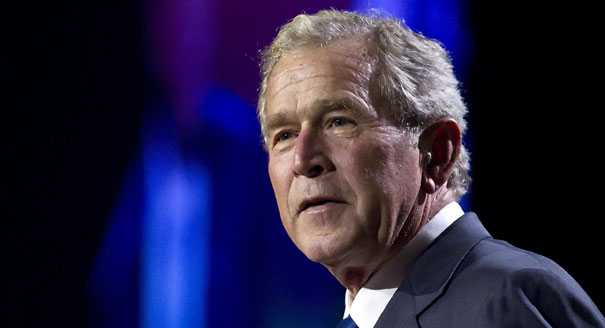
    Amnesty International accused Bush of 'responsibility for crimes under international law.' | AP Photo

    By TIM MAK

    The human rights group Amnesty International called on Canadian authorities Wednesday to arrest former President George W. Bush when he attends an economic summit in the province of British Columbia next week.

    The group accused Bush of “responsibility for crimes under international law including torture.”

    Amnesty International asked that Canada either prosecute or extradite Bush for violations that they allege took place during the CIA’s secret detention program between 2002 and 2009. The organization wrote a 1,000 page memorandum addressed to Canadian authorities to make the case for human rights violations by the 43rd president.

    “Canada is required by its international obligations to arrest and prosecute former President Bush given his responsibility for crimes under international law including torture,” Susan Lee, Americas Director at Amnesty International, said in a statement.

    The Canadian government responded to the request with critical words for Amnesty International.

    “I cannot comment on individual cases… that said, Amnesty International cherry picks cases to publicize based on ideology. This kind of stunt helps explain why so many respected human rights advocates have abandoned Amnesty International,” Canadian Minister of Citizenship and Immigration Jason Kenney told POLITICO, noting that Amnesty International had never sought a court order to bar Cuban dictator Fidel Castro or Tongolese dicator Gnassingbé Eyadema from Canada.

    “Perhaps this helps to explain why Salman Rushie has said that ‘it looks very much as if Amnesty’s leadership is suffering from a kind of moral bankruptcy,’ and why Christopher Hitchens has written about the organization’s ‘degeneration and politicization,’” Kenney added.

    Bush cancelled a visit to Switzerland in February after facing similar public calls for his arrest by the other human rights groups.

    Amnesty International said that Canada was obligated to arrest Bush under its commitments to the UN Convention Against Torture. The human rights organization objected to the Bush administration’s “enhanced interrogation techniques” and violations they characterized as “cruel, inhuman and degrating treatment and enforced disappearances.”

    “A failure by Canada to take action during his visit would violate the UN Convention against Torture and demonstrate contempt for fundamental human rights,” said Lee.

    www.politico.com, 12.10.2011


  • Turkish prosecutor seeks IDF arrests over flotilla raid

    Turkish prosecutor seeks IDF arrests over flotilla raid

    By REUTERS

    10/12/2011 22:57

    CNN Turk reports that Istanbul state prosecutor had written to Turkish Justice Ministry calling for arrest of 174 involved in ‘Marmara’ raid.

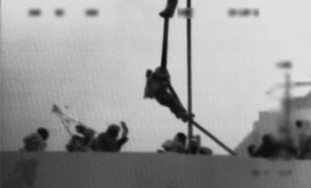
    A Turkish prosecutor is seeking the arrest of 174 IDF personnel allegedly involved in the naval commando raid that killed nine Turks on the Mavi Marmara ship carrying aid to the Gaza Strip last year, broadcaster CNN Turk reported on Wednesday.

    CNN Turk said on its website that Istanbul state prosecutor Mehmet Akif Ekinci had written to the Turkish Justice Ministry calling for the arrest of those who carried out the raid and those who ordered it.

    An official contacted by Reuters was not aware of the report and was checking.

    Last month, the IDF said it was taking legal precautions to protect soldiers and officers who participated in the operation to stop the Mavi Marmara, senior defense officials said. Turkish news reports claimed intelligence agencies had compiled a list identifying 174 soldiers who could be prosecuted for their involvement in the operation.

    The Istanbul deputy public prosecutor Ates Shasan Sozen told the Today’s Zaman newspaper that the list was compiled by IHH, the organization that organized the Gaza flotilla, and not by Turkish intelligence.

    The Sabah newspaper wrote that the names were acquired by Turkish intelligence agencies that had studied social connections on Facebook and Twitter, as well as photographs on those websites with ones taken on board the Mavi Marmara.

    The list of 174 names was transferred to Turkish prosecutors, in addition to pictures of 10 IDF soldiers the paper said could not be identified.

    Yaakov Katz and Oren Kessler contributed to this report.

    via ‘Turkish prosecutor seeks IDF arrests over flo… JPost – Defense.

  • EASTMED: US carrying Turkey’s water?

    EASTMED: US carrying Turkey’s water?

    J.E. Dyer’

    Cry havoc! – and let loose the frigates of war

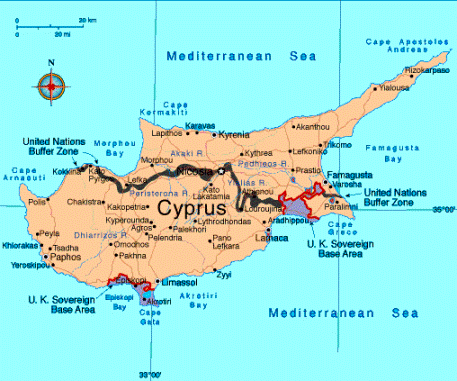
    The ante is being upped in the Eastern Mediterranean as the crisis south of Cyprus bubbles along.  Turkish news outlet Today’s Zaman reports that on Monday, the Turkish government announced a deployment of special forces along with the four frigates and naval helicopters maintaining a “security” presence in the undersea drilling area off Cyprus’ southern coast.  The special forces include a Special Underwater Defense Unit and a Special Underwater Attack Unit.

    Reporting the deployment of the Underwater Attack Unit is obviously a political move.  The unit has quite probably been deployed as indicated, but pointing out that it’s there can only have a political purpose.  Announcing that your special forces are coming is not generally the prelude to deniable covert action.

    The Erdogan government is probably increasing its force profile in order to establish a posture for bargaining.  That doesn’t mean that the Turks aren’t serious, or that they wouldn’t take military action; they’re not bluffing.  I do think they believe, however, that the EU will blink first.

    What’s the US doing?

    This may be because they appear to believe the US will intervene on their behalf in the coming days.  According to the government-friendly Today’s Zaman, an elaborate interlocking quid pro quo is being set up in which the Turkish government offloads its interest in a Turkish-Russian natural gas pipeline (the one known as “South Stream”) to private companies, and the US supports Turkey’s oil/gas claims in EASTMED.

    The US has long preferred the EU-backed “Nabucco” pipeline over South Stream, for moving gas from Central Asia to Europe.  Throughout the last decade, however, Russia maneuvered to inhibit progress on Nabucco (yes, named after the Verdi opera) by co-opting one potential participant after another.  (In one last-ditch effort, Russia’s Gazprom averted an Azerbaijani commitment to Nabucco by the simple expedient of buying up all the gas Baku was selling.)

    Here is Today’s Zaman (emphasis added):

    The [Nabucco] pipeline will also help improve relations with the US by lessening Russia’s influence in the region. Turkey reportedly expects to gain US support to be part of the natural gas and oil exploration process by Israel and Greece in the eastern Mediterranean, which Turkey also has rights to through the Turkish Republic of Northern Cyprus’ (KKTC) presence in the area.

    It is not exactly looking in the rearview mirror for the US administration to prioritize wining support for Nabucco, and reducing Turkey’s stake in South Stream.  But it’s close.  It’s worth noting at the outset that for Turkey, consigning her interest in South Stream to private companies is not the same thing as divorcing herself from the project.  It’s merely putting Turkish participation in a different context, one that seems more meaningful to the US government than to Turkey’s.

    But the importance of the whole “Nabucco versus South Stream” dynamic has receded significantly, with, first of all, the emergence of both of them as funded, viable projects, and second, with the Arab Spring and the increasing Islamization and activism of Turkey under a neo-Ottoman regime.  Seeing Turkey’s participation in these pipelines as a prize to be won is yesterday’s strategic factor: it has been overtaken by events.  Turkey has already agreed to participate in both.  Let her.

    Given Turkey’s increased saber-rattling, Russia is likely to slow down on the Turkish segment of South Stream anyway.  Turkey is upping the ante on South Stream by forcing Russia to renegotiate the sale of gas to Turkey.  The Russians and Turks are both masters of the art of negotiating to retain leverage and slow things down, as opposed to negotiating to get things done.  Meanwhile, the North Stream pipeline into Germany has a more promising financial future in the next decade.

    Russia is concerned about Erdogan’s behavior, and is cultivating friendships on the other side of Turkey in EASTMED.  A Russia-Turkey cabal is not our greatest worry today.  IfToday’s Zaman is right about the quid pro quo here, the Obama administration is spending too much to buy something worth very little.

    A bad solution, way overpriced

    The price is too high in part because it will be a triumph for Turkey’s saber-rattling if she gets what she has wanted all along:  a veto over oil-and-gas activities in EASTMED.  (The other part is the encouragement such an outcome would be for Turkey’s stated intention to ramp up her naval posture in the region.  More Turkish warships and aircraft patrolling EASTMED on a routine basis is not a stabilizing development.)

    I’ve been predicting that what Turkey wants is a multilateral mechanism in which she can exercise the veto she craves.  As the situation is developing now, Cyprus and Israel, having agreed on a maritime delineation of their Economic Exclusion Zones, are proceeding – quite properly, by the terms of international law – without reference to Turkey.  Turkey doesn’t want to start a war: she wants to leverage military threats to create a need for bargaining, and for a multilateral decision-making body in which she will participate.  Through such a body, Turkey would get a seat at the table for matters she has no natural right to exercise a veto over, and she could ultimately prevent everything except what she wants to do.

    If the US goes through with the diplomatic effort suggested by the Today’s Zaman article, and if the gambit succeeds, Erdogan will have achieved his goal, and the US government will have been his path of least resistance.  There is also the possibility of not succeeding; e.g., if we assume that the emerging gambit is opposed by Russia, the major nations of the EU, and Israel.  A diplomatic black eye for the US would be the least of the evils here, but the entire situation has a shabby, regrettable character; the US figures in it not as a superpower and arbiter, but as a target for diplomatic exploitation.

    La France Surcouf

    As the Obama administration practices leading from behind, others are polishing up their leading-from-the-front skills.  Greek news sources report that France is dispatching her own frigate, FS D’Estienne d’Orves, to patrol the afflicted area off Cyprus.  A caveat must be entered on this:  D’Estienne d’Orves will apparently not conduct a dedicated patrol in EASTMED; she will be heading for antipiracy operations in the Indian Ocean, and stopping for a show of maritime presence along the way.

    That said, if Greek commentators are overstating the import of the frigate’s activities en route, it is only in a tactical sense.  In a strategic sense, France is on the move, and whatever her navy does will take on greater significance in the coming days.  There has been no question that France played the leading political and geostrategic role in the NATO operation in Libya, a reality affirmed with the state visit to Libya of Nicolas Sarkozy, along with David Cameron, in September, and a growing taste in Europe for military photo ops like this one.

    (As an aside, a recent report suggests that the main US contribution to the Libya operation – reconnaissance and surveillance – was largely disdained by the French pilots who have made up most of the air attack force.  The pilots’ complaint is that it takes too long for the video/imagery intelligence from US assets to be processed through the NATO command center in Italy, so they have frequently operated without it.  This is a particularly interesting indicator of the light political governor on NATO operations in Libya; in other operations, the concern about collateral damage and mistargeting has been too great for the participating forces to consider dispensing with synoptic intelligence.  Indeed, the targeting process in other operations has often been delayed by the need for strike approval at the highest echelons for the most minor tactical targets.  The apparent absence of this decision-making regime in the Libya operation is noteworthy.)

    In just the last couple of days, France has announced her intention of establishing relations with the national council being formed by the Syrian opposition – another preemptive diplomatic action, and an interesting one in light of Turkey’s patent interest in the future of Syria, and the dust-up in the last few days over a call by Sarkozy for Turkey to acknowledge the slaughter of Armenians in World War I as a genocide.  Turkish news daily Hurriyet speculates on the return of a Franco-Turkish rivalry, like that which manifested itself after World War I in – naturally – Syria.

    Britain may no longer have the view she once did of the strategic importance of EASTMED, but France has always had a view of her own – and today she has one of the biggest, best-equipped navies in the region.  Sarkozy has been criticized by French traditionalists for an uninspired foreign policy; he may or may not be responding to the complaints of the “Groupe Surcouf,” which posted a letter in February 2011, when the Libya crisis was spinning up, lamenting that “the voice of France has disappeared from the world.”

    (The group is named after France’s famous “submarine-cruiser,” a big, heavy-gunned ship built to be capable of submerging, during the years of the Washington Naval Treaty of 1922, because the treaty did not impose limits on the size of a submarine. Surcouf was a quintessentially French blow for ingenious French independence from France’s commitments to collective security arrangements.  If you can’t love France, you can’t love anything.)

    French submarine-cruiser Surcouf; Wikimedia Commons

    Sarkozy may simply see the need for a counterweight to the injudicious US policy toward Turkey.  The Turks aren’t the only ones who detect some big quos being handed out from Washington for their quids.  Besides beefing up Turkey’s force of AH-1W Super Cobras, which are being used for the ground operations against the Kurdish separatists in Eastern Turkey, the US is reportedly selling armed drones to Turkey (something we have, to date, sold only to the UK).  The quid from Turkey in this case is the agreement to host the X-band radar for the NATO missile defense system, something we didn’t actually need Turkey for, as Bulgaria was anxious to host it.  Hosting it in Turkey will create difficulties in the matter of sharing radar data with Israel – which is currently routine, since Israel also hosts an X-band radar and is linked in to the NATO data system.

    Negotiate or we’ll shoot

    The US approach to Turkey comes off as unwarrantedly enthusiastic and indiscriminate right now.  The concerns about Turkey are obvious to everyone in the region, yet US policy is to court and gratify Erdogan’s activism.  Whatever the EU’s rarefied stance, the nationsof Europe will not join us in that burbling enthusiasm, and will find it natural instead to make common cause with a more wary Russia.  For our ally Israel it creates a separate but related set of concerns.  Israel too must lose no time in brushing up her alternatives, especially given the geographic importance of Syria to all the various EASTMED issues, including Israel’s own security.

    It is both good news and bad news that when there is a power vacuum in Europe and the Med, rhetoric and posturing multiply far faster than actual armed encounters.  The good news is that shooting is likely to be postponed.  The bad news, however, is that while we congratulate ourselves on the good news, power relationships will be changing materially.  If Turkey succeeds, by making threats, in getting a veto she has no right to over the economic activities of others, everything will have already changed.

    J.E. Dyer’s articles have appeared at Hot Air’s Green RoomCommentary’s “contentions,Patheosand The Weekly Standard online.