Category: Regions

  • Assad ‘eyes sectarian, ethnic fight’ in Turkey

    Assad ‘eyes sectarian, ethnic fight’ in Turkey

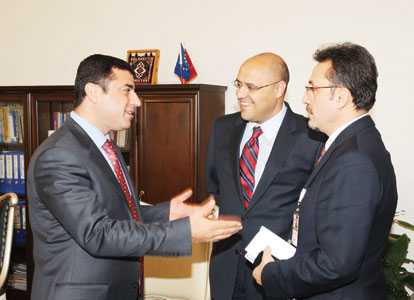
    over new constitution BDP leader Selahattin Demirtaş (L) speaks to Serkan Demirtaş (C) and Göksal Bozkurt of the Hürriyet Daily News. DAILY NEWS photo, Selahattin SÖNMEZ
    over new constitution BDP leader Selahattin Demirtaş (L) speaks to Serkan Demirtaş (C) and Göksal Bozkurt of the Hürriyet Daily News. DAILY NEWS photo, Selahattin SÖNMEZ

    GÖKSEL BOZKURT / SERKAN DERMİRTAŞ

    ANKARA – Hürriyet Daily News

    Selahattin Demirtaş, BDP co-chair, says he warned President Gül and Foreign Minister Davutoğlu against a spillover from Syria

    Syria is looking to stir up ethnic and sectarian unrest in Turkey, Peace and Democracy Party (BDP) co-chair Selahattin Demirtaş has warned, urging Ankara to reconcile with Turkey’s Kurdish population or face the risk of plunging deeper into conflict.

    “Syria is about to explode. The unrest is continuing. The threats of [President Bashar] al-Assad’s regime to Turkey should not be underestimated. He has given a message: ‘We have religious and ethnic differences, so does Turkey. If we have domestic disturbances, then so will Turkey,’” Demirtaş said in an interview with the Hürriyet Daily News on Oct. 13.

    To prevent a spill-over effect in Turkey from turmoil in the Middle East, the government and the Kurds must immediately reconcile, said Demirtaş, whose party is mainly focused on the Kurdish issue.

    The BDP leader said he had shared his concerns with both President Abdullah Gül and Foreign Minister Ahmet Davutoğlu. “I told them they have no time to lose, but they are making the problem worse with their complacency and lethargy. Ground operations, KCK operations, the isolation of [outlawed Kurdistan Workers’ Party (PKK) leader Abdullah Öcalan at] İmrali is an eclipse of reason. This is the time for dialogue and negotiations. I don’t think the upcoming days will be this comfortable.”

    Police have launched a number of raids to detain people accused of membership in the Kurdistan Communities’ Union (KCK), which is accused of being the urban wing of the PKK. The latter is listed as a terrorist organization by Turkey, the United States and the European Union.

    “If someone ignites a clash between Arabs and Kurds in Syria, the powers behind it will want to spread the unrest to Turkey. I don’t know if it will be an ethnic or sectarian conflict. I cannot say how it will happen, but they will try. We already have wounds, and they will try to rub salt in them,” the BDP leader said.

    Ratcheting up tensions

    Commenting on the recent assassination of Syrian Kurdish leader Meshaal Tamo, Demirtaş said the Kurds had not been involved in domestic insurrection, or revolted against al-Assad, and were balanced in their politics. He added that he was not directly in contact with Syrian Kurds and received information indirectly.

    “They might be trying to incite the Kurdish people with such assassinations. This could turn into a Kurdish-Arab, Sunni-Shiite conflict. Maybe that’s what they’re planning,” Demirtaş said. “The whole thing is heading toward a dangerous point.”

    The Turkish government has overstretched itself to the point of interfering with Syria, said Demirtaş, urging the ruling party to provide an explanation as to what the Turkish and Kurdish people should expect for the future of the region.

    “In such a period, the Justice and Development Party [AKP] and the Republican People’s Party [CHP] need to think about the next 100 years of the country,” Demirtaş said, also noting the threat posed by Iran to Turkey’s domestic stability.

    New constitution

    The BDP places great importance on the new constitution and will actively participate in its preparation, said Demirtaş.

    “The constitution cannot be made only by 12 deputies from four parties,” said Demirtaş, proposing the establishment of another commission that will bring together representatives of women’s, environmental and human rights organizations and minority communities. The new constitution must be approved by the public in a referendum no matter how many deputies approve it in Parliament, he added.

    “The constitutional commission must also solve the issue of jailed deputies,” the BDP leader said. “They can’t say it is not their job. If you’re making a new constitution, you also need to clear the path of mines. Eight deputies are behind bars, and Parliament cannot vote on the Constitution without them.”

    Demirtaş said Ankara was looking to South Africa and the dissolution of the Apartheid regime for inspiration to solve problems, adding that for this to work, the government had to end clashes with the PKK because “the new constitution cannot be prepared without peace. The commission can’t work while funerals take place every day.”

    Both the PKK and the government have the will to restart negotiations, said Demirtaş. For this to happen, Öcalan’s “terms must be met. The government must give this man, who has the power to bring the PKK militants down from the mountains, his freedom. Only Öcalan has the power to do this.”

    Demirtaş also called on the government to reveal the content of the protocols drafted between the National Intelligence Organization (MİT) and the PKK. “Those protocols contain the PKK’s disarmament. From what we understand, it is reasonable. Turkey could get rid of this problem for good. But the government’s approach has not been serious.”

    via Assad ‘eyes sectarian, ethnic fight’ in Turkey – Hurriyet Daily News.

  • Wall Street protests go global

    Wall Street protests go global

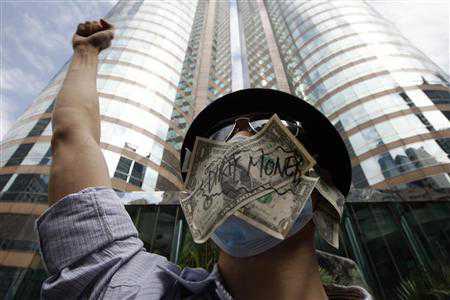
    Demonstrators worldwide shouted their rage on Saturday against bankers and politicians they accuse of ruining economies and condemning millions to hardship through greed and bad government.

    Galvanized by the Occupy Wall Street movement, the protests began in New Zealand, rippled round the world to Europe and were expected to return to their starting point in New York.

    Most rallies were however small and barely held up traffic. The biggest anticipated was in Rome, where organizers said they believed 100,000 would take part.

    “At the global level, we can’t carry on any more with public debt that wasn’t created by us but by thieving governments, corrupt banks and speculators who don’t give a damn about us,” said Nicla Crippa, 49, who wore a T-shirt saying “enough” as she arrived at the Rome protest.

    “They caused this international crisis and are still profiting from it, they should pay for it.”

    The Rome protesters, including the unemployed, students and pensioners, planned to march through the center, past the Colosseum and finish in Piazza San Giovanni.

    Some 2,000 police were on hand to keep the Rome demonstrators, who call themselves “the indignant ones,” peaceful and to avoid a repeat of the violence last year when students protesting over education policy clashed with police.

    “YES WE CAMP”

    As some 750 buses bearing protesters converged on the capital, students at Rome university warmed up with their own mini-demo on Saturday morning.

    The carried signs reading “Your Money is Our Money,” and “Yes We Camp,” an echo of the slogan “Yes We Can” used by U.S. President Barack Obama.

    In imitation of the occupation of Zuccotti Park near Wall Street in Manhattan, some protesters have been camped out across the street from the headquarters of the Bank of Italy for several days.

    The worldwide protests were a response in part to calls by the New York demonstrators for more people to join them. Their example has prompted calls for similar occupations in dozens of U.S. cities from Saturday.

    Demonstrators in Italy were united in their criticism of Prime Minister Silvio Berlusconi and angry at his victory in a vote of confidence in parliament on Friday.

    The government has passed a 60 billion-euro austerity package that has raised taxes and will make public health care more expensive.

    On Friday students stormed Goldman Sachs’s offices in Milan and daubed red graffiti. Others hurled eggs at the headquarters of UniCredit, Italy’s biggest bank.

    New Zealand and Australia got the ball rolling on Saturday. Several hundred people marched up the main street in Auckland, New Zealand’s biggest city, joining a rally at which 3,000 chanted and banged drums, denouncing corporate greed.

    About 200 gathered in the capital Wellington and 50 in a park in the earthquake-hit southern city of Christchurch.

    In Sydney, about 2,000 people, including representatives of Aboriginal groups, communists and trade unionists, protested outside the central Reserve Bank of Australia.

    “REAL DEMOCRACY”

    “I think people want real democracy,” said Nick Carson, a spokesman for OccupyMelbourne.Org, as about 1,000 gathered in the Australian city.

    “They don’t want corporate influence over their politicians. They want their politicians to be accountable.”

    Hundreds marched in Tokyo, including anti-nuclear protesters. In Manila, capital of the Philippines, a few dozen marched on the U.S. embassy waving banners reading: “Down with U.S. imperialism” and “Philippines not for sale.”

    More than 100 people gathered at the Taipei stock exchange, chanting “we are Taiwan’s 99 percent,” and saying economic growth had only benefited companies while middle-class salaries barely covered soaring housing, education and healthcare costs.

    They found support from a top businessman, Taiwan Semiconductor Manufacturing Corp (TSMC) Chairman Morris Chang.

    “I’ve been against the gap between rich and poor,” Chang said in the northern city of Hsinchu. “The wealth of the top one percent has increased very fast in the past 20 or 30 years. ‘Occupy Wall Street’ is a reaction to that.”

    Demonstrators aimed to converge on the City of London under the banner “Occupy the Stock Exchange.”

    “We have people from all walks of life joining us every day,” said Spyro, one of those behind a Facebook page in London which has drawn some 12,000 followers.

    The 28-year-old, who said he had a well-paid job and did not want to give his full name, said the target of the protests as “the financial system.”

    Angry at taxpayer bailouts of banks since 2008 and at big bonuses still paid to some who work in them while unemployment blights the lives of many young Britons, he said: “People all over the world, we are saying: ‘Enough is enough’.”

    Greek protesters called an anti-austerity rally for Saturday in Athens’ Syntagma Square.

    “What is happening in Greece now is the nightmare awaiting other countries in the future. Solidarity is the people’s weapon,” the Real Democracy group said in a statement calling on people to join the protest.

    In Paris protests were expected to coincide with the G20 finance chiefs’ meeting there. In Madrid, seven marches were planned to unite in Cibeles square at 1600 GMT (12 p.m. EDT) and then march to the central Puerta de Sol.

    In Germany, where sympathy for southern Europe’s debt troubles is patchy, the financial center of Frankfurt and the European Central Bank in particular are expected to be a focus of marches called by the Real Democracy Now movement.

    Reuters

  • How did Turkey save Gilad Shalit?

    How did Turkey save Gilad Shalit?

    İSMET BERKAN – [email protected]

    There is no one who does not know about Gilad Shalit, the soldier for whose sake Israel turned Gaza upside down, killed thousands of people, including women and children, and turned Gaza into an open-air prison. In fact, maybe he has been the most innocent hero of this long and bloody game, or the victim, since the day he was kidnapped by Hamas.

    After Hamas kidnapped Shalit and the Israeli army entered Gaza, only to fail at rescuing the soldier, Israel asked for mediation and assistance from Turkey.

    And, even at that time, which was the end of 2006 and beginning of 2007, Turkey stepped in and talks were carried out with Hamas, with some progress achieved. But Israel has a habit; it does the same job together with a few countries. The fact that other countries were also involved did not make the negotiations any easier; on the contrary, they got tougher. Moreover, they became entangled. At this point, Turkey stepped out.

    Turkey stepped out but Israel’s effort to save Gilad Shalit did not end until seven or eight months ago.

    Some seven or eight months ago, at a time when Turkish-Israeli relations were not at its best, the Israeli government once more consulted Turkey and asked for help to save Shalit because they had reached a certain point in negotiations and once more the talks were deadlocked. Would Turkey help overcome this deadlock?

    The subject was referred to Prime Minister Recep Tayyip Erdoğan by Foreign Minister Ahmet Davutoğlu. Erdoğan reacted very clearly to this demand: “This is a humanitarian issue; it has nothing to do with our Israeli politics or relations. Let us do whatever we can.”

    With this directive, the Foreign Ministry stepped in. They wanted Israel to pass all the information it had to Ankara. Then it was understood that a Western European country’s representative had played a serious role in the negotiations carried out until that time.

    That Western European came to Ankara. He met Davutoğlu and top level Foreign Ministry civil servants, conveyed all the information he had and explained the latest stage reached in the negotiations.

    From that moment on, a tough negotiation period started with Hamas on one hand and with Israel on the other. The National Intelligence Organization (MİT) stepped in and met with MOSSAD, Hamas and Egyptian intelligence.

    This shuttle diplomacy and secret meetings gradually bore fruit, the deadlocked situation in the negotiations ended and an advance was obtained.

    On one side of the negotiation was Hamas leader Khaled Mashaal who resided in Syria, on the other side was Israeli Prime Minister Benjamin Netanyahu and in the middle were Davutoğlu, the Foreign Ministry and MİT.

    The subject on which the negotiations were about to be locked was whether 27 Hamas women were to be released. But later this issue was overcome and a few days ago Mashaal called Davutoğlu from Syria and told him the deal was struck. “If you do not have any objection, we will announce it in a few hours. I wanted you to know first,” he said. Davutoğlu said: “This is a totally humanitarian matter. We thank you for being helpful in this issue. The deal is also appropriate from our point of view.”

    And after this talk, both Hamas and Israel announced the deal struck on Shalit.

    İsmet Berkan is a columnist for daily Hürriyet in which this piece appeared Oct. 14. It was translated into English by the Daily News staff.

  • Ansari urges Turkey to invest in India’s infrastructural growth

    Ansari urges Turkey to invest in India’s infrastructural growth

    Istanbul, Oct 14 (ANI): With India’s trade relation with Turkey already surpassing the target of US$ 5 billion ahead of current times, Vice President Mohammad Hamid Ansar has urged businessmen here to invest in India’s infrastructural growth.

    In his address at the dinner hosted by the confederation of businessmen and industrialists of Turkey at the Hilton hotel here, Vice President Ansari said: “In recent years, our mutual economic and commercial relations have become a major driving force of our bilateral relationship. Bilateral Trade has more than doubled in the last five years from US$ 1.5 billion in 2005 to US$ 4 billion in 2010, with an increasingly diverse export basket on both sides.”

    “For the current calendar year, the bilateral trade is expected to register a 80 plus percent increase over last year and touch US$ 6.5-7 billion, surpassing the target of US$ 5 billion that the two governments had set for 2012 during Prime Minister Erdogan’s landmark visit to India in 2008. This has been possible only due to the active exchanges and collaboration between our business communities, including that of members of TUSKON,” he added.

    Vice President Ansari said the trend in the flow of services and investments between India and Turkey is encouraging.

    “Today, over hundred Indian companies have registered businesses, investments and operations here, spanning the IT sector, airport infrastructure, automobiles, steel, irrigation and personal care products. Considering the expertise and experience of the Turkish companies in construction of infrastructure, it has emerged as a leading sector for investments from Turkey into India,” said Vice President Ansari.

    “I am confident that our business and industry would further strengthen the bilateral economic partnership. The prospects have never been brighter for us to intensify our engagement and tap our markets, and those of our regions and third countries to which we are important gateways. I call upon you to harness the huge untapped potential to increase the volume and enhance the quality of our economic engagement. Both governments are your partners in this enterprise,” he added.

    Expressing his delight to be in the historic and beautiful city of Istanbul, Vice President Ansari said: “I thank the leadership and people of Turkey for the warmth and hospitality shown to me and my delegation during the visit.”

    “My meetings in Ankara with President Gul, Prime Minister Erdogan and my gracious host Speaker Cicek have made evident the fund of goodwill that exists and reflects the mutual determination for a multifaceted and dynamic partnership between our two countries,” he added.

    Thanking the Confederation of Businessmen and Industrialists of Turkey for hosting him, Vice President Ansari said ‘we can together explore ways of furthering our mutual economic and commercial relations and take them into a higher orbit’.

    “As one of the largest institution representing the business community in Turkey, TUSKON has taken the initiative in facilitating outreach between our business and industry. TUSKON was active in the successful trade and investment delegation that visited India in March 2008 led by the State Minister for Foreign Trade Mr. Kursad Tuzmen. I understand that its members had more than 2000 one-on-one meetings. Its success is thus evident,” said Vice President Ansari.

    “The next step should be the opening of a representative office in India to help consolidate the surging growth rate in bilateral trade and facilitate the realization of our ambitious trade and investment targets,” he added.

    Stating that Turkey and India share many basic values and beliefs, Vice President Ansari said: “We share a commitment to democracy, a profound belief in a secular polity, respect for the rule of law and upholding of human rights fundamental freedoms, and an economic system that could unshackle the energies and capabilities of our dynamic people and lead them to higher levels of prosperity and well being.”

    “As members of the G 20, Turkey and India are witness to the momentous economic developments sweeping the global stage. We are witnessing a new and dangerous phase in the global economy that could threaten the global economic recovery that began in 2009. The IMF warned last month that the downside risks are ‘severe’ and include ‘a downward spiral of increased uncertainty and risk aversion, dysfunctional financial markets, unsustainable debt dynamics, falling demand and rising unemployment’,” he added.

    The Vice President further said ‘developing countries would be hit with weakening external demand and need to enhance domestic demand in an inclusive manner, bear the rising burden of inflationary pressures, and strengthen macroeconomic and financial frameworks’.

    “More than at any time in the past, nations and leaders are called upon to undertake collective economic actions and implement coordinated policies to enable a return to sustainable, balanced and inclusive growth. The backdrop to our bilateral economic cooperation is thus one of global uncertainty. Yet, it has a silver lining. Turkey has in 2010 experienced a real GDP growth of 8.9 per cent and is expected to grow by 6.6 per cent this year. India too had real GDP growth of 10.1 per cent last year and is projected to grow at 7.8 per cent this year,” said Vice President Ansari.

    “During the past five years, India had aimed at achieving faster and more inclusive growth, and has achieved an average GDP growth of 8.2 percent. This growth led to generation of incomes and employment opportunities to millions of our citizens and improved the living standards for the bulk of our population. It has also enhanced revenue generation of the government enabling it to launch social sector programmes, aimed at reducing poverty and enabling inclusiveness. We attach high priority to them,” he added.

    Asserting that India has set a growth target of 9 per cent per annum for the five-year period 2012-17 in the Twelfth Five Year Plan, Vice President Ansari said that this cannot be achieved without doubling the investment in infrastructure during the next five years, from US $ 500 billion over the past five years to about one trillion dollars.

    “We need more investments in roads and highways, new electricity generation and distribution networks, expanded and modernized railways networks, new and upgraded airport and port facilities. Such essential elements of infrastructure would provide our industry and agriculture with the connectivity needed for growth in production and trade, and for improving the quality of life of all of our people,” said Vice President Ansari.

    “We have also reiterated our commitment to continue the process of economic reforms. In a multi-pronged manner, we are proceeding with tax reforms, especially the introduction of a Goods and Services Tax, financial sector reforms, legal reforms, and major reforms in education and skill development. We are also committed to the pursuit of prudent fiscal and monetary policies and controlling inflation,” he added. By Praful Kumar Singh (ANI)

  • Turkey awaits the Arab Spring

    Turkey awaits the Arab Spring

    By M K Bhadrakumar

    The Arab Spring has apparently had no impact whatsoever on Europe’s entrenched views on Turkey. This much becomes clear from the annual report of the European Commission (EC) on Turkey issued in Brussels on Wednesday. The report took stock of Turkey’s reform program in terms of its membership bid of the European Union (EU) and roundly censured the country over human rights and its increasingly acrimonious spat with Cyprus.

    Conceivably, the EC report mummifies for a long time Turkey’s EU bid, which has spluttered in the past year or two. To add insult to injury, the EC gave the green light to two of Ottoman Turkey’s “grandchildren” in the Balkans – Serbia and Montenegro – on their respective aspirations to join the European club.

    Recent months have been a heady period for Turkey, which has convinced itself that the new Middle East taking shape in the upheaval of the Arab Spring would find it irresistible as a role model, and that the Western world would inevitably be compelled to revise its opinions and view Turkey in an altogether new light as the torchbearer of enlightenment in the Muslim world.

    Wednesday’s EC report comes as a reality check. The more things seemed to change, the more they remain the same. The EC report chastised Turkey about the lack of freedom of expression, women’s rights and freedom of religion as falling below accepted standards in the liberal democracies of Europe. It estimated that the shortfalls continued to disqualify Turkey from joining the EU.

    In a scathing reference, the EC report said, “In Turkey, the legal framework does not yet sufficiently safeguard freedom of expression. The high number of legal cases and investigations against journalists and undue pressure on the media raise serious concern.”

    Worn-out lens
    The harsh criticism by the EC comes as an embarrassment when the leadership of Prime Minister Recep Tayyip Erdogan has been riding the wave of the Arab Spring in the Muslim Middle East and exhorting the Arab world to follow Turkey’s unique example of combining or reconciling – depending on one’s point of view – Western-style liberal democracy with Islam.

    During his recent visit to Cairo, an assertive Erdogan crossed the Rubicon of Islam and gave audacious advice to the Egyptian people about the virtues of secularism – at a juncture when the Muslim Brotherhood is surging in that country and could be at the threshold of entering the corridors of power.

    Curiously, the EC report has been received with ennui in Turkey. As prominent editor Murat Yetkin put it, “The truth is that fewer and fewer people in Turkey care about what the EU is saying on the country day by day.” Yet, Turkey’s Minister for Europe, Egemen Bagis, responded polemically to the EC report and alleged that the human-rights record of many EU member countries couldn’t be “half as good as Turkey’s”.

    He said the EC report was simply out of focus:

    Although the report tries to take an objective and balanced picture of Turkey, we think that the camera used by the commission is old with a worn-out lens and the lens needs to be changed, as the picture has taken lots of blurred parts and the camera seems to be zooming on the false points.

    Bagis maintained for the record that Turkey would not be detracted from its chosen path of an EC-membership bid. However, he added the caveat that “full membership is Turkey’s only goal, no other goals can be accepted”. Turkey bristles at the “privileged partnership” that has been mooted by France and Germany as an alternative to regular membership.

    Objectively, the EC report is fair and balanced. It commends the Erdogan government for initiating civilian supremacy over the military, is supportive of his agenda to draw up a new constitution and even praises Turkey’s economic policies. On the other hand, it flags Turkey’s poor record of individual liberty and civil rights, the rule of law, freedom of expression, women’s rights and the erosion of the autonomy of regulatory bodies. “Significant further efforts are required to guarantee fundamental rights in most areas.”

    However, these European perspectives don’t surprise Turkey. The common perception in Turkey is that Brussels keeps coming up with excuses for not admitting Turkey into what is essentially a Christian club. The EC decision to encourage the membership bid by Serbia and Montenegro and to leave Turkey’s accession hanging will only reinforce the grouse of “cultural” discrimination toward Turks.

    The latest EC report may also have shifted the goal posts by introducing a new template, namely, Turkey’s latest acrimonious rift with Cyprus, which erupted over gas deposits in the Eastern Mediterranean.

    The report criticized Turkey for its strong reaction to the recent gas drilling by Cyprus in the Eastern Mediterranean and for carrying the rift to a potential flashpoint by starting its own seismic exploration in the region under a Turkish naval presence. It demanded that Turkey should make progress in normalizing relations with Cyprus and avoid “any kind of threat, source of friction or action that could damage good neighborly relations and the peaceful settlement of disputes”.

    Evidently, the new assertiveness in Turkey’s regional policies is not going down well in European opinion. In addition to Turkey’s showdown with Cyprus, European countries have been urging Ankara to address the tensions in its relations with Israel, but Erdogan has been in no mood to listen, and the rupture with Israel happens to be the one issue that has probably overnight made him a hero on the Arab street, while it has cost Turkey virtually nothing.

    Europe always took with a pinch of salt Turkey’s claims to play a leadership role in its surrounding regions. It sidelined Turkey’s swagger in the Balkans in the project over the disbandment of Yugoslavia; more recently, France initially didn’t even invite Turkey to the conclave discussing the Western intervention in Libya, although Arab countries were invited.

    Tunisia surges
    Most certainly, Europe (especially France) will ignore Turkey’s claim for any leadership role in Syria or the Levant, leave alone in the Maghreb region. The vocal supporter of Turkey’s regional leadership of a democratic Middle East happens to be Saudi Arabia and it has a special interest in doing so. French President Nicolas Sarkozy went to the Caucasus recently and put down Turkey rather harshly in an unwarranted display of derision.

    The paradox, as the EC report implies, is that Turkey’s own exciting reform program has ground to a virtual halt in the recent past, while Erdogan has been exhorting the Middle East to reform. Thoughtful Turkish commentators realize this contradiction. One of Turkey’s most respected political observers, Sedat Ergin, drew attention to this in a column this week titled “The problem of fine-tuning policies on Syria”.

    Ergin wrote, “As soon as the winds named ‘Arab Spring’ started blowing, [Turkey] took the stance supporting the demands for change and democracy.” Turkey’s choice, he argued, was and is essentially correct, but a contradiction nonetheless arises when Turkey expresses such robust opinions favoring democratic reform. Ergin pointed out:

    The Syrian regime’s actions against the opposition groups coincide with a time when Peace and Democracy Party [Kurdish political party] members are being subjected to mass arrests, when elected deputies are kept in jails and when the space for the Kurdish political movement to operate within democratic bounds is being entirely constricted in Turkey.

    Credit must be given to Erdogan that such frank discussions on the Kurdish problem are possible at all in today’s Turkey, whereas, before his advent to power, the Kurdish problem itself used to be forbidden terrain for public discourse. All the same, the past two years have been more or less barren, and Erdogan was even regressive on the democratization front despite being so advantageously placed in Turkish domestic politics.

    Erdogan needs to pay heed to the EC report when it gently underscores that Turkey is neglecting to do its own homework while immersed in espousing the cause of democratization in the Middle East. Out of the 35 chapters of the EU’s Acquis Communautaire that Turkey is expected to comply with to gain membership, negotiations have begun on only 13 chapters in the entire period since 2005 when the accession talks began under Erdogan’s stewardship.

    The EU, it increasingly appears, was actually the driving force behind Erdogan’s democratization program, and today the disconcerting reality is that Turkey may be losing interest in the EU membership project. A leading Turkish columnist, Semih Idiz, summed up the mood:

    Turkish-EU membership talks are currently at a standstill, with little prospect of being revived soon … EU is not something the majority of Turks look to with confidence or enthusiasm anymore … The average Turk is aware of the obstacles strewn on Turkey’s path … Put another way, the “EU stick” simply does not work anymore … because the “EU carrot” is not enticing for Turkey anymore, especially at a time of turmoil in Europe itself.

    Indeed, Turkey’s resounding success as an economic power-house during Erdogan’s rule and the crisis shaking the European economies do present contrasting pictures that are misleading public opinion that Turkey could as well do without EU membership. No doubt, the EU’s political leverage on Turkey is diminishing.

    If so, where will a fresh impetus for reform come from? The Turkish official claim is that the government has an innate urge to reform the country, no matter the EU membership bid. But that isn’t a convincing enough argument. So, could it be from the Arab Spring, which, ironically, Erdogan is charioting abroad?

    As Tunisia heads for an historic poll on October 23 to elect an assembly that would frame a new constitution, Islamist leader Rachid Ghannouchi stole a march over Erdogan by fielding as candidate for the Ennahda party in the capital, Tunis, a woman who does not wear a head scarf. Even after nearly nine decades of constitutional rule, Turkey has not reached a comparable point.

    Ambassador M K Bhadrakumar was a career diplomat in the Indian Foreign Service. His assignments included the Soviet Union, South Korea, Sri Lanka, Germany, Afghanistan, Pakistan, Uzbekistan, Kuwait and Turkey.
  • Speaking of apologies

    Speaking of apologies

    Turkey practices state-sanctioned genocide denial and prosecutes those who dare challenge it.

    By Emanuele Ottolenghi

    Buried somewhere in the middle of the “Report of the Secretary-General’s Panel of Inquiry on the 31 May 2010 Flotilla Incident” (the Palmer Report ) is a small detail that is bound to inconvenience Turkish Prime Minister Recep Tayyip Erdogan in his desire to break Israel’s Gaza blockade by deploying the Turkish Navy: “the absence of significant port facilities in Gaza.”

    Mr. Erdogan has dismissed the legal substance of the Palmer Report as null and void, and vowed to ecstatic crowds across North Africa that Turkey will break the blockade, even at the cost of sending the Turkish Navy to escort future flotillas. But, as the Palmer Report continues:

    “The only vessels that can be handled in Gaza appear to be small fishing vessels. This means that the prospect of delivering significant supplies to Gaza by sea is very low. Indeed, such supplies were not entering by sea prior to the blockade … Smuggling weapons by sea is one thing; delivering bulky food and other goods to supply a population of approximately 1.5 million people is another. Such facts militate against a finding that the naval blockade itself has a significant humanitarian impact.”

    Given the dearth of facilities in Gaza, then, Mr. Erdogan may just have a fishing expedition in mind – or a bootlegging job. But the extravagantly expensive use of warships to catch a lobster does not appear to concern him: “We don’t care if it costs $15 million or $150 million. We will not allow anyone to walk all over our honor,” Erdogan recently told reporters.

    In fact, Erdogan’s foreign minister rebuffed American attempts to mediate by saying that “no one should test our resolve on this matter.” Test or testosterone, it increasingly appears as if Mr. Erdogan will be rattling his fishing rods and sharpening his fishing hooks until the inevitable showdown. He recently told adoring fans from Egypt’s Muslim Brotherhood that the flotilla incident in itself was cause for war. The fact that Ankara has refrained from exacting revenge is because of a desire to preserve “Turkey’s grandeur.” But even grandeur apparently has limits – since, as Erdogan helpfully noted, Israel is acting like a “spoiled child.”

    So here we are – the grandeur of Turkey, which its humble prime minister blushingly extols to an adoring crowd of Islamist misogynists, pitted against Israel’s spoiled childishness.

    And all it would take, apparently, for Israel to avoid all the reckoning that a spoiled child sooner or later gets is to lift the blockade, pay compensation to the families of victims of the Israeli raid on the flotilla and issue an apology that Turkey could not reject – which, judging from Ankara’s conciliatory language, cannot amount to much more than an act of surrender and submission. Considering that Israel has already agreed to pay compensation, that the Palmer Report only calls for Israel to express regrets (which it has already done ), and that the blockade is both a legal and effective method of limiting the flow of arms into Gaza (per the Palmer Report ) – what’s surrender and submission, between us?

    Speaking of apologies, Turkey ranks 138 in the 2010 Reporters without Borders Freedom index for press freedom. How about releasing those 61 journalists that are still rotting in Turkey’s jails? How about apologizing to them? Or maybe their jail terms are the price one pays for Turkey’s grandeur (or Erdogan’s, at least ).

    No matter – that’s the least Turkey should apologize for.

    Turkey continues to practice state-sanctioned genocide denial and prosecutes those who dare challenge it. Isn’t it time, 90-something years after the Ottoman Empire eliminated as many as 1.5 million Armenians, that Mr. Erdogan’s “mildly Islamist” party, as The Economist leniently defines it, acknowledges Turkey’s dark past and apologizes on behalf of its country’s crimes?

    Not to belabor the point, but the list of things Turkey should apologize for is long. It continues to illegally occupy Northern Cyprus, the territory of a European Union member, after having conquered the land through an act of aggression that ended in ethnic cleansing and illegal settlements. No apology there so far – in fact, Turkey has just threatened to freeze ties with the EU if Cyprus receives the Union’s rotating presidency next year, as it is supposed to. Meanwhile, Mr. Erdogan is directing his gunboat diplomacy threats at Cyprus as well – as if occupation, ethnic cleansing and the creation of a fictitiously independent republic in the northern part of the island were not enough.

    Turkey also denies basic group rights to millions of its Kurdish citizens, discriminating against them because of their linguistic and ethnic differences. It violates the sovereignty of its neighbors by conducting ruthless cross-border raids with impunity. It has not made a name for itself in the human rights department when it comes to its fight against PKK terrorists.

    Moral of the story: If you behave like a bull, you should not live in a china shop. And if you live in a glass house, think twice before you throw stones at your neighbors. Mr. Erdogan wants an apology? How about starting with one?

    Emanuele Ottolenghi is a senior fellow at the Foundation for Defense of Democracies and the author of the newly published “The Pasdaran: Inside Iran’s Islamic Revolutionary Guards’ Corps” (FDD Press ).

    via Speaking of apologies … – Haaretz Daily Newspaper | Israel News.