11 October 2011, Tuesday / AYDIN ALBAYRAK, ANKARA
Experts state it’s strongly probable that Iran has released Murat Karayılan, the number two man in the PKK terrorist organization, after capturing him.
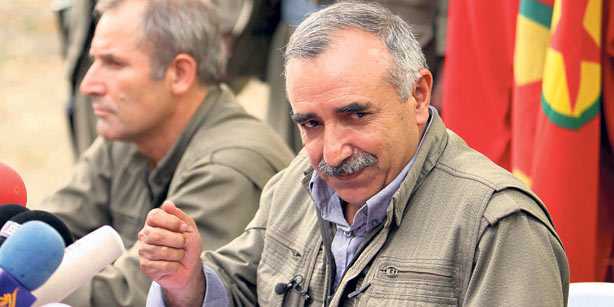
The war of words between Iran and Turkey over the latter’s decision to host NATO’s early-warning radar system may hint at a new crisis looming on the horizon between the two neighbors, with the Kurdish terrorist organization, the Kurdistan Workers’ Party (PKK), in play as a possible trump card by Iran against Turkey.
Iran may resort to a terror threat using the outlawed PKK against its neighbor Turkey because of the latter’s decision to host NATO’s early-warning radar system, experts warned, adding that the move may boomerang on Iran. Hasan Köni, professor of international law at İstanbul-based Kültür University, said Iran might use the PKK as leverage in the short run against Turkey. “I do not believe that they will go to a great length in doing so because of the boomerang effect of the terror that might hit back at Iran in the future,” he told Today’s Zaman.
There has been a wave of threatening statements from top Iranian civilian and military leaders in recent weeks, all blaming Turkey for agreeing to host NATO’s early-warning radar system on its soil, warning of unspecified consequences.
On September, Turkey agreed to go ahead with a NATO plan to set up an early-warning radar system in Malatya’s Kürecik town, which is in the east of the country.
Claiming that the missile shield aims to protect Israel and target Iranian missiles, Tehran criticized Ankara for its decision to deploy the NATO radar system. The latest warning came on Monday when the deputy head of the Iranian Armed Forces Joint Chiefs of Staff, Brig. Gen. Massoud Jazayeri, said, “Turkey should rethink its long-term strategic interests and draw lessons from the ‘bitter historical experiences’ of other countries.”
Jazayeri, warning of “adverse consequences,” urged Turkey to reconsider its decision to host the NATO radar, Iran’s state-run Press TV reported.
The Iranian commander also emphasized that Turkey should be held accountable for its all-out support for the Israeli regime following Ankara’s agreeing to the installation of the US-backed missile shield on its soil and went on to say, “Ankara should rely more on the strength of its Muslim nation as well as the potency of Muslims elsewhere and assume a role geared towards improving security in the region.”
Köni argued that Iran may also decide to extend support to the pro-Kurdish Peace and Democracy Party (BDP) and the PKK to destabilize Turkey. “When Turkey is busy with its domestic problems it would have no time to direct its attention either to Iran or to supporting Sunni groups in Arab countries,” he explained.
He underlined, however, that Iran has a limited role in the Kurdish issue because of Tehran’s fear of an eventual independent Kurdish state partly covering its own territory. “In the long run, Israel’s aim is to prepare the ground for the foundation of a Kurdish state and the largest Kurdish population is in Turkey. That is, until a structure is put in place in Turkey, it’s not possible for a Kurdish state to take shape — the structure in northern Iraq being inadequate for such an ideal — in which case, it’s clear the process will also cover Iranian territory, Kurds also being a minority group in Iran,” he said, noting that Iran would not want such a possibility.
President Mahmoud Ahmadinejad last week claimed the defense system was meant to protect Israel against Iranian missile attacks in the event a war breaks out with the Jewish state.
“The missile defense shield is aimed at defending the Zionist regime. They don’t want to let our missiles land in the occupied territories [Israel] if one day they take action against us. That’s why they put it there,” Ahmadinejad said in an address to the nation on state TV. Ahmadinejad said his government has conveyed Iran’s displeasure to Turkish officials.
“We told our Turkish friends that they did not make the correct decision and that it’s to their detriment,” he said.
Another signal of worsening relations came on Tuesday when Turkish Deputy Prime Minister Bülent Arınç, upon a question regarding the alleged capture and release of the number two man of the PKK terrorist organization by Iranian forces, said he’s always had doubts regarding the incident. “Iran and the PKK might be having negotiations, signs of which would surface soon,” he underlined.
Iranian security forces captured senior outlawed Kurdistan Workers’ Party (PKK) leader Murat Karayılan in August but later released him after negotiations with the terrorist organization, a Turkish daily reported on Tuesday.
The claim was put forth by Yeni Şafak daily columnist Abdulkadir Selvi, who said Iran was planning operations against bases of the PKK’s Iranian offshoot, a group called the Party for a Free Life in Kurdistan (PJAK), in the Kandil Mountains and suggested carrying out joint military operations with Turkey. Turkey reportedly preferred intelligence sharing to a joint operation and the country’s National Intelligence Organization (MİT) informed Tehran of Karayılan’s location.
Iranian forces then reportedly captured Ka-rayılan and his accomplices just a few days before Turkey launched an air offensive against PKK bases in Kandil. They were taken to the Iranian city of Urumiyya. Selvi says the fact that Iranian forces captured Karayılan a few days before Turkish airstrikes on Kandil and the fact that they took the PKK leader from Kandil and released him after a short while raise questions about whether Tehran had saved the PKK leader from strikes. On Aug. 18, the Turkish military launched aerial attacks on PKK targets in northern Iraq, killing up to 160 terrorists.
The daily claims that Iran did not inform Ankara about Karayılan’s capture and his transfer to Urumiyya and that the Tehran administration then released Karayılan after talks with the PKK. The content of the talks, however, were not released.
The Anatolia news agency reported on Aug. 14 that Iranian Parliament’s Foreign Affairs and Security Committee Chairman Alaeddin Boroujerdi had said Karayılan had been captured by Iranian security forces. According to Anatolia, Boroujerdi confirmed weekend news reports of Karayılan’s capture from the Iranian Fars news agency.
“The number two man of the PKK has been captured. Our intelligence forces accomplished a significant achievement by capturing Karayılan,” he was quoted as saying by Fars. However, Anatolia ran a correction later in the day saying Boroujerdi had actually said, “The number two man of the PKK has been captured,” without explicitly referring to Karayılan.
However, the explanation did not satisfy Turkey with the country’s deputy prime minister, Bülent Arınç, saying on Aug. 23 that “the whereabouts of Karayılan had not yet been clarified.” “There have still been no news reports with recent images of or statements from Karayılan. There is something about this we don’t know, but we can’t explain what,” Arınç said.
The role Turkey has assumed during the Arab Spring seems to be another reason for the adversarial statements coming from the Iranian side. According to Professor Sedat Laçiner, president of Çanakkale 18 March University, the missile shield is a major concern for Iran, but even more important is the Arab Spring. “Iran doesn’t see the Arab Spring as the “Arab” Spring, but a development through which the West is reshaping the Middle East to suit the interests of Israel. Therefore, in Iran’s eyes, Turkey acts as the West’s main agent in the process and puts all the responsibility on Turkey. In that context, we can say that what’s feared has taken place. Although it was not Turkey who planned the Arab Spring, of its own accord Turkey put itself in a position in which it looked like the leader of the Arab Spring. This is the cost of that attitude of Turkey. And Prime Minister Recep Tayyip Erdoğan’s statement regarding secularism in Egypt touched some sensitive nerves in Iran” he explains
Laçiner also sees in Iran’s recent attitude the effect of Turkey’s policy toward Syria, which is maybe the only regional ally Iran has. For Laçiner, it would be no surprise if Iran would support the PKK, because “Iran also did that in the past.”
Arzu Celalifer Ekinci of the Ankara-based International Strategic Research Organization (USAK), however, believes that Iran wouldn’t support the PKK against Turkey because it would have a boomerang effect as it did in the past.
Laçiner disagrees, however, saying: “Now the countries act mainly according to fast-paced daily developments. What is most important for Iran now is that the Arab Spring shouldn’t turn into an Iranian spring. That’s why it supports the PKK. It looks as if Iran and the PKK have reached a serious agreement, and it’s strongly probable that Iran has released Karayılan, the number two man in the PKK, after capturing him.”
 The Turkish government declared that it will suspend its relations with the European Union if the Greek half of Cyprus takes the rotating presidency of the Council of the European Union scheduled in July 2012 without first solving the reunification issue between the Greek Cypriots and the Turkish Cypriots. Turkey’s Prime Minister Erdogan stated that Turkey does not recognize Cyprus as a nation.