Blog

  • Turkish Lesson 14

    Turkish Lesson 14

    Lesson 14

    Şimdiki zamanda Olumsuz cümle ve Soru Yapma


    Making negative


    To make a verb negative in Şimdiki Zaman, you add  -m before the –iyor / -yor ending.


    Olumlu Cümle Olumsuz Cümle

    Şimdi seninle konuşuyorum.                          Şimdi seninle konuşmuyorum.

    Ayla bahçede kahve içiyor.                            Ayla bahçede kahve içmiyor.

    Semih Bey odasında gazete okuyor.              Semih Bey odasında gazete okumuyor.

    Nuray Hanım konuşma yapıyor.                     Nuray Hanım konuşma yapmıyor.

    Ben seninle geliyorum.                                   Ben seninle gelmiyorum.

    Harun beni çok seviyor.                                  Harun beni sevmiyor.

    Asuman çok sigara içiyor.                              Asuman çok sigara içmiyor.

    Stephanie kedileri seviyor.                             Stephanie kedileri sevmiyor.

    Şimdi araba sürüyorum.                                 Şimdi araba sürmüyorum.

    Şeyma İngilizce biliyor.                                  Şeyma İngilizce bilmiyor.

    Tony Türkçe konuşuyor.                                Tony Türkçe konuşmuyor.

    *Sen beni anlıyorsun.                                     *Sen beni anlamıyorsun.

    Biz şimdi havuzda yüzüyoruz.                       Biz şimdi havuzda yüzmüyoruz.

    Siz Adana’da oturuyorsunuz.                                    Siz Adana’da oturmuyorsunuz.


    * If you noticed – anla (to understand) has changed to anlıyorsun instead of anlayarsun. We call it “Ünlü Daralması” (Vowel Shrink). When –yor comes after a word whose last letter is a or e (yaşa, anla, söyle, de, ye), the vowel changes into a narrow vowel (ı,i,u,ü). We will discuss this subject in details in the following lessons.


    Yaşa-               yaşıyorum

    Anla-               anlıyorum

    Söyle-              söylüyorum

    Ye-                  yiyorum


    Making questions


    To turn a statement into a question in the –iyor tense, we add mı, mi, mu or mü before the personal ending. And mı, mi, mu, mü are always written apart. Examples will make  you understand better. Although you write them apart, they are spoken as one word.


    Bizimle geliyor musun?                      Are you coming with us?

    Serpil kitap okuyor mu?                     Is serpil reading a book?

    Ben İzmir’de yaşıyor muyum?           Do I live in İzmir?

    Bunu alıyor musun?                            Are you buying this?

    Benimle evlenir misin?                        Do you marry me?

    Milan’a gidiyor muyuz?                     Are we going to Milan?


    Exercise:


    Could you try to turn them in to qestions?


    Şimdi seninle konuşuyorum.              Şimdi seninle konuşuyor muyum?

    Ayla bahçede kahve içiyor.

    Semih Bey odasında gazete okuyor.

    Nuray Hanım konuşma yapıyor.

    Ben seninle geliyorum.

    Harun beni çok seviyor.

    Asuman çok sigara içiyor.

    Stephanie kedileri seviyor.

    Şimdi araba sürüyorum.

    Şeyma İngilizce biliyor.

    Tony Türkçe konuşuyor.

    Sen beni anlıyorsun.

    Biz şimdi havuzda yüzüyoruz.

    Siz Adana’da oturuyorsunuz.


    To make questions using question words such as Ne? Kaç? Kim? Nasıl? Nerede? Neden? Niçin? Kiminle? , we bring the question word before the verb.


    Ne = What

    Kaç = How many

    Kim = Who

    Nasıl = How

    Nerede = Where

    Neden = Niçin = Why

    Kiminle = Whom with


    (Sen) Nerede oturuyorsun?                Where do you live?

    Ne içiyorsun?                                      What are you drinking?

    Kim sigara içiyor?                               Who is smoking cigarette?

    İstanbul’a nasıl gidiyoruz?                 How are we going to İstanbul?

    Ayşe neden ağlıyor?                           Why is Ayşe crying?

    Sen neden ağlıyorsun?                        Why are you crying?

    Kaç kişi geliyor?                                 How many people are coming?

    Nerede buluşuyoruz?                          Where are we meeting?

    Nerede buluşuyorlar?                         Where are they meeting?


    Let’s have a look at our first sentences at this lesson and ask questions about them?


    -Şimdi seninle konuşuyorum.

    Q: Şimdi kiminle konuşuyorum?

    A: Seninle


    -Ayla bahçede kahve içiyor.

    Q: Ayla nerede kahve içiyor?

    A: Bahçede


    -Semih Bey odasında gazete okuyor.

    Q: Kim odasında gazete okuyor?

    A: Semih Bey.

    Q: Semih Bey nerede gazete okuyor?

    A: Odasında

    Q: Semih Bey odasında ne yapıyor? (What is Semih Bey doing in his room?)

    A: Gazete okuyor.


    – Nuray Hanım konuşma yapıyor.

    Q: Kim konuşma yapıyor?

    A: Nuray Hanım

    Q: Nuray Hanım ne yapıyor?

    A: Konuşma yapıyor.


    -Ben seninle geliyorum.

    Q: Kim benimle geliyor?

    A: Ben


    -Harun beni çok seviyor.

    Q: Kim beni çok seviyor?

    A: Harun


    -Stephanie kedileri seviyor.

    Q: Stephanie ne seviyor?

    A: Kedileri

    Q: Kim kedileri seviyor?

    A: Stephanie


    – Biz şimdi havuzda yüzüyoruz.

    Q: Biz nerede yüzüyoruz?

    A: Havuzda

    Q: Biz ne yapıyoruz?

    A: Yüzüyoruz.


    – Siz Adana’da oturuyorsunuz.

    Q: Siz nerede oturuyorsunuz?

    A: Adana’da.
     

  • Turkey Cultivates Sites of Its Christian Heritage

    Turkey Cultivates Sites of Its Christian Heritage

    By SUSANNE GÜSTEN

    ALASEHIR, TURKEY — Knapsacks shouldered and bibles in hand, a group of Christian pilgrims from Indonesia, China and the United States trooped into the remains of a fourth-century church in ancient Philadelphia last month. Gazing up at the columns that tower over what is today the Turkish market town of Alasehir, the pilgrims listened as their Australian guide read from the Apostle John’s letter to the early Christians of this city, one of the biblical Seven Churches of Revelation.

    Ibrahim Usta/Associated Press

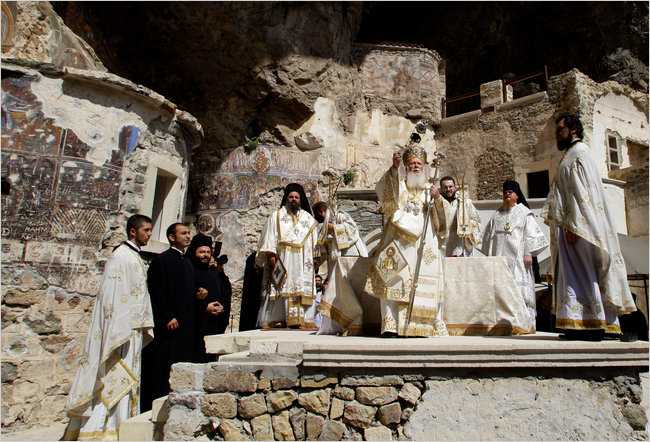
    Patriarch Bartholomew I, center, the spiritual leader of the world’s Orthodox Christians, conducted a service at the Sumela Monastery in Trabzon, northeastern Turkey, in 2010.

    “It makes you see the Bible in 3-D and color,” the guide, Dan Fennell, said of his tour of historical Christian sites around western Turkey.

    Mr. Fennell, who is based in Jakarta, has been leading pilgrimages to Anatolia for close to a decade. But these visits have become richer and more rewarding, he said, because Turkey has been cultivating the historical sites of Christianity.

    “In Laodicea, for example, where we are headed next, you can now see things you could not see five years ago,” Mr. Fennell said of the ruins of the seventh city addressed by the Apostle John.

    A Muslim nation long ill at ease with its pre-Ottoman history, Turkey has discovered Anatolia’s Christian heritage as a way of drawing visitors and of cultivating an image as a meeting-point and arbiter of civilizations.

    “We have recognized this as a special field of tourism and as a special cultural wealth,” the Turkish culture minister, Ertugrul Gunay, said in an interview in Ankara. By next year, his ministry aims to increase the number of religious tourists to Turkey to more than three million, from 1.3 million last year.

    “Until now, our concept of faith tourism was limited” to Muslim shrines “like the Mevlana tomb in Konya or the Halil-Ur Rahman mosque in Urfa,” Mr. Gunay said, “even though Anatolia is the home of important shrines of Christianity and Judaism as well.”

    “Now,” he added, “we are working to care for all of these sites, Muslim, Christian and Jewish, without discrimination, to restore them and maintain them and to open them up to the public to visit.”

    A case in point is the ancient metropolis of Laodicea, in southwestern Turkey, where Turkish archaeologists unearthed a spectacular church dating to the early fourth century.

    “This is one of the oldest churches in the world to survive in its original state,” said Celal Simsek, the archaeologist who is leading the excavation team that has worked through the winter to reveal the huge church that was first spotted underground last year on a radar scan. “When the 10 most important archaeological discoveries of the 21st century are totted up one day, this church will definitely be on the list.”

    Mr. Simsek dates the construction of the church to between 313 and 320 A.D., immediately after the Edict of Milan, by which Emperor Constantine I of Rome legalized Christianity in the year 313.

    Scrambling around the church, which has 10 towering pillars on a floor area of 2,000 square meters, or 21,500 square feet, flawlessly preserved mosaic floors and a walk-in baptismal fountain for mass christenings, Mr. Simsek said he was hoping to invite the pope to the official unveiling of the restored church, tentatively planned for next year.

    “I expect an onslaught of visitors in the coming years,” Mr. Simsek said.

    Pilgrims have already begun pouring in, on the last leg of a tour through the sites of the seven biblical churches, all of which are in western Turkey. Tourism to the site increased tenfold in the first months of this year, to 1,000 visitors a day, Mr. Simsek said, adding that “90 percent of visitors are pilgrims.”

    Mindful of the revenue that tourists provide, the nearby town of Denizli, in a first for Turkey, is now supporting the Laodicea digs financially, adding a million dollars year to financing from the local university and the Culture Ministry.

    A version of this article appeared in print on May 5, 2011, in The International Herald Tribune with the headline: Turkey Cultivates Sites of Its Christian Heritage.

    via Turkey Cultivates Sites of Its Christian Heritage – NYTimes.com.

  • Women Still an Untapped Labor Force in Turkey

    Women Still an Untapped Labor Force in Turkey

    By SUSANNE FOWLER

    ISTANBUL — Until she gave birth to her first child three months ago, 29-year-old Gulsen Cigdem worked at TransOrient International Forwarding, handling sales and logistics for moving goods by air, truck and sea.

    Now, her days are spent caring for her son, Doruk, while she and her husband, Tarik, who works in the technology sector, try to find an affordable baby sitter so she can return to work when her maternity leave expires. She wants to avoid becoming one of the hundreds of thousands of Turkish women who, armed with a university degree, find a well-paying and interesting job but do not return to the work force once they marry or start a family.

    “I got an education,” Mrs. Cigdem said during a recent interview. “I worked hard for that, and to just drop it because I became a mother is not my style.”

    Creating more economic opportunities for women like Mrs. Cigdem is among the goals of the 2011 Global Summit of Women meeting through Saturday in Istanbul as a sort of Davos for women, mirroring the annual gathering of world economic leaders at the Swiss resort. Held for the first time in Turkey, the conference is taking place in a country where women, once they find jobs, often struggle to stay in them.

    Researchers say that nearly half of all Turkish women enter the labor market at some point in their lives, but most end up quitting because of family obligations or poor working conditions. Raising rates of employment by women is “instrumental in building capacity for economic growth and poverty reduction,” a report by the Turkish State Planning Organization and the World Bank said.

    via Women Still an Untapped Labor Force in Turkey – NYTimes.com.

  • Expert on Genocide bill: France decided against impairing ties with Turkey

    Expert on Genocide bill: France decided against impairing ties with Turkey

    PanARMENIAN.Net – Recently, the relations between Turkey and France were rather strained. The adoption of a bill criminalizing the denial of Armenian Genocide would further exacerbate them, according to a Turkish Studies expert.

    Commenting on the French Senate’s non-adoption of the bill in a conversation with a PanARMENIAN.Net reporter, Ruben Melkonyannoted, “with Turkey’s increasing presence in the international scene, many countries, including France, have to reckon with it. Recent international situation does not favor adoption of Genocide resolutions or similar draft laws,” he said.

    The expert noted with regret that the Genocide issue was turned into a bargain between the states.

    Dwelling on the response of France’s Armenian community, the expert noted, “I expect the reaction will be sharp, yet I’m more interested in the response of Charles Aznavour, who earlier said he’d undertake drastic steps were the bill not adopted.”

    The French Senate on Wednesday, May 4 rejected a bill penalizing the denial of Armenian Genocide.

    The bill, which was recently rejected by the French Senate Constitution Commission, envisioned five years in prison and a fine of up to 45,000 euros for people on French soil who deny Armenian Genocide. The bill was not endorsed by the French government either.

    Earlier, the Coordination Council of Armenian Organizations of France called on Armenian community representatives to gather in front of the Senate during the discussion of the bill to be presented by Serge Lagauche at 2:30 pm Paris time.

    via Expert on Genocide bill: France decided against impairing ties with Turkey – PanARMENIAN.Net.

  • Sex, Fraud and Videotape

    Sex, Fraud and Videotape

    By Ayla Albayrak and Joe Parkinson

    Turkey’s general elections are usually volatile affairs, but with the governing AK Party streets ahead in opinion polls, this year’s contest is being labeled the most predictable for over a decade. But predictable doesn’t mean boring. Another staple of election season here is the emergence of scandalous revelations and accusations of foul play — and this time it’s no different.

    Last week, the opposition Nationalist Movement Party, or MHP, was shaken by the release of a video tape showing two party deputies apparently drunk and canoodling with two women. The tape’s footage showed one of the deputies, Recai Yildirim, bragging about his daily visits to brothels and informing a female companion that he would be “excited” to see her in a headscarf. The deputies resigned on Wednesday in a move analysts said could damage the party’s chances with conservative voters, boosting the governing AK Party.

    Deniz Baykal, former leader of the opposition Republican People’s Party, or CHP, pointed the finger at the ruling party, saying the video tape was “a trap ahead of the elections.” Mr. Baykal himself was ousted from party leadership by a similar scandal last year after a videotape showing him getting dressed after allegedly having sex in a hotel room with his former aide.

    The video scandal was followed this week by simultaneous police raids on two CHP party offices on allegations of corruption, according to state news Anadolu Agency. Thirty-four municipality workers were arrested in the offices, which were located in CHP strongholds in southwestern Turkey.

    A pro-secular heartland, Turkey’s southwest is one of the country’s few regions where the Islamic-leaning AK Party has struggled to win popular support.

    CHP leader Kemal Kilicdaroglu said the raids were politically motivated, questioning why corruption allegations were not investigated with similar vigor in the AK Party-led municipality of Kayseri in central Turkey.

    In a sign of growing tension, Minister of Transportation Binali Yildirim, who runs as an AK Party candidate for Izmir in southwestern Turkey, expressed concern about how the tape scandal and the raid would affect his party’s image. The governing party has been faced mounting accusations that it is aggressively suppressing opponents in politics and the media.

    “We have never undertaken illegitimate actions against our political rivals, and we never will,” said Mr. Yildirim.

    Analysts said the emergence of scandals and parties trading barbs was “standard fare” during a Turkish election season, but stressed that a growing number of voters were questioning whether recent revelations appeared to exclusively benefit the government.

    “There’s no direct evidence linking the AK Party hierarchy to the allegations against the opposition, but if you’re looking at who would benefit, there is a fairly causal link showing it serves AK Party interests. There is already an incredible amount of evidence disseminated by the opposition CHP about AK Party corruption in Kayseri, but it doesn’t receive the same attention,” said Atilla Yesilada, analyst at Global Source Partners, a research consultancy.

    via Sex, Fraud and Videotape – Emerging Europe Real Time – WSJ.

  • Turkey’s Universal Hospital Chain to Get $140 Million Investment

    Turkey’s Universal Hospital Chain to Get $140 Million Investment

    By Ercan Ersoy

    Asia Debt Management Capital of Hong Kong, PGGM NV and the World Bank’s International Finance Corp. agreed to invest $140 million for a 26 percent stake in Turkish hospital chain Universal Saglik Yatirimlari Holding AS.

    Universal, which runs 18 hospitals in 12 cities, will use the proceeds to invest in more sites in Turkey, especially in smaller towns, Chairman Azmi Ofluoglu said in an e-mailed statement from the four companies. They didn’t say how much of a stake each of the buyers will acquire. Istanbul-based Daruma Corporate Finance advised the seller in the deal, they said.

    Turkey’s economic growth is attracting investors in the country’s burgeoning health-care industry. The economy expanded 8.9 percent last year, the fastest pace since 2005, and may grow 4.6 percent this year, according to April 11 estimates from the Washington-based International Monetary Fund.

    Abraaj Capital Ltd., the Middle East’s biggest private equity firm, bought 54 percent of hospital operator Acibadem Saglik Hizmetleri & Ticaret AS for about $606 million in 2007 and 2008. Carlyle Group, the world’s second-biggest private equity firm, bought 40 percent of hospital operator Medical Park Saglik Grubu AS for an undisclosed price in 2009. Argus Capital Partners and Qatar First Investment Bank last year purchased 40 percent of hospital chain Memorial Health Group.

    To contact the reporter on this story: Ercan Ersoy in Istanbul at [email protected]

    To contact the editor responsible for this story: Benedikt Kammel at [email protected]

    via Turkey’s Universal Hospital Chain to Get $140 Million Investment – Bloomberg.