Author: Aylin D. Miller

  • A New Generation of Russian Women in Turkey

    A New Generation of Russian Women in Turkey

    I guess congratulations are in order for the Men in the Turkish Mediterranean city of Antalya.

    I can probably guess that these men are QUITE happy to be living amongst such a population of Russian Ladies.

    Turkish-Russian marriages make new ‘melez’ generation
    Saturday, July 12, 2008

    Approximately 10,800 Russian women who live in the Turkish Mediterranean city of Antalya are married to Turkish men, and most of these brides are university graduates, professionals and entrepreneurs. Their children make up a new generation of 4,000 Russian-Turkish ‘melez,’ or mixed, kids — many of whom will enter primary school this year

    Gülden Aydın
    ANTALYA – Hürriyet

    Upon arrival in Antalya it is difficult not to notice the number of Russians. Aside from the two-and-a-half million Russian tourists who usually keep to themselves in holiday resorts, about 15,000 Russians, 80 percent of whom are women, are living, working and mingling with locals here. Their blonde, thin, tall children are easy to spot in traffic, parks, bike paths and markets. Representatives of this new generation in Antalya, almost all the kids in this large and diverse group speak both Russian and Turkish.

    According to official data, 13,000 Russians live in Antalya, but the actual number is likely closer to 15,000. There are 310 active Russian companies in the city, and Russians are either managers or partners in 225 firms. The number of Russians who own real estate in the area is close to 800.

    Russian women who settle in Antalya tend to be young university graduates and entrepreneurs. Contrary to many views in Turkey, these women are not hopeless unqualified immigrants who had no choice but to move to Turkey.The women are attracted to the climate, natural sites and easy travel from Russia. According to Mircalol Husanov, the consul general for Russia in Antalya, Russians are qualified, educated people who contribute to the city’s social and cultural life.

    No Russian neighborhoods

    Russians who settle in Turkey are different from British and German residents. They do not live together in sites or blocs, and there is no Russian neighborhood in Antalya. Russians mingle with locals and try to speak Turkish with almost everyone. They are eager to learn Turkish to run their businesses effectively.

    Intermarriage plays a big role. Russians in Antalya are mostly women married to Turkish men. According to the Foreigners Culture and Solidarity Association, or FCSA, in Antalya, there are doctors, engineers or economists among them; however most Russian residents work in the service and tourism sectors.

    First generation of mixed kids heads to school

    Families want their children to have an education that is valid in both countries. The FCSA offers language courses for Turkish-Russian children and there is a private school founded by Russian Victor Bikkenev. Diplomas from Bikkenev’s school are not, however, valid in Russia, according to Husanov. Right now, there is a preparatory class in the Levent Aydın Anatolian High School’s elementary school department and a preschool class in the Governor Hüsnü Tuğlu Elementary School. In the next school year, Russian teachers will teach 40 children in the first, second and third grade classes.

    The consulate plans to open an elementary school in Antalya in the future and to bring in teachers from Moscow.

    Priests arrive from Russia for christening

    Russians living in Antalya do not have a church. Husanov said, “We know that this is a sensitive issue. We want to buy a lot in Antalya and build a decent church. I hope locals will not be disturbed by that.” For now, Easter and similar holidays are observed in homes. For children’s christenings, a priest arrives twice a year from the Russian church in Istanbul and the ceremony takes place in homes.

    Russian women were looked down on in Antalya in the past

    Irina Okay is an economist from St. Petersburg. She met Necat Okay in Antalya, fell in love and got married in 2001. She was happy to settle in Antalya and was one of the first Russian women to marry a Turk and settle in the city. Learning Turkish from newspapers and television, Irina founded the FCSA in 2006.

    “If my husband hadn’t helped me, our marriage would’ve ended. We Russians who arrived a decade ago were unfortunate in many respects. People looked down on us. We had to explain that we are different, well-educated and sophisticated women. In time, Turkish families have changed their opinions and now they like us.”

    Irina’s husband, Necat, is a tourism agent. He describes himself as a typical Turkish man. “I am pro-Western,” he said, “but no matter what I do, I am a Turk. I cannot change my certain way of thinking.” Necat said because Russians are free sprits they are having a hard time overcoming a difficult period. “Some of our traditions do not speak to them.”

    The Russian women, however, are different from Westerners. Due to the dire circumstances Russian-speaking countries have experienced in recent years, said Necat, if a Russian woman is happy in her marriage she tries hard to save it.

    Arina Yılmaz, 36, from Siberia, holds a university degree in quality control and has lived in Antalya for seven years. Her husband Ethem is an exporter. The couple met in Russia. Arina came to Turkey three months after Mr. Yılmaz returned to Turkey. They have son a four-and-a-half-year-old son, Timur. “I can say that I am happy; we tolerate each other’s choices.”

    Elena Durmuş, 35, studied economics at Moscow State University. Her husband is a contractor. Their son, Armağan, is seven-and-a-half years old. Their biggest worry is his education. “There should be multi-language schools in Antalya. Why is only English being taught here?”

    Natalia Çelik was a hairdresser in Moscow. She arrived in Antalya 11 years ago as a tourist and met her husband Hasan. They have been married for three-and-a-half years and have two kids, Timur Paşa, 8, and Asya, 2. Natalia misses Moscow a lot and visits once a year.

    Janna converted to Islam

    Dr. Janna Doğancı from Moscow married Ata who runs the Savoy Hotel in Konyaaltı. Janna works at the hotel’s beauty center. They met in 1996 while Janna was on vacation in Antalya. Janna will soon become a Turkish citizen. She converted to Islam after reading the Koran in Russian. “After we met we waited awhile to get married. In the meantime we have tried to figure out how to overcome the difficulties we face as a couple.”

    ‘Shall we visit babuşka?’

    Nadia and Adil Kürşat Ayhan run the Lidana Hotel in Konyaaltı. Their son Deniz is 3 years old. They have been married for six years. Nadia is from the city of Krasnoyarsk, Siberia. They visit her mother in Siberia after the tourism season ends; Nadia’s parents visit Antalya during the summer. Nadia asks her son, “Shall we visit ‘babuşka’? He replies, “Da!”

    She said, “I haven’t become a Turk yet.” Her husband jumped in, “If she had, we wouldn’t be happy.” To the question “Are you in love?” Nadia replies in laughter, “Like a dog!” Nadia knocks on wood, a common thing to do in both the Russian and Turkish traditions to avoid spoiling a good situation. “When I came here I didn’t even consider marrying a Turkish man. But we were so in love and it was impossible to let that go.”

    The FCSA has 100 members. They help Russians with the marriage process or to find a home in Antalya. The association introduces Russian and Turkish cultures. (Phone: (0242) 324 5235 – [email protected]).

    (You can read the original article here)

    Now I know that this resort town and that Turkey in general are very popular tourist destinations for Russians.

    It seems that Turkey has done a very smart thing and not hampered the movements of these ladies with any restrictive visa regimes and that has allowed this positive development to happen.

    Wouldn’t it be great if other western countries like the US, Canada, UK or Australia had the same attitude?

    One can only wish.

    But in the meantime places like Antalya might be another pretty good vacation spot to hangout in during this time of year.
  • PRESS RELEASE-EUROPEAN ARMENIAN FEDERATION-ARMENIA EXTENDS GOODWILL GESTURE TO TURKEY, AGAIN

    PRESS RELEASE-EUROPEAN ARMENIAN FEDERATION-ARMENIA EXTENDS GOODWILL GESTURE TO TURKEY, AGAIN

    YALANINDA OYLESI AZ GORULUR – ERMENI FEDERASYONUNDAN UYDURUK BIR BASIN DUYURUSU –
    EUROPEAN ARMENIAN FEDERATION
    for Justice and Democracy

    Avenue de la Renaissance 10
    B-1000 Bruxelles
    Tel/ Fax: +32 2 732 70 27/26


    PRESS RELEASE
    For immediate release

    Saturday, 12 July 2008

    Contact : Varténie ECHO
    Tel. / Fax. : +32 (0) 2 732 70 27

    ARMENIA EXTENDS GOODWILL GESTURE TO TURKEY, AGAIN

    Ankara Continues its Blockade of Armenia; Genocide Denial

    BRUSSELS, BELGIUM – Recently elected Armenian President Serge Sargyan made overtures to his counterpart in the Turkish Government this week, inviting President Abdullah Gül to join him in Armenia’s capital Yerevan to watch the upcoming soccer match between Turkey and Armenia on September 6th, reported that European Armenian Federation for Justice and Democracy (EAFJD). 

    Sargsyan also renewed the offer, made by previous Armenian presidents, to establish normal diplomatic relations with the Turkish Government, with no preconditions.  The announcements were made in an op/ed published in the Wall Street Journal earlier this week, which also called for the creation of an inter-governmental “commission to comprehensively discuss all of the complex issues affecting Armenia and Turkey”.

    To date, Turkey has not responded to Sargsyan’s proposal. 

    Turkey is continuing its devastating 15-year blockade of Armenia, imposed due to racial hostility stemming from the Armenian Genocide of 1915-1923.  Turkey continues to make false accusations as to the reasoning for the blockade – blaming everything from the Karabagh conflict to articles in the Armenian Constitution.

    The European Armenian Federation noted that Armenia’s calls for the unconditional removal of Turkey’s blockade is a matter of international law and would be beneficial to both countries as well as the region and international community overall.  As such, the Federation calls upon the European Union to increase its pressure on Turkey, which, as a candidate for European Union accession, is duty-bound to peacefully resolve all disputes with neighbouring countries in compliance with International law, as mandated in the Framework of Negotiations.

    The Federation goes on to note that Sargsyan’s proposal stands in the face of Turkey’s calls to establish a so-called historical commission comprised of revisionist historians to discuss the veracity of the Armenian Genocide, first suggested by Prime Minister Erdogan in 2005.

     “The scholarly community has long since spoken on this issue. The International Association of Genocide Scholars has gone so far as to send an open letter to the Turkish Prime Minister to express the pointlessness of such a commission.  Turkey itself scuttled a similar committee because that group properly characterized the Armenian Genocide” said Hilda Tchoboian, the president of the European Armenian Federation.

    The Federation regrets that Turkey continues its behind-the-scenes efforts to tie the establishment of normalized relations with Armenia with international genocide recognition and reparations – a genocide of which Turkey is guilty.

    “The recognition of genocide and the reparations that follow is a moral, legal and political responsibility that no State can escape,” continued Tchoboian. “At this point, the only question that remains is when Turkey will face that fact, stop living in the past, and rejoin the international community by recognizing the Armenian Genocide,” concluded the chairperson of the European Armenian Federation.


    You receive this Press Release from :
    European Armenian Federation
    for Justice & Democracy
    Avenue de la Renaissance 10
    Brussels, 1000

    The European Armenian Federation is the biggest and most influential Armenian grassroots organisation in Europe

  • American Armenians troubled by Ambassador Designate Yovanovitch’s answers

    American Armenians troubled by Ambassador Designate Yovanovitch’s answers

    American Armenians troubled by Ambassador Designate Yovanovitch’s answers
    11.07.2008 14:36 GMT+04:00      

    /PanARMENIAN.Net/ Senator Barack Obama has received written responses to the four written questions he submitted to U.S. Ambassador Designate Marie Yovanovitch as part of the Senate Foreign Relations Committee’s ongoing review of her nomination to serve as the next U.S. Ambassador to Armenia, the Armenian National Committee of America (ANCA) told PanARMENIAN.Net

    “We remain troubled by Ambassador Yovanovitch’s evasive answers, her outright non-responses, and her refusal, in her replies to Senator Obama and other Senators, to offer anything approaching a reasonable or factually supportable explanation of the reasons behind Administration’s misguided policy on the Armenian Genocide,” said Aram Hamparian, Executive Director of the ANCA.

    “This being said, it appears as though Ambassador Yovanovitch and her colleagues have learned from the disastrous Hoagland experience and are coming to understand that the U.S. Senate will not accept – and the Armenian American community will never allow – an Ambassador to
    Armenia who denies the Armenian Genocide.”

    Ambassador Yovanovitch appeared as a witness before the Committee on June 19th. During this appearance, she faced a series of pointed questions from Senator Bob Menendez (D-NJ) regarding the Bush Administration’s policy to mischaracterize the Armenian Genocide. Afterwards, as many as eight Senators, including Senator Menendez, submitted a series of written inquiries to the nominee.

    “We compromise our standing as a nation when we require that our Foreign Service officers either lie or conceal the truth in the conduct of our foreign affairs. This exercise of euphemisms and evasion in relation to the Armenian Genocide, which everyone knows is the result of Turkish government pressure, undermines our credibility,” added Hamparian. “Our diplomats should be sent abroad with a clear message: speak the truth and America will stand with you.”

    President Bush nominated Amb. Marie L. Yovanovitch in March of this year to serve as America’s next Ambassador to Armenia. The ANCA has spoken to Committee members about the value of carefully questioning Amb. Yovanovitch on the many issues she will face as the U.S. envoy in Yerevan, among them the recognition of the Armenian Genocide, Turkey and Azerbaijan’s ongoing blockades of Armenia, and the need for a balanced U.S. role in helping forge a democratic and peaceful resolution to the Nagorno Karabakh conflict.

    “The U.S. government – and certainly I – acknowledges and mourns the mass killings, ethnic cleansing, and forced deportations that devastated over one and a half million Armenians at the end of the Ottoman Empire. The United States recognizes these events as one of the greatest tragedies of the 20th century, the “Medz Yeghern” or Great Calamity, as many Armenians refer to it. That is why every April the President honors the victims and expresses American solidarity with the Armenian people on Remembrance Day.

    The Administration understands that many Americans and many Armenians believe that the events of the past that I have referred to should be called “genocide.” It has been President Bush’s policy, as well as that of previous presidents of both parties, not to use that term. The President’s focus is on encouraging Turkish citizens to reconcile with their past and with the Armenians. He seeks to support the painstaking progress achieved to date. President Bush believes that the best way to honor the victims is to remember the past, so it is never repeated, and to look to the future to promote understanding and reconciliation between the peoples and governments of Armenia and Turkey. A key part of that effort is to end Armenia’s isolation in the region by encouraging normalization of relations between Armenia and Turkey and the opening of their land border. The Armenian government has requested that we facilitate this process. It will not be easy nor will it likely be quick, but there are some hopeful signs,” Ambassador-Designate Yovanovitch said in her testimony before the Senate Foreign Relations Committee on June 19.

    President Bush’s previous nominee as U.S. Ambassador to Armenia, Richard Hoagland, was subject to two legislative holds by Sen. Menendez and was ultimately withdrawn by the Administration, following the nominee’s statements denying the Armenian Genocide.

    The ANCA led the Armenian American community campaign opposing Hoagland’s nomination, stating that a genocide denier could not serve as a credible and effective U.S. spokesperson in Armenia.

  • Credit crunch: Turkey overtakes Spain as most popular holiday destination

    Credit crunch: Turkey overtakes Spain as most popular holiday destination

  • Bilkent University mosque to feature church, synagogue

    Bilkent University mosque to feature church, synagogue

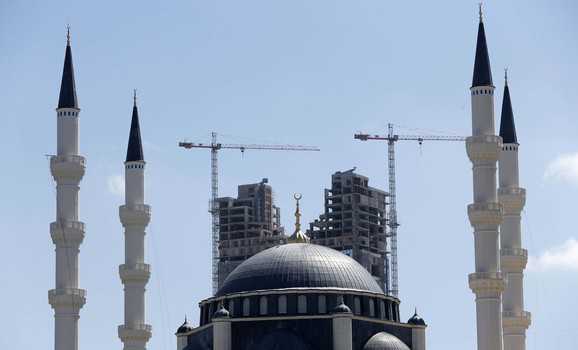
    Ankara will soon have another version of the Garden of Religions, inaugurated in December 2004 by Prime Minister Recep Tayyip Erdoğan in the Belek district of Antalya.

    A mosque complex is being constructed on the Bilkent University campus, and it will also feature a church and a synagogue. Expected to be Turkey’s new protocol mosque for official visits, the complex will see completion in September.

    To be named the Doğramacızade Mosque after the founder and honorary rector of the university, Professor İhsan Doğramacı, the complex will be a little different from its peer in Antalya, as the church and synagogue will be inside the mosque, forming two separate sections. The one in Belek has a garden with three separate places of worship.

    However, the project has one challenge to face: Before it is completed it needs to be endorsed by the Directorate of Religious Affairs, which must make an interpretation in line with Islamic jurisprudence about the permissibility of followers of three different religions worshipping in the same place.

    A number of officials from the directorate told Today’s Zaman that they knew about the construction of the complex but had no idea about the two separate rooms to be used inside the mosque as a church and a synagogue.

    In their appeal for the directorate’s approval, officials from the Professor İhsan Doğramacı Foundation requested that they themselves be permitted to appoint an imam to the mosque, but they also said that they were not averse to the idea of the directorate appointing a qualified and accomplished imam to such an important mosque.

    The mosque’s plan was drawn up upon the instructions of Doğramacı, the son of a Turkoman family from Kirkuk. Its architecture is described as “very authentic and republican style” by Doğramacı. Having bought the building plot shortly before construction began, Doğramacı is covering all the building expenses himself. Paying close attention to every detail of construction, he is reported to have spent about $1 million so far.

    What makes the project distinctive is that it has been planned as the official protocol mosque of Ankara. The two rooms inside the mosque will be set aside for Christian and Jewish students and lecturers from the Bilkent, Hacettepe and Middle East Technical universities.

    The building plot is 12,000 square meters. The mosque will sit on a 4,500-square-meter portion, and the rest of the plot will be set aside for green areas. The mosque building will also have conference and exhibition halls for conferences and panel discussions on religious and ethical issues.

    In addition to the women’s section, the mosque will have two benches at the back for those with health problems that prevent them from kneeling and prostrating in prayer. There will be a moving walkway for the elderly and a separate entrance and exit for official guests to enter and leave with ease. There will also be a large parking lot.

    Project based on Islamic tolerance

    Houses of worship of the three Abrahamic religions sharing a common space is not actually a first in the history of Muslim Turks. The first example to be cited would be İstanbul’s Dar’ul-ajaza charity home, which for centuries had separate places for the followers of all three religions to worship. With the idea of allowing all people, regardless of faith, to benefit from these charitable institutions in mind, the Ottoman state had a worship room built for all three of the religions in this charitable place, along with innumerous others.

    Similar places that combined places of worship of all three religions existed throughout the Ottoman lands, particularly in İstanbul’s Ortaköy district and Hatay, or Antioch.

    When the first Garden of Religions was opened in Antalya in 2004 by Prime Minister Erdoğan, the inaugural ceremony was attended by Ali Bardakoğlu, the head of the Directorate of Religious Affairs, Alphonse Sammut, a representative of the Turkish Catholic churches, Dasiteos Aragnostopoulos, a representative of the Fener Greek Orthodox Patriarchate, İshak Haleva, chief rabbi of the Turkish Jewish congregation and the Armenian patriarch, Mesrob II Mutafyan. The Kuşadası Businessmen’s Association (KUSİAD) also launched a similar project after witnessing foreign visitors’ positive reactions to the two previous projects. The Kutadası Garden of Religions is being built on an 8,500-square-meter plot. The site will have conference and exhibition halls, too.

    ERCAN YAVUZ ANKARA

    Source: Todays Zaman, 12 July 2008