Year: 2010

  • Tajikistan President says ready to cooperate with Turkey

    Tajikistan President says ready to cooperate with Turkey

    TUSKON Chairperson Rizanur Meral, in his part, said that they accepted President Rahmon’s invitation to Tajikistan.

    Thursday, 23 December 2010 11:32
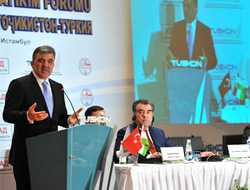
    President of Tajikistan Emomali Rahmon said Wednesday that “without investments, it would not be possible to make use of Tajikistan’s natural and human potential”.

    Speaking at the “Turkey-Tajikistan Trade and Investment Forum”, organized by the Confederation of Businessmen and Industrialists of Turkey (TUSKON) in north-western province of Istanbul, Rahmon said that “the Tajik government was doing all it can for investors”.

    We expect great changes in joint commercial and economic spheres. The groundwork for such a change is ready. We, once again, invite you to Tajikistan. Any businessperson travelling to Tajikistan will not feel as a foreigner, Rahmon underlined.

    The trade volume between Turkey and Tajikistan increased by two fold in 2010 when compared to the previous year. Nonetheless, the trade volume is far behind the trade volume in 2007 which was 500.5 million USD, Rahmon said.

    Conditions are ripe to develop Turkish-Tajik commercial and economic relations. To date, Turkey has extended assistance worth 40 million USD to Tajikistan. There are 53 Turkish companies operating in Tajikistan, however, this number is very few, Rahmon said.

    Tajikistan has taken crucial steps for commerce and investments. We can state that Tajikistan has entered a phase that businesspeople can have confidence in. Volatile days in Tajikistan are over, Rahmon said.

    Tajikistan still faces certain problems in investments. Without investments, it would not be possible to utilize Tajikistan’s natural and human potential. We invite, once more, (Turkish) investors to Tajikistan, Rahmon said.

    “Ready for cooperation”

    Touching on Tajikistan’s natural resources, Rahmon stressed that there could be great opportunities to produce electricity in his country.

    Tajikistan has the world’s richest silver mines. Certain mineral resources are being processed by companies from China and Canada. Many other mineral resources are currently waiting to be processed, Rahmon underlined.

    We are ready to cooperate with Turkey. Turkish companies are presently involved in 60 projects in Tajikistan that are worth around four billion USD, Rahmon said.

    TUSKON Chairperson Rizanur Meral, in his part, said that they accepted President Rahmon’s invitation to Tajikistan.

    We will visit Tajikistan with a group of Turkish businesspeople in the first half of 2011, Meral also said.

    “$317 mln-trade volume”

    The Republic of Tajikistan is a mountainous landlocked country in Central Asia. Afghanistan borders it to the south, Uzbekistan to the west, Kyrgyzstan to the north, and People’s Republic of China to the east. Tajikistan also lies adjacent to Pakistan and the Gilgit-Baltistan region, separated by the narrow Wakhan Corridor.

    Turkish President Abdullah Gul also said that Turkish businessmen should boost their investments in Tajikistan.

    Gul said that Turkey and Tajikistan were eager to boost bilateral ties.

    Gul said that Tajikistan had rich mines, marble reserves and water resources, stating that Turkish businessmen should make good use of numerous opportunities in this country.

    Turkish businessmen should attach a special interest in this country, he said.

    Trade volume between Turkey and Tajikistan was 317 million U.S. dollars in the first 10 months of 2010.

    Most of Tajikistan’s population belongs to the Persian-speaking Tajik ethnic group, who share language, culture and history with Afghanistan and Iran. Once part of the Samanid Empire, Tajikistan became a constituent republic of the Soviet Union in the 20th century, known as the Tajik Soviet Socialist Republic (Tajik SSR). Mountains cover over 90% of this Central Asian republic.

    After independence, Tajikistan suffered from a devastating civil war which lasted from 1992 to 1997. Since the end of the war, newly established political stability and foreign aid have allowed the country’s economy to grow. Trade in commodities such as cotton and aluminium has contributed greatly to this steady improvement.

    AA
  • Pakistan, Turkey to share expertise in field of anti-terrorism, anti-money laundering

    Pakistan, Turkey to share expertise in field of anti-terrorism, anti-money laundering

    ISTANBUL: Turkish Interior Minister Besir Atalay held a meeting with Federal Minister for Interior, Senator A. Rehman Malik at Ministry of Interior, Istanbul. The meeting held in a very cordial atmosphere in which bilateral issues and matters pertaining to Human Smuggling, Drug Smuggling, money laundering and terrorism came under discussion.

    The Turkish Minister of Interior Besir Atalay appreciated Pakistan for action against terrorists and making Pakistan more safer. He appreciated the role of Pakistan in the war against terrorists and recognized the services of people of Pakistan and law enforcers for fighting fearlessly against terrorists. Both the Interior Ministers agreed to share expertise in the field of anti-terrorism and anti-money laundering.

    Turkey will send delegation of senior officers to Pakistan to share their expertise and Pakistan also agreed to send the delegation of officers to learn Turkish experience. Both Interior Ministers once again re-affirmed to work together and to make the region safer for the coming generations.

    via ONLINE – International News Network.

  • Turkey, Japan in Exclusive Talks for Nuclear Plant

    Turkey, Japan in Exclusive Talks for Nuclear Plant

    By Tsuyoshi Inajima

    (Updates minister’s comments in third paragraph.)

    Dec. 23 (Bloomberg) — Turkey is holding exclusive talks with Japan to build its second nuclear power plant after failing to reach an agreement with South Korea.

    Turkey aims to conclude a deal with Japan in three months, Energy Minister Taner Yildiz said today in an interview in Tokyo. Yildiz is due to hold talks with Toshiba Corp., Tokyo Electric Power Co. and Itochu Corp.

    South Korea and Turkey failed to reach an agreement to build a nuclear power plant in Sinop on the Black Sea coast because of “differences in issues including electricity sales price,” South Korea’s Ministry of Knowledge Economy said Nov. 13. Japan, which won a nuclear plant contract in Vietnam in October, plans to spur economic growth by exporting more nuclear reactors and technology products.

    “We have some targets to recover the time we have lost” to build the nuclear plant, Yildiz said. “Within three months, main frameworks should be determined,” including financing, treasury, insurance, partnerships and power tariffs, he said.

    Yildiz said his visit to Japan comes after officials from Toshiba and the Japanese government held two rounds of technical meetings in Turkey on the project. “They told us their first impression is quite positive,” he said.

    Turkey received an offer from Japan to build a nuclear plant in the country, CNBC-e television said on Oct. 7, citing Yildiz. The offer is an “aggressive one,” the Istanbul-based news channel cited the minister as saying then.

    ‘More Aggressive’

    “Major players including Japan are getting more aggressive in the global nuclear market after they were beaten by South Korea last year to the United Arab Emirates’ $18.6 billion order,” said Shin Min Seok, an analyst at Daewoo Securities Co. in Seoul.

    South Korea emerged as a competitor in the global nuclear market after Korea Electric Power Corp. beat General Electric Co. and Areva SA in December last year to the U.A.E. order.

    Yildiz and his Japanese counterpart Akihiro Ohata are due to sign a memorandum of understanding on nuclear power cooperation tomorrow, Japan’s trade ministry said in a statement yesterday.

    On Dec. 25, the Turkish minister is scheduled to visit Tokyo Electric’s Kashiwazaki Kariwa nuclear power plant, the world’s biggest atomic power station, according to an e-mailed statement by the ministry. Tokyo Electric officials including Executive Vice President Sakae Muto will meet Yildiz at the plant in northern Japan, company spokesman Norio Takahashi said by telephone today.

    Calls to the offices of the spokesmen for Toshiba and Itochu weren’t answered as businesses and markets are shut for a public holiday today. An Itochu spokesman didn’t immediately respond to a voice message seeking comment left on his mobile phone.

    Russia and Turkey signed a contract in May to build Turkey’s first nuclear power plant with four reactors, at a cost of about $20 billion after more than a year of negotiations. Russia’s Rosatom Corp. will operate the plant in Akkuyu for 60 years, Russian Deputy Prime Minister Igor Sechin said Dec. 15.

    “My expectation and hope is that the cost will not be higher than numbers we have been talking with Russia and South Korea,” Yildiz said today.

    –With assistance from Shinhye Kang in Seoul. Editors: Amit Prakash, John Viljoen.

    To contact the reporter on this story: Tsuyoshi Inajima in Tokyo at [email protected].

    To contact the editor responsible for this story: Amit Prakash at [email protected].

    via Turkey, Japan in Exclusive Talks for Nuclear Plant – BusinessWeek.

  • Davutoglu Says Karabakh Peace Only Possible Through Teritorial Integrity

    Davutoglu Says Karabakh Peace Only Possible Through Teritorial Integrity

    ISTANBUL (Today’s Zaman)—Ankara continues to support a resolution of the Nagorno-Karabakh conflict that sees the dissolution of the mountainous Armenian Republic and its transfer to Azeri control, Turkish Foreign Minister Ahmet Davutoglu said Thursday.

    “Turkey wishes restoration of peace and order in southern Caucasus within the framework of this solution. We want normalization of relations not only between Turkey and Armenia but also between Armenia and Azerbaijan,” Davutoglu told reporters during the 11th summit of the heads of state and government of the Economic Cooperation Council (ECO) in Istanbul.

    Asked if pressure on Turkey would change its stance on the Nagorno-Karabakh conflict, Davutoglu said Turkey defends a solution based on Azerbaijan’s territorial integrity. “This is the norm of international relations. Similarly, Turkey wishes peace and order to prevail in the southern Caucasus within the scope of this solution,” he said, adding that Ankara is eager to normalize relations with Armenia.

    Davutoglu ruled out the likelihood that Turkey will capitulate under pressure, adding that Ankara is ready to support every kind of peaceful process in the Caucasus.

    via Davutoglu Says Karabakh Peace Only Possible Through Teritorial Integrity | Asbarez Armenian News.

  • Don’t Blame Kobe for Turkey’s Armenian Genocide

    Don’t Blame Kobe for Turkey’s Armenian Genocide

    Who would have thought that Kim Kardashian would take off on Kobe Bryant for anything other than their shared sports and celebrity status? Kardashian has carved out a growth industry in flesh, baring, body ogling and sex titillation. But there’s Kardashian lambasting Bryant for his two year deal pitching the glories of riding the skies on Turk Hava Yollari AO, Turkish Airlines, the country’s state-run airlines.

    Kardashian and a legion of Armenian organizations and leaders are ticked at Bryant for the deal which they say is tantamount to Bryant endorsing Turkey’s slaughter of 1 to 2 million Armenians in 1915. They want Bryant to do two things, scrub the deal and speak out against Turkey for its dogged refusal to admit its murderous crime against the Armenians.

    Bryant does not put a PR sheen on that crime, and knocking him for the airlines deal does nothing to bring Turkey to heel for the genocide. It’s simply the pure symbolism on the protester’s part in using Bryant as the foil for their legitimate campaign to get Turkey to admit the slaughter. The slaughter has been well-documented. Turkey’s near century refusal to admit, apologize, and atone for it for nearly a century is a galling blight on history, morality, and human rights. Armenian organizations are right to press the case against the Turkish government for the massacres. But that’s where it should begin and end. The fault and the blame for Turkey’s refusal to admit the killings lay with the Turkish government, the United Nations, Congress. Armenians have pushed for years the various world organizations and Congress to brand the massacres as genocide.

    The House Foreign Affairs Committee resolution was introduced in 2007. It stalled. The Obama administration has come under fire for refusing to support Congressional action on the genocide resolution. The resolution specifically calls on Obama to reflect “understanding and sensitivity” to Armenian genocide.  The resolution puts the Obama administration in a virtual no win situation. If it endorses it, it risks a major breach with the Turkish government. The country is just too vital as an ally that provides crucial intelligence, military and logistical support for its wars in Afghanistan and Iraq, and a counterbalance to l Iran and counter and radical Islamic groups in the region. Though France passed a resolution recognizing the genocide in 2001 and it had no effect on trade between the countries. France is not waging war in Afghanistan and does not need Turkey aid in protecting its regional interests. The Congressional resolution bumps up hard against Middle East geopolitics and security interests. Bryant’s airline deal will have absolutely no effect in influencing US and Turkish relations.

    Then there’s the genocide. It is compared with the Nazi Holocaust against the Jews and Armenian activists say that German companies, and the German government were held accountable, apologized and paid reparations. There also the comparison to the US government’s apology and payments to Japanese-Americans for the seizure of their property, businesses, and internment during World War II, the US governments  apologies and land concession to American Indians for the theft of their land. In each case, the actions were government sanctioned, condoned and encouraged.  It was not the act of one individual doing business with a company decades after the historic crime. That’s the case with Bryant and Turkish Airlines.

    In the past celebrities have been hammered by activist groups for shilling for controversial products or companies such as the Kruggerand sales during the Apartheid era or Nike accuse of sweat shop labor practices in Asia.  The offending companies or products directly affected the lives of workers, and propped up a government that grossly violated human rights. In each case, the celebrity was lending their name to that exploitation and human rights abuses.

    Bryant’s deal doesn’t fit that category. A spokesman for Turkish Airlines got it right in the statement defending the airlines deal with Bryant, “Kobe Bryant is a cultural figure, not a historian, and is in no way related to a sensitive and complex controversy over highly contested history.”Still, Armenian leaders hector Kobe as a hypocrite for denouncing the genocide in Darfur. But that is not a fair comparison. The genocide in Darfur did not happen a century ago. It’s recent and by some accounts still ongoing.  That genocide has been universally condemned.

    Kobe for his part has remained tight lipped about the deal. There is little reason to think or expect that he will cancel it. It is a straight business proposition made by a major corporation with one of the world’s best most recognizable celebrities. Armenian groups are right to press Congress and the Obama administration to press the issue of Turkey’s responsibility for its historic crime. Just don’t blame Kobe for it.

    Earl Ofari Hutchinson is an author and political analyst. He hosts nationally broadcast political affairs radio talk shows on Pacifica and KTYM Radio Los Angeles. This post was republished, with his permission.

    via Don’t Blame Kobe for Turkey’s Armenian Genocide | The Atlanta Post.

  • Iranian president: ‘Sanctions have always failed’

    Iranian president: ‘Sanctions have always failed’

    Istanbul, Turkey (CNN) — After meeting Thursday with Turkey’s president in advance of multinational discussions on Iran’s controversial nuclear program, Iranian President Mahmoud Ahmadinejad said he hopes the talks will be productive but stressed that international sanctions “have no impact on Iran’s decision-making process” and “have always failed.”

    Ahmadinejad and Turkish President Abdullah Gul, along with ministers of the two countries, met separately Thursday after the 11th summit meeting of the Economic Cooperation Organization at the Ciragan Palace in Istanbul. Leaders and delegations from Afghanistan, Pakistan and other Central Asian countries also attended the summit, whose aim was to promote regional economic development and cooperation among member states.

    Discussions between Iran and what is known as the P5 plus 1 — the five permanent members of the U.N. Security Council (the United States, Britain, France, Russia and China) plus Germany — are to be held in Istanbul in late January. This second round of talks was agreed to after two days of discussions between Iran and the six-nation group earlier this month in Geneva, Switzerland.

    Though Turkey will have no direct role in the January discussions, “It is in our advantage as well as Iran’s that the matter is resolved through diplomatic ways,” Gul said.

    “Turkey has important contributions. It is important that progress is made in the content of these meetings,” he added.

    The United States, other Western countries and Israel fear that Iran wants to develop nuclear weapons, an allegation Tehran has steadfastly denied, saying its nuclear program is strictly for peaceful purposes. Iran already faces stiff sanctions from the international community because it has continued to enrich uranium.

    “We hope the Istanbul meeting becomes a good meeting with lasting results,” Ahmadinejad said during a news conference Thursday. However, he said, “Sanctions have no impact on Iran’s decision-making process … and sanctions have always failed. … Our enemies cannot harm our very strong economy by imposing sanctions on Iran.”

    In a speech during the summit, Gul, who now assumes the rotating presidency of the Economic Cooperation Organization, succeeding Ahmadinejad, pointed to the low levels of economic cooperation among the ECO countries and said: “We need to develop the region and give back its former glory,” referring to the ancient silk and spice roads that ran through Central Asia.

    Gul also called on member states that have not yet signed the Economic Cooperation Organization Trade Agreement to sign it.

    A declaration was issued at the end of the summit calling on member countries to have closer economic cooperation.

    The Turkish president, during a news conference, called the summit “very productive.” He said Iraq made a bid to join the organization, which was welcomed by the member states.

    The Economic Cooperation Organization, established in 1985, promotes regional economic development and cooperation. In addition to Turkey, Iran, Afghanistan and Pakistan, members include Azerbaijan, Kazakhstan, Kyrgyzstan, Tajikistan, Turkmenistan and Uzbekistan.

    Azerbaijan will host the next organization’s summit in 2012.

    via Iranian president: ‘Sanctions have always failed’ – CNN.com.