Year: 2010

  • Istanbul’s cultural heritage goes online

    Istanbul’s cultural heritage goes online

    ISTANBUL – Anatolia News Agency

    The cultural valuables of Istanbul are now accessible thanks to a website project. The first of its type in Turkey, the website presents 200 years of history. ‘From now on, everyone will be able to reach all kinds of information about Istanbul in a virtual environment. They can develop projects on Istanbul and reveal the city’s culture, cultural industry and tourism policies,’ said Istanbul Culture and Tourism Director Ahmet Emre Bilgili
    A project named “Istanbul’s Cultural Heritage and Culture Economy Inventory,” which aims to gather Istanbul’s cultural values under the same roof and present the data for general use in a virtual environment, has been finished. The website www.istanbulkulturenvanteri.gov.tr began to operate Wednesday morning.

    At a press conference held Tuesday at Richmond Hotel, Istanbul Culture and Tourism Director Ahmet Emre Bilgili said the project was implemented in collaboration with the Culture and Tourism Ministry, the Turkish Academy of Sciences, or TUBA, and Istanbul Metropolitan Municipality with support from the French Institute of Anatolian Studies and the Istanbul 2010 European Capital of Culture Agency.

    “From now on, everyone will be able to reach all kinds of information about Istanbul in a virtual environment. They can develop projects on Istanbul and reveal the city’s culture, cultural industry and tourism policies. This website was one of the biggest deficits of the city,” Bilgili said.

    Bilgili said the application was a first in Turkey and very important in the world. “Within the scope of the project, it has been collaborated with 200 institutes and worked with the world’s best experts. This work will be a model for other Turkish cities. If every city takes its own inventory like we did, Turkey’s cultural heritage and industrial inventory will be revealed,” he said.

    Bilgili said the inventory would be continuously developed and updated and the real owner of the project would be the Istanbul Governor’s Office and the Istanbul Metropolitan Municipality. “The website’s language is only Turkish at the moment, but it will be translated into different languages. Also, 17 books have been prepared for the project and three of them have been published by the Istanbul Bilgi University.”

    Dedicated to mankind and the Turkish nation

    TUBA President Yücel Kanpolat highlighted the significance of the project, saying that it revealed what Istanbul has and what it doesn’t. He said the project was nonprofit and was dedicated to mankind and the Turkish nation, adding that they would ready to share the project with other countries.

    The project’s coordinator Hakan Tanrıöver said the project was completed in 15 months by a 48-person team. “Istanbulkulturenvanteri.gov.tr has 150,000 webpages and 60,000 photos. The data is gathered under six main titles including ‘rural architecture,’ ‘archaeology,’ ‘public culture,’ ‘culture economy,’ ‘maps’ and ‘Istanbul bibliography.’

    Tanrıöver said people could follow 200 years of change of the same place since 1776 and all maps were included in the website. “All of Istanbul’s cultural and traditional values have been documented. This is an extraordinary resource for Istanbul lovers and researchers. Also, the records of all books, doctorate and master theses on Istanbul are available on the website, which includes 27,690 structures.”

    Sea walls documented for the first time

    Tanrıöver said Istanbul’s sea walls were also documented in the inventory for the first time, and they informed the municipality’s relevant department about bad structures around the sea walls.

    “The total budget of the project was 1.5 million Turkish liras. One million liras was provided by the Istanbul 2010 Agency and the rest by TUBA and the Culture and Tourism Ministry,” he said.
  • Metro on Istanbul’s Anatolian side to have cars ‘without conductors’

    Metro on Istanbul’s Anatolian side to have cars ‘without conductors’

    ISTANBUL – Hürriyet Daily News

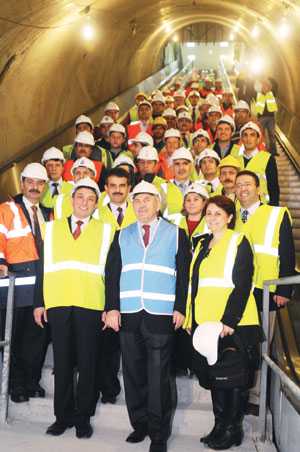
    The Istanbul mayor and other officials pose in their construction gear.

    Istanbul will receive its first fully computerized metro trains in 2011, according to Istanbul Mayor Kadir Topbaş.

    “With the advance technology we are using, the wagons will be able to enter into the system without the presence a conductor when required,” Topbaş said Wednesday during a speech at the under-construction Küçükyalı Station on Istanbul Anatolian side.

    Küçükyolu is the ninth station on the 16-station Kadıköy-Kartal metro line.

    The construction of the metro line was started in March 2008 and was continuing apace, said Topbaş, adding that the 22-kilometer line was part of a metro project costing $1.5 billion.

    “In a single line 70,000 commuters will be transported an hour and the total commute time will be diminished to 29 minutes between Kadıköy and Kartal,” said Topbaş, noting that approximately a million passengers would benefit from the metro line every day.

    Topbaş said 83 percent of the construction, 40 percent of the detailed work and 21 percent of the electro-mechanical work on the line had already been completed.

    “We are hoping to do a test drive in May 2011 while the project will be ready for use at the end of 2011,” said Topbaş.

    The construction of 15 of the 16 stations was continuing, while Ayrılık Çeşme, which the Kadıköy-Kartal line is sharing with the Marmaray rail project, was finished in December, said Topbaş, adding that they planned to extend the metro line to the Asian side’s Sabiha Gökçen Airport in the upcoming years.

    The stations connecting Kadıköy and Kartal metro line include İbrahimağa, Acıbadem, Ünalan, Göztepe, Yeni Sahra, Kozyatağı, Bostancı, Küçükyalı, Ayrılık Çeşme, Maltepe, Gülsuyu, Cevizli, Hastane and Soğanlık.

    The metro project owned by the Istanbul Metropolitan Municipality is being realized by Avrasya Metro Group, a joint venture of Astaldi, Mak-yol, and Gülermak.

  • Ottoman architecture not just from Armenians and Greeks, says historian

    Ottoman architecture not just from Armenians and Greeks, says historian

    ISTANBUL – Anatolia News Agency

    Two recent exhibitions on Istanbul’s Armenian and Greek architects have caused a debate among experts on Ottoman architecture. While some say there is an attempt to show that Istanbul’s recent architectural heritage belongs to Armenians and Greeks only, others think that such a prejudiced approach goes against academic objectivity

    Selman Can has studied Ottoman architecture extensively.

    Turkish architects have been ignored in architectural exhibits opened as part of the 2010 European Capital of Culture, and curators have tried to show that Istanbul’s architectural heritage solely belongs to Armenians and Greeks, according to an art historian.

    “There are attempts to show Istanbul’s architectural heritage is merely the preserve of Armenians and Greeks. There are already many events on the same issue,” said Atatürk University Fine Arts Faculty member Associate Professor Selman Can, who researches Ottoman architecture and art and is due to soon publish a book on the issue. “Isn’t there any structure built by Turks in the city? I want the supporters of these exhibition projects to ask themselves this question.”

    Can made the comments in response to two exhibitions about Istanbul’s Greek and Armenian architects that recently opened as part of the Istanbul 2010 European Capital of Culture events.

    Speaking to the Anatolia news agency, Can said he had spent years sifting through the thousands of archive documents regarding Ottoman architecture. He said because few Turkish art historians can speak or read Ottoman Turkish, very few of the documents have been evaluated.

    He said one of the exhibitions recently opened as part of the Istanbul 2010 European Capital of Culture events, titled “Armenian Architects of Istanbul in the Era of Westernization” that features 100 photos of buildings reportedly built by 40 Armenian architects, who lived in Istanbul at the end of 19th century and the beginning of the 20th century.

    Can said the archive documents showed that the real architects of the structures, most of which are claimed to belong to the Balyan family, were different.

    “A similar exhibition titled ‘Greek Architects of Istanbul in the Era of Westernization’ was opened for Greeks,” Can said. “Why is the third step of these projects not Istanbul’s Turkish architects?”

    Arguing that the exhibitions did not show the truth, Can said the most radical change in the 19th century in Ottoman architecture was that construction projects were put up for tender.

    “In this period, Armenians and Greeks won a big part of these tenders because they had financial power. Particularly, the Balyan family carried out a contracting business for three generations. The Balyans owned the first official construction company in the era worth more than 1 million Ottoman gold coins.”

    Can said the Balyans were the biggest contractor family at the end of 19th century and most of their projects were built in collaboration with different architects.

    Touching on the Armenians, Can said: “By exaggerating their works, they succeeded in promoting their community very well. They had international support and architecture was used as a tool to form an identity and a nation.”

    Imperial architecture

    Art Historian Süleyman Faruk Göncüoğlu said the structures built at the turn of the last century were in the empire’s style of architecture at the time.

    Ottoman architecture was a reflection of the civilization, he said, adding that the last civilization in the world was the Ottomans and that all those following it were merely cultural hegemonies.

    He said Istanbul architecture included many structures built under the coordination of Seyyit İsmail Zühtü Altunizade.

    “Most of the buildings claimed to be built by Armenian architects were built under the coordination of Altunizade. When we look at 19th century Ottoman structures, the Düyunu-i Umumiye [Istanbul Men’s School], Haydarpaşa Hospital, Şişli Etfal Hospital, Cibali Tekel Building [currently Kadir Has University] are all from the Sultan Abdülhamit II period,” Göncüoğlu said.

    “I agree with [Can] because he expresses his ideas about archival documents,” he said.

    He said such exhibitions showed the richness of Turkish architecture but should not be limited to a certain community. “This is to deny the architectural understanding of the Ottoman civilization and will cause unnecessary debates,” Göncüoğlu said.

    Archive documents should be primary source

    Marmara University Faculty of Literature member Professor Selçuk Mülayim said some members of the Balyan family were contractors and others were master builders.

    “Some did not have an architectural education. Archive documents should be based on this issue. The architectural style of a structure is not important; they all reflect Ottoman identity. But art historians search for the architecture of a building. As a result, all of the 19th century buildings show us the Ottoman identity,” he said.

    Speaking about the debates, Mimar Sinan University Architectural Restoration Department member Professor Suphi Saatçi said regardless of their identity, Balyans or others, all of those architects served the same empire.

    “The Balyans were not the architects; they were contractors. Regardless, they served on this land as Ottoman citizens,” Saatçi said, adding that such debates were not dangerous. “Discussing whether the Balyans were real architects or not is not a problem. A scientific debate is always useful.”

    A prejudiced approach

    Bosphorus University History Department member Associate Professor Ahmet Ersoy said it would be prejudiced to attempt to exclude Ottoman Greeks and Armenians from the heritage of Ottoman architecture and culture. He said such an approach would go against academic objectivity.

    “No one can deny that Greeks and Armenians had a central role in the Ottoman construction sector. The Balyans were the most effective and productive family as contractors and investors in this field. The main problem is how the archives are used. Raw information in an archive can be manipulated by prejudiced researchers,” he said.

    Real architects according to archives

    A number of buildings that have been attributed to the Armenian Balyan family actually belong to others, according to Atatürk University Fine Arts Faculty member Associate Professor Selman Can, who studies the issue.

    – The Sultan Mahmut II Tomb does not belong to Garabed Balyan, but to engineer Abdülhalim Efendi.

    – The Bayezit Fire Tower, Rami Barracks and Ortaköy Mosque do not belong to Senekerim Balyan, Kirkor Balyan and Nikoğos Balyan, but to Seyyit Abdülhalim Efendi.

    – The Mecidiye Barracks (Taşkışla) and Harbiye Military Museum do not belong to Serkis Balyan, but to British architect William James Smith.

    – The Yıldız Hamidiye Mosque does not belong to Serkis Balyan, but to the Greek Nikolaki Kalfa.

    – The Sarayburnu storehouses do not belong to Simon Balyan, but to German August Jasmund.

    – The Baltalimanı Palace (Büyük Reşit Paşa Palace) does not belong to Sarkis Balyan, but to Italian Gaspare Fossati.

  • Tt eSPORTS has announced the first launch in Turkey

    Tt eSPORTS has announced the first launch in Turkey

    Tt eSPORTS is soonly going to have an official press launch in Istanbul on 27th, Dec, 2010. This exclusive event will be opened to the most important press in the technology field and big retail store representatives. At this launch, Tt eSPORTS is proud to have MSI as main sponsor of mother boards and graphic cards in the demo systems, and Tt eSPORTS will release their latest keyboards, mouse, and headsets: CHALLENGER,CHALLENGER Pro, MEKA G1, BLACK, ISURUS, and SHOCK.

    Tt eSPORTS will also announce the sponsorship of Turkey’s best Star Craft 2 team, Team V4, which will give a demonstration game play and share their secrets of being the top players in Turkey. Team members: Anzelot, Borked, Darvin, Oyman, Sugosu, Vedetta and Venom show their excitement taking part in Tt eSPORTS’s launch to Turkey.

    Pentagram, manager of Team V4 said: “The sponsorship with Tt eSPORTS and the Team V4 is another example of the strong foundation building process that the Team V4 is trying to develop by being linked with reputable companies, that helps to build a professional attitude within the team.”

    MSI PR Specialist, Gokhan Bodur and Zeynep Wang from Tt eSPORTS Turkey.

    Zeynep Wang, representative of Tt eSPORTS and Thermaltake points out:” Gaming industry is a highly potential market in Turkey right now. Tt eSPORTS, just as what we’re doing in all over the world, will bring the true e-sports spirit and make every gamer in Turkey have the chance to live in Tt eSPORTS culture!”

    Ever since the first appearance in mid 2010, Tt eSPORTS had received attentions with its unique appoarch, and its launch in Turkey is also highly expected from all over the world. Want to know more about who Tt eSPORTS is and what we’re going to do? Just grab your coat and have a quick visit to Dedeman Hotel (Esentepe, Istanbul) on 27th, Dec, 2010 at 14:00. Testing system will be built in the event to make sure evey participant can get a chance to test Tt eSPORTS’s extraordinary gaming gear. And of course, at the end, with Tt eSPORTS’s exciting giveaways, evey participants will not be left going home along!

    About Team V4

    Team V4 is no doubt the best and strongest team we can ever see from Turkey’s Star Craft 2 teams. 4 members of Team V4 are playing in SC2 Turkish National Team (Darvin , Oyman/ Waradmiral, Pentagram, Sugosu). In the main leagues in Turkey (ESL and TSL), Team V4 members are also always occupying the first 3 places. With the power of the rest team members (Anzelot, Borked, Vendetta, Venom), this powerful 8-member team is always challenging for higher glory.

    About MSI

    MSI, world’s leading motherboard and graphics card manufacturer will be the the main hardware sponsor of the event, providing extreme gamers with iron stable and top performance rigs thanks to MSI’s Military Class components, for mor information, please visit: tr.msi.com

    About Tt eSPORTS

    Thermaltake is a well known brand for gaming & DIY in Case, Cooler, and PSU for years. Due to the constant requests for keyboards and mice from gamers and end users, Thermaltake decided to create a series of gaming keyboards, mice, and headsets with the Tt eSPORTS brand. By using Tt eSPORTS, we want to extend our product lines into the gaming industry, and provide more ”personalized gaming” gears to gamers and enthusiasts worldwide. With years of experience in gaming industry, Tt eSPORTS is committed to bring the most personalized and the highest quality weapons for the most competitive cyber battles. For more information, please visit www.ttesports.com tr.thermaltake.eu

    via Tt eSPORTS has announced the first launch in Turkey. | bit-tech.net.

  • Turkey to build new tram line to connect cruise tourists to Blue Mosque

    Turkey to build new tram line to connect cruise tourists to Blue Mosque

    Mayor said the project will be completed within five months, before the start of next year’s tourist season.

    Wednesday, 22 December 2010 17:44

    World Bulletin / News Desk

    A new tram line will be built near the Salıpazar cruise ship port to make it easy for cruise tourists to visit İstanbul’s famous tourist destinations, including Sultanahmet Square, home to the Blue Mosque and the Hagia Sophia.

    The new tram line will connect the tourists to the current tram line, which stretches from Kabataş to Zeytinburnu, passing through the historical peninsula, Mustafa Demir, the mayor of İstanbul’s Fatih Municipality, told the Anatolia news agency on Wednesday.

    “The project is ready. We will have it ready in time for next year’s tourism season,” Demir noted.

    The mayor said ships bring with them thousands of people who visit the city for a short period of time. To ensure these visitors make the most of their short stay, he said the municipality had to improve transportation between the port and major landmarks.

    A route was arranged this year for buses to carry cruise tourists to Sultanahmet Square upon a request from the Turkish Association of Travel Agents (TÜRSAB).

    Sultanahmet Square will be made more visitor-friendly with a new, specially designed granite pavement project, Demir had earlier announced. He said the project will be completed within five months, before the start of next year’s tourist season. The project will be carried out with funding from the İstanbul 2010 European Capital of Culture Agency.

    The tourist district was closed to vehicle traffic earlier this year as part of another project by the İstanbul Metropolitan Municipality Transportation Coordination Center (UKOME) to create more space and comfortable areas for visitors.

    “There are currently eight different zones paved with eight different types of stone in the area, without any harmony between them,” said Demir, explaining the rationale behind the project.

  • I finally arrived! And in one piece to boot!

    I finally arrived! And in one piece to boot!

    Random impressions of Turkey so far:

    Surprise, surprise, the Bosphorous is beautiful!

    A couple of nights ago was a full moon, and we sat out on the balcony with some friends (because it has hovered around 60 degrees here) which overlooks the Bosphorous and had some conversation, wine, and music.  It. Was. Wonderful.

    I love the neighborhood we’re staying in – a strange mix of genuine Turkish and globalized upscale (Swatch stores and piercing parlors, and also the office of the Communist Party of Turkey).There’s an adorable tram system (called tramvaj, like in Russia, and tokens are jetoni, like in Russia), which looks antique and matches all the rolling carts that the roasted chestnut vendors use (no I haven’t tried them yet, yes I plan to.)  I could easily use this to get around, but instead I’ve been walking next to them.

    If you stop moving even for an instant, you have a pack of men descend on you like vultures on some choice carrion.  Here, in no particular order, is a list of my favorite things street vendors have said to me so far:

    -“Sir!  Sir!”

    -“As soon as I saw your beautiful green eyes, I knew you were from America”

    – (extending a half eaten sandwich) “I will share my bread with you!” (Actually I’m not sure what this one was about.  I almost stopped just to find out.)

    -(In the Spice Bazaar, in a high-pitched English accent) “Ooooh Cindy look at the colors, they’re LOVELY!”

    -“Devushka!” (because I am always happy when someone does not automatically assume I’m American.  Score two for me!)

    In Istanbul, neighborhoods are divided up by what kind of crap they sell.  So, for example, there’s the rug section of town, the home appliance section of town (I actually saw someone selling bathroom fixtures of all varieties at the market, ps), and the musical instruments section of town (which I have to walk through to get to the Galata Bridge to cross over the Golden Horn).  The musical instruments part of town is characterized by the steepest hill in the universe.  There are stray cats everywhere here, but they seem happy and healthy and I always see people playing with them.  By which I mean full grown men sitting on the street drinking tea and playing with kittens.

    Last night I went to DoRock which is a heavy metal club.  When I got there they were playing 80s metal videos from VH1 on a giant projector screen.  The band was actually great – they played everything from “Johnny B. Goode” to “Smoke on the Water” and I was (pleased to be) dance-abducted (I was bouncing around in my chair when the 50s music started) by this GIANT Turkish guy with full mustache and beard and scene-appropriate 80s hair who was a GREAT dancer  and kept lifting me above his head and dipping me and profusely kissing my hands.. The only downside was the TURKISH TOILET, which even the hostel does not have.  DISPLEASED.

    Side note: Turkey’s beer is Efes – it comes in several variants, and is both cheap and delicious.

    Today I saw the Hagia Sophia, which was amazing.  I’m still surprised how much cooler these churches are than outside when I walk in, even after a million times.  I also keep forgetting the impossibility of getting a good shot.  All those angles, but something’s always in your way.  I tried anyway.  People have also scratched their names into the beautiful stone, which is disgusting.  The light was amazing, though.

    There are tons of street musicians, and I’ve found that Turkish people will just start singing spontaneously to themselves.  I like this.

    Two days ago, Leah and I wound up right outside the Blue Mosque just as call to prayer started.  The call to prayer is BEAUTIFUL, especially if you are close.  The only problem is that if you are in an area with a lot of mosques, they all play it over their PA, and they are all slightly off as it moves from one direction to another, so its just a cacophony of competing sounds.  In general, there’s always music or shouting or tram bells coming from somewhere.  Combine that with wafting incense, kevaps, etc, and Istanbul is a sure bet for sensory overload.

    via I finally arrived! And in one piece to boot! – Istanbul, Turkey Travel Blog.