Year: 2010

  • Turkey builds on regional ties

    Turkey builds on regional ties

    By Borzou Daragahi, Los Angeles Times

    Reporting from Beirut —

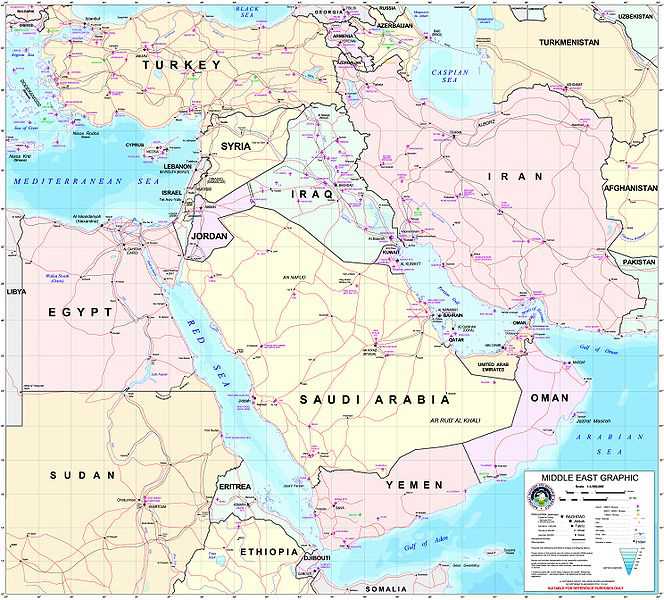
    Turkey took over the rotating leadership of a trade organization that includes Iran, Afghanistan, Pakistan and Central Asian states on Thursday in a post that highlights the country’s increasing economic and political clout.

    Iran’s newly designated caretaker foreign minister, Ali Akbar Salehi, made his first diplomatic appearance at the 11th summit of the Economic Cooperation Organization, or ECO. He joined other envoys and heads of state for a gathering meant to solidify ties between the lands of the ancient Silk Road and establish a free-trade zone among the countries by 2015.

    Get dispatches from Times correspondents around the globe delivered to your inbox with our daily World newsletter. Sign up »

    “It should be our priority to make the old Silk Road a corridor of energy, trade, communication and transportation to promote the welfare of our respective countries,” Turkish President Abdullah Gul said, according to Turkey’s semi-official Anatolia news agency.

    Turkey, Iran and Pakistan founded the ECO a quarter century ago. The trade bloc took on added importance with the addition of newly independent Central Asian states such as energy-rich Azerbaijan as well as Afghanistan in the early 1990s.

    Under an ambitious leadership rooted in the country’s Islamist movements, Turkey has since become a regional powerhouse, with an economy ranking in the top 20 worldwide and a growth rate that rivals that of China. It presents itself as a gateway to Central Asia, though initial attempts to draw Kazakhstan, Turkmenistan, Kyrgyzstan, Uzbekistan and Tajikistan into its sphere of influence under a pan-Turk banner foundered.

    “They’ve turned Istanbul into a major hub,” said Henri Barkey, a Turkey specialist at Lehigh University in Pennsylvania.

    Turkey has also sought to present itself as a diplomatic broker, seeking to ease tensions between Iran and the West and between Syria and Israel. It is scheduled to host international talks next month on Iran’s nuclear program.

    The United States in particular has grown nervous both about what foreign policy analysts have described as Turkey’s lurch eastward and its more ambitious diplomatic endeavors, especially since the rise in the last decade of Prime Minister Recep Tayyip Erdogan and his Justice and Development Party, known by its Turkish initials, AKP.

    “Turkey has evolved from an ordinary wing country of the Cold War era toward a central country determining its position on its own,” said Taha Ozhan, an Istanbul-based analyst at the Foundation for Political and Economic Research, a Turkish think tank close to the government. “Instead of trying to understand Turkey’s recent foreign policy initiatives with concepts like ‘axis shift’ or ‘change of direction,’ one needs to consider them as part of a larger effort to adapt to the transformation process in today’s world order.”

    To many regional countries, Turkey plays an enviable balancing act, maintaining warm and commercially beneficial ties with Syria and Iran on one hand while remaining a member of the North Atlantic Treaty Organization, supplying troops to the security force in Afghanistan and seeking to improve a frayed relationship with Israel on the other.

    “The diplomats of Turkey are playing the role of old wise tribal leaders in settling the disputes in the region,” said Davoud Hermidas-Bavand, a Tehran-based former Iranian diplomat and professor of international relations. “The star of Turkey in term of politics, economy and culture is shining much more brightly than before.”

    But Barkey cautioned not to exaggerate the summit’s significance to Ankara because the organization lumps more economically developed Turkey with authoritarian backwaters such as Azerbaijan and Turkmenistan and war-ravaged Afghanistan and Pakistan. “In the land of the blind, the one-eyed man is king,” he said.

    [email protected]

    Special correspondent Ramin Mostaghim in Tehran contributed to this report.

    Copyright © 2010, Los Angeles Times

    via Turkey builds on regional ties – latimes.com.
  • Iran’s Ahmadinejad urges West to choose ‘path of cooperation’

    Iran’s Ahmadinejad urges West to choose ‘path of cooperation’

    By Scott Peterson, Staff writer / December 23, 2010

    East Sussex, England

    Iran’s President Mahmoud Ahmadinejad advised Western nations Thursday to create a “win-win” scenario for nuclear talks next month by choosing a “path of cooperation over confrontation.”

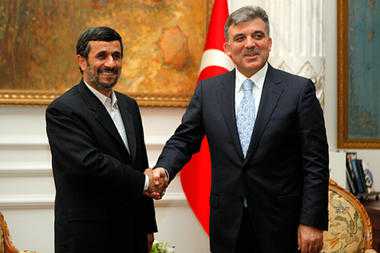
    Iran's President Mahmoud Ahmadinejad (l.) shakes hands with his Turkish counterpart before their meeting in Istanbul on Dec. 23.  Osman Orsal/Reuters
    Iran's President Mahmoud Ahmadinejad (l.) shakes hands with his Turkish counterpart before their meeting in Istanbul on Dec. 23. Osman Orsal/Reuters

    But Mr. Ahmadinejad also delivered a number of broadsides against the West during a regional economic summit in Istanbul, Turkey, where the next round of nuclear talks between Iran and world powers are due by the end of January.

    Co-opting the US tactic of casting the Islamic Republic as having a “clear choice” on its controversial nuclear program – to stop enriching uranium that might be used for weapons, or face unspecified “consequences” – Ahmadinejad said that world powers had “two choices.”

    “One [choice] is to follow the previous policies, and the results of that are clear,” said Ahmadinejad. “They [world powers] used all their resources and they were defeated. They didn’t want us to become nuclear, and now we are. It’s an irreversible trend. To follow the path of confrontation will only have one result: failure.

    “The second path is the path of cooperation,” Ahmadinejad said. “That is in the interest of all parties [and] will be a win-win situation. There will not be failure or defeat for either party.” The January meeting could be “a landmark event, where we can replace confrontation with cooperation.”

    Calm, but defiant

    The Iranian president gave another calm performance, which has been a hallmark since he was elected in 2005 and then given a second term in contested elections in June 2009.

    During his tenure and years of tough rhetoric, Iran’s nuclear program has advanced from a few hundred spinning centrifuges to well over 8,000 installed today, just under half of them working.

    Iran says it only wants to peacefully produce nuclear power, which it is entitled to as a signatory of the Nuclear Non-Proliferation Treaty. The US, many in Europe, and Israel believe the program masks a nuclear weapons effort.

    Ahmadinejad again chided the West Thursday for its tough approach, even though since Iran’s 1979 Islamic revolution his country has interpreted its “independence” by constantly focusing on anti-US and anti-Israel rhetoric, burning American flags, and leading thousands of ideologues each week to chant “Death to America!”

    “For 32 years the same Western countries have chosen to follow a policy of confrontation with us, when we wanted to follow a policy of freedom in our country,” the president said. “One of the theaters of confrontation is the nuclear issue. Against international law … they wanted to stop Iran becoming a nuclear [energy] nation. They staged psychological warfare, economic sanctions and political measures to stop Iran gaining access to nuclear energy. They suffered a defeat.”

    Iran feeling sanctions’ pinch

    Iran’s economy is feeling the pinch from four layers of UN Security Council sanctions aimed at forcing Iran to stop enriching uranium – a process to make nuclear fuel, that it refined to higher levels can also be used in bombs – until it resolves remaining questions about possible military efforts.

    Ahmadinejad has always dismissed sanctions, but is under pressure inside Iran from a lackluster economy and dramatic subsidy reforms enacted last weekend that have caused critical fuel and food prices to skyrocket.

    “We think these sanctions will have no effect on our decision-making process,” said Ahmadinejad, according to the official simultaneous translation of Thursday’s press conference. “Those countries that talk about the effect of sanctions in the third millennium are backward and simple-minded…. So these sanctions cannot work and will fail, especially with a great nation like Iran.”

    The Iranian president noted that even though Iran’s economy had been targeted, in fact European countries across the board, from the UK and Ireland to Portugal and Greece, were have to impose strict austerity measures.

    “They wanted to hurt our economy; instead now it’s their own economies that are hurting,” said Ahmadinejad, according to the real-time official translator. “This is the work and the will of Allah.”

    via Iran’s Ahmadinejad urges West to choose ‘path of cooperation’ – CSMonitor.com.

  • Sirkeci Gare – Istanbul’s emblematic train station

    Sirkeci Gare – Istanbul’s emblematic train station

    Orient Express and Sirkeci Gare are two tightly connected key words. Although the famous luxury train no longer runs all the way to Istanbul, a visit to the station is a worthwhile trip down memory lane.

    The pink brick, white stucco and black wrought iron structure is a prime example for late 19th century Ottoman architecture which sought to combine oriental elements with western modern style. The architect of the train station was a German, August Jachmund, who had come to Istanbul to study Ottoman architecture and ended up lecturing at Istanbul’s polytechnic. The building was completed in 1888 and inaugurated in 1890.

    Approach the station from the street car stop of the same name and admire a gleaming steam engine which is exhibited at the left of the side entrance. The exterior is beautifully maintained whereas the interior serves as a modern day train station which connects Istanbul to the Balkans and Greece.

    However, 19th century nostalgia remains very much in evidence. First is the Orient Express restaurant which serves excellent food and is full of photographs and memorabilia of times gone past.

    Next to it is a tiny museum. Admission is free and it’s only one room, but you can admire a lot of exhibits connected to the Orient Express, like old log books, the reconstruction of a luxury dining car, a conductor’s uniform, even cutlery and crockery which was used on the famous train. The charm of this museum lies in its small size and the fact that, short of touching, you can get really close to the exhibits and study them at your leisure.

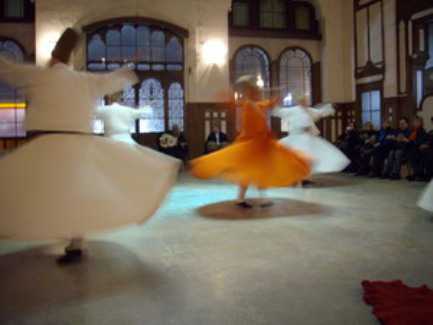
    Also within the station is a community hall. For some reason this is the venue where several nights a week the Sufi lodge of Istanbul arranges a performance of the whirling dervishes, the best I have seen outside of the festival in Konya because the performers are Sufi who have trained many years to achieve perfection. Tickets to the event can be obtained from many shops and kiosks in the vicinity or along Divan Yoglu.

    Leave by the front entrance, cross the square and take a last look at the graceful structure which is an important historical landmark of Istanbul before crossing the Galata Bridge to sample some fish buns and perhaps proceeding to visit the Galata Tower.

    via Sirkeci Gare – Istanbul’s emblematic train station | Tips from the T-List.

  • Turkey seeks response to Greek Cyprus hooliganism

    Turkey seeks response to Greek Cyprus hooliganism

    FULYA ÖZERKAN
    ANKARA – Hürriyet Daily News

    Turkey is readying to use legal and political channels to respond to attacks against Turkish basketball players during a match in Greek Cyprus. ‘Our first priority was to ensure the players’ safe return after the attack. That was done and the next step will be to bring the issue onto the international agenda,’ a diplomatic source says

    Turkey is poised to take strong legal and political measures in pressing for an international response to an assault Tuesday night on a Turkish basketball squad by home-team fans during a match in Greek Cyprus.

    “Our first priority was to ensure the players’ safe return after the attack. That was done and the next step will be to bring the issue onto the international agenda,” a diplomatic source told the Hürriyet Daily News & Economic Review on Thursday.

    Turkey will pursue legal channels by sending a letter of complaint to the world basketball governing body, while the government presses the United Nations and the European Union to take action. Ankara holds the U.N. Peacekeeping Force in Cyprus responsible for not taking sufficient security measures.

    “We will, of course, complain to the United Nations both in Nicosia and New York because while our team’s initiative to play the match in Greek Cyprus was a [friendly] gesture, our players’ safety was not ensured,” the diplomatic source said. “Because Greek Cyprus is a member of the European Union we will also take initiative at the EU level.”

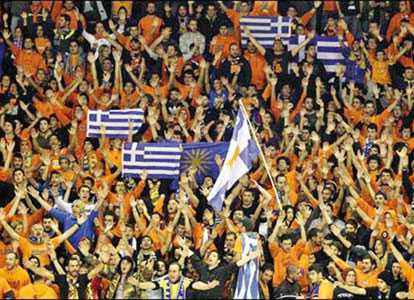
    During a FIBA Eurochallenge game against Apoel in Nicosia on Tuesday night, players on Turkey’s Pınar Karşıyaka were severely attacked by hundreds of Apoel fans who threw objects at the team and charged the court after the match’s final buzzer. The game had no particular importance since both teams’ places in Group G were already certain.

    The Turkish basketball players returned home to the Aegean province of İzmir through Greece because Greek Cypriot officials rejected Pınar Karşıyaka’s request to spend the night with security in northern Cyprus. They argued that such a step would be tantamount to recognizing Turkish Cyprus, which is only recognized by Turkey. Greek and Turkish Cypriots have been divided since 1974, when Turkey sent troops into the north after a rebellion by Greek Cypriots who wanted to unify with Greece.

    “The Greek Cypriot squad played in a previous match in İzmir, where they were warmly welcomed without encountering any incident. Turkish authorities did not even feel the need to take any extra security measures,” one source familiar with the developments told the Daily News.

    “Our players thought they would be treated the same and in return decided to play the match in Greek Cyprus but what was expected did not happen,” the source added.

    Immediately following the incident, Turkish Foreign Minister Ahmet Davutoğlu held a telephone conversation with Kaya Türkmen, the country’s ambassador to northern Cyprus. Embassy officials contacted by the Daily News said Türkmen would be unable to comment due to his busy schedule.

    Turkey will track the issue, says FM

    In Istanbul, Davutoğlu said Thursday that necessary security measures were not taken. “This is not an excusable situation, and we will keep track of the issue,” he told a group of journalists in Istanbul’s Çırağan Palace, where he was attending the 11th summit of the Economic Cooperation Organization.

    The Turkish foreign minister also said statements of apology made by Greek Cypriot authorities immediately after the attack were not sufficient, and emphasized that brotherhood and peace must prevail in sports events.

    In initial remarks, Greek Cypriot President Dimitris Christofias slammed those involved in the assault as “brainless,” saying their actions harmed the interests of the Greek Cypriot side.

    “This has caused big problems for the Republic of Cyprus because this gives great fuel to Turkish propaganda,” he was quoted as saying.

    * Daily News reporter Erisa Dautaj Şenerdem contributed to this report from Istanbul.

    Hürriyet Daily News

  • [Australian] PM orders review of spy bodies

    [Australian] PM orders review of spy bodies

    Dylan Welch

    December 24, 2010

    THE ballooning powers and funding of Australia’s spy agencies will be investigated for the first time in six years, with Prime Minister Julia Gillard announcing an independent review of their role.
    The review will run in the first half of next year and follows a boom decade for intelligence, with Australia’s six spy agencies enjoying ever-greater powers and funding.
    ”The review will ensure Australia continues to have a well-co-ordinated, appropriately resourced and adaptable intelligence system that supports our national interests,” Ms Gillard said.
    The agencies’ growth has been accompanied by criticism that they have grown too fast, and that the powers of the parliamentary and statutory intelligence watchdogs have not been able to keep up.
    The six Australian intelligence agencies are: the Australian Security Intelligence Organisation (ASIO); the Australian Secret Intelligence Service (ASIS); the Office of National Assessments (ONA); and the three Defence intelligence agencies.
    In recent years ASIO has become the country’s wiretap hub, and its budget appropriations have grown by 535 per cent – from $69 million to $438 million annually – since 2001. Over the same period ASIS and ONA have experienced growth rates of 344 per cent and 443 per cent, respectively.
    A spokeswoman for Ms Gillard yesterday said the review was not designed to put the brakes on the spy agencies’ funding.
    ”The aim of the review is to ensure that our intelligence agencies are working effectively together – it is not aimed at identifying reductions in resourcing,” she said.
    The review is the result of a recommendation in the 2004 Flood review of the intelligence agencies, which found they should be independently examined every five to seven years.
    It will be headed by the former secretary of the Attorney-General’s Department, Robert Cornall, and an ethicist and theologian from Melbourne university, Associate Professor Rufus Black.
    Staff will interview the ministers for defence and foreign affairs, Stephen Smith and Kevin Rudd, as well as the Attorney-General, Robert McClelland, and the heads of all six agencies.

    http://www.theage.com.au/national/pm-orders-review-of-spy-bodies-20101223-196l8.html, December 24, 20

  • Istanbul’s Historical Peninsula to be closed to traffic

    Istanbul’s Historical Peninsula to be closed to traffic

    ISTANBUL – Anatolia News Agency

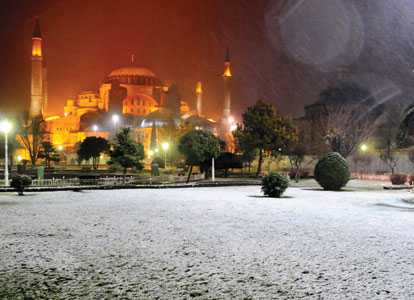
    The municipality’s transportation unit will close some streets in Istanbul to traffic where historical mosques are located. Hürriyet photo

    Istanbul Metropolitan Municipality’s transportation unit will close 90 streets on the city’s historical peninsula to traffic beginning Jan. 1, 2011.

    The new restrictions will include streets in parts of Beyazıt, Sultanahmet and Sirkeci and will be limited to the area along the Beyazıt – Sultanahmet – Sirkeci tram route, Ragıp Gümüşpala Street and Cemil Birsel Street. The area will only be open to pedestrian traffic.

    According to a decision from the Transportation Coordination Center, or UKOME only official vehicles, such as police and municipal patrol vehicles, bank and post office vehicles, and fire engines and ambulances would be able to enter the area. Parking in the pedestrian area will also be forbidden.

    Fatih Mayor Mustafa Demir said making the area open to pedestrians only would have a positive impact on the area’s tourism potential and preliminary works were begun at the beginning of 2010 in conjunction with various nongovernmental organizations and the Turkey Travel Agencies Union, or TÜRSAB.

    Demir said a special tram for cruise passengers who come to Istanbul for a limited time was also being planned. “The project has been completely planned out but some bureaucratic problems remain. I hope we overcome them,” he said, adding that the project, set to cost 2 million Turkish Liras, was planned to be completed by May next year.

    Currently, cruise passengers are transported to Sultanahmet by buses that are only allowed to idle in the area for 15 minutes because of the potential damage they could cause the Basilica Cistern, Demir said.