Year: 2010

  • Christmas ceremony held in St Antuan Church in Istanbul

    Christmas ceremony held in St Antuan Church in Istanbul

    Cristian prayers recited verses from the Bible in the ceremony. Istanbul Beyoglu Mayor Ahmet Misbah was among to participants of celebrations.

    Saturday, 25 December 2010 15:17

    Christmas Ceremony was held in one of Istanbul’s biggest church of St Antuan on Friday.

    During the night, Christian believers recited many hymns as well as Bible verses in the St Antuan which is being in the Istanbul’s most colorful street of Beyoglu. Tourists who are visiting Turkey also attended the ceremony.

    In the ceremony, Beyoglu Mayor Demircan underlined that, every religion members live in Beyoglu in a peace. “We did not want to them alone in their holy night” noted Demircan.

    Christmas or Christmas Day is a holiday observed generally on December 25 to commemorate the birth of Jesus, the central figure of Christianity.

    The date is not known to be the actual birthday of Jesus, and may have initially been chosen to correspond with either the day exactly nine months after some early Christians believed Jesus had been conceived, the date of the Roman winter solstice, or one of various ancient winter festivals.

    Christmas is central to the holiday season, and in Christianity marks the beginning of the larger season of Christmastide, which lasts twelve days.

    Although nominally a Christian holiday, Christmas is also celebrated by an increasing number of non-Christians worldwide, and many of its popular celebratory customs have pre-Christian or secular themes and origins. Popular modern customs of the holiday include gift-giving, music, an exchange of greeting cards, church celebrations, a special meal, and the display of various decorations; including Christmas trees, lights, garlands, mistletoe, nativity scenes, and holly.

    In addition, several figures, known as Saint Nicholas and certain mythological figures such as Father Christmas and Santa Claus among other names are associated with bringing gifts to children during the Christmas season.

    CHA

  • tehran times : ‘Regional cooperation can stop foreign interference’

    tehran times : ‘Regional cooperation can stop foreign interference’

    Tehran Times Political Desk

    TEHRAN – An expansion of ties between regional countries can stop certain foreign countries that interfere in regional affairs, Iran’s deputy interior minister for security affairs said on Saturday.

    Ali Abdollahi, who was talking to the Azerbaijani deputy interior minister in Istanbul, said regional cooperation is essential for promoting security in the region.

    Therefore, it is necessary that all the nations in the region increase their interactions, Abdollahi added.

    The Azerbaijani official, for his part, said Baku is really interested in expanding cooperation between Iranian and Azeri police forces.

    He expressed hope that cooperation between the two countries will increase in the future

  • Elmira Bayrasli: Turkey’s Answer to the Armenian Question

    Elmira Bayrasli: Turkey’s Answer to the Armenian Question

    Turkey dodged yet another bullet in the U.S. House of Representatives yesterday when a resolution “recognizing” the Armenian “genocide” failed to reach the floor for a vote. Had Resolution 252 gone before legislators, it, in all likelihood, would have passed. That is exactly what the powerful Armenian-American lobby is determined to make happen. And that is a reality Ankara must either be prepared to accept or prevent by normalizing relations with Armenia.

    There is no doubt that something horrible happened to over 1.5 million Armenians in eastern Anatolia in the spring of 1915. It is a vexed issue, fraught with intense emotion. Armenians and their sympathizers maintain that it was genocide. It is a charge the Turks deny.

    Given that the Turkish government hasn’t made public archived material on the matter or been willing to debate the issue, it is difficult to defend them. The heart wrenching stories of Armenians who survived deportations, starvation and executions make it impossible to do so. There is an overdue need to access Ottoman archives where the world — and not one side — can make a more informed conclusion. That would upset any effort for a Congressional resolution. It would also be more in line with Ankara’s “zero problems” foreign policy.

    Because Turkey is facing, according to its foreign minister, Ahmet Davutoglu, “pressure to assume an important regional role,” the country has made it a priority to “carry out a careful foreign policy.” Open and good diplomatic relations with all of Turkey’s neighbors is its underpinning. While that has happened with Syria and Iran, it has not with Armenia. That must change.

    In 2009, Turkey and Armenia had launched talks intended to normalize relations. Secretary of State Hillary Clinton, along with the Swiss government, was actively involved. Among the things that were brokered was the inclusion of a clause that would have had historians examine the evidence from 1915. Unfortunately, the Turks scuttled the negotiations that otherwise would have been a remarkable step that could have avoided yesterday’s close call, and any other ones in the future.

    Passionate Armenian-Americans have lobbied to label Ottoman actions as genocide for decades. Protected by the Pentagon, the National Security Council and the Israeli lobby, the Turks, NATO’s second most powerful members, have managed to avoid the Armenian question entirely. Since adopting a more activist approach to regional Middle Eastern affairs, which has included closer ties to Tehran and championing the end of Palestinian isolation in Gaza, Ankara is no longer shielded by anyone.

    Without a strong ally on Capitol Hill, U.S.-Turkish relations have hit an all-time low. Resolution 252 has found the perfect moment to rear its head. There is little political capital to defend a country everyone inside the beltway considers “lost.” It is an issue that will most certainly resurface in the next Congressional session. It is unlikely to continue to come out in Turkey’s favor.

    That the House resolution labels the Ottoman Empire’s actions “genocide” does not make it so. It is a point of semantics, in which there are no legal ramifications. It is nothing more than political pandering to a very effective ethnic lobby.

    Still, it is a pandering that the U.S. and Turkey cannot afford. Much is at stake in the Middle East, particularly in Iraq, Iran and Afghanistan, where Turkey has lent Washington tremendous and reliable support; support Washington is keen to continue. Sadly, its policymakers are no longer in a position to rescue Turkey at the eleventh hour. Nor should Turkish policy makers want them to. Turkey’s new independent diplomacy puts the responsibility of tackling the Armenian question in its own hands.

    To start the process, Turkey must normalize relations with Armenia, which have never been formally established. Though the two shared an open border when Armenia declared independence from the USSR in 1991, it was closed down in 1993 over a border dispute Armenia has with its other Turkic neighbor, Azerbaijan. Turkish-Armenian reconciliation must include the examination of historical records of 1915. Armenians and Turks deserve to know the truth about the events that took place at that time.

    Armenians are eager to reconcile with the Turks. The BBC reports “most people in Armenia feel their landlocked country has been too isolated since the Turkish border closed and are ready for it to reopen.” Armenia, which continues to suffer from the legacy of the Soviet planned economy, has remained “underdeveloped.” Yerevan wants to do business with its economically powerful Turkish neighbor, its only real link to the West. Many deals are already underway. Flights between the two countries are packed with businessmen signing agreements to trade and collaborate.

    Turkey was able to avoid a relationship with Armenia and the Armenian question for years. Armed with a bold, new foreign policy, a strong economy and an Armenian neighbor ready to engage, Turkey has what it needs not only to permanently frustrate Armenian-American efforts for a “genocide” resolution, but, more importantly, to set the truth about 1915 straight. Nothing could prove Turkey’s capacity for true global and mature leadership more.

    via Elmira Bayrasli: Turkey’s Answer to the Armenian Question.

  • Turkey nuke decision due by March

    Turkey nuke decision due by March

    Kyodo News

    Japan and Turkey agreed Friday to reach a “certain conclusion” in about three months on whether Japan will build a nuclear power plant on the Black Sea coast, an industry ministry official said.

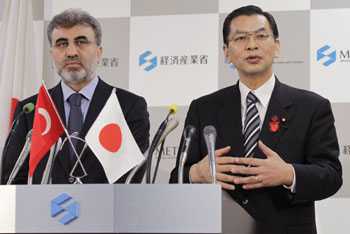
    Building ties: Economy, Trade and Industry Minister Akihiro Ohata and visiting Turkish Energy and Natural Resources Minister Taner Yildiz field questions at a Friday news conference in Tokyo. KYODO PHOTO

    The agreement was reached during talks in Tokyo between Economy, Trade and Industry Minister Akihiro Ohata and visiting Turkish Energy and Natural Resources Minister Taner Yildiz, who also signed a memorandum on civil nuclear cooperation in the development of human resources and other areas.

    At a joint news conference after the talks, Ohata pitched Japan’s nuclear power technologies as safe and earthquake-resistant, while the Turkish minister seemed eager to seek cooperation.

    “We are expecting that the construction of a nuclear power plant in Turkey could be achieved under the cooperation of both the public and private sectors of the two countries,” Yildiz said.

    Japan has been trying to export its nuclear power technologies. But there is no guarantee negotiations with Turkey will go smoothly.

    via Turkey nuke decision due by March | The Japan Times Online.

  • Scramble to limit political damage

    Scramble to limit political damage

    THE government yesterday scrambled to launch a damage limitation exercise following the violence against a Turkish basketball team by a faction of APOEL hooligans, which has handed Turkey the PR coup of the year.

    Government spokesman Stefanos Stefanou said that on the instructions of President Demetris Christofias letters were being sent to the United Nations and the European Union in a bid to put things into perspective and to give the whole story.

    The incident, which took place on Tuesday night after the end of a FIBA Eurochallenge game between APOEL and Pinar Karsiyaka, was also condemned by all political parties yesterday.

    Police on Tuesday night were forced to use tear-gas after the game to disperse a crowd of around 500 APOEL supporters after they started throwing things at the Turkish team and followed them when police ushered the Turkish players to safety.

    No one from the Turkish team was injured, police said but the Turkey has made a meal out of the incident, even calling Athens and Brussels on Tuesday night to make it known that the Cyprus talks could be affected.

    But in a written statement yesterday, the foreign ministry said: “The persistent effort of the Turkish government to politically exploit such unfortunate events, by interpreting them with political motives, is both unacceptable and worthy of condemnation.”

    Three 15-year-old boys arrested on Tuesday were yesterday charged with assault, rioting and use of dangerous objects and released to be summoned at a later date.

    Police yesterday were also studying television footage of the trouble in a bid to identify more suspects.

    Turkey’s EU negotiator Egmen Bagis called the attack “inhuman” and said Ankara would closely follow the proceedings against those arrested.

    “This attack by insolent Greek Cypriots threatens the prospects for peace in Cyprus,” he said. “How can one expect the Turkish and Greek communities to live together?”

    The foreign ministry yesterday said the government was committed to solving the Cyprus problem and reunify the country “whereby the whole of the Cypriot people, Greek Cypriots and Turkish Cypriots alike, will live together in conditions of peace and prosperity.”

    “We, therefore, call upon Turkey, instead of causing problems, to demonstrate the same constructive stance,” the ministry said.

    The ministry condemned the “unacceptable events” adding that regrettably, such dismal events do occasionally occur at sporting events in European countries.

    “Cypriot teams were treated similarly in the past while in Turkey, although the Government of the Republic of Cyprus has never tried to attach any political connotation to such incidents.  The ministry said Turkish sports teams had also competed many times in Cyprus without any problems whatsoever.

    Spokesman Stefanou said the unacceptable, condemnable and damaging actions, in essence negated a series of games between Turkish and Cypriot teams that had been played without incident.

    Stefanou said Turkey was now exploiting “the gift given to her by fanatical hooligans” and urged political forces on the island to isolate those who find excuses to create political problems.

    Beyond the political fallout, as expected the incident has had repercussions on the APOEL team.

    The team was fined €40,000 by international governing body FIBA and will have to play the next three home games without spectators.

    FIBA Secretary General and IOC member Patrick Baumann said: “I wish to congratulate FIBA Europe for reacting quickly and decisively on an incident that is shameful and has absolutely no place in sport.”

    “In the past sport has done much to unite people and to overcome political differences. The violence that occurred in Nicosia on Tuesday is utterly unacceptable,” he added.

    Karsiyaka said it was not happy with the penalty and accused FIBA of protecting the Cypriot team.

    “That shows a clear sign of FIBA’s protecting Greeks and Greek Cypriots,” Naz?m Torbaoglu, manager of the basketball branch of the Kar??yaka club, told Do?an news agency. “I think a worthy sanction would have been an at least two-year-ban from playing in European competitions.” Torbaoglu said the team will appeal the ban.

    The Cyprus Basketball Federation has issued an apology to FIBA and its Turkish counterpart.

    “Such acts of hooliganism are an enemy to our sport and should find us all on the same side in the battle against it” Secretary General Emilios Theodosiou wrote.

    The Cyprus Basketball Federation also expressed its intention to cooperate fully with police to identify the individuals responsible for the acts of violence.

    via Scramble to limit political damage – Cyprus Mail.
  • Was Turkey preparing to occupy Adjara?

    Was Turkey preparing to occupy Adjara?

    by georgiatoday.ge

    Armenian and Russian sources have seized on American embassy cables published by WikiLeaks which claim that Turkish armed forces were ready to occupy Adjara during the war of August 2008 in the event of Russian troops coming 100 km from the Georgian-Turkish border.

    The leaked information suggests that Turkey’s Prime Minister, Recep Erdogan and members of the Turkish parliament flew to Moscow to inform Russia’s President Dimitri Medvedev that Turkey, as a NATO member country would have the right to bring military units to the conflict zone in order to protect the territory of the neighboring country.

    In such a scenario, the cables claim, Turkey would have sent its ground units into Adjara supported by air power. There is in fact a precedent for the scenario, as in 1921 when the Red Army conquered Georgia, Turkey’s military units moved in to occupy Adjara.

    Is this all true?

    The cables claim that on March 3, 2009 the Georgian Interior Minister, Vano Merabishvili told Georgian journalists that if during the Russian-Georgian war, the government had not been able to ensure the country’s security, Turkey was ready to bring its armed forces in through Adjara to protect Georgia.

    According to the Kars agreement, signed by Russia after the occupation of Georgia in 1921, Turkey has the right under international law to bring troops into the Autonomous Republic of Adjara, but it is hard to believe that an armed conflict could take place between NATO-member Turkey and Russia over the territory.

    There are several reasons for doubting that the sides would ever have

    come to blows: First – the Turkey would not have been able to act in

    the name of NATO without the consent of every NATO member state.

    Second – Turkey could bring troops to Adjara but not as a NATO-member state, it would only have been possible to use the Kars agreement to justify a military presence in the territory, not actual conflict.

    Third – Ankara would have done its best not to allow military confrontation between the Turkish and Russian military units to occur as such an event would cause a serious international incident.

    On the morning of August 11, 2008, Russian jets bombed a Georgian military base in Khelvachauri, Adjara as well as Sharabidzes, Kapandichi and Makho, villages 10 km from the Georgian-Turkish border.

    Russian planes flew well within the exclusion zone near the Georgian-Turkish border but no response was seen from Ankara.

    During the August war, a Russian commando unit entered Poti and bombed several sites in the port town. One month later, a Russian control-checkpoint was still located at the entrance to Poti. Even though these actions took place less than 100 km from the Georgian-Turkish border (70 km), there was no serious military reaction from the side of the Turkish government.

    These factors certainly shed doubt on the truth of the reports being circulated in the Russian and Armenian media.

    It cannot be ruled out that agencies of certain countries may be trying to use the WikiLeaks data to spread misinformation as it is quite difficult to check the validity of the information in the vast hoard of data that can be found on the website.

    /Times.am/