The entire staff of the Religious Affairs Foundation’s Women’s Activities Center has decided to collectively resign from their posts following the removal from office of the center’s head, Ayşe Sucu, daily Milliyet reported Sunday.
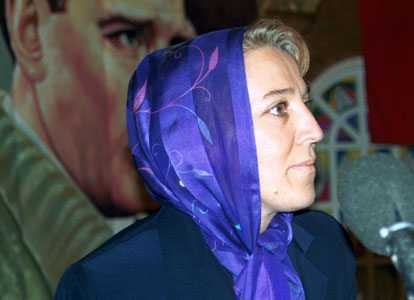
Sucu, who is known for her liberal views about religion and women and for wearing a loose style of headscarf, reportedly told her close friends that she was surprised and hurt by the foundation’s decision to let her go. Hürriyet photo
Sucu, who is known for her liberal views about religion and women and for wearing a loose style of headscarf, reportedly told her close friends that she was surprised and hurt by the foundation’s decision to let her go.
Foundation head Necati Akçeşme said in a statement that the change was the result of “new excitement and new understanding” in the foundation. The Religious Affairs Directorate is undergoing personnel changes under new head Mehmet Görmez, who has recently identified three new deputies and appointed four general managers.
In his written press statement, Akçeşme did not mention Sucu by name, but identifying her by her post, said her personal life and thoughts did not play a role in the decision. Sucu had previously said wearing a headscarf is not a religious obligation for Muslim women.
Sucu collected her belongings from her office Saturday after receiving the official statement about her removal from office. “I was always focused on my work. I achieved a lot of firsts. There has been great success here,” she reportedly told her friends, according to Milliyet. “I am really hurt by this act while there are a great number of women [paying attention to our work]. I did not deserve this.”
Monday press meeting
Vildan Karabulut, the deputy head of the center, said the staff has no quarrel with any person or institution. “This is a change in posts and it is pretty normal,” she said. “But Mrs. Ayşe should have been installed in the place she deserved.” Karabulut confirmed that the center’s staff had decided to collectively resign. “With our head removed from office, the acting board no longer has the power to act. They brought us to that position,” she said. “We are going to hold a press meeting Monday.”
The son of Turkish parents who migrated to Germany in the 1960s, Aydın Bilge grew up caught between two worlds. Raised by his grandmother in Turkey, Bilge moved to Germany once his parents had become financially stable enough to send for him.
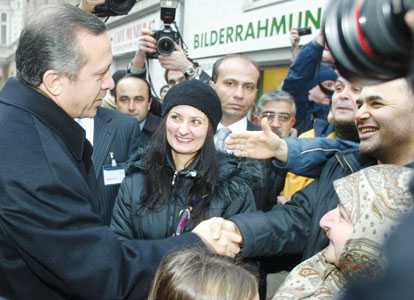
This file photo shows Turkish Prime Minister Recep Tayyip Erdoğan shaking hands with Turkish residents of Berlin's Kreuzberg district in 2004. AP photo
“It was hard for me to adapt to Germany. I was subjected to xenophobia here,” he told the Hürriyet Daily News & Economic Review. But when Bilge, who described himself as “both Turkish and German,” traveled to Turkey in 2005 to search for his identity, he did not receive a much warmer welcome. He had married a Turkish woman, but his mother-in-law did not approve of him because he was “Almancı” (a Turk who works in Germany).
“I was seen differently just because I was dressed differently and wore earrings. I returned to Germany. I lost my happy marriage,” Bilge said.
This sense of belonging to nowhere, of struggling with a double identity that sometimes feels like a lack of one at all, haunts many Turkish-Germans, particularly members of the second generation of Turks living in Germany, the most sizeable Turkish migrant group in Europe. Next year will mark the 50th anniversary of the beginning of mass immigration of Turkish workers, mostly from rural areas, to meet the additional labor demand during the economic restructuring of Germany known as the “economic miracle.”
Nearly half a century after West Germany signed a bilateral recruitment agreement with Turkey in 1961 to create a formal guest-worker program, many Turks still feel labeled due to their cultural background in Germany, where they are the subjects of ongoing integration debates.
The meaning of integration and an integrated immigrant are not easy to define, however. One official explained integration as speaking the language, having the ability to participate in education, social life and the job market and accepting German laws and basic values. “We are not talking about assimilation,” the official said. “But there are certain basics that immigrants should comply with.”
Even the word “integration” is enough to rile some members of the Turkish community. “People are telling us about integration. What does it mean? What do they expect us? Shall I go out in the street and shout ‘I am German’?” said Dursun Şahin, the vice president of the Turkish-German Businessmen’s Association.
“Integration is not a one-way street. We are coming from a different culture. If they want to send the Turks back, then they should not talk about integration,” he said. “Next year will be the 50th anniversary of Turks living in Germany. We have been paying taxes for 50 years.”
Some Turkish immigrants say they are discriminated against in German society because of their backgrounds and names, even if they speak very good German and dress like everyone else. “Many Turkish-origin people are sending out CVs for jobs but although they meet the required qualifications, they are not called for interviews. It has been discovered that their CVs were not even looked at by German employers because of their Turkish names,” said İlknur Gümüş from the Intercultural Center for Counseling and Meeting in Berlin.
Debates over integration
“One out of four people in Germany has a migration background,” said Barbara John, a lecturer at Humboldt University in Berlin. “The door for guest workers opened in 1955. It was assumed they would come and stay for two years and then go, but that was not the case.”
The assumption that Turkish migrants would work in Germany temporarily and then return to Turkey was also shared by the guest workers themselves, who centered their life plans around their eventual return. A recent study carried out by the Istanbul-based Koç University’s migration department revealed that second-generation Turks were affected personally and emotionally by their families’ plans to return.
“The return orientation of the ‘guest worker’ generation had consequences not only for the persons directly concerned but also for their families and especially for their children, the so-called 1.5 and second generations,” the study read.
Today immigrant groups in Germany are mostly associated with debates over integration, a policy prioritized by Chancellor Angela Merkel’s government. Saying language is the primary obstacle before foreigners’ integration, German officials have allocated 10 percent of Germany’s GDP to education in 2011, versus a global average of 4.9 percent, and migrants will benefit from the increase significantly. Since 2005, the German government has spent a total of 1 billion euros on education but lingered below the global average each year.
“We have done a lot for the integration of foreigners. A comprehensive effort began a few years ago,” said one German official, speaking on condition of anonymity. “We are late but not too late. I would have preferred earlier, of course.”
The integration debate was rekindled recently when a former member of the German Central Bank, Thilo Sarrazin, wrote a book saying foreigners – especially Muslims – were coming to Germany to take advantage of the German welfare system. Sarrazin’s book, which is on its way to being the most successful political book in the country since World War II, is seen as “very insulting,” “humiliating” and “biased” among German government circles, but it has at least brought the issue of integration back to the agenda again.
One immigrant’s story
Aydın Bilge’s story is in many ways a typical one. His family migrated to Germany in the 1960s as part of the guest-worker program, but since his parents did not speak any German, his mother did not want to give birth in a German hospital and instead returned to Turkey in her ninth month of pregnancy. When Bilge was three weeks old, his parents left him in Turkey, in the care of his grandmother. Speaking about the identity problems he faced after his parents brought him back to Germany, Bilge said there were no incentives at that time for immigrants to learn the language or integrate socially. He said he also holds the Turkish government responsible for not defending the rights of the Turkish community in Germany. “But I don’t blame anybody,” he said. “I have a problem with my own identity. I’ve been suffering for 30 years.”
Germany’s integration paradox
As the German government keeps the integration issue high on the agenda and generates policies to avoid the creation of parallel societies, or “ghettos,” German society is growing more xenophobic, making it harder to accept differences.
The bad consequences of migration were related to bad management of the issue, according to Professor Ahmet İçduygu, director of the Migration Research Program at Istanbul’s Koç University, who claimed the Sept. 11 terrorist attacks in the United States marked a breaking point that encouraged the return of assimilation policies amid rising Islamophobia not only in Germany but across Europe.
“In this new century, there has been a return to old policies. German laws are becoming conservative; they include culture and language tests and do not allow double citizenship,” he said. “But you cannot ignore the realities of life. People communicate, which is different from the past. Assimilation is no longer easy.”
German officials admit integration is a two-way street, meaning that while Turks try to adapt themselves to German rules and laws, German society should also show more readiness to accept differences.
“We will not make concession on our culture. Integration does not mean assimilation. We do not want to get assimilated,” said Aydın Bilge, a member of the second generation of Turks living in Germany. “The Germans should also move closer to us and explore our culture. We need to find a middle road. In the end we are all in the same boat.”
She sailed through the very sea she was named after, before she finally reached home. It was here, at the very same dock, that the Mavi Marmara set off on a mission of mercy to gaza seven months ago.
That effort, dubbed the freedom flotilla, with seven ships in total, was attacked in international waters by the Israeli military. Nine aid workers were killed in the incident, including 8 Turks and one US citizen, with almost 60 more injured.
As she pulled into Sarayburnu port, the Mavi Marmara was welcomed by thousands of well-wishers. But the celebrations were tinged with sadness with the presence of the families of those killed. But they too stood by the effort to break the Israeli siege of Gaza.
Also among the crowd were some of the hundreds of volunteers from around the world who’d been onboard when the ship was attacked.
Ahsan Shamruk, a Palestinian who now lives in London, was shot twice in the back of the head.
See and hear Ahsan Shamruk who says he has mixed feelings because he is reminded of the bloodshed on the sihp
Israel has continued to insist that its military acted properly, and that the organisers of the flotilla wanted a confrontation. But those claims have been branded as laughable by the activists who were onboard the ships.
A recent UN fact-finding mission concluded that the Israeli attack breached both international humanitarian law and human rights law, and that it betrayed unacceptable levels of brutality. The incident has also strained relations between Turkey and Israeli, with the Turkish government continuing to demand an apology from Israel.
The IHH charity remains defiant. It organised the Turkish contingent of the flotilla including the Mavi Marmara, and has pledged to send an even larger flotilla of ships to break the siege again in May of 2011.
Israel insists that its commandos were dealing with a serious threat when they opened fire onboard this vessel. But that narrative has been disputed by every single passenger who was onboard this ship. And Bulet Yildirim, the head of the IHH, says that the ship is now not only a symbol of conscience, but also now a symbol of freedom.
Backed by influential politicians and a major media campaign, the pro-Armenian lobby’s defeat by its conventionally powerful rival in the “genocide resolution” debate shows both the strengths and limits of guerrilla tactics in political battles.
In their campaign to get the U.S. House of Representatives to recognize World War I-era killings of Armenians in the Ottoman Empire as “genocide,” U.S. Armenians artfully utilized some of the classic strategies of “guerilla warfare,” capitalizing on the elements of surprise and mobility to harass a larger, traditional “army” – in this case, Turkey.
But the strong effort to get such a resolution passed before the last day of the current House term – and with it, the leadership of Armenian advocate Nancy Pelosi – was, in the end, unsuccessful, as the lower house of the U.S. Congress wrapped up its two-year term Wednesday without taking up the topic.
The nature of many such political, and military, confrontations can be illuminated by considering the famous words of former U.S. Defense Secretary Donald Rumsfeld: “You go to war with the army you have, not the army you might want.” In Rumsfeldian terms, the Armenians were equipped with the backing of outgoing House Speaker Pelosi, most of the Democratic big shots in the House and a full-fledge media campaign, but lacked the strong firepower needed to counter their conventionally powerful rival.
That the duration between the initiative and the outcome is inversely proportional to the success of the operation is another key tenet of guerrilla warfare, and one that proved crucial in this case. The Armenians decided to launch their “genocide” recognition effort at a time when their ally, Pelosi, had lost midterm congressional elections against the Republicans and would cede her post in early 2011. The latest push was a last-ditch chance to win before the Republican takeover takes place.
Celebrity-led campaign
The pro-resolution media assault began with a brilliant high-tech attempt by reality-TV star Kim Kardashian and rock musician Serj Tankian, both Armenian-American celebrities, to use the social-networking websites Twitter and Facebook to urge their millions of followers to demand that Pelosi schedule a vote before the year’s end on the “genocide resolution” bill pending in the House. Then last week, the Armenian National Committee of America, the largest and most influential U.S. Armenian group, structuralized and finalized the Armenian demand for a House floor vote.
Armenia claims up to 1.5 million Armenians were systematically killed in 1915 under the rule of the Ottoman Empire. Turkey denies this, saying that any deaths were the result of civil strife that erupted when Armenians took up arms for independence in eastern Anatolia.
Initially the Turks were confused; they were unable to grasp whether this was a serious and well-planned last-minute effort to get recognition for the Armenian claims of genocide or simply a way to raise funds for ANCA at the end of the year. The seriousness of the situation became clear Dec. 17, when ANCA announced that a House floor vote on the bill could be imminent.
At this point, the disadvantages of the Armenian guerrilla attack became apparent. Turkey immediately mobilized its allies in Washington, mainly President Barack Obama’s White House, the State Department and large defense companies. As regional power Turkey put its full weight to bear on the issue, the fight began to transform from a guerrilla attack into conventional warfare, giving Ankara the advantage.
In this way, a vote was averted Dec. 17, and the Armenians began to lose their strength. This, too, follows the guerrilla-warfare principle that as the length of time between the guerrilla initiative and the intended result increases, the guerrillas’ chances of success fade. Eventually the Armenian effort formally was defeated when Pelosi declined to schedule a vote on the “genocide” bill Wednesday, the last day of the outgoing House.
Throughout the later phases of the battle, Turkey and the Obama administration did play their parts well. Turkey refrained from blatant threats against the United States, and the White House declined to put public pressure on Pelosi. The pressure was of the behind-the-scenes variety. “Obama and his people deliberately stayed away from actions that would be seen as undermining Pelosi and the House’s sovereignty,” said one analyst in Washington.
One prime concern within the U.S. administration was that the passage of the Armenian “genocide” bill might prompt Turkey – already a self-confident and independently acting power seeking to make its own policies in the Middle East and confronting Israel – to speed up a “paradigm shift” in its foreign policy, a fear one U.S. official privately confirmed.
Reactions from Turkey, Armenia
Turkish Foreign Minister Ahmet Davutoğlu on Thursday expressed pleasure that a resolution on recognizing Armenian claims of genocide had not been included in the official daily agenda of the U.S. House of Representatives.
“We are pleased that a development that would strike a blow to balances in the Caucasus and Turkish-American and Turkish-Armenian relations did not happen in the U.S. Congress. Common sense prevailed yesterday,” Davutoğlu told reporters. “We thank the U.S. administration for their efforts. This incident once again proved that assessment of historical incidents by political authorities is principally wrong.”
The Armenians were furious by the House’s failure to vote, but pledged to fight back in the new Congress. “Armenian-Americans are angered and disappointed by the failure of Speaker Pelosi and the House Democratic leadership to honor their commitment to allow a bipartisan majority to vote for passage of the Armenian genocide resolution,” said ANCA chairman Ken Hachikian. “Speaker Pelosi clearly had the majority, the authority and the opportunity to pass the Armenian genocide resolution, yet refused to allow a vote on this human-rights measure.”
“I am happy that reason and common sense have prevailed,” said Namik Tan, Turkey’s ambassador to Washington.
“We now know that a majority of Congress agrees with President Obama about the importance of the U.S.-Turkey relationship, and expect this wisdom to carry over into the next Congress so that we can avoid yet another needless round of bashing our ally Turkey,” said Lincoln McCurdy, president of the Turkish Coalition of America, a U.S. Turkish group.
Once more, Washington became a battlefield for Turks and Armenians last week over HR 252, a resolution urging the United States House of Representatives to recognize the World Ward I era killings of Armenians during the final days of the Ottoman Empire as “genocide.”
There are quite a few upshots of this latest face-off. One of the first results was a strong showing of the newly energized and vibrant American-Turkish community which is better organized at this time due to mainly social networking sites like Facebook or Twitter, and as a leader of this vibrant respond, the Turkish Embassy in Washington, which swiftly got its acts together early hours in Friday morning to determine the strategy to encounter the Armenian pressure.
Though one of the Armenian-American leaders that I talked to this week, who wanted to stay an anonymous, disagreed with me on this point and said that this factor had a very little real effect in terms collision of the bill: “On the contrary,” the source said, who has been in this fight for decades, “it was a decision that the State Department, White House and Congressional leadership had taken sometime ago that they cannot push the current Ankara government further to the East and did not want to risk alienating it.”
I had a long conversation with the US Representative from Tennessee’s 9th district, Mr. Steve Cohen over the phone this week as well following the end of the 111th session of the U.S. Congress. The Congressman also made some similar observations about Turkey’s image in the Congress. Cohen, whose grandfather Abraham Hassan or Hassen (spelled differently in different documents) was born in Turkey in 1895, and who proudly calls himself a “descendant of a Turkish family,” stated that this last battle was more difficult for Turkey’s friends in the Congress to encounter, especially because of Turkey’s strained relations with Israel. “In the past, supporters of Israel in the House were meant also supporters of the Turkey cause. Not anymore. Turkey’s NATO membership and solid alliance to the West also used to be a strong argument. Now, in addition to Turkey’s Israel policy, dealing with Iran also raised questions and attributed to debate about Turkey is turning its face from West to East. And this was certainly not helpful either.”
Mr. Lincoln McCurdy, the president of the Turkish Coalition of America, credited Steve Cohen, along with Rules Committee senior ranking member Alcee Hastings (Democrat-Florida), Gerald E. Connoly (Democrat-Virginia) and Bill Delahunt (Democrat-Massacheusetts, who left the Congress) for they were significant voices in energizing the opposition against Democratic leadership not to bring the bill to the floor within the party.
His opposition to the bill was based on practical reasons and Cohen conveyed to me his conversation with General David Petraues, who is in the charge of the U.S. Central Command currently. Petraues described the genocide resolution as “harmful” and “mistaken,” and talked about Turkey’s traditional help to the US troops around the world.
While the US Congress was going to through its last hours and it was unknown to us whether HR 252 was going to be brought to the floor by the Speaker Pelosi, I was at the White House to talk about Turkey-US relations of 2010 with the spokesperson of the White House National Security Council, Mike Hammer. In our conversation, I heard many compliments about Turkey and how much President, personally invested in the relations with it with exception of two matters. (Hammer also said that early Turkey visit was fully President’s idea.) It was worth paying attention on Hammer’s cautionary note over Turkey’s dealing with Iran and strained relations with Israel.
Whether it is about powerful Jewish lobbies or historic bonds between the US and Israel, Israel is still an exceptional ally for the U.S. Even the Netanyahu government, which made everything about the Middle East Process more difficult for the Obama administration, did not diminish the popularity of Israel among Americans and for their administration. Therefore, unless something extraordinary happens to the bond between the two, which was defined as “unbreakable” by Obama at his speech in Cairo, there is little evidence for the U.S. to change its stance when it comes to Israel.
However, if there are still some who imagine that the U.S. administration would break its ties with Turkey just because there are some significant policy differences on these or potential other matters in the future, they also are badly mistaken. As Hammer explained to me in so many different levels and various partnerships that the two carry currently, it became clear to at the end of our talk that the U.S. administration will not retreat to invest and improve the bilateral ties with Turkey.
For realpolitik and national security reasons, today’s Turkey is too important an ally to be mistreated by Washington. And we have witnessed this during the most difficult times in 2010 when the U.S. administration was extremilty careful not to criticize Ankara publicly. In addition to all of that, finally, the latest Cablegate revelations, and impending thousands of cables also makes the U.S. government extra cautious in the relations with Turkey, not to anger it with such resolutions.
“The Armenian Genocide bill” of HR 252, at a time when almost all Democratic leadership positions both in the US administration and the House have been occupied by the supporting voices of the bill in the past, had failed this week. And this failure happened also when the U.S. Congress and the Ankara administration are on odds on number of issues that are cited above.
So was the battle a complete win for the Turkish side and loose for the Armenian side? No it is not.
Even though there is a lesser chance in coming years for another passage of a similar bill in the U.S. Congress, since the new Republican House majority appears to be more in line with the Turkish arguments, the Armenian diaspora still made enough damage to Turkey’s image or brand within a week, which Ankara works hard to polish for sometime.
It is true that the Armenians failed in effort to get the recognition of the genocide bill, though as the same Armenian leader confided in me this week that Armenians believe that “this is not end of the story. 1915 wiped out a nation,” he told me, “and our properties got stolen. This fight will go on with various tracks, whether by blocking an Ambassador to Azerbaijan, pushing for the Genocide bill or following the legal actions until we get the justice.”
One unchanged truth out of the battle, which a considerable part of it was conducted in the cyber world, is that the resolution fight continues to poison the relations between the two communities once or twice measure in every year. And the gap between them appears to be getting wider.Turkey’s Washington Ambassador Namik Tan, who talked to scores of Congressmen and used twitter and other social networking sites to rally the Turkish community against the resolution, during a press conference this week to the Turkish press, stated that he indeed would like to reach out to the Armenian community to talk and engage, instead of a fight.
I also echo Ambassador Tan’s wish in this holiday season and applaud this spirit of engagement, and hope that still miracles can happen.
St. Nicholas preached and died in Demre, where his legend lives on
Matt Porter
GlobalPost
DEMRE, Turkey — When journalist Francis Church replied to 8-year-old Virginia O’Hanlon in 1897, “Yes, Virginia, there is a Santa Claus,” he could have added: “in Turkey.”
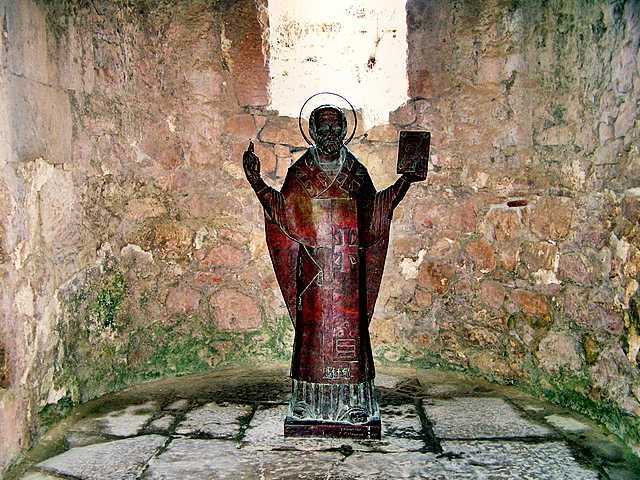
Hundreds of Orthodox Christians and other pilgrims descended on the village of Demre, Turkey, to the St. Nicholas Church where St. Nicholas served as the Bishop of Myra from 325-350 A.D.
The church still stands today, but has been destroyed and rebuilt several times. St. Nicholas was martyred here and buried under the church until his bones were stolen by Italians in 1087 and taken to Bari, Italy, where they remain.
“We’re lucky to still have this church intact,” said priest Vissarion Komezias, who was one of the celebrants at the 2009 celebration of St. Nicholas’ feast day, which is marked by Christians around the world on Dec. 6.
“At best, they become museums [like this], at worst they are abandoned or destroyed,” said Komezias.
For the last three years, the Turkish government has allowed the Eastern Orthodox Church to once again celebrate a mass in Nicholas’ church. From 2002 to 2006, the Turkish government had organized its own “prayer for peace” instead.
During the 2009 liturgy given in both Greek and Turkish, celebrant Hrisostomos Kalaycı from the Istanbul Patriarchate thanked the Ministry of Culture and Tourism.
“The people of Anatolia have been famous since ancient times for their diligence, their faith in God’s orders, their honesty and modesty,” Kalayci said. “I pray to God for love and peace in our country. May St. Nicholas help us all.”
Kalayci, Komezias, and other priests from the Orthodox Church served the wall-to-wall crowd. Candles flickered against the crumbling walls of the more than 1,500-year-old church while pictures of John the Baptist, Jesus, Mary and child, and Saint Nicholas himself adorned the altar. The saint’s image was brought to the center where a candle and the bishop’s mitre (traditional headdress) rested beside it.
The crumbling pillars next to the altar symbolized the church’s tumultuous history that includes earthquakes and war. The church underwent several restorations including by the Romans in 1043, the Russians in the 19th century, and more recently with the assistance of the small Greek island of Megisti.
“Our people rebuilt this church,” said Megisti resident Evangelia Mavrothalassitis.
Turkish officials gave the 73-year-old Mavrothalassitis and her son free admission to the church for the labor her island contributed during the last restoration. Megisti, or Kastellorizo, sits just a few miles off the coast of Demre. In 2006, the Turkish Ministry of Culture made a $40,000 investment to restore the church’s roof.
Saint Nicholas, known commonly for his generosity to children, is actually patron saint to the most causes and people — among them: sailors, bakers, thieves, Greece, Apulia and Sicily. Nicholas was first named a patron to sailors after a legend emerged that he appeared to seamen caught in a tempest and guided them home.
“We grew up in Germany knowing the legend of St. Nicholas,” said 58-year-old Erica Venna. “We wanted to see the origins for ourselves.”
Germans, Greeks, Russians and Italians were among the countries represented at the service. A group of German university students came with their Turkish-born professor as their guide.
“Our aim [today] is to present Santa Claus as a real man who helped poor people,” said Ismet Yenmez. “We also want to introduce Turkish culture to the students.”
One story tells of a man in Myra who had no dowry to offer any of his three daughters. Without a dowry, historians say “women were sold into slavery or worse.” According to the legend, St. Nicholas threw three bags of gold through the man’s window on three different nights. Some say the bags landed in a stocking or shoe, which is where the European tradition originated. Three separate historical accounts tell this story differing only on the number of women or amount of gold, according to the Saint Nicholas Center.
Thirty-two countries from around the world have distinct traditions devoted to Nicholas, including Muslim Turkey.
“All of us love Noel Baba [Father Noel],” said 44-year-old Demre resident Nurhan Kale. “He is from here. He has his own culture here.”
When asked why Turks love St. Nicholas, Kale said that St. Nicholas was “good to children.” In Turkey, some parents give their children presents on New Year’s Day in honor of the mythical gift-giving Noel Baba. The holiday is celebrated without any religious references.
“We tell the children he was an important man and this is why you are receiving the gift,” Kale added.
Whether you know him as Saint Nicholas, Santa Claus, Noel Baba, Father Christmas, Papa Noel, Kris Kringle or Belsnickle, the legend will always have its origins along Turkey’s Mediterranean seaside.