ISTANBUL – Turkey, Afghanistan and Pakistan will hold a joint military exercise in March 2011, following a decision by the leaders of the three countries at the trilateral summit of Central Asian countries in Istanbul on Friday.
Security cooperation among the three countries will focus on joint military drills, the fight against terrorism and drug trafficking and a joint program on police cooperation, according to a report by the Turkish Hürriyet Daily News.
The leaders further decided to establish infrastructure for audiovisual conferences and a natural disaster emergency operation centre.
Afghanistan also asked for Turkish technical assistance to increase its project development capacity.
“Development (of our countries) is a strategic tool to maintain peace, stability and serenity,” Turkish President Abdullah Gül said at the Summit opening.
It was important for the three countries to provide a positive environment for private investment and to strengthen cooperation in the fields of air transportation, commerce and energy.
The leaders also agreed to launch an “ideas platform” to increase research, academic and media cooperation between the peoples of Turkey, Afghanistan and Pakistan and to strengthen their historic, mutual friendship.
via Turkey, Afghanistan and Pakistan to hold joint military exercise | VANCOUVERITE.
ANKARA (A.A) – Greek Prime Minister George Papandreou will join foreign ministers of Afghanistan and Pakistan to address Turkish ambassadors around the world who will come together in Turkey next month.
Turkish Foreign Ministry’s annual conference of ambassadors will take place in the Turkish capital Ankara and the eastern province of Erzurum, a winter vacation spot. More than 150 Turkish ambassadors from around the world will first meet in Ankara between January 3 and 6 and then in Erzurum from January 6 to 9, ministry officials said.
Greek Premier Papandreou, as well as Afghan Foreign Minister Zalmay Rassoul and Pakistan’s Foreign Minister Mahmood Qureshi are confirmed speakers of this year’s conference.
Papandreou, to be accompanied by his foreign minister Dimitris Droutsas, is expected to fly directly to Erzurum without any visits to Istanbul or Ankara, diplomats said.
Turkish Prime Minister Recep Tayyip Erdogan will also attend the conference to listen to his Greek counterpart, diplomats added.
This year’s annual conference of ambassadors will be the third of a series. Last year, it was held in the southeastern province of Mardin.
The conference is a venue where Turkish foreign policy is discussed and Turkish diplomats review the past year. Its goal is to create an atmosphere for exchange of views in free discussion sessions and make coordination between Ankara and missions more effective.
Here’s a ‘today’ Yule story that occurred 3 weeks ago~AND NOW, in time for the holidays, I bring you the best Christmas story you never heard.
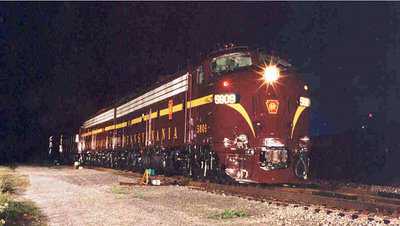
1. It started last Christmas, when Bennett and Vivian Levin were overwhelmed by sadness while listening to radio reports of injured American troops. “We have to let them know we care,” Vivian told Bennett. So they organized a trip to bring soldiers from Walter Reed Army Medical Center and Bethesda Naval Hospital to the annual Army-Navy football game in Philly, on Dec. 3. The cool part is,they created their own train line to do it. Yes, there are people in this country who actually own real trains.Bennett Levin – native Philly guy, self-made millionaire and irascible former L&I commish – is one of them. He has three luxury rail cars. Think mahogany paneling, plush seating and white-linen dining areas.He also has two locomotives, which he stores at his Juniata Park train yard.One car, the elegant Pennsylvania , carried John F. Kennedy to the Army-Navy game in 1961 and ’62.Later, it carried his brother Bobby’s body to D. C. for burial. “That’s a lot of history for one car,”says Bennett. He and Vivian wanted to revive a tradition that endured from 1936 to 1975, during which trains carried Army-Navy spectators from around the country directly to the stadium where the annual game is played. The Levins could think of no better passengers to reinstate the ceremonial ride thanthe wounded men and women recovering at Walter Reed in D. C.and Bethesda , in Maryland. “We wanted to give them a first-class experience,”says Bennett.“Gourmet meals on board, private transportation from the train to the stadium, perfect seats – real hero treatment.” Through the Army War College Foundation, of which he is a trustee, Bennett met with Walter Reed’s commanding general, who loved the idea. But Bennett had some ground rules first, all designed to keep the focus on the troops alone: No press on the trip, lest the soldiers’ day of pampering devolve into a media circus. No politicians either, because, says Bennett, “I didn’t want some idiot making this trip into a campaign photo op” And no Pentagon suits on board,otherwise the soldiers would be too busy saluting superiors to relax. The general agreed to the conditions, and Bennett realized he had a problem on his hands. “I had to actually make this thing happen,” he laughs. Over the next months, he recruited owners of 15 other sumptuous rail cars from around the country – these people tend to know each other – into lending their vehicles for the day. The name of their temporary train?The Liberty Limited. Amtrak volunteeredto transport the cars to D. C. – where they’d be coupled together for the round-trip ride to Philly – then back to their owners later. Conrail offered to service the Liberty while it was in Philly. AndSEPTA drivers would bus the disabled soldiers 200 yards from the train to Lincoln Financial Field, for the game. A benefactor from the War College ponied up 100 seats to the game – on the 50-yard line – and lunch in a hospitality suite. And corporate donors filled, for free and without asking for publicity, goodie bags for attendees: From Woolrich, stadium blankets.From Wal-Mart, digital cameras.From Nikon, field glasses.From GEAR, down jackets. There was booty not just for the soldiers, but for their guests, too, since eachwas allowed to bring a friend or family member. The Marines, though, declined the offer.“They voted not to take guests with them, so they could take more Marines,”says Levin, choking up at the memory. Bennett’s an emotional guy, so he was worried about how he’d react to meeting the 88 troops and guests at D. C.’s Union Station, where the trip originated. Some GIs were missing limbs. Others were wheelchair-bound or accompanied by medical personnel for the day. “They made it easy to be with them,”he says. “They were all smiles on the ride to Philly. Not an ounce of self-pity from any of them. They’re so full of life and determination.” At the stadium, the troops reveled in the game, recalls Bennett. Not even Army’s lopsided loss to Navy could deflate the group’s rollicking mood. Afterward, it was back to the train and yet another gourmet meal – heroes get hungry, says Levin – before returning to Walter Reed and Bethesda . “The day was spectacular,” says Levin. “It was all about these kids. It was awesome to be part of it.” The most poignant moment for the Levins was when 11 Marines hugged them goodbye, then sang them the Marine Hymn on the platform at Union Station. “One of the guys was blind, but he said, ‘I can’t see you, but man, you must be beautiful!’ ” says Bennett. “I got a lump so big in my throat, I couldn’t even answer him.” It’s been three weeks, but the Levins and their guests are still feeling the day’s love. “My Christmas came early,”says Levin,who is Jewish and who loves the Christmas season.“I can’t describe the feeling in the air.”Maybe it was hope. As one guest wrote in a thank-you note to Bennett and Vivian,“The fond memories generated last Saturday will sustain us all – whatever the future may bring.” God bless the Levins. And bless the troops, every one.
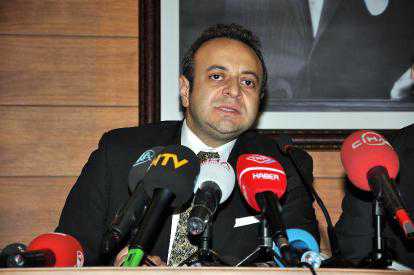
Turkish State Minister and chief EU negotiator Egemen Bağış has said that Kurds in Turkey had not expressed demand or expectation for autonomy.
Bağış said different cultures, religions, beliefs, ethnic identities and political views could exist in harmony in Turkey. DHA photo
Speaking on a TV program on pro-government Kanal 7 on Sunday, Bağış said differences between the Turks and Kurds stemmed from cultural richness, adding that nobody should harm national unity or feelings of brotherhood, and that everybody should preserve national integrity.
His comments came after a workshop organized by the Democratic Society Congress, or DTK, in the southeastern province of Diyarbakır called for launching a debate regarding autonomy for Turkey’s Kurds, speaking Kurdish in public institutions and installing the language as a secondary mode of communication at schools.
Bağış said different cultures, religions, beliefs, ethnic identities and political views could exist in harmony in Turkey, adding that demands for “democratic autonomy” were the efforts of some people to exploit a potentially volatile political situation.
Bağış said a political party that claimed to represent Kurds in Turkey did not even have 20 members, but the ruling Justice and Development Party, or AKP, had nearly 60 members of Kurdish origin, adding that half the deputies in the pro-Kurdish Peace and Democracy Party, or BDP, did not even speak Kurdish.
None of the parties has the right to solely represent any ethnic group, belief or national sentiment, Bağış said. “Both this flag and the holy book are ours.”
The important thing for the AKP is peace in the nation, he said.
Regarding Turkey’s European membership negotiations, Bağış said 27 negotiation chapters have been opened, while 13 have been completed.
Turkey had not given up on negotiations, Bağış said, adding that it was a long path and Turkey was determined to stick to it, despite political obstacles.
After negotiations have been completed, Turkey would ask the public whether they wanted the nation to become an EU member or not, he said.
When reminded that the Greek Cypriot administration would take over the EU term presidency in 2012, Bağış said term presidencies did not have much of an effect on membership negotiations, so the Greek Cypriot administration’s presidency would not have a significant influence over Turkey’s accession process.
More chapters were opened to negotiations during the EU presidencies of Germany and France – who are both relatively negative towards Turkey’s EU membership – compared to the presidential terms of Spain, Belgium or Finland, which are more positive towards the Turkey’s membership, Bağış said.
Commenting on a recent attack by Greek Cypriot basketball fans on Turkish team Pınar Karşıyaka after a game played in Greek Cyprus last Tuesday, Bağış said the Greek Cypriots were trying to simplify the incident by claiming that it was hooliganism.
When 3,000 people attack between 10 to 15 people it is not a simple issue, Bağış said.
ISTANBUL: Afghan President Hamid Karzai has said there are suggestions that the Taliban open a representation office in Turkey or another impartial country “to facilitate reconciliation” in the war-torn country.
Responding to a reporter’s question while attending the Pakistan-Afghanistan-Turkey Trilateral Summit in Istanbul, Karzai said Kabul would be happy if Turkey could provide such a venue, Anatolia news agency reported.
Turkish President Abdullah Gul said he was not aware of such suggestions but stressed that Turkey “will do anything that would contribute to stability and security in Afghanistan,” according to Anatolia.
During the Trilateral Summit, Karzai held talks with his counterparts Abdullah Gul of Turkey and Asif Ali Zardari of Pakistan.
It was the fifth such meeting since 2007 when Turkey launched the initiative to push Afghanistan and Pakistan to enhance cooperation against insurgents and improve ties poisoned by the insecurity plaguing their rugged border.
WikiLeaks’ release of US diplomatic cables, needless to say, will have an enormous impact on relations between the United States and the rest of the world.
Turkey, like other countries in the region, was affected by the release of documents although President Barack Obama called Prime Minister Recep Tayyip Erdoğan on Saturday and told him some of the comments in the cables do not reflect the view of the current US government and that the US-Turkish alliance is vital, Erdoğan’s office said in a statement on its website. However, earlier this month, Erdoğan reacted furiously to claims relayed in a 2004 diplomatic memo.
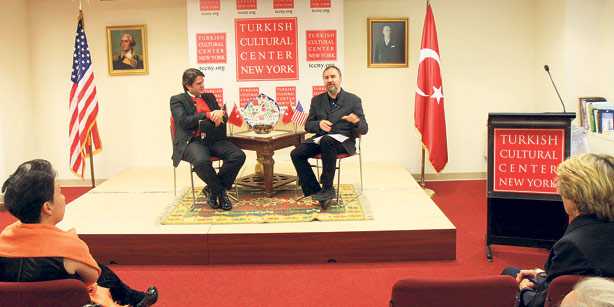
Aydoğan Vatandaş interviews Tony Karon, a senior editor at Time magazine, at the Turkish Cultural Center in New York.
Tony Karon is currently a senior editor at Time magazine and an accomplished journalist who has been focusing on the Middle East for many years. I interviewed Karon about the so-called shift in Turkish foreign policy and how Turkey was portrayed in the US documents.
How do you think the political shifts in Turkey that you have mentioned in your own writings are portrayed in these documents that were released?
To begin with, I think that what we see in the WikiLeaks documents is a lot of what I call nostalgia — nostalgia for an era that is long past and gone. So you have President Hosni Mubarak suggesting to US diplomats that the United States might actually overthrow the current Iraqi government and restore a dictatorship because that is what the country needs.
You have the Israelis saying perhaps it might be better if Gen. Musharraf was back in power in Pakistan and also obviously expressing all this alarm about Turkey — that Turkey has gone over to the Islamists’ side, the Iranian side and so on. You have Saudi Arabia’s king supposedly asking the US to attack Iran. What is remarkable about all these things, though, is that if you read the subtext, they are not happening. They are not happening.
The Saudis are complaining, supposedly, “When are you going to do this?” And of course, the answer is probably they are not going to do it. Defense Secretary Robert Gates has made it very clear, the reason the US is not going to bomb Iran is because there is not a military option that makes sense. Gates has said this very explicitly, and I think very courageously. This is not a point of view that is very well exercised in Washington discussion.
Politicians who might be seeking re-election don’t really say this sort of thing and of course Gates is not seeking re-election, and he says very clearly that bombing Iran’s nuclear facilities — at best — will set back Iran’s nuclear program by two or three years. But it will unleash all manner of unpredictable consequences across the region. It will strengthen the regime behind the hard-liners, and most importantly it will make sure that Iran does go ahead and build nuclear weapons — which right now, according the US intelligence assessments and most others, Iran has not yet taken the critical decision to do. It’s putting the means to make that decision within reach. Assembling, under the rubric of a civilian nuclear energy program, the means to create a “break-out” option, as it’s called (like Japan has) whereby assembling a weapon becomes something that can be done in a number of months rather than 10 years. Gates’ argument is a very pragmatic realist point of view, but it’s not what some US allies in the region want to hear.
What do you think the WikiLeaks documents reflect?
What I think WikiLeaks is reflecting, both from the questions that are coming to the US and their response to these questions, is that this is not the US of 2001 and certainly not the US of the Cold War, when changing a government in Baghdad at a whim might have been a conceivable option. It might be what is wanted, but in these times it is not a conceivable option, and that is what I think people are reacting to.
So within that schema you think: Where was Turkey in that Cold War schema for the United States? It was a good soldier. Turkey was there in the Korean War and there in the Afghan War and has been pretty much marching lock step with the US for most of the last half century. Yet suddenly, you see these events where a more democratic Turkey, where popular opinion is a lot stronger in shaping what the government is doing, and it is actually breaking with the US strategy.
In 2003, we have the Turkish Parliament voting that Turkish territory cannot be used to attack Iraq. And we see Turkey breaking with the US on the question of Iran and what’s the best way to approach Iran’s nuclear development. On the question of the Israeli-Palestinian conflict and Hamas, the US remains committed to a view of the region in terms of moderates versus radicals. It’s a prism of dividing the region according to those who are on our side and those who are on the other side — which President Bush put as “those who are not with us are against us.”
Plainly, that policy is not working.
Turkey is advocating something different. Turkey is looking to build bridges between Iran and Western parties. Turkey is looking to build bridges between Hamas and Fatah. Turkey is looking to reconcile Syria and Israel, Syria and the Saudis, and so on. But it is acting independently. In fact one of the cables very explicitly complains that US has “lost control” in this relationship.
That is a source of anxiety in a lot of the cables.
But also in some ways you can see that it is a positive thing. Even some of the US diplomats are recognizing that there is a lot of value in what Turkey is doing, even the break that Turkey is making. Frankly, it is departing from policies that haven’t worked. That, for me, is the take-away. It’s all very well to say, “Oh, you are being disloyal,” but sometimes a friend has to say, is this working? Are we getting where we want to get with Iran or the Palestinians, with Israel, with the rest of the region? If not, the question is, are these policies going to change?
I think that Turkey in some ways is creating and presenting a different set of options. That is a source of anxiety but also, I think, if you look at one of the key cables from Ambassador Philip Gordon, he concludes that this (break) is Turkish democracy in action. Turkey’s government’s decisions are being shaped by its population. This is what a democratic Middle East actually looks like, and this is not a bad thing. Turkey is offering a model of economic prosperity and development, a government based on Islamic values rooted in the region, integrating its neighbors from the European side from the Asian and Middle Eastern side, and it’s a source of stability. And is that really a bad thing? Should that be a source of anxiety? Not if we are relinquishing the Bush administration’s disastrous policies of trying to remake the region through revolutionary means.
When Turkey refers to its historical background, particularly its Ottoman Empire background, we see that the US is a little bit anxious about this. What are your thoughts on this?
I think in the US probably there is a reaction to the idea that Turkey has ambitions to govern all of its former Ottoman possessions. Obviously, that would be a source of anxiety in the United States and probably in a lot of those countries. But if we take the idea that Turkey has a certain history of managing a very complicated set of relationships across a very wide territory and maintaining hundreds of years of stability, then perhaps that appears in a different light.
When the US was setting up the Coalition Provisional Authority to run Iraq after the ouster of Saddam, there was an anecdote from Noah Feldman at NYU, who was one of the professors who was going to help the US as a constitutional advisor to set things up in Baghdad. He was on the US plane with the first group of experts flying there and he was reading a book on Iraqi history. He said everybody else on the plane was reading a book either about Japan or Germany in 1945.
So, what the US was bringing to Iraq, the expertise it was bringing to managing this very complicated place, was its own distinct history — America’s own success stories in Berlin and Tokyo of 1945. And actually some of the reporting suggested that J. Paul Bremer, the viceroy who was in charge of the coalition provisional authority, had a chart on his wall where he had benchmarks of progress based on the occupation of Germany in 1945, and he was checking things off as those benchmarks were achieved. In fact, one of the journalists saw an economic document in which the currency hadn’t been changed. So this document about Iraq still had reference to the Reichsmark.
In one of the cables, the Turkish side is claiming that actually what they aim to do in the Middle East is also to reduce the Iranian influence in the Arab street. Do you think this is rational or understandable?
Yes, I think that that is very important. It’s only if you view the region as a zero-sum game, either you’re on our side or you’re on the Iranian side, that it is a problem. It’s only if you see the region in those binary terms that that it becomes a win for Iran. In fact, I think the foreign minister, Davutoğlu, makes the point in that the regimes the US works with in the Arab world are very discredited by and large by their own populations. They carry very little credibility, which is why the combination of that, with their failure to challenge Israel, and to challenge the US on enabling policies, makes them very unpopular in the Arab world. These all combine to be a primary reason why Ahmadinejad actually became so popular on the Arab street.
But you can see by the opinion surveys a year after Prime Minister Erdoğan challenged the Israelis on Gaza that Erdoğan had eclipsed Ahmadinejad in terms of popularity on the Arab street as the most popular leader amongst the public. You think to yourself, if the goal is stability, integration, development and so on in that part of the world, who is a better role model? Who do we want those on the Arab street looking up to for a role model? I think it’s no contest, obviously.
Turkey has interests that differ from the US in terms of how the Iranian nuclear standoff issue should be resolved, but Turkey’s interests are hardly identical to those of Iran.
There is obviously potential geopolitical competition; the Turkish side is clearly aware of it. If the US is basing a strategy for stabilizing the Middle East on the likes of Saudi Arabia, Jordan, Egypt and so on, they are not regimes that seem to have much vitality in them. They are not regimes that have much popular legitimacy, that have much momentum. It is hard to imagine Saudi Arabia as a source of stability in troubled parts of the region over many years, so I think that the point that is made in the cables is correct.
And actually maybe we should think about why Iran’s influence in the region has grown so exponentially over the past decade. It is really not that hard to see that the key components of it are: a war in Afghanistan that takes the Taliban enemy away from Iran and a war in Iraq that eliminates its primary enemy in Saddam Hussein and an unpopular occupational policy in both countries and an Israeli invasion of Lebanon in 2006 that fails to actually achieve its designed goal.
It’s plain to see that this massive investment in force in the region as a means of transforming things in a positive direction has absolutely failed. It has achieved the opposite result. Militarily the US is unrivaled in its means to use force and will be for decades to come, but politically it’s in a lot of trouble. So, again, Turkey is an example, and it seems like those cables are saying to the US that you need to spend time thinking about what is working and what is not. You need to deal with the reality of what can be achieved in the region.
If the peace talks do not work, what do you think the next step of the Obama administration is going to be?
The peace talks are not going to work. You heard it here first. I think that what we are seeing really is that the current run of peace talks are in some ways mimicking the rituals of Oslo. The Oslo agreement, though, is long gone, that moment in history has long gone. In fact, it was rendered a little absurdly in the photographs. There is one of Obama leading Netanyahu, President Mahmoud Abbas, King Abdullah and President Mubarak, and there was almost an identical photo on the same White House carpet in 1995, with President Bill Clinton with Yitzhak Rabin, Yasser Arafat, King Hussein and Hosni Mubarak. There is a moment of comedy in this. The premise of Oslo has been that Israelis and Palestinians in bilateral talks will be able to agree on how to partition Palestine, how to complete that which the United Nations began in 1947. The partition plan which was accepted by the Israelis but not accepted by the Palestinians. The Israelis remade the map very deliberately. In the original partition they were awarded 55 percent of the territory. They ended up in 1948 with 78 percent of the territory.
On the Palestinian side, Yasser Arafat had very cleverly managed to reinvent the attainment of statehood in the remaining 22 percent of what had been British Mandate Palestine, as a revolutionary goal. In other words, there was a bit of sophistry in that the Palestinian national movement had been formed on the basis of recovering that which was lost in 1948, he very cleverly reinvented the national goal as the attainment of statehood. This was around 1988 when the PLO adopted statehood (on the basis of the 1967 borders) as a goal. At some point in his Cairo speech, in talking about the Palestinians, President Obama says they have been struggling for 60 years for a state of their own. Well that’s not quite how it’s been. That is a bit of fudge of the narrative, but nonetheless that’s now in place.
The United States, I think accepts the proposition of using the ‘67 borders, but the question becomes whether it actually becomes part of diplomatic strategy. Frankly, in my opinion, domestic politics here is such that I would doubt that the Obama administration, looking to secure its re-election two years from now, is going to risk it because it would be extremely risky to do.