The relations of the Armenian Intelligence Service with terrorist organizations is well known in Russia, in the USA, and in the Western World. Selling weapons to PKK, a terrorist organization, with the help of the famous criminal nicknamed “Ded Hasan” (Usoyan) via the territory of Armenia and performing terror acts in BTC (Baku-Tbilisi-Ceyhan) pipeline is also known to the public. Now, the Armenians, being afraid of Azerbaijan’s economic development, are cooperating with the terrorist organizations to prevent Azerbaijan from developing its military power.
By judging these facts given by Hafiz Musayev, the Major-General of the Azerbaijan National Security Ministry, in his book titled “The Principles and Characteristics of Special Services Activities in the Fight of Against International Terrorism”, we can assume that the terrorists supported by the Armenians try to deliver a blow to the interests of the USA and the Western countries in Azerbaijan. The importance of the book lies in its having developed dozens of interesting suggestions by analyzing the methods of fighting of foreign intelligence services against international terrorism and the activities of intelligence and counter-intelligence services in the regional war on international terrorism.
The book is a clear and authoritative guide to strengthening the cooperation of world leading countries in the war against international terrorism and for this purpose, the author suggests the formation of the Regular International Secret Service Network in the Europe and USA. The membership of such organization should be on a voluntary basis.
Throughout the book the author steps calmly and firmly into the fact that, all terror organizations know that fighting against them the USA and the Western countries carry the 30% of the cargo by using Azerbaijan’s air space en route to the conflict zones. And the activities of the terrorists are more concentrated on how to interfere with carrying the cargo than on Azerbaijan. Armenia and the Armenian Diaspora try to direct the activities of terrorists towards Azerbaijan by fighting against the interests of the USA.
The author also comments on the Armenians living in the USA and the Western countries who became billionaires. But their hostility and ill-intentioned policy towards Azerbaijan inveigles them into the fight against the interests of the countries who fed them.
The book consistently presents that there is no such a notion as “friend” for the Armenian lobby living the USA who supports the unmasked Armenian terror organizations in the USA. It has already been proved that the Armenian lobby is even ready to shock the interests of the USA with the purpose of joining Daglig Garabag to Armenia.
The book shows how, under the strong statements of the President of Azerbaijan Republic Ilham Aliyev, agitated are the Armenian officials in Yerevan and the Armenian Lobby in the USA. Based on the information from the mass-media, it has become known that the USA Intelligence Service has laid bared the relations of Armenian Lobby in the USA with the terrorist organizations.
Today Armenia and the Armenian Lobby by using their relations with the terrorist organizations try to strike a blow to Azerbaijan who is ready to free its occupied territories by declaring a war on Armenia. But mostly the interests of the USA and western countries will suffer from this terror attacks. The political elites of the USA and the West must realize this without any hesitation.
Thoroughly discussing terrorism issues in the globalization era, the author quotes academician R. Mehdiyev, the head of President’s Administration of the Republic of Azerbaijan, who masterly analyses the process of globalization:
“Globalization has already made remarkable gifts to the mankind, opened new perspectives in development, and expedited the processes of world movement. Meanwhile, as it happens in every gigantic process, the globalization has also its own negative features appearing in various, sometimes in nihilistic forms. First of all, it indicates itself in living level growing disparity of the population of the “rich” and “poor” countries.”
The way out of this situation of the Armenian people living in poverty is becoming limited day by day. For its expansionist policy Armenia has been put aside of all regional-economic projects. Taking part in these projects Azerbaijan and Georgia have been developing their economies, but Armenian economy went down. The poverty inveigles the Armenian people into trading in arms, drugs, and in cooperation with international terrorist organizations.
But the role of the Azerbaijan Intelligence Service in struggle against international terrorism is unexampled. In most of his interviews the Azerbaijan National Security Minister Eldar Mahmudov announced that the relations of the Azerbaijan Intelligence Service with the world most powerful Intelligence Services are in a high level and he supplied with some examples on discovering suspects linked to terrorist organizations and their extradition.
Turkey’s foreign minister said on Tuesday that Turkish Republic was resolved to protect rights of its citizens.
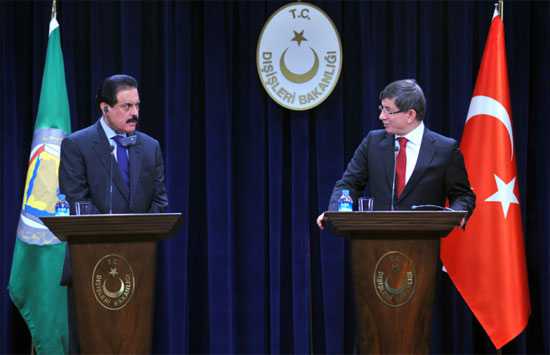
“We are still waiting for apology and indemnity from Israel,” Foreign Minister Davutoglu said while commenting on Turkey’s expectations from Israel because of attack of Mavi Marmara ship.
Speaking to reporters at a news conference with Abdurrahman Hamad Al-Attiyah, Secretary-General of Gulf Cooperation Council (GCC), Davutoglu said Turkey’s stance on the matter was clear.
“Turkey expressed its views on the Israeli attack on Mavi Marmara ship and the aid convoy in many platforms. There is no need to reiterate them. Our stance is explicit. Turkish Republic is capable of protecting the rights of its citizens and resolved to take every kind of measures to protect those rights. No change is in question in our stance.Turkey’s views, expectations and demands have been expressed. We will continue to exert every kind of diplomatic efforts for our demands to be met. There are different statements coming from the Israeli party,” Davutoglu said.
On May 31, Israeli soldiers attacked the “Palestine Our Route Humanitarian Aid Our Load” flotilla in international waters. Nine activists were killed and 54 others were injured by Israeli attacks.
-DAVUTOGLU TO TRAVEL TO IRAQ-
Asked to comment on his planned visit to Iraq, Davutoglu said he was planning a visit to Iraq on January 10-11. “We had a telephone conversation with Iraqi Prime Minister Nuri al-Maliki after he established the government. We decided to have second meeting of High Level Strategic Cooperation Council soon.”
Davutoglu said works regarding the details of the meeting continued and necessary statements would be made soon, adding Turkey’s support to Iraq would always continue.
Iraq’s parliament approved last week Prime Minister Nuri al-Maliki and his government, nine months after the general elections.
Turkey put its imprint as one of the most influential countries not only on 2010, but on the first decade of the third millennium. At the start of the new decade, too, Turkey’s geopolitical position, rich historical heritage, cultural depth, well-educated young population, ever-strengthening democracy, growing economy, and constructive foreign policy make it an indispensable country in a world transformed by rapid globalisation.
By making use of all of its assets, Turkey is contributing to regional stability and peace, and working towards a global order based on justice, equality and transparency. As an emerging power, Turkey will continue to realise its own potential and simultaneously contribute to global peace.
The chaotic conditions of the post-Cold War world have made civil wars, occupations, nuclear armament, and human trafficking chronic problems. While globalisation offers new opportunities, it also causes new global problems and deepens the inequalities embedded in the world order. It is no longer possible to sustain the current world order, which, based as it is on a skewed notion of centre-periphery relations, merely produces injustice and inequality.
Turkey seeks to contribute to regional and global peace by facilitating democratic reforms domestically and implementing a principled foreign policy. As a Nato member, Turkey aims to become a full member of the European Union and establish cordial relations with all of its southern and eastern neighbours. Turkey’s posture — looking both at the East and the West — is neither paradoxical nor inconsistent. On the contrary, Turkey’s multidimensional geopolitical position is an asset for the region.
There are few countries that can play such a critical role. Turkey constitutes a new synthesis because of its ability to link such diverse qualities and backgrounds. Turkey is thus capable of overcoming the dichotomies of East-West, Europe-Middle East and North-South.
Indeed, this capacity is essential because we need to leave behind the Manichean disagreements, conflicts, and fears of the Cold War era. Those who see the world through those old, fearful lenses have difficulty in understanding Turkey’s rising profile and dynamism. But the realities of the 21st century necessitate a multi-dimensional and inclusive political perspective.
Acting on these principles, Turkey is following a proactive foreign policy, stretching from the Balkans to the Middle East and the Caucasus. This geography is Turkey’s natural historical and cultural hinterland. Turkey’s cultural and historical links with the peoples of these regions are deep and conducive to regional peace.
Turkey cannot remain indifferent to this geography, for it stands at the centre of it. History clearly shows that it is impossible to establish and sustain global peace without ensuring peace and stability in the Balkans and the Middle East. Turkey is following a constructive and inclusive policy for these regions, which are marked by remarkable models of cohabitation, science, arts, culture and civilisation.
Owing to our recent efforts, the wounds of the Bosnian war are being healed, facilitating peace and stability among Balkan peoples. Turkey’s efforts are also helping prevent wars in the Middle East, and our intense efforts have helped keep a diplomatic track open on the Iranian nuclear issue.
Moreover, we are helping to facilitate political stability in Iraq and helping the Nato mission in Afghanistan. And, of paramount importance, Turkey is making enormous efforts to help establish an independent and sustainable Palestinian state — efforts that are appreciated by Turkey’s western and eastern friends alike.
Today, Turkey is following a policy that represents a sense of justice in the Middle East, and is working towards the removal of artificial borders and walls among the region’s peoples. We desire to live in a region where the dignity of every person is respected. That is why we have objected to Israel’s aggression in and blockade of Gaza, and will continue to do so.
We know that it is not possible to attain global peace unless we establish sustainable peace in the Middle East, which requires resolving the Palestinian question. Therefore, we urge Israel and all other countries involved to follow constructive and peaceful policies.
Motivated by these principles, Spanish Prime Minister José Luis Rodríguez Zapatero and I showed through our “Alliance of Civilizations Initiative” in 2004 that cultural, historic and religious differences are no reason for conflict. The basis for our approach to humanity is the following principle of the famous Turkish poet Yunus Emre: “We love and respect the created because of the Creator.”
As a result, we stand firmly opposed to discrimination against any society, religion, sect, culture, or country. I consider anti-Semitism, Islamophobia and prejudice against Christianity crimes against humanity, whose common values and ethical rules oblige us to confront and reject all forms of discrimination.
Besides its cultural, historic and diplomatic values, Turkey’s vibrant economy has become a source of stability and welfare. When my party took office in 2002, the Turkish economy totalled around $250 billion. Today, Turkey’s annual GDP has reached $800 billion, making it Europe’s sixth-largest economy and the 17th largest in the world. It has also been one of the least impacted by the global economic crisis, with growing foreign trade, a strong banking system and diverse and prospering small- and medium-size enterprises. Thus, the Turkish economy returned to its pre-crisis levels in 2010.
All of these qualities have transformed Turkey into an attractive place for business, media, artists, diplomats, students and non-governmental organisations from around the world. Turkey’s ever-increasing soft power is becoming one of its most significant traits, which we will continue to use to enhance regional and global peace.
The impact of globalisation has brought about a rebalancing of power, but the demand for justice, transparency, and legitimacy remains constant. The global problems of our times necessitate cooperation, political will and sacrifice. That is why we are following a proactive policy in multilateral institutions to facilitate an equitable sharing of our world’s resources.
Turkey will continue to work toward a just and equitable global order in 2011 and beyond. This is a responsibility emanating from our history, geography and the universal values that we hold.
Mona Diamond was appointed the Turkish honorary consul general for the state of Georgia in 2005. In the same year, she became the chairman of the American Turkish Friendship Council, a not-for-profit organization for the promotion of close relations between the United States and Turkey.
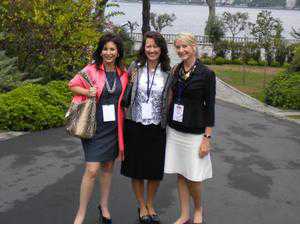
Left to right: Mona Diamond, Turkey's honorary consul general based in Atlanta with Dawn Shields, CFO of GeoResults, an Atlanta-based telecom database marketing and consulting firm and Laura Howell, a consultant with Steelcase Inc., a global workplace furnishings company, outside of the Sabanci Museum in Istanbul during a business mission to Turkey in September 2010.
In 2009, she organized and chaired an International Women’s Entrepreneurship and Leadership Summit in Istanbul, Turkey, and in September 2010, she partnered with two Turkish American business organizations and the American Chamber of Commerce Executives to head a delegation of civic and business leaders from throughout the U.S. to several Turkish cities.
Ms. Diamond responded to the following questions from GlobalAtlanta about her current activities in promoting relations between Georgia and Turkey as well as her plans for the coming year, including her efforts to open a breast cancer clinic in Mersin, Turkey.
To learn more about Ms. Diamond’s activities on behalf of Turkey, go to
GlobalAtlanta: How do you think Turkey is perceived by Americans generally? In what ways do you think that these perceptions may be inaccurate?
Ms. Diamond: I believe most Americans know very little about the Republic of Turkey. What they do know might not necessarily be correct. For example, many Americans feel Turkey is an Arab country and that the Turkish language is written in Arabic. Both are incorrect facts. The Turkish language is written with the Latin alphabet just as in English. Turkey is considered a European country and has applied for full membership into the European Union. Turkey is also a member of NATO. Although Turkey is 98 percent Muslim, Jews, Christians and all minorities live harmoniously and are allowed to practice their religion, cultures, and traditions freely.
Turkey is a secular country. As of 1923 many reforms were put in place by the founder of the republic and the first president, Mustafa Kemal Ataturk. For example, women were given the right to vote and to be elected, equal education and employment opportunities exist both for men and women. Most Americans have no idea that the population is as large as 73 million people and that Turkey is the only country in the world that is on two continents—Europe and Asia.
GlobalAtlanta: And vice versa, how do the Turks view Americans generally and in what ways do you think that they may be mistaken?
Ms. Diamond: Most Turkish people form their opinions of Americans simply by what they see in the movies and watch on TV programs.
GlobalAtlanta:How have you in your role as honorary consul general tried to change these perceptions?
Ms. Diamond: As honorary consul general, it is my mission to introduce Turkey to the citizens of Georgia and to promote and expand educational, economic and humanitarian relationships between the Untied States and the Republic of Turkey. To achieve this mission, I founded the American Turkish Friendship Council, a 501 (c) (3) organization. This organization works hand in hand with me as honorary consul general of Georgia.
Through this organization, we have established the Endowed Emory University Turkish Lecture Series. We partner with the Claus Halle Institute for Global Learning.
We provide for credit Turkish language classes at Georgia State University with financial help from the Turkish consul general’s office in New York.
Another program of the American Turkish Friendship Council is the funding of the “Catoms” (Multipurpose Community Centers) Scholarship Program. The overall objective of Catoms is to enhance the status of women and the young population in southeastern Turkey. Catoms have various social programs, including a scholarship program. They select successful students who are unable to continue their education due to social and financial problems. The friendship council is a proud sponsor of these scholarships.
The main project of the friendship council is The Turkish Breast Cancer Center in the city of Mersin, Turkey. The center, which will be located in the State Hospital in Mersin, will serve a region of the country in need of a comprehensive approach to the detection and treatment of breast cancer.
The clinic will provide the resources necessary to detect, diagnose and treat breast cancer at the earliest stage possible and to promote awareness of the disease. Early detection followed by treatment and rehabilitation is the key to increased recovery rates.
We are very proud to be working very closely with the Turkish minister of health, Dr. Recep Akdag, and his staff who have made major changes and overall improvement of health and to provide a higher standard of living to the citizens of Turkey.
Turkey has an outstanding medical health system with highly qualified physicians and state of the art hospitals. Many patients from foreign countries are coming to receive medical care in Turkey each year.
The Breast Cancer Center to be established in Mersin will yet be another area of medical expertise. This project will be a collaboration of Turkish and U.S. doctors under the guidance of Dr. Lorraine Tafra, former president of the American Society of Breast Surgeons and director of the Anne Arundel Medical Centers Breast Center Clinic in Maryland.
The above examples are but a few of the projects of the ATFC and demonstrate how as honorary consul general of Turkey and the chairman of the American Turkish Friendship Council, I try to influence the population of Georgia to work together in building relationships and mutual understanding with the citizens of Turkey.
GlobalAtlanta: In what ways has Turkey’s economy changed in recent years and what opportunities do these changes represent for U.S. companies?
Ms. Diamond: There have been many changes in Turkey’s economy in the last decade. Turkey conveys the highest quality of goods to meet world standards and offers the market the best pricing structures. The Turkish economy has become the 17th largest economy in the world with its GNP at 750 billion U.S. dollars. Turkey is predicted to enter the top 10 economies in 2023. The Turkish economy grew with a 5.8 percent average increase between 2002 and 2008. The national income per capita exceeds $10,000 and has tripled since 2002 as inflation is only about 5 percent.
GlobalAtlanta: How is it that Turkey has emerged with a higher credit rating after the economic crisis than before?
Ms. Diamond: According to Deputy Prime Minister Ali Babacan, Turkey has experienced a turning point in the history of the economy in the last eight years. Strengthening the economic structure, increasing the level of prosperity and eliminating the problems that constitute obstacles for a functioning healthy economy have formed the main frame of the reform efforts that were started in 2002. Reorganization of the banking system, strengthening of the public financial structure and rationalizing the social security system have all served to this purpose.
In this way, Turkey’s economy has grown uninterrupted for a long time and has become Europe’s sixth and the world’s seventeenth largest economy. The banking sector with high quality assets and 20 percent of capital adequacy level did not need any public contribution even during the crisis period. The Turkish banking structure has a significantly stronger structure than many developed or developing countries. The increase in the problematic loans of the banking sector with high asset quality is also at a minimal level.
GlobalAtlanta: You led a large and diverse delegation from the U.S. to Turkey earlier this year. The delegation was composed of chamber of commerce representatives, economic development officials, attorneys and business people. Are trips like this effective in initiating trade and other business relations? Do you have any specific examples?
Ms. Diamond: In September 2010 as honorary consul general of Turkey, I partnered with TABA, Turkish American Business Association and TACCI, the Turkish American Chambers of Commerce. We took a diverse delegation from the U.S. to visit the cities of Istanbul, Izmir, Bursa and Kocaeli. The delegation composed of presidents of chambers of commerce, economic development official, attorneys and business people interested in initiating trade with Turkey. Highlights of the trip were meeting with high ranking government officials such as the Minister of Trade Zafer Caglayan.
Minister Caglayan pointed out that Turkey and the U.S. are two countries with years of deep routed friendship and alliance. U.S. exports to Turkey are in a highly increasing trend but imports from Turkey have not increased at the same level. The minister feels it is of utmost importance that a trade balance exists between the U.S. and Turkey. The aim is to double exports from Turkey over the next five years.
President Obama and the Turkish Prime Minister Erdogan have established the Economic and Commercial Strategic Cooperation Framework recently. Turkish Deputy Prime Minister Ali Babacan and Minister of Trade Zafer Caglayan will represent Turkey. U.S. Secretary of Commerce Gary Locke and U.S. Trade Representative Ron Kirk will be the representatives for the United States. Turkish and American businessmen doing business in both countries will come up with new projects and ideas aimed at elevating to a higher level the economic and commercial relations between the two countries.
Several of the attendees have shown an interest in joint ventures with Turkish companies and some in establishing a distribution center for their goods. Overall, the trade mission to Turkey was very positive.
GlobalAtlanta: In what specific areas do you think U.S. companies (especially small- and medium-sized companies) should invest in Turkey?
Ms. Diamond: Turkey has a young, dynamic and well-educated population. Turkey’s location is at the center of commercial transit points. The fast developing domestic market is also an important reason for the foreign investor in Turkey. In the last six years the GNP increased from $220 billion to $750 billion.
The population of Turkey is 73 million people. The average age is 28. The potential of Turkey is unbelievable; it has 400,000 university graduates, more than 44 million credit card holders and nearly 30 million Internet users.
Turkey has a stabilized political system and stabilized economy and a low inflation rate, competitive interest rates, which makes it enticing for foreign investment.
The Turkish government also offers incentives for foreign investors. So many top American companies have their business in Turkey including Best Buy, Citibank, The Coca-Cola Company, Conrad, Ernst &Young, Ford, Frito-Lay, Goodyear, Hewlett-Packard, Hilton, IBM, Johnson & Johnson, JP Morgan, Merrill Lynch, Motorola, Pfizer, Philip Morris International, Procter & Gamble, Starbucks Coffee, The Ritz Carlton Hotel, UPS, Wells Fargo and Nike.
GlobalAtlanta: What will be your major goals as honorary consul general for 2011?
Ms. Diamond: It is with great personal satisfaction that I serve as the honorary consul general for Turkey in Georgia. I have the opportunity to introduce Turkey to so many Americans and build bridges of understanding between Turkey and the United States. In the year 2011 we will be working to put a Breast Cancer Center in Mersin, Turkey. This is collaboration between American and Turkish doctors and will be placed in the State Hospital. The aim is to bring breast cancer awareness to women in the Mersin region of Turkey.
We will continue with giving scholarships to keep girls in schools in the eastern cities of Turkey through Catoms.
We will also partake as we do each year with the Endowed Turkish Lecture Series at Emory University, with the Turkish language program that is taught at Georgia State University.
At Oglethorpe University, we are planning to have a contemporary art exhibit from Turkey. The High Museum of Art is working with us in order to bring an art exhibit to this museum as well.
We will decorate a tree from Turkey and display it at Fernbank as we have done for the first time in 2010. Also, we will continue to be involved with Congressman John Lewis’s International Fair.
Once again, we hope to bring many speakers from Turkey to talk about investment in the country and joint ventures that can take place between Turkish and American partners.
As you can see, we expect 2011 to be a very exciting year and hope to bring more Americans together with our Turkish population here in Atlanta.
We want our friends to learn about our culture, food, history and business opportunities and to visit Turkey if at all possible. The future looks very bright.
As honorary consul general and chairman of the American Turkish Friendship Council, I invite one and all to join us and experience the warm hospitality of Turkey!
Development might seem remarkable considering that Greece and Turkey have been rivals and almost on the brink of war at various times
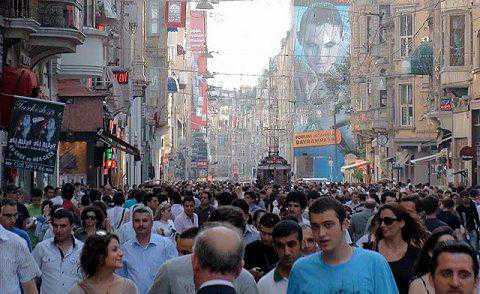
Crowded streets in Istanbul (File Photo)
With the Greek economy deep in recession, some Greeks are now looking to neighboring Turkey – in particular Istanbul – for the chance of a better life. A remarkable development considering the relations between the two have been marked by alternating periods of mutual hostility and reconciliation ever since Greece won it independence from the Ottoman Empire in 1821.
Eleni Varmazi is drinking a coffee in a cafe, taking a rest from her job teaching at one of Istanbul’s numerous private universities. Varmazi is one of a growing number of Greeks who has found work in Istanbul.
“I applied in the UK, in Ireland , in Brussels in the European Union, in Cyprus for many positions, and here also. I am very happy with my jobs with my students , I was looking forward to teaching Turkish students and everything is going great on this level. It is even more convenient than trying to find a job in London or in Berlin. It’s closer you can go back for weekends. I know two or three people who have moved here and found a job here, and I am sure their a lot more,” she said.
Varmazi’s story might seem remarkable considering that Greece and Turkey have been rivals and almost on the brink of war at various times. But Varmazi’s story is no longer that unusual.
Ionis Grigoriadis is an expert on international relations at Bilkent University. I met him in Fener, the ancient Greek quarter of Istanbul, where he has bought a house. Grigoriadis says the fact that a growing number of Greeks are coming to Istanbul is proof that relations between the two countries are improving.
“We are no where close to the very difficult circumstances of the late 90’s where the two countries came to the brink of war. Students from Greece come to Istanbul to learn Turkish. In the last year a very popular TV series from Turkey attracted a very high rating in Greek TV, which shows that the very low resolution view of Turkey is changing. That people understand Turkey is many things of course there are dark sides like in many countries. So things are moving to a more balanced approach,” he said.
At the opening of an exhibition celebrating Greek architecture in Istanbul, a first for the city, Greek not Turkish is the prevailing language. Laki Vingas is a senior member of the city’s Greek community. He says the community was on the verge of collapsing but believes its now turned the corner.
“They had a target time until their children were graduating from the high school and then the whole family was leaving. That’s why from 100,000 people we are now left 3,000 people. Everybody used to say not their identity, not to mention their Greek Orthodox of Turkey, so they were trying to hide their name, their religion their identity. Where as now they are saying this openly. Unfortunately it was very bad century , the 20th century. So we feel the 21 century is a turning point for us,” he said.
At Istanbul’s Zografen Greek High school, an English teacher is preparing her class for their final exams. There are only four pupils. The large high school has less than 100 pupils. But where in the past, upon graduating, pupils would leave for Greece, now pupils want to stay – like Natasa.
“I want to become a translator at university in Turkey , because I was born here, I am living here. I love Istanbul. I have friends here and to left for them. I want my future here,” she said.
There are no official figures on how many Greeks are working in Istanbul, but the numbers are believed to be small and growing. Along with the ongoing economic turmoil in Greece and Turkey’s burgeoning economy, analysts believe Istanbul will be a destination for an increasing numbers of Greeks. After all, the name “Istanbul”, stems from the Greek word for “I go to the city”.
via VOA | Increasing Number of Greeks Flee to Turkey For a Better Life | Europe | English.
The Istanbul leg of the program will take place during the 10th !f Istanbul Film Festival, running from Feb. 17 to 27
The Sundance Institute, which manages the Sundance Film Festival, one of the most prestigious independent film festivals in the world, and the !f Istanbul AFM International Independent Film Festival are set to collaborate on a new project.
Film Forward, a program initiated under an incentive of the United States President Barack Obama to develop worldwide inter-cultural dialogue, has chosen Istanbul as one of its 10 partner cities and !f Istanbul as the collaborating film festival for the project.
Founded by Robert Redford in 1981, the Sundance Institute has chosen 10 films from various countries for the program. These films will be screened in the 10 chosen cities and discussions with the directors and the Sundance Institute crew will run after the screenings.
The program is set to begin in New York in December, 2010 and will conclude in Washington, September 2011, with a screening of all the films in the project.
The Istanbul leg of the program will take place during the 10th !f Istanbul Film Festival, running from Feb. 17 to 27, with the support and collaboration of the U.S. Embassy in Ankara.
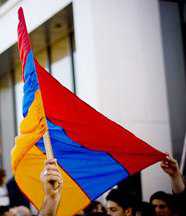 The relations of the Armenian Intelligence Service with terrorist organizations is well known in Russia, in the USA, and in the Western World. Selling weapons to PKK, a terrorist organization, with the help of the famous criminal nicknamed “Ded Hasan” (Usoyan) via the territory of Armenia and performing terror acts in BTC (Baku-Tbilisi-Ceyhan) pipeline is also known to the public. Now, the Armenians, being afraid of Azerbaijan’s economic development, are cooperating with the terrorist organizations to prevent Azerbaijan from developing its military power.