Year: 2010

  • Filmmakers clamoring for involvement in historical Istanbul films

    Filmmakers clamoring for involvement in historical Istanbul films

    EMRAH GÜLER

    ISTANBUL – Hürriyet Daily News

    Two films about the history of Ottoman Istanbul hit theaters this week. The big budgets of projects celebrating Istanbul as a 2010 European Capital of Culture have prompted many filmmakers to seek involvement in projects set in historical Istanbul. Wait for more movies in the near future
    Unless a director is releasing a movie hoping to cash in on cheap laughs, historical movies and documentaries fall into the riskiest categories for Turkish producers to approach.
    Unless a director is releasing a movie hoping to cash in on cheap laughs, historical movies and documentaries fall into the riskiest categories for Turkish producers to approach.

    Unless a director is releasing a movie hoping to cash in on cheap laughs, historical movies and documentaries fall into the riskiest categories for Turkish producers to approach.

    Period dramas and historical movies have, in the past, been some of the most popular films to screen in Turkey.

    Half a century ago, they were the ultimate form of entertainment, not because of their accurate portrayal of the relevant period but for quite the opposite reason. They suffered from borderline cinema disorder, being more histrionic than historical.

    The notorious B-movies of the 1960s and 1970s have become history themselves, as Turkish cinema has gone through a renaissance of its own in the last two decades. Diverse examples of high caliber cinema have found their way into movie theaters but historical cinema has remained an area where not much improvement can be observed.

    For one, historical movies and documentaries fall into the riskiest categories for Turkish producers to approach. Unless you are releasing a movie hoping to cash in on cheap laughs (exemplified by the movies featuring the vulgar antics of Recep İvedik) or hoping to hit a nation’s soft spot on nationalism (for example, the “Valley of the Wolves” series), box office gross is a pure gamble in Turkey. What producer would want to greenlight an expensive production when there is another story set in an Anatolian village in the present day?

    Of course there is one thematic exception in this otherwise general trend in the profitability of historical movies: Atatürk films. Two years ago, renowned documentary director and biographer Can Dündar’s intimate account of Atatürk’s life, “Mustafa,” caused quite a stir, dividing the nation. This was good news for the box office. Last year, two quite mediocre features on Atatürk hit the theaters. Both writer, composer, singer and filmmaker Zülfü Livaneli’s “Veda” (Farewell) and Turgut Özakman’s “Dersimiz Atatürk” (Today’s Lesson, Atatürk) depicted the former Turkish leader’s life in dry, chronological order, merely better than a high quality middle school documentary.

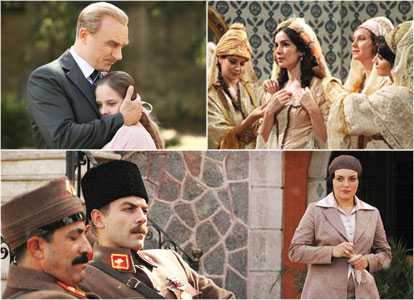
    This week, you will see the words Ottoman and Istanbul in two movies. One of them, a high-octane action/conspiracy/history thriller in the line of Jerry Bruckheimer’s “National Treasure” series. The other, a love story set in Ottoman Istanbul.

    The Abdülhamid Code

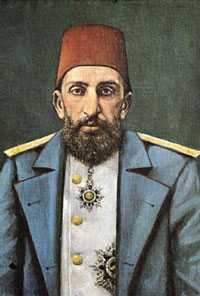
    Director Hakan Şahin’s “Sultan’ın Sırrı” (Secret of the Sultan) features an American professor traveling to Istanbul to find a mysterious chest built by Sultan Abdülhamid II about a century ago. He learns the chest is somehow relevant to the present dynamics of the power games over oil and the best place to look for it is Topkapı Palace, now the Topkapı Museum.

    In a mixture of the “National Treasure” movies and Dan Brown’s “The Da Vinci Code” and “Angels & Demons,” secret societies and historical conspiracies are revealed through by mysterious museum director (that would be historian İlber Ortaylı in real life). The conspiracies go back to the Gulf Wars, the Iran-Iraq War, World War I, and finally to the final years of the Ottoman Empire, giving way to action scenes in the historic underground passages of Istanbul. The film was written by historian and journalist Ömer Erbil, and features locations in many of Istanbul’s historic buildings, like Yıldız Palace, Hagia Sophia and the Archaeology Museum.

    The other film is an unabashed promotion of Istanbul, as one of the many projects celebrating Istanbul’s status as a 2010 European Capital of Culture, with the story never really given priority over the beautiful footage of the city. “Şenlikname: Bir Istanbul Masalı” (Festivities: An Istanbul Tale), directed by İsmail Eren, is a love story set in the Ottoman period that begins with the kidnapping of the Sultan’s daughter. But which period or sultan is not very clear. The film promises to be a jumble of historical imagery from the Ottoman period, including the “mehter” band of musicians, pirates, and palace guardsmen.

    The big budgets of projects celebrating Istanbul as a 2010 European Capital of Culture have prompted many filmmakers to seek involvement in the projects set in historical Istanbul. One of these is the big budget production about the Ottoman conquest of Istanbul, anticipated by many with apprehension. “Fetih 1453” (The Conquest 1453) has been a hot topic of debate for the last year – with its acclaimed advisors on history, costumes and architecture, its ambitious war scenes enhanced by state-of-the-art CGI technology and its mysterious casting of the role of Sultan Mehmed II, who was just 21 when he conquered Istanbul. The costume shops must now be running amok with booming demands for Ottoman dress.
  • 16th-Century Istanbul Mosque Gets Makeover

    16th-Century Istanbul Mosque Gets Makeover

    Standing in the main sanctuary of Suleymaniye Mosque, Amin, a cleaner of the mosque’s carpets, raised his hands in joy. “It’s Suleymaniye, it’s muhtesem,” he said, using a Persian word meaning “majestic.” The reason for celebration: the completion of a three-year restoration of the 453-year-old imperial mosque.

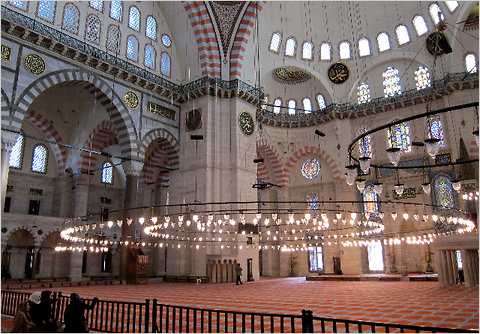
    The restored interior of the Suleymaniye Mosque in Istanbul.
    The restored interior of the Suleymaniye Mosque in Istanbul.

    Suleymaniye was built at the height of Ottoman architecture for the sultan Suleyman the Magnificent, by Mimar Sinan, the Frank Gehry of his time. Arches in the upper balconies seem to split in an architectural sleight of hand, geometric patterns and kaleidoscopic Arabic calligraphy ring the inside of minor domes that appear to froth around the central dome, which floats nearly 175 feet above the floor. It’s a bit like walking into an M.C. Escher drawing.

    But just a few years ago, there was cause for concern. The structure’s ability to withstand a serious earthquake was in question; cement plaster, applied to the walls in the 1960s, was suffocating the building. With a budget of $14.5 million, the recently completed restoration works, carried out by the Gur Yapi construction firm, included much needed structural work on the domes, as well as changes to the interior decorations that attempt to return the designs to their original style.

    In the process of correcting previous restorations, original 16th-century hand-painted patterns, as well as panels of Iznik tiles, were uncovered in the upper galleys and are now on display.

    “It doesn’t look Botox-ed,” said Saffet Emre Tonguc, a local tour guide, said. “You can feel the age of the building.”

    via 16th-Century Istanbul Mosque Gets Makeover – NYTimes.com.

  • The Ottoman sultans in Amsterdam

    The Ottoman sultans in Amsterdam

    by Philippa Burton

    15-12-2006

    The exhibition Istanbul: The City and the Sultan is opening in Amsterdam’s De Nieuwe Kerk this weekend. Organized in collaboration with four Turkish museums, it takes visitors on a leisurely walk through the city during its Ottoman period (15th to early 20th century), with stops at the court, the armoury, the harem, the mosque, the library, the hamam or baths, the bazaar and more.

    More than 250 treasures of the sultans, many of them from Topkapi Palace Museum, have been brought to the Netherlands for the exhibition. They include arms, carpets, jewellery, silverware, porcelain, paintings, caftans and turbans, and a nice collection of calligraphy manuscripts and other historical documents.

    The director of De Nieuwe Kerk, Ernst Veen, places the exhibition within the “other countries and cultures” policy of the museum: “By telling the story of the culture and cultural heritage of other countries, we also hope to build a bridge towards greater knowledge and understanding.”

    East and West
    Istanbul is the only city that straddles two continents and also the place which famously proves Rudyard Kipling wrong: here East and West do meet. Founded as Byzantium by Greek colonists in 667 BC, it grew into a metropolis after Constantine the Great selected it as the site for his capital, which he called New Rome, in 330 AD. The name never caught on and the city was renamed Constantinople in his honour. For 1,100 years it was the capital of the Eastern Roman, or Byzantine Empire, before being conquered by the Ottoman sultan Mehmed II in 1453.

    The capture of Constantinople gave great prestige to the Ottoman state, which was seen as an empire from then on. Mehmed the Conqueror, as he was later known, ordered the construction of great works including the sultans’ Topkapi Palace. Constantinople’s Haghia Sofia, the world’s greatest cathedral throughout the Middle Ages, became the Aya Sofia mosque, and the Blue Mosque was also built across from it to rival its beauty. The Ottoman Empire ended with the First World War and the founder of modern Turkey, Kemal Atatürk, renamed the city Istanbul and ordered Aya Sofia turned into a museum.

    Contacts with the Netherlands
    In 1612 the Ottoman Empire became one of the first great powers to recognize the young Dutch Republic. Commercial ties were at first mediated by Jewish bankers and merchants who, the century before, had fled the Spanish inquisition and found refuge in the sultan’s realm. Soon, Dutch traders began dealing directly with the sultan’s court and exchanges multiplied. The famous Dutch tulip was in fact imported from the Ottoman Empire; it is a common motif on the tiles of Topkapi Palace and graces its gardens overlooking the Bosporus to this day.

    An inspired setting
    De Nieuwe Kerk (New Church) is an inspired setting for the exhibition. The contrast between the originally Roman Catholic then Protestant church building and the Islamic art inside will remind anyone who has been there of the interior of Istanbul’s Aya Sofia, that other museum with a mixed religious past, where Christian mosaics and medallions bearing the names of Muhammad and the first caliphs stand side by side.

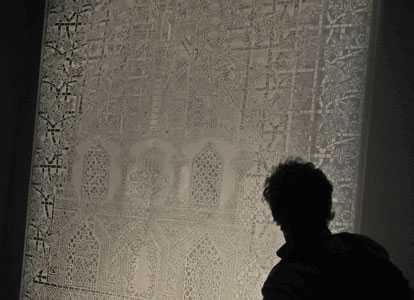
    The clever play of veils by the exhibition’s architects and designers emphasizes this contrast while also separating the interior of the church into manageable spaces. Visitors should remember to look up often to catch the endless combinations of overlapping Christian architectural details and translucent Islamic motifs. Those in need of a rest can enjoy a Turkish coffee or apple tea, and a piece of lokum – the famed Turkish Delight – in the Turkish coffeehouse that has been set up under the church’s organ.

    Other events
    De Nieuwe Kerk has organized an extensive programme of activities around the exhibition, with weekly lectures (in Dutch) and concerts throughout the months of January, February and March 2007. Amsterdam’s Podium Mozaïek makes the link with the present with its Turkije Nu/Turkey Now theatre and film programme, which investigates the sources of inspiration, dreams and motivations of artists of Turkish origin who live in the Netherlands today.

    For a full programme, see:

    De Nieuwe Kerk
    Podium Mozaïek

  • The Book of Istanbul, edited by Jim Hinks and Gul Turner – review

    The Book of Istanbul, edited by Jim Hinks and Gul Turner – review

    Istanbul spans the largest metropolitan area in Europe, so it’s hardly surprising that most of the 10 authors represented in this anthology express concerns about the traffic. Nedim Gursel writes of a furious, gun-wielding sergeant shouting at the cars: “For some reason he threatened to burn rather than roast errant drivers. Just for taking the roundabout carelessly, he would burn us.” The religious rifts of a city straddling two continents are concisely dealt with in Muge Iplikci’s story of a female student prohibited from wearing the hijab: “She would give up a piece of herself, first a headscarf . . . In the end she would leave college behind her like some forgotten item on a bench.” Sema Kaygusuz is worried about feral cats overrunning a city where “almost everybody’s ancestors come from somewhere else”, while Ozen Yula spins an elliptical parable about a panther who devours a schoolchild and is beaten by its keepers with iron rods. One hopes there’s a metaphorical element to this tale, otherwise it’s a terrible indictment of Turkish zoos.

    via The Book of Istanbul, edited by Jim Hinks and Gul Turner – review | Books | The Guardian.

  • Kobe Bryant endorses Turkish Airlines, Los Angeles Armenian community protests

    Kobe Bryant endorses Turkish Airlines, Los Angeles Armenian community protests

    Turkish Airlines is going to start non-stop service from Los Angeles to Istanbul next March, and they wanted to raise their profile in America and abroad with an international star as an endorser. Meet Kobe Bryant. He’s big worldwide and pretty much the king of Los Angeles, so the two sides inked an endorsement deal. Kobe will appear in a promotional film for the airline, make visits to Turkey and get paid for the use of his image to promote the primary airline of Turkey. Which has enraged the sizeable Armenian community in Los Angeles (maybe half a million people). They have promised protests and maybe a boycott. [Pro Basketball Talk]

    via Friday Blogdome: Kobe Bryant endorses Turkish Airlines, Los Angeles Armenian community protests | Off the Bench.

  • Fibre-optic intercontinental link to cost $500 million

    Fibre-optic intercontinental link to cost $500 million

    A group of six telecommunications companies from across the region has agreed to invest US$500 million (Dh1.83 billion) in a vast fibre-optic network.

    The move is designed to put an end to internet outages and to make the region’s digital network more reliable.

    The network, which the companies intend will open in the second quarter of next year, will begin in Fujairah and is planned to connect Riyadh in Saudi Arabia, Amman in Jordan and Tartous in Syria before linking up with Istanbul in Turkey and then Europe.

    The UAE’s Etisalat, Saudi Arabia’s Mobily, Syria Telecommunications Establishment, Orange Jordan, Mada-Zain Partnership, also in Jordan, and Turkey’s Superonline said the regional cable network would have a huge capacity for data traffic and meet demand for intercontinental data and IP services in the region.

    “We are building an internet highway between Fujairah and Istanbul,” Sureyya Ciliv, the chief executive of Turkcell Group, which owns Superonline, said at a signing ceremony in Ankara.

    “[This] project will allow internet traffic, [that] so far has struggled along a narrow pathway, to comfortably reach the speed of a multi-lane highway.”

    It is hoped the network will eventually provide a data-carrying capacity of 12.8 terabits per second and reach about two billion people.

    Mohammad Omran, the chairman of Etisalat, said in July the network would provide extra capacity to meet expected future demand fuelled by broadband growth, multimedia applications and video.

    The agreement is also in line with Zain’s efforts to help boost internet penetration levels in Jordan.

    “The demand for intercontinental connectivity continues to grow at a remarkable rate,” said Ali Amiri, an executive vice president of Etisalat and chairman of the consortium leading the project. “The growing technical literacy of the local population and availability of rich local content are all driving the demand for ever more capacity,” he added.

    Analysts said the internet outages that had afflicted the Middle East and India in recent years, thought to be the result of damage caused by passing ships to submarine cable systems, could become a thing of the past.

    “The idea is to provide multiple routes so that if one route is broken the traffic isn’t stopped,” said Badii Kechiche, a telecoms analyst at Pyramid Research in London.

    Irfan Ellam, a telecoms analyst with Al Mal Capital, said the cable network would not necessarily herald faster internet speeds but it would make web connections in the region more reliable.

    “In the past, you had cable cuts off the coast of Egypt, which caused the internet to slow down in the UAE. The more connections the UAE has, the better [because] they can route the traffic through other cables.”

    * with additional reporting by Farah Halime

    [email protected]

    [email protected]