Year: 2010

  • RAPID ISLAMIZATION OF TURKEY: SHOW TRIALS BEGIN

    RAPID ISLAMIZATION OF TURKEY: SHOW TRIALS BEGIN

    Dan F writes, “Historically, the military has been the guarantor of secularism in Turkey, stepping in whenever the country’s Islamists (e.g. their current prime minister) threaten to take control. However, this time may be different because PM Erdogan is a very shrewd man and has built up his power gradually over time, reaching the point where he feels strong enough to engineer a reverse military coup.”

    If Europe dares to approve Turkey for EU membership, with its dreams of a resurrection of the Ottoman empire, it’s the death of the continent.

    While participating in a Middle East panel of the Academy of Achievement in Chicago in September of 2007, Turkish Prime Minister Recep Tayyip Erdogan warned against religious definitions of terrorism and specifically objected to the phrase “moderate Islam.” Erdogan said,”Turkey is not a country where moderate Islam is sovereign. First of all, the ‘moderate Islam’ concept is wrong. The word ‘Islam’ is a simple word — it is only Islam. If you say ‘moderate Islam,’ then an alternative is created.”

    Religious study is now mandated in state schools in Turkey.

    The Judiciary becomes subservient to the government (The PM).

    Further, in 2007, Turkey and Iran formed a military alliance. Ryan Mauro has a look at Turkey’s Islamization: One Step Closer

    Ahmadinejad erdogan

    “If there is not a change in personality, then Turkey will become Iran No. 2”

    New Turkish coup trial begins

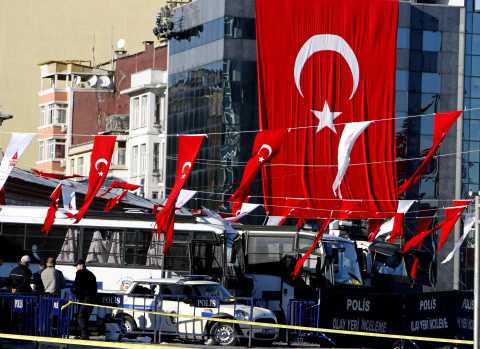
    ANKARA, Turkey — About 200 active and retired Turkish military officers, including former chiefs of the air force as well as dozens of generals and admirals, went on trial Thursday on charges of plotting to overthrow the Islamic-rooted government in 2003.

    The trial is held at a special court house in the town of Silivri, near Istanbul, and marks the government’s increasing confidence in confronting a military that once held sway over Turkish political life. All 196 suspects, who are free pending trial, face between 15 and 20 years in prison if convicted on charges of “attempting to topple the government by force,” according to the indictment, the state-run Anatolia news agency said.

    Prosecutors have not made public any evidence or details of the accusations, but the Taraf newspaper has published what it calls leaked copies of documents pertaining to an alleged conspiracy dubbed “Sledgehammer.”

    The allegations include plans to blow up at least two major mosques during Friday prayers; assassinate some Christian and Jewish leaders; and shoot down a Turkish warplane and blame it on Greece, the country’s historic rival.

    Taraf said the conspirators hoped the chaos would lead to calls for a military takeover, and planned to turn stadiums into open-air prisons capable of holding tens of thousands of detainees. The paper says it has provided the documents to prosecutors, who are using them in their case.

    The military, which has overthrown three governments since 1960 and pressured an Islamic-led government to step down in 1997, has denied such a plot, saying documents used as evidence were from a military training seminar during which officers simulated a scenario of internal strife.

    One of the key suspects, retired Gen. Cetin Dogan, former commander of Turkey’s first army who chaired the seminar, said there was nothing illegal in the seized documents and his remarks at the seminar have been manipulated.

    “I am not a man of coups, I am a man of legal platforms,” the state-run Anatolia news agency quoted Dogan as saying outside the court house on Thursday.

    HaberTurk television said the suspects arrived at the court in buses from a military guest house. They quickly entered the giant court house, which was specially designed to hold the large number of suspects.

    Dozens of television crews stood far away from the entrance of the compound and only a small group of reporters were allowed to cover the trial. A small group of protesters shouted slogans outside the court house, demanding the punishment of the suspects.

    Irem Cicek, the daughter and lawyer of one of the suspects, Navy Col. Dursun Cicek, said the accusations against her father were based on a printed document that had no signature on it.

    “He is accused of preparing a list of navy officers who would assist the alleged plan. The accusation is based on a Word document with no signature. It can be prepared by anyone,” she told HaberTurk television. “It is so sad to see so many valuable people who have worked for this country as defendants in there.”

    Unable to independently assess the evidence, Turks remain divided on the authenticity of the plot and the threat it may have posed. What is clear, however, is that the balance of power in Turkey has tipped significantly in favor of civilian authorities, whose arrests of high-ranking military officers would have once been unimaginable.

    In late November, the government suspended three high-ranking officers – two major generals and a rear admiral – from duty pending the outcome of the trial, which could take at least a few years.

    Also among the suspects is the former head of the country’s National Security Council, once a powerful group of top military officials that exerted strong pressure on the government to follow a strictly secular line, including conducting close surveillance of radical Islamic movements. Prime Minister Recep Tayyip Erdogan’s government has dramatically curbed its powers since coming to power in 2002 and turned it into a merely advisory body on security affairs.

    A panel of three judges headed by newly appointed Omer Diken began asking every suspect to identify himself during the opening hearing, HaberTurk said. Diken was appointed on Tuesday when the previous presiding judge was removed in an unanimous vote by a state judiciary board because of an ongoing disciplinary probe related to other cases.

    More than 400 people – including academics, journalists, politicians and soldiers – are already on trial on separate charges of plotting to bring down the government. That case focuses on a conspiracy by an alleged gang of extremist secular nationalists called “Ergenekon,” the name of a legendary valley in Central Asia believed to be the ancestral homeland of the Turkish people.

    Critics say the cases are built on flimsy evidence and illegal wiretaps, and are designed to silence Erdogan’s pro-secular opponents. The government denies the cases are politically motivated and says it is just trying to work to improve democracy.

  • Ghana, Turkey in oil barter deal

    Ghana, Turkey in oil barter deal

    Turkey says it has reached an agreement with Ghana to buy oil from the country through a barter scheme arrangement.

    News in the Turkish media seen by ghanabusinessnews.com says Turkey’s State Minister for Foreign Affairs, Zafer Çağlayan has indicated that he has had talks with two oil producing countries in West Africa – Nigeria and Ghana, and the two countries have responded positively to such an arrangement. The Turkish Minister recently toured Ghana, Nigeria and Equatorial Guinea, all oil producing countries. And while in Ghana, he was reported to have met Ghana’s Vice President John Mahama.

    Under the arrangement, he said Turkey will purchase oil from Nigeria and Ghana and pay for it by investing in tourism, energy, health and other infrastructure.

    Ghana officially became an oil producing country following the launch of commercial activities by President Mills at the Jubilee oil field yesterday December 15, 2010.

    Ghanabusinessnews.com has been unable to reach the Vice President’s office for comments.

    By Emmanuel K. Dogbevi

    via Ghana, Turkey in oil barter deal : Ghana Business News.

  • Tehran softens its rhetoric in nuclear dispute

    Tehran softens its rhetoric in nuclear dispute

    Michael Theodoulou

    Last Updated: Dec 20, 2010

    The Iranian government has suddenly adopted an unusually emollient tone in addressing its nuclear dispute with world powers, while also voicing the desire to improve relations with key countries in the region and beyond.

    Mahmoud Ahmadinejad, Iran’s hardline president, said he hoped for a “win-win” outcome from discussions with the five permanent members of the United Nations Security Council and Germany, the so-called P5+1.

    Iran’s charm offensive was launched on Saturday by Mr Ahmadinejad and his new caretaker foreign minister, Ali Akbar Salehi, a US-educated nuclear scientist who is fluent in English and Arabic.

    Some analysts suspect Tehran may be prepared to curb parts of its nuclear programme in exchange for an end to punitive sanctions that, US officials insist, are hurting Iran far harder than it cares to admit.

    The key to any deal is that Iran is allowed to continue enriching uranium for peaceful purposes, but under enhanced international supervision: a scenario Hillary Clinton, the US Secretary of State, raised recently.

    On the home front, however, a sour note was struck yesterday by Mr Salehi’s long-serving predecessor, Manouchehr Mottaki, who was on an official visit to Senegal when he was unceremoniously fired by the president last Monday.

    “Sacking a minister while (he is) on a mission is unIslamic, undiplomatic, offensive and outside the practices of politics,” Mr Mottaki fumed.

    Ignoring such criticism, Mr Ahmadinejad appears focused instead on the high-stakes talks over Iran’s nuclear programme with global powers.

    Those talks, which resumed earlier this month in Geneva after a hiatus of more than a year, are due to continue in Istanbul, Turkey, at the end of January.

    Speaking in a live interview with state television late on Saturday night, the Iranian president said he hoped all parties could emerge with their “dignity and reputation” intact. The Geneva talks, he said, had been “positive”.

    Mr Ahmadinejad called for international sanctions against Iran to be lifted and to turn the “policy of confrontation” into one of co-operation”. He said: “If we move toward interaction it’s a win-win situation. There will be no loser. We want everyone to be a winner from the very beginning.”

    The Iranian president suggested that, after Istanbul, further talks could be held in Brazil which, like Turkey, voted against imposing the latest set of UN Security Council sanctions against Iran in June. And, after Brazil, negotiations could move to Tehran itself.

    Mr Ahmadinejad’s conciliatory words came hours after Mr Salehi took office in a ceremony that was also intended as a farewell gathering for Mr Mottaki – who snubbed the event.

    Mr Salehi, who is still head of Iran’s Atomic Energy Agency, used his address to send friendly signals to many countries.

    He talked of the need for cooperation with Saudi Arabia, whose concerns about Iran’s nuclear programme were highlighted in a US cable released recently by the WikiLeaks website. Working together, Iran and Saudi Arabia could “solve the problems of the region and the world of Islam”, Mr Salehi said.

    Commentary:

    Washington can bide its time on Tehran’s nuclear ambition

    Last Updated:Dec 20, 2010

    US and Israeli advocates of bombing Iran’s nuclear facilities may have claimed vindication when WikiLeaks cables revealed that some Arab regimes were singing the same tune behind closed doors, but that doesn’t make military action any more likely.

    TONY KARON

    Meanwhile Turkey, he added, shares cultural and ideological ties with Iran that make them natural partners. And relations with Russia and China, which disappointed Iran by backing Washington’s push for a fourth round of sanctions, require “special political attention”.

    Mr Salehi also offered an olive branch to the 27-nation European Union, which earlier this year angered Iran by imposing new sanctions.

    “If the EU speedily transforms its confrontational style into positive interaction, it would be in the interests of both parties,” he said.

    The energy-hungry EU, he implied, could not afford to ignore his country’s huge oil and gas reserves. Mr Salehi did not, however, address Iran’s relations with the US.

    Iran’s conciliatory new diplomatic tone may also be aimed at reassuring jittery Iranians that their government is doing its best to stave off further international sanctions at a time when many are concerned about rising prices because of its government’s programme to slash subsidies on fuel and food, which went into effect yesterday.

    Washington, meanwhile, has been attempting to drum up regional support against Iran’s nuclear programme. In Bahrain, Admiral Michael G Mullen, chairman of the US Joint Chiefs of Staff, met on Friday night with the island nation’s king, Hamad bin Isa Khalifia.

    “From my perspective, I see Iran continuing down the path to developing nuclear weapons,” Mr Mullen asserted.

    Military strikes on Iran’s nuclear facilities, he added, would be “destabilising”. A “regional approach” and dialogue with Tehran was needed, Mr Mullen said. But, he insisted: “All options have been on the table and remain on the table.”

    [email protected]

  • Turkish Police Frees 2 Kidnapped Bulgarians

    Turkish Police Frees 2 Kidnapped Bulgarians

    Police in Istanbul had freed two Bulgarian nationals, who have been kidnapped by a group of Turks for ransom.

    The news was announced Saturday by the Bulgarian news agency BTA.

    Three people have been arrested and police are still on the lookout for two more.

    According to police officials’ reports, on December 13, a woman, identified as Emiliyana S. called the Istanbul police from Bulgaria to inform her husband, Bulgarian businessman, Krasen D., and his driver, who is an ethnic Bulgarian Turk, have been kidnapped. The abductors asked for a ransom of EUR 1 M.

    The investigation found out the victims were held in a villa in an Istanbul suburb.

    The police seized illegal guns and drugs. Two of the five abductors managed to escape in a car with Bulgarian license plates, which was later found abandoned.

    Krasen D. told the Turkish police he arrived with his driver in Istanbul on December 11 for business. On the next day, the kidnappers invited him for talks involving textile trade, but upon arrival the two were locked in the villa.

    Krasen, who was able to conceal a cell phone, managed to call his wife in Bulgaria.

  • Little America in heart of İstanbul: Kemerburgaz

    Little America in heart of İstanbul: Kemerburgaz

    Kemerburgaz is the latest address of choice for those seeking a peaceful lifestyle away from the traffic jams and noise of İstanbul. It is a sub-district of Eyüp, right next door to İstanbul.

    It is only 25 kilometers away from İstanbul’s city center. It takes 15, 20 and 25 minutes to travel, respectively, to Maslak, Etiler and Taksim and there are neither traffic nor parking problems in Kemerburgaz. These are not the only reasons why Kemerburgaz is such an attractive location. With its lush forests and clean air, it also offers a suburban lifestyle near the heart of the city. With its rising luxury residential sites and charming communities, it is a location of choice for celebrities, businessmen and politicians. Thus, ministers Ahmet Davutoğlu and Ömer Dinçer and celebrities Hülya Avşar, Yılmaz Erdoğan, Yağmur Atacan, Pınar Altuğ, Mehmet Aslantuğ and Arzum Onan are among those who have chosen to live in Kemerburgaz. More and more İstanbulites from the upper income groups are moving to Kemerburgaz. We peered into the changing face of Kemerburgaz and looked into the luxury addresses.

    Kemerburgaz is considered İstanbul’s wellspring. Driving there we are welcomed by the looming aqueducts of the Roman and Byzantine eras. It still provides much of the drinking water for the inhabitants of İstanbul. Trailing behind by a number of water tankers, we reach Kemerburgaz without being stuck in traffic jams. As we arrive at the center, we get the impression that it has really not changed much. It is still reminiscent of a small town with its mosque, health center, park and the small teahouse in the square. Only a few occasional housing estates scattered among apartment buildings and old houses are noticeable.

    Leaving the town center, we head to İstanbul Street toward the Gezi pastry shop and immediately feel as if we have arrived in a completely different country. The luxury houses and estates are striking: Kemer Rose Rezidans, Kemer Park Evleri, Mesa Yankı Evler, Mesa Yamaç Evler, Zengin Bahçe Konutları and many more luxury housing estates are lined up here. Most of them have interesting designs. These residential estates feature all kinds of sporting facilities, including golf driving ranges, swimming pools, saunas and tennis courts. The luxury living estates are particularly favored by families who seek a natural environment for their children to grow up in. The quality of education offered by a newly opened private high school plays an important role in luring new residents to the area.

    New employment opportunities for local residents

    Long-time inhabitants of Kemerburgaz say they have been observing with amazement the changes in their district over last 10 years. They say there were once gardens and stables where there are now these luxury estates. “Until 10 years ago, Kemerburgaz did not even have proper roads,” says Hüseyin Diyar, who has worked as a butcher in Kemerburgaz for 30 years. He adds that after the initial luxury communities moved to the area, many others mushroomed in Kemerburgaz. But he does not complain about this situation, because he sees that the increase in wealthy residents in the area will lead to new employment opportunities. He gives the example of local women, who stayed at home in the past, now earning an income by taking domestic jobs cleaning the homes of the well-to-do. Some young people have become drivers and security guards. There are even jobs for retired people in the area. Real estate experts indicate that many famous apparel brands as well as restaurant and cafe chains have opened branches in the district during the last year. Thus, popular brands of Etiler, Bebek and the like are now rushing to have a place in Kemerburgaz. This is also driving the labor market in the neighborhood.

    What about real estate prices in Kemerburgaz?

    As house prices are generally high they tend to attract residents from the upper income group. Rental prices in the area vary greatly, depending on individual premises and size of the apartment. For instance, you can find an apartment at Mesa Yankı Evleri for TL 2,500 while you can rent one for TL 1,700 per month at Atrium Hill. We can say that rentals on average range from TL 2,000 to TL 5,000 per month. There is also a similar variance with respect to properties for sale. Of course, the expenses don’t end with buying an apartment or villa as you will also have to pay the high monthly outgoings that can range from TL 200 to TL 2,000.

    via Today’s Zaman, your gateway to Turkish daily news.

  • “Black Sea Melodies from Trabzon and Thessaloniki to İstanbul” Kemençe Concert, Istanbul

    “Black Sea Melodies from Trabzon and Thessaloniki to İstanbul” Kemençe Concert, Istanbul

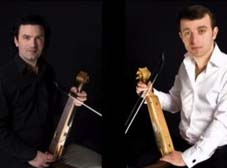
    Thirty year-old Adem Ekiz, from Trabzon’s Beşköylü neighborhood is currently one of the most popular kemençe players in Thessaloniki. Greek families invite him to their homes and parties and sing along with him during the Greek folk songs that Ekiz writes and composes himself.

    Ekiz helped organize a unique event on Wednesday. He and his friend Lermi, who is also from Trabzon, along with Nikos Mihailidis, 34; Filipos Kesapidis, 38; and Mihalis Siopis, 25, who all grew up in the same neighborhood in Thessaloniki, came together to İstanbul to perform at a concert.  It was called “Black Sea Melodies from Trabzon and Thessaloniki to İstanbul”.  They played the kemençe.

    Ekiz has been friends with Thessaloniki kemençe players for 10 years. Mihailidis’ family lives in Thessaloniki but his relatives lives in Bafra and Sivas. He has been playing the kemençe since he was a young boy. He came to Turkey for the first time in 1994.  He met Greeks who live in different Turkish cities, played the kemençe for them, and listened to them play the kemençe. He studied political science in Athens and has been doing his doctorate in cultural anthropology at Princeton University since 2006. The topic of his dissertation is “Music and the Sense of  Belonging.” He is researching how music unites people. He completed his field work in Trabzon in September. He speaks Turkish very well.  He took classes at TÖMER while he completing his master’s degree in political science at Boğaziçi University in 2000. He can speak Turkish so well that he gives private Turkish lessons to students and businessmen in Greece.

    Most people who are interested in the kemençe know Mihailidis very well. His album “Horon ke Trağodiya” was released in 2000. It is interesting to know that he was the first artist to release an album of Greek folk songs in Turkey.  However, the album was not very popular. Mihailidis has released two solo albums in Greece and Canada. He released a Greek folk song album with Kesapidis in

    via “Black Sea Melodies from Trabzon and Thessaloniki to İstanbul” Kemençe Concert, Istanbul | Greek Reporter Europe.