Month: September 2010

  • A Tale of Two Monasteries

    A Tale of Two Monasteries

    Thomas de Waal

    |

    September 9, 2010

    On August 15 this year, a remarkable event took place at Soumela monastery in northeastern Turkey in the beautiful wooded valleys that the Greeks call the Pontus. The Ecumenical Patriarch of Constantinople celebrated the first service in the ruined monastery since 1923, the year when the Pontic Greeks were deported from their homeland.

    It took many years of quiet diplomacy by church officials, non-governmental activists, mayors and—an important group in this rapprochement—musicians, for Greeks and Turks to bridge their differences sufficiently to let the Soumela service take place. An American photographer of Pontic Greek origin, Eleftherios (“Ted”) Kostans was in the church and wrote me his impressions:

    There were a couple of stand-out moments I thoroughly enjoyed. One being the Patriarch’s speeches in Greek and Turkish. He was both eloquent and considerate of all peoples, in a way that made reminded us, we are all human first. The second wonderful moment was quite thrilling for me as Greek and as a Pontian. When the Patriarch walked through the crowed inside the Soumela walls carrying his staff I was just a few steps away and could see him gazing the walls. The smell of frescoes and priests singing suddenly came together for me. Silence hit the room for a moment and suddenly the crowed yelled, “Axios! Axios! Axios!” [the Greek word for ‘Worthy’]……It came from all directions as the crowed closed in around the Patriarch….Wow! For me, that was the climactic moment. Not just for the day. But symbolically, it represented the return to Pontus and announced officially that yes we are Pontians and this is our homeland.

    Only a year before I was with Eleftherios outside the monastery walls on August 15, the Feast of the Virgin Day, when it all went badly wrong and a Turkish museum curator broke up what she declared to be an unauthorized service.

    This year’s breakthrough was clearly authorized at the top, another move in the tentative “Christian opening” made by the governing AK Party, as it challenges some of the desiccated doctrines of the Turkish state. Plenty of powerful nationalist forces vehemently opposed the service as an invitation to “Christian fifth columnists” to infiltrate a Turkish state musuem. But now a precedent has been set, hopefully the Soumela liturgy will become an annual event.

    None of this can be said a parallel service planned for September 19: the first liturgy for more than 90 years in the 10th century Armenian church of Akhtamar on Lake Van. The Armenian patriarch of Istanbul is due to officiate in what would again be a historic event—Armenians’ return to a place that from which they were bloodily driven out in 1915. Thousands of Armenians are due to visit, with many of them staying in ordinary Turkish homes.

    Unfortunately, unlike Soumela, the Akhtamar service is threatening to turn into a disaster. Armenian officials and clergy are saying they will not come because the Turkish government has not carried through on its promise to reinstall a cross on the monastery dome. The government, currently locked in a fight over the September 12 constitutional referendum, is doing nothing to correct this.

    I understand the concerns of some Armenians who won’t go to Akhatmar. They want to see rapprochement with Turkey, but they believe that the church service is a distraction from the political business that the Turkish government flunked when it failed to press ahead with ratifying the Protocols on normalizing relations, signed last year in Zurich.

    But some Armenians are going much further, denouncing the whole event and calling for a boycott. One commentator called the liturgy a “scandalous show” and Armenians who are going there “tools of Turkish propaganda.” These people, who oppose any incremental changes with Turkey and demand nothing less than a full Turkish government apology for committing Genocide in 1915 are in a curious way the allies of the Turkish nationalists who oppose rapprochement for opposite reasons. If the Akhtamar service is a failure, it will be a blow against those liberal Turks, such as the governor of Van province and in the presidential administration, who are still pushing for normalization with Armenia.

    I am certain of two things: There will eventually be a breakthrough in Armenian-Turkish relations. And when it happens, both Armenians and Turks will say things about the other and about the past that they are not saying now. The issue is all in the timing and how to build enough mutual trust to stiffen the resolve of the leaders who will do the final deal.

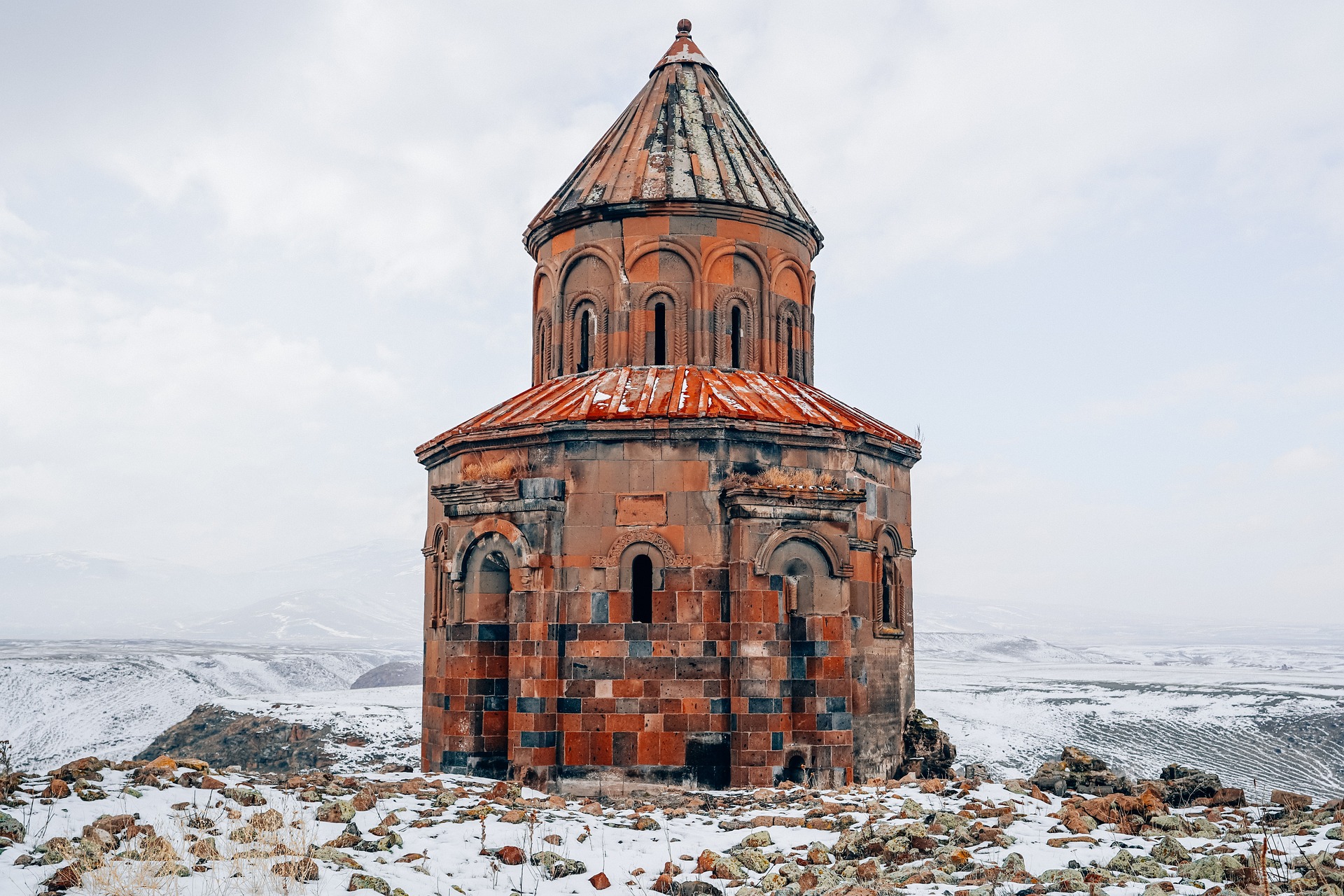
    (photo of Akhtamar Monastery by Ioiez Deniel)

    More by

    Thomas de Waal

    • Civil Society
    • History
    • Religion

    • Armenia
    • Greece
    • Turkey

    Stories Related to A Tale of Two Monasteries

    • Turkish Journey
    • The Never-Ending Armenian Genocide Resolution
    • Lobbyists
    • Letter to the Editor

  • Turkey Allows Bono Interfaith Meeting, While Refusing Crosses

    Turkey Allows Bono Interfaith Meeting, While Refusing Crosses

    Submitted by Armen Hareyan on 2010-09-11

    The Prime Minister of Turkey Recep Erdogan offered Bono to hold his interfaith event in Istanbul while refusing crosses on churches and operating number of sacred Christian places in the country as museums, including the Hagia Sofia temple in Istanbul.

    Well-known and famous Irish rock-band U2 frontrunner Bono was hosted in Istanbul yesterday, as part of their worldwide tour. Turkish Prime-Minister Recep Tayyip Erdogan took the chance to offer the rock idоl holding an interfaith event in Istanbul as an effort, once again, to show-off the tolerance and European face of Turkey. The initial aim is to bring the three religions together – Islam, Christianity and Judaism. If in the official rhetoric the ruling elite of Turkey is always ready to mislead the public opinion, the real deeds are somewhat showing the true reality. And the reality these days is the whole story around the Armenian issue.
    It may seem for an average European that religious freedom issues are high in the agenda of Turkey, amid even the upcoming constitutional referendum on September 12. Recently a Greek church in a Turkish province has been opened up for a one-day-a-year liturgy. The same is on the agenda with Armenians – as the Akhtamar Church of the Holy Cross (Surp Hach – in Arm.) is scheduled to host a liturgy on September 19.

    Turkey repoens 10th century Armenian church as a museum, allows worship only once a year.

    The Holy Cross church – a 1,100-year-old standing monument of Armenian heritage in those lands sacred with Armenian blood during the Genocide years, was re-opened as a museum in 2007 – as a message to the Armenians and the international community that Turkey had heartfelt sentiments towards its Armenian minority, and is ready to continue behind-the-scene talks on normalization with Yerevan. However, the church was then opened as a museum since the incumbent government refused to install a cross on the dome, and the Armenian Patriarchate of Istanbul has not been able to consecrate it as a church up to now. One more controversy comes into mind as the church still remains under the authorities of Van province and not the Patriarchate – as other religious monuments.

    Nowadays a new show-like developments happening in Turkey with regards to the upcoming liturgy in the church. Last week the government announced that they were not able to install the cross, despite earlier assurances of the opposite. Immediately, the Holy See of Echmiadzin suspended its earlier decision to send two high-level churchmen to the event. Before the distressing news came from Turkey, the attending/ignoring debate in Armenia and elsewhere in Armenian Diaspora hit the ceiling with both pro and cons sentiments and statements. One of the prominent Diaspora public figures said that the event is scheduled “to exploit this event for propaganda purposes”.

    Despite all the criticism towards Erdogan, he continues to feed the show. Even considering the obvious failure of the much-spoken and widely advertised democratic initiative and the Kurdish opening, AKP government doesn’t want to acknowledge that half-steps are good only for short-time show-offs, but evidently not sufficient for securing long-term and sustainable achievements. For instance, the Kurdish opening, that was largely supported by the international community now turned out to another wave of repressions and mass arrests of Kurds in Eastern provinces of Turkey.

    Whatever it is – but the Turkish “show must go on”. The government uses all the available chances to speak up and voice their readiness of phony tolerance. No chance is to be missed. The only issue is that international community, and Armenians worldwide, were very timely to acknowledge these false and misleading half-steps. Now Armenians returning their earlier purchased tickets to Turkey, as the RFE/RL reported last week. The much-anticipated 5000-ish tourist-boom and a much more follow-up in eastern provinces of modern Turkey is now questioned. The trade union of Van voiced their readiness to help improving the situation, but Armenians are rightfully firm on their initial will of having the cross on top the church.

    After all, the next morning of September 19, we will have an unchanged Turkey that is accused by the international community – Russian, Europeans and Americans – for destroying the Armenian-Turkish rapprochement and other openings that were the key-arguments of Gul/Erdogan/Davudoglu triplet. Unfortunately, another chance is now being missed.

    Written by Hovhannes Nikoghosyan
    Mr. Nikoghosyan is a research fellow at Yerevan-based Public Policy Institute.

  • CENSORSHIP AT WWW.BOSTON.COM

    CENSORSHIP AT WWW.BOSTON.COM

    If you click on

    To read about “Groundbreaking for Armenian memorial in Boston today” by Globe Staff, September 9, 2010, you will read readers’ comments.

    But you will also see this:

    “We removed Kirlikovali’s comment”

    Twice (so far!)

    Why?

    Were the messages using curse words, insults, slander, lies, deception, falsification, misrepresentation, or anything remotely related to any one of these traits?

    Absolutely, positively not!

    Armenian falsifiers and Turk haters may disagree with me, but that does not make what I write wrong or justify censorship.

    If anyone can prove to me that my message is not substantiated or justified by historic facts, I will stop writing altogether.

    But if my writing have legitimate historical sources and sound evidence, then I want an apology from www.Boston.com, a long overdue one, along with a chance to present my case, perhaps in the form of an unabridged, uncensored op-ed.

    Is that a deal?

    Please read the following message and contemplate. See if you can justify censorship by a major news outlet in a major American city in 21st Century.

    WHY SUCH INTOLERANCE TO DISSENT?

    Is it because the Armenian pressure in Boston, and Massachusetts, is that unbearable?

    Is it because the Armenian Revolutionary Federation, established in 1890 in Tbilisi, Georgia, and involved in many acts of violence and terrorism against Ottoman and Turkish Muslim since then, responsible for the murder of many thousands of Muslims since 19th Century, is now headquartered in Boston?

    Is it because the ABCFM (American Board of Commissioners for Foreign Missions)—the Protestant missionaries– mentors of Armenian separatism, insurgency, revolts, treason, terrorism, and more, are also located in Boston?

    Is it because the Boston Globe is the first American newspaper to surrender to Armenian intimidation, harassment, and other forms of political, religious, and economical pressure?

    Or is it simply because of the deeply ingrained anti-Turkish, anti-Muslim in Boston Globe?

    Or is it all of the above, some of the above, and/or some other, overt or covert, considerations, too?

    Whatever the reason, www.Boston.com’ s blatant censorship is and shall remain as a shameful stain in America’s record of freedom of speech, enshrined in the U.S. constitution, and legendary accommodation of diversity, and tolerance of dissent. This is an unfortunate lapse and a reflexive return to the “sundown towns” of a dark America when slavery was shamelessly justified in the columns of newspapers, including Boston Globe.

    Boston.com failed in its duty to present all sides of a story to its unsuspecting and trusting readers. It seems Boston.com is quiet at ease with censoring opinions they do not like.

    You be the judge.

    ***

    Here is my message censored by www.Boston .com:

    ***

    A HATE MONUMENT IN BOSTON: WHAT A SHAME!

    Allegations of Armenian genocide are racist and dishonest history. They are racist because they ignore the Turkish dead: about 3 million during WWI; more than half a million of them at the hands of Armenian nationalists. And dishonest because they simply dismiss the six T’s of the Turkish-Armenian conflict:

    1) TUMULT (as in numerous Armenian armed bloody revolts between 1882 and 1920)

    2) TERRORISM (by well-armed Armenian nationalists and militias victimizing Ottoman-Muslims between 1882-1920)

    3) TREASON (Armenians joining the invading enemy armies as early as 1914 and lasting until 1921)

    4) TERRITORIAL DEMANDS (where Armenians were a minority, not a majority, attempting to establish Greater Armenia, the would-be first apartheid of the 20th Century with a Christian minority ruling over a Muslim majority )

    5) TURKISH SUFFERING AND LOSSES (i.e. those caused by the Armenian nationalists: 524,000 Muslims, mostly Turks, met their tragic end at the hands of Armenian revolutionaries during WWI, per Turkish Historical Society. This figure is not to be confused with about 2.5 million Muslim dead who lost their lives due to non-Armenian causes during WWI. Grand total: more than 3 million. Source: “Death & Exile” by Prof. Justin McCarthy.)

    6) TERESET (temporary resettlement) triggered by the first five T’s above and amply documented as such; not to be equated to the Armenian misrepresentations as genocide.)

    VAN REVOLT BY ARMENIANS: IT WAS THE 9/11 FOR THE OTTOMAN EMPIRE

    According to the “Dictionary of WWI” by Stephen Pope & Elizabeth-Anne Wheal, 2003, ISBN 0 85052 979-4, page 34, 120,000 Muslims, mostly Turkish, were killed by Armenian nationalists in 1914. And that does not even take into account the infamous Van Rebellion by Armenians in April of 1915 where about 40,000 Muslim inhabitants of the town were cut down by Armenians and the city was turned over to Russian invader.

    The U.S. crossed oceans and continents to wage a trillion dollar global war on terrorism because about 3,000 of its citizens were killed on American soil. Why is it, then, so difficult to understand that the Ottoman Empire, having lost 120,000 of its citizens, resorted to similar , but much lesser, measures of TERESET (Temporary Resettlement) of the arrogantly treasonous perpetrators?

    24TH OF APRIL, 1915: IT IS THE BEGINNING OF OTTOMAN GUANTANAMO, NOT A BOGUS GENOCIDE

    24th of April, 1915, is the beginning of OTTOMAN GUANTANAMO, not the alleged genocide. On that day, some 237 Armenian suspects (not thousands as claimed) of treason and terrorism were arrested and sent to central Anatolia, and subjected to house arrest, which meant they could roam around during the day but had to check into a designated house at night. So it is not exactly even Guantanamo, is it? All of the Armenians were returned in the end, except two. They were murdered but on unrelated matters of money and trade. No matter how one slices it, this does not sound like genocide, does it?

    SINCE WHEN DEFENDING ONE’S HOME A GENOCIDE?

    Turks and Armenians had lived in a relatively harmonious cohabitation in Anatolia for nearly a millennium before the Armenian took up arms against their own government towards the end of that millennium (i.e. 1894-1915). Had the Armenians (and others) not taken up arms against their own neighbors, co-citizens, and government, they would have still been living in Anatolia today, just like the Armenians of Istanbul who mostly stayed loyal to the Ottoman Empire .

    ***

    I posted the following today. Let’s see if the white-hooded fellows at the censorship board at www.Boston.com will allow my messages to stand:

    1917

    “…For fourteen days, I followed the Euphrates; it is completely out of the question that I during this time would not have seen at least some of the Armenian corpses, that according to Mrs. Stjernstedt’s statements, should have drifted along the river en masse at that time. A travel companion of mine, Dr. Schacht, was also travelling along the river. He also had nothing to tell when we later met in Baghdad… …In summary, I think that Mrs. Stjernstedt, somewhat uncritically, has accepted the hair-raising stories from more or less biased sources, which formed the basis for her lecture…”

    Source: H.J. Pravitz, A Swedish officer, Nya Dagligt Allehanda, 23 April, 1917 issue
    (A Swedish Newspaper published from 1859 to 1944)

    1923

    “…In some towns containing ten Armenian houses and thirty Turkish houses, it was reported that 40,000 people were killed, about 10,000 women were taken to the harem, and thousands of children left destitute; and the city university destroyed, and the bishop killed. It is a well- known fact that even in the last war the native Christians, despite the Turkish cautions, armed themselves and fought on the side of the Allies. In these conflicts, they were not idle, but they were well supplied with artillery, machine guns and inflicted heavy losses on their enemies….”

    Source: Lamsa, George M., a missionary well known for his research on Christianity,
    The Secret of the Near East, The Ideal Press, Philadelphia 1923, p 133

    1928

    “…Few Americans who mourn, and justly, the miseries of the Armenians, are aware that till the rise of nationalistic ambitions, beginning with the ‘seventies, the Armenians were the favored portion of the population of Turkey, or that in the Great War, they traitorously turned Turkish cities over to the Russian invader; that they boasted of having raised an Army of one hundred and fifty thousand men to fight a civil war, and that they burned at least a hundred Turkish villages and exterminated their population…”

    Source: John Dewey, The New Republic, 12 November 1928

    1976

    “… The deafening drumbeat of the propaganda, and the sheer lack of sophistication in argument which comes from preaching decade after decade to a convinced and
    emotionally committed audience, are the major handicaps of Armenian historiography
    of the diaspora today…”

    Source: Dr. Gwynne Dyer, a London-based independent journalist, 1976

    1988

    “…In all the countries, under all the regimes, the staff of the armies in the field evacuate towards the back, the populations which live in the zone of fights and can bother the movement of the troops, especially if these populations are hostile. Public opinion does
    not find anything to criticize to these measures, obviously painful, but necessary. During
    winter of 1939-1940, the radical – socialist French government evacuated and transported in the Southwest of France, notably in the Dordogne, the entire population of the Alsatian villages situated in the valley of the Rhine, to the east of the Maginot line. This German-speaking population, and even sometimes germanophil, bothered the French army. It stayed in the South, far from the evacuated homes and sometimes destroyed until 1945….And nobody, in France, cried out for inhumanity…”

    Source: Georges de Maleville, lawyer and a specialist on the Armenian question, La Tragédie Arménienne de 1915, (The Armenian tragedy of 1915), Editions F. Sorlot-F. Lanore, Paris, 1988, p 61-63

    2005

    “…From 1911 to 1923, the Ottoman Empire and the people of Turkey participated in five long, hard, and destructive wars. These were the Tripolitanian War / Trablusgarb Harbi / Türk Italyan Harbı (1911-1912), the two Balkan Wars (1912-1913), World War I (1914-1918), and the Turkish War of National Liberation (1918-1923). To most Turkish people who lived through that era, these wars were really only one, the Seferberlik, or period of mobilization, which went on continuously throughout these years.

    During these wars, the entire infrastructure of life in the Ottoman Empire was destroyed. Fields were left barren and uncultivated; roads and railroad lines were destroyed and their equipment wrecked; harbors and quays were blown up by repeated bombing, and many of the people living nearby were killed; Istanbul and the other great cities of the empire were partially destroyed by bombing, bombarding and great fires. The entire nation, thus, was for all practical purposes destroyed. One of the greatest miracles of Atatürk’s leadership during and after the Turkish War of National Liberation was the manner in which he was able to raise the Turkish people from this wreckage and lead them to revive and reconstruct what became the Turkish Republic.

    In the midst of all this destruction, no fewer than 30 percent, one third, of all the people who lived in the Ottoman Empire at the start of the war died. In the war zones, Macedonia and Thrace, western Anatolia, northeastern Turkey and southeastern Turkey, that percentage was as high as sixty or even seventy percent, much higher than any other country that was involved in these wars. No-one was counting, so it is very difficult to give actual figures, but perhaps no fewer than four million people died in the lands of the Ottoman Empire during these wars, and these were people of all races and religions, all ethnic origins, they were Muslims, Jews and Christians, they were Turks and Armenians, Arabs and Greeks, and many more…”

    Source: From “The Ottoman Holocaust”; a lecture delivered by Stanford J. Shaw (1930-2006, Professor of Modern Ottoman History, Bilkent University, Ankara, Turkey; Professor of Turkish History, University of California, Los Angeles,) to the First International Symposium on Armenian Claims and The Reality of Azerbaijan, sponsored by the Atatürk Research Center, 5 May 2005, Ankara, Turkey

    ***
  • Turkey must lift veil on ‘first Holocaust’

    Turkey must lift veil on ‘first Holocaust’

    * Katerina Cosgrove
    * From: The Australian
    * September 10, 2010 12:00AM

    TRAVEL to Istanbul or any of the Aegean coast towns of Turkey and you may think this secular, hospitable place with its pebbled beaches and Hellenistic ruins has no secrets. Travel east and you come to traditional Turkey, a land of headscarves and workaday mosques, a far cry from the architectural wonders of the Suleiman Mosque and Aghia Sophia.

    Here you will see desecrated frescoes in 10th-century churches, towns and villages whose names have been changed.

    Beneath Turkey’s veneer as an easy tourist destination lies a history that is darker, a reality more complex.

    Scratch the surface and the mass graves, the bloodstained banknotes and the dearth of ethnic minorities beg questions the Turks still refuse to answer.

    Here took place a forgotten genocide. Robert Fisk calls it “the first Holocaust” and claims “the parallel with Auschwitz is no idle one”. Turkey’s reign of terror against the Armenians was an attempt to destroy the entire race. The death toll was about two million between 1915 and 1917.

    Those who didn’t die during the deportations were taken to concentration camps and worked to death or killed. Others were herded into underground caves in their thousands and set on fire – the world’s first gas chamber, which became a model for the Nazis.

    Most of the survivors are now dead, their descendants scattered, even as far as Australia. Yet there are two million Turks today with an Armenian grandparent.

    Fethiye Cetin grew up proudly Turkish; reciting nationalist poems at school festivals, comfortably ensconced in her culture.

    All this was shattered the day she learned that Seher, her Muslim grandmother, was really Heranush, a Christian Armenian. During a death march, Heranush was wrenched from her mother’s arms by a gendarme on horseback and brought up Turkish Muslim. She kept her past secret until she was close to death. Then she finally confided in her granddaughter.

    Cetin is a human rights lawyer, writer and activist for the recognition of the genocide. In her intimate, tender memoir she tells the story of a woman who was no nameless victim, nor bearer of grudges. What occurred in Heranush’s world at the dawn of the20th century was typical of the pattern throughout eastern Turkey, the former Armenia.

    When the Young Turks triumvirate took over the government from the corrupt Ottomans they promised Christian minorities equality and the right to bear arms. So when Turkish gendarmes came to Heranush’s village in 1915 with guns and bayonets, they brought also a sense of betrayal. Men and boys were rounded up, taken away to be shot, their throats cut and bodies thrown into rivers or ravines. The death marches began; the endless lines of elderly and infirm forced from their villages into the Syrian desert, to the killing centres of Shaddadie and Der ez Zor.

    Of course there were humane Turks who hid Armenians in their homes, adopted children, saved them.Yet the stubborn fact remains that the majority of Turks still refute the genocide today. Officially there is a culture of denial in Turkey, leading to self-censorship, trials in criminal courts, prison, even murder. In January 2007, Armenian journalist and academic Hrant Dink was gunned down outside the offices of his Turkish-Armenian newspaper Agos by an ultra-nationalist, a 17-year-old boy. Before his death, he had been convicted under infamous article 301 of the Turkish Penal Code, the crime of “anti-Turkishness”.

    Cetin represented him during his trial, and continues to work for his family. He wrote articles urging his own people to forget the “poisonous blood” between them and the Turks and reconcile their differences. The Turkish popular press twisted his meaning, attributing to him the words, “Turkish blood is dirty”.

    It has since been proven that security forces knew of plans for the murder, that his phone was tapped and his emails and correspondence intercepted. How far the government, police and judiciary are involved in reprisalsis cause for debate.

    Yet after Dink’s death, the boy who killed him was photographed posing with the two gendarmes, smiling under a Turkish flag.

    This is the same law under which Nobel Prize-winning author Orhan Pamuk was tried, after merely talking about the genocide in a Swiss magazine. He faced up to three years in prison.

    “What happened to the Ottoman Armenians in 1915 was a major thing that was hidden from the Turkish nation; it was a taboo,” he said. “But we have to be able to talk about the past.”

    In 2006, Turkish-American Elif Shafak wrote a novel, The Bastard of Istanbul, containing one Armenian character, descendant of those killed in the genocide. She was put on trial for the same crime of “denigrating Turkishness”, but the charges were dropped. How could they not see the absurdity of pressing charges against a fictional character?

    Armenia is now an eighth of its original size. Many of its western provinces were ceded to Turkey after World War I, from Lake Van to Erzerum to the Black Sea coast. Yerevan, the capital of the Republic of Armenia, is where the country’s spiritual symbol, Mount Ararat, can be seen from every window, yet it is across the border on Turkish soil.

    Cetin’s memoir highlights our need to officially recognise this atrocity as genocide, to record the details of these lost and grant them their place in history. It reminds us of our duty to finally put names and stories to all those in unmarked graves, mothers and fathers and children whose bones will never be found.

    Katerina Cosgrove is the author of The Glass Heart and a forthcoming novel based on the Armenian genocide. She will be in conversation with Fethiye Cetin at Sydney’s Gleebooks today at 6.30pm. Cetin’s memoir, My Grandmother, is published by Spinifex Press

    Related Coverage

    • The divided self The Australian, 27 Aug 2010
    • Turkey expands influence in Middle East The Australian, 17 Jun 2010
    • Does Gaza signal Turkey’s defection The Australian, 2 Jun 2010
    • Armenian genocide the final frontier The Australian, 23 Apr 2010
    • Obama raises nuclear terrorist spectre The Australian, 11 Apr 2010

  • Florida Pastor Calls Off Koran Bonfire, Turns to NY Mosque

    Florida Pastor Calls Off Koran Bonfire, Turns to NY Mosque

    Florida Pastor: Muslim Leader Lied About Ground Zero Mosque, Koran Burning Only Suspended

    Thursday, 09 Sep 2010 05:34 PM
    Article Font Size

    By: David A. Patten

    The anti-Muslim leader of a tiny Florida church says he was lied to and is rethinking his decision to cancel burning Korans to mark 9/11.

    Pastor Terry Jones earlier Thursday had backed off his threat to burn the Koran after he said he was promised that a planned Islamic center and mosque would be moved away from New York’s ground zero. Muslim leaders denied there was such a deal.

    Later outside his church he said that the imam he thought he made the deal with “clearly, clearly lied to us” about moving the mosque.

    Jones and Imam Muhammad Musri stood side by side in a news conference where the pastor said he would cancel Saturday’s event.

    Musri later told The Associated Press there was only an agreement for him and Jones to travel to New York and meet Saturday with the imam overseeing plans to build a mosque near ground zero.

    After meeting with a Florida imam, Jones had agreed to cancel plans to burn the Koran on Saturday, and instead announced plans to fly to New York City, where he wants to protest against the Islamic center being built near ground zero.

    Jones and Imam Muhammad Musri announced that the Koran-burning protest had been canceled shortly after 5 p.m. Thursday.

    “If they were willing to either cancel the mosque at the ground zero location, or if they were willing to move that location, if they were willing to move it away from that location, we would consider that a sign from God,” Jones said.

    Jones said Imam Musri had been in contact with Imam Feisel Abdul Rauf.

    But Rauf, the controversial imam at the center of the ground zero mosque controversy, quickly denied he had reached any deal to cancel the planned Islamic center or had even discussed it with Musri.

    “I am glad that Pastor Jones has decided not to burn any Korans,” Rauf said in a statement to CNN. “However, I have not spoken to Pastor Jones or Imam Musri. I am surprised by their announcement. We are not going to toy with our religion or any other, nor are we going to barter. We are here to extend our hands to build peace and harmony.”

    Jones appeared to indicate that Rauf had agreed to move the ground zero mosque location. However, Musri did not speak to the imam, but spoke instead to the imam’s staff, who agreed to meet with Jones and Imam Musri on Saturday.

    Slideshow: Prominent Voices Speak Out Against Koran Burning

    The network also reports that Rauf’s staff said merely that the imam “was open” to selecting a new location, not that he promised to do so.

    Nevertheless, Jones declared: “He has agreed to move the location. That cannot of course happen overnight. We felt that that would be a sign that God would want us to do it.

    “The American people do not want the mosque there,” he said, “and of course Moslems do not want us to burn the Koran. The Imam has agreed to move the mosque.”

    Jones also said he received a telephone call from Defense Secretary Robert Gates asking him not to proceed with the Koran-burning protest which had inflamed Islamic tensions throughout the world.

    Interpol and the State Departments had issued alerts warning Americans that a backlash of violence abroad could result.

    Imam Musri appeared to side with Jones on the question of the location of the ground zero mosque, saying it is unnecessary to place it that close to the site of the tragic terrorist attack of 9/11. He called on Muslims throughout the world to remain peaceful exemplars of the Muslim faith.

    President Obama warned Thursday burning the Koran would be a “recruitment bonanza” for al-Qaida.

    A few hours before the announcement of the burning cancellation, Obama told ABC that he hoped Jones “understands that what he’s proposing to do is completely contrary to our values. I just want him to understand that this stunt that he is talking about pulling could greatly endanger our young men and women in uniform who are in Iraq, who are in Afghanistan.”

    The proposed event triggered flag-burning demonstrations abroad and sharp debates domestically over whether the same political correctness now flowing from the highest levels of the Obama administration also should apply to proposals to build a mosque two blocks from ground zero in New York City.

    Former Alaska Gov. Sarah Palin commented: “People have a constitutional right to burn a Koran if they want to, but doing so is insensitive and an unnecessary provocation — much like building a mosque at ground zero. It will feed the fire of caustic rhetoric and appear as nothing more than mean-spirited religious intolerance. Don’t feed that fire.”

    The State Department had advised U.S. embassies around the world to reassess their security measures.

    The Rev. Franklin Graham, son of famed evangelist Dr. Billy Graham, had sent a personal letter to Jones, urging him not to burn the book that Muslims consider holy.

    Graham, who professes love for Muslim people but has been outspoken in his view that Islam does not lead to salvation, said, “It’s never right to deface or destroy sacred texts or writings of other religions even if you don’t agree with them.”

    Cardinal Theodore McCarrick, the Catholic archbishop emeritus of Washington, D.C., went even further Wednesday during a news conference at the National Press Club sponsored by the Islamic Society of North America.

    If “someone sees the Gospel as the truth of God’s presence in our world, that person should embrace the Gospel,” McCarrick told CNSNews.com. “If a person sees the Koran as proof of God’s presence in the world, then I cannot say, ‘Don’t embrace the Koran.’”

    Jones, whose church has just 50 members, ignited international protests with his plan to burn Korans to protest Shariah and acts of violence he contends are linked to the Islamic faith. Demonstrations included the following

    • Thousands of Afghans burned the U.S. flag and chanted “death to the Christians” on Thursday.
    • About 200 Pakistanis marched in Multan and burned a U.S. flag at the rally.
    • A Muslim cleric in Afghanistan said Muslims would have a religious duty to react if the Koran were burned, heightening fears that Americans could be attacked.
    • Gen. David Petraeus, who met with Afghan President Hamid Karzai Wednesday to discuss the controversy, said in an e-mail to The Associated Press that extremists would use images of the Koran in flames “to inflame public opinion and incite violence.”
    • Declaring “shame on you,” evangelical Richard Cizik lectured Christians who openly reject Muslims because of their religious faith. “As an evangelical, I say, to those who do this, I say, ‘you bring dishonor to the name of Jesus Christ. You directly disobey his commandment to love our neighbor,” Cizik said at the National Press Club event.
    • The nations of Pakistan and Bahrain issued official denunciations of the planned burning of the Koran.
    • The president of Indonesia sent a letter to Obama, asking that the book-burning be halted.

    Several U.S. leaders and organizations, including New York City Mayor Mike Bloomberg, have condemned the Koran burning while at the same time defending the church’s First Amendment right to express its views.

    “We defend his right to the speech,” said Brandon Hensler, a spokesman for the Florida ACLU, “and we absolutely, simultaneously condemn the things that he’s saying, because they’re not tolerant of different religious viewpoints. The reverend himself has admittedly not read the Koran, and he’s simply using this as a jumping stone to get on the world stage, which he’s clearly achieved.”

    The debates over the appropriate exercise of First Amendment rights in the case of the mosque and the burning of the Koran is triggering a broader discussion of the uneasy relationship between Islam and Christianity in America.

    The Koran-burning protest comes in the context of the controversial decision to build a Muslim community center and mosque a few blocks away from ground zero in New York.

    The imam behind the Park51 facility, formerly known as the Cordoba initiative, warned that relocating the facility could also spark Muslim violence against Americans.

    “The headlines in the Muslim world will be that Islam is under attack,” said Imam Feisel Abdul Rauf in an exclusive CNN interview, adding that, “if you don’t do this right, anger will explode in the Muslim world.”

    Rauf also suggested that, if he had it all to do over again, he would have selected a different location.

    “If I knew this would happen, if it would cause this kind of pain, I wouldn’t have done it,” he said.

    The recent controversies over the coexistence of Islam and Christianity appear to be creating cultural ripples nationwide.

    Muslim, Christian, and Jewish groups are planning rallies to celebrate unity and tolerance on the anniversary of the 9/11 attacks Saturday. It is not known if any of those observances will be held in Hartford, Conn., however, where the town council is embroiled in controversy after city leaders announced they would allow imams, as well as rabbis and Christian pastors, to provide the invocation before council meetings.

    “If they check their history, we’re a Christian nation,” Pat McEwen of the evangelical group Operation Save America told Fox News. “For years, prayers just referred to God. I think breaking with that tradition is a bad idea.”

    © Newsmax. All rights reserved.

  • Police search Sarkozy party HQ in L’Oreal investigation

    Police search Sarkozy party HQ in L’Oreal investigation

    MP party chief Xavier Bertrand says that police searched the party headquarters in Paris on Wednesday as part of their ongoing investigation into the alleged involvement of Labour Minister Eric Woerth in the L’Oreal scandal.

    French police probing a party financing scandal linked to L’Oreal heiress Liliane Bettencourt have searched the headquarters of President Nicolas Sarkozy’s majority UMP, the party said Thursday.

    Police from the financial investigations squad searched the Paris headquarters on Wednesday afternoon, the party’s leader Xavier Bertrand said, in the latest development of the months-long scandal.

    Several judicial investigations are under way into affairs linked to Bettencourt’s fortune, including allegations of tax evasion and illegal campaign funding that have implicated Labour Minister Eric Woerth.

    The party’s director general Eric Cesari told AFP the police had come to look for “correspondance between Eric Woerth and Patrice de Maistre”, the manager of Bettencourt’s 17-billion-euro (22-billion-dollar) fortune.

    Woerth was previously UMP treasurer and head fundraiser for Sarkozy’s 2007 presidential campaign. He has been accused of a conflict of interest because his wife worked for Maistre, helping manage the billionairess’s estate.

    Woerth denies any wrongdoing but has been politically weakened and the long-running investigation has undermined his and Sarkozy’s attempt to push through pensions reform.

    Cesari said police had announced their visit and spent an hour a half at the headquarters checking archives, but did not take anything with them.

    Police told AFP the search was ordered by a prosecutor in the western Paris suburb of Nanterre who is investigating various aspects of Bettencourt’s affairs and allegations implicating Woerth.

    The magazine Paris Match reported on its website that investigators were searching for a letter sent by Woerth to Sarkozy in March 2007 in which Woerth called for Maistre to receive France’s top state honour, the Legion d’Honneur.

    France 24