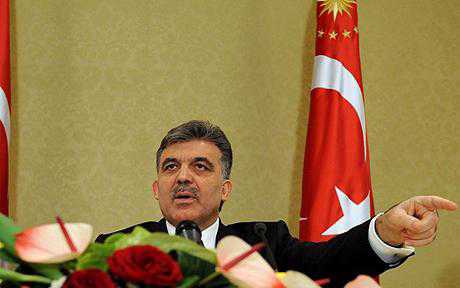
A Turkish court has ruled that President Abdullah Gul should face trial over a funding scandal in the 1990s involving a now-defunct Islamist party to which he belonged.
Published: 6:45AM BST 19 May 2009
Copyright of Telegraph Media Group Limited 2010
The court overturned a prosecutor’s decision to drop the case, ruling that Gul’s immunity as president did not cover allegations dating to the period before he took office, Anatolia news agency reported.
Authorities must now re-examine the case that alleges falsification of documents and violation of laws governing political parties.
The case threatens to exacerbate tensions between Turkey’s ruling Islamist-rooted party and secularists, who accuse Mr Gul and Recep Tayyip Erdogan, the prime minister, of seeking to erode the country’s secular traditions.
The ruling AKP has said it fully embraces secularism.
Mr Gul’s office denounced the court ruling in a statement and said a previous judgement had cleared him of responsibility in the case involving the Welfare Party, accused of embezzling money from the public treasury in the 1990s.
“The efforts in some circles to attempt to present our president as a suspect when he is neither charged nor in the process of being tried does not in any way result from good intentions,” it said.
The statement said Mr Gul could only be put on trial for treason.
Government spokesman Cemil Cicek also disputed the ruling.
“It is unthinkable that presidents not be protected by immunity when deputies are,” he said.
Welfare was outlawed in 1998 for undermining Turkey’s secular system, a year after it relinquished power under pressure from the military.
Farzad Farhangian, a 47-year-old press attache at the Iranian Embassy in Brussels, arrived in Norway on Monday night and is planning to hand an application for asylum to Norwegian authorities Tuesday, his lawyer told Babylon & Beyond from Oslo.
Farhangian’s move marks the third time in less than a year that an Iranian diplomat has defected and applied for asylum in a Scandinavian country.
Saying he was angered by the crackdown on dissidents during the Iranian presidential elections last year, Farhangian slammed Tehran’s hard-line government at a news conference in Oslo on Tuesday and said he had joined the political opposition to President Mahmoud Ahmadinejad.
“I’m apologizing to the Iranian people. During the last 30 years I was of service to the Iranian people, 23 of them in the diplomatic service, but the deviation that the Iranian republic has reached leaves me no choice. I hope to be a voice of the opposition,” Agence-France Presse quoted Farhangian as saying before reporters.
Arild Humlen, a Norwegian lawyer who first met with Farhangian on Tuesday morning, says his client is receiving protection from Norwegian authorities.
According to Humlen, Farhangian had for some time expressed strong criticism toward the Iranian government. When a delegation of Iranian officials from Tehran recently showed up in Brussels to put some pressure on the diplomat, Farhangian knew it was time to go, Humlen said.
On his arrival in Norway, Farhangian joined a former colleague from the Iranian Foreign Ministry: Mohammad Reza Heydari, the former consul at the Iranian Embassy in Oslo who resigned earlier this year in protest of the government and became a campaigner for the Iranian political opposition.
Rahman Saki of the Norwegian-Iranian Support Committee in Oslo told Babylon & Beyond that he and Heydari have been working together since the former diplomat’s resignation in January. Together, they’ve reached out to Iranian diplomats and supported those who’ve contemplated quitting.
“We’ve been active in working with diplomats after Heydari came out and announced that he had resigned. Me and Heydari work very close. … We’ve sent faxes to them, and we’ve called Iranian diplomats and talked to them,” he said.
They reached Farhangian, who, according to Saki, contacted Heydari, an old friend, for advice. Discussions went on for months before Farhangian decided to take the final step, Saki said. He also said that Farhangian arrived in Oslo with his wife and son.
Saki says more Iranian diplomats are thinking of resigning from their posts.
“There are several who are interested, but the situation is difficult,” he said.
Just a few days ago, the former charge d’affaires at the Iranian Embassy in Finland announced that he had resigned. At first, Hossein Alizadeh remained tight-lipped about whether he would stay in Finland, but media reports said Monday that he would apply for political asylum there. Heydari obtained political asylum in Norway earlier this year.
Turkey does not want violence and a blockade in its vicinity, Foreign Minister Ahmet Davutoglu said Sept. 15, Anatolia news agency reported. Turkey will do everything it can for a permanent peace between Israel and Syria, he said, adding that Turkey supported political dialogue, mutual economic dependence, multiculturalism, co-existence and security in the region. He discussed the need for a comprehensive peace in the Caucasus, including Azerbaijan-Armenian peace. He also said Turkey and the United States agreed on Iran, adding that Turkey does not want nuclear weapons in the region but wants a diplomatic solution to Iran’s nuclear problem.
Iran has agreed to donate $25 million (£16 million) to Turkey’s ruling Justice and Development Party (AKP) in a move that will increase fears that Prime Minister Tayyip Erdogan is preparing to abandon the country’s secular constitution.
Con Coughlin
Published: 5:13PM BST 14 Sep 2010
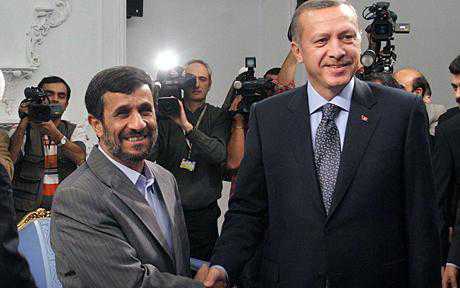
Western diplomats say they are alarmed by reports that Mr Erdogan has negotiated a deal with Iranian President Mahmoud Ahmadinejad for Tehran to make a substantial contribution to the campaign funds of Turkey‘s leading Islamic party.
Under the terms of the deal Iran has agreed to transfer $12 million to the AKP, with further payments of up to $25 million to be made later in the year. The money is said to be meant to help support Mr Erdogan’s campaign for re-election for a third term in next year’s general election.
Related Articles
Turkey backs constitutional reform
Turkish court rules president should stand trial
Tayyip Erdogan’s AKP set for victory as violence mars local elections in Turkey
Eight charged over killing of 44 at Turkish engagement party
Syria bans full face veil at universities
£7bn Nabucco gas pipeline to ease Europe’s dependency on Russia
The Turkish government denied having received the money from Iran.
The Turkish prime minister announced he would stand for a historic third term following his success in last weekend’s referendum on constitutional reform.
The government argued that the reforms were necessary to improve Turkey’s chances of membership to the European Union. But secular critics of the reforms, which provide the government with powers to overrule Turkey’s powerful judiciary, argue that they will pave the way for a key Western ally to become an Islamic state.
The judiciary is widely regarded as the guardian of Turkey’s secular constitution. In 2008 it came close to banning the AKP after it campaigned for women attending university courses to wear Islamic headscarves.
Western diplomats now fear that the AKP’s deal with Iran will heighten fears among Turkish secularists that Mr Erdogan will exploit the government’s new powers to drive through the AKP’s radical Islamic agenda.
“The agreement between the AKP and Iran is a very worrying development,” said a senior Western diplomat. “It will increase the suspicions of many Turks that the government is deepening its ties with Islamic states.
Earlier this year Turkey annoyed Washington after it publicly backed Iran’s controversial nuclear programme. Relations between Turkey and Iran have deepened following Ankara’s backing for the aid flotilla which attempted to break Israel’s blockade of the Gaza strip.
Apart from transferring funds to the AKP, diplomats say Iran has also agreed to provide financial support for the IHH, the Turkish Islamic charity IHH which supported last May’s aid flotilla which ended in disaster when it was intercepted by Israeli commandos, which resulted in the deaths of nine activists.
14 Eylül 2010 tarihli (bugün) gazete makalenize istinaden yazmaktayım. İktidar partisi olan Adalet ve Kalkınma Partisi hakkında gazeteniz ve web sitesinde yayınlanmış olan bu haber bizi tam anlamıyla şaşkınlığa uğratmıştır. Böyle bir olay asla gerçekleşmediği gibi, haberinizdeki iddialar hiçbir kanıta dayanmamaktadır. Yalanlardan başka hiçbir şeye dayanmayan bu haberi kati olarak reddediyor ve Partimiz aleyhine yapılmış böylesine temelsiz ve sinsi bir iddianın gazetenizde nasıl basılmış olabileceğine dair derhal bir açıklama bekliyoruz. Ayrıca, acilen kamuya duyuracağınız bir özür ve düzeltme ile birlikte, söz konusu makalenin kamu açıklaması yapılarak web sitenizden derhal silinmesini talep ediyoruz. Bu konuyu ulusal ve uluslararası mahkemelere götürme hakkımızı saklı tutuyoruz.
15 Eylül 2010 21:02
Ak Parti’den The Daily Telegraph’a dava
Çelik, yazılı açıklamasında, The Daily Telegraph gazetesinde dün yayımlanan ve AK Parti’nin İran’dan yardım aldığına dair yalan ve provokatif haberi yalanladıklarını, ancak aynı gazetenin bugün de yalan haberinin arkasında durduğunu ifade eden bir açıklamada bulunduğunu belirtti.
Çelik, şunları kaydetti:
”Hiçbir dayanağı olmayan bu haberin, İsrail’in Mavi Marmara gemisinde gerçekleştirdiği katliamı meşrulaştırmaya çalışan çevrelerin tezlerini yansıtması düşündürücüdür. Haberde İHH’yi terörist ilan etme ve AK Parti ile İHH arasında kurumsal bağ kurma gayreti açıkça görülmektedir. Bu açık bir komplodur.
Bu haberin gazetecilik geçmişi belli bir kişi tarafından, Türkiye’deki referandumun hemen sonrasında yapılması ayrıca dikkat çekicidir.
Bu provokatif komploya karşı ulusal ve uluslararası mahkemelerde dava açma süreci başlatmış bulunmaktayız.”
By Harut Sassounian
Publisher, The California Courier
At the request of Sen. Barbara Boxer, the Senate Foreign Relations Committee had postponed from early August to mid-September its vote on Matt Bryza, nominee for U.S. Ambassador to Azerbaijan. Senators Boxer, Harry Reid, and Robert Menendez were satisfied neither with Bryza’s answers during the confirmation hearing nor subsequently with his written responses.
Harut Sassounian
While Congress was in recess for the past 40 days, a number of newspapers and websites questioned the appropriateness of Bryza’s nomination to such an important post. They raised several conflict of interest issues regarding Bryza and his Turkish-born wife, Zeyno Baran, who until recently was director of the Center for Eurasian Policy at the Hudson Institute, a Washington think tank.
This article shall focus on a single issue — the allegation that Bryza and Baran had received gifts during their August 23, 2007 wedding in Istanbul. If true, this would not only abort Bryza’s chances of becoming ambassador, but more importantly, it would get him into serious legal trouble. Under U.S. laws, government officials and their spouses are prohibited from receiving gifts, even wedding presents, unless these are given by close acquaintances. Such gifts have to be reported to the U.S. government, and the Internal Revenue Service. Bryza’s case is more complicated. If he got gifts that he did not report, while telling the Senate Foreign Relations Committee under oath that he did not receive such gifts, he could be charged with non-reporting of a gift, tax evasion, and perjury.
Bryza’s celebrity wedding triggered a major controversy when Azeri jouranlist Adil Khalil reported in the opposition newspaper Azadlig that Haydar Babayev, Azerbaijan’s Minister of Economic Development, had paid most of the couple’s wedding expenses. Babayev refuted the accusation and filed a lawsuit for libel, causing Khalil to be arrested, severely beaten, stabbed, and forced to flee to France. The newspaper’s editor, Ganimat Zahid, was also arrested on unsubstantiated charges. Last month, Azadlig suspended publication, after it was evicted from its offices by the authorities. Having exhausted all domestic court appeals, the newspaper’s editor filed a claim against Azerbaijan with the European Court of Human Rights.
According to Azeri and Turkish media reports, around 400 prominent guests from several countries attended Bryza’s 2007 lavish wedding, held under tight security. Among the attendees from Turkey were the Minister of Energy and Natural Resources, the U.S. Consul General in Istanbul, the Armenian Patriarch of Turkey, members of parliament, and major media figures. Bryza also invited Armenian officials to his wedding, including Pres. Robert Kocharian and Foreign Minister Vartan Oskanian, neither of whom attended. At the time, Bryza was Deputy Assistant Secretary of State and U.S. co-chair of the OSCE Minsk Group, the mediators of the Artsakh (Karabagh) conflict.
Several high-ranking Azeri officials also attended Bryza’s wedding in Istanbul: Foreign Minister Elmar Mammadyarov who served as a wedding witness, Minister of Economic Development Haydar Babayev, Azeri National Petroleum Company President Rovnaq Abdullaev, Deputy Speaker of Parliament Valeh Aleskerov, and Azerbaijan’s Consul General in Los Angeles Elin Suleymanov. Pres. Ilham Aliyev’s letter of congratulation was read at the start of the wedding. According to documents obtained by this writer from the European Court of Human Rights, the Azeri editor claimed that Pres. Aliyev sent “a special gift to the bride.”
Even though Bryza and Baran requested that in lieu of gifts guests make a contribution to a Turkish charity, it is common practice in the Middle East to hand gifts — particularly jewelry — to a newlywed couple. For example, Turkey’s Foreign Minister Ahmet Davutoglu, during a meeting with Hillary Clinton in Kabul in July, told her that he would be sending a gift to the Secretary of State, on the occasion of her daughter’s wedding.
According to the Media Rights Institute, Minister Babayev’s lawyers confirmed during a court hearing in Baku that he attended the wedding and “even had a gift” for Bryza. Yet, at his Senate confirmation hearing, Bryza refuted the allegation that an Azeri official had financed his wedding, adding that its entire cost was paid by the couple’s families.
The allegation that Bryza received wedding gifts should be thoroughly investigated before the Senate votes on his nomination. Even though Senators and members of the Armenian, Greek, and Cypriot communities oppose Bryza for multiple reasons, the wedding expenses and gifts are the only issues that could have serious legal ramifications. Therefore, the Senate should wait for the outcome of the lawsuit filed by the Azeri editor in the European Court of Human Rights.
Bryza should fully cooperate with such an investigation in order to clear the clouds of suspicion hanging over his head, before he is rushed to Baku. He should provide the complete list of his wedding guests and disclose all gifts received by the newlyweds and their families.
U.S. investigators should contact everyone who attended Bryza’s wedding to verify what gifts they gave to the couple on that occasion. He should also be asked to produce a record of his wedding expenses and how they were paid.
A few days ago, Sen. Boxer wrote a letter to this writer expressing her serious concern about Bryza’s inadequate responses to her questions both during and after the confirmation hearing. She pledged to continue her efforts “to determine if he is the appropriate representative for the United States in this highly volatile region of the world.”
Sen. Boxer and her colleagues should either reject Bryza’s nomination outright or place a hold on it until all allegations against him are investigated and proven to be true
Turkey’s hopes of joining the EU have been boosted by Sunday’s vote to curb the influence of the military and to enhance the parliament’s role in appointing judges, say German media commentators. But they add that more fundamental constitutional reform is now needed.
Turkish Prime Minister Recep Tayyip Erdogan got a strong boost on Sunday when 58 percent of voters backed his package of reforms of the country’s military-era constitution. The changes are aimed at bringing Turkey more in line with European Union standards and helping the country’s bid to join the bloc. They have also strengthened Erdogan ahead of a general election next year.
Erdogan said the result meant the country had “crossed a historic threshold toward advanced democracy and the supremacy of law.” The reform was held on the 30th anniversary of the coup in which the army seized power in 1980. It makes the military more accountable to civilian courts and hands parliament more power to appoint judges.
The European Commission and United States President Barack Obama welcomed the result. A White House statement said the president “acknowledged the vibrancy of Turkey’s democracy as reflected in the turnout for the referendum that took place across Turkey today.”
German Foreign Minister Guido Westerwelle called the vote “an important step on Turkey’s path to Europe” but added that the outcome of accession negotiations remained open.
Erdogan’s Islam-rooted Justice and Development Party (AKP) has clashed repeatedly with Turkey’s highest courts, which see themselves as guardians of the country’s secular values. The opposition accused the AKP of trying to seize control of the judiciary as part of a back-door Islamist coup.
German media commentators say the referendum will help Turkey’s EU aspirations, and that Erdogan’s critics are wrong to claim that Turkey will be turned into an Islamic dictatorship as a result of the reform now approved.
But they add that the reform must just be a first step and that Turkey needs more fundamental constitutional change based on a broad compromise between the government, opposition and other major groups in society. So far Erdogan, self-assured after almost eight years in power, seems uninterested in taking that step. He should change his mind to tackle the growing impression that the AKP has become too authoritative and self-serving, German media commentators say.
The Berlin daily Der Tagesspiegel writes:
“The reforms won’t turn Turkey into an Islamic dictatorship, as Erdogan’s critics claim. On the contrary, they will make the country more democratic, even though Turkey has a long way to go before it reaches EU levels. To get there one thing above all has to happen. In this moment of triumph Erdogan should drop his ambition to do everything unilaterally. He could thereby hand Turkey an important gift — a new political culture.
“Erdogan’s victory is also a success for Turkey’s EU aspirations. Brussels had supported the reforms despite some objections, and the curbs to the army’s power were especially important to the EU.”
“The long and hard-fought campaign leading up to the referendum made clear how deeply large parts of the Turkish population mistrust the AKP. Many Turks no longer regard the AKP, which has now been in power for almost eight years, as a force for reform but as a party which polarizes people and focuses mainly on its own advantages. Few believe the AKP wants to turn Turkey into an Islamic theocracy. But many believe it is becoming more authoritative.”
“Basically all parties in Ankara agree that Turkey needs more than just repairs to the current constitution. Before the vote the opposition suggested bringing all parties and important associations together to talk about a completely new constitution. Erdogan himself spoke about the need for a new constitution. But so far the prime minister, so certain of his power and ability to enact change, has shown no inclination to accommodate the other parties. He should do so now.”
The left-wing Frankfurter Rundschau writes:
“The reform is a rebuff to the army’s self-proclaimed right to seize power whenever it sees fit as guardian of the republic. And it subordinates a justice system that had grown into a state within a state. For many older Turks the day of the referendum awakened bad memories because it was held on the 30th anniversary of the military coup. More than half a million people were imprisoned during the dictatorship and more than 500 sentenced to death, and hundreds died of torture. Many Turks will have voted in favor of constitutional change for that reason.
“The outcome of the referendum may be seen as a success for Erdogan, but that is not decisive. It isn’t Erdogan who has won, but Turkish democracy. But this reform is only a first step. The ‘generals’ constitution’ that is geared towards protecting the state from its citizens rather than strengthening the rights of citizens must now be comprehensively overhauled.”
The conservative Die Welt writes:
“Most of the points in the constitutional reform are indeed in line with European standards. But the government’s portrayal of the referendum contains four significant misconceptions.”
“Firstly, the 1980 coup also brought benefits to the country. It is true that 65,000 people were arrested, many tortured and 27 executed. But in each of the three preceding years some 1,200 to 1,500 people had been killed by political terrorism. That stopped after the coup, so the generals saved lives. At least 750,000 weapons were confiscated. The constitution — made legitimate by a referendum — that is now being ‘overcome’ ensured greater stability by keeping smaller parties out of parliament. Tough reforms stabilized the economy. This, too, is a legacy of the generals: stability and prosperity, the foundation for democratic reforms.”
“Secondly, the reform isn’t ‘overcoming’ the undemocratic aspects of the constitution: the 10 percent hurdle for parliamentary representation remains in place. It excludes whole groups of society from political representation.
“Thirdly, this isn’t a change of system but a transition of power within the system. By taking over the appointment of judicial staff and undermining the power of the army the government is trying to take over the lower-ranking long-term positions of power.
“The fourth misconception is a self-delusion. The AKP is dreaming of running the country as permanently as the army once did. But every party that gets the necessary majorities will be able to use these reforms in the same way to take over the state. What Turkey needs, but isn’t trying to achieve, is a separation of state and ideology.”